
How Do You Know If Your Soil Carbon Is Actually Going Up?
You measure it, and it is harder than the marketing suggests. Syntropic systems build soil carbon fast. We have covered how much they sequester and through which pathways. This is the other half of the question, the one that decides whether your climate claim is real: proving it on your own ground.
Here is the trap. Almost every soil test a gardener orders reports organic matter percentage. Carbon accounting needs organic carbon stock, measured in tons per acre. Those are not the same number, and getting from one to the other takes two extra pieces of information most labs do not give you unless you ask.
Worth saying plainly: this is not a reason to disbelieve syntropic soil claims. It is a reason to measure properly before you make one.
What we will cover:
- Why organic matter percentage alone tells you almost nothing about carbon stored
- The three measurements that turn a lab result into tons per acre
- Which test to order, what it costs, and which lab reports carbon directly
- Free field checks that catch real change between paid tests
Key Takeaway
Concentration is not stock. A soil can hold the same percentage of carbon and a different tonnage of it, because building soil structure lowers bulk density. If you only track percent, a genuinely improving soil can look flat. Measure bulk density or your numbers do not mean what you think.
What Turns a Percentage Into Tons Per Acre?
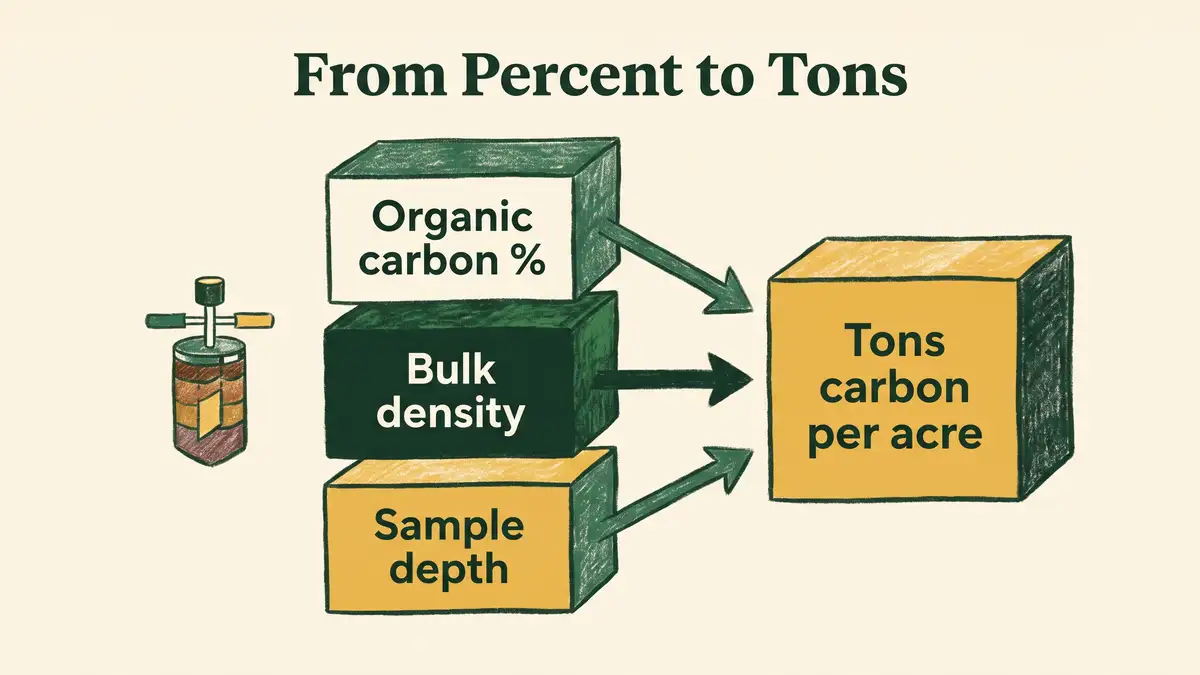
Three things: carbon concentration, bulk density and the depth you sampled. South Dakota State University Extension lays out the arithmetic directly: carbon stock is the percentage of carbon multiplied by bulk density, depth and the area of an acre. Their worked example runs a soil at 1.96 percent carbon through a 0 to 2.5 inch layer at a known bulk density.
Drop any one of those three and the sum collapses. Two soils reading 3 percent organic carbon hold very different tonnages if one is compacted and the other is loose and aggregated.
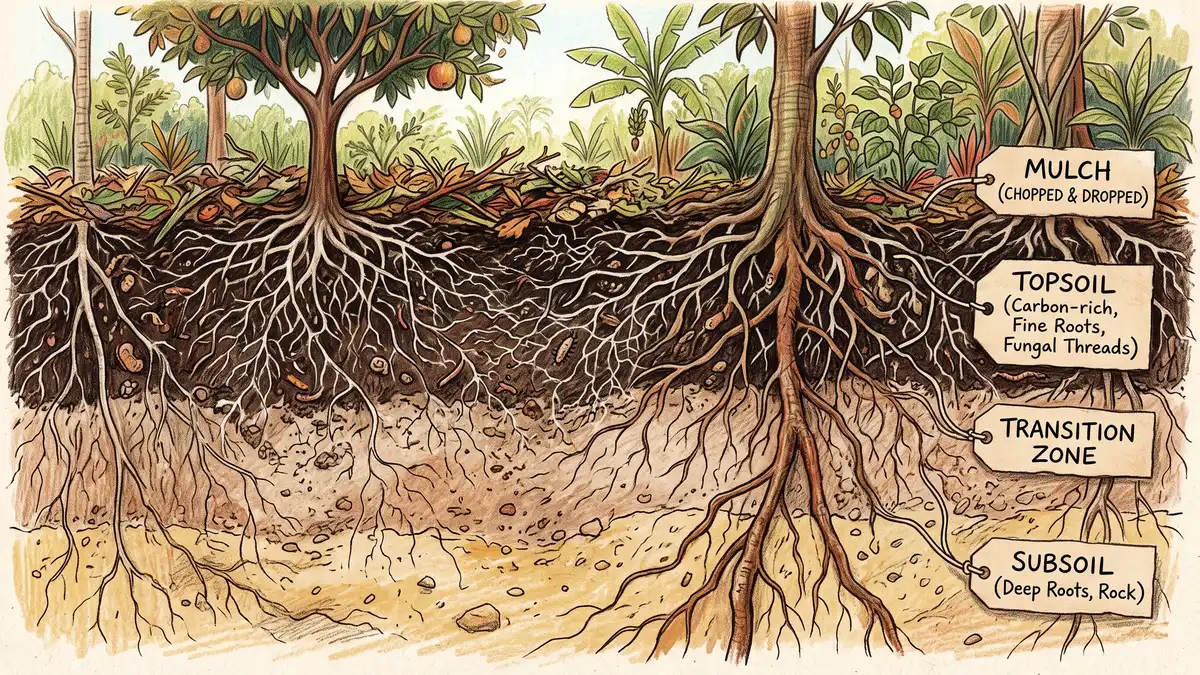
That matters especially in syntropic systems, because the whole method works by loosening soil. Aggressive chop-and-drop pruning, dense rooting and zero tillage all reduce bulk density over time. Track percent alone and you can post real carbon gains that never appear in your data.
The 1.724 Problem
Most garden labs report organic matter, then anyone wanting carbon divides by 1.724, the old Van Bemmelen factor, which assumes organic matter is 58 percent carbon. NC State's survey of representative row-crop fields notes organic matter estimated by multiplying measured carbon by 1.72. It is a convention, not a measurement, and the real ratio varies by soil type and management. A critical review in Geoderma examined this factor directly and found the assumption does not hold uniformly. If you are making a carbon claim, get carbon measured, not inferred.
Which Test Should You Actually Order?
It depends whether you want a trend line or a number you can defend. The gap between those two is roughly $100 a sample.
| Test | Cost | Reports | Good For |
| UW Lawn & Garden test | $30/sample | pH, organic matter %, P, K | Multi-year trend tracking |
| UW physical analysis add-on | $25/sample | Sand, silt, clay | Interpreting your baseline |
| Cornell basic soil health | $100/sample | Soil organic carbon, total C, total N | Real carbon accounting |
| Cornell standard | $140/sample | Above plus more indicators | Whole soil-health picture |
| Cornell NRCS-216 panel | $180/sample | SOC plus NRCS protocol set | Programme-aligned reporting |
Sources: University of Wisconsin Soil and Forage Lab, Lawn and Garden, Cornell Soil Health Laboratory analysis packages
The distinction matters. Cornell's soil health packages report soil organic carbon and total carbon directly rather than organic matter, which is what you want if you are quantifying anything. Standard agronomic garden tests report organic matter by loss-on-ignition, which burns off organic material and weighs the difference. Useful, cheap, and one conversion factor away from the number you actually want.
Neither test gives you bulk density automatically. Cornell's sampling guidance asks growers to contact the lab before sampling if bulk density is needed. Plan for it at the start or you will be resampling.
How Do You Sample So the Numbers Mean Something?
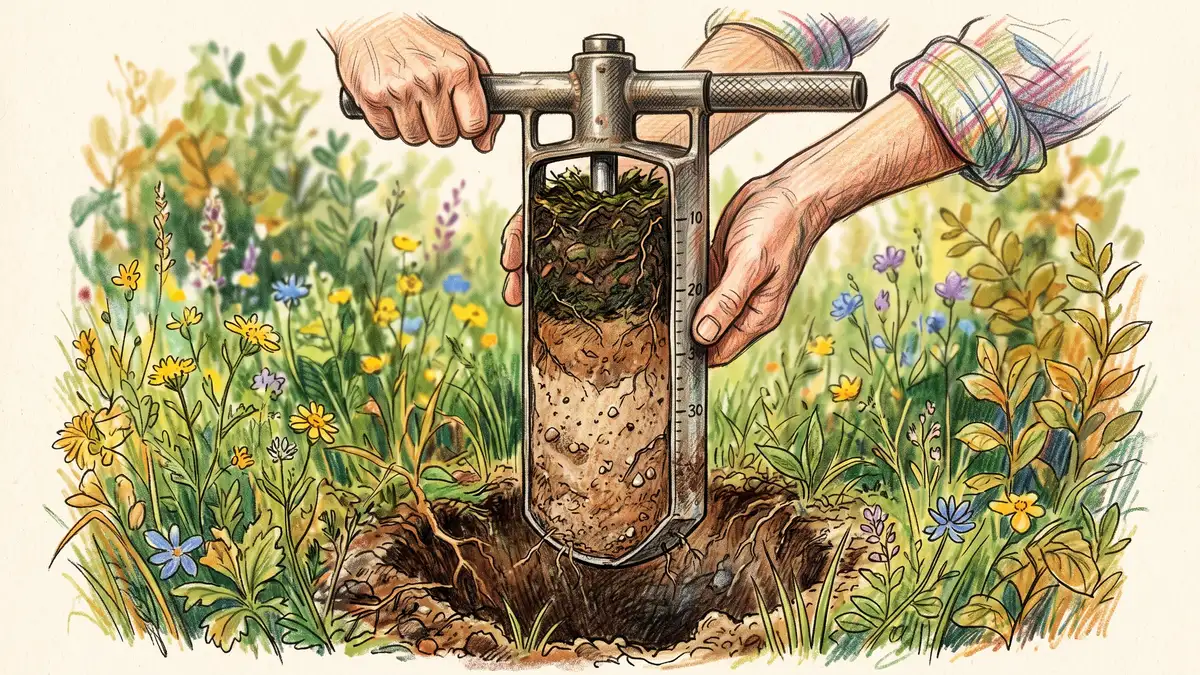
Consistently, and in the same places every time. Soil carbon varies enormously across a few feet, so the single largest source of error is not the lab, it is you sampling somewhere slightly different.
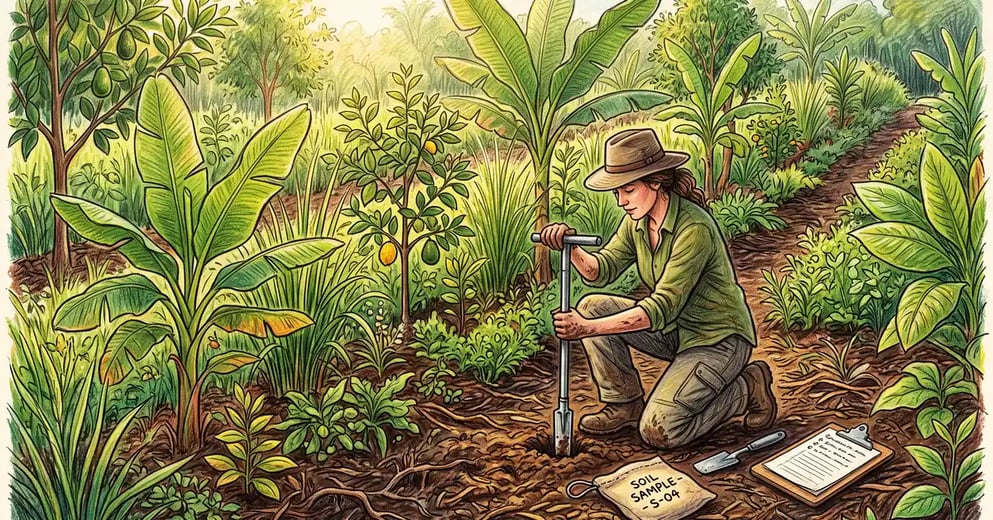
Extension sampling protocols converge on the same core practices: take multiple cores and combine them into one composite sample, control depth precisely, avoid unrepresentative spots, and keep the timing consistent between years. Penn State's sampling instructions and Kansas State's guide both walk through composite sampling in detail.
Fix your sampling points before the first test
Mark three to five permanent locations per management area, record them with GPS coordinates or fixed measurements from a corner post. Resampling the same ground is what makes a comparison valid.
Sample by depth increment, not by shovel-full
Take 0-4 inches and 4-12 inches as separate samples if you can afford it. Shallow-only sampling flatters you: surface mulch systems concentrate gains at the top, and a 0-4 inch result overstates what is happening across the profile.
Take a bulk density core at the same time
A known-volume ring driven to a set depth, dried and weighed. Without it you are stuck with concentration only. Ask your lab for the protocol before you go out.
Resample on a three to five year cycle
Annual testing mostly measures weather and sampling noise. Real management-driven change needs years to rise above that variability. Set the baseline, then leave it alone.
Why This Works: Observe and Interact
The first permaculture principle is to observe before acting, and long enough to see the pattern rather than the noise. Soil carbon is the clearest case there is. One test tells you where you stand; the same test repeated on the same ground for a decade tells you whether your system is doing what you believe it does. The baseline you take this month is the most valuable measurement you will ever make, and only because of what it lets you compare against later.
What Can You Track for Free Between Tests?
Structure, water and life, all of which move before the lab number does. None of these substitute for a carbon measurement, but they tell you whether you are heading in the right direction between paid tests.
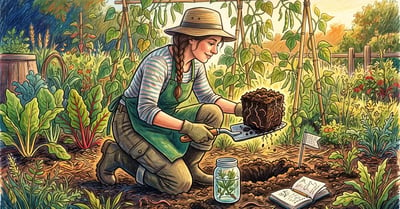
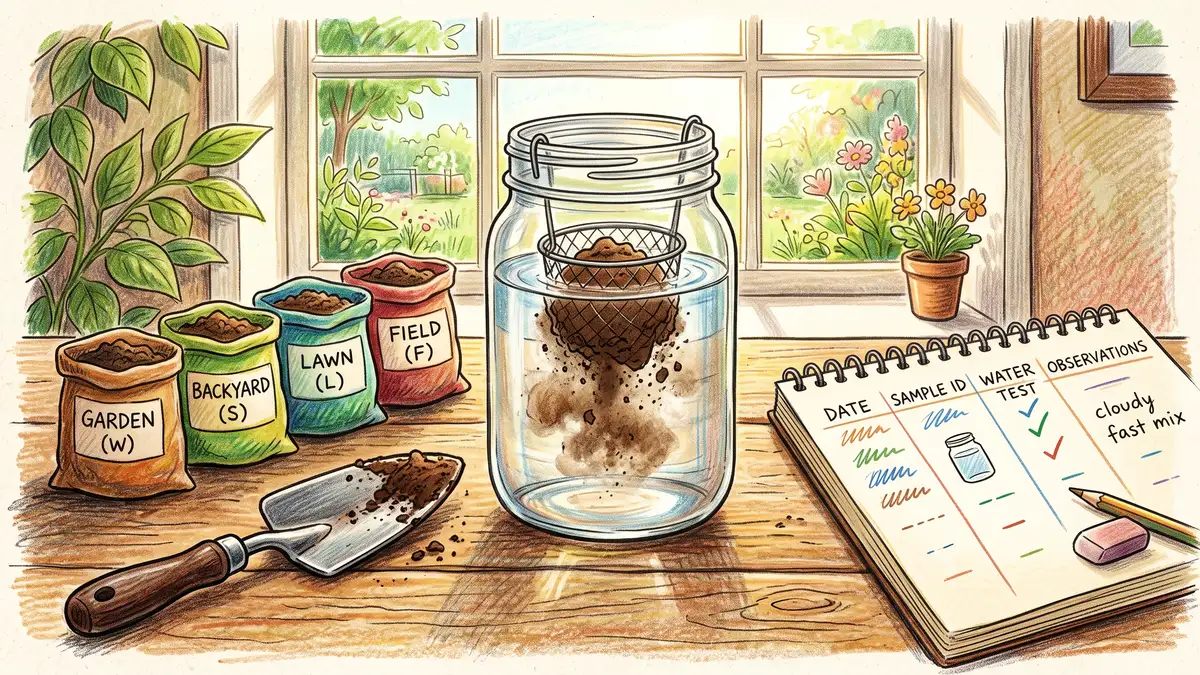
The slake test is the most useful. Drop an air-dried clod into a jar of water and watch. Soil with good organic binding holds together for minutes; degraded soil collapses into cloud in seconds. Aggregate stability is a direct consequence of organic carbon and fungal activity, and it responds within a season or two.
Infiltration is the second. Time how long a fixed volume of water takes to soak into a set area, from the same spot each year. Earthworm counts in a spade-depth cube are the third. All three are free, repeatable, and honest, and none of them can be gamed by sampling shallower.
Real gains are documented. A study of conservation tillage found soil organic carbon concentrations rose by an average of 39 percent across plots over 42 months. Syntropic systems, which combine no tillage with continuous biomass return, plausibly do better, but "plausibly" is doing work in that sentence until you have your own numbers. Our soil testing guide covers the DIY end in more detail.
Frequently Asked Questions
What is the difference between soil organic matter and soil organic carbon?
Organic matter is everything organic in the soil: carbon plus hydrogen, oxygen, nitrogen and the rest. Organic carbon is just the carbon fraction, conventionally taken as about 58 percent of organic matter, which is where the 1.724 conversion factor comes from. Most garden soil tests report organic matter because it is cheaper to measure. Carbon accounting needs organic carbon, and a review in Geoderma has questioned whether that fixed conversion holds across soil types.
How do I calculate tons of carbon per acre?
Multiply organic carbon percentage by bulk density, by the depth you sampled, by the area of an acre, keeping your units consistent. South Dakota State Extension publishes the full worked calculation. The step everyone skips is bulk density, which is the mass of dry soil per unit volume and must be measured with a known-volume core rather than assumed. Without it you have a concentration, not a stock.
How often should I test soil carbon?
Every three to five years, from permanently marked locations, at the same time of year. Annual testing on a home-scale site mostly measures sampling variability and seasonal moisture rather than real management effects. Take a thorough baseline now, including bulk density and at least two depth increments, then be patient. The comparison is the point, and it needs time to become meaningful.
Does syntropic agriculture really build soil carbon faster?
The evidence points that way, and the mechanism is clear: no tillage, dense multi-layer rooting, and repeated biomass return through pruning. Whether your site matches published figures is an empirical question about your soil, your climate and your management, not something you can assume from the method. Read the numbers in our piece on carbon sequestration in syntropic systems, then measure your own.
Is a $30 garden soil test worth it for carbon tracking?
For trends, yes. A loss-on-ignition organic matter reading from the same lab, same spots and same season is perfectly good at showing direction over five or ten years. What it cannot do is give you a defensible carbon stock figure, because it measures organic matter rather than carbon and comes without bulk density. Use the cheap test for feedback and a soil health panel when you need a number that holds up.
Get the Weekly Dig
One practical permaculture guide a week, written for gardeners who do this on weekends: building living soil without buying it in bags. Free, no spam, unsubscribe any time.
Join the Weekly DigTake the baseline before you plant. It costs one afternoon and it is the only thing that turns a good intention into a measurement. Start with the syntropic method itself, and read what carbon does once it is down there in the soil health guide.
Resources
- South Dakota State Extension — Soil Carbon Cycle and Laboratory Measurements of Carbon
- Cornell Soil Health Laboratory — Soil Health Analysis Packages and Pricing
- Cornell Soil Health Laboratory — Soil Sample Collection Protocol
- University of Wisconsin Soil and Forage Lab — Lawn and Garden Testing
- University of Wisconsin Extension — Soil Test Procedures (A2809)
- Penn State Agricultural Analytical Services Lab — Soil Sampling Instructions
- Pribyl (2010), Geoderma — A Critical Review of the Conventional SOC to SOM Conversion Factor
- Improvements in Soil Health and Soil Carbon Sequestration Under Conservation Management