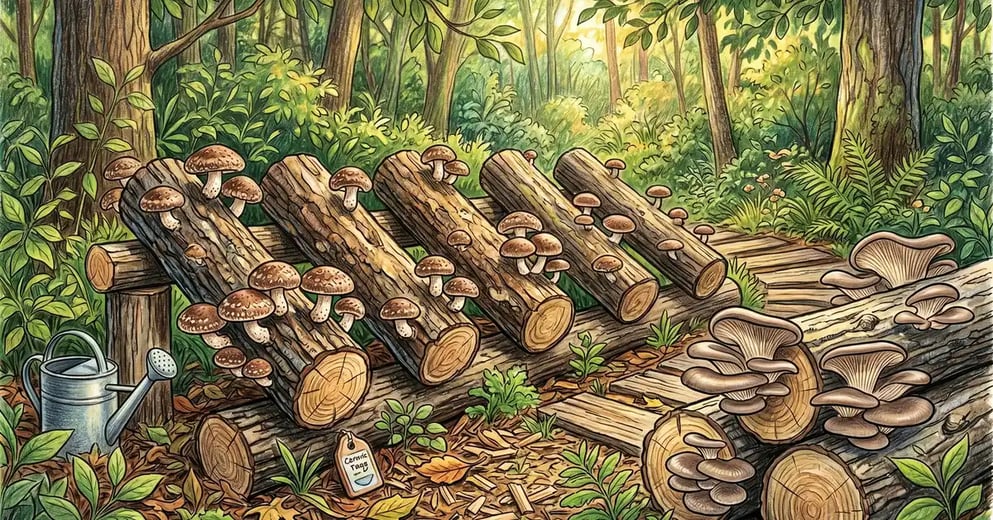

Growing shiitake and oyster mushrooms on small-diameter hardwood logs is one of the most reliable, low-input ways to add high-value protein to a backyard permaculture system. A single 4-ft log can produce 2 to 4 pounds of mushrooms across 3 to 5 years of fruiting, with no soil tillage, no chemical inputs, and almost no daily care once the logs are inoculated. food forest mushrooms
Sources: Cornell Small Farms Mushroom Project field trials; Mudge and Gabriel, Farming the Woods (2014); Field and Forest Products supplier data.
Mushroom logs sit at a sweet spot inside a permaculture food system. They use a resource (small-diameter hardwood thinnings) that most gardens already have or can find for free. They occupy the shaded forest edge or north side of a building where vegetables refuse to grow. They produce a high-protein crop without competing with the annual garden for sun, water, or compost. And they integrate cleanly with woodland management, because every 3 to 5 ft of straight, healthy hardwood stem is a future producer of food.
This guide covers what you need to know to grow your first shiitake (Lentinula edodes) and oyster (Pleurotus ostreatus, P. pulmonarius) logs in the US backyard, from selecting wood through 5 years of harvests. The methods come from the Cornell Small Farms Mushroom Project, Steve Gabriel's Farming the Woods, US university extension trials, and decades of practitioner experience in commercial log-grown mushroom production.
Why mushroom logs belong in a permaculture system
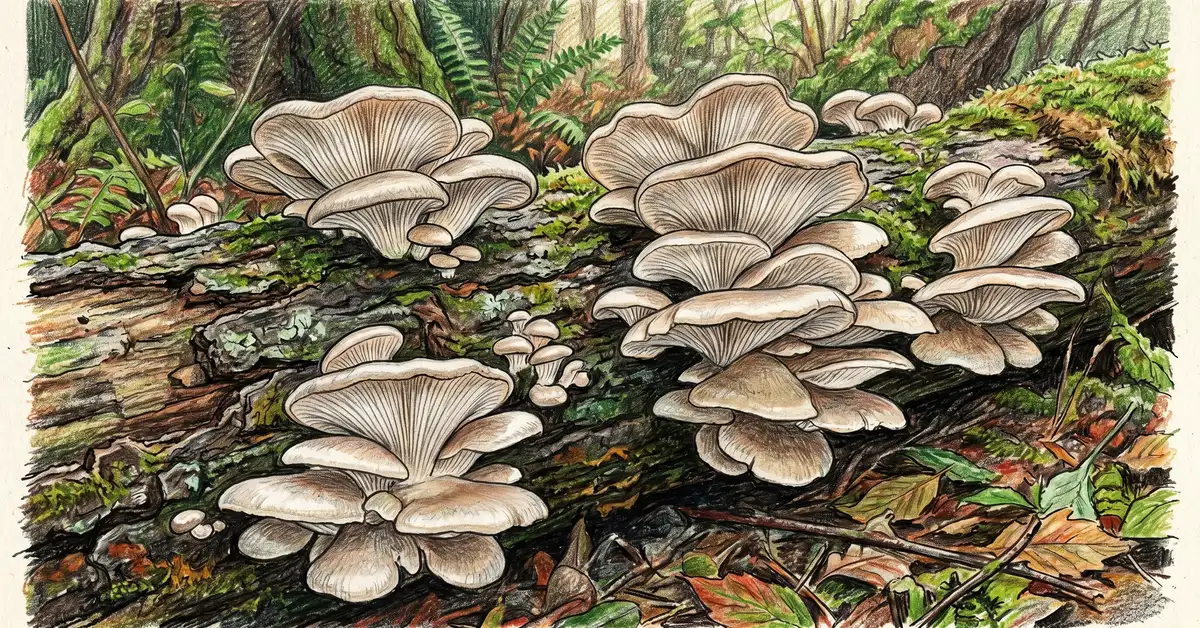
Annual vegetable gardens demand sun, soil, water, and tillage. Mushroom logs demand none of those. They produce in deep shade, on stacked dead wood, with rainfall as their only irrigation in most US climates. The economic case is also strong. A 4-ft log of properly inoculated shiitake produces 2 to 4 pounds of mushrooms over its productive life. At supermarket prices of $12 to $18 per pound for fresh shiitake (USDA Agricultural Marketing Service retail tracking), a single log returns $24 to $72 in food value for roughly $3 to $5 in spawn and wax costs.
The ecological case matters more inside a permaculture frame. Mushroom logs:
- Capture vertical space: Logs stack in lean-to or crib piles, fruiting along the entire length, producing more food per square foot of ground than most ground crops.
- Use degraded fertility: The logs feed on lignin and cellulose, returning enriched mycelium-laced substrate to the soil when they finally collapse after 5 to 8 years.
- Tolerate edge and shade: Forest edge, north-facing walls, and dense canopy gaps that grow nothing else can carry productive mushroom yards.
- Integrate with woodland thinning: Selective thinning of small hardwoods improves the woodlot and produces the exact log diameters mushroom culture needs.
- Provide protein: Fresh mushrooms run 2 to 3 percent protein by wet weight and are exceptionally rich in B vitamins, ergosterol (vitamin D2 precursor), and beta-glucans.
Why this works (the permaculture insight)
Mushroom logs are a textbook example of permaculture principle 3: obtain a yield. The same hardwood thinnings that most landowners burn or chip would already cycle their stored carbon back to the soil and atmosphere. Inoculation captures that cycle for human food first, then for soil enrichment. You are not adding a new input to the land. You are routing an existing flow of woody biomass through a high-protein food crop on its way to the soil. That stacked function (fuel, food, soil amendment) compressed into one decomposition cycle is the hallmark of well-designed permaculture.
Choosing the right wood
Not every tree species supports the same mushrooms. Match the wood to the spawn for reliable production.
| Mushroom | Best US hardwood species | Acceptable alternates | Avoid |
| Shiitake | White oak, red oak, sugar maple, hop hornbeam, ironwood | Sweet gum, beech, hickory, hard maple | Soft maple, conifers, walnut, locust, sassafras |
| Oyster (P. ostreatus) | Tulip poplar, cottonwood, willow, soft maple | Aspen, alder, beech, sweet gum, ash | Oak (too dense, slow), conifers, walnut |
| Oyster (P. pulmonarius, summer/Italian) | Tulip poplar, beech, soft maple | Birch, alder, sweet gum, magnolia | Oak, conifers, walnut |
| Lion's mane (advanced) | Red oak, beech, sweet gum, sycamore | Sugar maple, birch | Conifers, walnut, locust |
Source: Cornell Small Farms Mushroom Project species compatibility matrix; Mudge and Gabriel (2014), Farming the Woods.
Log diameter matters as much as species. Shiitake prefers 3 to 8 in logs because the dense ring of sapwood under thick bark is where the mycelium colonises and fruits. Logs much thinner than 3 in dry out and burn through their food too fast. Logs much thicker than 8 in take years to colonise and become unwieldy to lift. Oyster mushrooms tolerate a wider range, 4 to 12 in, because they colonise faster and use a broader species pool.
Cut logs in late winter to early spring (roughly January through March in most of the US), after the trees have hardened off for winter but before bud break. At that point the sapwood is loaded with stored sugars and the bark is still tight on the stem. A loose bark log is a failed log: as the bark cracks and falls, the mycelium dries out and gives way to competitor fungi. Cut to 3 to 4 ft lengths within a week of felling, and inoculate within 2 to 6 weeks of cutting to give your spawn a clean head start.
The 6-step inoculation procedure
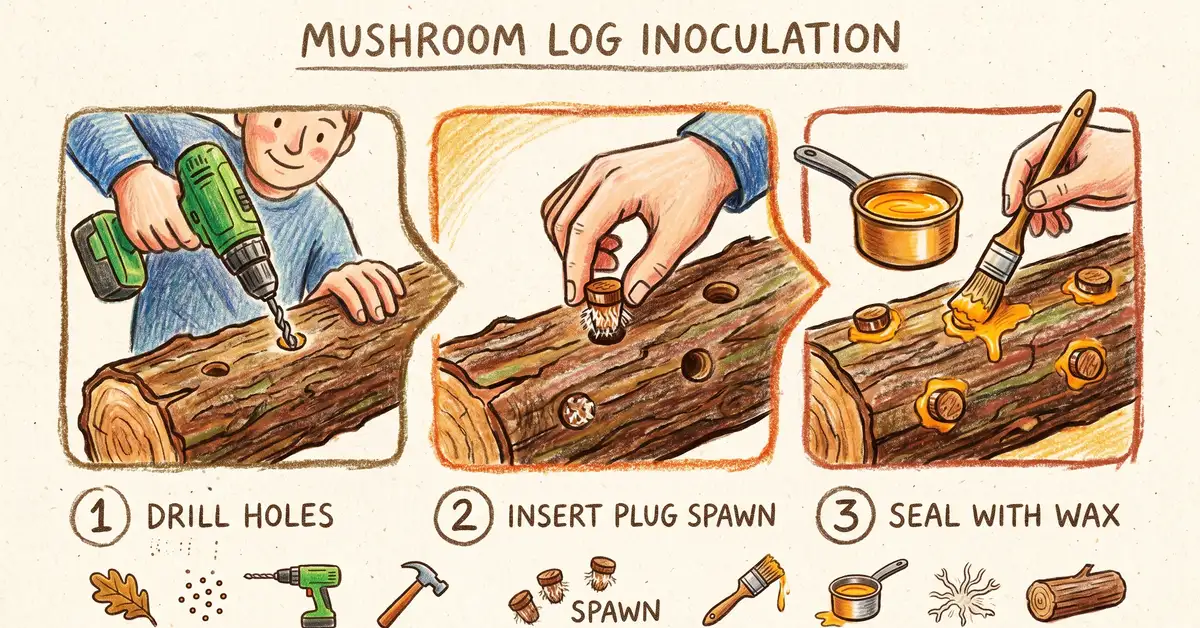
Inoculation is the most labor-concentrated step. Plan to spend about 30 to 45 minutes per log. A weekend session of 10 to 15 logs is achievable for one person and sets up several years of harvests.
Source spawn from a US supplier
Order plug spawn (wooden dowels colonized by mushroom mycelium) or sawdust spawn from Field and Forest Products (Wisconsin), Fungi Perfecti (Washington), Mushroom Mountain (South Carolina), or North Spore (Maine). Allow 2 to 3 weeks lead time in winter. For a beginner, plug spawn is the easier choice: no inoculation tool required, just a hammer. Sawdust spawn yields 2 to 3 times more inoculation points per dollar but requires a thumb-style or angle-grinder inoculation tool.
Drill the holes
Use a 5/16 in drill bit with a depth stop set at 1.25 in. Drill rows along the long axis of the log, 4 to 6 in apart within each row. Offset the rows by half the spacing in a diamond pattern, with rows 2 to 3 in apart around the circumference. Plan on 40 to 60 holes per 4-ft log of 4 to 6 in diameter. The diamond pattern speeds colonisation by giving the mycelium short, predictable jumps between inoculation points.
Insert the spawn
For plug spawn: drop a plug into each hole and tap flush with a hammer. The plug should sit slightly below the surface of the bark. For sawdust spawn: load the spawn tool and inject one charge per hole, then tamp the surface flush with a finger or rubber mallet. Work quickly to keep the spawn from drying.
Seal with food-grade cheese wax
Melt cheese wax (not paraffin, which cracks) in a small slow cooker or double boiler to 180 to 200 degrees F. Dab a small amount over each inoculation hole with a foam brush. The wax seal locks in moisture and locks out airborne competitor spores during the slow colonisation phase. Re-wax any hole that visibly cracks during incubation.
Stack the logs in spawn run
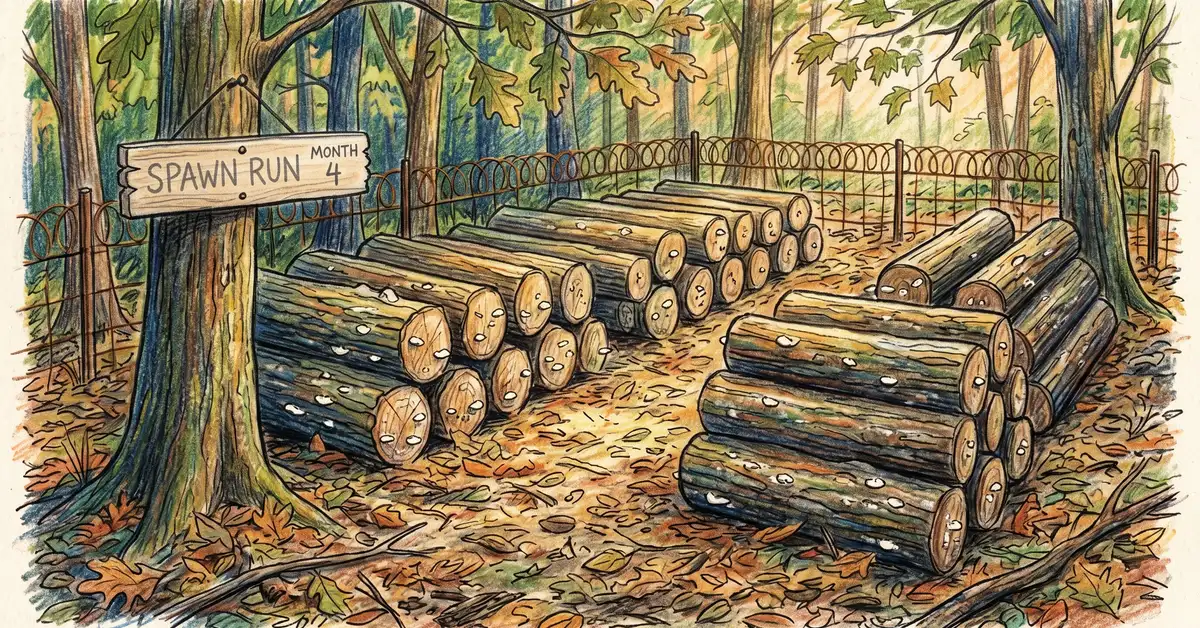
Move the inoculated logs to a shaded site (60 to 80 percent shade, north side of a building or under dense canopy). Stack in a lean-to against a fence rail, a crib pile, or directly on the ground supported on a pair of skids 4 in off the soil so they do not pick up ground-dwelling competitors. Cover the pile lightly with shade cloth for the first month if the site is too sunny or dry.
Wait, soak, and harvest
Shiitake colonises for 6 to 18 months. Oyster colonises for 3 to 6 months. Look for white mycelium visible at the log ends and white tendrils peeking from the wax seals as a sign of full colonisation. Once colonised, soak the logs in cold water (50 to 65 degrees F) for 24 hours to force fruit. Move to fruiting position. Pins appear in 3 to 7 days. Harvest mushrooms when the cap edge starts to flatten but before it fully unfurls. Rest each log 6 to 8 weeks between forced fruitings.
Shiitake versus oyster: which to choose
Both species reward beginners, but they suit different gardens and different patience profiles.
Shiitake is the workhorse of US backyard log production. The mushrooms keep for a week refrigerated, ship well to farmers' markets, and dry beautifully for winter storage. Shiitake also tolerates the widest US climate range, from USDA zone 4 through zone 9, and rewards patience: a properly maintained shiitake log produces for 3 to 5 years. The downside is the long incubation. A log inoculated in March 2026 may not yield its first flush until autumn 2027.
Oyster is the impatient gardener's mushroom. Pearl oyster (P. ostreatus) fruits in cool conditions, summer oyster (P. pulmonarius) in warmer conditions, golden oyster (P. citrinopileatus) in the heat of US Southeast summers. Oyster colonises 3 to 4 times faster than shiitake and will often produce a small flush the first autumn after a spring inoculation. The trade is shorter productive life (2 to 4 years per log) and more delicate post-harvest handling. Fresh oysters keep only 3 to 5 days refrigerated.
A balanced backyard mushroom yard often includes both. Inoculate 8 to 12 shiitake logs in your first season for steady production starting in year two, then add 4 to 6 oyster logs in your second season to get quick wins while the shiitake colonises.
Force fruiting with the cold water shock
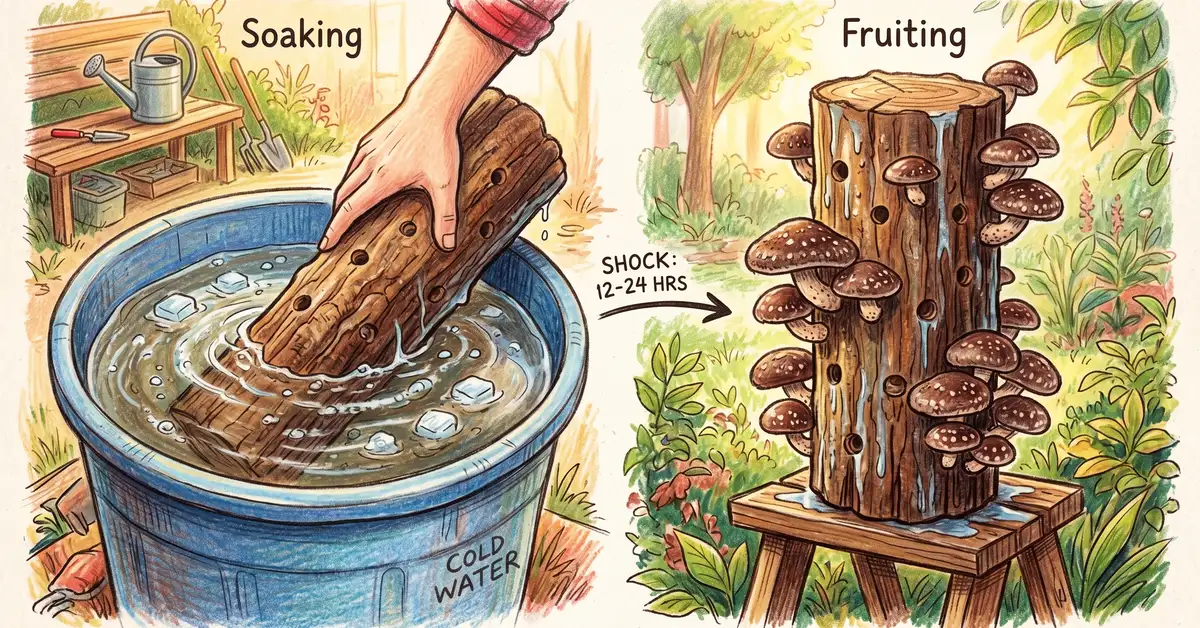
Mushroom logs left to nature fruit when temperature, humidity, and rainfall align. That is a fine strategy for a single log, but a multi-log yard benefits from scheduled fruiting. The technique is the cold water shock soak: a 24 hour immersion in 50 to 65 degree F water triggers the mycelium to redirect resources into fruit body formation. The temperature gradient mimics the natural autumn cold snap that triggers wild fruiting.
Set up a stock tank, plastic bin, or kiddie pool deep enough to submerge a 4-ft log. A water-filled 100-gallon stock tank holds 4 to 6 logs at once. Use cold well water, or chill municipal water with ice for the first few hours. Weight the logs with cement blocks or rocks to keep them submerged. After 24 hours, lift the logs and move them to fruiting position: stand them on end in a shaded, humid spot or lean them against a fence rail. Mist daily if humidity drops below 65 percent.
Pins (the tiny first nubs of fruit) appear 3 to 7 days after the soak. Harvest 5 to 10 days after pinning when the caps reach their full size but before the edges curl up. After the flush, rest each log for 6 to 8 weeks before the next forced fruiting. A shiitake log can be force-fruited 2 to 3 times per year, generating 6 to 12 oz per flush.
The mushroom yard in a permaculture design
Place the mushroom yard inside Zone 2 of the permaculture site (see our guide to permaculture zones). The yard wants weekly visits during fruiting flushes (harvest, water soak setup) and monthly attention otherwise (check moisture, re-wax cracks, scout for pests). That cadence fits Zone 2 better than the daily-managed kitchen garden of Zone 1.
Pair the yard with a shade tree or living trellis. A productive mushroom yard runs alongside understory plantings: low-light edibles such as ramps, ostrich fern fiddleheads, and woodland strawberries. The dense shade and consistent humidity that mushrooms love also serve the woodland understory.
Integrate with woodland thinning. A 1-acre US backyard with established hardwoods can sustain a small mushroom operation indefinitely by removing 2 to 4 small straight hardwoods per year in selective thinning, choosing trees that crowd more valuable specimens. The cut wood feeds the mushroom logs; the thinning improves the residual stand. This pattern of stacked function is the same logic that drives syntropic agriculture's succession planting.
Beyond shiitake and oyster: other log mushrooms
Once you have a year or two of practice with shiitake and oyster logs, the wider world of log-cultured mushrooms opens up.
- Lion's mane (Hericium erinaceus): Spectacular cascading white mushrooms with a seafood texture. Grows on red oak, beech, and sweet gum logs. Sensitive to humidity, prefers freshly cut logs and humid shade.
- Chicken of the woods (Laetiporus sulphureus): Bright orange shelf mushroom on oak. Slower to dial in, but a stunning addition once established.
- Reishi (Ganoderma lucidum and G. tsugae): Medicinal mushroom that grows readily on cherry, hemlock (tsugae) or hardwood stumps. Long-fruiting (1 to 2 years per log) with high commercial value.
- Nameko (Pholiota microspora): Small amber-capped Japanese mushroom on cherry, sweet gum, or sugar maple. Sticky cap, prized in miso soup.
- Turkey tail (Trametes versicolor): Medicinal polypore that grows on almost any hardwood. Easy beginner choice for the medicinal angle.
For commercial-scale work, the Cornell Small Farms Mushroom Project, Penn State Extension, and the University of Vermont Center for Sustainable Agriculture have published trial data on each of these species across US climate zones. For a deep dive into agroforestry and forest farming, Steve Gabriel's Farming the Woods remains the practitioner standard.
Common problems and how to solve them
| Problem | Likely cause | Fix |
| Bark falls off in year 1 | Logs cut too late (after bud break) or held too long before inoculation | Cut next batch in winter, inoculate within 4 weeks; the affected logs may still produce, just less reliably |
| Green or black mold on log surface | Trichoderma or Aspergillus competitor; usually too wet or too warm in spawn run | Move logs to a drier, shadier site; brush off surface mold, log may still colonise underneath |
| No fruiting after 18 months | Incomplete colonisation, often from inadequate spawn density or wrong species pairing | Soak in cold water; if no response after 2 weeks, the log is likely a failed inoculation |
| Tiny, dried-out fruit | Low humidity at fruiting position | Mist 2 to 3 times daily; move to deeper shade; cover loosely with shade cloth tent |
| Slugs eating young fruit | Ground-dwelling slugs reaching the log | Raise logs on skids; ring fruiting position with diatomaceous earth or crushed eggshell; harvest pins promptly |
Source: Cornell Small Farms Mushroom Project troubleshooting guide; Penn State Extension fact sheets on log-grown specialty mushrooms.
A 2-year backyard mushroom plan
If you are starting from zero, here is a realistic 2-year setup that puts mushrooms on your table without overcommitting.
Winter year 1: cut and order
Cut 10 to 15 small hardwood logs (oak for shiitake, tulip poplar for oyster), 3 to 4 ft long, 3 to 6 in diameter. Order 1 to 2 lb of shiitake plug spawn and 1 lb of oyster plug spawn. Total cost: $50 to $80 in spawn plus $15 in cheese wax.
Spring year 1: inoculate
Spend one weekend inoculating all 10 to 15 logs. Stack in shaded position. Expect first oyster flush in fall of year 1.
Year 2: first major shiitake harvests
Force fruit shiitake logs in late spring, mid summer, and early fall using the cold water soak. Expect 6 to 12 oz per log per flush, 2 to 3 flushes per year. Year 2 yield: 5 to 15 lb fresh shiitake, plus continued oyster production.
Year 2 winter: scale up
Cut and order another 10 to 20 logs to bring your yard to a continuous production schedule. With overlapping log ages, you can move from feast-or-famine to a steady weekly harvest from year 3 onward.
If you want a fast-tracked entry point, Farming the Woods by Steve Gabriel and Ken Mudge devotes an entire chapter to log-grown mushrooms inside woodland systems, with diagrams of stacking patterns, soak schedules, and a 10-year economic model for a 200-log shiitake yard. The Cornell Small Farms Mushroom Project also offers free downloadable plans and budget templates for small US producers.
Get the Weekly Dig
One practical permaculture guide a week, written for gardeners who do this on weekends: permaculture design for real backyards. Free, no spam, unsubscribe any time.
Join the newsletterFAQ
How long does it take to grow mushrooms on a log?
Shiitake logs take 6 to 18 months from inoculation to first fruiting, then produce for 3 to 5 years. Oyster logs take 3 to 6 months from inoculation to first fruiting, then produce for 2 to 4 years. The colonisation phase is the slow part. Once fruiting begins, a single forced soak triggers a new flush within 3 to 7 days.
What is the best wood for shiitake mushrooms?
White oak and red oak are the gold standard for shiitake in the US. Sugar maple, hop hornbeam, sweet gum, and ironwood also perform well. Avoid soft maple, conifers, walnut, locust, and sassafras. Cut logs 3 to 8 in diameter and 3 to 4 ft long, with tight bark, in late winter.
What is the best wood for oyster mushrooms?
Tulip poplar is the gold standard for oyster mushrooms in the US, followed by cottonwood, willow, soft maple, aspen, and alder. Oyster colonises faster than shiitake and tolerates a wider species range. Logs of 4 to 12 in diameter work; thicker logs produce longer.
How do I force a mushroom log to fruit?
Submerge a fully colonised log in cold water (50 to 65 degrees F) for 24 hours. Use a stock tank, plastic bin, or kiddie pool. Weight the log to keep it submerged. After 24 hours, lift the log to a shaded fruiting position. Pins appear in 3 to 7 days. Harvest 5 to 10 days after pinning.
How many mushrooms does one log produce?
A 4-ft shiitake log of 4 to 6 in diameter yields 2 to 4 pounds of fresh mushrooms across 3 to 5 years of fruiting. Per flush, expect 6 to 12 oz. A 4-ft oyster log yields 1.5 to 3 pounds across 2 to 4 years. Yields vary with wood species, log diameter, log moisture, and force-fruiting frequency.
Where can I buy mushroom plug spawn in the US?
The major US suppliers are Field and Forest Products (Wisconsin), Fungi Perfecti (Washington), Mushroom Mountain (South Carolina), and North Spore (Maine). Order 2 to 3 weeks ahead in winter. Plug spawn is easier for beginners; sawdust spawn is more cost effective at scale.
Do I need to use cheese wax to seal mushroom logs?
Yes. Food-grade cheese wax (not paraffin) seals the inoculation holes against moisture loss and airborne competitor spores during the long colonisation phase. Melt to 180 to 200 degrees F in a small slow cooker or double boiler. A 1 lb block seals roughly 30 to 50 logs.
Can I grow mushrooms on logs in any climate zone?
Shiitake performs across USDA zones 4 through 9. Pearl oyster handles cool climates. Summer oyster prefers warmer regions. Golden oyster thrives in the Southeast summer. In very arid US climates (the Southwest), supplemental misting and deeper shade are required, or growing in a humid shed.
Resources
- Cornell Small Farms Mushroom Project: free production guides and budget templates
- Penn State Extension: Specialty Mushrooms fact sheets
- North Carolina State Extension: Growing Shiitake in Agroforestry
- Field and Forest Products: US plug and sawdust spawn supplier (Wisconsin)
- Fungi Perfecti: Paul Stamets' spawn company (Washington)
- Farming the Woods by Ken Mudge and Steve Gabriel (Chelsea Green, 2014)
- University of Vermont Extension: Specialty Mushroom Production research