
What "Syntropic" Actually Means in a Backyard
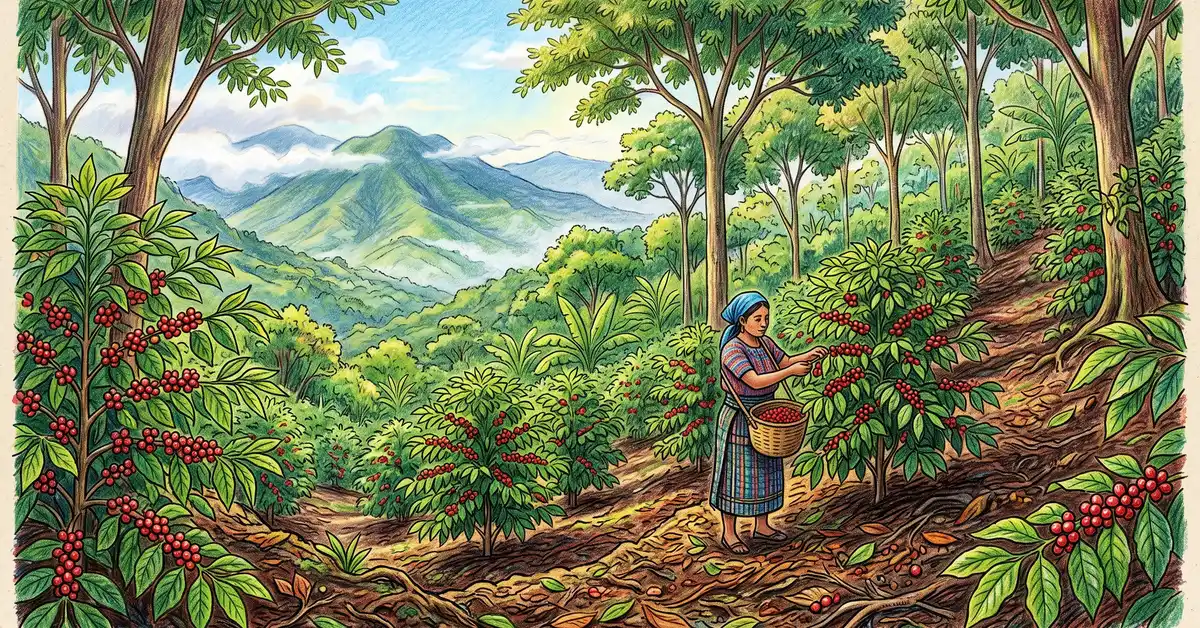
Syntropic agriculture sounds technical. The two-sentence version: it's a way of gardening where you plant densely, in stratified layers, and feed the soil by aggressively pruning your own plants and dropping the cuttings as mulch. The system gets more productive over time because each cycle of pruning forces accelerated regrowth and pumps biomass into the soil. Ernst Götsch — a Swiss farmer who restored 1,200 acres of degraded Brazilian cocoa land starting in the 1980s — is the practitioner who codified the method.
For a weekend gardener in USDA zone 5–8, the question isn't "should I do what Götsch does in tropical Bahia?" but "what's the smallest version of this I can start in my backyard this season?" The honest answer: a 4×8 ft (1.2×2.4 m) strip beside your existing beds, planted with a stratified mix of trees, shrubs, and herbs, and pruned on a regular rhythm. You'll see soil and yield changes within one full growing season. The Propagate Ag cold-climate syntropic guide and the Renke de Vries temperate-adaptation interview are the two most useful starting points for cold-climate practitioners.
Key Takeaway
Don't try to recreate a Brazilian cacao restoration in Pennsylvania. Start with a small, dense, stratified strip; substitute cold-tolerant species for tropical placeholders; and commit to the pruning rhythm — that's what makes the system syntropic instead of "permaculture with extra steps."
The Five Principles You Have to Get Right
Skip any of these and the system stalls. Mountain Time Farm's principles guide covers the same five with field-tested temperate-zone adjustments.
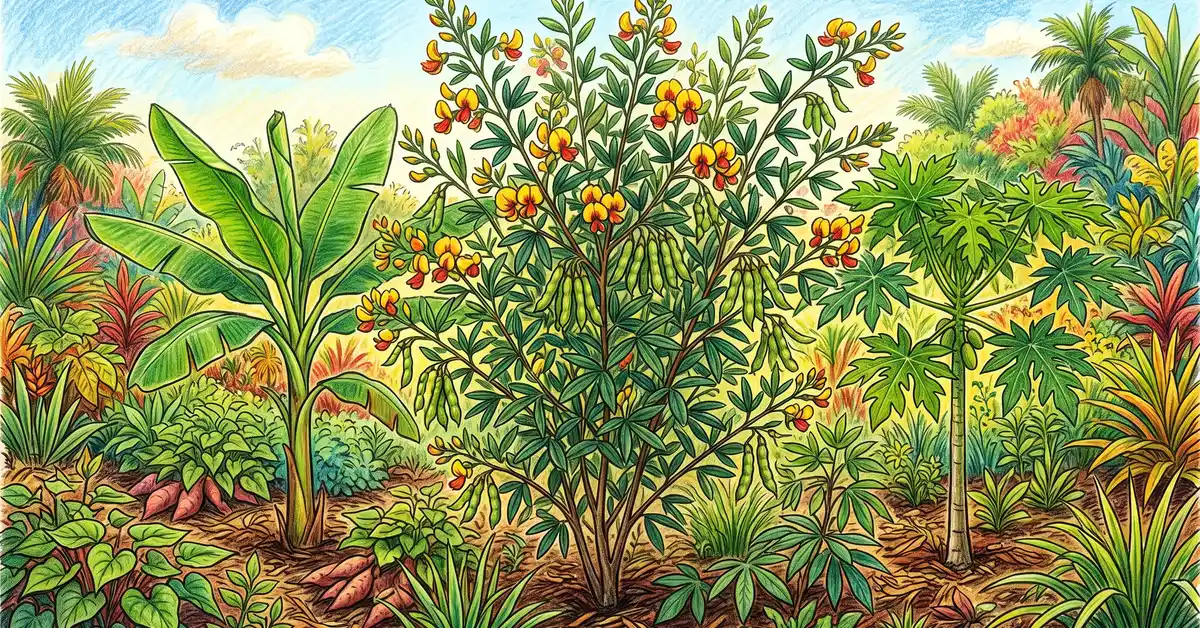
1. Stratification. Every plant is assigned a vertical role: emergent (tallest), high, medium, or low canopy at maturity. You plant species from all four tiers in the same square foot. In tropical syntropy that's banana / pigeon pea / inga; in temperate it's mulberry or apple / hazelnut / currant or comfrey / strawberry.
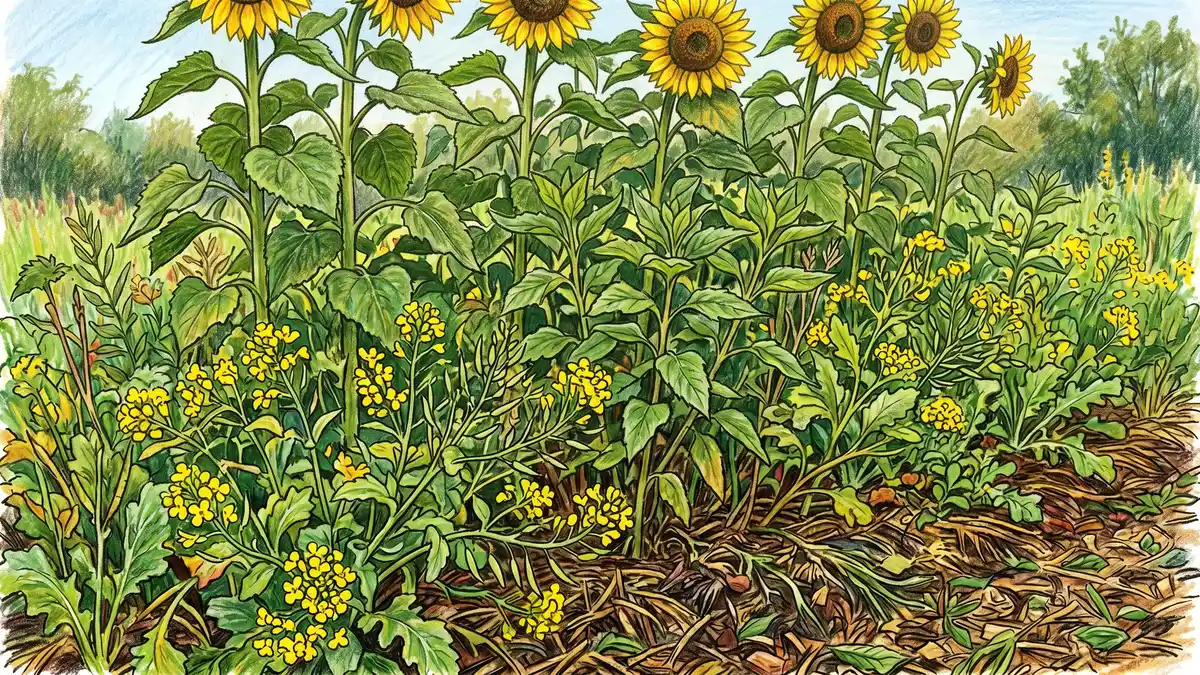
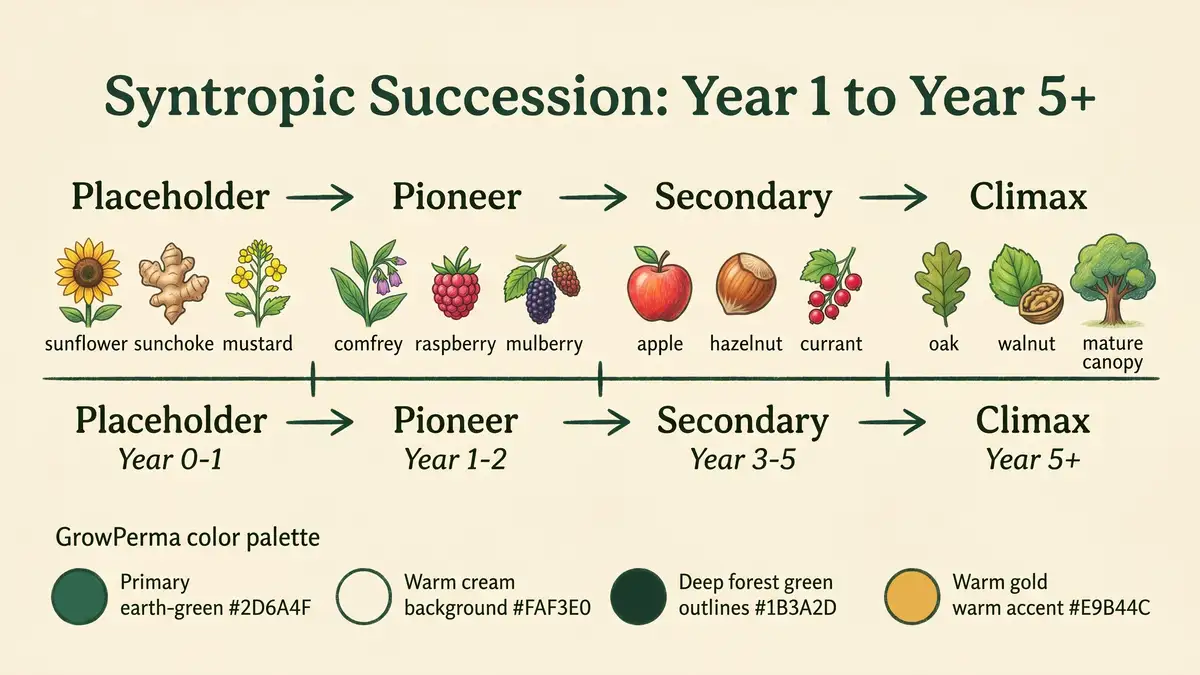
2. Succession. Plant species in four overlapping waves: placeholder (sunflower, sunchoke, mustard — fast biomass, year 1 only), pioneer (comfrey, raspberry, mulberry — fast biomass, persistent), secondary (apple, hazelnut, currant — main producers years 3–10), and climax (oak, walnut, mature canopy — decades). Plant them all at once, prune the placeholders out as the secondaries mature.
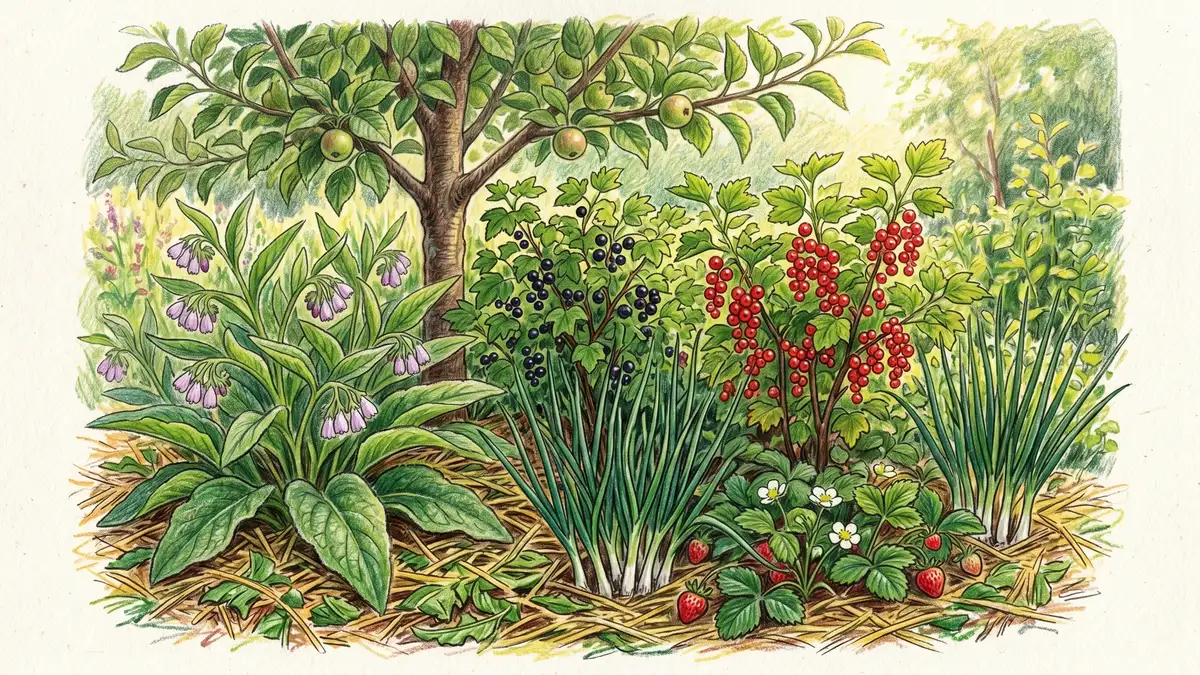
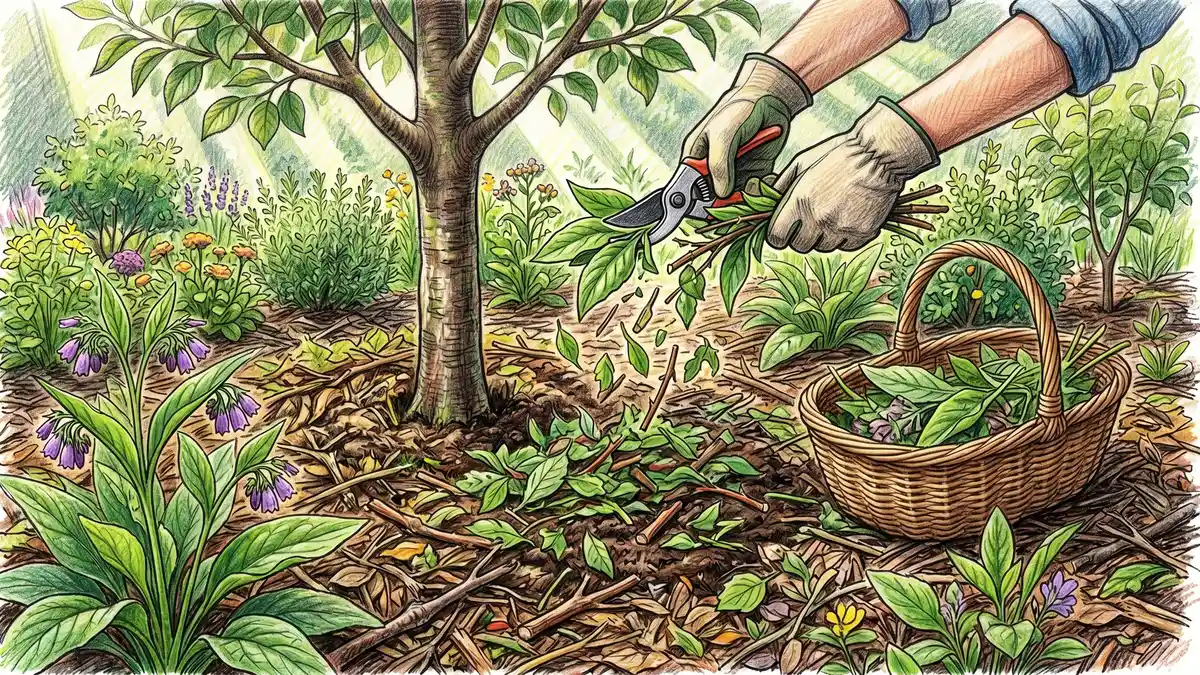
3. Pruning is the engine. This is the part most beginners get wrong. In a syntropic garden, you prune to drive growth and cycle biomass, not just to control shape. The RHS overview of chop-and-drop covers the basic mechanic; in syntropy you do it 3–6 times per season for herbaceous species and at flowering for woody ones. Pruned material drops directly on the bed as mulch.
4. High density. You plant at 2–3× the spacing of a conventional orchard or garden, on the assumption you'll thin/prune as the system matures. Sparse planting starves the system of biomass and light competition that drives growth.
5. The soil is never bare. Living roots or thick mulch cover every square inch, every day of the year. This is the principle Yale's FORE program highlights as the underlying mechanism behind the system's soil-building rate.
Why This Works: Disturbance + Succession
What looks like "constant pruning" to a tidy gardener is mimicking natural disturbance — a tree falls, light hits the floor, succession restarts. Syntropic practice deliberately stages those disturbances at human-scale and human-frequency. A 2025 NIH-indexed peer-reviewed study on a temperate agrosilvopastoral system documented the soil-microbiome changes that follow this kind of structured disturbance — measurable shifts in fungal/bacterial ratios within months of management changes.
Your First Steps: Building a 4×8 ft Starter Strip
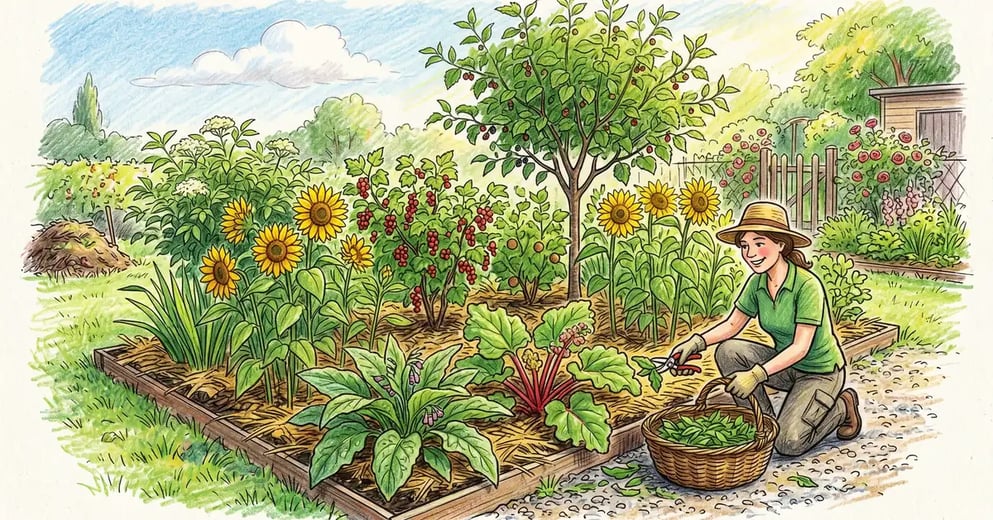
Pick a 4×8 ft (1.2×2.4 m) strip on the south- or southeast-facing edge of your yard, full sun, decent drainage. Run it east-west so the tallest species don't shade the smaller ones. Then follow the sequence below.
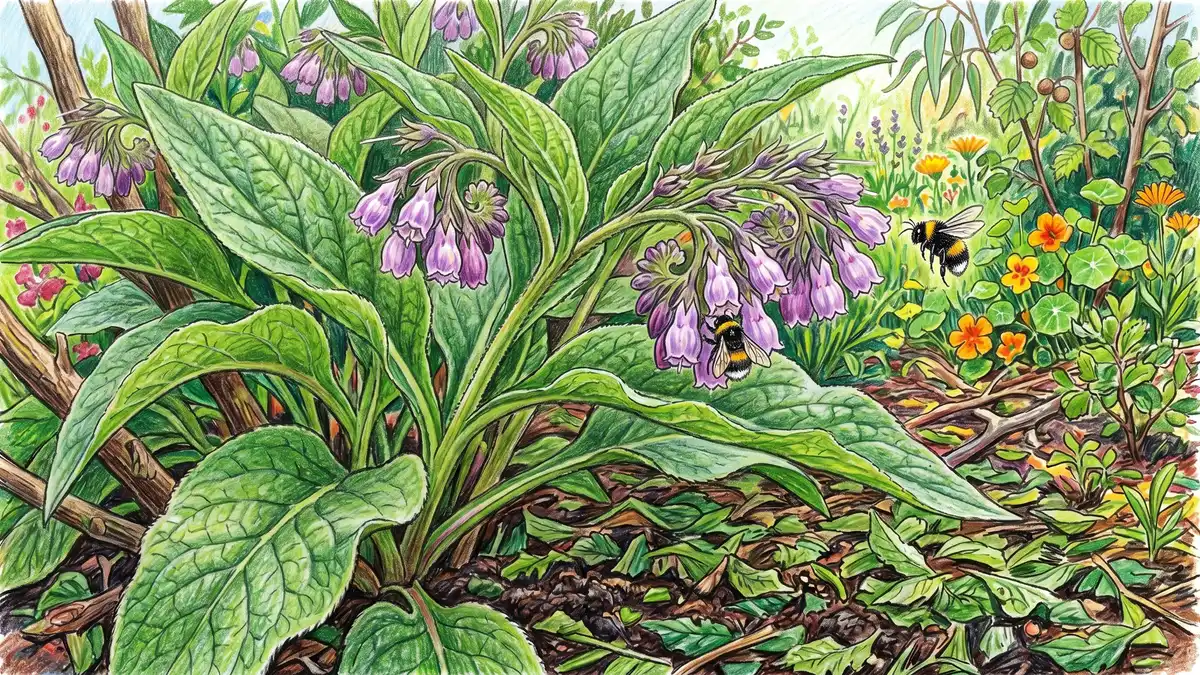
The single most important species in a temperate syntropic garden is comfrey (Symphytum × uplandicum 'Bocking 14'), the sterile cultivar that won't seed everywhere. It's your biomass engine. Plant it at the front of the strip on day one, chop it 4–6 times per season, drop the cuttings as mulch. One mature comfrey plant produces roughly 30–50 lbs (14–22 kg) of cuttings per year — enough to mulch a 4×8 strip several times over.
Sheet-mulch the strip (1 weekend)
Lay flattened cardboard over the existing grass or weeds. Cover with 4–6 inches (10–15 cm) of straw, wood chips, or leaf mould. Water thoroughly. Wait 2–3 weeks before planting, or plant transplants directly through slits in the cardboard immediately.
Plant your secondary and climax layer first
One semi-dwarf apple, mulberry, or pear at the back of the strip (the climax/secondary). 2–3 currant or hazelnut shrubs spaced 24 in (60 cm) along the length. This is your long-term backbone.
Plant the pioneer layer
4–6 comfrey crowns spaced 12 in (30 cm) along the front edge. Add raspberry canes or a row of perennial onions on the cool side. These are persistent biomass-and-yield producers from year 1 onward.
Fill every gap with placeholders
Sow sunflowers, sunchokes (just bury a few tubers), mustard greens, and buckwheat into every visible bare spot. These won't be in the system in year 3 — they exist to produce biomass, light competition, and root activity in year 1.
Start the pruning rhythm
From late spring onward: chop comfrey to ground level when it hits about 18 in (45 cm) of growth — drop cuttings on the bed. Cut sunflowers and mustard at flowering. Harvest sunchokes in autumn and replant a few. By year 2, you're pruning the woody species at flowering too.
What to Plant Where: Temperate-Zone Substitutions
Most of the published syntropic species lists assume tropical Bahia. Renke de Vries' temperate site in Germany and other northern-European and northeastern-US practitioners have worked out the temperate substitutions. The table below is the practical short list for zones 5–8.
| Tropical (Götsch) | Temperate substitute | Role |
| Banana | Comfrey ('Bocking 14'), rhubarb | High-biomass herbaceous, chopped repeatedly |
| Pigeon pea | Black locust, autumn olive (where allowed), goumi | N-fixing pioneer, fast biomass |
| Inga / cassava | Mulberry, raspberry | Persistent pioneer producer |
| Cacao | Apple, pear, hazelnut, currant | Secondary main-producing layer |
| Mango / mahogany | Walnut, oak, hickory | Climax canopy, decades horizon |
| Squash / pumpkin | Sunflower, sunchoke, buckwheat, mustard | Year-1 placeholders, frost-killed |
Sources:.
The Pruning Rhythm: How the System Actually Works
Pruning is what separates syntropic from "let it grow into a polyculture mess." A reasonable rhythm for a 4×8 ft strip in zones 5–8:
April–June (active growth). Chop comfrey when it hits about 18 in (45 cm). Pinch back any sunflowers or sunchokes that are starting to over-shade the shrub layer. Drop everything as mulch on the bare spots between woody plants.
July (mid-season). Second comfrey chop. Cut raspberry canes that have fruited. Mulch heavily before the heat dome. Top up with chips or straw if you're seeing soil through the mulch anywhere.
August–September (late-season). Third comfrey chop. Let placeholder species (sunflower, mustard) flower for pollinators, then cut at peak bloom. Apple and other secondary species can be summer-pruned at this point.
November–February (dormant). Final dormant prune of woody species (apple, currant, mulberry, hazelnut). This is shape-and-light-management work. Layer fallen leaves and chipped material on top of the bed.
Common Mistake to Avoid: Treating It Like an Ornamental Garden
The single most common reason a syntropic strip fails in a temperate backyard is under-pruning. The gardener plants everything densely, then can't bring themselves to chop down a comfrey "when it looks so beautiful." The whole system stalls — biomass cycling slows, succession freezes, weeds move in. The pruning is the syntropic practice. If you skip it, you have a polyculture, not a syntropic garden.
The chop-and-drop rhythm at the heart of this method is covered in detail in our chop-and-drop mulching guide, and the succession logic — placeholder → pioneer → secondary → climax — is explored in natural succession in the garden. For the broader theory, our complete introduction to syntropic agriculture is the pillar piece. The species you'll plant in the climax layer overlap with our temperate food forest trees guide, and the broader frame sits inside the 12 permaculture principles and the foundational what is permaculture introduction.
Frequently Asked Questions
What's the difference between syntropic and permaculture?
Both aim at productive polycultures. The big difference: permaculture leans toward passive design (let the system stabilize), while syntropic agriculture leans on active intervention — heavy pruning, dense planting, deliberate succession management. Practically, syntropic gardens look more disturbed and require more weekly hands-on time than a typical permaculture food forest. Yale's FORE blog on syntropic agroforestry covers the theoretical distinction in more depth.
Will a syntropic garden really work in a temperate climate?
Yes, but not identically to the tropical version. Temperate practitioners substitute cold-tolerant placeholders (sunflower, mustard, sunchoke) for tropical species (banana, pigeon pea, cassava), use comfrey as the core herbaceous biomass engine, and accept that biomass-cycling rates are slower than in Bahia. Propagate Ag and Renke de Vries' large temperate syntropic site in Germany are working proofs.
What's the simplest first step I can take this weekend?
Sheet-mulch a 4×8 ft (1.2×2.4 m) strip with cardboard and 4–6 inches (10–15 cm) of straw or wood chips. Plant a single comfrey crown at the front and a single semi-dwarf apple or mulberry at the back. That's the syntropic skeleton — everything else (currants, hazelnuts, placeholders) gets layered in over the next few weekends as you find the plants. The pruning rhythm starts the following spring.
Do I really need to chop and drop, or can I just compost?
Chop-and-drop and composting do different things. Composting moves biomass off the bed and processes it elsewhere, then you bring finished compost back. Chop-and-drop keeps the biomass in place — fungal networks, root channels, and surface decomposition all happen continuously where the plants are growing. RHS overview of chop-and-drop covers the mechanics. In a syntropic system, chop-and-drop is non-negotiable — the speed of the soil change depends on it.
Will it work in a small backyard or only on acreage?
It scales down well. Götsch demonstrates it on hundreds of acres, but the same principles work on 32 sq ft (3 m²). What matters is the stratification, density, and pruning rhythm — not the total area. Small-scale temperate practitioners (Edible Acres, Twisted Tree Farm in NY zone 5) have documented working syntropic strips at backyard scale.
For a month-by-month view of what the opening season actually delivers, see syntropic agriculture year 1.
Get the Weekly Dig
One practical permaculture guide a week, written for gardeners who do this on weekends: food forest and guild designs that produce. Free, no spam, unsubscribe any time.
Join the Weekly DigResources
- Agenda Götsch — Ernst Götsch's official site
- Propagate Ag — Cold Climate Syntropic Agriculture
- Regenerative Skills — Adapting Syntropic Agroforestry to Temperate Climates (Renke de Vries)
- Mountain Time Farm — The Principles of Syntropic Agroforestry
- Yale Forest School FORE — Syntropic Farming & Agroforestry
- Trees Shape the Soil Microbiome of a Temperate Agrosilvopastoral System (peer-reviewed, NIH PMC, 2025)
- Largest Temperate Syntropic Agroforestry Site (Germany, video tour)
- RHS — Chop and Drop: All You Need to Know
- Tree Yo Permaculture Education — Chop and Drop of Trees and Biomass Plants
- Götsch, E. — Syntropic Agriculture (PDF)