
The permaculture ideal is a food forest that waters itself. The reality, for the first three to five years, is that a young fruit tree in most of the US will die without help. Swales and mulch buy you a lot, but they do not carry a two-year-old apple through a July dry spell. drip irrigation for a vegetable garden gravity-fed water lifting
So the honest question is not whether to irrigate a food forest, but how to do it precisely enough that you can switch it off later. Drip is how, and the numbers behind a good drip layout are simple enough to work out on the back of an envelope.
Why Drip Instead of a Sprinkler or a Hose?
Because almost none of it is wasted. The US EPA WaterSense program describes microirrigation as delivering water slowly and directly to plant roots, and drip systems typically run near 90 percent application efficiency against roughly 75 percent for sprinklers and about 60 percent for surface methods, figures echoed in the FAO irrigation efficiency tables.
The second reason matters more in a food forest. A sprinkler wets everything, including the leaves of plants you were trying to keep dry and the paths you were trying to keep weed-free. Drip lets you water one guild and not the one next to it.
Key Takeaway
Drip is not just more efficient, it is more selective. In a polyculture where a young pear and an established elderberry sit ten feet apart with completely different needs, selectivity is worth more than the water savings.
How Much Water Does a Fruit Tree Actually Need?
Less than people fear in year one, far more than they expect at maturity. A newly planted tree in a temperate climate typically needs on the order of 3 to 5 gallons (11 to 19 L) per week, delivered in one or two soakings rather than daily sips. A mature tree with a 10-foot (3 m) canopy under peak summer demand can use 10 to 15 gallons (38 to 57 L) per day.
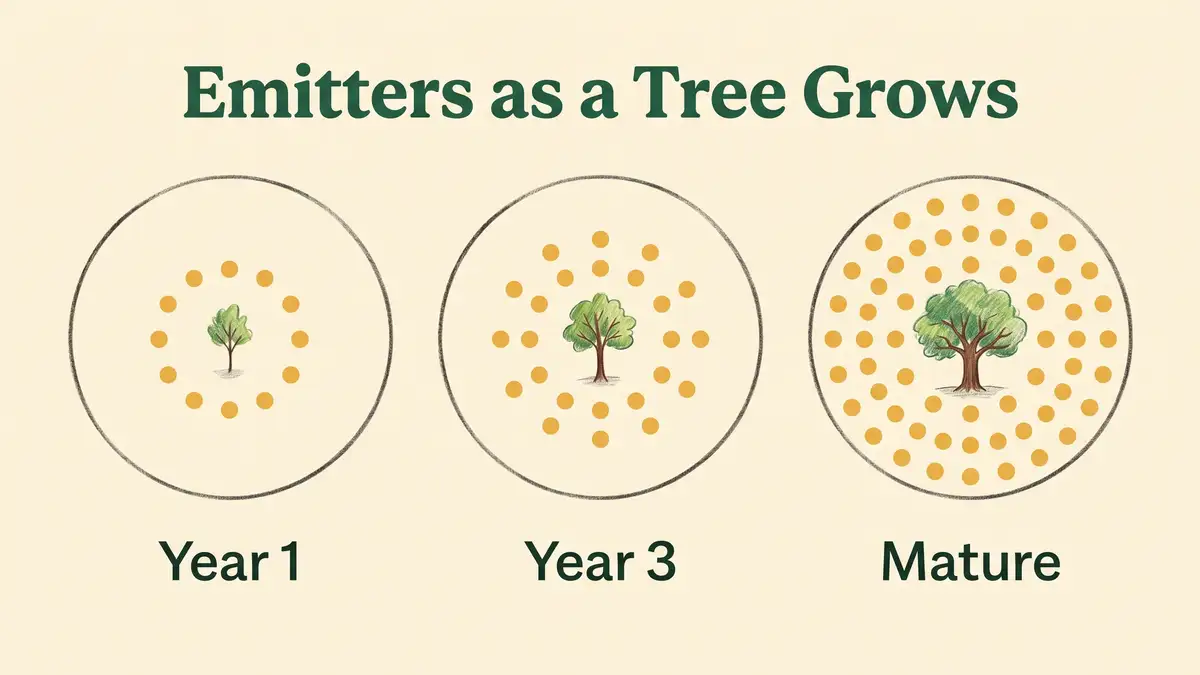
| Tree Age | Water Per Week | Emitters | Placement |
| Year 1 | 3-5 gal. (11-19 L) | 2 | 12 in. (30 cm) from trunk, opposite sides |
| Year 2-3 | 8-15 gal. (30-57 L) | 3-4 | Ring at the dripline |
| Year 4-5 | 20-40 gal. (76-151 L) | 4-6 | Ring at and just beyond the dripline |
| Mature, peak summer | 70-100+ gal. (265-379+ L) | 6-8 | Two concentric rings |
Sources: UC IPM, Utah State University Extension, Colorado State University Extension
Treat those as a starting point, not gospel. Actual demand swings with your climate, your soil and the species. UC IPM ties requirements to canopy area, a species plant factor and local evapotranspiration, which is the proper way to do it if you want precision.
Common Mistake to Avoid
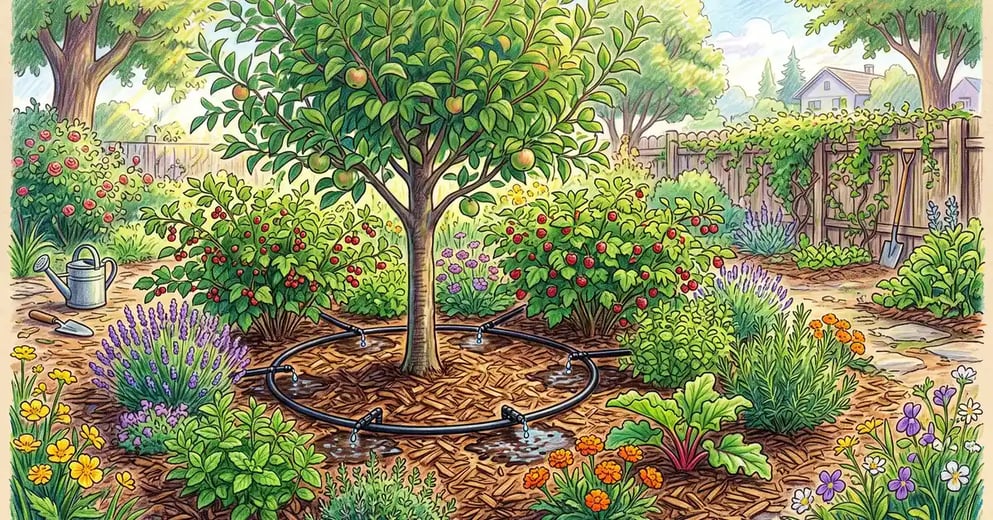
Never put an emitter against the trunk. Constant moisture at the root collar invites crown rot and bark disease, and it trains roots to stay in a tiny cylinder instead of spreading. Keep emitters at least 12 inches (30 cm) out in year one, and move the ring outward toward the dripline as the canopy widens. Emitters that never move are the most common food forest irrigation fault.
How Far Does Water Actually Spread From One Emitter?
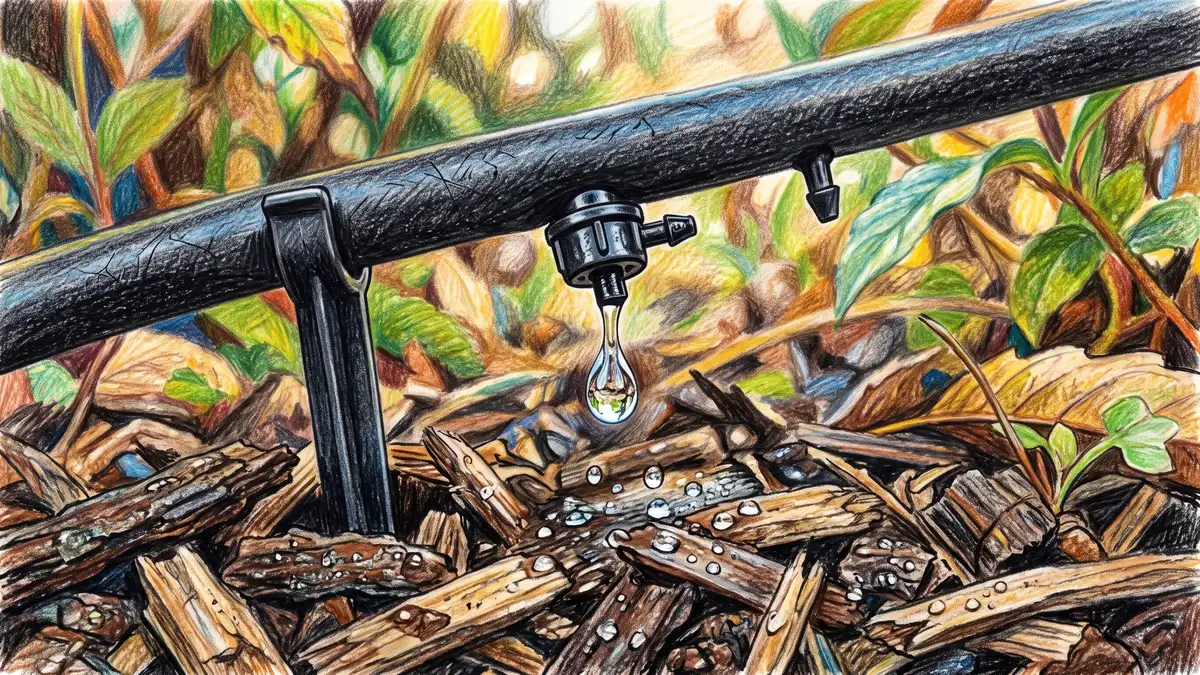
This is the part that decides your emitter count, and it depends entirely on soil texture. Water leaving an emitter moves down under gravity and sideways by capillary action, and the balance between those two changes dramatically with particle size.
In sand, gravity wins and you get a narrow deep plume, often only 12 to 18 inches (30 to 46 cm) across. In clay, capillary action wins and you get a wide shallow disc, sometimes 3 feet (0.9 m) or more. Loam sits in between with a rounded bulb.
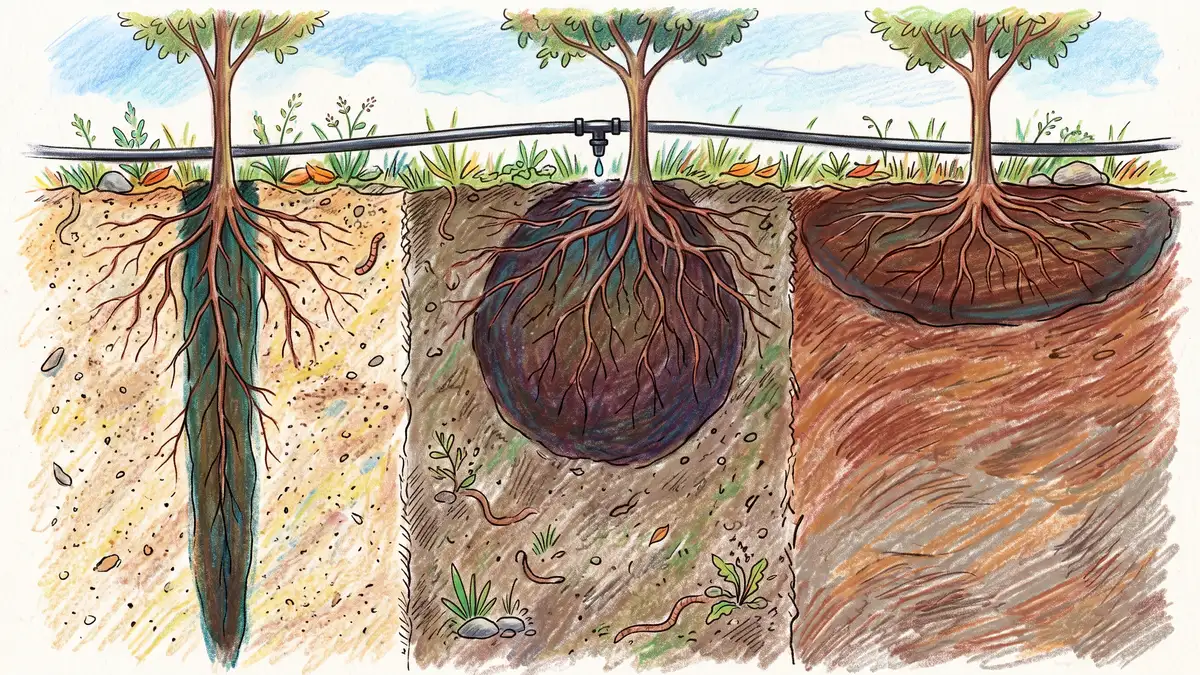
The practical consequence: sandy soil needs more emitters spaced closer together, clay needs fewer spaced wider. Run a test before you commit. Set one emitter going for an hour, then dig a small hole beside it and measure how wide and how deep the damp zone reaches. That one measurement tells you more than any general rule.
Why This Works: Design From Pattern to Detail
Permaculture says read the pattern first, then work out the details. Soil texture is the pattern here, and emitter count is the detail that follows from it. Copy someone else's emitter spacing without checking your own wetting pattern and you are solving their soil's problem, not yours.
How Long Should You Run It?
The arithmetic is straightforward. Divide the gallons you need by the total flow rate of the emitters on that tree, then convert to minutes. Penn State Extension walks through the same calculation for vegetables and the logic transfers directly.
Add up your emitter flow
Four emitters rated at 1 gallon per hour give you 4 GPH total for that tree. Emitter ratings are printed on the body, usually 0.5, 1 or 2 GPH.
Divide the weekly target by that flow
A year-three tree needing 12 gallons per week, on 4 GPH, needs 3 hours of run time per week. Split it into two runs of 90 minutes rather than seven short ones.
Check the depth, not the clock
After the first run, push a long screwdriver into the soil beside an emitter. It should slide easily to about 12 inches (30 cm). If it stops at 4 inches, run longer.
Adjust seasonally, then taper by year
Cut run time by roughly half in spring and fall against midsummer, and stop entirely once the ground freezes. Reduce total volume each year as roots extend.
What Does the System Need at the Tap?
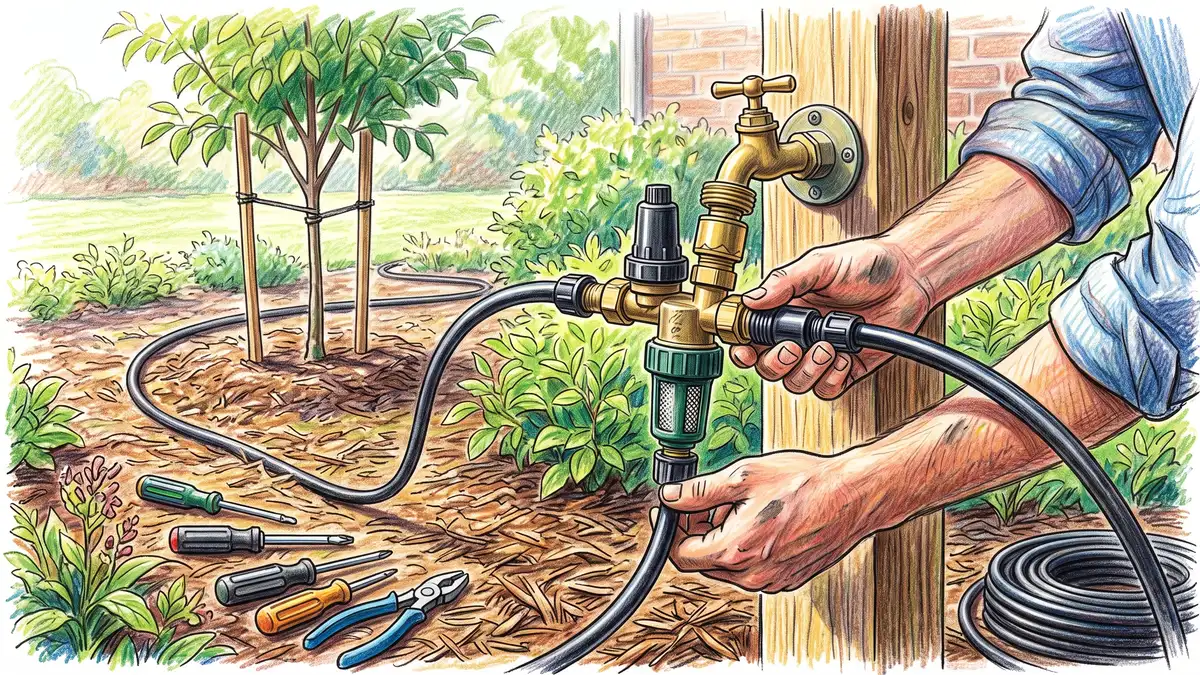
Four parts, in this order, and skipping any of them is what kills drip systems. A backflow preventer, which is a code requirement in most US jurisdictions. A mesh filter, because emitters clog. A pressure regulator, since household pressure will blow drip fittings apart. Then your mainline tubing.
Clogging is the failure mode that quietly ruins systems. Clemson Extension covers the physical, chemical and biological causes and the maintenance that prevents them. In practice, flush the line ends twice a season and check for dry emitters whenever you walk the beds.
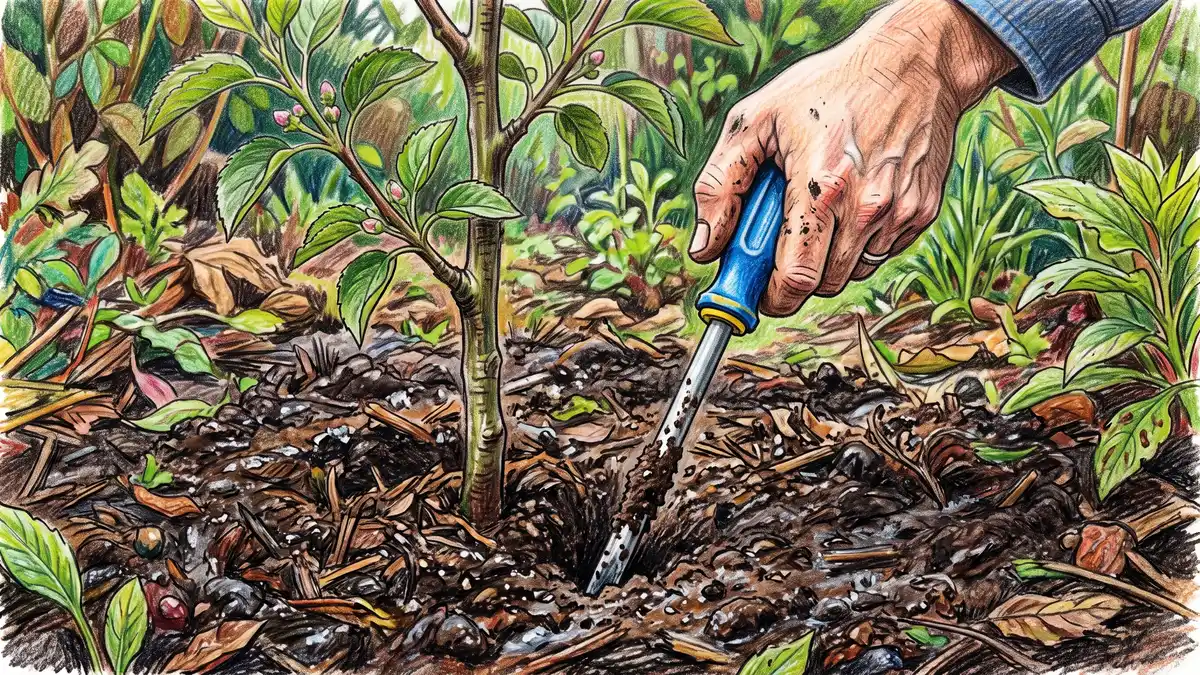
Run drip lines on top of the soil and under the mulch. Mulch keeps the tubing out of UV light, which more than doubles its life, and it stops evaporation from the wetted surface. UF/IFAS covers microirrigation layout for mixed plantings, and our mulching guide covers depth.
One more design decision that food forests get wrong more than any other garden type: put drought-tolerant and thirsty plants on separate circuits. A single zone serving a mature fig and a first-year currant will always be wrong for one of them.
Key Takeaway
Zone by water need, not by geography. Establishment plantings on one circuit, established perennials on another, and you can dial each down independently as the system matures rather than irrigating the whole thing forever.
What Should You Buy: a Kit or Parts?
It depends on how many trees you are watering and whether they all want the same amount. That second question matters more than the first. A kit puts every emitter on one zone, which is fine for a row of young trees planted the same spring and wrong for a food forest where a year-one plum sits next to a five-year-old apple.
| Your situation | What to buy | Why |
| 1 or 2 young trees near a tap | Nothing yet | A 5-gallon bucket with a small hole drilled in the base delivers the year-one ration in one fill |
| 3 to 8 trees, similar age | A complete kit | One zone is enough, and a kit ships with matched fittings |
| Same, but you are away a lot | A kit with a timer | Deep weekly soakings only work if they actually happen |
| A food forest, mixed ages, 10+ trees | Parts, one faucet kit per zone | You need separate circuits for thirsty and established plants |
Emitter counts per tree follow the table above; product details from the manufacturer listings, checked September 2026.
The mistake that wastes the whole order
"Half-inch" drip tubing is not one size. Outside diameters run from roughly 0.600 to 0.710 inches depending on the brand, and compression fittings only seal on the tubing they were made for. Buy the tubing and the faucet kit from the same brand, or you will be back at the store with a leaking connector on day one.
1. Rain Bird Landscape and Garden Drip Kit (LNDDRIPKIT): a 108-piece kit that connects to an outdoor faucet and comes with three kinds of watering devices, drippers, micro-bubblers and micro-sprays, all pressure-compensating. The bubblers are the useful surprise for trees: they put out more water over a wider circle than a single dripper, which suits a young tree whose roots are already reaching past the planting hole. Best for: three to eight trees and shrubs planted around the same time.
My take: the default for most backyards. Ignore the micro-sprays for trees; they wet the leaves and the paths, which is exactly what you were trying to stop.
Check price on Amazon (paid link)
2. Raindrip Automatic Watering Kit with Timer (SDFSTH1P): sold for flowers, shrubs and trees, sized to water up to ten individual plants, and it includes the timer. Best for: anyone who travels in July, which is when young trees die.
My take: the timer is the reason to buy it. A system that relies on you remembering is a system that fails the first hot week you are busy.
Check price on Amazon (paid link)
For a food forest with more than one zone, skip the kits and build from three parts. You need one faucet kit per zone, a roll of half-inch mainline, and one pressure-compensating emitter for every position in the table above. Ten trees of mixed age come to roughly 30 to 40 emitters.
3. Rain Bird Faucet Connection Kit (FCKIT-1PK): the three parts from the section above in one assembly, a backflow preventer, a 25 PSI pressure regulator and a 150-mesh filter, connecting a 3/4-inch faucet or hose thread to half-inch tubing. Best for: the head of each zone.
Check price on Amazon (paid link)
4. Rain Bird Half-Inch Distribution Tubing, 100 ft (T63-100): 0.634-inch outside diameter, the size the Rain Bird faucet kit above is made for. Run it on the soil surface under the mulch. Best for: the mainline that loops past each tree.
Check price on Amazon (paid link)
5. Raindrip 1 GPH Pressure-Compensating Drippers (PC4050B): 1 gallon per hour, the default rating for fruit trees from the FAQ below, and pressure-compensating, so the tree at the far end of the line gets the same water as the one next to the tap. Best for: sloped ground and long runs.
Check price on Amazon (paid link)
Why This Works: Plan for the System You Will Switch Off
Buying parts instead of a kit looks like more work, and for a row of same-age trees it is. In a food forest it is the cheaper path over five years, because each zone can be turned down on its own as the trees establish. The goal is not a watering system. It is trees that stop needing one.
Frequently Asked Questions
What size drip emitters should I use for trees?
For fruit trees, 1 gallon per hour emitters are the usual default, with 2 GPH used in fast-draining sandy soil where you want more volume before lateral spread and 0.5 GPH in heavy clay where slower delivery avoids surface pooling. Match the rating across all emitters on a single zone so run time works out evenly. Use pressure-compensating emitters if your ground slopes, since gravity otherwise gives the downhill trees far more water than the uphill ones.
How often should I water a newly planted tree?
Deeply, once or twice a week, rather than a little every day. Frequent shallow watering keeps roots in the top few inches where they dry out fastest, while deep soakings pull roots downward and build drought tolerance. In the first few weeks after planting the root ball may need checking every two or three days in hot weather, since it can dry out even when surrounding soil is damp. Push a screwdriver into the soil to check before adding more.
How long should I run drip irrigation for trees?
Divide the gallons your tree needs by the combined flow rate of its emitters. Four 1 GPH emitters deliver 4 gallons an hour, so a tree needing 12 gallons a week needs three hours weekly, best split into two soakings. Then verify by depth rather than trusting the number: water should reach about 12 inches (30 cm) down. Sandy soil needs shorter, more frequent runs; clay needs longer runs spaced further apart to avoid runoff.
When can I stop watering a food forest?
Most fruit trees need supplemental irrigation for three to five years, and the taper is gradual rather than a hard stop. Reduce total volume by roughly a quarter each year from year three, while keeping the soakings deep so roots keep chasing water downward. UC Master Gardeners note that even established fruit trees benefit from occasional deep irrigation in drought years. Pair this with swales and berms and you shorten the timeline.
Does mulch reduce how much I need to irrigate?
Substantially. A 3 to 4 inch (7.5 to 10 cm) layer of organic mulch cuts surface evaporation, moderates soil temperature and keeps the wetted zone from drying between runs, which means fewer and shorter irrigation cycles for the same result. It also shields drip tubing from UV degradation. Keep mulch pulled back several inches from trunks so the root collar stays dry, and top it up annually as it breaks down into the soil.
Is a bubbler or a drip line better for fruit trees?
For a young tree, drip emitters, because two or three placed a foot from the trunk put water exactly where the small root ball is. As the canopy widens, bubblers start to earn their place: one bubbler wets a wider circle than several drippers and suits a tree whose roots have spread past the planting hole. On sandy soil, stay with drippers on a ring at the dripline, since a bubbler's water drops straight down and is lost below the roots.
Get the Weekly Dig
One practical permaculture guide a week, written for gardeners who do this on weekends: food forest and guild designs that produce. Free, no spam, unsubscribe any time.
Join the Weekly DigA good drip system is temporary infrastructure. You build it so that in five years you can turn most of it off and leave it in place for the dry summers. For the design context, see our food forest guide, and for catching water before you ever need to pipe it, permaculture water harvesting.
Resources
- US EPA WaterSense — Microirrigation
- UC IPM — Watering Fruit and Nut Trees
- Utah State University Extension — Drip Irrigation for Trees
- Colorado State University Extension — Watering Mature Shade Trees
- Penn State Extension — Determining How Long to Run Drip Irrigation Systems
- UF/IFAS Gardening Solutions — Microirrigation
- Clemson Extension — Micro-Irrigation System Maintenance to Prevent Clogging
- Clemson HGIC — Landscape Irrigation Management: Determining When to Irrigate
- UC Master Gardener Program of Sonoma County — Fruit Trees in a Drought
- University of Missouri Extension — Irrigation System Pros and Cons
- FAO — Annex I: Irrigation Efficiencies