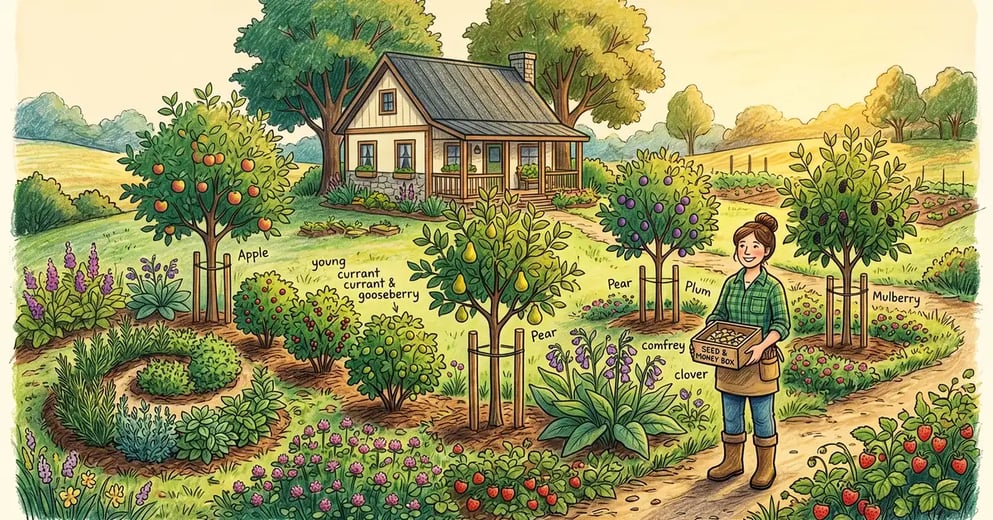

You watched the video. The homesteader points at her four-year-old food forest, picks an apple, smiles at the camera, and says "this only cost about $2,000 to set up." You did the math on your own quarter-acre. Plants alone hit $1,400. Fencing for deer is another $1,200. Mulch, soil amendments, drip irrigation, tools, you are already past $4,500 and have not planted a single tree. the return side of the ledger
The honest number is closer to $3,200 to $5,800 for year one on a quarter acre in the US, and $5,100 to $9,200 cumulative over five years once you factor in mulch top-ups, replacement plants, deeper pruning tools, and harvest infrastructure. This guide breaks it down line by line, year by year, with the cost-saving moves that work, the hidden expenses that bite, and the USDA NRCS programs that can cover up to 90 percent of qualifying practices if you apply early enough.
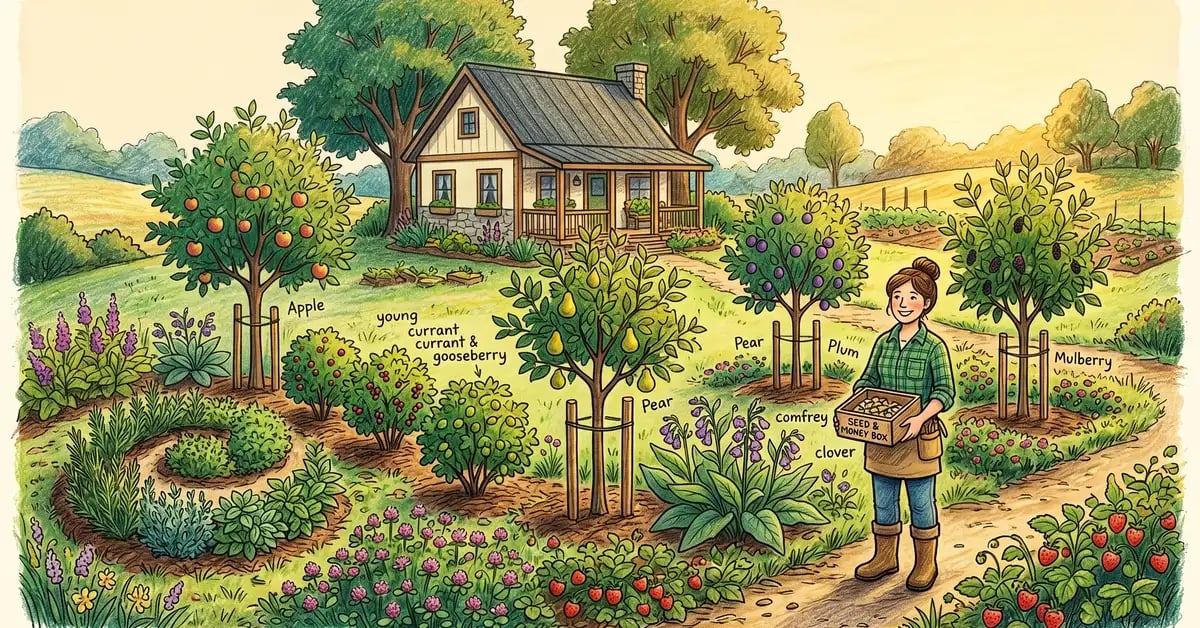
Defining the Scale: How Big Is Your Food Forest?
Cost scales roughly linearly with area for the first acre, then improves as you spread fixed costs (tools, fencing infrastructure, irrigation mainline) across more planting area. Three common US scales:
| Scale | Area | Plants | Year-1 cost range |
| Backyard food forest | 1/10 acre (about 4,300 sqft) | 40 to 80 plants | $1,500 to $3,000 |
| Small homestead | 1/4 acre (about 10,900 sqft) | 100 to 200 plants | $3,200 to $5,800 |
| Larger homestead / market | 1 acre | 400 to 800 plants | $8,000 to $16,000 |
Source: Composite of Food Forest Living establishment cost case study and Permaculture Apprentice food forest setup guide (2024)
Year 1: The Establishment Year (60 to 70 Percent of 5-Year Cost)
Year one is the heaviest spending year. You buy almost every plant the system will need (or every plant that goes in during the first planting window), build the fence, install irrigation infrastructure, and gather the tool kit you will use for the next 20 years.
Realistic line items for a 1/4-acre US food forest:
| Year-1 item | Cost range | Notes |
| Plant material (trees, shrubs, perennials) | $1,200 to $2,400 | 50 plants average $22 to $48 each |
| Deer fencing (7 ft, 1/4 acre perimeter) | $600 to $1,500 | Largest underestimated line item |
| Mulch (15 to 25 cubic yards) | $300 to $700 | Free wood chips from arborist saves big |
| Soil amendments and compost | $200 to $500 | Soil test first ($15 to $40) |
| Drip irrigation kit and mainline | $250 to $600 | Non-negotiable for July survival |
| Tools (broadfork, pruners, loppers, shovel) | $300 to $600 | Buy once, use 20+ years |
| Stakes, ties, tree guards | $100 to $250 | Required for every sapling |
| Labor (DIY, valued at $0) or hired | $0 to $1,500 | Owner-operator saves most |
Source: Composite of Food Forest Living case study and Rutgers Snyder Farm deer fencing cost data
Year-1 total range: $2,950 to $7,550 depending on labor model, fence design, and how much you scrounge.
The Plant Cost Detail: Where Most of the Money Goes
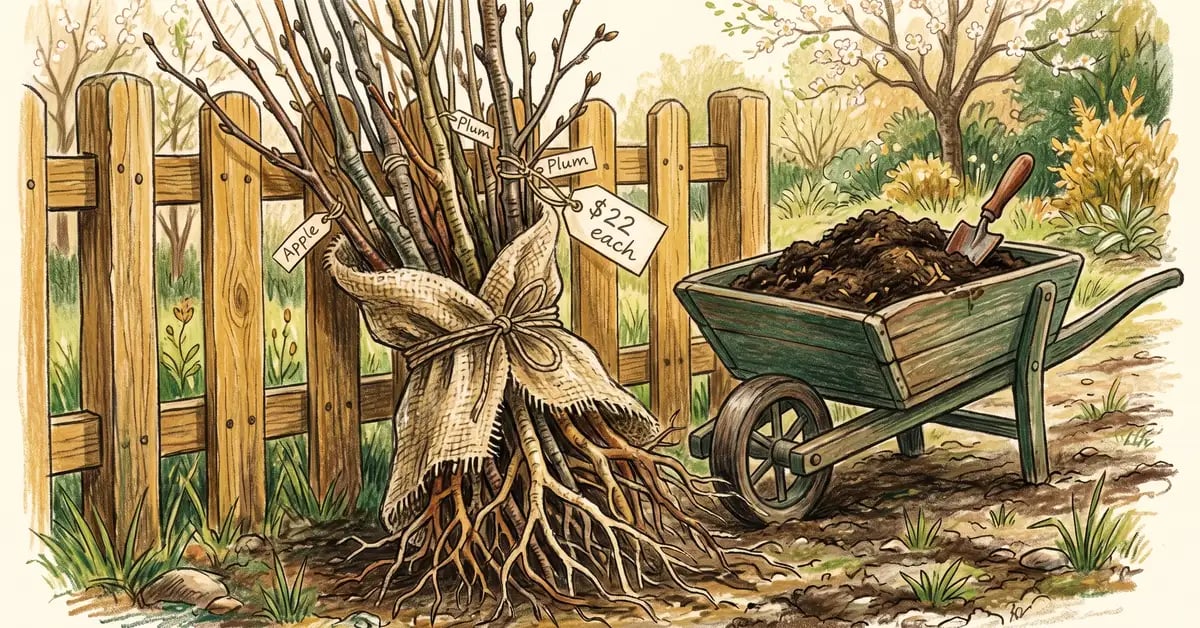
Plants are the biggest single line item, and price varies by 3x depending on how you buy. Container-grown trees from a garden center run $40 to $80 each. Mail-order bare-root from a specialty nursery runs $22 to $48 each. Local plant swaps and bareroot bundles run $5 to $20 each when available.
From One Green World's 2026 bare-root availability list and 13 Point 3 Farms spring 2026 bare-root pricing, typical 2026 US bare-root prices for the standard food forest mix:
| Plant type | Bare-root price (2026) | Typical count, 1/4 ac |
| Apple (semi-dwarf) | $32 to $45 | 3 to 5 |
| Pear, plum, peach | $32 to $52 | 3 to 5 |
| Mulberry | $28 to $40 | 1 to 2 |
| Chestnut | $45 to $80 | 0 to 2 |
| Currant, gooseberry | $14 to $24 | 6 to 12 |
| Raspberry, blueberry | $12 to $20 | 10 to 20 |
| Comfrey, sorrel, herbs | $5 to $12 | 15 to 30 |
| Strawberry runners | $0.80 to $1.50 | 50 to 100 |
Source:, and Roots to Fruits Nursery bundle pricing
The Fencing Reality (The Line Item Nobody Plans For)
If you have deer (most of the US east of the Rockies, and large parts of the West), a tall fence is non-negotiable. A single hungry doe in October eats $400 of new apple saplings in one night.
Per Cornell Cooperative Extension's low-cost deer fence designs (2018), installation costs typically run $2.50 to $4 per running foot for a 7-foot fence. Rutgers Snyder Farm notes that solid woven-wire 8-foot fence runs closer to $10 per foot installed.
For 1/4 acre with roughly 420 linear feet of perimeter: polypropylene mesh on T-posts (DIY) costs $600 to $900, woven wire 7 ft (DIY) costs $900 to $1,500, and solid woven wire 8 ft (installed) costs $3,000 to $4,500.
Lower-cost alternative for deer pressure under 25 per square mile: a 3-wire electric fence with bait stations runs $250 to $400 for 1/4 acre and works if maintained.
Years 2 Through 5: Maintenance and Expansion
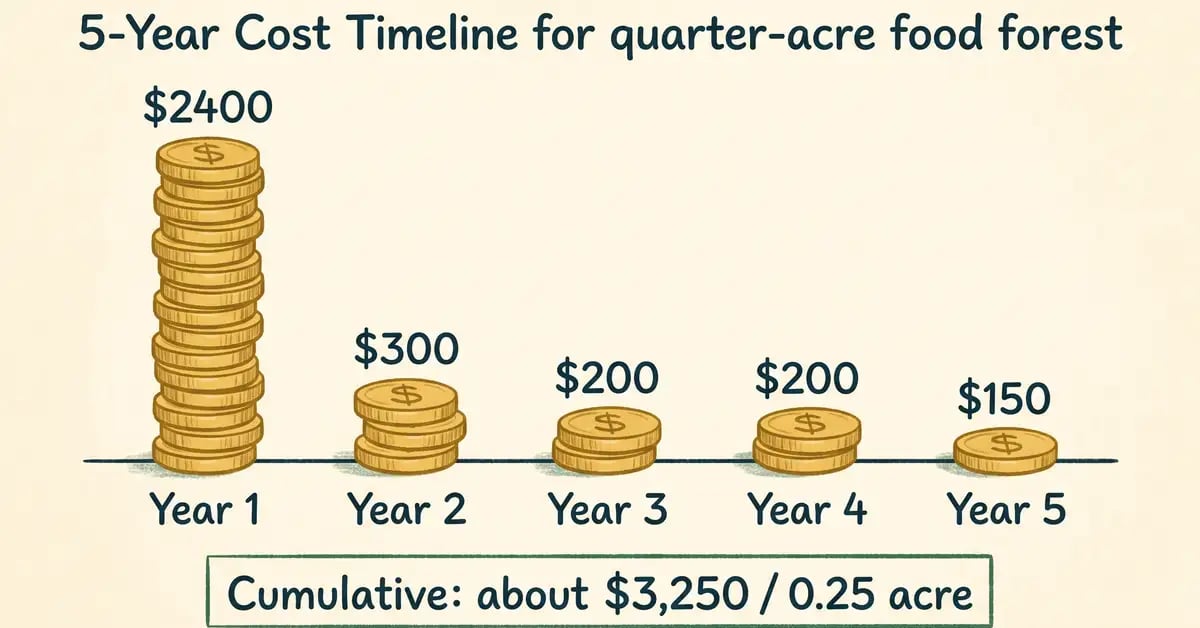
| Year | Typical cost (1/4 ac) | Main items |
| Year 2 | $300 to $700 | Mulch top-up, 5 to 10 replacement plants, perennial fill-in |
| Year 3 | $200 to $500 | Mulch, expansion plants, light pruning gear |
| Year 4 | $200 to $500 | Mulch, sharpening tools, first fruit-thinning supplies |
| Year 5 | $200 to $700 | Heavier pruning tools (loppers, pole pruner), first processing gear (drying rack, baskets) |
Source: Composite of Food Forest Living case study and Permaculture Apprentice guide
Cumulative 5-year cost for a 1/4 acre: roughly $3,850 to $9,950 depending on fence choice, labor model, and how aggressively you propagate from your own cuttings.
USDA NRCS Cost-Share: The Biggest Discount Most Homesteaders Skip
The USDA NRCS Programs and Initiatives portal offers cost-share through the Environmental Quality Incentives Program (EQIP) for practices including tree and shrub establishment (Practice Code 612), windbreaks (380), riparian buffers (391), and pollinator habitat. Cost-share commonly covers 50 to 75 percent of qualifying practice expenses, and 75 to 90 percent for beginning farmers, veterans, and socially disadvantaged producers.
According to the Northwest Natural Resource Group EQIP overview and UF/IFAS Florida cost-share programs publication, the application is paperwork-heavy and usually starts 6 to 12 months before planting. The application complexity reportedly deters a majority of eligible producers, but for a homesteader who applies early, EQIP can cut establishment costs in half. Check with your local Soil and Water Conservation District for the application window and qualifying practices in your county.
Why This Works
Food forest economics are the practical demonstration of permaculture's principle "Catch and Store Energy." Standard annual gardens require capital and labor every year forever. A food forest front-loads investment in years 1 to 2, then the trees, shrubs, and perennials produce for 20 to 50 years on a fraction of the ongoing cost. Year 5 maintenance on the same quarter acre that cost $3,500 to establish runs $200 to $700. By year 7 to 10, fruit yields cover all ongoing costs and start paying back the establishment investment in produce you would otherwise buy. The system is not cheap to start. It is cheap to keep, and the cheapness compounds for decades.
Cost-Saving Strategies That Actually Work
Step 1: Buy bare root, never container
Bare-root trees from specialty mail-order nurseries cost 40 to 60 percent less than container-grown nursery stock. Order in fall, plant in late winter or early spring.
Step 2: Source free wood-chip mulch
Local arborists pay to dump wood chips. Sign up with ChipDrop or call tree services directly. A free truckload (10 to 15 cubic yards) saves $300 to $700 in year one.
Step 3: Propagate from cuttings
Comfrey, currant, gooseberry, raspberry, willow, mulberry all root from hardwood cuttings. One mature plant produces 10 to 30 cuttings each winter. Year-2 plant cost drops to near zero.
Step 4: Join a local seed and scion exchange
Most US states have at least one fruit explorers chapter, permaculture meetup, or master gardener group with annual swaps. Grafted scion wood and rooted cuttings change hands for free.
Step 5: Apply for NRCS EQIP cost-share
Start the application 6 to 12 months before planting. Cost-share commonly covers 50 to 75 percent of qualifying practices, more for beginning farmers and veterans.
Step 6: Build the fence in stages
Fence the highest deer-pressure side first with the budget you have, expand the fence in year 2 and 3. Saves the full fence cost in year 1.
Hidden Costs People Forget
- Soil test ($15 to $40). Skipping it leads to $200+ of wrong amendments later.
- Gopher / vole protection ($30 to $80). Wire baskets at planting save your $40 saplings from a $0 rodent.
- Drip irrigation mainline ($150 to $300). The branch lines are cheap, the backflow preventer and pressure regulator are the missing line items.
- Stakes, ties, and tree guards ($100 to $250). Every sapling needs them and they add up.
- Labor on year-1 weekends. Plan 40 to 80 hours of your own labor for a 1/4 acre establishment.
- Pole pruner around year 5 ($60 to $150). You need it when the trees go past 8 feet.
Get the Weekly Dig
One practical permaculture guide a week, written for gardeners who do this on weekends: food forest and guild designs that produce. Free, no spam, unsubscribe any time.
Join the Weekly DigFrequently Asked Questions
How much does it cost to start a food forest in the US?
A 1/4-acre US food forest typically costs $3,200 to $5,800 in year one, including plants, deer fencing, mulch, irrigation, and basic tools. Cumulative 5-year cost is $5,100 to $9,200. Backyard scale (1/10 acre) drops to $1,500 to $3,000 in year one, full 1-acre scale rises to $8,000 to $16,000.
What is the biggest cost in a food forest?
Plant material is the largest line item at 35 to 45 percent of year-one budget. Deer fencing is the second biggest and the most commonly underestimated, typically running $600 to $1,500 for a 7-foot fence around a quarter acre.
Are food forests cheaper than vegetable gardens long term?
Yes after about year 4. Annual vegetable gardens cost $50 to $200 per 100 sqft every year, forever. A food forest costs $3,000 to $6,000 to establish, then $200 to $700 per year for maintenance. Cumulative 10-year cost favors the food forest, and the gap widens past year 10.
Does USDA NRCS pay for food forests?
Yes, indirectly. NRCS does not have a "food forest" practice code, but qualifying components (tree and shrub establishment, windbreaks, riparian buffers, pollinator habitat) are funded through EQIP at 50 to 75 percent cost-share, higher for beginning farmers and veterans. Apply through your local Soil and Water Conservation District 6 to 12 months before planting.
Can I start a food forest for under $1,000?
For 1/10 acre with heavy DIY, free wood chips, bare-root mail order, propagating from cuttings, and a 3-wire electric deer fence, yes. The lean budget is roughly $800 to $1,500 for the first year. Below that you are skipping fencing or irrigation, which is a false saving.
How long until a food forest pays for itself?
Fruit yields typically reach 100 lbs per quarter acre by year 4 to 5, growing to 400 to 800 lbs per quarter acre by year 8 to 10. Valued at $3 to $6 per lb retail, a mature 1/4-acre food forest produces $1,200 to $4,800 in food value annually, paying back the $5,100 to $9,200 establishment within years 5 to 8 of harvest.
What is the cheapest part of a food forest to scale up?
Ground cover and herbaceous perennials. Comfrey, strawberry, sorrel, mint, chives all propagate by division and runner. Doubling the herb and ground cover area in year 2 costs nothing if you propagate from the year-1 plants.
The Takeaway
A US food forest on a quarter acre costs $3,200 to $5,800 in year one and $5,100 to $9,200 cumulative over five years. Plant material is the largest line at 35 to 45 percent of year-one spend. Deer fencing is the most underestimated line at $600 to $1,500 for a 7-foot fence. USDA NRCS EQIP can cover 50 to 90 percent of qualifying practices for homesteaders who apply 6 to 12 months ahead. Cost-saving moves that actually work: bare-root mail order, free wood-chip mulch from arborists, propagation from cuttings, local seed and scion swaps. By year 5 the system maintains itself for $200 to $700 a year. By year 8 to 10 the fruit yield pays back the establishment investment, and the food forest produces on a fraction of the cost of any annual garden for the next 20 to 40 years.
Resources
- Food Forest Living: How Much It Cost to Start Our Food Forest
- Permaculture Apprentice: Creating a Food Forest Step-by-Step Guide (2024)
- One Green World: 2026 Bare Root Availability List
- 13 Point 3 Farms: Spring 2026 Bare Root Fruit Trees
- Roots to Fruits Nursery: Bare Root Fruit Tree Bundle
- Cornell Small Farms: Low-Cost Deer Fence Designs (2018)
- Rutgers Snyder Farm: Deer Fencing to Reduce Crop Damage
- Cornell Cooperative Extension Putnam County: Reducing Deer Damage
- USDA NRCS: Programs and Initiatives (EQIP, CSP, CIG)
- Northwest Natural Resource Group: EQIP Cost-Share Overview
- UF/IFAS: Cost Share Programs for Agricultural Producers
- South St. Louis SWCD: NRCS EQIP Forestry Program