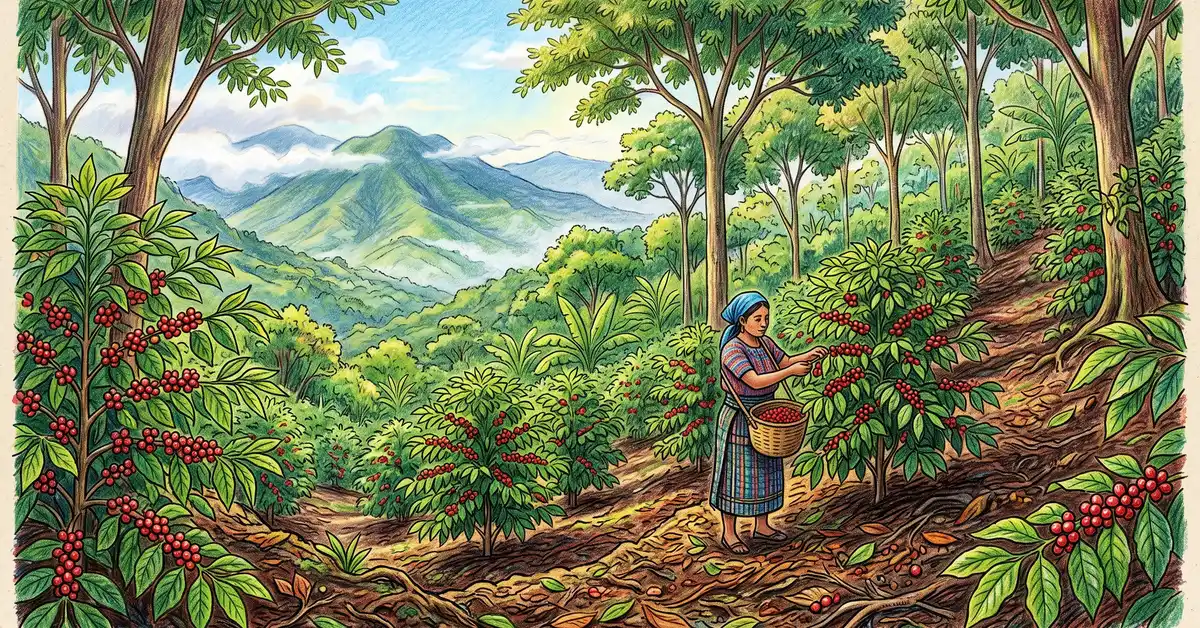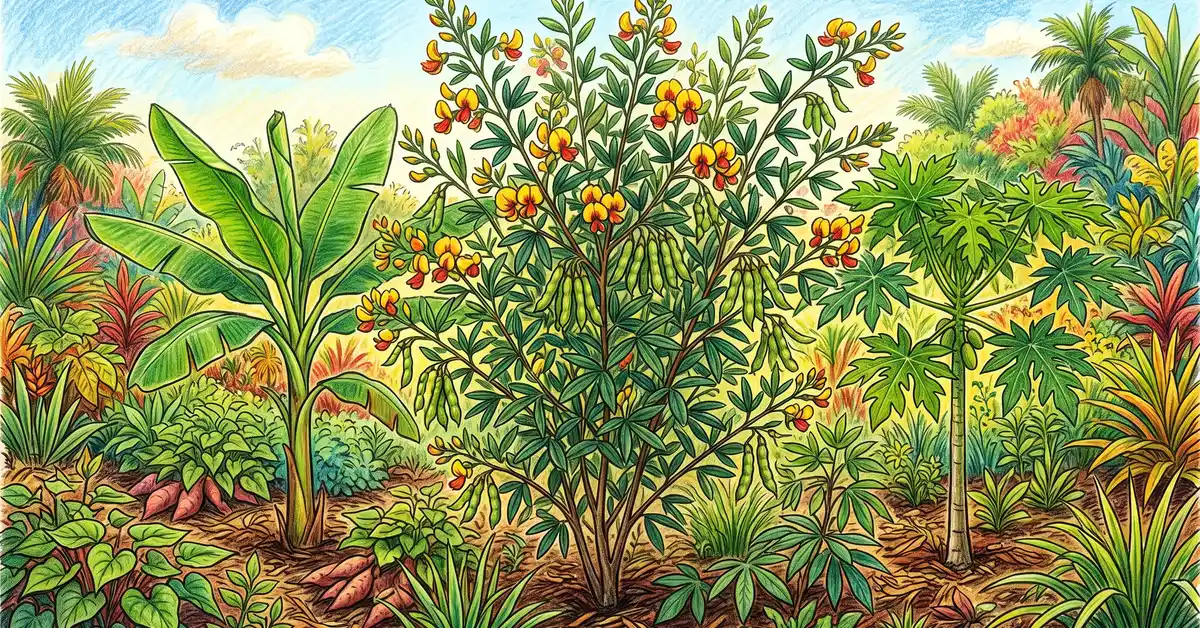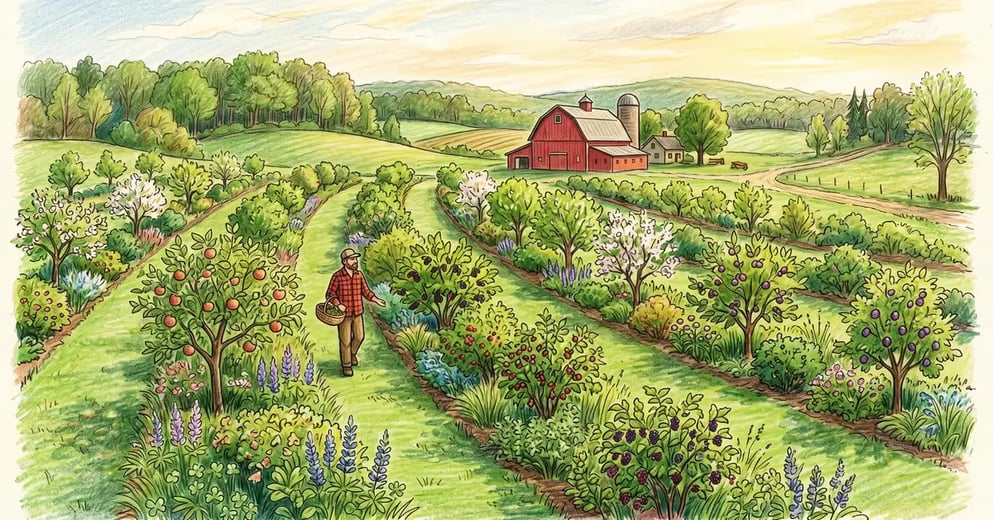

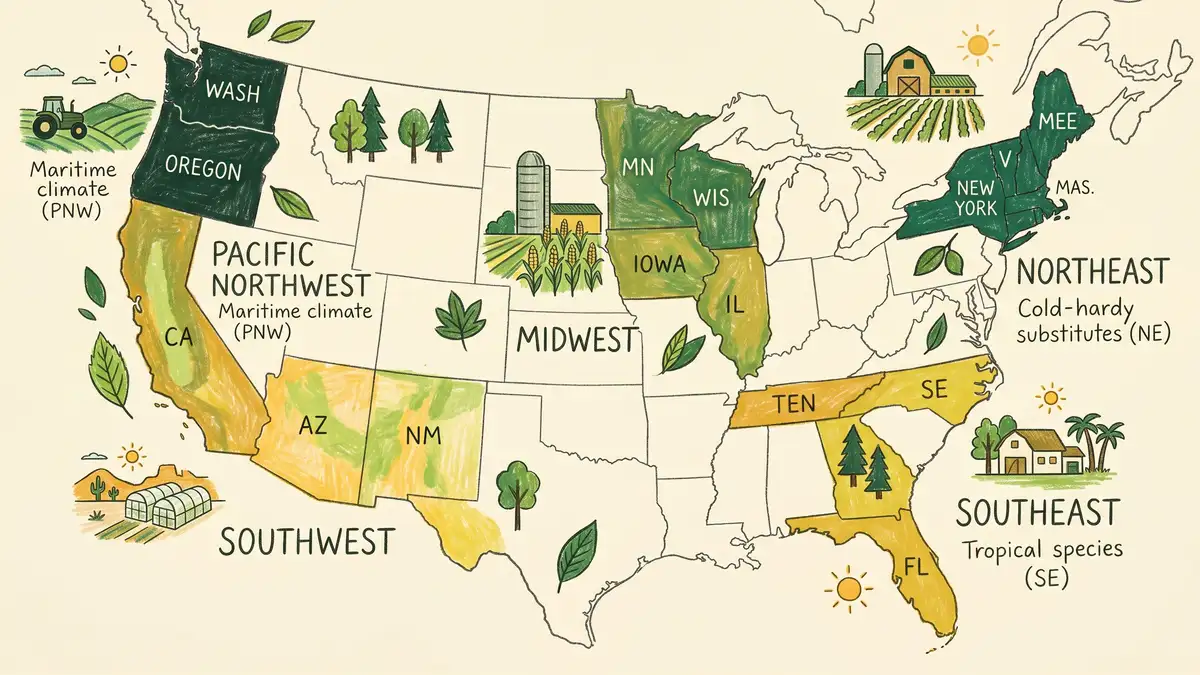
Syntropic agriculture was born tropical. Ernst Götsch built the system on his 1,200-acre farm in Bahia, Brazil, beginning in 1984, using bananas as biomass producers and pigeon pea as nitrogen fixers in a year-round growing climate. The question every US grower asks is whether the same system works in a place that gets snow. The short answer is yes, with substitutions. The longer answer is the subject of this guide: the US farms actually doing it, where they are, what they have substituted, and what they have learned the hard way. the humid subtropical Southeast
You will meet farms in Vermont, Florida, Tennessee, Wisconsin, California, and the Pacific Northwest, see the species substitutions that replaced banana with mulberry and papaya with paw paw, understand the timeline differences between tropical and temperate systems, and know exactly which networks and resources US practitioners use to learn. Every farm and figure cited here is documented in published sources.
Key Takeaway
Syntropic agriculture works in the US when growers substitute cold-hardy biomass species (mulberry, willow, alder, sea buckthorn) for the tropical originals (banana, papaya, pigeon pea), accept a longer establishment timeline (7-10 years versus 3-5 in Brazil), and adjust pruning cycles to the slower temperate growth (3-4 cuts/year versus monthly). The leading US farms include Mountain Time Farm (Vermont), 7th Generation Farm (Tennessee), Everoak Farm (Florida), New Forest Farm (Wisconsin), and Raising Cane Ranch (Washington). For the design fundamentals see our syntropic row design guide.
Why Syntropic Adapts to the US in the First Place
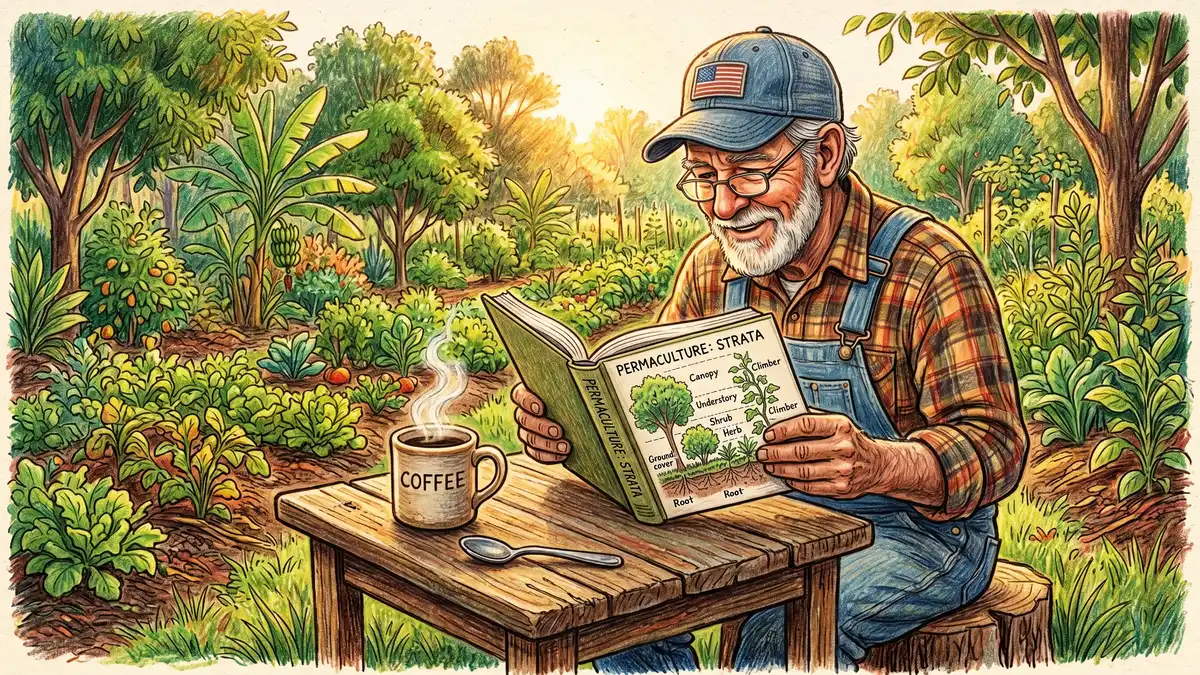
Götsch's original system relied on three things you cannot get in most of the US: a year-round growing season, fast-coppicing tropical biomass species, and an absence of hard frost. Agenda Gotsch's official material shows banana being chopped multiple times a year and papaya regrown from suckers within months. None of that translates north of zone 9.
What does translate is the architecture: dense polyculture rows on contour, four functional strata (emergent, high, medium, low), scheduled disturbance through pruning, and biomass returning to the row as mulch. Propagate Ag's cold-climate guide documents how the framework holds while the species list changes. ATTRA NCAT's overview covers the soil-restoration claims that have prompted US adoption.
Five US Farms Leading the Way
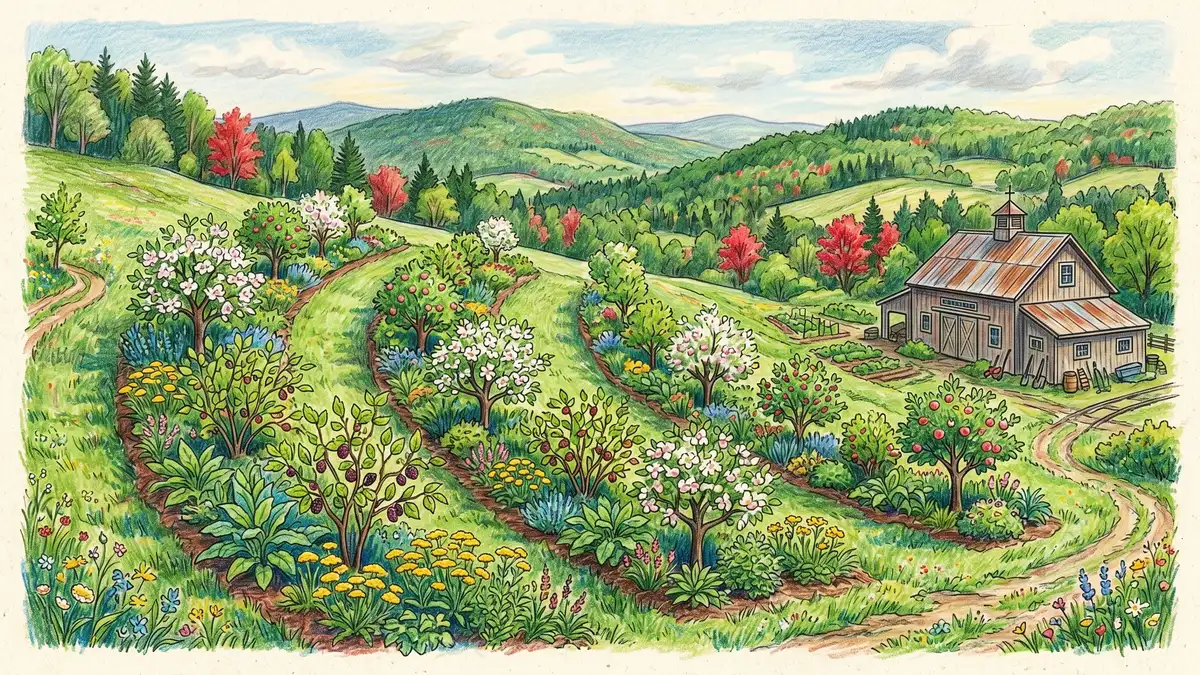
Mountain Time Farm, Vermont (Northeast). The most documented temperate-zone US case study. Their published series covers the design philosophy and the actual economics. They report the system requires patience and a non-conventional financial model, with profitability arriving in years 7-10 rather than the 3-5 typical of tropical operations.
7th Generation Farm, Tennessee/Kentucky (Southeast Upland). One of the few US farms openly publishing its syntropic approach in the southeastern climate transition zone. Their site documents an integrated production system that pairs syntropic strata with livestock rotation.
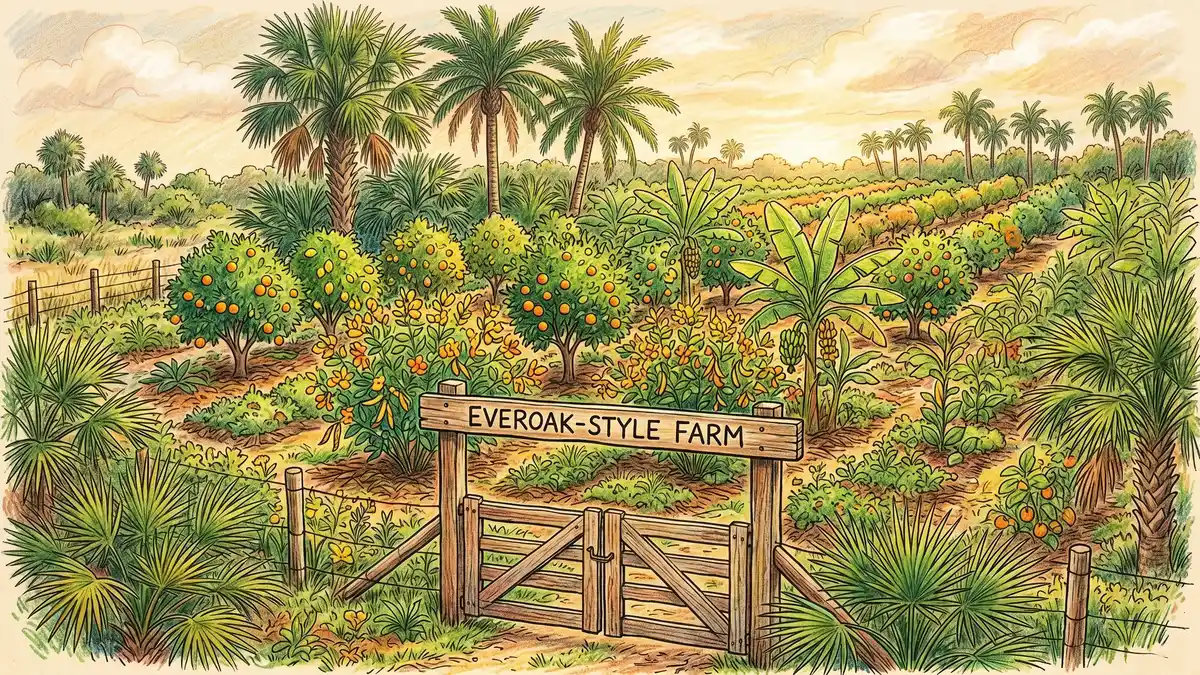
Everoak Farm, Florida (Subtropical). Closest to the original Götsch model in US terms because Florida shares enough climate similarity with coastal Bahia for tropical biomass species (banana, pigeon pea) to actually work. A documented farm tour shows the system at year 4-5.
New Forest Farm, Wisconsin (Upper Midwest). Mark Shepard's farm is best known as a restoration agriculture case study, but his keyline-plus-alley-cropping system shares the syntropic logic of dense polyculture, scheduled disturbance, and soil regeneration. New Forest Farm's published materials document chestnut-, hazelnut-, and apple-based silvoarable rows on a 106-acre former conventional grain operation.
Raising Cane Ranch, Washington (Pacific Northwest). A maritime-climate adopter that has integrated syntropic alley cropping with cider apple production. The ranch's public material documents an evolving silvoarable system.
For the broader US agroforestry context, the Savanna Institute's Agroforestry Farm Network tracks farms across Illinois, Iowa, and Wisconsin, and NOFA-Mass's agroforestry program has been incubating syntropic-adjacent projects across New England since 2020.
What Each Region Has Substituted
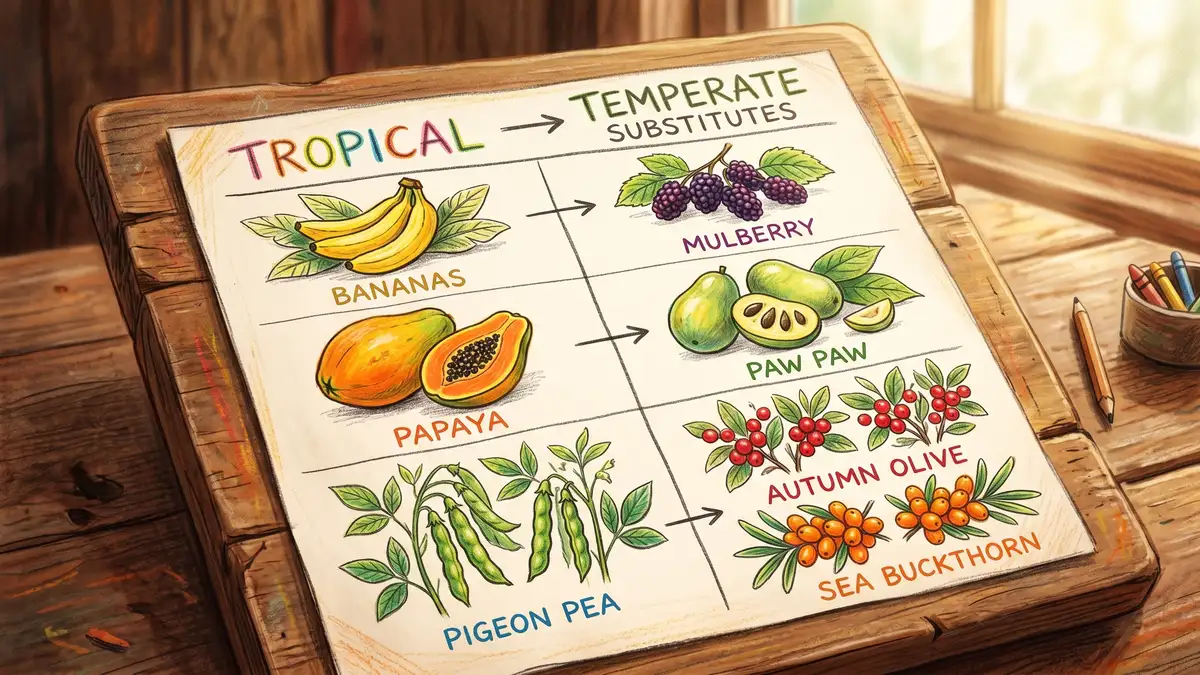
The single highest-leverage adaptation is the species list. Götsch's banana, papaya, pigeon pea, and eucalyptus do not survive a New England winter, so US growers have built tested substitution palettes by region.
| Stratum | Tropical Original | US Temperate Substitute | Region |
| Emergent biomass | Eucalyptus, banana | Mulberry, willow, alder | All US zones 4-9 |
| High stratum | Papaya, banana | Apple, pear, plum, mulberry, paw paw | Zones 4-8 |
| Medium stratum | Coffee, cacao | Hazelnut, currant, gooseberry, jostaberry | Zones 4-8 |
| Nitrogen fixer (shrub) | Pigeon pea | Goumi, sea buckthorn, autumn olive (where not invasive) | Zones 3-8 |
| Low stratum | Sweet potato, taro | Comfrey, yarrow, asparagus, garlic, strawberry | All US zones |
Sources:
For Florida and the Gulf Coast, this substitution table changes substantially because tropical species can survive. Everoak Farm documents direct use of banana, pigeon pea, and similar Götsch-vocabulary species. A SIT Graduate Institute analysis (PDF) investigates similar systems in semi-arid contexts including parts of California and the Southwest.
Timeline: Why Temperate Is Slower
Mountain Time Farm's published economics piece documents the timeline difference plainly. Brazilian Götsch farms reach productive maturity in 3-5 years; Vermont systems take 7-10. The reasons are biological:
Slower biomass turnover
Temperate biomass species coppice 2-4 times per year compared with monthly in the tropics. The chop-and-drop cycle that drives soil building runs at perhaps a quarter of the tropical pace.
Slower production tree maturation
Temperate apples, pears, and plums need 4-7 years to reach bearing age. Tropical papaya bears in 12-18 months and banana in 12-24 months.
Winter dormancy
Roughly 4-5 months of the year nothing grows. The system sleeps through winter, while tropical Götsch farms operate every month.
Sparser tropical N-fixers
Pigeon pea fixes nitrogen aggressively in 12 months. Goumi and sea buckthorn fix nitrogen across decades, but the per-year contribution is lower.
Why This Works: Succession at Latitude
Syntropic agriculture is fundamentally a managed acceleration of natural succession. Natural succession in temperate forests takes 80-150 years from bare ground to mature canopy; in the tropics it takes 30-50. Compressing that into a productive cropping system means the tropical version compresses harder. The temperate adapter is doing the same physics, just at a slower clock. Patience is the load-bearing element of the design, which connects to the broader permaculture principle of using small and slow solutions.
What US Farms Have Documented About Results
Quantified case studies are still emerging. The most rigorous work to date includes:
SARE-funded research on adapting Götsch methods. SARE project FNE23-064 documents an effort to adapt Brazilian syntropic farming practices to integrated high-tunnel vegetable systems in the Northeast.
Peer-reviewed temperate agroforestry research. A 2020 study in Plant and Soil documented early effects of temperate agroforestry practices on soil organic carbon, with measurable gains in the first 4-6 years even in cooler climates. A 2024 PMC paper documented soil microbiome shifts in temperate agrosilvopastoral systems that mirror the syntropic mechanism.
Cost-benefit analysis. A SIT cost-benefit framework analysis (PDF) works through the financial model that distinguishes syntropic systems from conventional alley cropping, including the labour-intensive establishment phase.
Mountain Time Farm's published economics summarises what most US adopters report informally: profitability is delayed, the labour cost during establishment is real, but the system becomes substantially less labour-intensive after year 7 as the canopy closes and self-mulching takes over.
Common US Mistakes
Common Mistake to Avoid
Planting tropical biomass species in zones 5-7 and watching them die. The single most common US syntropic failure is treating Götsch's species list as a recipe rather than a framework. Banana, papaya, pigeon pea, and most tropical eucalyptus do not survive a New England, Midwest, or Pacific Northwest winter. Substitute mulberry, willow, alder, sea buckthorn, and goumi. The framework holds; the species change.
The other persistent mistakes:
Inter-row spacing too narrow. US growers often try to maximise rows on a small property and end up at 3-4 m between rows. The closed canopy then crowds out the alley crops and the system becomes a forest, not an agroforestry system. 6 m (20 ft) is the homestead floor; broadacre operations use 8-12 m for tractor access.
Expecting tropical-tempo results. Vermont is not Bahia. Mountain Time Farm's economics piece is candid that profitability arrives at year 7-10. Adopters who plan for 3-5 years like Brazilian operations get blindsided.
Skipping pruning. The temperate clock is slower than tropical, but pruning still has to happen. Without 3-4 chop-and-drop cycles per year, the biomass is not returning to the soil and the system stalls. The mechanism is detailed in our chop-and-drop mulching guide.
Treating syntropic as identical to permaculture. They overlap but are not the same; the differences matter for design choices. See our syntropic vs permaculture comparison for the framework distinctions, and our syntropic introduction for the full background.
How to Learn US Syntropic in 2026
The US syntropic learning ecosystem is small but growing. The best resources currently include:
Mountain Time Farm's published series. The design and economics articles are the most thoughtful writing from a temperate US practitioner.
Propagate Ag's cold-climate guide. Their published guide is the most accessible entry point into temperate adaptations.
Andrew Millison's content. YouTube channel documents farm visits and design walkthroughs across the US, and his OSU Permaculture Design course is the longest-running US academic-adjacent program.
Forests4Farming Academy. Free online syntropic courses with global content but US-relevant adaptations.
Geoff Lawton's Permaculture Circle. Permaculture Design Course online with case-study modules including US temperate adaptations.
USDA National Agroforestry Center's alley cropping standards. Their published standards are the regulatory foundation for many farms layering syntropic methods on top of conventional alley cropping.
Savanna Institute's Farm Network. Growing Midwest collection of working agroforestry farms.
Frequently Asked Questions
Are there syntropic farms in the United States?
Yes, though the network is still small and concentrated in temperate transition zones. The most documented include Mountain Time Farm in Vermont, 7th Generation Farm in Tennessee, Everoak Farm in Florida, New Forest Farm in Wisconsin, and Raising Cane Ranch in Washington. Several Savanna Institute network farms in Illinois, Iowa, and Wisconsin practise syntropic-adjacent methods, and NOFA-Mass has incubated similar projects across New England.
Can syntropic agriculture work in cold climates?
Yes, with substitutions. Replace tropical biomass species (banana, papaya, pigeon pea) with temperate substitutes (mulberry, willow, alder, sea buckthorn, goumi). Accept a longer establishment timeline of 7-10 years versus 3-5 in the tropics. Adjust pruning cycles to 3-4 per year instead of monthly. The architectural framework (dense polyculture rows on contour, four functional strata, scheduled disturbance) holds across climate zones; only the species list changes.
What is the difference between US syntropic and Brazilian Götsch syntropic?
The framework is identical. The differences are climate-driven: tropical species replaced with temperate substitutes, slower establishment timeline, fewer pruning cycles per year, and longer dormancy. US practitioners also typically integrate alley cropping standards from the USDA National Agroforestry Center, which Brazilian operations do not need to navigate.
How long does it take to establish a syntropic farm in the US?
For temperate zones (5-8): 7-10 years to full productivity. For subtropical zones (9-10): 4-6 years, closer to Brazilian timelines. Year 1 is the labour-intensive establishment phase. Year 2-3 sees the first biomass cycles and minor production. Year 4-6 brings first significant fruit yields. Year 7+ is mature canopy productivity with reduced labour.
Is syntropic farming profitable in the US?
Eventually yes, but not on the same timeline as conventional agriculture. Mountain Time Farm reports profitability arrives in years 7-10 for Vermont systems. Many US syntropic farms supplement food-product revenue with education, courses, agritourism, and consultation during establishment years. The cost-benefit framework analysis from SIT documents the labour-cost realities of the establishment phase.
What organisations support US syntropic adoption?
Savanna Institute (Midwest), NOFA-Mass (New England), USDA National Agroforestry Center (national), Propagate Ag (cold-climate consulting), and Mountain Time Farm (Vermont education). Andrew Millison's content and Geoff Lawton's online courses also serve as primary learning resources for many US adopters.
Growers in California and the dry Southwest should also read how the method shifts in Mediterranean and summer-dry climates, where biomass rather than land is the binding constraint.
Get the Weekly Dig
One practical permaculture guide a week, written for gardeners who do this on weekends: food forest and guild designs that produce. Free, no spam, unsubscribe any time.
Join the Weekly DigResources
- Agenda Gotsch (official Götsch site)
- Mountain Time Farm: The Future of Syntropic Agroforestry
- Mountain Time Farm: The Economics of Syntropic Agroforestry
- Propagate Ag: Cold Climate Syntropic Agroforestry
- ATTRA NCAT: How Syntropic Agriculture Restores Soil and Farms
- USDA National Agroforestry Center: Alley Cropping
- University of Missouri Center for Agroforestry: Alley Cropping Training Manual (PDF)
- Savanna Institute: Agroforestry Farm Network
- NOFA-Mass: Agroforestry Program
- SARE: Adapting Brazilian Syntropic Farming Practices
- New Forest Farm (Mark Shepard, Wisconsin)
- 7th Generation Farm (Tennessee)
- Raising Cane Ranch (Washington)
- Forests4Farming Academy (free online courses)
- Lancaster Farmland Trust: Beginner's Guide to Syntropic Farming
- SIT: Cost-Benefit Framework Analysis of Syntropic Farming (PDF)
- Plant and Soil 2020: Early Effects of Temperate Agroforestry on Soil Organic Carbon