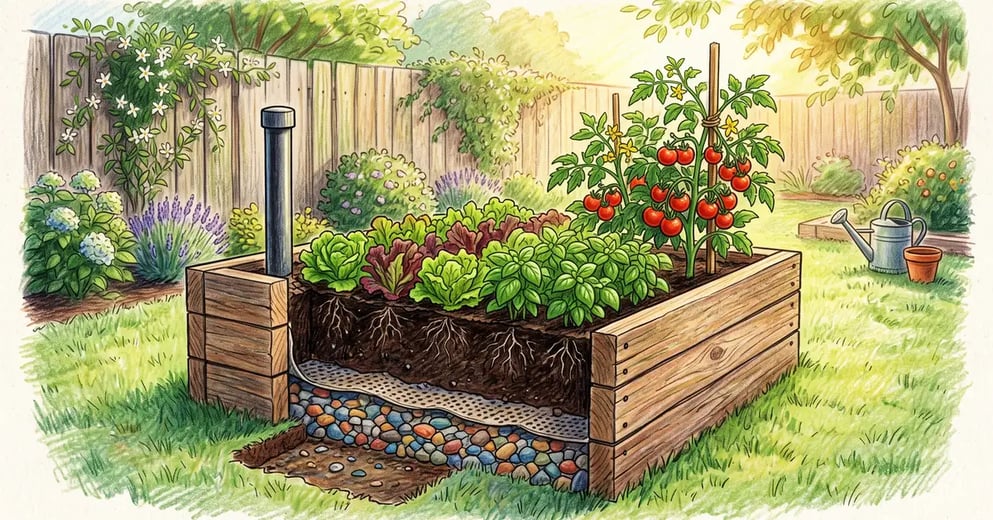

You go away for a long weekend in July and come home to wilted lettuce and split tomatoes. A wicking bed is one answer: a raised bed with a sealed water reservoir underneath, so soil draws moisture upward as plants use it instead of you standing there with a hose every evening. The idea is clever, and also over-promised online. Here is what a wicking bed actually is, what the evidence supports, how to build one, and which crops will quietly hate it. setting up drip irrigation soil moisture meter
What Is a Wicking Bed and How Does It Actually Work?
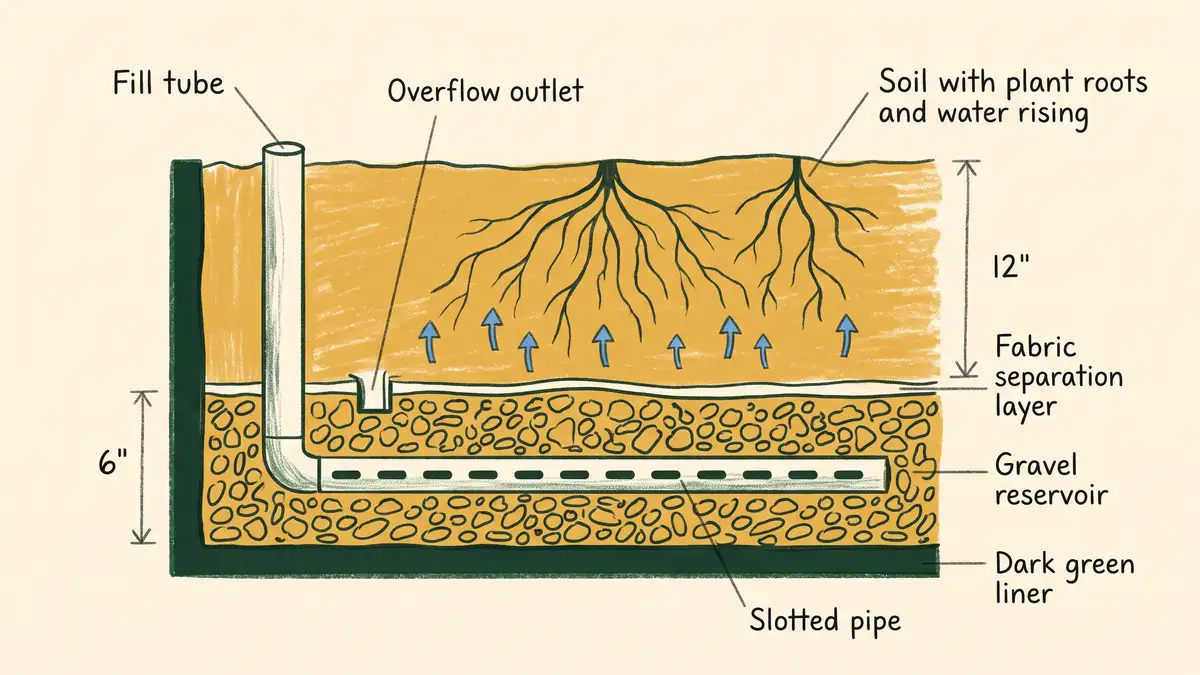
A wicking bed is a raised bed with a waterproof liner and a water reservoir in the bottom, usually 4 to 6 in. (10 to 15 cm) deep, with 8 to 12 in. (20 to 30 cm) of soil above it. You fill the reservoir through a vertical pipe rather than watering the surface, and capillary action pulls water up into the root zone.
Capillary action is the force that makes a paper towel corner soak up a spill. Water clings to soil particles and to itself, and in narrow pore spaces those forces beat gravity. The University of Nebraska-Lincoln's soil physics course puts the theoretical range at 1 to 8 ft (0.3 to 2.4 m) in sand and 12 to 20 ft (3.7 to 6 m) in clay. Those are equilibrium figures over long periods, not what happens in a garden bed in a week.
What you will find below:
- Where the popular water-saving numbers come from
- A weekend build for a 4x8 ft bed, roughly $120 to $250
- Why 12 in. of soil above the reservoir is the number
- Five crops that do poorly in wicking beds, and why
- Keeping mosquitoes out and salts down in year two
Key Takeaway
A wicking bed is a sub-irrigated raised bed. The reservoir does not make plants grow better on its own; it removes the daily watering decision and keeps soil moisture steady, which is what most vegetables actually want.
Do Wicking Beds Really Save Water? What the Evidence Shows
Be sceptical here. Wicking beds are commonly credited with cutting water use "up to 50 percent," but that figure comes from practitioner guides and supplier documentation, not controlled trials. As far as we can find, no US extension service has published a replicated wicking-bed water trial.
What is well documented is the parent category. Sub-irrigation, where water is delivered below the root zone and moves upward, is an established agricultural practice with its own USDA NRCS conservation practice standard. Sub-surface delivery avoids the two biggest losses in surface watering: evaporation from bare soil and wind drift.
| Claim | Evidence Level | What We Would Say |
| Up to 50% less water than surface watering | Practitioner guides only | Plausible mechanism, unverified number |
| Refill every 10 to 17 days in warm weather | Practitioner reports | Matches what most gardeners report; varies hugely by crop and climate |
| Sub-irrigation cuts evaporative loss | USDA NRCS practice standard | Well established for the general method |
| Higher yields than conventional raised beds | No controlled home-garden data | Treat as unproven |
Sources: USDA NRCS Practice Standard 443, UF/IFAS EDIS AE515, Colorado State University Extension
The real win is consistency rather than gallons saved. Uneven watering sits behind a long list of vegetable problems, from blossom end rot in tomatoes to bolting in lettuce. A reservoir smooths the peaks and troughs, and for many gardeners that alone justifies the build.
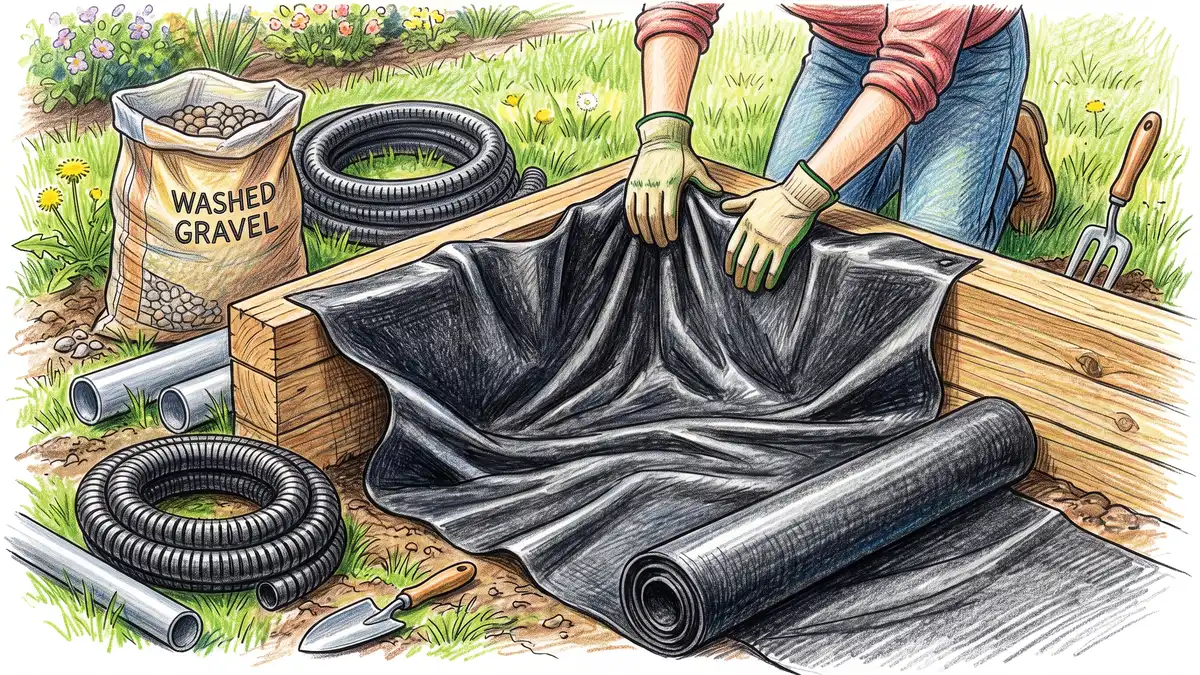
How to Build a Wicking Bed: Step by Step
Budget a weekend and roughly $120 to $250 for a 4x8 ft (1.2x2.4 m) bed. The liner is usually the biggest cost. Skip pressure-treated lumber unless you have checked the treatment: Oregon State University Extension publishes guidance on which treated woods suit food-growing beds, and older CCA-treated timber is not one of them.
Build or level the frame
The bed must be level, or it drains to the low end and leaves the high end dry. Allow at least 16 in. (40 cm) of internal depth for reservoir plus soil. Untreated cedar, larch, or galvanised steel all work.
Line it completely
Use EPDM pond liner or food-grade HDPE, at least 20 mil thick, in one piece, up all four sides. Any pinhole is a slow leak you will never find again, so pad sharp corners with old carpet or geotextile.
Set the reservoir and fill tube
Lay 4 to 6 in. (10 to 15 cm) of washed gravel, or run slotted corrugated drainage pipe and backfill around it. Stand a 3 in. (75 mm) PVC fill tube in one corner, reaching the base, and cap it with fine mesh.
Drill the overflow
Drill through liner and frame at the exact top of the gravel layer and seal it with a bulkhead fitting. This is the most important hole in the build. Without it, heavy rain waterlogs the root zone and roots suffocate.
Separate, fill, and mulch
Lay geotextile fabric over the gravel so soil cannot wash down. Add 12 in. (30 cm) of friable, compost-rich mix, mulch the surface, then fill through the tube until water runs from the overflow.
Why This Works: Catch and Store Energy
Bill Mollison's second permaculture principle is to catch and store energy where it is abundant. A wicking bed is that principle in miniature: rain and a single deep fill are stored in the reservoir and released slowly rather than running off. Same logic as a swale, shrunk to bed scale.
Which Soil Depth and Mix Actually Wicks?
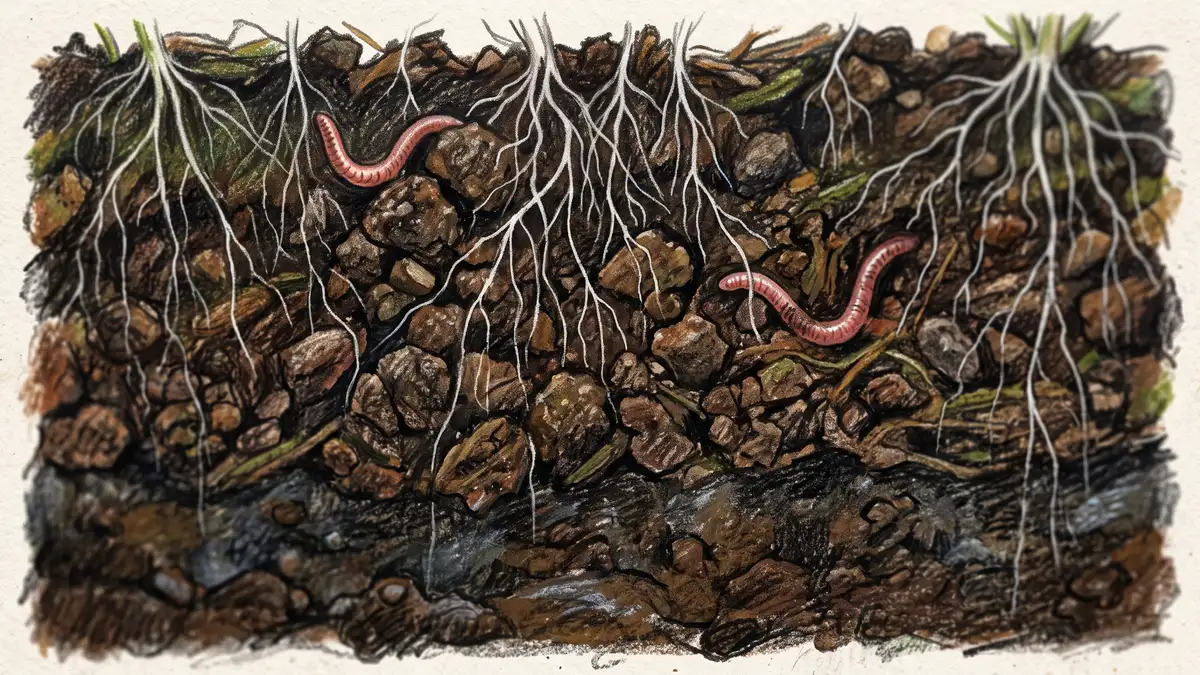
Twelve inches is the number that keeps appearing, and it is not arbitrary. Water in a typical compost-rich garden mix climbs about 9 in. (23 cm) reliably. Build 12 to 14 in. (30 to 35 cm) of soil above the reservoir and you get a permanently moist lower root zone, a moist middle, and a top layer dry enough for oxygen to reach the roots.
Get the mix wrong and the system fails silently. Pure sand drains too fast. Heavy clay wicks high in theory but so slowly it is useless. What you want is the same thing that works in any good raised bed soil mix: roughly half quality topsoil or loam, a third finished compost, the balance coarse material for structure.
| Soil Type | Capillary Rise (theoretical) | Wicking Bed Verdict |
| Gravel | Under 2 in. (5 cm) | Reservoir only, never growing medium |
| Sand | 1 to 8 ft (0.3 to 2.4 m) | Rises fast, holds little; blend, do not use alone |
| Silt loam | 12 to 16 ft (3.7 to 4.9 m) | Excellent balance of rise and retention |
| Clay | 12 to 20 ft (3.7 to 6 m) | Rises highest but far too slowly |
| Compost-rich blend | Roughly 9 in. (23 cm) in practice | The target for a wicking bed |
Sources: University of Nebraska-Lincoln, Soils Part 2: Soil Water, UNL Irrigation Home Study Course, Soil Water
Mulch the surface anyway. It seems redundant when water comes from below, but a layer of straw or wood chips stops the top inch crusting and cuts surface evaporation.
Need the gear for this?
Metal, cedar or DIY: what each costs over ten years and where each one fails.
Compare raised bed kitsWhat Should You Not Grow in a Wicking Bed?
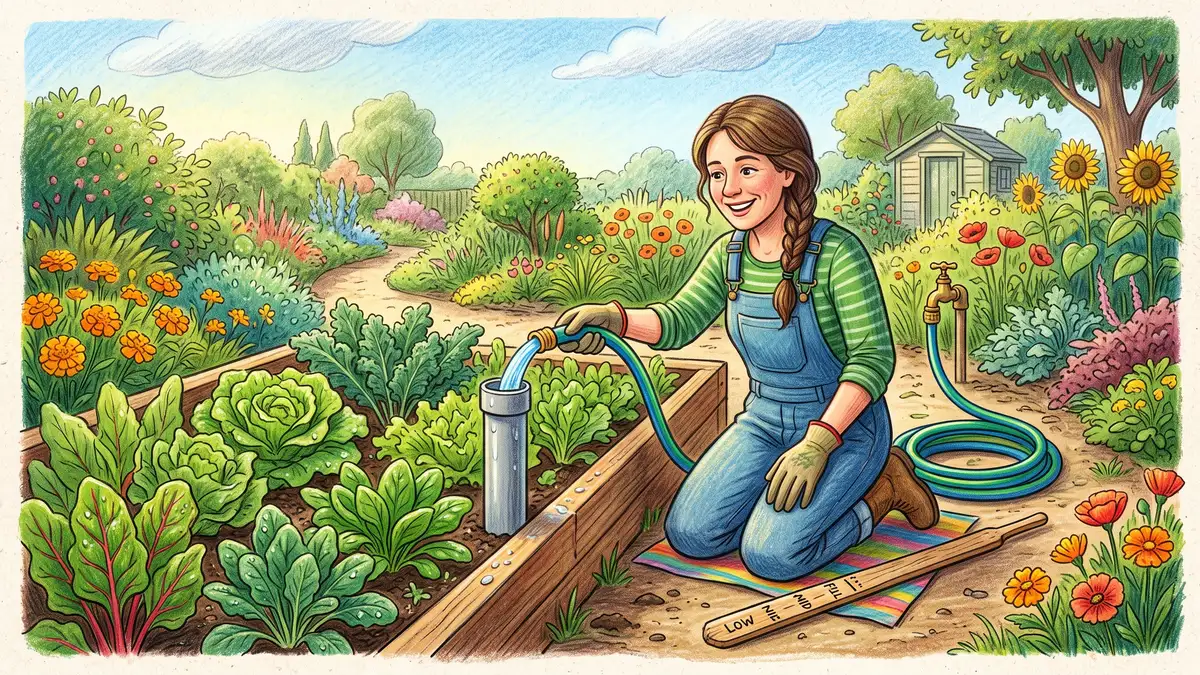
Wicking beds reward crops that like steady moisture and shallow-to-medium roots. Lettuce, chard, spinach, basil, bush beans, bok choy, celery, and most annual herbs do well. Tomatoes and peppers do fine once established, and even moisture genuinely helps with blossom end rot. The poor performers share one trait: they want a dry-down period, or they root deeper than the bed allows.
- Long-rooted carrots and parsnips. They hit the geotextile and fork. Short varieties are fine.
- Garlic and onions. They need to dry off as bulbs mature; a damp base invites rot.
- Rosemary, thyme, lavender, sage. Mediterranean herbs want sharp drainage and will sulk.
- Potatoes. Hilling depth and reservoir depth compete for the same space.
- Winter squash and pumpkins. They sprawl and drink more than a small reservoir supports.
Common Mistake to Avoid
An unsealed reservoir is a mosquito nursery. Cap the fill tube with fine mesh, screen the overflow, and if your area has mosquito pressure, drop in a Bti larvicide. The EPA notes that Bti targets mosquito, blackfly, and fungus gnat larvae and is not toxic to people, pets, bees, or other insects. The CDC specifically recommends dunks for standing water that cannot be emptied, such as rain barrels, which is exactly what your reservoir is.

What Goes Wrong in Year Two?
The failure that catches people out is not leaks or mosquitoes. It is salt. Every time water moves up and evaporates, the dissolved minerals it carried stay behind. Top-watering flushes those salts down and out. Bottom-watering never does, so they concentrate in the upper root zone over a season or two.
The fix takes ten minutes. Two or three times a season, water from the top with a hose until water runs from the overflow. Add half a cup of compost per square foot each spring, scrub the reservoir every 90 days with dilute vinegar to clear biofilm, and check the overflow before the first heavy rain of autumn.
Why This Works: Closing the Loop
Wicking beds were systematised in the early 2000s by Australian engineer Colin Austin, working on water scarcity rather than gardening convenience. Feed the reservoir from a downpipe or rain barrel and you have a closed loop: roof catches rain, reservoir stores it, capillary action distributes it, mulch stops it escaping. Each element does more than one job, which is what permaculture design is about.
Key Takeaway
Build the overflow drain properly, keep soil depth at 12 to 14 in. above the reservoir, flush from the top a few times a season, and screen the fill tube. Those four things account for almost every wicking bed that succeeds or fails.
Frequently Asked Questions
How does a wicking bed work?
A sealed liner holds a reservoir, typically 4 to 6 in. (10 to 15 cm) of gravel or slotted pipe, in the base of a raised bed. Above it sits separation fabric and 12 to 14 in. (30 to 35 cm) of soil. You fill the reservoir through a vertical pipe, and capillary action pulls water upward into the soil as plants use it. An overflow drain at the top of the reservoir stops the bed waterlogging in heavy rain.
What are the disadvantages of a wicking bed?
Three real ones. The build costs more and takes longer than a plain raised bed, roughly $120 to $250 in materials for a 4x8 ft bed. Salts accumulate in the root zone because bottom-watering never leaches them out, so you need to top-flush a few times a season. And the reservoir is standing water, which means mosquito management. Published water-saving figures also come from practitioner sources rather than controlled trials.
What should you not plant in a wicking bed?
Avoid crops that need a dry-down period or root deeper than the soil layer: garlic and onions, which rot if the base stays damp as bulbs cure, long-rooted carrots and parsnips, which fork on the fabric layer, and Mediterranean herbs such as rosemary, thyme, lavender and sage that want sharp drainage. Potatoes are awkward because hilling depth competes with reservoir depth. Leafy greens, basil, bush beans, celery, tomatoes and peppers do well.
How often do you fill a wicking bed?
In warm weather with a fully planted bed, gardeners commonly report refilling every 10 to 17 days. In spring or autumn, or with light planting, it can stretch to a month. Do not guess: drop a dowel down the fill tube as a dipstick and check weekly. Refill when the reservoir is roughly a quarter full rather than letting it run dry, because a dry wicking layer takes a while to re-establish contact with the soil above.
Are wicking beds worth it?
They are worth it if your problem is time or absence rather than water cost. If you travel, garden on a hot exposed site, or keep losing plants to inconsistent watering, a wicking bed removes that failure mode. If you already water reliably, the extra cost buys less. At larger scale, swales and berms or a hugelkultur bed do a similar job with no liner and no plumbing.
Get the Weekly Dig
One practical permaculture guide a week, written for gardeners who do this on weekends: raised beds, from fill to first harvest. Free, no spam, unsubscribe any time.
Join the Weekly DigResources
- University of Nebraska-Lincoln, Soils Part 2: Soil Water, capillary rise by soil texture
- UNL Irrigation Home Study Course, Irrigation Home Study Course, Chapter 3: Soil Water
- University of Minnesota Extension: Raised bed gardens
- Oregon State University Extension EM 9879: Pressure-treated wood for raised bed construction
- Colorado State University Extension: Irrigating the vegetable garden
- US EPA: Bti for mosquito control
- CDC: Mosquito larvicides and treating standing water
- UF/IFAS EDIS AE515: Estimated water savings potential of landscape practices