
Your berry bushes are producing less than they did three years ago and you suspect pruning is the problem. You are probably right. The most common mistake in a home berry patch is not pruning badly, it is pruning at the wrong time for that plant, or letting the bush fill with wood that no longer fruits. the timing rules for fruit trees
The good news is that timing follows one rule. Every berry bush fruits either on wood grown last year or on wood grown this year, and once you know which, the pruning window answers itself. This guide sorts the common backyard berries into those two groups and gives you the window for each.
What you will get from this guide:
- The pruning window for blueberries, both raspberry types, blackberries, currants and elderberry
- How to tell a floricane from a primocane in about four seconds, standing in the patch
- Exactly how many canes to remove, with numbers from extension research rather than guesswork
- Why late winter is the default window, and the two situations where it is the wrong call
- What to do with the prunings, which is not the same answer for every plant
Key Takeaway
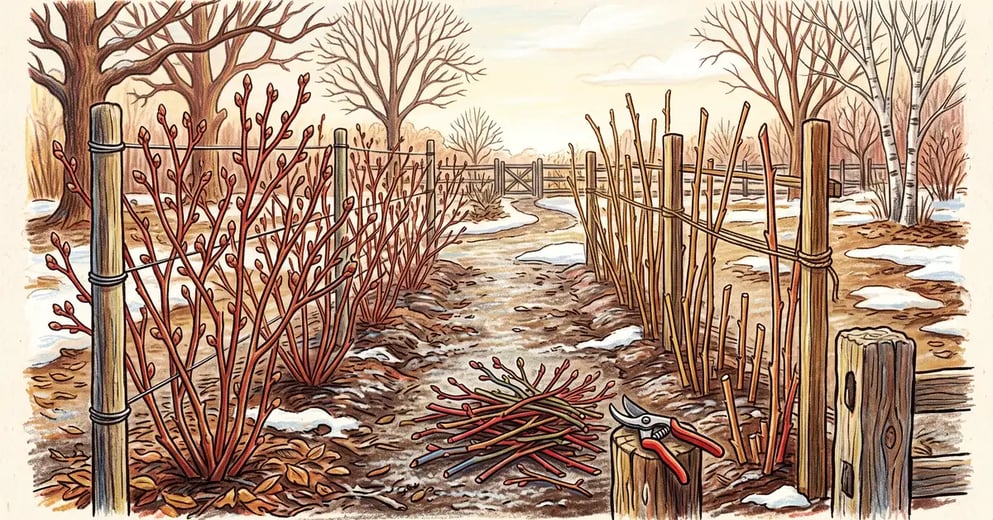
Late winter, while the plant is still dormant but the worst cold has passed, is the right window for the large majority of berry bushes. The two important exceptions are summer-bearing raspberries and blackberries, whose spent canes come out right after harvest, and fall-bearing raspberries, which can simply be mown to the ground.
What Determines When You Prune a Berry Bush?
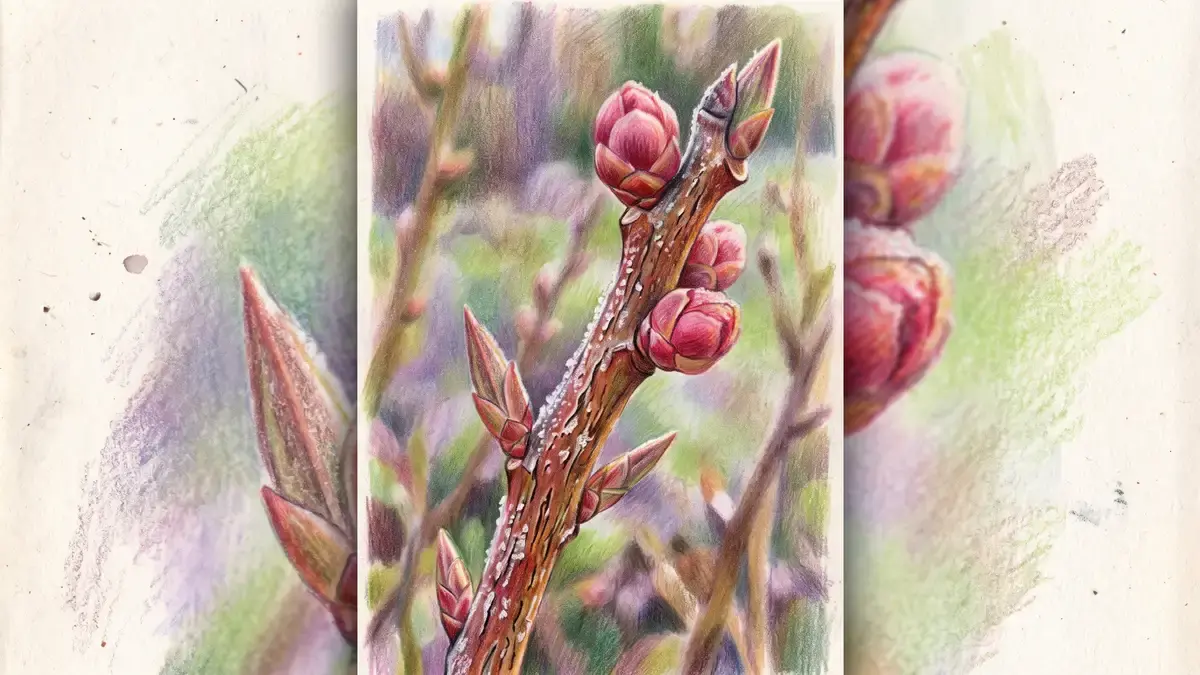
One question decides everything: does this plant fruit on old wood or new wood?
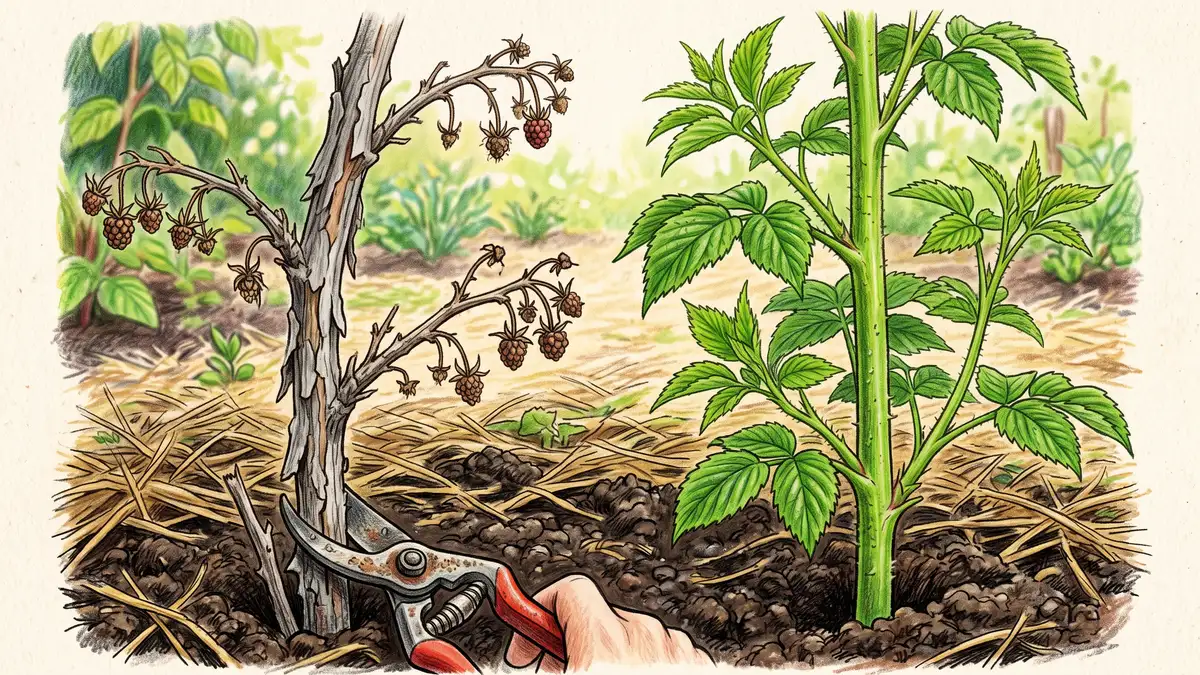
Canes that grow one year, overwinter, then fruit the following summer are floricanes. Canes that grow and fruit in the same season are primocanes. Summer-bearing raspberries and most blackberries are floricane fruiters; fall-bearing raspberries fruit on primocanes. Blueberries, currants and gooseberries set their crop on buds formed the previous season, which puts them in the old-wood camp.
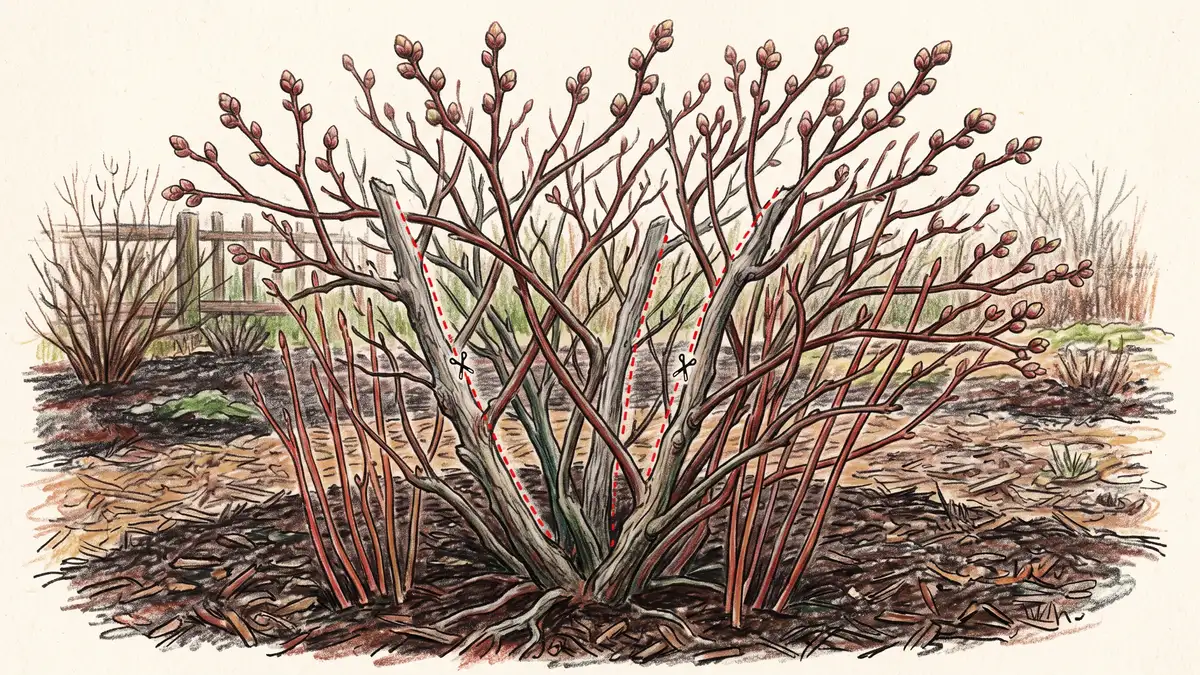
You can read this in the patch without knowing the variety name. Floricanes are woody, brownish and often peeling, with the dried remains of last year's fruiting laterals. Primocanes are green or reddish and flexible. On a blueberry, fat rounded buds at the stem tips are flower buds, slim pointed ones are leaf buds. Cut the fat ones and you have cut the crop.
When to Prune Each Type of Berry Bush
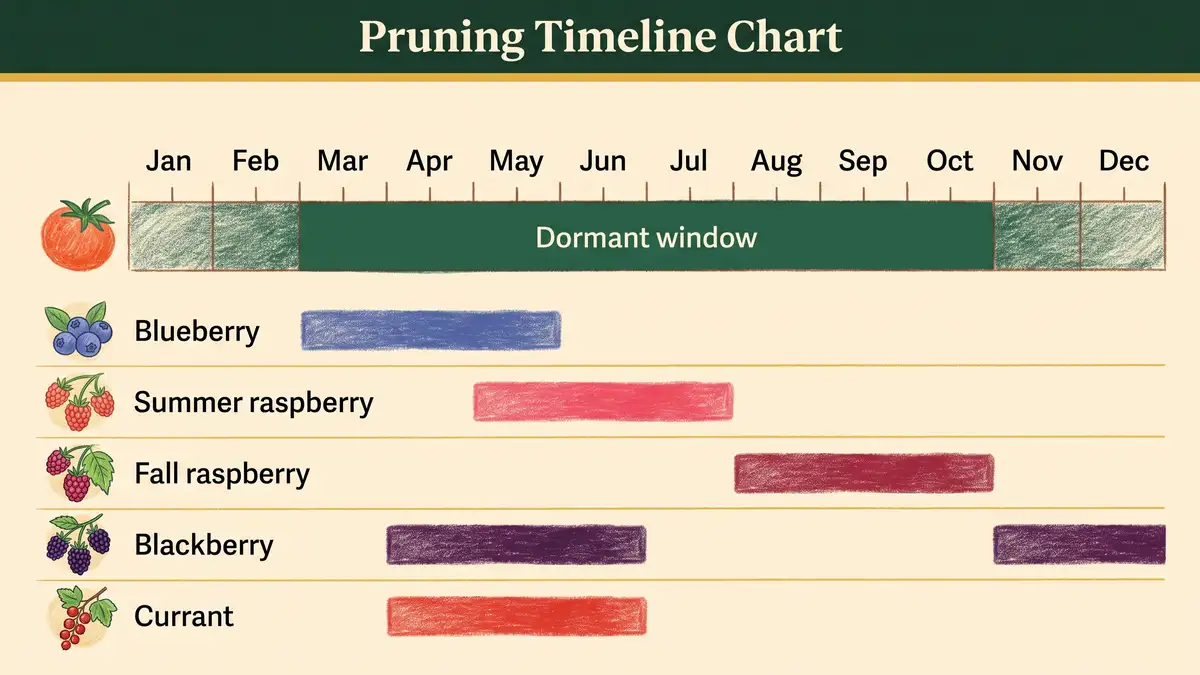
Here is the whole calendar in one place. Anchor these to your own conditions rather than a fixed date, which we cover further down.
| Berry | Fruits On | Main Pruning Window | What You Remove |
| Highbush blueberry | Previous season's wood | Late winter to early spring, dormant | 1 to 3 of the oldest, thickest canes at the base |
| Summer-bearing raspberry | Floricanes (second-year canes) | Right after harvest, then tidy in late winter | All spent floricanes to ground level; thin primocanes in winter |
| Fall-bearing raspberry | Primocanes (current-year canes) | Late fall or early spring, fully dormant | Every cane, cut to the ground |
| Blackberry, erect and semi-erect | Floricanes | After harvest, plus late winter laterals | Spent canes after fruiting; shorten laterals to 12 to 18 in. |
| Black raspberry | Floricanes | After harvest, plus summer tipping | Spent canes; tip primocanes at about 3 ft in early summer |
| Currants and gooseberries | Wood 1 to 3 years old | Late winter, dormant | Anything older than three years, at the base |
Sources: NC State Extension, Principles of Pruning the Highbush Blueberry, University of Minnesota Extension, NC State Southeast Regional Caneberry Production Guide
Two entries deserve emphasis. Summer-bearing brambles should have their spent floricanes cut out as soon as the last berry comes off, not left until winter. Those canes are dead and will not fruit again, and removing them opens the canopy and cuts disease pressure. Leaving them standing is the most common reason a raspberry row turns into a cane-blighted thicket.
And fall-bearing raspberries are the easiest fruit in the garden. Because they fruit on this year's growth, you can cut every cane to the ground while dormant and lose nothing. Ten minutes with loppers. Leaving them gives two smaller crops, but the single-crop approach is simpler and healthier.
Why Late Winter, and When It Is the Wrong Call
Dormant pruning works because the plant has already pulled its carbohydrate reserves down into the roots and crown. Cutting then removes structure without removing stored energy, so every banked calorie is redirected into fewer, better-placed buds. That is the whole mechanism behind the yield response.
Waiting for late winter is about cold injury. Cuts made before the coldest part of the year expose tissue that has not compartmentalised, and in zones 3 to 5 that can mean dieback well below the cut. After the deep cold breaks but before bud swell is the widest safe margin.
Common Mistake to Avoid
Do not prune while the wood is frozen. Frozen canes are brittle, they crush rather than cut cleanly, and a ragged wound is a far better entry point for cane blight. Wait for a mild dry day. For the same reason, sanitise your pruners between plants when cutting out anything diseased, since pruning moves a pathogen down a row faster than anything else.
Late winter is wrong in two situations: spent floricanes on summer-bearing brambles, which come out in July or August; and dead, diseased or broken wood, removed the moment you notice it. Sanitation pruning has no calendar.
How Much Should You Actually Remove?
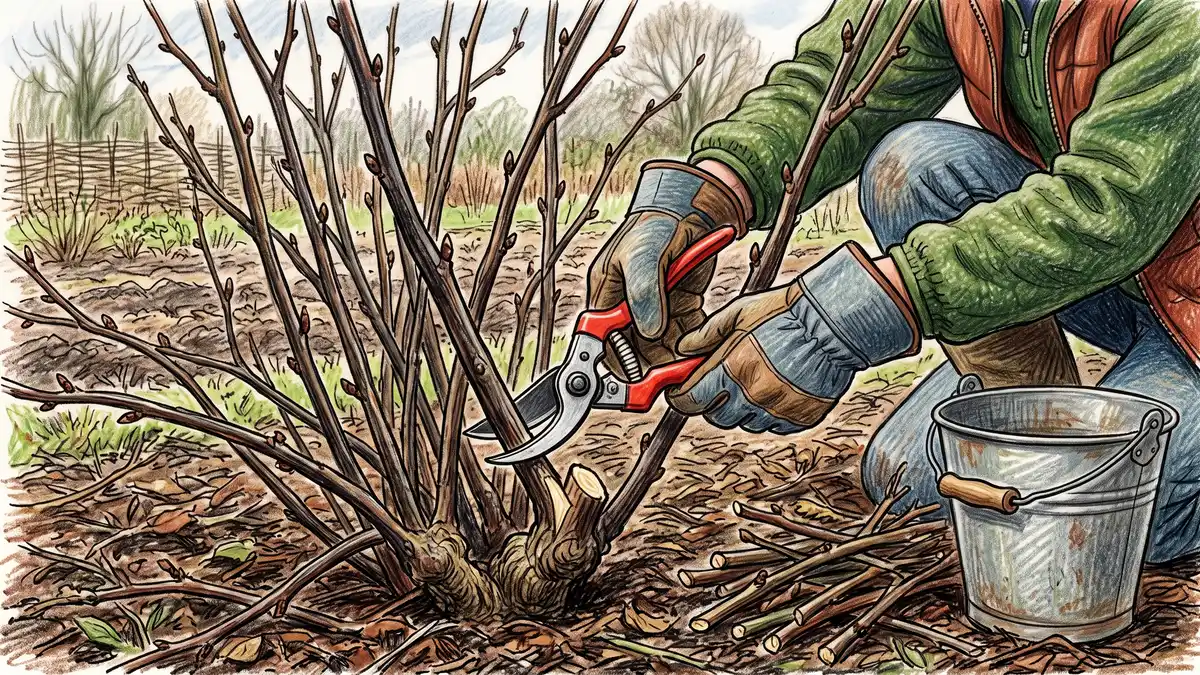
This is where most home gardeners are too timid. Michigan State University Extension puts the target age structure for a productive blueberry bush at roughly 20 percent one to two-year-old shoots, 60 percent three to six-year-old canes, and 20 percent older than six years, due for removal. That last fifth is your annual job.
In practice: on a mature blueberry (four years or older), keep 6 to 10 healthy canes rising from the base, spanning one to six years of age. Each winter take out 1 to 3 of the oldest, cutting them right down at the base. They are easy to spot, thick with grey peeling bark. The hard limit is one third of the bush per year, so a neglected plant gets renovated over three seasons.
For brambles the numbers come from cane density. In a hill system, retain 10 to 12 strong canes per hill. In a hedgerow, narrow the row to about 12 inches (30 cm) wide and shorten laterals to 12 to 18 inches. Black raspberries also want summer tipping: pinch the top 3 to 4 inches off primocanes at about 3 feet, forcing the branching that carries next year's fruit.
Why This Works: Managed Succession
Renewal pruning is succession compressed into a single bush. Instead of letting one cohort of canes age out together and the whole plant decline, you keep six age classes running side by side, retiring the oldest each year. It is the same principle that keeps a layered food forest productive across decades: staggered ages mean something is always coming into its prime.
How to Adjust the Timing for Your Zone
Stop using a calendar date and start using the plant. "Late winter" means March in Minnesota and January in Georgia, and a warm February moves it either way. Two markers work everywhere.
Wait until the hardest freezes are behind you
In zones 3 to 5 that usually means late February into March. In zones 6 to 7, February. In zones 8 to 9, January is normally safe. You are looking for the point where a sustained deep freeze is unlikely, not where frost is impossible.
Prune before bud swell, not after
Once buds visibly fatten, the plant has begun moving reserves upward and you lose more with every cut. On blueberries the flower buds are obvious by then, which conveniently also makes it the easiest moment to judge what you are removing.
Pick a dry, mild day
Wet conditions spread fungal spores and frozen wood cuts badly. A dry day above freezing gives you clean cuts that seal quickly. This matters more in humid regions than anywhere else.
Decide where the prunings go before you start
Healthy prunings from blueberries and currants can be chopped and dropped as mulch under the bush. Anything showing cane blight, orange rust or fireblight-like symptoms should leave the garden entirely, not go on the compost pile.
That last step matters. In perennial systems the instinct is to return all biomass to the soil, and for clean wood that is right; our chop and drop guide covers how. But sanitation overrides the closed loop: orange rust is systemic and incurable, and returning that material is how a patch gets written off.
Key Takeaway
Anchor pruning to the end of hard freezes and the start of bud swell, not to a month. That single adjustment makes the same advice work in zone 3 and zone 9, and it makes you resilient to the warm winters that are increasingly shifting bud break earlier.
Why This Works: Working With the Shrub Layer
Berry bushes occupy the shrub layer, the tier that does most of the productive work in a temperate food forest. Unlike canopy trees, shrubs are built to be knocked back and regrow, which is why they respond to pruning with vigour rather than stress. You are not fighting the plant when you cut it hard, you are giving it the disturbance its life strategy expects.
Frequently Asked Questions
When is it too late to prune blueberry bushes?
Once the flower buds have swelled and begun to open, you are past the ideal window. Pruning then removes reserves already committed to the crop, and you will see it in that season's yield. If you have missed it, wait until next winter rather than prune a bush in flower. The exception is dead or diseased wood, which comes out whenever you spot it.
Do you cut back blackberry bushes in the fall?
For standard floricane-fruiting blackberries, the canes that fruited should have been removed right after harvest in late summer, not left for fall. What remains going into winter are this year's primocanes, which carry next summer's crop, so they must stay. In late winter you shorten their laterals to roughly 12 to 18 inches. With a primocane-fruiting variety you can cut everything to the ground in late fall or early spring, the same as a fall-bearing raspberry.
Can I cut my blueberry bushes to the ground?
You can, and for a badly neglected plant it is sometimes done, but you will lose two to three years of harvest while it rebuilds. Extension guidance favours phased renovation: remove no more than one third of the bush each year, oldest grey-barked canes first, across three seasons. You keep picking the whole time.
How do I know which raspberry type I have?
Watch when it fruits. A crop in June or early July means summer-bearing, fruiting on floricanes. A crop from late summer into fall means primocane-fruiting. Some fall-bearing varieties do both. If unsure, leave the canes standing for one season and observe. Getting the type right matters far more than the exact date.
Should I prune berry bushes the first year after planting?
Yes, but lightly, and for a different reason. On a newly planted blueberry, extension guidance is to remove any flower buds in the first year so the plant puts everything into roots and structure rather than a token crop. On new brambles, remove weak or damaged canes and let the rest establish. Establishment pruning builds the plant; later pruning manages production, and the two look quite different.
Can I compost the prunings?
Healthy prunings, yes. Woody material breaks down slowly, so chop it small and treat it as a brown, carbon-rich input. Better still, chop and drop it under the bush as mulch. What should never go on the pile is material with orange rust, cane blight or any systemic disease, since home piles rarely hold the temperatures needed to kill those pathogens. Bag it and remove it. For more on what belongs in a pile, see our complete guide to composting.
Get the Weekly Dig
One practical permaculture guide a week, written for gardeners who do this on weekends: food forest and guild designs that produce. Free, no spam, unsubscribe any time.
Join the Weekly DigResources
- NC State Extension, Principles of Pruning the Highbush Blueberry
- Michigan State University Extension, Revitalize Blueberries With Renovation
- Penn State Extension, Pruning Blueberries in Home Fruit Plantings
- University of Maine Extension, Bulletin 2253 Growing Highbush Blueberries
- University of Minnesota Extension, Pruning and Training Raspberries
- NC State Extension, Southeast Regional Caneberry Production Guide: Pruning and Training
- Oregon State University Extension, Berry Pruning Basics
- Oregon State University Extension, EC 1306 Growing Raspberries in Your Home Garden