
Does Companion Planting Actually Work? The Honest Answer
Yes, but probably not the way most companion-planting charts say it does. The mechanisms that hold up under peer-reviewed scrutiny are real — trap cropping, beneficial-insect support, niche-complementary polyculture, and species-specific allelopathy. The folk-wisdom pairings ("carrots love tomatoes," "basil makes tomatoes taste better") mostly don't.
The agricultural-science term you'll see in the literature is intercropping or polyculture, not "companion planting." That distinction matters: intercropping has been studied in controlled field trials since the 1970s, while the popular companion-planting tradition traces back to Louise Riotte's Carrots Love Tomatoes (1975) — a folk-tradition compilation that contained no controlled experiments or citations. As UC ANR Master Gardeners put it in a 2022 review, the new science of companion planting treats the garden as an ecosystem of interactions, not a list of pairings to memorise.
Key Takeaway
Companion planting works through general ecological mechanisms — trap crops, insectary flowers, root-zone biochemistry, light partitioning — not specific "this plant loves that plant" magic. Treat your garden as a polyculture system and you'll get most of the documented benefits without memorising folk lists.
What Has Strong Scientific Support
Four mechanisms have repeatedly shown up in controlled trials, university extension publications, and peer-reviewed journals. The table below maps each one to its documented effect size and the kind of source that backs it.
| Practice | Documented effect | Evidence source |
| Three Sisters polyculture (corn + climbing bean + squash) | Land Equivalent Ratio 1.2–1.4 (20–40% more total yield per land area) | Mead & Willey 1980; Zhang et al. 2014 (peer-reviewed) |
| Trap cropping (blue Hubbard squash, nasturtium) | 30–60% reduction in primary-crop pest infestation | U Missouri IPM; UNL push-pull field trial |
| Insectary plants (sweet alyssum, dill, fennel) | 50–70% lower aphid density; 2–4× increase in beneficial-insect captures | UNH 2023 study; USDA ARS; Xerces Society synthesis |
| French marigold (Tagetes patula) for root-knot nematode | 40–60% reduction in nematode populations after 8–12 weeks of root exudation | USDA NRCS field trials; J. Nematology 2012 (peer-reviewed) |
Sources:.
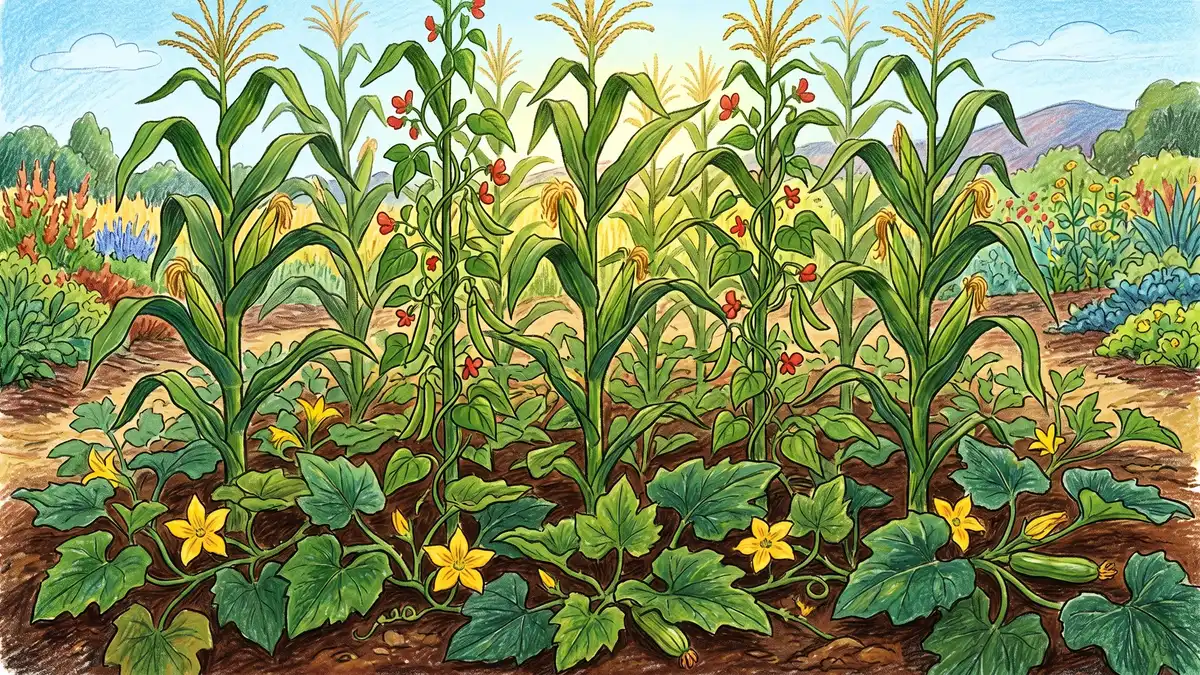
1. Three Sisters polyculture. Maize, climbing bean, and squash grown together is the most rigorously studied traditional polyculture in agriculture. Zhang and colleagues (2014, Proceedings of the Royal Society B) showed that the system achieves a Land Equivalent Ratio (LER) of 1.2–1.4 — meaning the same yield as 20–40% more monoculture land area — through root-foraging niche complementarity: each species pulls nutrients from a different soil zone. The classic Mead and Willey field trials reported the same range, and USDA organic-systems work in Michigan validated it for temperate North America. The catch: cultivar selection and spacing matter critically. Pair the wrong determinate bean with sweet corn and your LER drops to roughly 1.0.
2. Trap cropping. A sacrificial plant attractive to a target pest pulls herbivory pressure off your main crop. University of Missouri IPM reports that blue Hubbard squash (Cucurbita maxima) bordered around a primary squash crop reduces squash bug and squash vine borer (Melittia cucurbitae) infestation by 30–50% in replicated trials. A University of Nebraska-Lincoln push-pull study documented similar reductions when Blue Hubbard and nasturtium (Tropaeolum majus) were combined as trap and repellent crops. Trap cropping is real and effective — but it's active, not passive: you have to monitor and manage the trap crop.
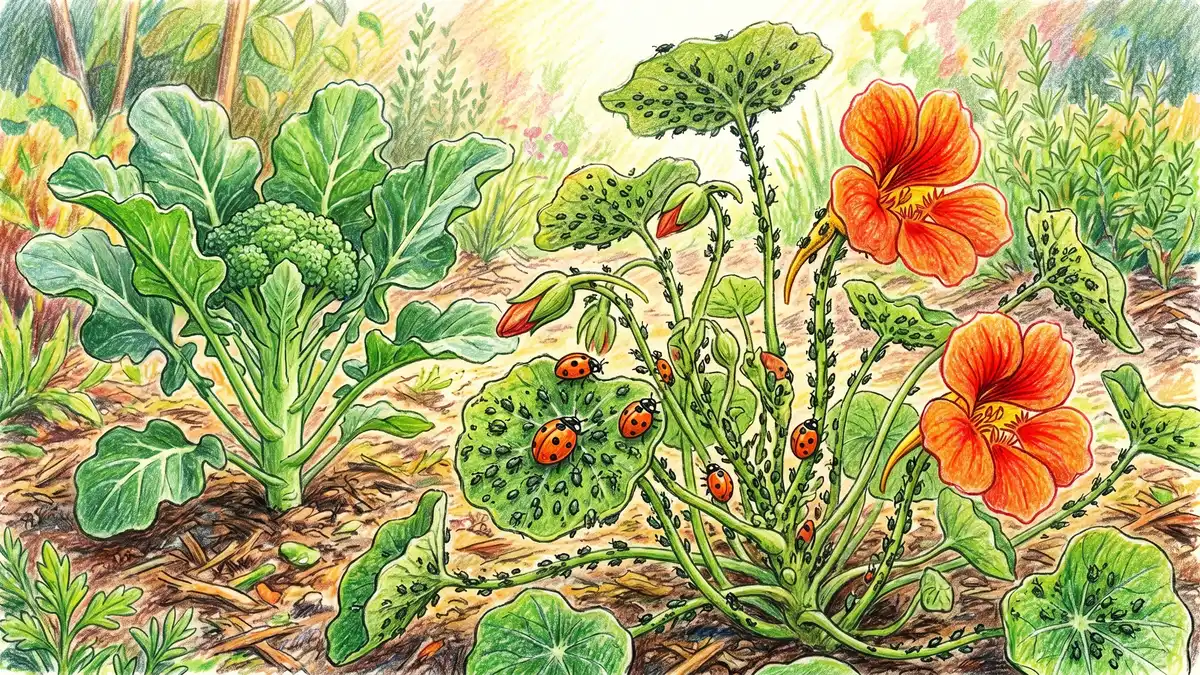
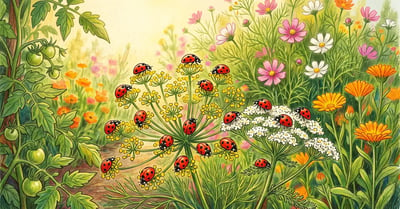
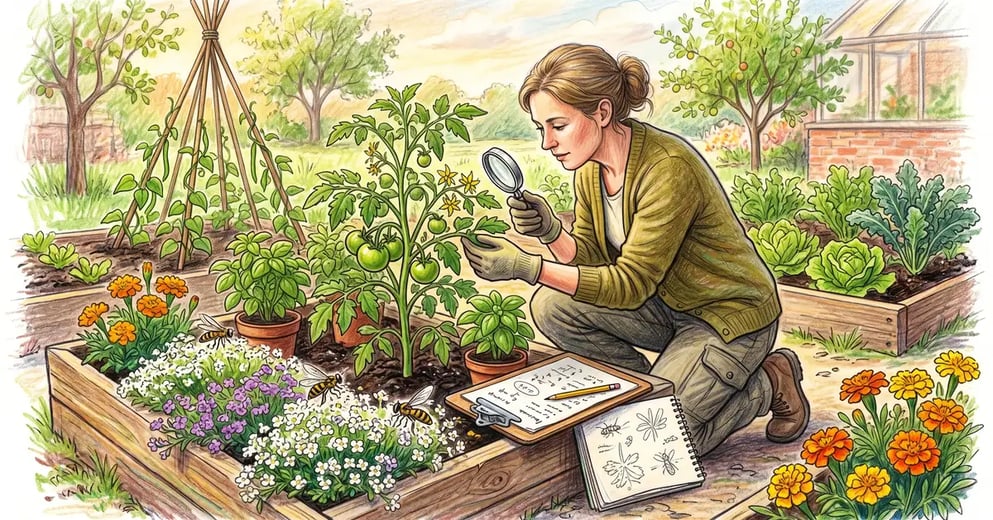
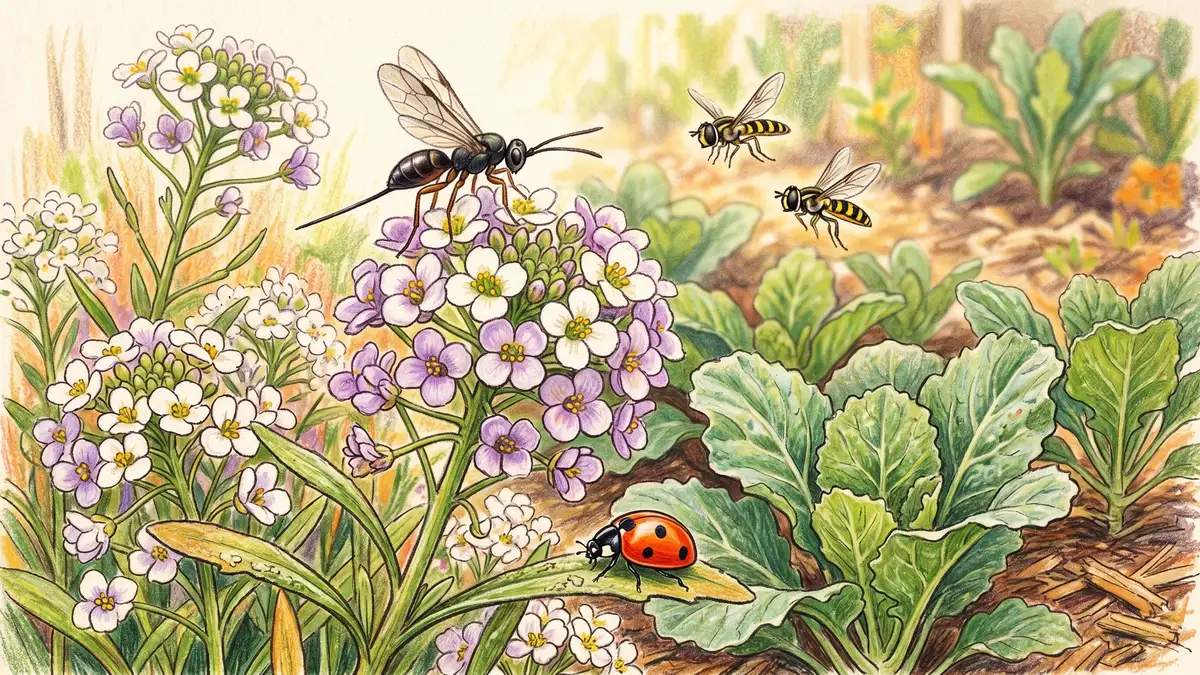
3. Beneficial-insect (insectary) plants. Interplanting flowering species that supply nectar and pollen sustains predator and parasitoid populations all season long. University of New Hampshire research (2023) identified sweet alyssum (Lobularia maritima) as the most effective hoverfly attractant tested, with the longest bloom period and highest syrphid retention. USDA Agricultural Research Service reported alyssum so effective at aphid control in organic lettuce that it can be planted on up to 10% of bed area as a dedicated insectary strip. A 2024 peer-reviewed study (NIH PMC) found that intercropping sweet alyssum and coriander in broad-bean rows improved the predator-to-pest ratio and increased hoverfly egg and larval populations.
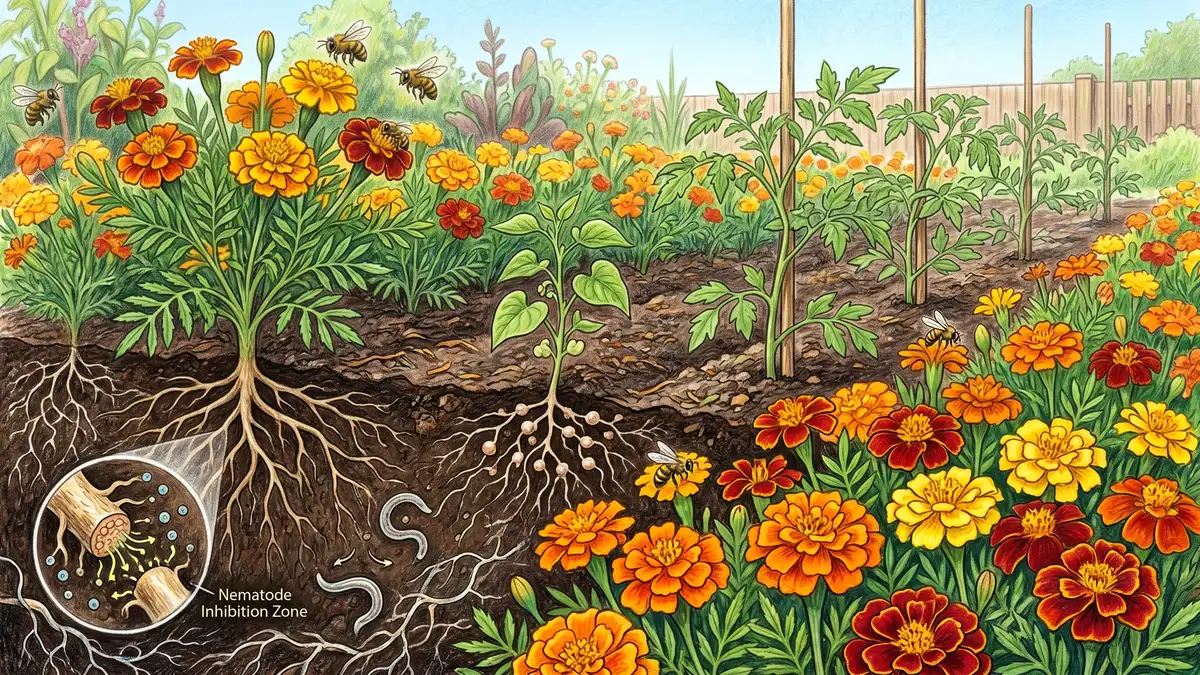
4. Marigolds for soil-borne nematodes. French marigold (Tagetes patula) roots produce alpha-terthienyl, a thiophene compound toxic to root-knot nematode (Meloidogyne spp.) larvae. Hooks and colleagues (2012, Journal of Nematology) documented 50–70% reductions in juvenile nematode populations after 8 weeks of T. patula root exposure. USDA NRCS field trials of marigold cover crops grown for 8–12 weeks before tomato planting reduced subsequent root-knot infestation by 40–60%. Note the specifics: the cultivar matters (T. patula > T. erecta), and you need 8–12 weeks of active root exudation. A few marigolds dotted around the bed for two months won't do it.
Why This Works: Niche Complementarity
What permaculture calls "stacking functions" the agronomy literature calls niche complementarity. Three Sisters works because each species occupies a different vertical layer (root, mid, canopy) and a different ecological role (structure, nitrogen fixer, ground cover). Trap cropping and insectary plants work because they expand the food web, not because of mythical plant friendships. The science and the permaculture framework are saying the same thing in different vocabulary.
What Has Mixed or Weak Evidence
Some popular pairings have some support but not enough to bet a season on.
Marigolds for above-ground pests. The same marigolds that suppress nematodes underground do not reliably deter whiteflies, spider mites, or aphids on neighbouring leaves. UC Davis field trials and Penn State olfactometer studies found no significant pest-population difference in marigold-interplanted plots compared to controls. The chemistry that protects roots doesn't work the same way through the air.
Basil with tomatoes for flavour. The popular claim is that basil improves tomato taste. The evidence: weak. Some pollinator attraction benefits exist (basil flowers support bees and hoverflies), but no controlled flavour trial has demonstrated that basil neighbours change tomato fruit chemistry in a meaningful way.
Within-season nitrogen transfer from beans. The folk claim that beans "feed" their tomato or corn neighbours this season is contradicted by ¹⁵N isotopic studies showing only 2–8% of legume-fixed nitrogen transfers to neighbouring crops within a single growing season. Most fixed N stays in the legume biomass and only becomes plant-available after residue mineralisation in subsequent seasons. Three Sisters works partly because it's a cumulative system over time.
Sunflower allelopathy. Sunflower roots can inhibit lettuce growth in sterile pot trials but rarely in field conditions, where soil biology and organic matter mask any effect. Don't make planting decisions on this one.
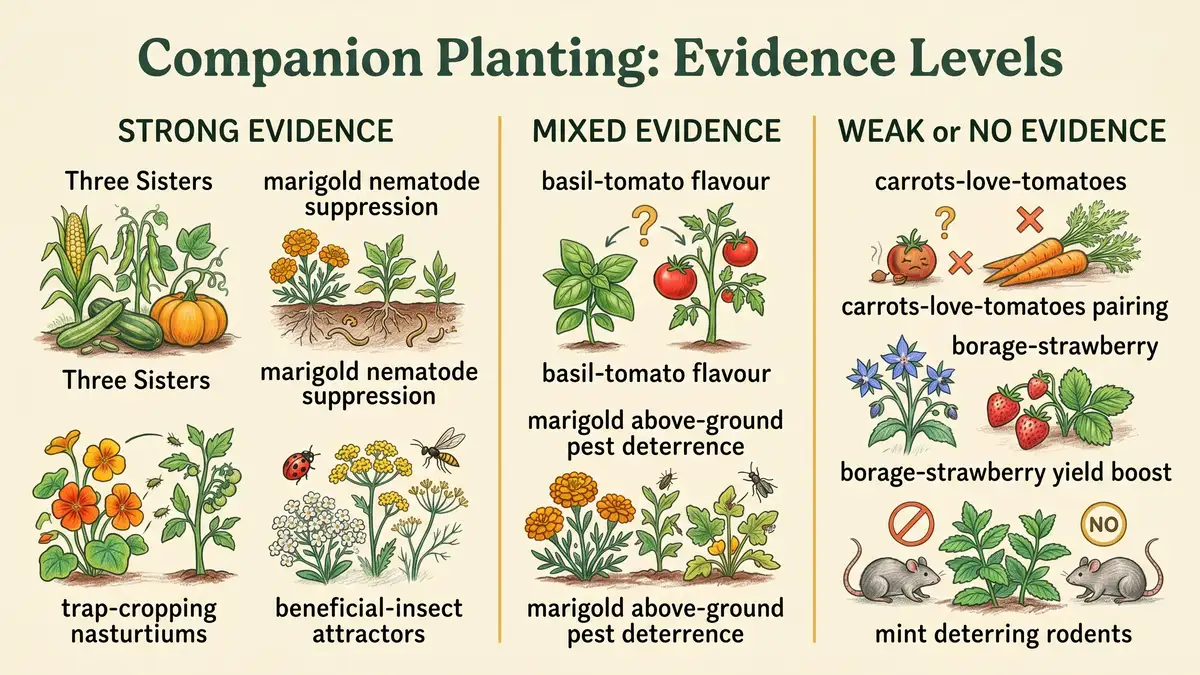
What's Folklore, Not Science
A few claims circulate widely with no controlled-trial backing.
Mint deters pests by chemistry. Mint (Mentha spp.) does dominate neighbours, but Penn State and University of Wisconsin trials found no allelopathic effect on common vegetables. What looks like inhibition is competition — mint's vigorous rhizome system simply outgrows everything within reach. The fix is containment, not avoidance.
"Carrots love tomatoes." Riotte's 1975 categorical pairing list — the source of dozens of modern companion-planting charts — was a synthesis of folk traditions, not a research review. The book itself contains no peer-reviewed citations, and where modern researchers have tested specific Riotte pairings they typically find no measurable yield effect.
Onions and garlic deter rabbits and rodents. Sometimes asserted, never demonstrated in controlled trials. Rabbits eat what they want.
The well-documented exception is black walnut allelopathy: Juglans nigra produces juglone (5-hydroxy-1,4-naphthoquinone) in roots, leaves, and hulls, and it kills sensitive plants like tomatoes and peppers within 60–80 ft (18–24 m) of the trunk. Penn State Extension and University of Illinois Extension both publish lists of juglone-tolerant species — this one is real, well-established, and worth respecting.
Common Mistake to Avoid
Treating popular companion-planting charts as evidence-based protocols. Many lists copied around the gardening internet trace back to Riotte (1975) and have never been validated. Plant for documented mechanisms — trap crops, insectary plants, niche complementarity, soil-borne nematode suppression — and you will outperform someone following a list of "love/hate" pairings every season.
How to Apply the Science This Season
This is what the evidence actually tells a serious practitioner to do, in priority order.
Plant insectary strips on 5–10% of your bed area
Sweet alyssum, dill, fennel, yarrow, and buckwheat in alternating short blocks support hoverflies, parasitoid wasps, and ladybeetles. Aim for continuous bloom from spring through frost. This is the single highest-evidence intervention for organic vegetable beds.
Use trap crops for known pest pressure
Border squash with blue Hubbard for vine borer and squash bug. Plant nasturtium near brassicas and beans for aphids. Monitor weekly and remove or destroy trap-crop plants when they're heavily colonised — that's the work that makes the mechanism real.
Run French marigolds as a pre-crop for nematode-prone beds
If you've had root-knot nematode problems on tomatoes or peppers, sow Tagetes patula as a dense cover for 8–12 weeks before planting. Till in or terminate before transplant. This is a soil-treatment protocol, not a decorative interplanting.
Build a Three Sisters bed with the right cultivars
Use a tall heritage corn (not sweet corn), an indeterminate climbing bean, and a vining squash. Plant corn first; sow beans 2–3 weeks later when corn is 6 in (15 cm) tall; plant squash on the perimeter. Cultivar matters more than the idea — get this wrong and the LER advantage disappears.
Stop trying to memorise pairing lists
Replace folk pairing rules with a polyculture mindset: diversity, continuous flowering, structural complexity (root, mid, canopy), and tolerating beneficial volunteers. The system-level practices outperform any specific pairing chart over a season.
The science of companion planting fits neatly inside the broader companion planting framework on this site, and especially the deep dive in our complete companion planting chart. The Three Sisters bed is covered in detail in Three Sisters planting: the original companion garden. If insectary plants and beneficial-insect support interest you, look at how the herb spiral guide integrates flowering herbs as a habitat patch. The principles behind why mixed plantings outperform monocultures connect directly to the wider 12 permaculture principles and the soil-system framing in our soil health guide.
Frequently Asked Questions
Does companion planting actually work?
Yes — but through specific, well-documented mechanisms rather than the "love/hate" pairings popular charts list. Trap cropping, insectary plants, niche-complementary polycultures like Three Sisters, and soil-borne nematode suppression by French marigolds all have peer-reviewed evidence behind them. Folk pairings like "carrots love tomatoes" or "basil makes tomatoes taste better" mostly do not. Plant for the mechanism, not for the chart.
What's the strongest evidence-based companion-planting practice for a backyard garden?
Insectary strips. Plant sweet alyssum, dill, fennel, yarrow, or buckwheat on roughly 5–10% of your bed area to support hoverflies, parasitoid wasps, and ladybeetles. UNH research found alyssum the most effective single hoverfly attractant tested. USDA ARS work documented 50–70% aphid reductions in alyssum-bordered organic lettuce. The intervention is cheap, low-effort, and the evidence base is consistent.
Do marigolds really repel pests?
Only some, and only in a specific sense. French marigolds (Tagetes patula) suppress soil-borne root-knot nematodes via the root compound alpha-terthienyl — that's well documented in peer-reviewed work. But trials have repeatedly failed to show that marigolds deter above-ground pests like whiteflies, spider mites, or aphids on neighbouring leaves. The marigold story is real underground; the leaf-level repellent claims are mostly folklore.
Will planting beans next to my tomatoes give the tomatoes nitrogen this season?
No, not in any meaningful amount. Isotopic-tracer studies show only 2–8% of legume-fixed nitrogen transfers to neighbouring crops within the same growing season; most stays in the bean biomass. The nitrogen benefit of legumes is real but accrues mostly the following season, after residue mineralisation. Three Sisters works partly because it's a multi-year cumulative system, not because beans hand nitrogen to corn during a single summer.
Are there pairings the science says to actively avoid?
Plants in the juglone-sensitive list near a black walnut tree (Juglans nigra) — tomatoes, peppers, eggplant, potatoes, cabbage, and azaleas all suffer or die within 60–80 ft (18–24 m) of the trunk. Penn State Extension publishes a tolerant-vs-sensitive species list. This is the rare allelopathic interaction with strong, repeatable, extension-validated evidence.
Get the Weekly Dig
One practical permaculture guide a week, written for gardeners who do this on weekends: companion pairings that hold up under scrutiny, and the ones that do not. Free, no spam, unsubscribe any time.
Join the newsletterResources
- Zhang et al. (2014) — Root foraging elicits niche complementarity-dependent yield advantage in Three Sisters polyculture (NIH PMC)
- Effects of Tagetes patula on root-knot nematodes — alpha-terthienyl mechanism (NIH PMC)
- Effects of intercropped insectary plants (sweet alyssum, coriander) on broad-bean predator–pest ratios (NIH PMC, 2024)
- UC ANR Master Gardeners — Better Together: The New Science of Companion Planting
- University of Missouri IPM — Trap Cropping with Blue Hubbard Squash
- University of New Hampshire — Attracting Hoverflies for Biological Pest Control
- USDA Agricultural Research Magazine — Flower Power Protects Organic Lettuce Fields
- ATTRA-NCAT — Companion Planting & Botanical Pesticides: Concepts & Resources
- University of Nebraska-Lincoln — Push-Pull Trap Crop Management with Blue Hubbard Squash and Nasturtiums (PDF)
- Penn State Extension — Landscaping and Gardening Around Walnuts and Other Juglone-Producing Plants
- University of Illinois Extension — Plants That Inhibit Other Plants (juglone overview)
- Riotte, L. (1975) — Carrots Love Tomatoes (the foundational folk-companion-planting compilation, for context)