
Most permaculture-curious gardeners reach the same wall: they understand the syntropic philosophy from Ernst Götsch's work, they have read about chop-and-drop, but they cannot picture the actual layout. How wide are the rows? What goes in them? In what order? At what density? This article answers those questions specifically, with measurements in feet and metres, named species suited to USDA zones 5 to 8, and the row-design pattern Brazilian and temperate practitioners are actually using today. alley width and row spacing growing pigeon pea as a nurse shrub
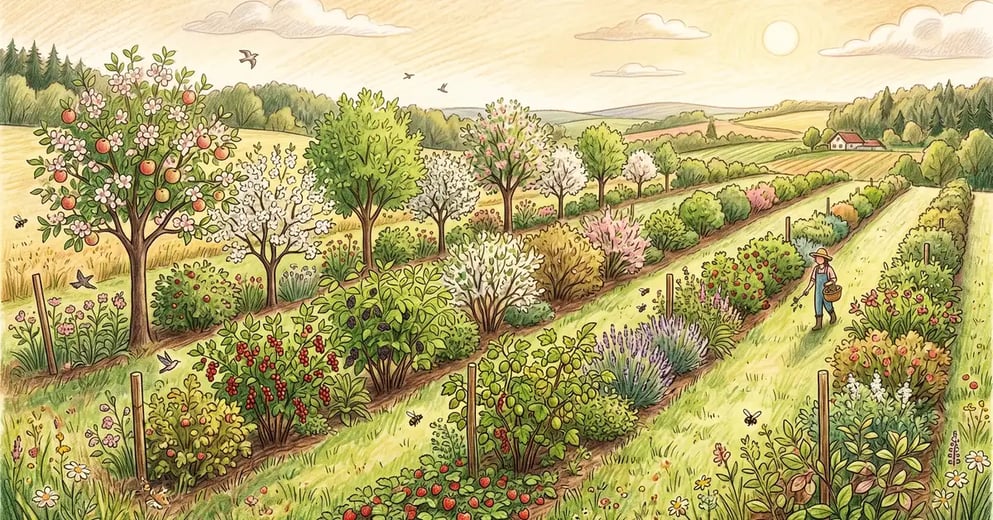
Syntropic row design is not free-form companion planting. It is a deliberate spatial pattern: dense lines of carefully sequenced species running parallel across the site, with managed alleys between rows for access and annual crops. Get the spacing wrong and you either crowd the trees into competing for water, or you waste land that should be filling with biomass. Get the species sequence wrong and the system stalls in mid-succession. The next 1,800 words give you the dimensions and the species list.
Key Takeaway
A syntropic row is a dense linear polyculture packed with species from four strata, planted at 30 to 50 cm (12 to 20 in) intervals along the row, with 15 to 30 ft alleys between rows. Orient rows east to west in temperate climates so morning and afternoon sun reaches both sides equally. Manage the system through 3 to 4 chop-and-drop cycles per year and species rotation as the canopy closes.
The Four Strata in a Syntropic Row
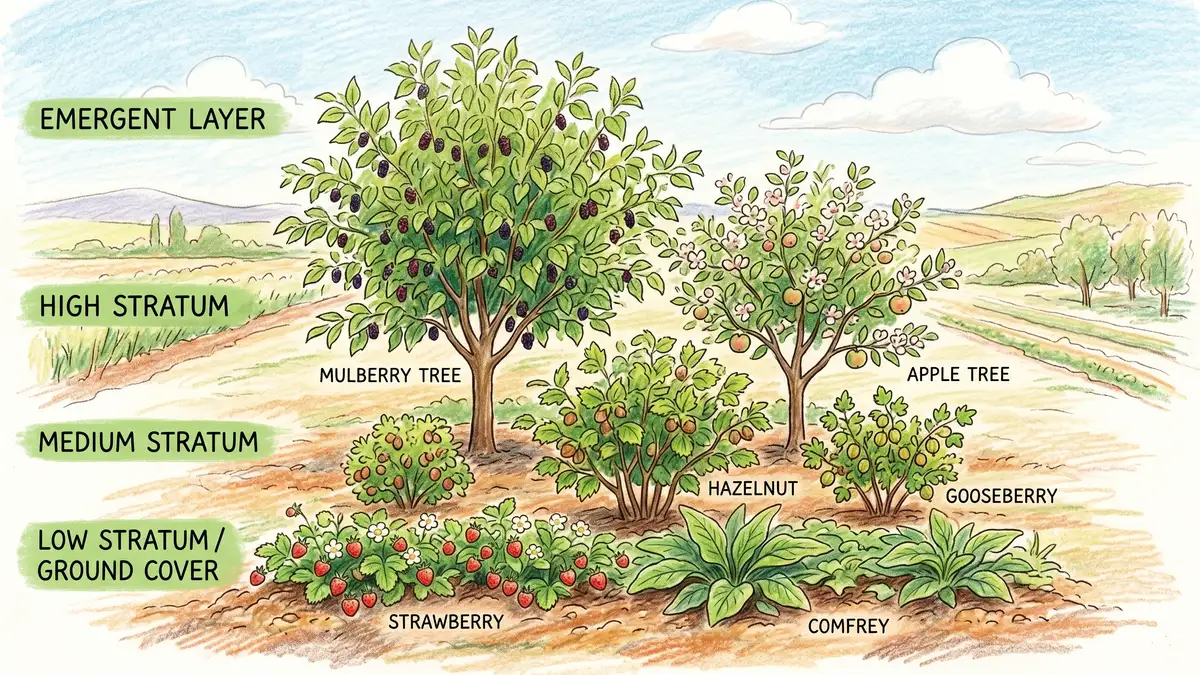
Götsch's vocabulary, published on Agenda Gotsch, organises every plant in a row by stratum: a vertical position determined by mature height, light demand, and lifespan. Each stratum is filled with multiple species so the row never has bare niches.
| Stratum | Mature Height | Light Demand | Temperate Examples (Zones 5-8) | Role |
| Emergent | 40+ ft / 12+ m | Full sun | Black walnut (with caveats), oak, chestnut | Long-lived canopy, climate stabilisation |
| High | 15-30 ft / 5-9 m | Full sun | Apple, pear, plum, mulberry, persimmon | Primary food production |
| Medium | 6-15 ft / 2-5 m | Partial sun | Hazelnut, elderberry, currant, gooseberry, jostaberry | Berry production, biomass |
| Low | 0-6 ft / 0-2 m | Partial shade tolerant | Strawberry, comfrey, garlic, sweet potato, asparagus | Ground cover, root crops, dynamic accumulators |
Sources:
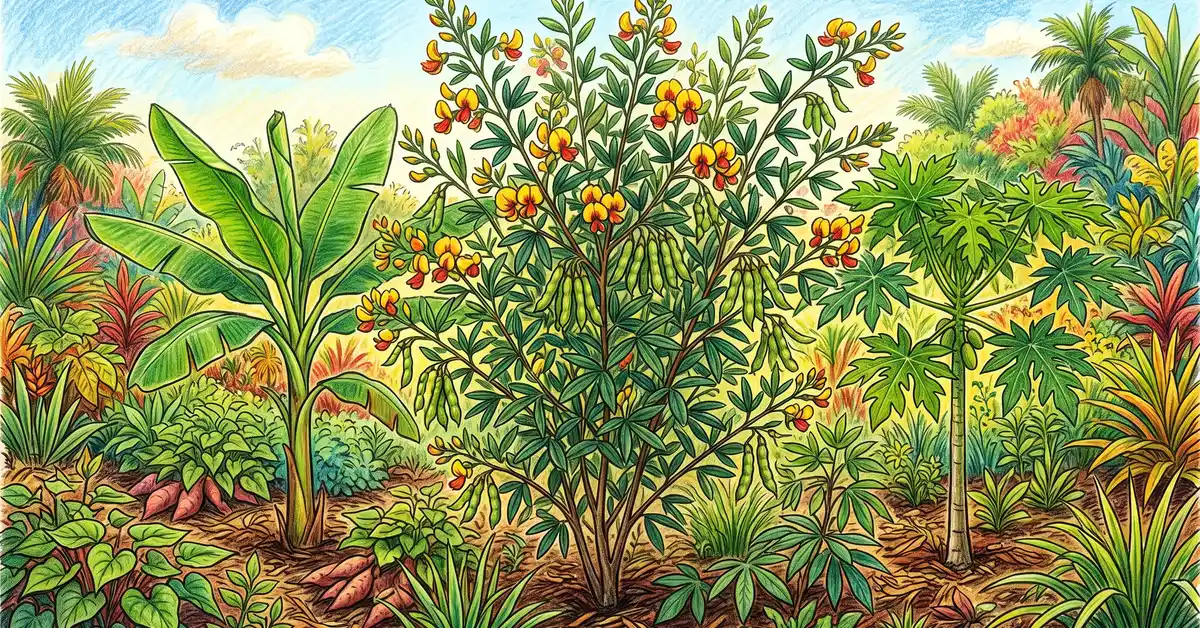
Critical detail temperate growers miss: in tropical climates Götsch fills strata with fast-growing biomass species (banana, eucalyptus, pigeon pea) that turn over annually. In temperate zones we substitute with mulberry, willow, alder, autumn olive (where not invasive), and elderberry, which coppice well and rebuild biomass from cuts. The same principle, slower clock. The relationship between strata and succession is covered more fully in our piece on natural succession in the garden, and the underlying ecological logic comes straight from core permaculture design principles applied at scale.
Inter-row Spacing: 4 m, 6 m, 8 m, or 12 m?
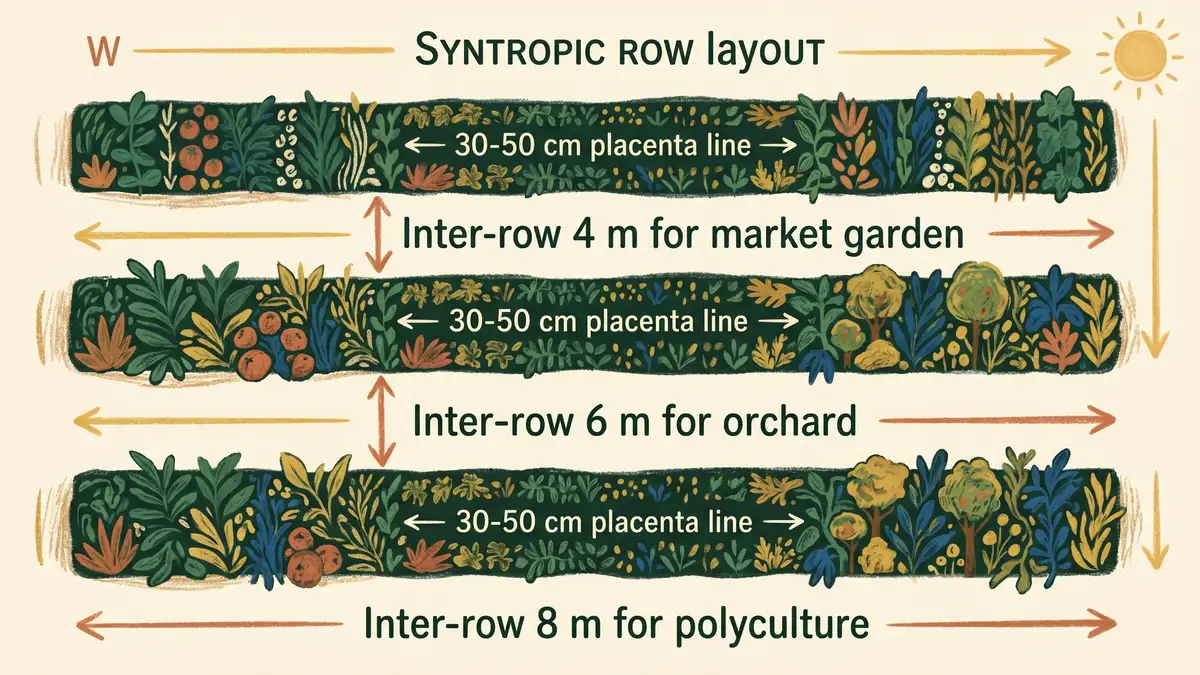
The single most consequential design decision is alley width. Get it wrong and the system either chokes itself in shade or wastes land. Mountain Time Farm's syntropic guide recommends 15 to 30 feet (4.5 to 9 m) inter-row spacing depending on equipment and crops, and USDA Forest Service alley cropping documentation covers the standard agroforestry equivalents.
| Inter-row Spacing | Use Case | Equipment | Trade-off |
| 4 m / 13 ft | Market garden + tree rows | Hand tools, walk-behind | Heavy shade by year 5; crop alley shrinks |
| 6 m / 20 ft | Orchard rows + cover crop | Compact tractor, BCS walking tractor | Balanced productivity, most common for homesteads |
| 8 m / 26 ft | Mixed perennial polyculture | Standard tractor | More usable alley sun; longer time to canopy closure |
| 12 m / 39 ft | Broadacre alley cropping | Full-size farm equipment | Maximises annual crop output, slower succession |
Sources:
For most homestead and small market garden contexts, 6 m (20 ft) is the workhorse number. It accommodates a BCS walk-behind tractor, lets you cycle annual crops in the alley for the first 4 to 6 years, and produces a closed canopy by year 8 to 10 that needs aggressive pruning rather than mowing.
In-row Density: Why 30 to 50 cm Spacing Is Non-Negotiable
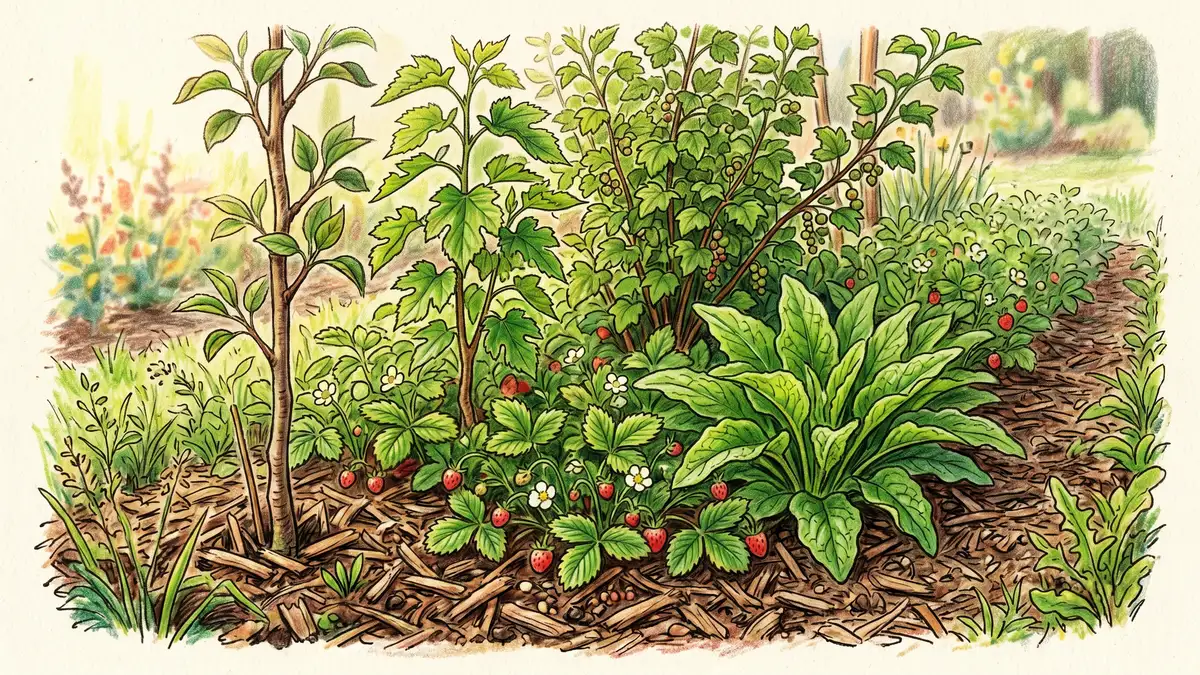
This is where syntropic design diverges sharply from conventional orchard or alley cropping. Inside the row itself, plants are packed close: 30 to 50 cm (12 to 20 in) apart along the line, often closer for biomass species. The Brazilian term is linha de placenta, the placenta line: a dense seedbed that nurses the slower production species while pioneer biomass plants race through their lifecycles and are cut back.
The density is not optional. It does three things at once: shades and protects the soil during establishment, generates biomass for the first chop-and-drop cycles, and triggers the natural successional response that drives the system. A 2025 study published in Frontiers in Sustainable Food Systems found that wide-narrow row configurations combined with high-density planting optimise agronomic performance, economic returns, and resource use efficiency, the same logic Götsch applied empirically decades earlier.
Why This Works: Disturbance and Succession
Natural forests do not establish in tidy spacing. They establish in dense pioneer communities that self-thin through competition and disturbance. Syntropic row planting mimics that pattern: many species enter together, the fastest grow first and shade the soil, the practitioner harvests biomass to mimic natural disturbance, and the slower production species emerge into the gaps. Density plus disturbance equals succession. Without density there is no biomass to cut. Without cutting there is no succession. The two are inseparable.
Row Orientation, Slope, and Water
Two rules consistently come from temperate practitioners. Orient rows east to west on flat or gently sloping land so morning and afternoon sun reach both row faces, and orient rows on contour on slopes greater than 5% to slow water and stop erosion. The two rules conflict on east-west slopes; on those sites, follow contour and accept partial-day shading.
If you build swales along the row line, treat the swale as an integral part of the row architecture. Plant the placenta line on the downslope berm of the swale, where buried wood (hugel-style) and trapped water provide the moisture pulse that drives the dense planting through its first season. Propagate Ag's cold-climate syntropic guide has good visuals of slope-and-row interactions.
A Worked Temperate Row: Species and Sequence
For a homesteader in zones 5 to 8 building a single 50 ft (15 m) row with 6 m (20 ft) inter-row spacing, here is the species list and sequence that practitioners report establishes successfully. Start with bare soil, add 4 inches of wood chips, and plant the line in late spring after last frost.
Year 1 placenta line: dense pioneer planting
Along the 50 ft row, alternate every 30 to 40 cm: mulberry whips, elderberry cuttings, comfrey crowns, sunflower seeds, sun hemp (where hardy), bean seeds. This generates the first wave of biomass. Heavy mulch on the spaces between plants. Annual cover crops (rye, vetch) fill any gaps.
Year 1 anchor planting: production species
Tucked between the pioneers at roughly 8 to 10 ft (2.5 to 3 m) intervals: 5 high-stratum production trees (e.g., 2 apple, 1 plum, 1 pear, 1 mulberry kept for fruit). Between each fruit tree, 1 medium-stratum berry shrub (currant, gooseberry, hazelnut). At ground level: strawberry, asparagus, garlic, perennial herbs.
Year 1 first chop-and-drop (late summer)
Cut the sun hemp, sunflowers, and any beans to ground level. Spread cut material along the row as mulch. The first biomass cycle has fed the soil. Pioneer shrubs (mulberry, elderberry) keep growing.
Year 2 to 3: aggressive pruning of biomass shrubs
Mulberry and elderberry now need 2 to 3 cuts per year. Use a curved blade (foice) or pole pruner. Each cut returns nutrients to the row. Production trees enter their second-year growth, currants begin bearing.
Year 4 to 6: succession transition
Selective removal of biomass species (or hard coppicing to ground) opens light to production trees as they reach bearing age. Replace removed pioneers with longer-lived species: hazelnut for medium stratum, oak or chestnut for emergent canopy. The system shifts from biomass production to food production while staying densely planted.
Year 7+: mature production with maintenance pruning
Canopy closure, fruit harvest dominates. Annual chop-and-drop continues at lower intensity. Maintenance pruning replaces aggressive coppicing. The alley between rows transitions from annual crops to shade-tolerant perennials or pasture.
Pruning Schedule and Tools
Syntropic rows demand pruning, not because the trees need it for fruit, but because the system needs disturbance to drive succession. Mountain Time Farm identifies disturbance alongside stratification, succession, density, and diversity as the five core principles, and pruning is your scheduled disturbance.
| Tool | Use | Replaces |
| Foice (Brazilian curved blade) | Cut soft biomass shrubs (mulberry, elderberry, sun hemp) at ground level or at a node | Brush cutter, machete |
| Pole pruner / loppers | Reach high biomass cuts on mulberry suckers, willow regrowth | Standing on ladders |
| Hand pruners (Felco 2 or similar) | Production tree maintenance, fine work on currants/gooseberries | None, daily tool |
| Hand sickle / scythe | Cut herbaceous biomass, comfrey, taller cover crops | Mower for in-row work |
| Rake (wide tine) | Spread chopped material along the row evenly | None, finishes every cut |
Sources:
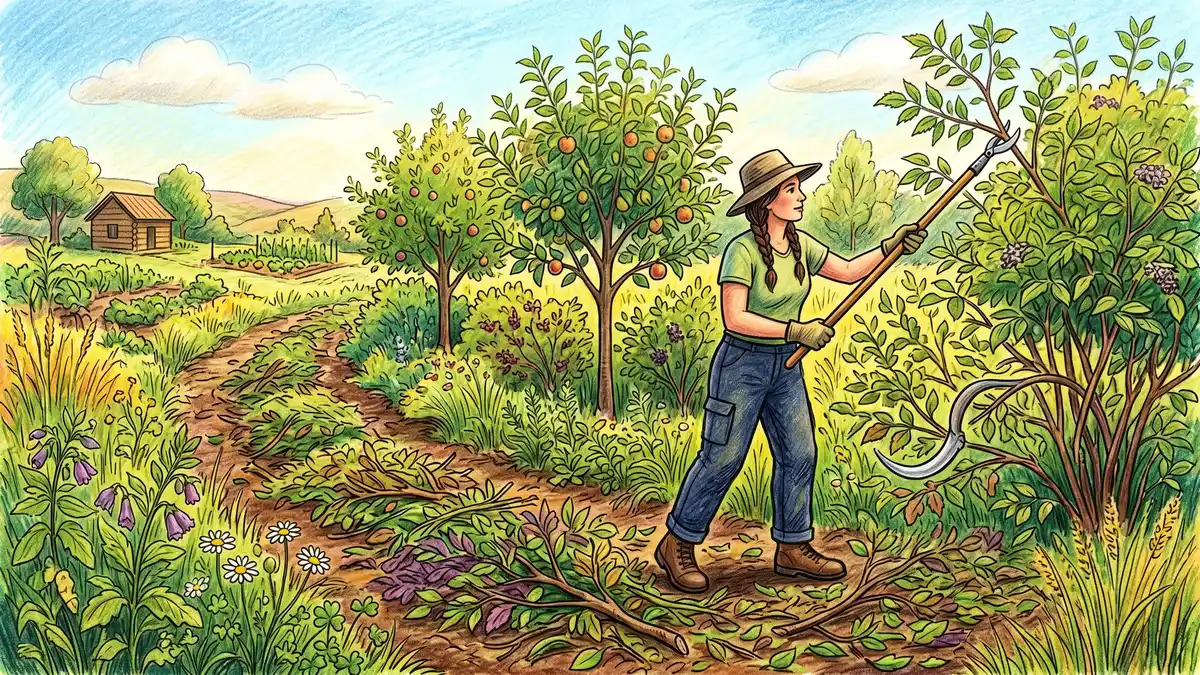
The tempo for a 50 ft temperate row is roughly 3 to 4 cycles per growing season: one in late spring, one mid-summer, one late summer, and a light final cut in autumn. Each cycle takes 30 to 60 minutes once you have the rhythm. Read more about the technique in our deep dive on chop-and-drop mulching.
Five Row Design Mistakes to Avoid
Common Mistake to Avoid
Skipping the placenta line. Newcomers often plant production trees at orchard spacing and add a few biomass shrubs as an afterthought. This is not syntropic, it is just an orchard with extra plants. Without a dense placenta line, you have no biomass to cut, no soil shading, and no succession driver. Plant dense first, thin later.
The other four mistakes appear in practitioner debriefs and the PMC alley cropping spacing study from Hungary:
Inter-row alleys too narrow. Anything under 4 m (13 ft) closes canopy by year 4 and forces you out of the alley. For most temperate gardeners, 6 m is the floor.
Skipping the eastern-western orientation. North-south rows put one side in deep shade through afternoon, halving production from the shaded face. East-west rows balance light. Only deviate if slope contour requires it.
Using slow-establishing pioneers in cold climates. Tropical syntropic systems lean on banana, papaya, pigeon pea. None of those work in zones 5 to 8. Use mulberry, willow, alder, elderberry, sea buckthorn, autumn olive (where not invasive), and Siberian peashrub instead.
Not pruning aggressively enough. The most common temperate-climate failure is treating biomass shrubs like ornamentals. Mulberry and elderberry need 2 to 3 hard cuts per growing season. Without that disturbance the system stalls and the biomass becomes a shade problem rather than a soil-feeding asset.
For a fuller comparison of approaches see our piece on syntropic agriculture vs permaculture key differences, and for the full first-time setup walk our how to start a syntropic garden guide. Once your row is functioning, the deeper companion-planting framing in syntropic agroforestry: trees + annual crops covers what to grow in the alley between rows. For a single-tree analogue at homestead scale, the apple tree guild article applies the same stratum-and-density logic to one fruit tree rather than a row.
Frequently Asked Questions
What is syntropic agroforestry?
Syntropic agroforestry is a regenerative agriculture system developed by Swiss-Brazilian farmer Ernst Götsch on his 1,200-acre farm in Bahia, Brazil. It uses dense polyculture rows organised by ecological strata (emergent, high, medium, low) and managed through scheduled pruning to mimic natural forest succession. The system produces food, biomass, and soil organic matter simultaneously while requiring no external fertiliser inputs once established.
How wide should syntropic rows be?
Inter-row alleys typically range from 4 m (13 ft) to 12 m (39 ft) depending on use case. Market gardens often use 4 m, homestead orchards use 6 m (the most common), mixed perennial polycultures use 8 m, and broadacre alley cropping uses 12 m. In-row plant spacing along the placenta line stays much denser, typically 30 to 50 cm (12 to 20 in) regardless of inter-row width.
What direction should syntropic rows run?
On flat or gently sloping land, orient rows east to west so morning and afternoon sun reach both row faces equally. On slopes greater than 5%, follow contour to slow water and prevent erosion, and accept the asymmetric shading that results. Where the two rules conflict, contour wins, soil retention is non-negotiable.
What plants go in a temperate-climate syntropic row?
For zones 5 to 8: emergent stratum could be oak, chestnut, or black walnut (with juglone caveats). High stratum is apple, pear, plum, mulberry, persimmon. Medium stratum is hazelnut, currant, gooseberry, jostaberry, elderberry. Low stratum is strawberry, comfrey, garlic, sweet potato, asparagus, perennial herbs. Pioneer biomass shrubs include mulberry, willow, alder, elderberry, sea buckthorn, and Siberian peashrub. Avoid tropical species like banana and pigeon pea outside zones 9+.
How is syntropic agroforestry different from alley cropping?
Both involve parallel tree rows with crops in alleys, but syntropic rows are radically denser, multi-stratum, and managed through scheduled pruning to drive succession. Standard alley cropping (USDA National Agroforestry Center definition) typically uses single-species or sparse tree rows for windbreak, timber, or nuts, with mostly bare understory and conventional alley crop management. Syntropic systems treat the row itself as the productive unit; alley cropping treats the alley as productive and the trees as supporting infrastructure.
How often do you prune a syntropic row?
Three to four pruning cycles per growing season for a temperate-climate row, more for tropical. Late spring, mid-summer, late summer, and a light autumn cut. Each cut targets specific species: early-season cuts hit fast biomass producers like sun hemp and sunflower; mid-season hits coppicing shrubs like mulberry and elderberry; late-season cleanup includes any annual cover crops in the alley. The system is high labour in years 1 to 5 and lower labour from year 7 onward.
How long until a syntropic row is productive?
Year 1 produces biomass and starts the soil cycle. Year 2 to 3 brings first berries from currants and gooseberries. Year 4 to 6 brings first significant fruit yields from apple, pear, plum. Year 7+ is full canopy productivity. The system is fastest in tropical climates (3 to 5 years to full production) and slower in temperate (7 to 10 years), but the trajectory is consistent across both.
Once the row is planted, what a first-year row actually produces covers the harvests, pruning and workload of the opening season.
Get the Weekly Dig
One practical permaculture guide a week, written for gardeners who do this on weekends: food forest and guild designs that produce. Free, no spam, unsubscribe any time.
Join the Weekly DigResources
- Agenda Gotsch: What Is Syntropic Farming?
- Mountain Time Farm: The Principles of Syntropic Agroforestry
- Mountain Time Farm: Designing and Implementing a Syntropic Agroforestry System
- Mountain Time Farm: How to Get Started with Syntropic Agroforestry
- USDA Forest Service National Agroforestry Center: Alley Cropping (PDF)
- University of Missouri Center for Agroforestry: Alley Cropping Training Manual (PDF)
- University of Missouri AgEBB: Alley Cropping Overview
- Frontiers in Sustainable Food Systems (2025): Wide-Narrow Row Configuration and High-Density Planting
- PMC: Effect of Tree Spacing on Yields in Alley Cropping Systems (Hungary case study)
- Propagate Ag: Cold Climate Syntropic Agriculture
- Propagate Ag: Alley Cropping with Forage Crops
- Rancho Mastatal: How to Optimise Your Syntropic Agroforestry Site