Most food forest advice is written for temperate climates, where the enemy is cold and the reward for patience is a system that slowly closes canopy. In the subtropical Southeast the problem inverts. Growth is not the constraint. Everything grows, constantly, including the things you did not plant.
A food forest in Florida or along the Gulf Coast is a genuinely different design problem, and the three things that decide whether yours works are sand, storms and disease. Get those right and the species list almost writes itself.
What Makes a Subtropical Food Forest Different?
There is no dormancy. A temperate food forest gives you four months off. A subtropical one does not, which means year-round pest pressure, year-round pruning, and year-round competition from vines and volunteers. Extension publications on banana, papaya and guava all stress continuous observation for exactly this reason.
The second difference is underfoot. Much of Florida is sand with very low organic matter, and in heat and humidity that organic matter burns off almost as fast as you can add it. UF/IFAS soil work has documented how quickly nitrate moves down through the profile on sandy soils left without cover. Fertilizer applied to bare sand is largely a donation to the aquifer.
What you'll get out of this guide:
- Which species actually hold up by layer, with cold tolerances
- Why lychee survives hurricanes and avocado does not
- The citrus decision nobody wants to make
- How to build organic matter in soil that eats it
Key Takeaway
Design for the storm, not the harvest. UF/IFAS wind research recommends roughly 30 by 30 feet (9.1 by 9.1 m) of rooting space for a large tree and at least 3 feet (0.9 m) of uncompacted rooting depth. Crowded canopy trees on shallow soil are what you lose first.
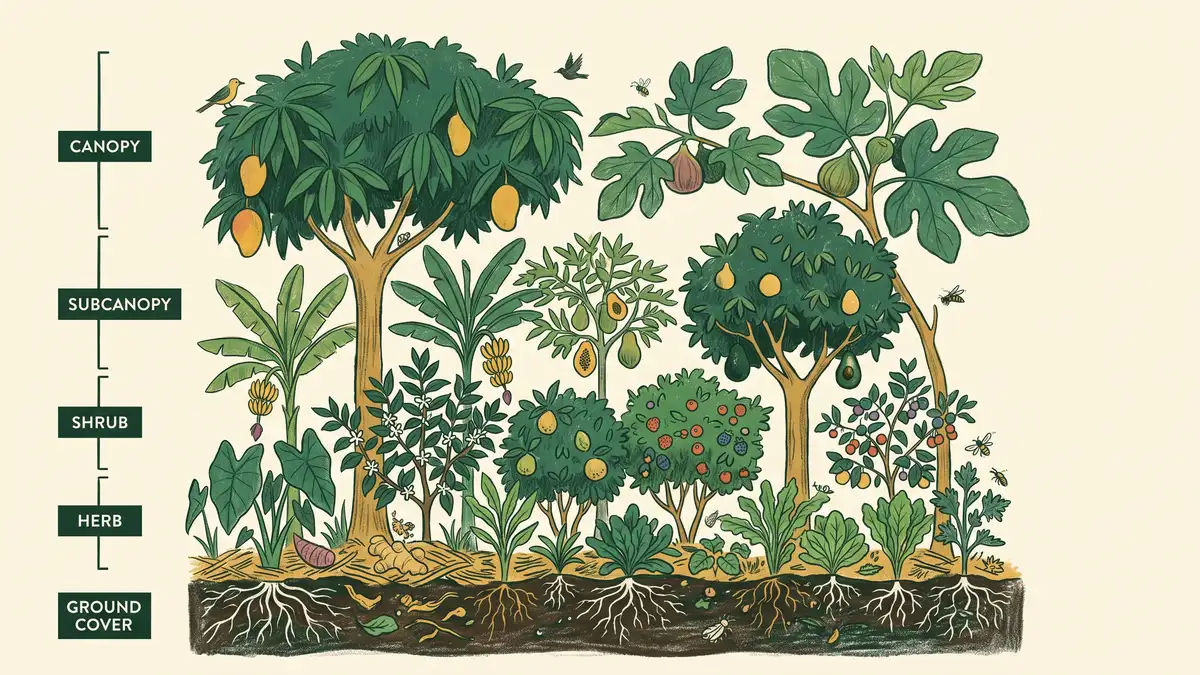
Which Species Work in Each Layer?
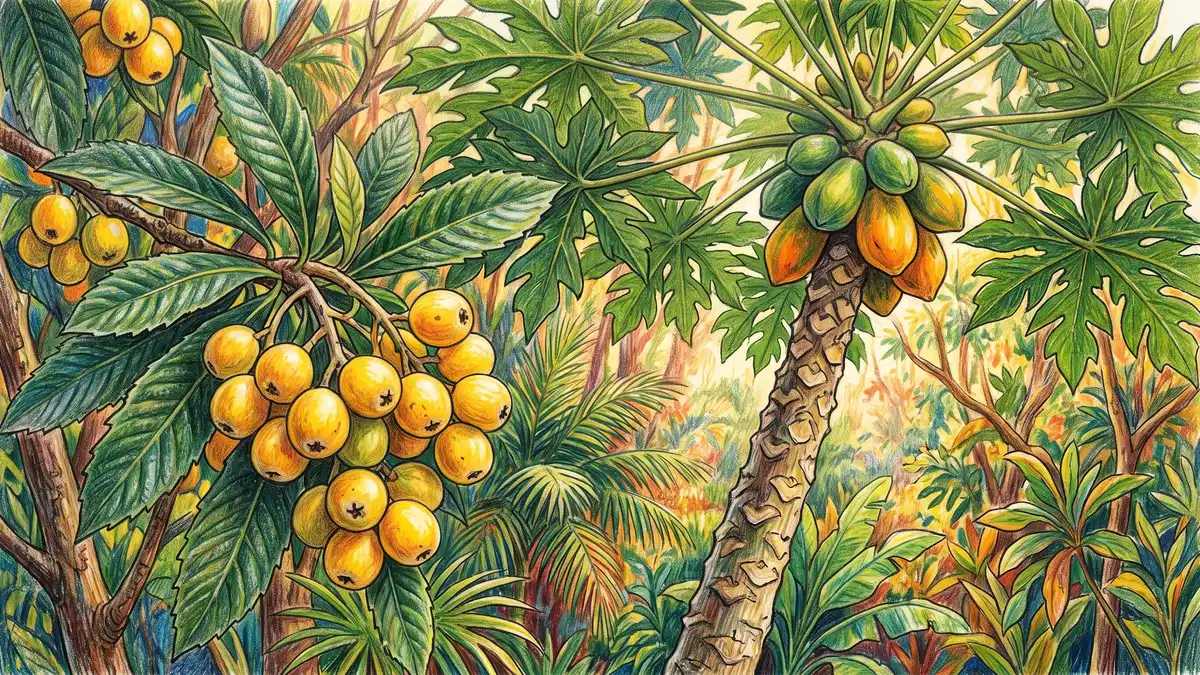
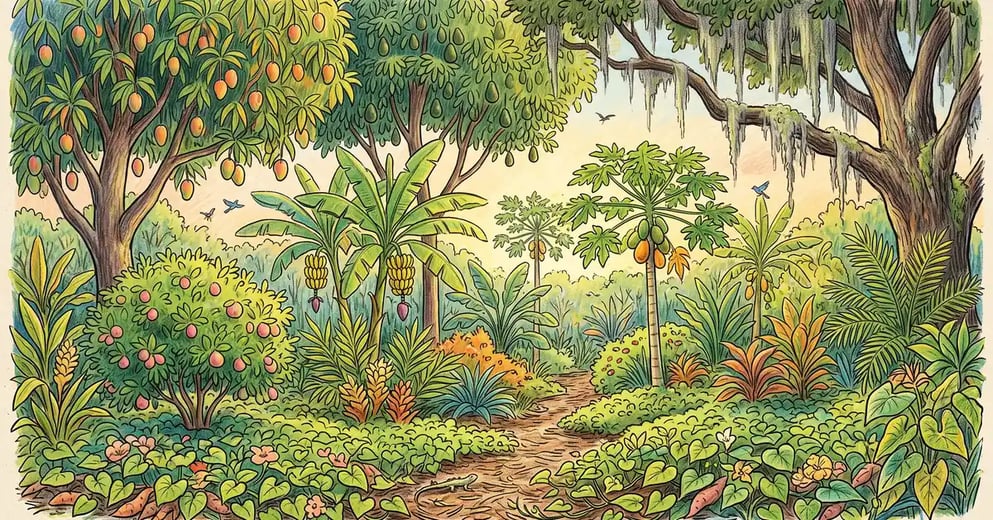
Zone matters enormously here. A mango is a canopy tree in Miami and a dead stick in Tallahassee. Loquat is the most underrated tree in the region, hardy to roughly 12°F (-11°C), though its flowers are damaged around 27°F (-2.8°C), which is why northern growers get a tree but not always a crop.
| Species | Layer | Cold Limit | Years to Fruit |
| Mango | Canopy | Injured near 32 F (0 C) | 3-5 grafted |
| Avocado | Canopy | Damaged below 30 F (-1 C) | 3-4 grafted |
| Lychee | Canopy | Injury in the mid-20s F | 4-7 |
| Loquat | Subcanopy | Hardy near 12 F (-11 C) | 2-3 |
| Banana | Subcanopy | Foliage burns near freezing | 1-2 |
| Papaya | Shrub | Frost sensitive | Under 1 |
| Pigeon pea | Shrub | Frost sensitive, resows | Under 1 |
Sources: UF/IFAS EDIS MG216, UF/IFAS Circular 1034, UF/IFAS EDIS MG040, UF/IFAS FR173.
Papaya and banana are the fastest route to actual food while the slow trees establish. Both fruit within a year or two, both produce enormous quantities of soft biomass, and both are effectively disposable, which in a hurricane zone is a feature.
Before you plant anything non-native, check it. UF/IFAS runs a formal Assessment of Non-Native Plants in Florida's Natural Areas, and guava in particular carries regional restrictions. Planting an invasive into a system designed to spread itself is a mistake that outlives you.
How Do You Design for Hurricanes?
This is where subtropical food forest design departs hardest from the textbooks. Post-hurricane surveys summarised by UF/IFAS rank fruit trees by wind resistance, and the results are inconvenient: lychee ranks among the most wind resistant, and avocado among the least.
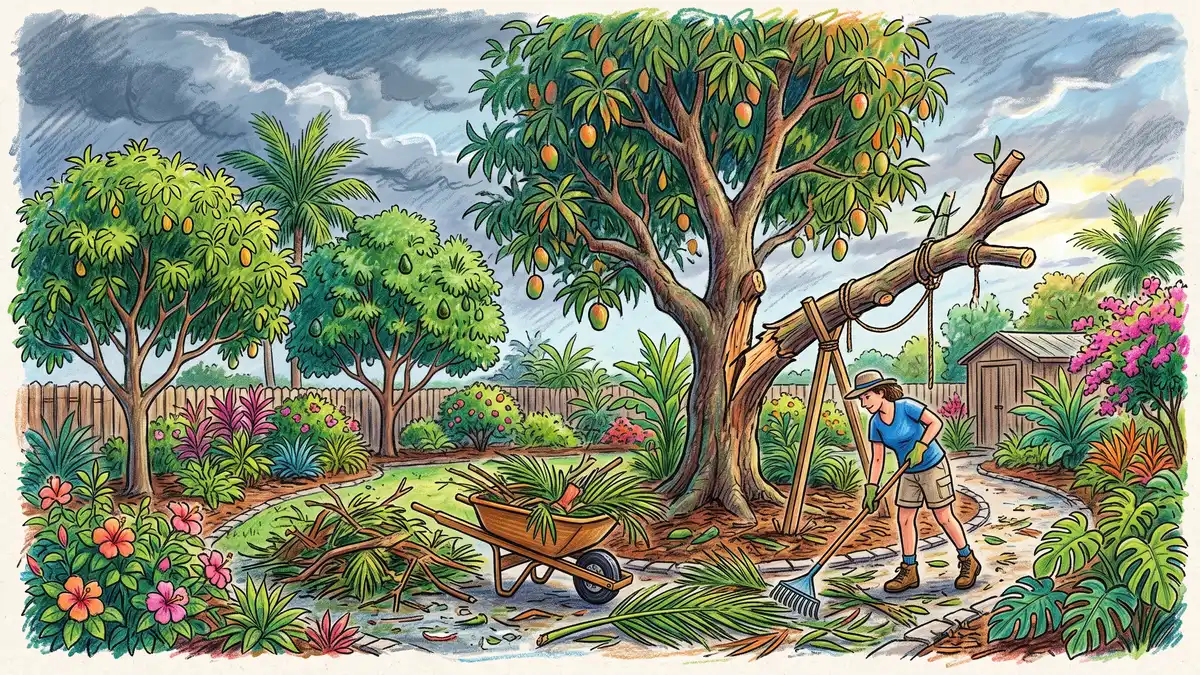
That does not mean skip avocado. It means do not make avocado the backbone of your canopy, keep it pruned low and open, and give it the deep uncompacted root run the guidance calls for. A dense unpruned canopy on 2 feet (0.6 m) of soil over hardpan is a sail on a shallow anchor.
Think Hard Before Planting Citrus
Citrus greening, or HLB, has changed the calculation for dooryard citrus in Florida. UF/IFAS citrus guidance calls for regular scouting and prompt removal of infected trees to limit spread of the pathogen and its psyllid vectors. A citrus tree in a food forest is a long-term monitoring commitment, not a plant-and-forget layer. Plenty of experienced Florida growers now put that space into loquat, mulberry or jaboticaba instead.
How Do You Build Soil That Keeps Disappearing?
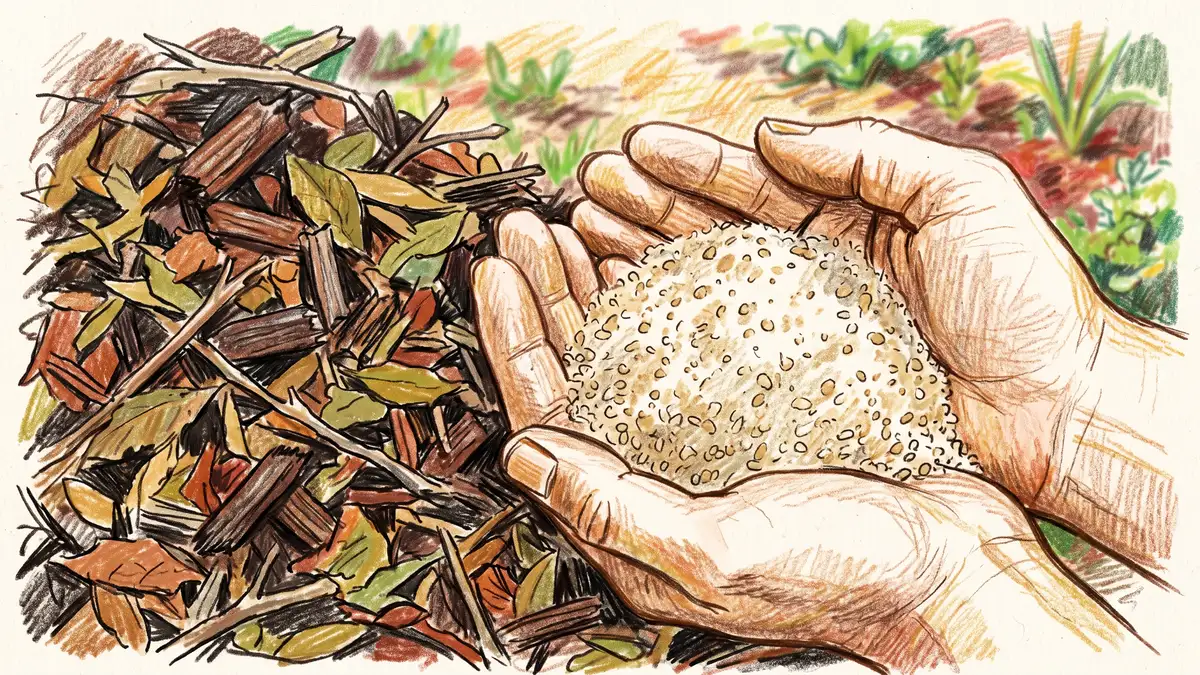
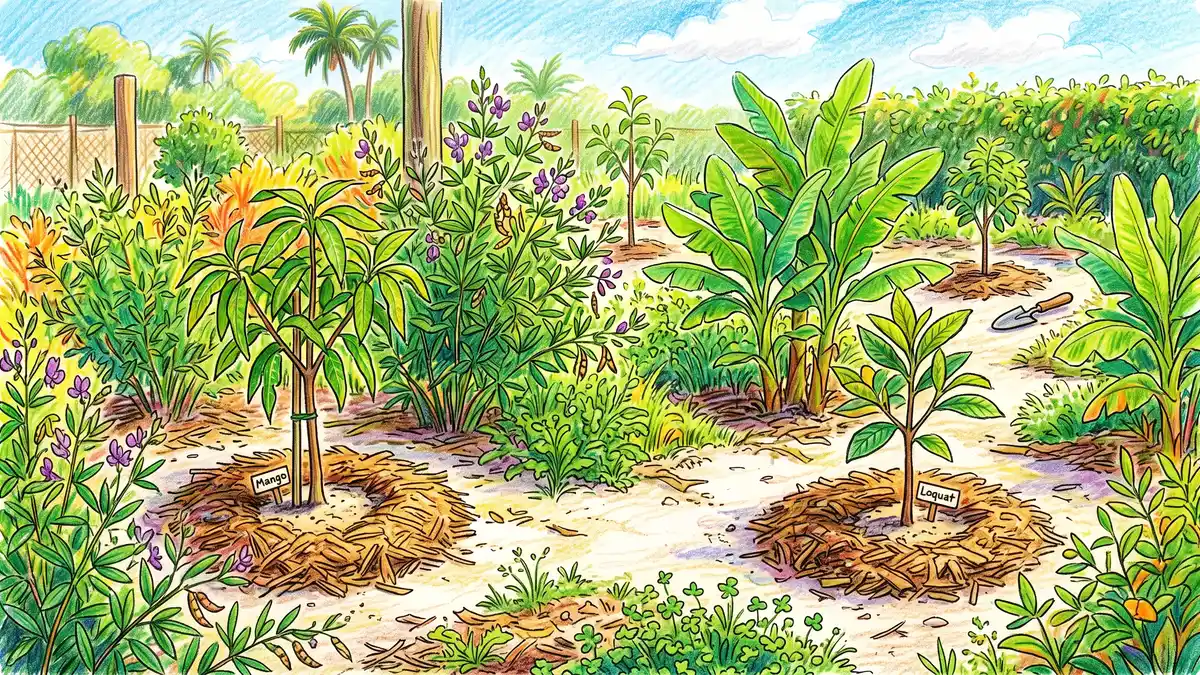
Continuously, and mostly with plants rather than purchases. In a climate where decomposition runs year-round, a one-time compost application is gone within a season. What works is a permanent living cover plus a steady biomass supply grown on site.
That is why pigeon pea, banana and cassava earn their place regardless of yield. They generate cuttable biomass fast, so your mulch arrives free and continuously rather than by the truckload. Sweet potato and perennial peanut hold the ground between them. This is chop-and-drop doing the heavy lifting, and it is the practice that makes subtropical systems viable at all.
Why This Works: Closing the Loop
A tropical forest sits on famously poor soil, and it works because almost none of the nutrient stock is in the ground. It is in the living biomass, cycling continuously through leaf fall and decay. Your sandy site is telling you the same thing: stop trying to store fertility in the soil and start storing it in standing plants you can cut. That is the shift from feeding a garden to running an ecosystem.
Drainage deserves a mention too. On flatwoods sites with a high water table, wet season ponding kills trees that will not tolerate saturation. UF/IFAS avocado guidance is blunt about planting only where water does not stand after typical summer rain. Mounding canopy trees 12 to 18 inches (30 to 46 cm) above grade is cheap insurance. Our food forest site assessment guide covers how to test this before you plant.
Frequently Asked Questions
How long until a Florida food forest produces?
Faster than a temperate one. Papaya fruits within a year and banana within one to two, so a well-planned system gives you real harvests in season one rather than season five. Loquat follows at two to three years, mango and avocado at three to five from grafted stock, and lychee at four to seven. The approach that works is planting all of those simultaneously so the fast producers carry you while the canopy establishes, which also gives you the biomass to mulch the slow trees.
Can I grow apples or peaches in the Southeast?
Peaches yes, apples marginally. It depends on chill hours, the accumulated cool time a temperate fruit needs to break dormancy properly. Low-chill peach and nectarine cultivars have been bred specifically for zones 8b and 9 and perform well across much of the northern Gulf Coast and north Florida. Standard cultivars bred for the Midwest will leaf out erratically and set poorly. Check the chill hour requirement of the specific cultivar against your local averages before buying.
What about nematodes?
Root-knot nematodes are a genuine constraint in sandy Southeast soils and they do not go away. The perennial system has an advantage here, because you are not replanting susceptible annuals into the same ground each season. Practical management is choosing resistant rootstocks where available, keeping organic matter and soil biology as high as your climate allows, and avoiding highly susceptible species in known hot spots. There is no home-scale eradication option, so design around them.
Is it really more work than a temperate food forest?
Yes, and anyone telling you otherwise has not maintained one through a Gulf Coast August. There is no dormant season to catch up in, growth rates mean pruning is continuous, and vine pressure is relentless. The compensation is that the same conditions produce fruit in a fraction of the time and let the system recover from damage quickly. Budget for year-round light maintenance rather than seasonal bursts.
How many species should I start with?
Fewer than you want to. Diversity protects against catastrophic loss, which matters when a single hurricane or freeze can take out a layer, but twenty unfamiliar species planted at once is twenty things to learn simultaneously. Start with six to eight proven performers across the layers, learn how they behave on your site, then add. The seven layers framework is a design tool, not a shopping list you must complete in year one.
Get the Weekly Dig
One practical permaculture guide a week, written for gardeners who do this on weekends: food forest and guild designs that produce. Free, no spam, unsubscribe any time.
Join the Weekly DigResources
- UF/IFAS FR173 — Wind and trees, hurricane resistance
- UF/IFAS Circular 1034 — Avocado in the Florida home landscape
- UF/IFAS MG216 — Mango growing in the Florida home landscape
- UF/IFAS MG040 — Banana growing in the Florida home landscape
- UF/IFAS MG045 — Papaya growing in the Florida home landscape
- UF/IFAS CG086 — Florida citrus production guide
- UF/IFAS Assessment — Guava (Psidium guajava)
- UF/IFAS Assessment — Perennial peanut (Arachis glabrata)
- UF/IFAS Soil and Water Sciences — Nitrate leaching on sandy soils
- UF/IFAS News (2026) — Cold-hardy avocado breeding trials
- UF/IFAS Gardening Solutions — Jaboticaba
- UF/IFAS Gardening Solutions — Pineapple guava