
You grew more than you can eat. That is the good problem, and a root cellar is the oldest answer to it: a space that holds a fall harvest through winter on nothing but soil temperature and airflow. No compressor, no freezer burn, no power bill. Jerusalem artichokes that store best in the ground
The catch is that a root cellar is not one climate. It is at least two, and putting the wrong crop in the wrong corner turns a season of work into a bin of compost by January.
What Is a Root Cellar, and Does It Need to Be a Cellar?
A root cellar is any space that stays cold without freezing and holds humidity without going mouldy. Traditionally that meant a chamber dug into a hillside or under a house, using the stable temperature of the soil below frost depth. It does not have to be that. University of Alaska Fairbanks Cooperative Extension notes that many families meet their winter storage needs with a walled-off section of a basement or garage roughly 4 by 6 feet (1.2 by 1.8 m) with a window for ventilation.
Two numbers run the whole system. Temperature, and relative humidity. Get those right for each crop group and everything else is housekeeping.
What this guide covers:
- The four storage zones and which crop belongs in each
- Extension temperature, humidity and shelf-life numbers you can plan around
- Curing, which is where most storage failures actually begin
- Which crops poison each other with ethylene
- Cellar ventilation, and five alternatives if you cannot dig one
Key Takeaway
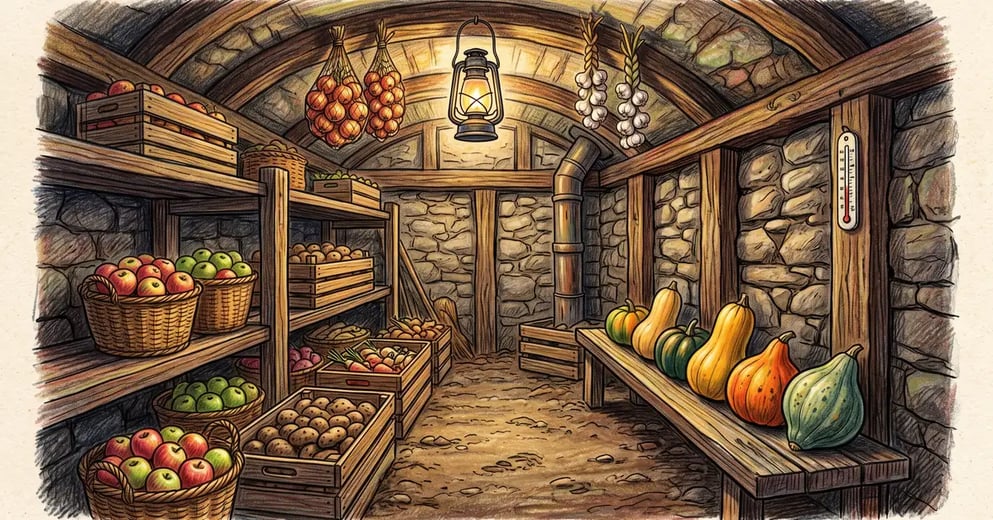
Think in four zones, not one room. Cold and damp for roots and cabbage, cold and dry for onions and garlic, cool and dry for winter squash and pumpkins, and apples isolated from everything because they gas off ethylene. A shelf near the floor and a shelf near the ceiling in the same space will often give you two of those zones for free.
What Temperature and Humidity Does Each Crop Need?
This table is the working core of the article. Numbers are from extension storage tables, and the spread reflects genuine variation between cultivars and harvest maturity.
| Crop | Temperature | Humidity | Storage Life |
| Carrots (topped) | 32 F (0 C) | 90-100% | Up to 5-6 months |
| Beets, turnips, parsnips | 32 F (0 C) | 90-95% | 3-5 months |
| Cabbage | 32-38 F (0-3 C) | 90-100% | 3-6 months |
| Potatoes (late crop) | 38-40 F (3-4 C) | 85-95% | 5-10 months |
| Onions, garlic | 32-40 F (0-4 C) | 60-70% | 4-8 months |
| Winter squash | 50-60 F (10-16 C) | 50-70% | 3-5 months |
| Pumpkins | 50-55 F (10-13 C) | 50-70% | 2-5 months |
| Sweet potatoes | 55-60 F (13-16 C) | 85-90% | 4-7 months |
| Apples | 30-40 F (-1 to 4 C) | 90-95% | 1-12 months |
| Pears | 29-31 F (-2 to -1 C) | 90-95% | 2-7 months |
Sources: University of Maine Cooperative Extension Bulletin 4135, University of Alaska Fairbanks CES, Michigan State University Extension
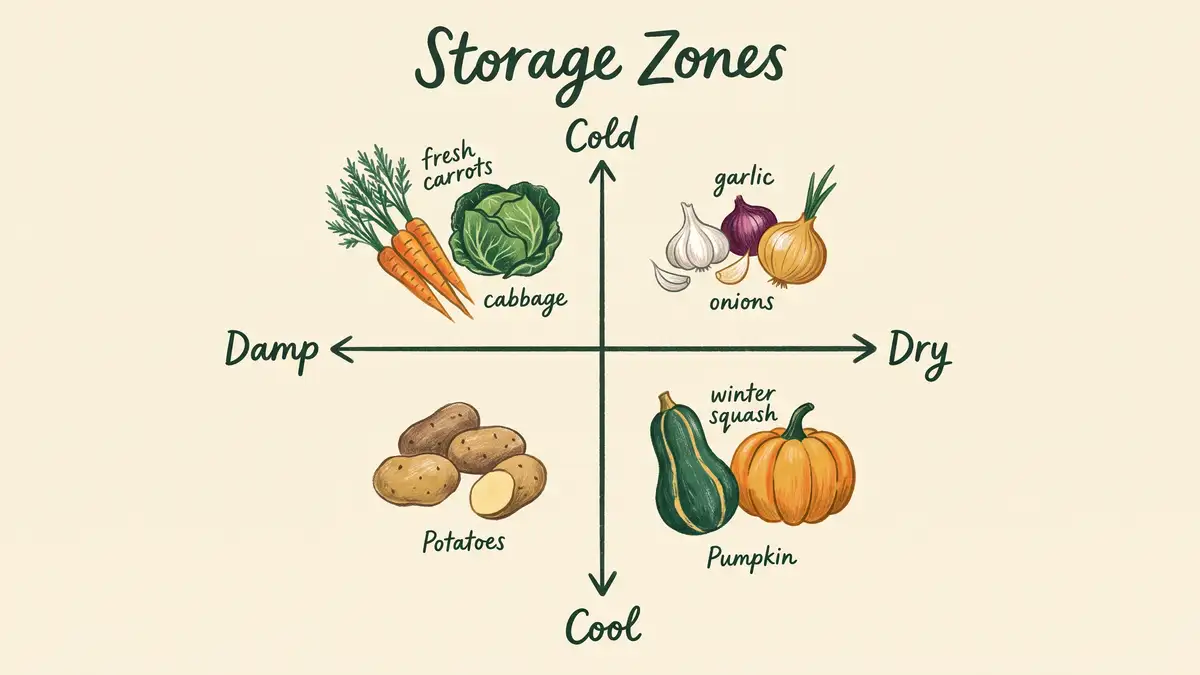
Note the split. Roots and cabbage want it cold and nearly saturated. Squash and pumpkins want it a full 20 degrees warmer and half as humid. Onions sit in the odd corner of cold but dry. If your storage is one uniform box, something is going to be unhappy.
Why Does Curing Matter More Than the Cellar?
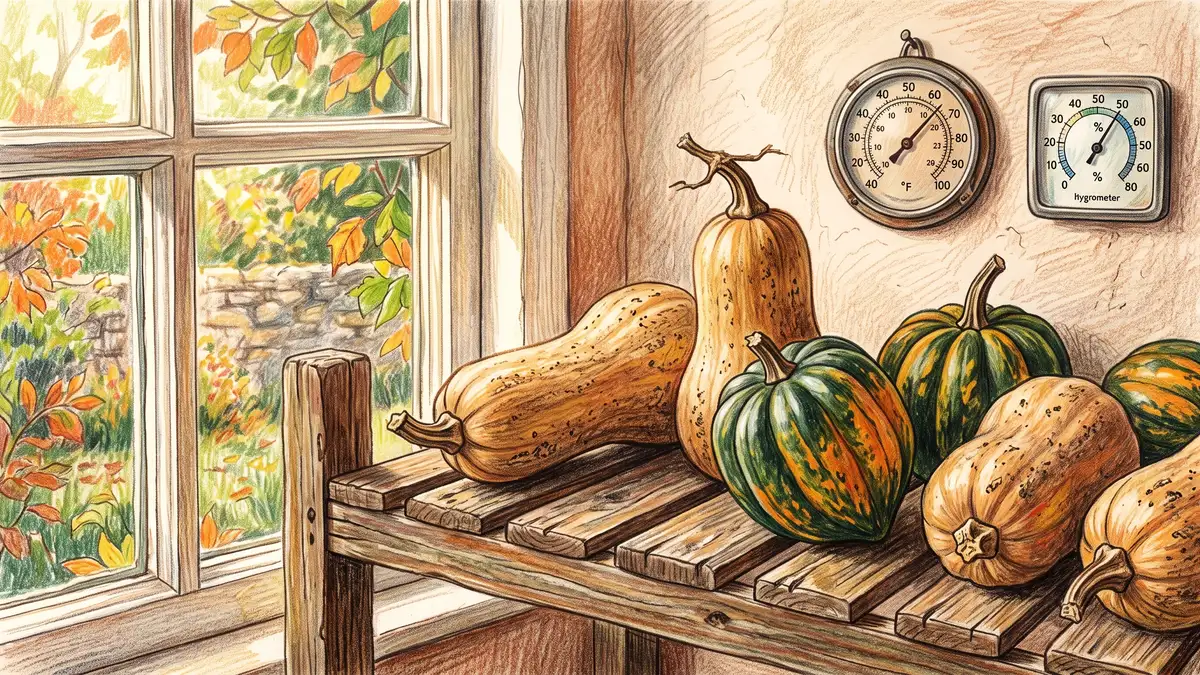
Most storage crops need a warm, dry holding period before they go cold. Curing hardens skins, heals harvest wounds, and dries down necks and stems so pathogens cannot get in. Skip it and you are storing an open wound.
Iowa State University Extension recommends curing most winter squash for 5 to 8 days at 80 to 85 F (27-29 C) and 80 to 85 percent humidity before moving it to 50 to 55 F storage, with one important exception: acorn squash should not be cured, because the heat and humidity actually shorten its life.
Sweet potatoes want about 10 days at 75 to 85 F (24-29 C) per Utah State University Extension, and they rot fast below 45 F, so never put them with the carrots. Onions need 2 to 4 weeks at 75 to 90 F (24-32 C) in well-ventilated air until the necks are papery, as University of Nebraska-Lincoln Extension describes. Garlic, once cured, keeps 1 to 2 months at ordinary room temperature of 68 to 86 F (20-30 C) below 75 percent humidity according to UMass Extension, and much longer once cold.
Never Store Apples With Your Vegetables
Apples and pears are climacteric fruit: they release ethylene gas as they ripen, and ethylene is a plant hormone that other crops respond to. Michigan State University Extension documents carrots developing a distinctly bitter flavour from ethylene exposure through isocoumarin formation, along with yellowing in cabbage and premature sprouting in potatoes. Winter squash yellows and shortens its shelf life next to apples too. Give the fruit its own sealed container or its own room, and do not store onions near potatoes either, since each will take on the other's flavour.
How Does a Root Cellar Actually Stay Cold?
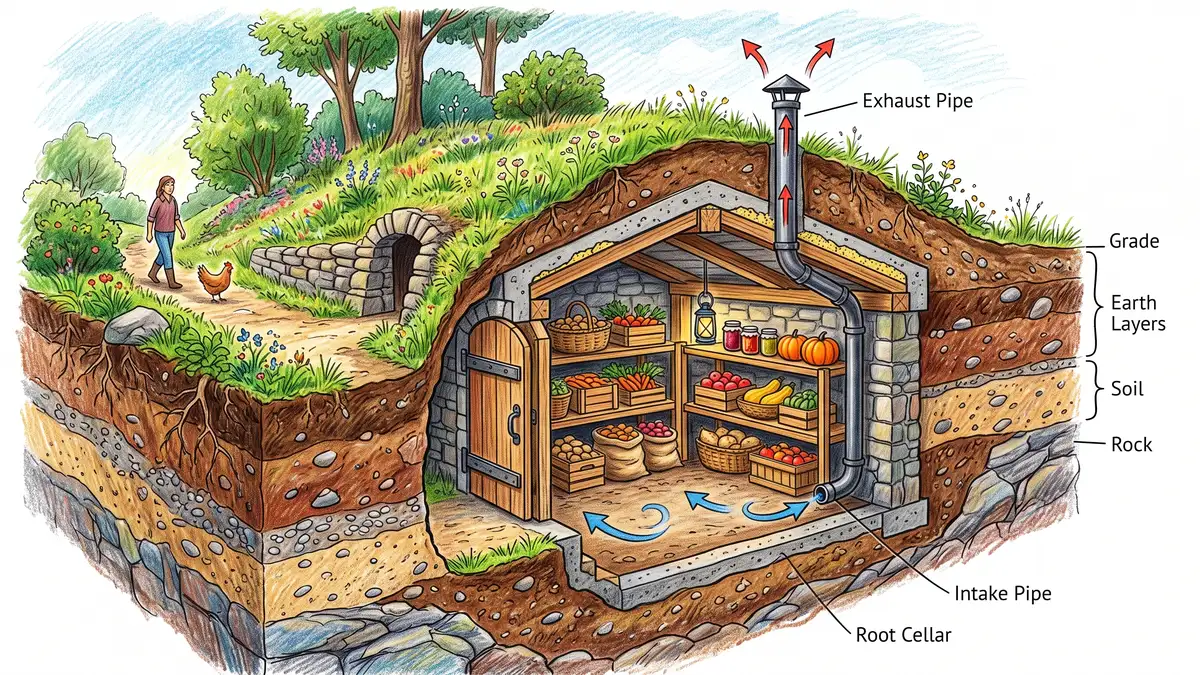
Two mechanisms. Earth contact gives you thermal mass and a temperature that lags the air outside by weeks. Ventilation gives you control, and it is the part people leave out.
The standard arrangement is a low intake vent near the floor on one side and a high exhaust vent through the roof on the opposite side. Cold air is denser, so it sinks in through the low pipe; warm, moist air rises and leaves through the high one. Opening and closing those two vents is your entire thermostat. On a cold night you open both to pull the temperature down; on a hard freeze you close them.
Why This Works: Catching and Storing Energy
This is one of the cleanest expressions of a core permaculture principle you will find in a household. The cellar catches cold at night, stores it in earth and stone, and releases it slowly all day, in exactly the same way a mass wall catches and stores heat. There is no input, no maintenance, and no failure mode beyond forgetting to close a vent. It is the same thinking that puts a food forest in the ground instead of an annual bed. Systems that run on stored energy rather than delivered energy are the ones that keep working when everything else stops, which is really what a permaculture approach is aiming at.
What If You Cannot Build a Cellar?
Wall off a basement corner
The cheapest real option. A 4 by 6 foot (1.2 by 1.8 m) insulated partition against an exterior foundation wall, with a window or vent, gets you into the cold-and-damp range in most of the country.
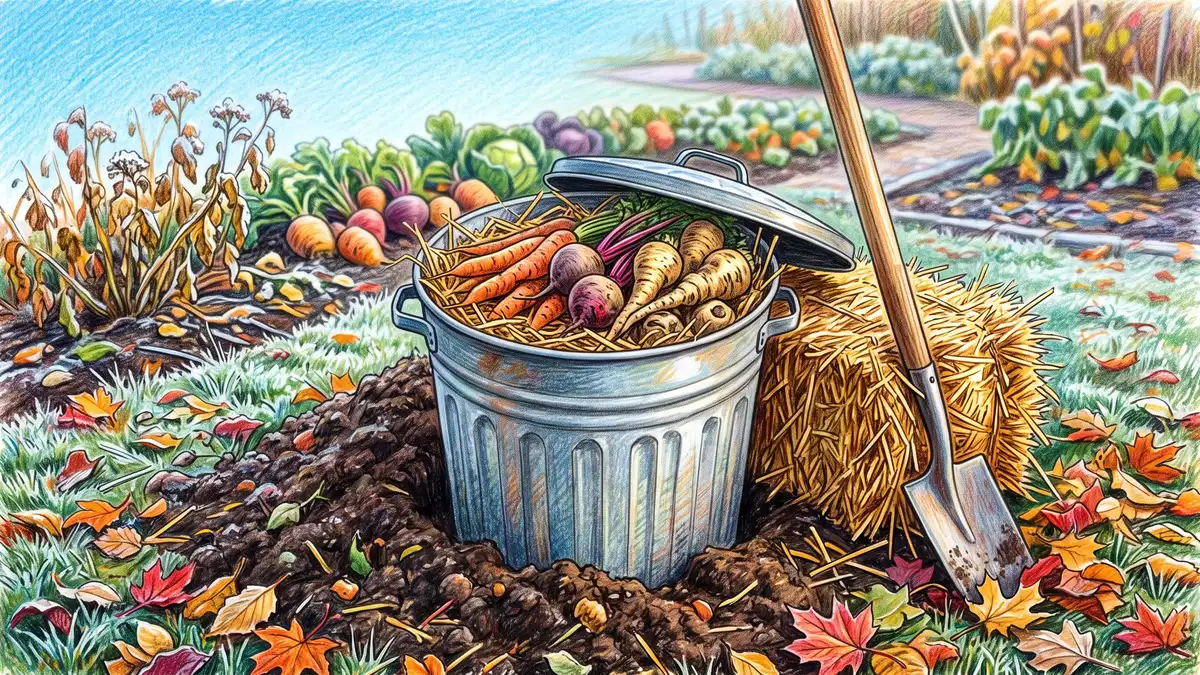
Bury a garbage can
Utah State Extension recommends a shorter can around 20 gallons (76 L) so you can reach the bottom. Sink it to the rim, straw at the base, pack roots in, then cover the lid with soil and mulch. Insulate heavily once the ground freezes hard.
Leave roots in the ground
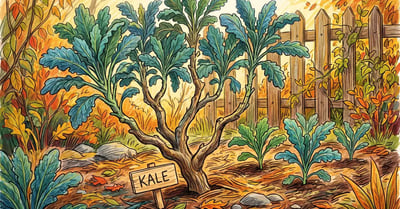
Carrots, parsnips and leeks overwinter in place under a foot (30 cm) of straw in many zones, and kale keeps standing right through it. Free storage, but you cannot get at any of it once the ground is frozen solid.
Use an unheated garage or crawl space
Works for the cold-and-dry group, onions and garlic especially. Monitor for freezing, since garage temperatures swing far more than cellar temperatures.
Pack roots in damp sand or sawdust
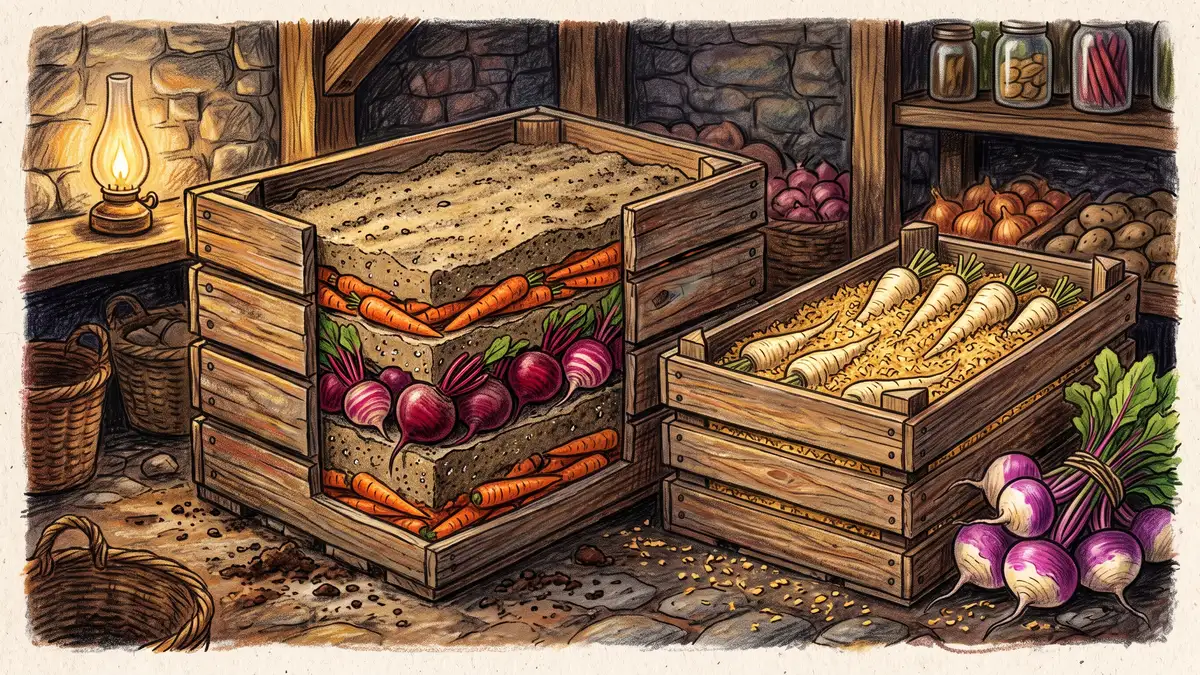
The single most effective humidity fix. Alternating layers of carrots or beets with moist sand in a crate holds them at near-saturation regardless of ambient humidity. It also stops them touching, which limits rot spread.
Whatever you build, exclude rodents from the start: quarter-inch hardware cloth over every vent, a tight-fitting door, and no food debris on the floor. Hang a thermometer and a hygrometer at the level your produce actually sits, and inspect every two weeks. One rotting potato takes a crate with it.
Key Takeaway
Start with one crop group and one method this fall rather than building the full system. Carrots in damp sand in a basement corner will teach you more about your own conditions than any table can, and the learning transfers directly when you scale up. Pair it with the rest of your winter garden preparation and you will be eating your own food in February.
Frequently Asked Questions
How cold does a root cellar need to be?
Between 32 and 40 degrees Fahrenheit (0-4 C) for the main root and brassica group, which covers carrots, beets, turnips, parsnips, cabbage and potatoes. Below 32 F you risk freezing damage, and above 45 F respiration speeds up and shelf life drops sharply. Winter squash, pumpkins and sweet potatoes are the exception and want a separate warmer spot at 50 to 60 F. If you can only hit one temperature, hit the cold one and store squash indoors.
How do you build a root cellar in a basement?
Wall off a corner against an exterior foundation wall, ideally on the north side, using insulated studwork so you separate it from the heated part of the house. Add a low intake vent and a high exhaust vent, or use an existing window, and screen both with hardware cloth. Install slatted shelving so air moves around the produce, keep the floor bare or gravelled to allow humidity, and hang a thermometer and hygrometer at produce level.
Why should potatoes not be stored in the refrigerator?
Because temperatures much below 40 degrees Fahrenheit trigger cold-induced sweetening, where starch converts to sugar. The potatoes taste noticeably sweet and, more visibly, they brown and darken badly when fried. Store them at 38 to 40 F instead. Keep them completely dark as well, since light exposure causes greening and the formation of solanine, which is bitter and mildly toxic, so cut away any green areas before cooking.
What vegetables should not be stored together?
Keep apples and pears away from everything. They emit ethylene, which makes carrots bitter, yellows cabbage and squash, and pushes potatoes into sprouting. Keep onions and garlic away from potatoes, since each absorbs the other's flavour and the humidity that suits potatoes will soften onions. And keep sweet potatoes away from the cold group entirely, because they rot rapidly below 45 F. Three separate zones covers almost every conflict.
How long will vegetables keep in a root cellar?
Longer than most people expect. Late-crop potatoes run 5 to 10 months at 38 to 40 F, carrots reach 5 to 6 months, cabbage 3 to 6 months, onions and garlic 4 to 8 months once properly cured, and apples anywhere from 1 to 12 months depending on cultivar and how close to 32 F you can hold them. Winter squash is shorter at 3 to 5 months. Those numbers assume undamaged produce, correct curing, and fortnightly inspection.
Get the Weekly Dig
One practical permaculture guide a week, written for gardeners who do this on weekends: permaculture design for real backyards. Free, no spam, unsubscribe any time.
Join the Weekly DigResources
- University of Maine Cooperative Extension Bulletin 4135 — Storage Conditions: Fruits and Vegetables
- University of Alaska Fairbanks CES — Vegetable Storage in Root Cellars
- Utah State University Extension — Harvest and Storage of Vegetables and Fruits
- Michigan State University Extension — Storage Conditions and Ethylene Sensitivity
- Iowa State University Extension — Harvesting and Storing Winter Squash
- University of Nebraska-Lincoln Extension — Harvesting and Curing Onions
- UMass Extension — Garlic Harvest, Curing and Storage
- Oregon State University Extension SP 50-767 — Preserving Pumpkins and Winter Squash
- University of Alaska Fairbanks CES — Green Potatoes: Causes and Concerns