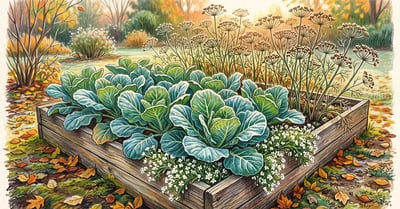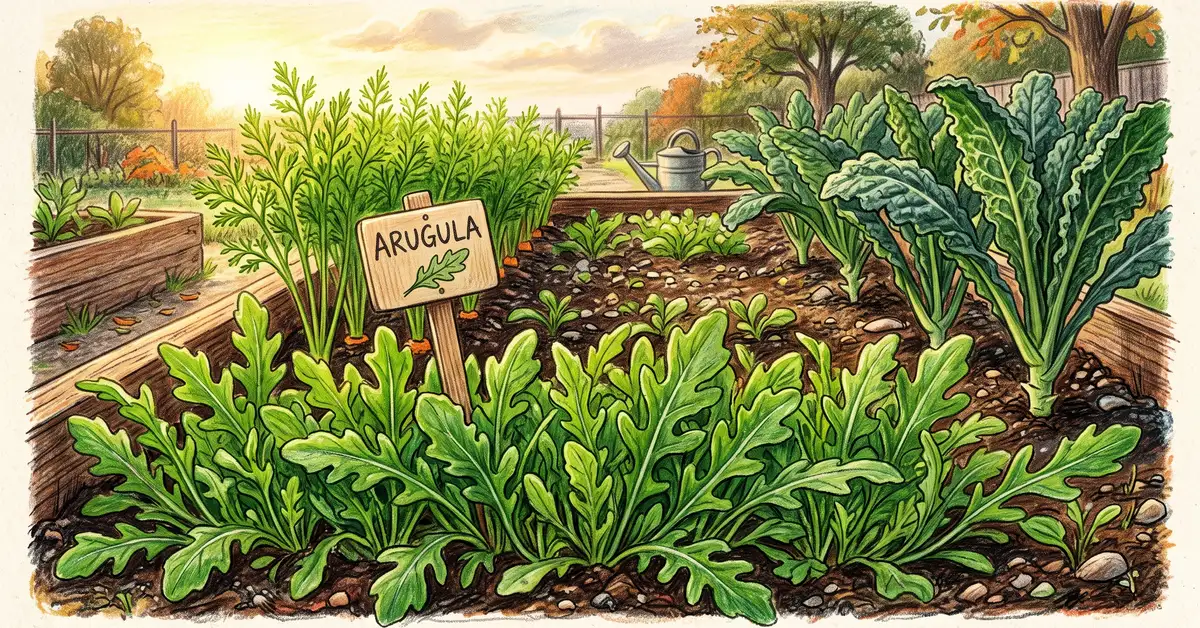

Kale is the crop that keeps producing after the tomatoes have collapsed and the squash has given up. It handles frost, it regrows from the crown all season, and it will feed a household from September through March in most of the country. The problem is that every brassica pest in North America knows exactly where to find it. companion planting arugula companion plants for collard greens
Companion planting is the usual answer, and most of what gets written about it is folklore. Some of it is not. Below is the split, with the trial data attached.
What Actually Works When You Companion Plant Kale?
The honest summary: undersowing with clover has real published support, insectary flowers have decent support, and the aromatic-herb-repels-pests story mostly does not. The mechanism that matters is not smell. It is visual and tactile interference with how brassica pests locate a host plant, described by Finch and Collier as the appropriate and inappropriate landings theory. A pest lands, tastes something that is not a brassica, and leaves.
What this guide covers:
- The pests that actually cost you kale yield, with extension thresholds
- Clover undersowing: the numbers, and the yield penalty nobody mentions
- Companions with a documented mechanism, not just tradition
- What to keep away from kale and why
- A bed layout you can copy this fall
Key Takeaway
If you only do one thing, plant alyssum and buckwheat at the ends of your kale rows to feed hoverflies and parasitic wasps, and interplant alliums down the middle. Both are cheap, both have a mechanism behind them, and neither costs you bed space you were using. For the full picture on pairings, see our companion planting chart.
What Is Kale Actually Up Against?
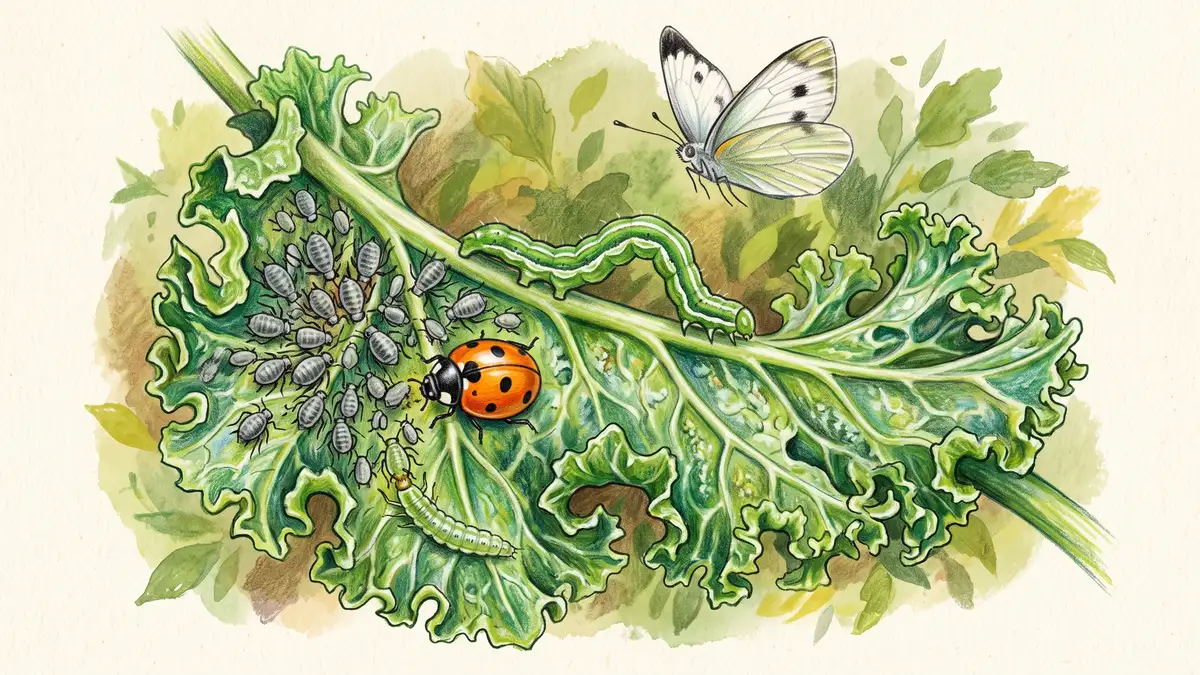
Five pests do most of the damage in US gardens, and knowing which one you have changes the response.
| Pest | What You See | Practical Response |
| Imported cabbageworm (Pieris rapae) | Large ragged holes, green frass near midribs | Row cover from transplant. Bt if populations climb. |
| Cabbage aphid (Brevicoryne brassicae) | Grey waxy clusters in leaf crevices and growing tips | Insectary flowers for hoverflies. Strong water spray. |
| Cabbage looper (Trichoplusia ni) | Irregular holes, larvae hiding deep in the crown | Hand-pick. Scout the crown, not the outer leaves. |
| Flea beetle | Pinhole shot-holes on seedlings | Cover seedlings. Damage matters most before true leaves. |
| Cabbage root fly (Delia radicum) | Stunting and yellowing with no obvious cause | Clover undercrop, collars, rotation. |
Sources: University of Wisconsin Extension, University of Florida IFAS
Two numbers are worth carrying around. Wisconsin Extension sets a treatment threshold for imported cabbageworm at about 10 percent of plants affected in seedbeds and 30 percent between transplant and cupping, which is a useful reminder that a few holes are not an emergency. And University of Florida IFAS notes the cabbage aphid transmits at least 20 viral pathogens in the crucifer family, so aphids are the one to take seriously even at low counts.
Does Undersowing Kale With Clover Actually Work?
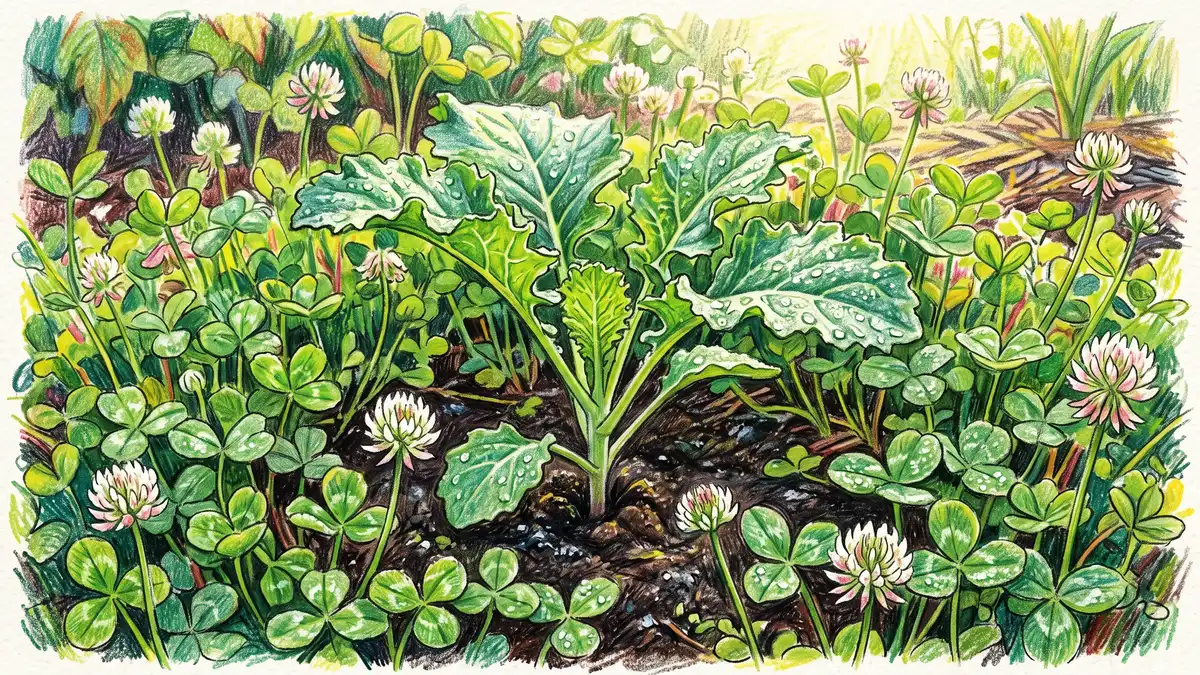
Yes, and the mechanism is more interesting than the folk version. Karssemeijer and colleagues, publishing in 2024, studied how diversified cropping systems affect the cabbage root fly. The clover undercrop did not stop the flies laying eggs. In some cases egg deposition went up. What changed was survival: larval mortality rose sharply, on the order of 30 to 40 percent, because the clover supported ground-dwelling predators like carabid beetles and rove beetles that eat root fly eggs and larvae.
So the clover is not a repellent. It is habitat for the things that eat your pest. That distinction matters, because it tells you the clover has to be established and dense enough to shelter beetles, not a token sprinkle.
The trade-off is real. Living mulch competes for water and nitrogen, and yield penalties in undersown brassicas are commonly reported. NOFA Massachusetts trials of perennial clover living mulch found cabbage heads equivalent in size to bare-soil rows, which is encouraging, but that result depended on adequate fertility and moisture. On a dry sandy site, expect smaller plants.
Why This Works: Building a Standing Predator Population
Permaculture calls this creating a beneficial habitat niche, and the yield logic is straightforward for a homesteader. A bare-soil bed asks predators to arrive after the pest does. A clover understory keeps them living in the bed year-round, so the response is immediate instead of delayed by a week. You are not buying pest control, you are housing it. Same principle as a wildlife-friendly garden, applied to a production bed.
Which Kale Companions Are Actually Worth the Space?
Ranked by evidence, not tradition.
| Companion | Mechanism | Evidence Strength |
| White clover undersowing | Ground predator habitat, nitrogen, weed suppression | Strong. Published field trials. |
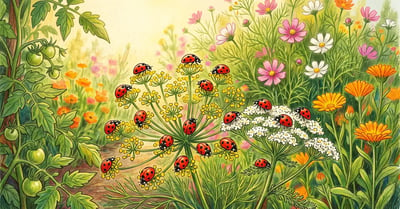
| Sweet alyssum, buckwheat | Nectar for hoverflies and parasitic wasps that eat aphids | Good. Insectary effect well documented. |
| Onions, garlic, leeks | Non-host plant interference with pest host-finding | Moderate. Consistent with landing theory. |
| Nasturtium | Trap crop pulling aphids and cabbageworm away | Moderate. Works, but needs removal once loaded. |
| Thyme, dill, sage, mint | Aromatic confusion | Weak. Largely anecdotal. Plant them if you eat them. |
Sources: Karssemeijer et al., 2023, Utah State University Extension
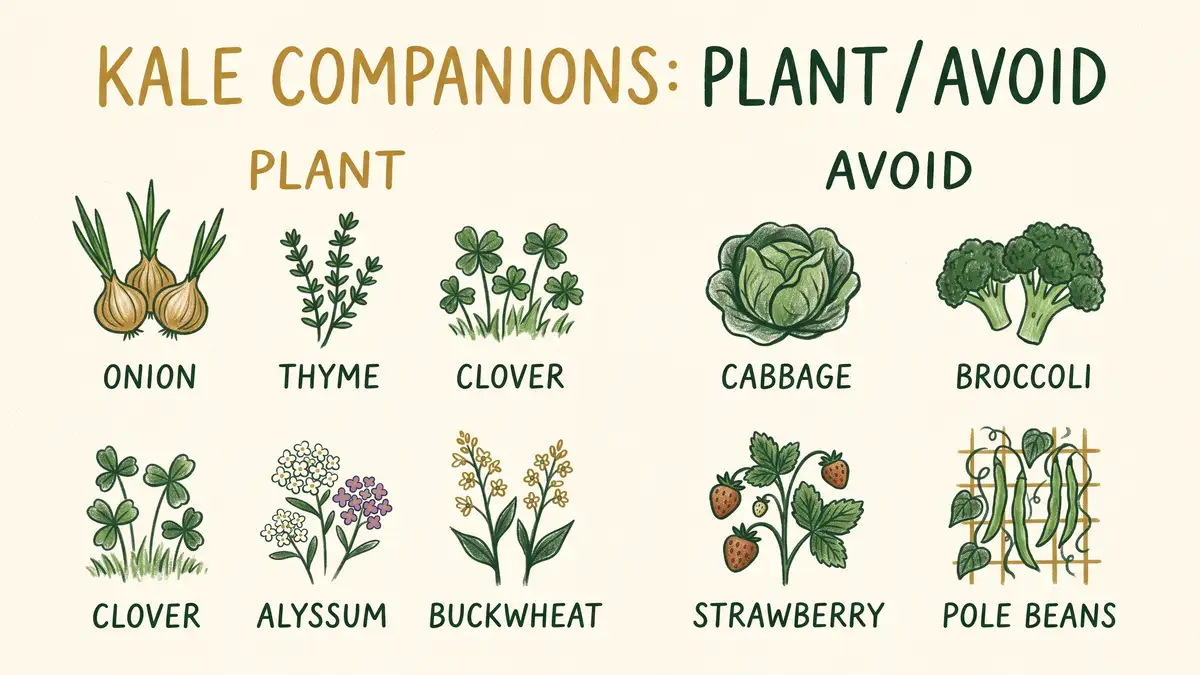
The aromatic herbs deserve a fair hearing. They are not harmful, they occupy edge space you were not cropping anyway, and several are useful in the kitchen. Just do not count on them instead of row cover. Our guide to companion planting herbs goes into where they do pull their weight.
What Should You Keep Away From Kale?
Other brassicas are the main one, and the reason is disease rather than competition. Cabbage, broccoli, cauliflower, collards, turnips, radishes and mustards all share the same pest complex and the same soilborne pathogens, so planting them together concentrates pressure and shortens your rotation options.
Clubroot Ends a Bed for Years
Clubroot (Plasmodiophora brassicae) produces resting spores that survive in soil for the better part of a decade. NC State Extension advises rotating infested ground away from brassicas for a minimum of four to seven years, and notes even that is not a guarantee. Raising soil pH toward 7.2 suppresses it, which is one of the few cases where liming is a disease control measure. Check your soil pH before planting a large brassica block, and never move soil or transplants from an infested bed.
Also worth separating: strawberries, which share Verticillium susceptibility; pole beans, which shade kale badly and compete at the same height; and heavy nightshade blocks, mostly because their peak nutrient demand overlaps with kale's and both are hungry.
How Do You Lay Out a Productive Kale Bed?
Feed the bed first
Kale is a heavy feeder. Season-long nitrogen demand runs roughly 100 to 130 pounds per acre, about 2.5 to 3 pounds per 1,000 square feet, best split into two or three applications. Compost plus a nitrogen side-dress at week four works.
Space at 12 to 18 inches, rows 18 to 36 inches apart
Utah State Extension recommends 12 inches between plants (30 cm); go to 18 inches (45 cm) for full-size bunching. Transplants need 5 to 6 weeks from seed.
Sow clover in the walkways, not under the transplants
Establish the kale first, then broadcast white clover into the paths and between rows about three weeks after transplanting. Sowing at the same time lets the clover outcompete young kale.
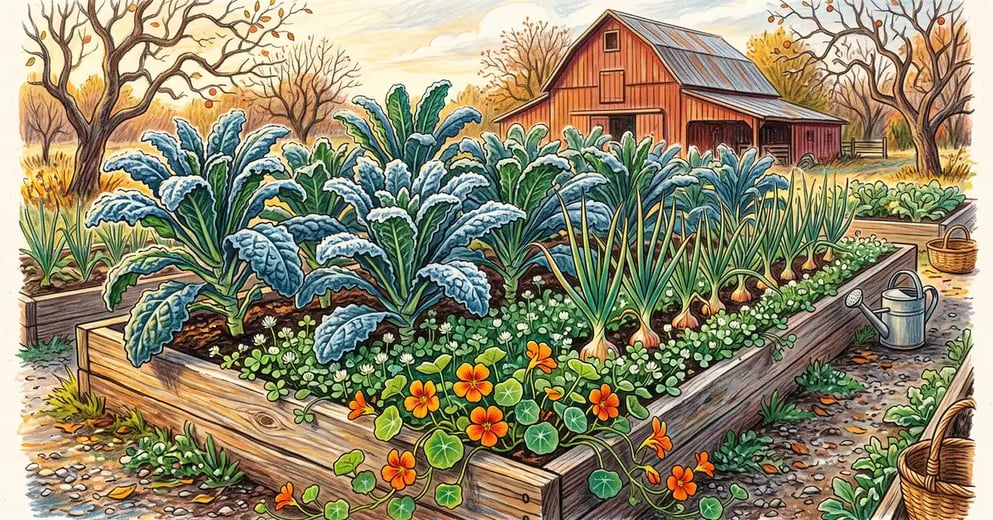
Cap the rows with alyssum and buckwheat, alliums down the middle
Insectary flowers at the row ends, a line of garlic or bunching onions between kale rows. Both are harvestable, so no space is wasted.
Row cover from transplant until the weather cools
This does more for yield than every companion plant combined. Remove it once cabbage white butterflies stop flying, then leave it off for winter or re-cover for hard freezes.
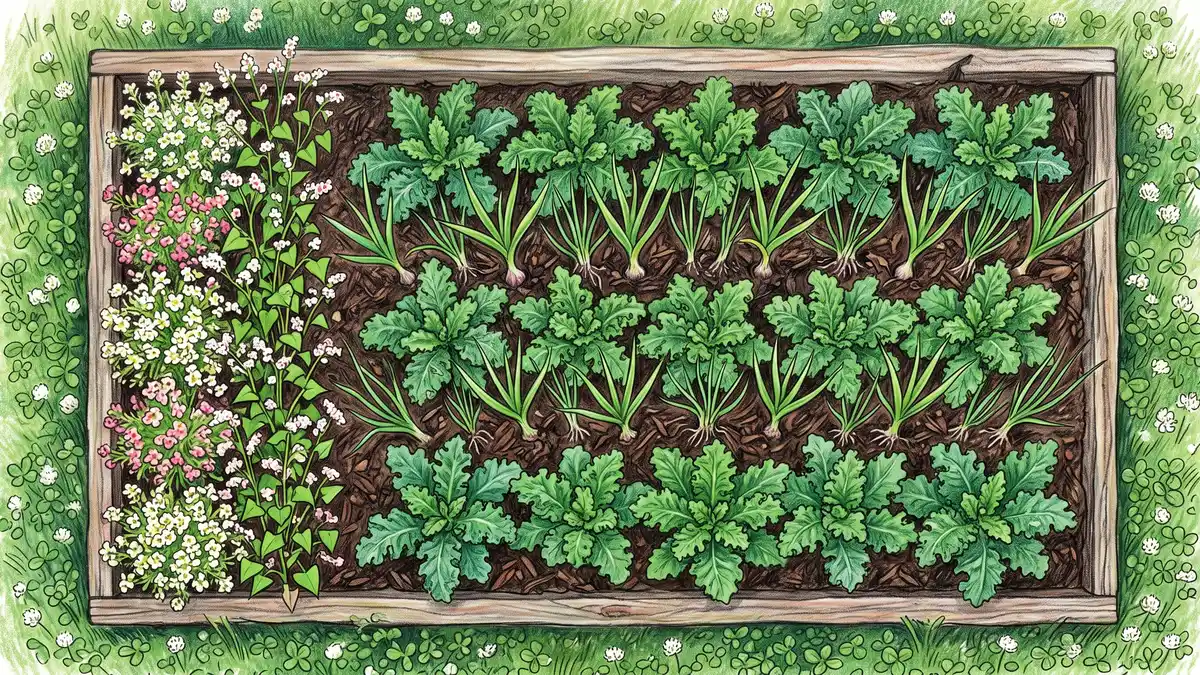
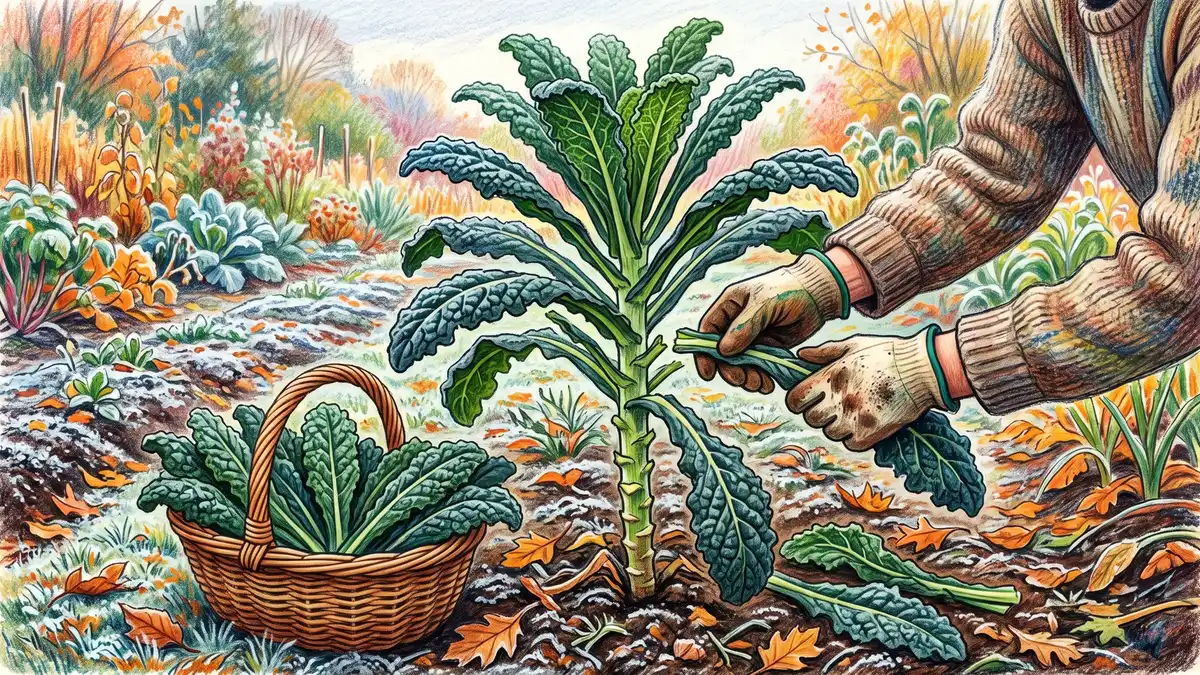
Time and cost: a 4 by 8 foot bed takes about 90 minutes to prepare and plant, and roughly $25 in transplants, clover seed and flower seed. Harvest by snapping the lower outer leaves and leaving the crown, and a single plant will keep producing for six months or more. For yields per row length, LSU AgCenter publishes expected garden yields per 100-foot row.
Key Takeaway
Rank your effort like this: row cover, then fertility, then clover understory, then insectary flowers, then everything else. Companion planting improves a well-managed kale bed. It cannot rescue a hungry, uncovered one.
Frequently Asked Questions
What should you not plant with kale?
Avoid other brassicas above all: cabbage, broccoli, cauliflower, collards, turnips, radishes and mustards share kale's pests and its soilborne diseases, especially clubroot. Also separate kale from strawberries, which share Verticillium susceptibility, and from pole beans, which will shade it out. Nightshades are not toxic to kale but compete hard for nitrogen at the same time kale needs it most. Group brassicas as one rotation block and move that block every year.
What to plant with kale in a raised bed?
In a small raised bed, prioritise plants that earn their space twice. Bunching onions or garlic between kale rows give you a harvest and interfere with pest host-finding. Sweet alyssum in a corner feeds hoverflies whose larvae eat aphids. Low-growing lettuce or spinach fills gaps early in the season before kale sizes up. Skip the clover understory in a small bed, since competition for water is proportionally worse and you have no path space to spare.
Can you plant kale and lettuce together?
Yes, and it is one of the better small-space pairings. Lettuce is shallow-rooted, quick, and finishes before kale reaches full size, so you get a harvest from the same square footage without meaningful competition. Lettuce also benefits from the light shade mature kale casts during warm spells, which delays bolting. Sow lettuce between kale transplants at planting time and clear it by the time the kale canopy closes.
Are spinach and kale companion plants?
They coexist without problems, though neither actively helps the other. Both are cool-season crops with similar water and fertility needs, and spinach is not a brassica, so it does not share kale's pest complex or clubroot risk. The practical caution is nitrogen: two heavy feeders in the same bed will strip it faster than one, so feed accordingly. Plant spinach as a fast intercrop between kale rows and harvest it before the kale canopy closes over.
Can you plant kale next to peppers?
You can, but the timing rarely lines up well. Peppers want heat and are peaking exactly when kale is struggling through summer, and both are moderate-to-heavy feeders. If you do it, put the kale on the north or shaded side so it gets afternoon relief from the pepper foliage, which genuinely helps summer kale hold quality. Just do not expect either crop to help the other. This is coexistence, not partnership.
Get the Weekly Dig
One practical permaculture guide a week, written for gardeners who do this on weekends: companion pairings that hold up under scrutiny, and the ones that do not. Free, no spam, unsubscribe any time.
Join the Weekly DigResources
- Utah State University Extension — How to Grow Kale in Your Garden
- University of Wisconsin Horticulture — Imported Cabbageworm
- University of Florida IFAS — Cabbage Aphid (Brevicoryne brassicae)
- NC State Extension — Clubroot of Brassicas
- Karssemeijer et al., 2024 — Diverse Cropping Systems and Cabbage Root Fly Larval Mortality
- NOFA Massachusetts — Growing Vegetables in a Perennial Clover Living Mulch
- University of Minnesota Extension — Planting Vegetables for Fall Harvest
- LSU AgCenter — Expected Vegetable Garden Yields