
Most winter garden checklists are a list of chores. The useful version is a sequence, because half of these jobs only work if you do them in the right order and before a specific deadline. dividing perennial vegetable crowns storing your harvest without electricity what to do with fall leaves how to winterize raised garden beds growing through winter in a cold frame stopping vole damage over winter protecting plants from frost keeping pepper plants alive until spring which crops can stay in the ground
Cover crops have to be in the ground weeks before frost or they will not establish. Winter mulch on perennials has to go on after the ground freezes, not before. Lime takes years to move soil pH. Get the order right and autumn is the highest-leverage work in the gardening year. Get it wrong and most of it is wasted effort.
What you will learn:
- The sowing deadline for each cover crop, in weeks before frost
- Seeding rates converted to pounds per 1,000 square feet
- Why winter mulch goes on after the freeze, not before
- Why fall is the right time to soil test, and what lime actually does
- The five-minute jobs that prevent expensive damage
Key Takeaway
Two dates control everything. Six to eight weeks before frost is your last call for cover crops and late soil amendments. After the ground freezes is when winter mulch goes on perennials. Everything else can happen whenever you have an afternoon.
Why Not Just Leave the Beds Bare?
Because bare soil in winter is soil in motion. USDA NRCS estimates put average soil loss on conventionally managed cropland in 1930 at about 14.9 tons per acre per year, before modern conservation practice.
That figure is historical and field-scale rather than a prediction for your vegetable bed, but the mechanism is identical at any size. Raindrops and snowmelt break up surface aggregates, the surface crusts, and particles move downhill. A living root or a mulch layer stops all three.
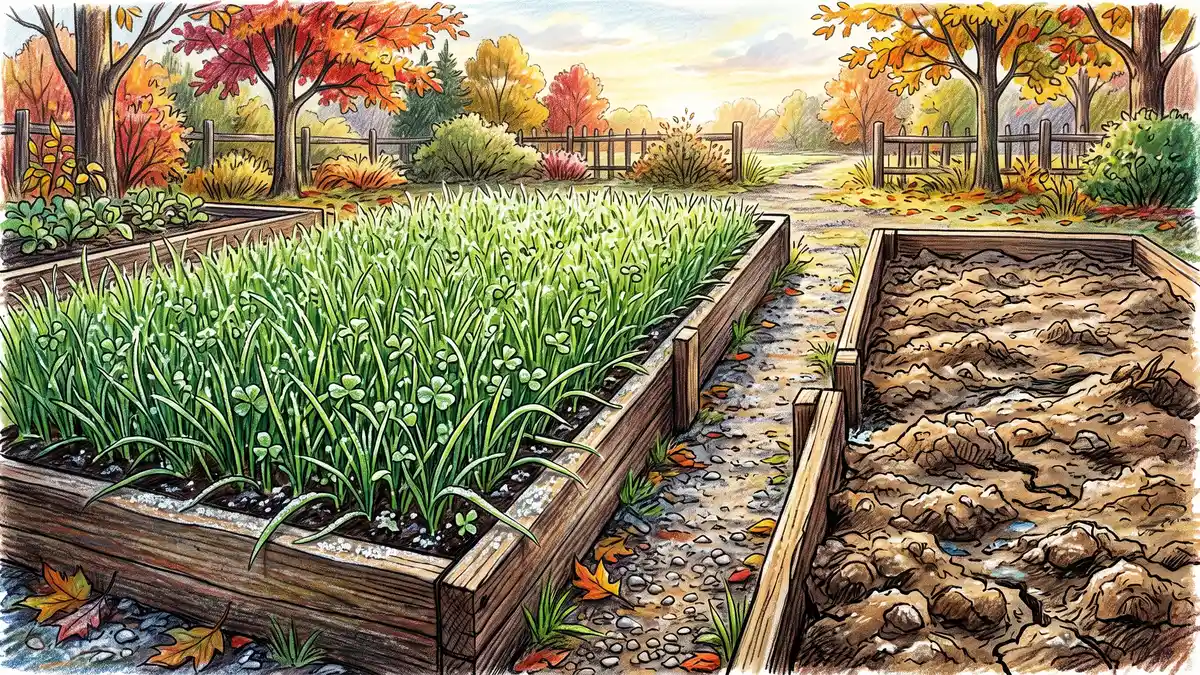
Why This Works: Keeping Living Roots in the Ground
A cover crop is not just armour on the surface, it is a root system feeding soil biology through months when nothing else is. Penn State reports cereal rye producing up to 10,000 pounds of dry matter per acre, and a comparable mass of root exudates and fine roots goes downward at the same time. That is the permaculture principle of never leaving a niche empty, applied to the season rather than the space.
What Should You Sow, and by When?
UMass Extension's rule is 6 to 8 weeks before your fall frost date for most species. That is the hard deadline, and it is earlier than most people expect. In much of Massachusetts, UMass puts rye and oats in the ground before September 15.
| Cover Crop | Sow By | Rate per 1,000 sq ft | Behaviour |
| Cereal rye | 6-8 weeks before frost | 0.7-2.75 lb | Overwinters, needs spring termination |
| Oats | 6-8 weeks before frost | Follow packet rate | Winter-kills in the North, no spring work |
| Crimson clover | 8-10 weeks before frost | About 0.23 lb drilled | Fixes nitrogen, needs establishment time |
| Hairy vetch | Mid-September in the upper Midwest | Higher when broadcast | Hardy to -20°F, slow in fall |
Sources: UMass Extension, Late Season Cover Crops, Penn State Extension, Cereal Rye as a Cover Crop, USDA NRCS, Crimson Clover Fact Sheet, USDA NRCS, Hairy Vetch Fact Sheet
Two practical notes from Penn State. Use the top of the rate range when you are broadcasting rather than drilling, because seed-to-soil contact is worse. And rye paired with hairy vetch is an excellent mix, rye holding the soil in fall while vetch is slow, then vetch climbing the rye and fixing nitrogen in spring. Rye paired with oats is a poor mix, because the fast oats outcompete the rye and then winter-kill, leaving you a thin stand.
Which one to choose comes down to how much spring work you want. Oats die and disappear. Rye survives and needs terminating. Our guide to winter rye covers that decision, and winter cover crops compares the full set.
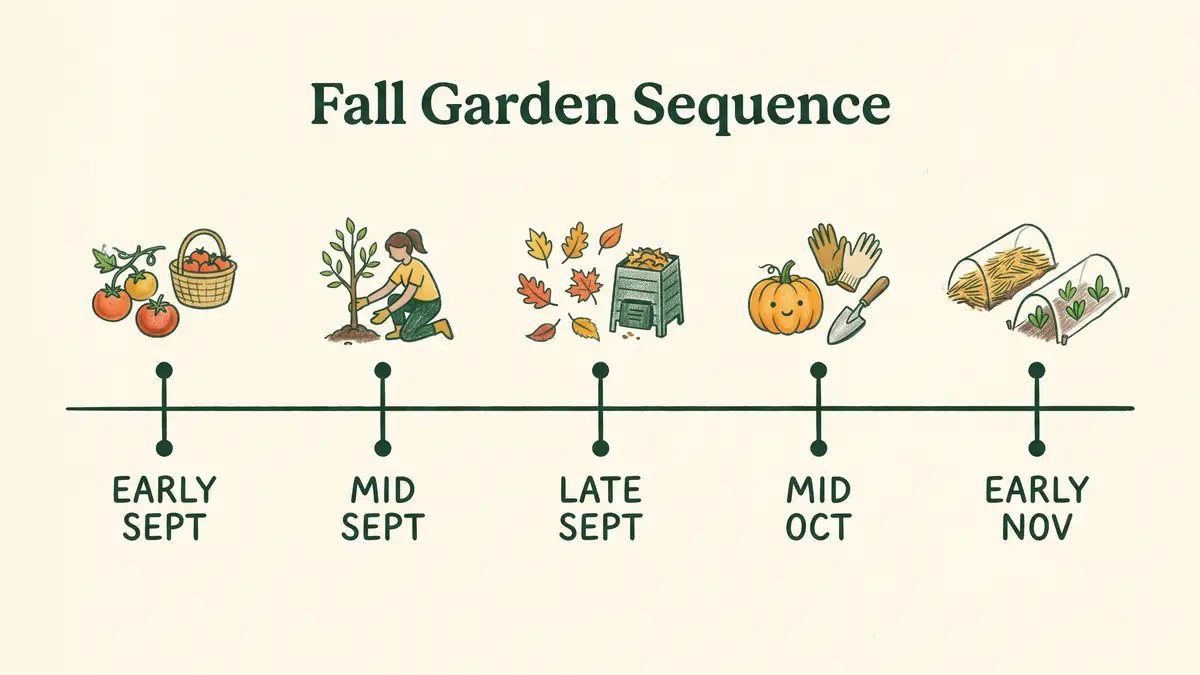
Why Test Soil in Fall Rather Than Spring?
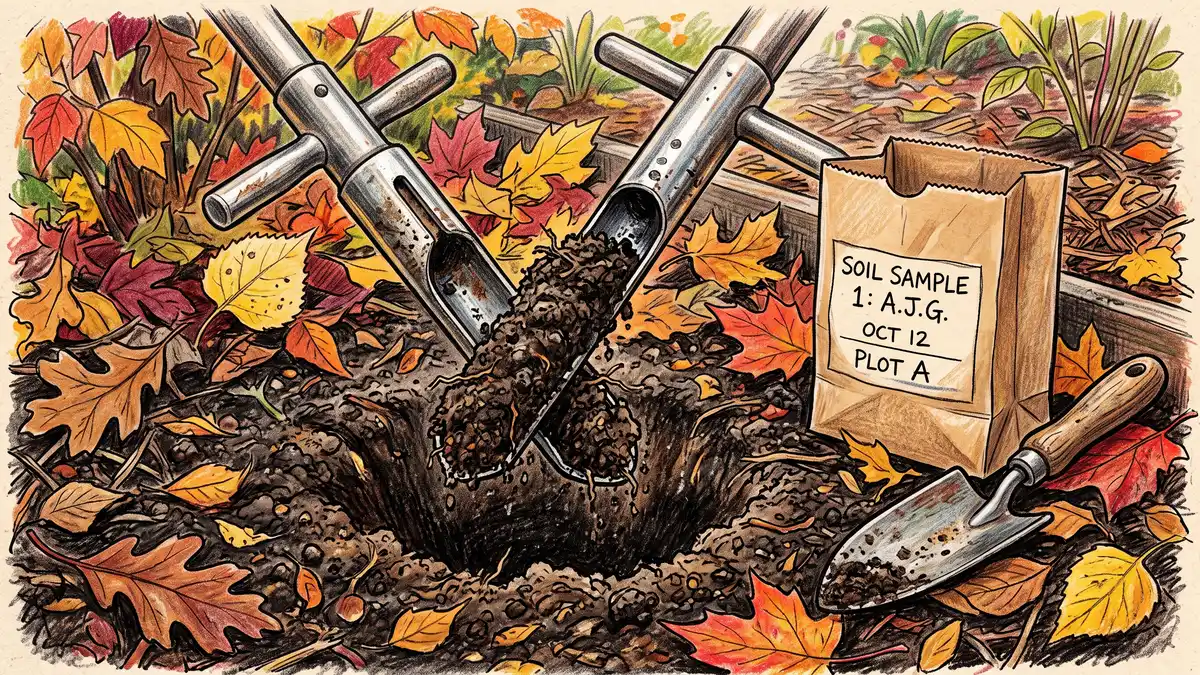
Because amendments need time, and lime needs a lot of it. Penn State Extension recommends autumn sampling specifically so that any lime the test calls for can go on over winter, including on frozen ground, which avoids compacting wet spring soil.
The timescale is the point. University of Wisconsin Extension puts lime equilibration at 2 to 3 years, with a retest recommended after 3 to 4. Lime applied in April does very little for the crop you plant in May.
Fall testing also spreads the lab queue. Send samples in September or October and you get results back with months to act on them, rather than joining the spring rush when everyone wants an answer in a fortnight.
When Does Winter Mulch Go On?
After the ground freezes, and this is the single most misunderstood job on the list. Winter mulch on perennials is not there to keep plants warm. It is there to stop the soil thawing and refreezing.
Frost heaving is the damage you are preventing. Ice lenses form and expand in the soil, lifting crowns and roots upward, snapping fine roots and exposing crowns to drying air. A plant fully hardy to your winter lows can still die this way. Mulching before the freeze traps warmth, keeps the soil in the thaw-refreeze zone longer, and makes the problem worse.
For newly planted trees and shrubs, University of Minnesota Extension calls for 3 to 4 inches (7.5 to 10 cm) of shredded wood mulch over the root zone, kept clear of the trunk itself. Our mulching guide covers depths by material.
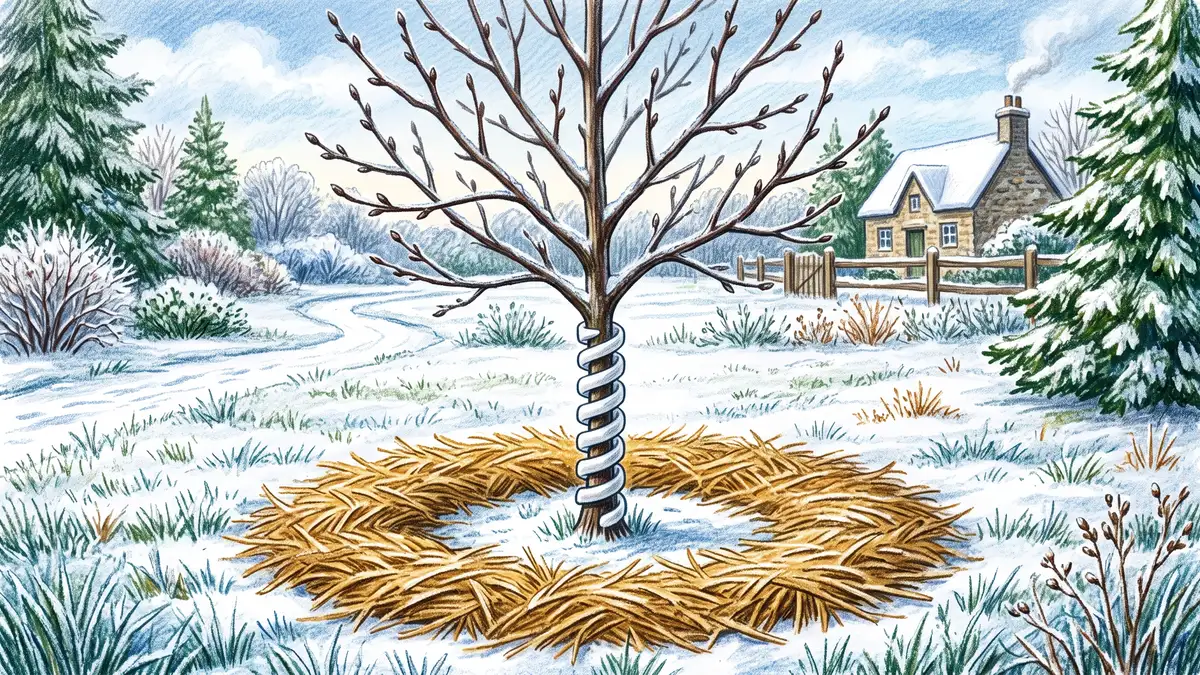
Mulch Against the Trunk Is an Invitation
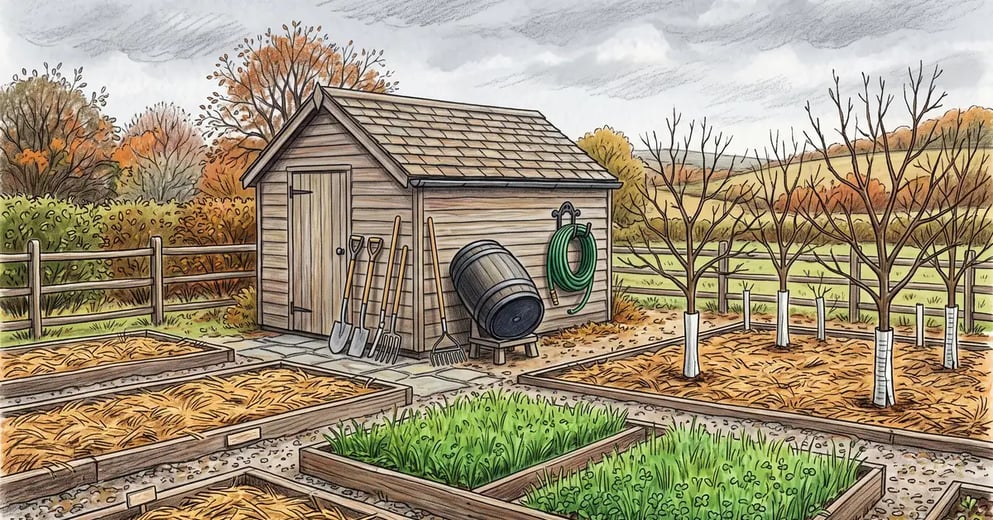
Piling mulch against a trunk or crown holds moisture on bark that needs to stay dry and gives voles and mice a covered approach to gnaw at the base under snow. Leave a hand's width of clear ground all the way around, and fit a trunk guard that extends above your expected snow line rather than stopping at ground level.
What Are the Five-Minute Jobs That Save the Most?
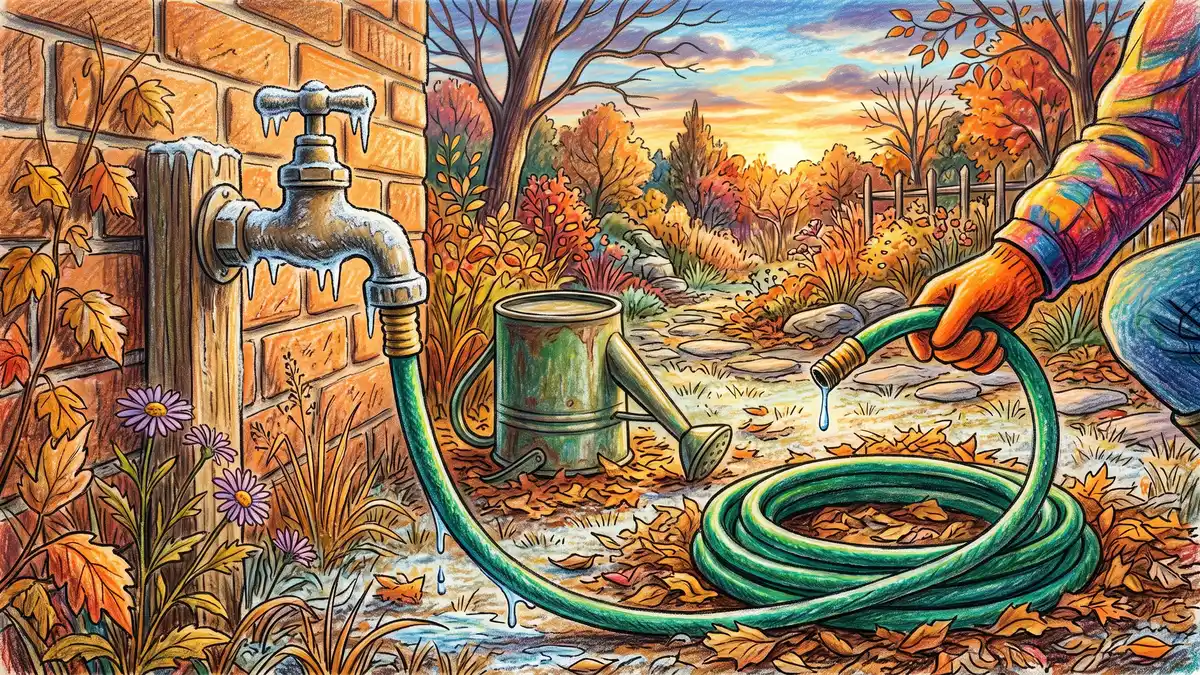
The water ones. Illinois Extension's winterization guidance is blunt about it: completely drain irrigation lines and remove hoses from spigots before freezing weather. A hose left connected traps water in the spigot and the pipe behind it, and that is how a wall gets opened up in February.
Rain barrels come off the same list. Drain them, disconnect the downspout diverter, and either store them inside or leave them inverted so they cannot fill and split.
Water the evergreens deeply before freeze-up
Evergreens keep losing water through their needles all winter and cannot replace it from frozen soil. Oklahoma State Extension suggests watering during dry late-autumn spells, and Minnesota Extension calls for heavy watering before the ground freezes. This is the cheapest insurance against winter burn there is.
Drain and disconnect everything that holds water
Hoses off spigots, irrigation lines blown or drained, rain barrels emptied and inverted, watering cans upside down. Twenty minutes of work against a burst pipe.
Fit trunk guards above the snow line
Rabbits and voles feed on bark under snow cover, and the damage is often only visible in spring when the tree fails to leaf out. Guards go on before the first heavy snow.
Store seed cold and dry
Utah State University Extension gives 35 to 40°F (2 to 4°C) and relative humidity below 40 percent as ideal for seed storage. A sealed jar with a desiccant packet in the back of a refrigerator meets both conditions and costs nothing.
Clean, sharpen and oil tools before storage
Soil left on steel over a damp winter is what turns a good spade into a rusty one. Scrape, sharpen, wipe with oil, store dry. Ten minutes per tool, once a year.
Key Takeaway
Sequence beats effort. Test soil and sow cover crops early, drain water systems at first frost warning, and mulch perennials only once the ground has frozen. Doing the same list in the wrong order is where most of the value gets lost.
Frequently Asked Questions
How do I winterize a vegetable garden?
Work the sequence rather than the list. Take soil samples in September or October so amendments have time to act. Clear only the beds that carried disease this season and sow a cover crop in them at least 6 to 8 weeks before your frost date, as UMass Extension recommends. Leave healthy stems and leaf litter standing as habitat. Drain hoses and irrigation before the first freeze. Then, once the ground has actually frozen, mulch perennials and new woody plants to stop freeze-thaw heaving.
Should I cover my raised beds with plastic in winter?
Generally not. Plastic sheds rain rather than letting it in, kills the soil biology underneath through heat and oxygen starvation, and traps a layer of dead air rather than living cover. A cover crop or a straw and leaf mulch does the same erosion-control job while feeding the soil and letting water through. The exception is a short-term solarisation or a low tunnel over an actively growing winter crop, which is a different purpose entirely.
How late can I plant a cover crop?
UMass Extension's guidance is 6 to 8 weeks before your fall frost date for most species, with rye and oats going in before September 15 in much of Massachusetts. Past that window, seed germinates but does not build enough top growth or root mass to hold soil through winter. If you have missed it, mulch the bed with straw or shredded leaves instead. That gives you the erosion protection this year and you can sow on time next season, working back from your first frost date.
What perennials should I cut back in fall?
Fewer than tradition suggests. Cut back anything that had a fungal or borer problem this season, and leave the rest standing through winter as overwintering habitat and structure that traps insulating snow. Our guide to what to cut back and what to leave works through the specific exceptions with the extension evidence behind each one.
Does fall garden prep actually improve next year's harvest?
The soil work does, measurably, though through accumulated mechanisms rather than one dramatic intervention. Preventing erosion keeps topsoil and organic matter in place. Cover crop roots feed soil biology through months when the beds would otherwise be inert. Lime and slow amendments applied in fall have the 2 to 3 years University of Wisconsin Extension says they need to shift pH. It is compounding rather than dramatic, which is exactly the pattern our practical guide to permaculture describes.
Get the Weekly Dig
One practical permaculture guide a week, written for gardeners who do this on weekends: permaculture design for real backyards. Free, no spam, unsubscribe any time.
Join the Weekly DigResources
- UMass Extension, Late Season Cover Crops
- Penn State Extension, Cereal Rye as a Cover Crop
- USDA NRCS, Crimson Clover Cover Crop Fact Sheet
- USDA NRCS, Hairy Vetch Cover Crop Fact Sheet
- USDA NRCS, Historical Changes in Soil Erosion 1930-1992
- Penn State Extension, Fall Is the Perfect Time for Soil Sampling
- University of Wisconsin Extension A2809, Soil pH and Lime Requirement
- University of Minnesota Extension, Protecting Trees and Shrubs in Winter
- Oklahoma State University Extension, Winter Desiccation Injury of Evergreens
- Illinois Extension, How to Winterize Outdoor Plumbing
- Utah State University Extension, Seed Storage and Handling
- Iowa State University Extension, Rain Barrel Ready
- University of Nebraska Extension, Rainwater Harvesting With Rain Barrels