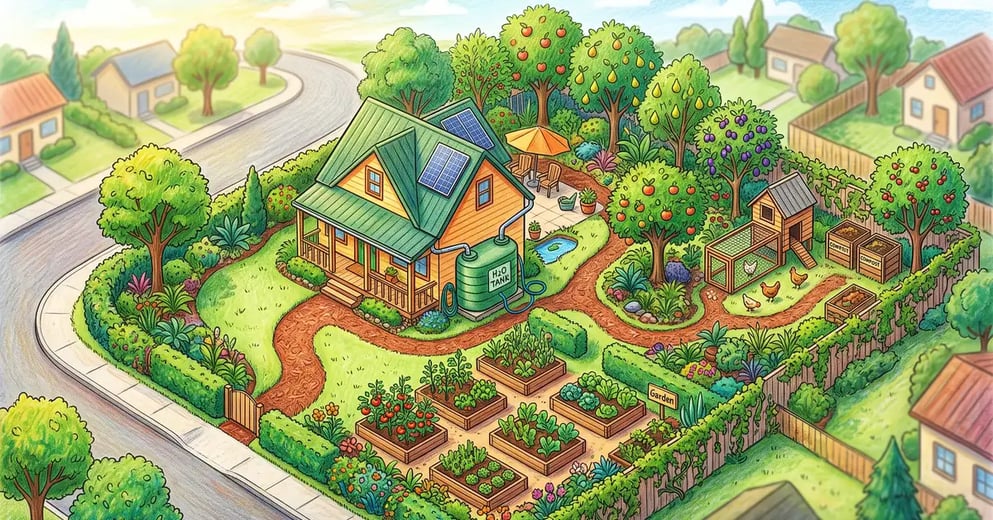

Most people assume homesteading takes acreage. It does not. A typical US quarter-acre lot is about 10,890 square feet, and even after you subtract the house, driveway, and paths, you are left with 5,000 to 8,000 square feet of workable ground. That is enough to grow a serious share of your family's food, raise a few hens, catch your own irrigation water, and build deep soil, all without leaving the suburbs.
It comes down to design. A quarter-acre lot rewards planning the way a small farm does: every square foot has a job, high-use plantings sit close to the door, and vertical space does double duty. This guide lays out how to zone a suburban lot, how much it can actually produce, and the space-saving moves that make it work, grounded in biointensive research, cooperative extension guidance, and real urban homesteads.
What you'll learn:
- How much food a quarter-acre lot can realistically produce
- How to zone a small suburban lot the permaculture way
- Space-savers: espalier trees, vertical beds, and square-foot spacing
- Fitting in chickens, rainwater, and compost without crowding the yard
Key Takeaway
A quarter-acre lot can produce several thousand pounds of food a year when it is zoned like a small farm: a daily-harvest kitchen garden by the door, a food forest and chicken run in the mid-yard, and fruit trees along the boundaries. Intensive raised beds, espaliered trees, and a few hens turn a lawn into a working homestead, while a rain barrel and a good compost pile keep it fed and watered on-site.
How Much Food Can a Quarter-Acre Lot Actually Grow?
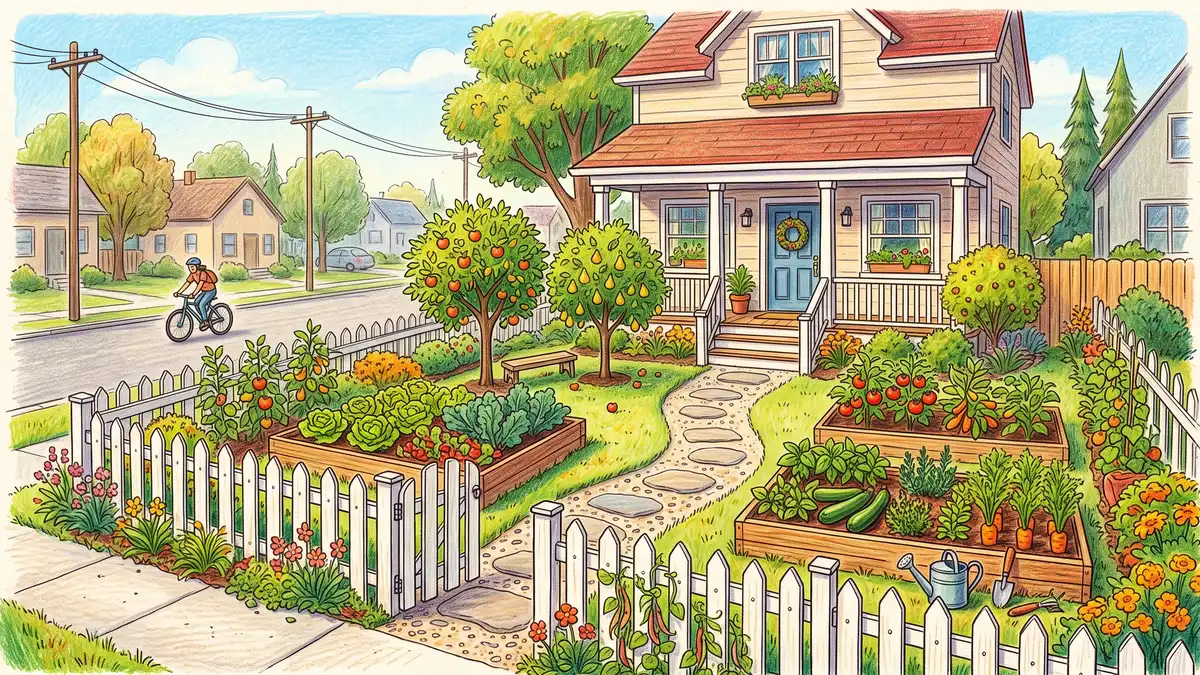
More than most homesteaders expect. The Dervaes family's Urban Homestead in Pasadena produces about 7,000 pounds of food a year on roughly one-tenth of an acre. Scale that management to a full quarter acre and you are looking at 14,000-plus pounds a year, an upper bound that took the family decades of skill to reach, but a real proof of concept.
The research backs it up. John Jeavons's Grow Biointensive trials found that a carefully planned mix of compost, calorie, and vegetable crops can grow all the nutrients one person needs for a year in about 4,000 square feet, and that 100 square feet of intensively grown wheat yields around 15,000 calories. Biointensive beds also use three to eight times less water per pound of food than conventional rows. On a quarter acre, dedicating even 600 to 1,000 square feet to calorie-dense roots and grains meaningfully cuts your grocery bill.
How Do You Zone a Suburban Quarter-Acre Lot?
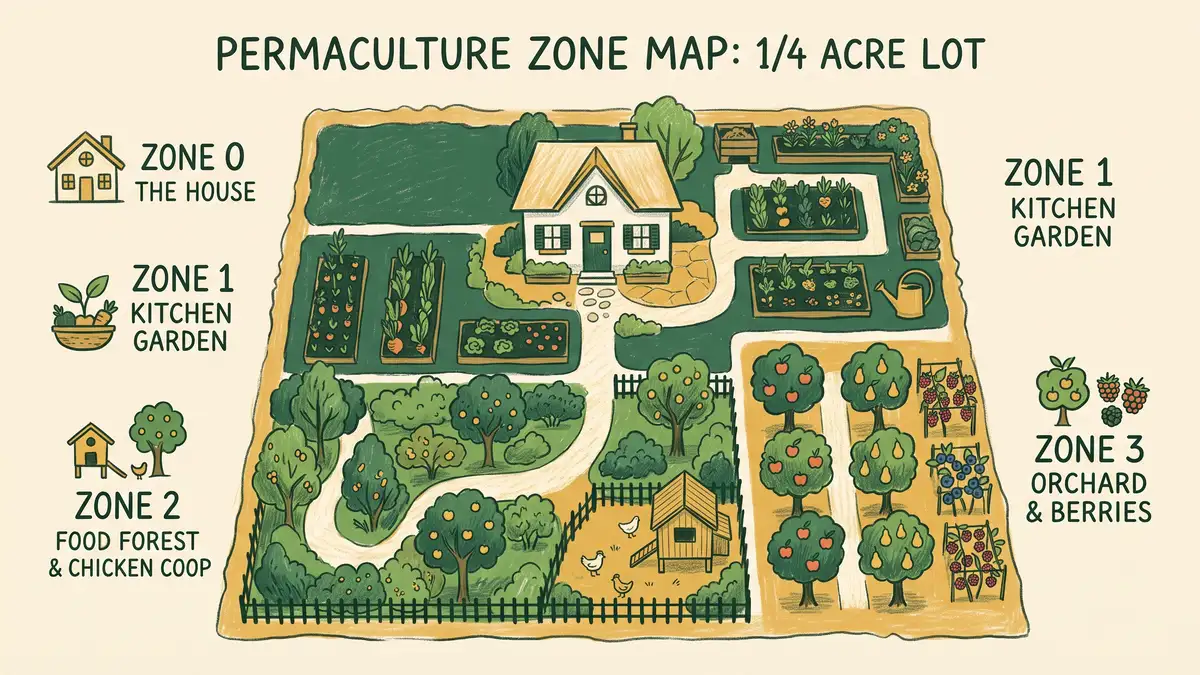
Put what you touch daily closest to the door, and let the rest ripple outward. Permaculture zoning, from Bill Mollison and David Holmgren, organizes a site by how often you use each part. On a small lot the distances are short, so zones wrap around the house rather than forming neat rings, but the logic still holds. Toby Hemenway's Gaia's Garden shows how to fit real functional zones into a town-sized yard using edges, side yards, and fences.
Zone 1 is your daily kitchen garden: 200 to 600 square feet of raised beds right outside the back door for salad, herbs, and soft fruit. Zone 2 fills the main yard with a food forest, berry patches, and a chicken run, things you visit a few times a week. Zone 3 runs the boundaries: espaliered fruit trees, a small orchard, and the sunniest beds for staple roots and grains you tend weekly. Tuck a small wild corner for pollinators where an HOA allows it. If you want the full framework, our guide to permaculture zones walks through each one.
Why This Works: Relative Location
Zoning is really the permaculture principle of relative location: place each element where its needs and outputs connect to its neighbors. The herbs you snip nightly go by the kitchen because that is where you are; the chickens sit next to the compost so their manure and your scraps flow together. Nothing is placed randomly, which is what turns a collection of beds into a system that runs on less effort.
What Are the Best Space-Saving Techniques?
Grow up, grow dense, and use your fences. Square-foot gardening packs a 4-by-4-foot bed into sixteen cells, and University of Florida IFAS Extension notes each square holds 16 carrots or onions, or 4 leafy greens like lettuce. The dense canopy shades out weeds and cuts watering. Keep beds no wider than four feet so you can reach the middle without stepping in.
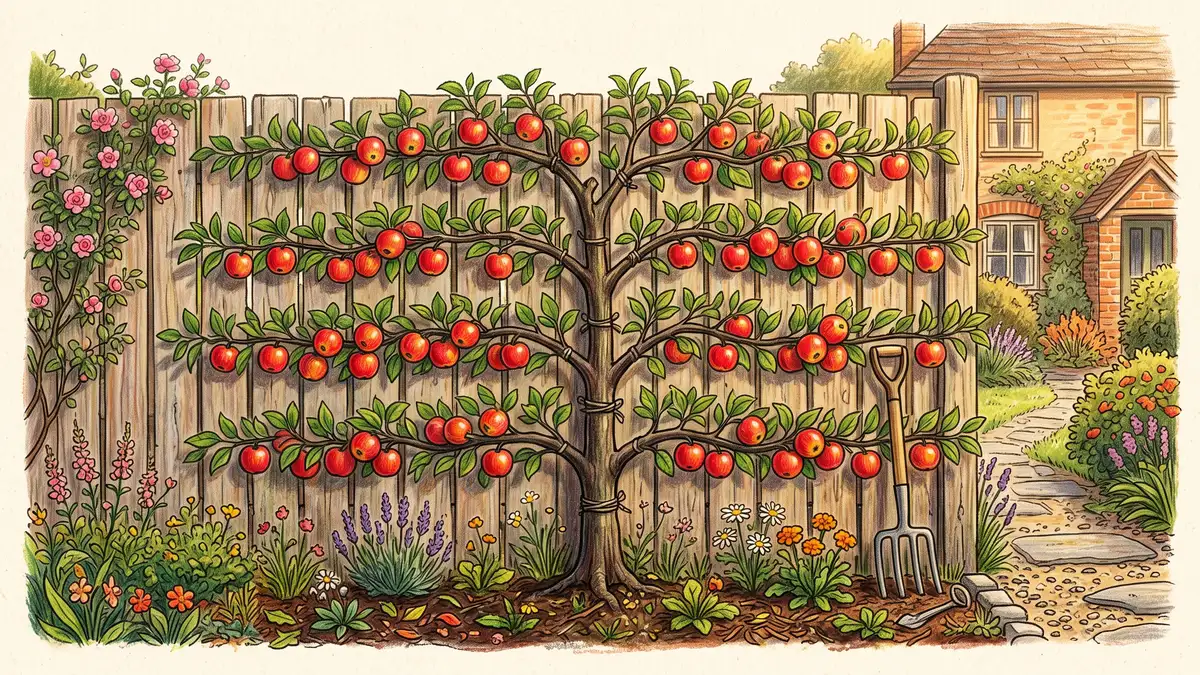
Fruit trees are where suburbia usually gives up, and where espalier changes the math. Oregon State University Extension explains how to train a dwarf tree flat against a trellis with posts 8 feet apart and wires every 18 inches, typically in three tiers. A 40-foot back fence becomes five trellis bays and five trees; add house walls and side yards, and a quarter acre can carry ten or more fruit trees in almost no ground space. That is the edible-forest density Hemenway champions, achieved on a lot most people call too small.
Can You Keep Chickens on a Small Lot?
Yes, and they pay their rent in eggs, manure, and pest control. Cornell Cooperative Extension recommends 2.5 to 3.5 square feet per bird inside the coop plus 4 to 5 square feet in the run, so a flock of eight fits in a coop of roughly 24 to 35 square feet with a similar-sized run, easy to slot into Zone 2. Bury the run fencing at least six inches deep, since predators digging under the run are the top cause of losses.
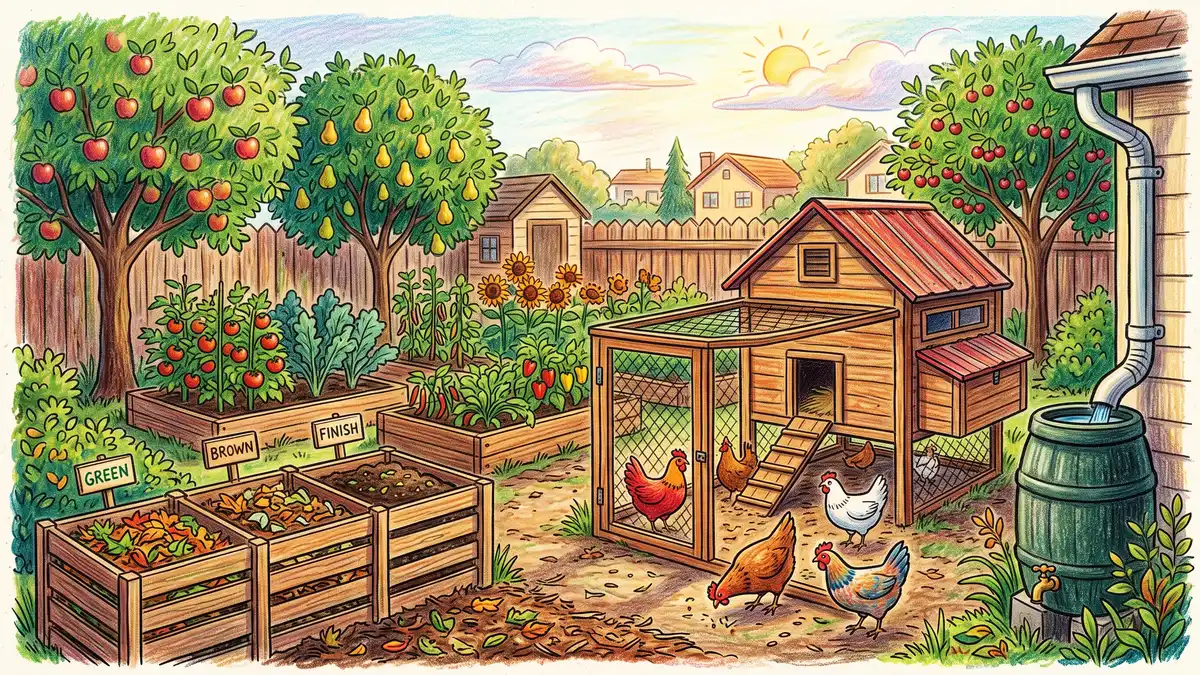
Eight hens can supply well over a thousand eggs a year while turning kitchen scraps and garden waste into rich, nitrogen-heavy compost. Site the coop near your compost pile so manure and bedding go straight into the system, and near the food forest so the birds can help with pests and cleanup. Just check your local rules first: setbacks from wells and property lines, flock caps, and hens-only ordinances are common.
How Do You Handle Water and Soil On-Site?
Catch the rain off your roof and compost everything. The USDA NRCS rainwater formula (area x rainfall x 7.48 gallons per cubic foot x runoff coefficient) shows a 620-square-foot roof yields about 167 gallons from a half-inch of rain. A full 1,800-square-foot house roof captures around 1,000 gallons per inch, more than enough to cover a 400-square-foot vegetable garden's 1-to-2-inch weekly need through most of the season.
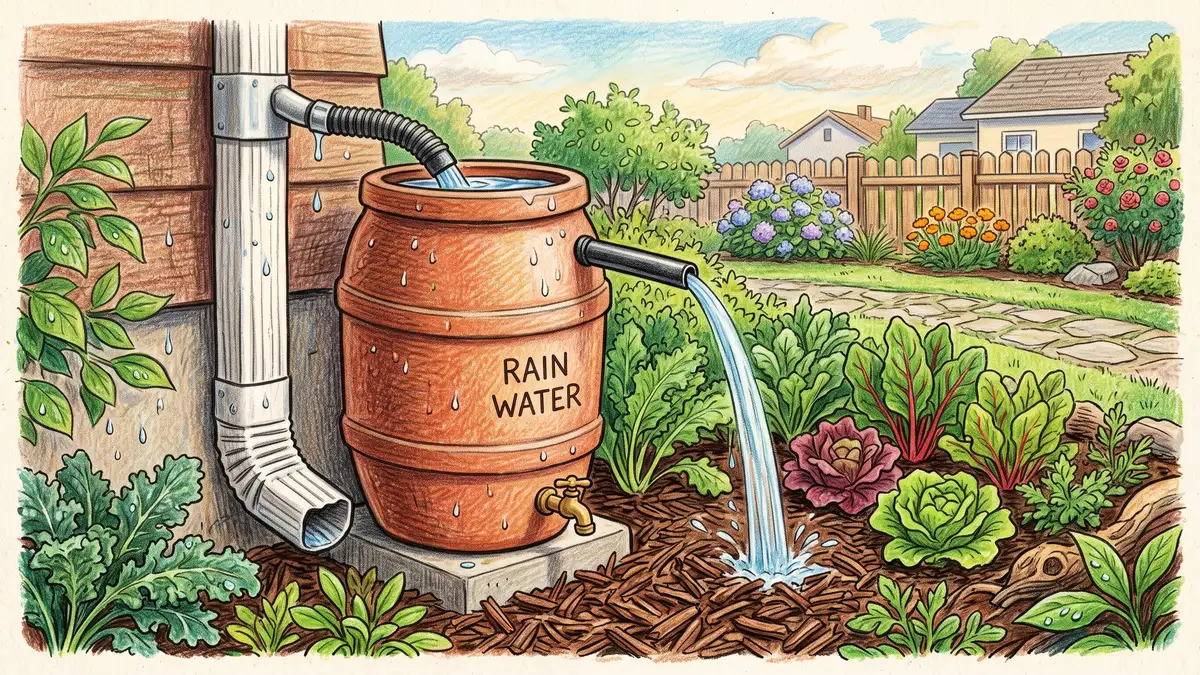
Soil is the other half. University of Minnesota Extension recommends a compost pile built as a 3-to-5-foot cube, big enough to heat, small enough to breathe. Work finished compost in at 1 to 2 inches, keeping it to no more than about 25 to 30 percent of a raised-bed blend. Here is how the pieces fit on a quarter-acre lot.
| Element | Space Needed | What It Gives Back |
| Kitchen garden (Zone 1) | 200-600 sq ft | Daily salad, herbs, greens |
| Food forest (Zone 2) | Mid-yard, layered | Fruit, berries, mulch |
| Chicken coop + run | ~50-70 sq ft for 8 hens | 1,000+ eggs, manure, pest control |
| Espalier / orchard | Fence line, ~2 ft deep | 10+ fruit trees |
| Rain barrels | Beside downspouts | ~1,000 gal per inch of rain |
| Compost pile | 3-5 ft cube | Free fertility, soil building |
Sources:
Common Mistake to Avoid
Do not skip the rulebook before you dig. HOA covenants and local zoning can restrict front-yard gardens, chicken flocks, and structure setbacks, and finding out after you build is expensive. The good news is the trend favors growers: Florida law now bars local governments from banning residential vegetable gardens, and cities like Maplewood, Minnesota explicitly allow front-yard gardening. Check your municipal code and HOA rules first, then design within them.
Frequently Asked Questions
How big is a quarter acre, and how much of it can I garden?
A quarter acre is about 10,890 square feet, roughly a 104-by-104-foot square. On a developed suburban lot, the house, driveway, and paths take a big bite, so your actual cultivable ground is usually somewhere between 5,000 and 8,000 square feet. That is still a lot of growing space. Biointensive research suggests about 4,000 square feet can supply a full year of nutrients for one person, so even half of a typical quarter-acre yard, planted intensively, can feed much of a small household. The key is to treat every usable strip, including front yard, side yards, and fence lines, as potential growing space rather than assuming only the back yard counts.
How much food can a quarter-acre homestead produce?
Several thousand pounds a year is realistic with intensive management. The Dervaes Urban Homestead in Pasadena produces about 7,000 pounds annually on one-tenth of an acre, which scales to well over 10,000 pounds on a quarter acre, though that represents decades of experience and heavy labor. A more typical suburban homesteader dedicating a few hundred square feet to square-foot beds, a small food forest, and a few fruit trees can still harvest hundreds of pounds of vegetables and fruit plus a steady egg supply. Yields depend on climate, crop mix, and how much time you invest, so start with realistic goals and scale up as your soil and skills improve.
What permaculture zones make sense on a small lot?
On a quarter acre, the zones wrap around the house instead of forming wide rings. Zone 1 is your daily kitchen garden, raised beds of greens and herbs right by the back door. Zone 2 is the main yard: a food forest, berry patch, and chicken run you visit a few times a week. Zone 3 runs along the boundaries with espaliered fruit trees, a small orchard, and staple-crop beds you tend weekly. Zones 4 and 5, normally wild land, shrink to a small pollinator corner or native-plant patch where your HOA allows it. The point is not the exact map but the gradient: high-attention plants close, low-maintenance ones farther out.
How many fruit trees can I fit on a quarter acre?
Far more than you would guess, if you use dwarf trees and espalier. Training trees flat against fences and walls, with trellis posts every 8 feet, lets a 40-foot back fence carry five trees where a conventional planting might fit two or three. Add house walls and side-yard fences and a quarter-acre lot can support ten or more fruit trees in a couple of feet of ground depth, plus dwarf trees dotted through the food forest. Espalier does require regular pruning and training, so plan it into your seasonal routine, but it delivers real fruit yields without the wide canopies that would otherwise shade out your vegetables.
Do I need chickens to make a suburban homestead work?
No, but they close a lot of loops. A small flock of hens turns kitchen scraps, garden waste, and bugs into eggs and nitrogen-rich manure, and their scratching helps clear and prepare beds. Cornell Extension's spacing guidelines mean eight hens fit comfortably in a coop and run under 70 square feet, easy to place in the mid-yard. That said, plenty of productive quarter-acre homesteads run on compost and cover crops alone. If your local rules make chickens difficult, or you are not ready for daily animal care, focus first on soil, water, and intensive beds, and add livestock later once the garden systems are humming.
Get the Weekly Dig
One practical permaculture guide a week, written for gardeners who do this on weekends: permaculture design for real backyards. Free, no spam, unsubscribe any time.
Join the Weekly DigResources
- Ambrook — 7,000 Pounds of Produce on 1/10th of an Acre (Urban Homestead)
- EcoFarming Daily — John Jeavons on Grow Biointensive Yields
- University of Florida IFAS — Square-Foot Garden
- Cornell Cooperative Extension — Backyard Chickens
- Poultry Extension — Raising Chickens for Egg Production
- Oregon State University Extension — Train Fruit Trees as Espaliers
- USDA NRCS — Rainwater Harvesting (Backyard Conservation)
- University of Minnesota Extension — Composting in Home Gardens
- University of Florida IFAS — Vegetable Garden Policy and Law
- University of Connecticut Extension — Permitting and Regulating Backyard Chickens