
North America has lost roughly 3 billion birds since 1970, and protected nature reserves in Europe have seen flying insect biomass drop by 76% over 27 years. Those numbers are not abstract. They map onto every fenced lawn, every paved cul-de-sac, every monoculture flower bed. Permaculture and wildlife corridors are the design response: a way to make your backyard one node in a network of connected habitat that animals can actually move through. This guide shows you the ecology behind it, the five corridor types that fit a US garden, and how a single property line plays into something much larger. crop genetic diversity in the garden
The ecology in 5 minutes
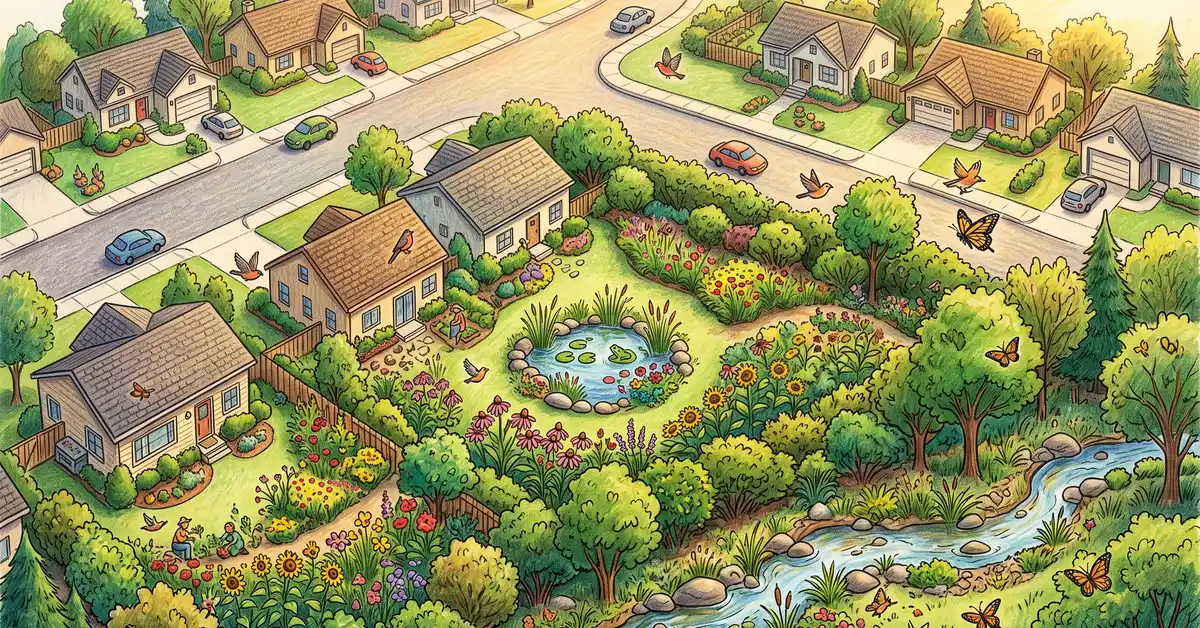
A wildlife corridor is an area of habitat that connects wildlife populations separated by human structures (roads, fences, lawns, buildings). The US Fish and Wildlife Service defines it simply as a piece of undeveloped land connecting two habitats so wildlife can move safely between them (USFWS). The Society for Conservation Biology North America notes that corridors increase the ability of fish, wildlife, and plants to move between habitats for migration, dispersal, genetic exchange, and climate adaptation (SCBNA).
Landscape ecologists describe the world as a mosaic of three things: patches (chunks of habitat), corridors (the connective tissue between them), and a matrix (everything else, often hostile to a given species). The classic conservation biology review by Beier and Noss (Conservation Biology, 1998) showed that the majority of well-designed studies found corridors increase movement rates, gene flow, and population persistence (Beier & Noss 1998, PDF). Why this matters at backyard scale: the IPBES Global Assessment 2019 confirms that habitat loss and fragmentation are among the leading drivers of global biodiversity decline, and that private land in the US is now a meaningful conservation surface (IPBES SPM 2019, PDF).
Why this is a permaculture question
Permaculture asks you to read patterns before you intervene. The patch-corridor-matrix is a pattern. So is the food web that connects an oak tree to the chickadee feeding caterpillars to its young. Holmgren's principles "use and value diversity", "use edges and value the marginal", "integrate rather than segregate", and the Zone 5 idea of leaving space wild all line up with corridor design (PermaculturePrinciples.com). A garden built with these principles is not just productive; it is permeable. Animals and pollen and seeds can move through it.
The "Homegrown National Park" idea
Entomologist Doug Tallamy at the University of Delaware has done the most to translate corridor ecology into something a US homeowner can act on. In Nature's Best Hope (2019) he points out that more than 40 million acres of the US are turfgrass lawn, an area roughly equal to New England. If half of that lawn were converted to native plantings, the resulting network of small high-quality patches would form a distributed corridor system on private land that rivals the area of formal protected reserves (Tallamy on the Homegrown National Park idea).
A single yard rarely changes a population trajectory. Forty million linked yards can. That is the leverage point.
Five corridor types that fit a US garden
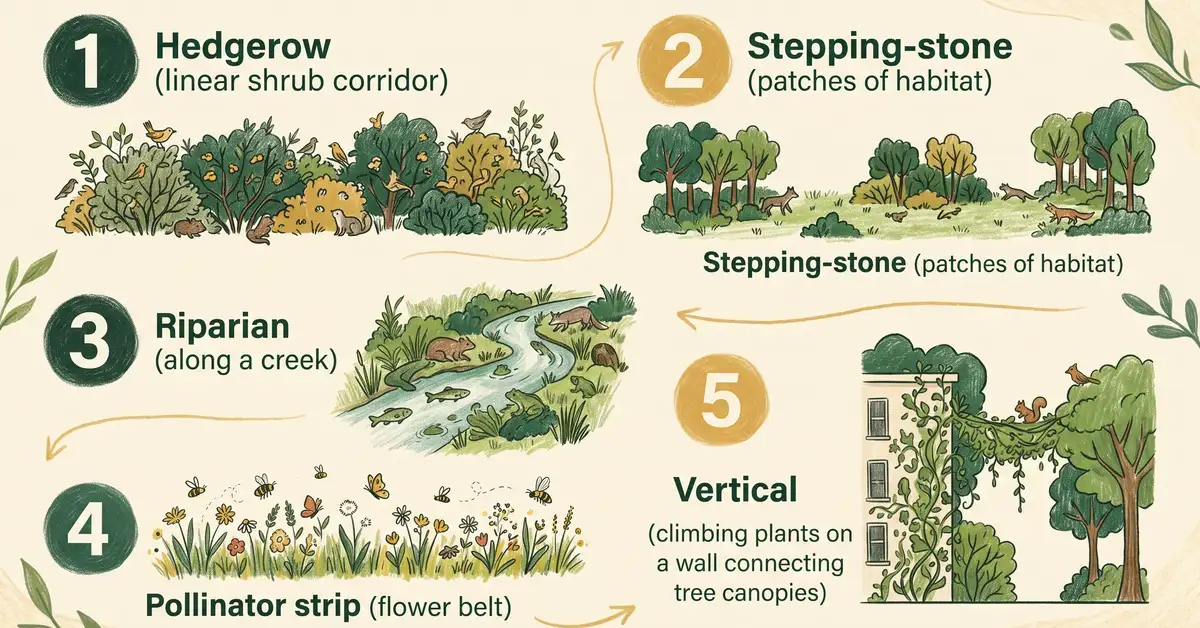
Hedgerow (linear corridor)
A 6 to 12 ft wide strip of mixed native shrubs along a property line or fence. Layer it: small trees (serviceberry, dogwood, redbud), shrubs (elderberry, viburnum, hazelnut, blueberry), and a herbaceous edge of native flowers and grasses. Hedgerows are the most generalist corridor type. They serve birds (nesting and forage), pollinators (continuous nectar), small mammals (cover), and pollen-dispersing insects. Time: one weekend to plant a 30 ft starter section. Cost: $200 to $600 for 50 ft of mixed bare-root stock.
Stepping-stone corridor (patches)
If a continuous strip is not possible, a series of small habitat patches (think 50 to 200 sq ft each) spaced no more than 30 to 50 ft apart can still function as a corridor for pollinators and small birds. A native flower bed, a small clump of shrubs, a patch of native grasses, a pocket meadow. The key is regular spacing and matched plant lists across the patches so animals encounter familiar resources.
Riparian (along water)
If a stream, ditch, or seasonal swale runs near your property, riparian planting is the single highest-leverage corridor type. Streams are natural movement highways for amphibians, reptiles, small mammals, and many bird species, and they connect across watersheds at landscape scale. Plant native shrubs and trees (elderberry, willow, dogwood) along the bank, leave at least 10 to 20 ft of unmown buffer, and avoid lawn-to-water transitions.
Pollinator strip
A continuous belt of nectar-rich native flowers, typically 3 to 6 ft wide, designed for sequential bloom from March through October. Xerces Society publishes regional pollinator plant lists matched to your ecoregion (Xerces Society). A pollinator strip along a driveway, sidewalk, or property line can connect garden to garden across an entire block.
Vertical corridor
In dense urban or balcony settings, climbing native vines (Virginia creeper, native honeysuckle, native clematis) on walls, trellises, and pergolas can connect ground-level resources with tree canopies and roofs. This serves birds, bats, and many insect species. A 30 ft vertical run of native vine planted at the base of a fence can equal a 100 sq ft ground-level patch in habitat value.
The hedgerow: the workhorse of backyard corridors
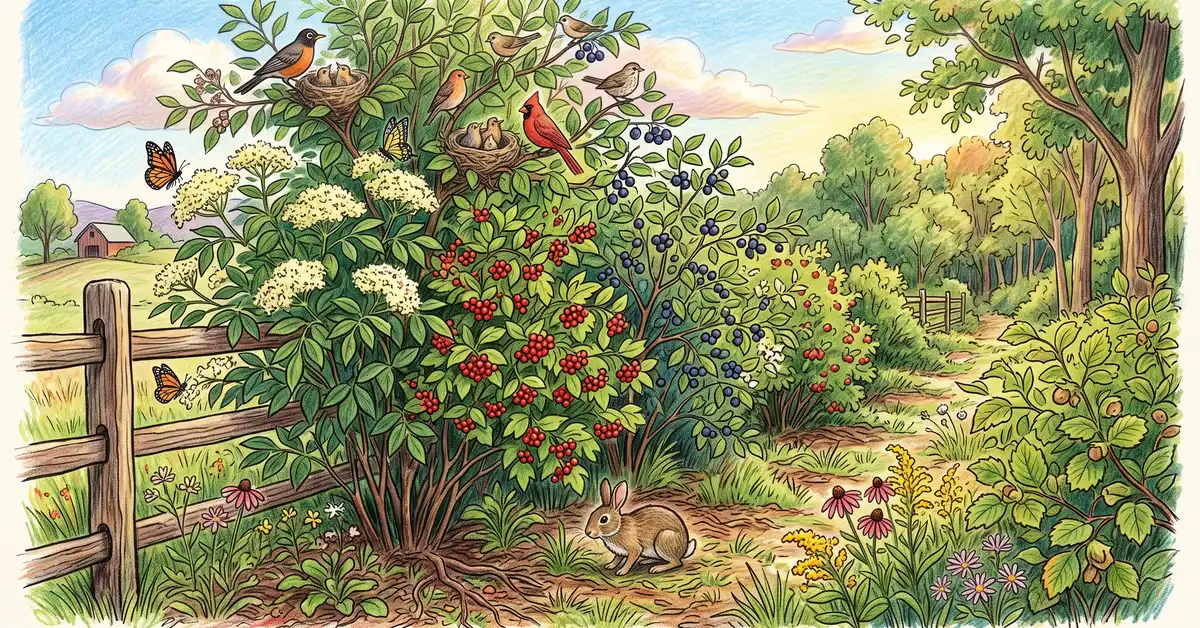
A native hedgerow is the most flexible corridor for most US backyards. Hall and colleagues found in their 2017 review of urban pollinator ecology that linear habitat features significantly increase pollinator abundance and diversity, especially when planted with diverse native species (NWF Native Plant Habitats). The structure matters as much as the species list: layered hedgerows that combine tall shrubs, mid-story species, and a flowering ground layer create more niche space than any single-species hedge.
| Region | Tall layer (6-15 ft) | Mid layer (3-6 ft) | Herbaceous edge |
| Northeast / Mid-Atlantic | Serviceberry, eastern redbud, witch hazel | Elderberry, arrowwood viburnum, spicebush | Joe pye weed, goldenrod, asters |
| Southeast | American beautyberry, wax myrtle, sweetbay magnolia | Yaupon holly, oakleaf hydrangea | Black-eyed susan, blanketflower |
| Midwest | American hazelnut, serviceberry, ninebark | Elderberry, gray dogwood, prairie willow | Purple coneflower, little bluestem, milkweed |
| West / Pacific Northwest | Pacific ninebark, Oregon grape, vine maple | Snowberry, red flowering currant | Yarrow, native lupine, camas |
| Southwest | Desert willow, mesquite, manzanita | Apache plume, fairyduster | Penstemon, native salvias |
Sources: USDA NRCS Plant Materials Centers regional releases; National Wildlife Federation Native Plant Finder; Xerces Society regional pollinator plant lists
Keystone native plants: the disproportionate movers
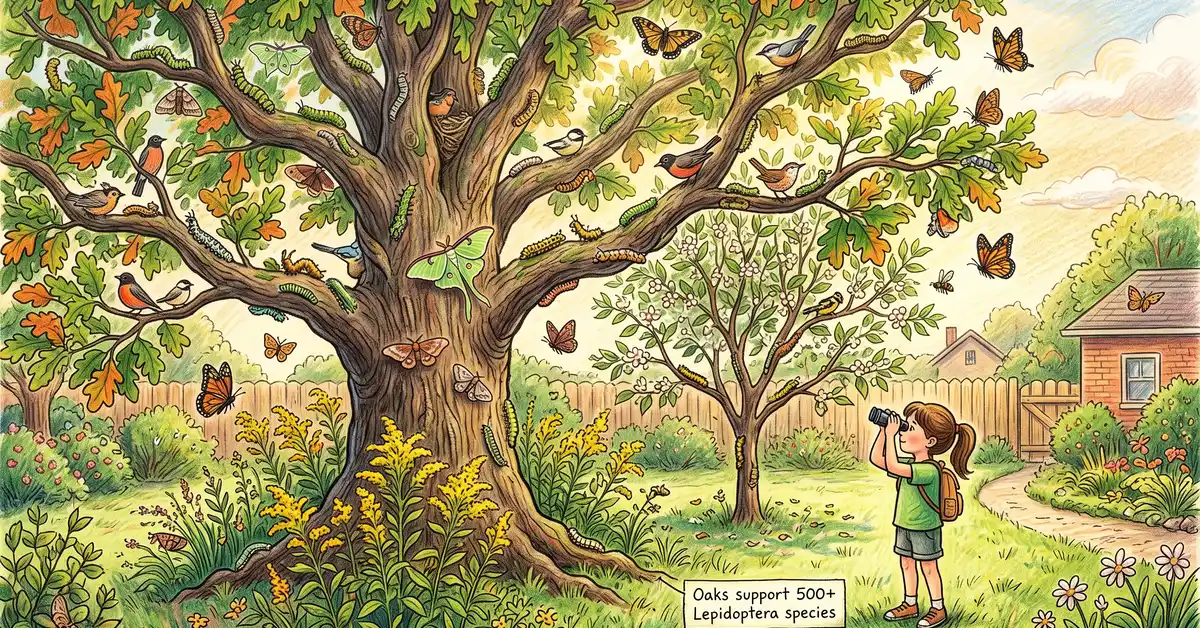
Not every native plant carries equal ecological weight. Tallamy and Shropshire's landmark 2009 paper in Conservation Biology compared the value of native and introduced plants as host plants for Lepidoptera (butterflies and moths) and found enormous differences (Tallamy & Shropshire 2009). The National Wildlife Federation summarises the keystone genera that punch above their weight (NWF Keystone Plants):
Why caterpillars are the ecology you cannot see
Roughly 96% of North American terrestrial birds feed insects, mainly caterpillars, to their young. A pair of breeding chickadees needs 6,000 to 9,000 caterpillars to fledge one brood. So when you ask which plants support birds, you are really asking which plants support caterpillars. The answer turns out to be that 5% of native plant genera support 75% of the caterpillar species in any given region. Plant those 5%, and the food web springs back to life.
| Keystone genus | Caterpillar species supported (US) | Notes |
| Oaks (Quercus) | ~950 | Single highest-leverage native; bur, white, swamp white, pin work in most regions |
| Willows (Salix) | ~450 | Pussy willow and arroyo willow good for backyard scale |
| Cherries and plums (Prunus) | ~400 | Black cherry, chokecherry, beach plum |
| Goldenrod (Solidago) | ~115 | Pollinator favorite; not the ragweed everyone blames for allergies |
| Asters (Symphyotrichum) | ~110 | Late-season nectar; New England aster, calico aster |
| Sunflowers (Helianthus) | ~70 | Native perennial species, not the giant annual |
| Blueberries (Vaccinium) | ~280 | Highbush blueberry doubles as edible |
Source: NWF Keystone Plants for Birds and Wildlife (Tallamy data, 2022)
If you plant nothing else, plant one oak (where space allows) plus three or four of the herbaceous keystones (goldenrod, asters, sunflower, native milkweed). You will have done more for biodiversity in 100 sq ft than most acres of formal park.
The pollinator strip in detail
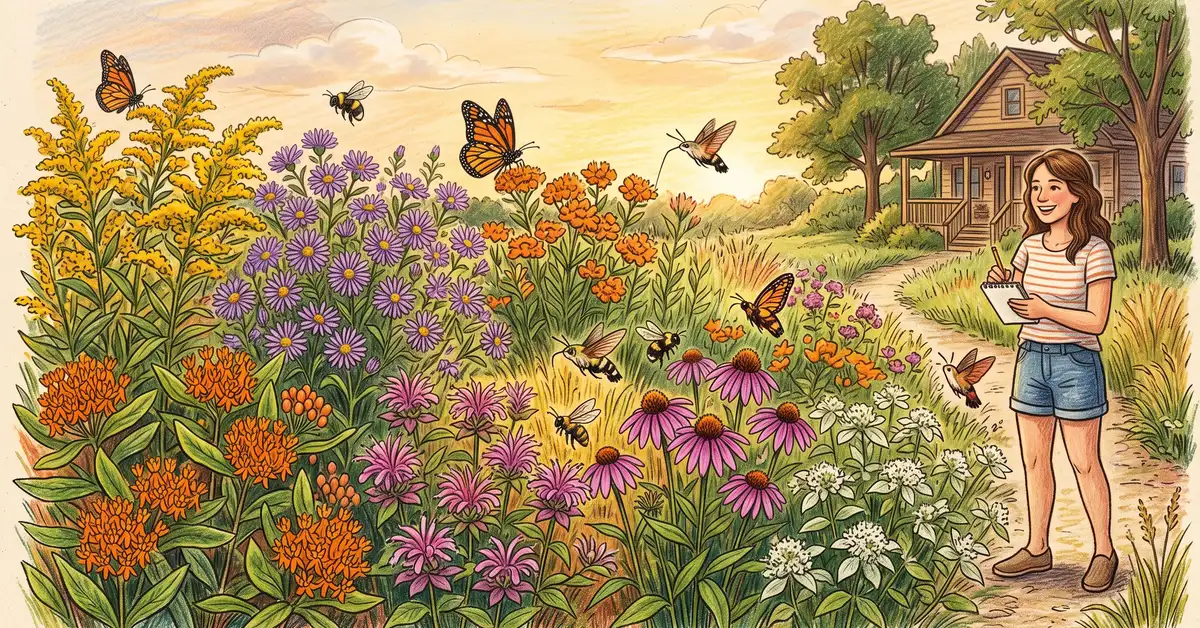
Native bees in the US number over 4,000 species, and most have foraging ranges of just a few hundred feet. That means a pollinator strip in your yard is local infrastructure. Xerces Society guidance is to aim for at least 3 to 4 species in bloom in each of the three main seasons (spring, summer, fall) so the strip provides continuous forage from March through October.
| Bloom window | Reliable natives (most of US) | What they feed |
| Early spring (Mar-May) | Wild geranium, golden alexanders, columbine, serviceberry | Bumble bee queens, early native bees, hummingbirds |
| Late spring (May-Jun) | Bee balm, anise hyssop, foxglove beardtongue, native sages | Specialist bees, swallowtails, hummingbird moths |
| Summer (Jun-Aug) | Mountain mint, milkweed, coneflower, black-eyed susan | Monarchs, native bees, predatory wasps |
| Late summer (Aug-Sep) | Joe pye weed, ironweed, blazing star | Late-season migrants, monarchs fueling for migration |
| Fall (Sep-Oct) | Goldenrod, asters, witch hazel | Pre-overwintering bumble bee queens, late migrating monarchs |
Sources: Xerces Society regional pollinator plant lists; Audubon Native Plant Finder
Water as a corridor anchor
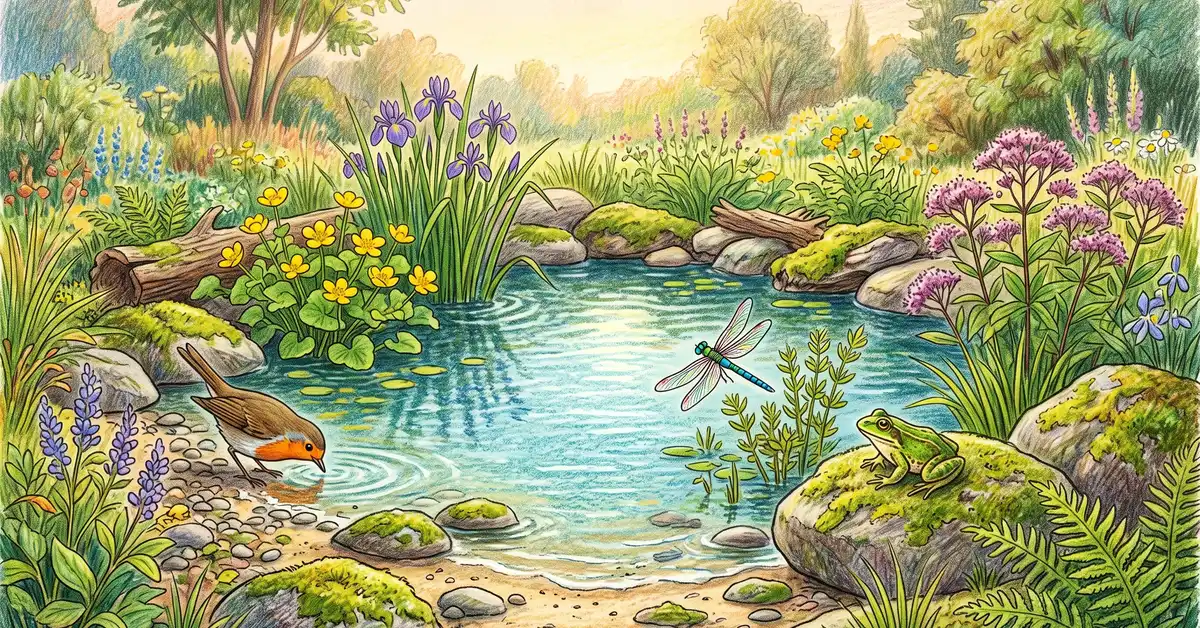
Even a small water feature dramatically increases visitation rates by birds, amphibians, and insects. The Cornell Lab of Ornithology notes that adding water (especially moving water from a small bubbler or solar pump) consistently increases the diversity of birds visiting a yard (Cornell Lab on bird-friendly gardens).
Three options at different scales: a bird bath ($20 to $60, refresh weekly), a small frog pond (10 to 30 sq ft, 18 to 24 in deep at deepest point, with shallow shelves, $30 to $200), a rain garden tied to a downspout (8 to 12 ft across, planted with native moisture-tolerant species, doubles as erosion control). Each one acts as an anchor that pulls organisms toward the rest of your corridor.
Avoiding "ecological traps"
Connecting to your neighbors
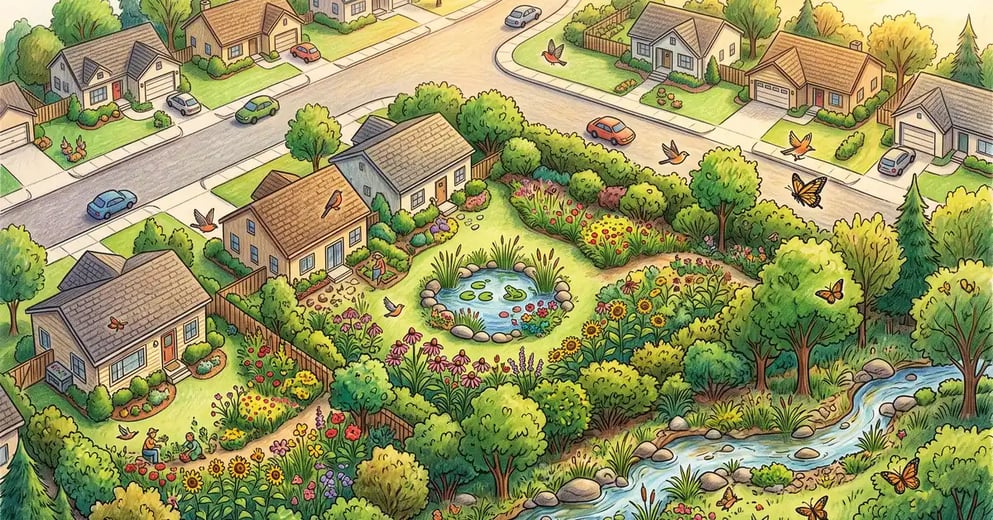
A single property changes very little. A block-long network of yards changes everything. The math behind Tallamy's Homegrown National Park concept is essentially the question: what if 100 yards on your street each contributed 200 sq ft of native habitat connected at the property lines? You would have, in effect, a 20,000 sq ft corridor running the length of your block, a meaningful regional patch by ecological standards.
Practical moves that scale neighbor-to-neighbor: plant your hedgerow against a shared fence, leaving the fence permeable; trade seeds or divisions of native perennials at a block party; certify your yard through the National Wildlife Federation's Certified Wildlife Habitat program (NWF Habitat Essentials) which requires food, water, cover, places to raise young, and sustainable practices, and put the sign in your front yard so neighbors see it; submit observations to iNaturalist or eBird so the local data gets richer over time.
For a deeper look at how this fits into the broader permaculture sectors and how zones connect to wildlife habitat, see permaculture sectors: wind, sun, water, and wildlife and permaculture zones explained.
Get the Weekly Dig
One practical permaculture guide a week, written for gardeners who do this on weekends: permaculture design for real backyards. Free, no spam, unsubscribe any time.
Join the Weekly DigYour one-weekend starter plan
Saturday morning: walk and map (1 to 2 hours)
Walk your property and the surrounding 2 to 3 blocks. Note what is already there: street trees, parks, vacant lots, drainage ditches, creeks, parks. Sketch the existing patches and possible corridor lines. Identify the property edge that connects most logically to an existing habitat feature.
Saturday afternoon: order keystone plants (1 hour)
Use the National Wildlife Federation Native Plant Finder (search by ZIP code) or Audubon Native Plant Finder. Order an oak seedling (where you have room), 3 to 6 native shrub plugs (elderberry, viburnum, serviceberry), and 12 to 18 herbaceous keystone plants (goldenrod, asters, milkweed, mountain mint). Total cost typically $80 to $200 from a regional native plant nursery.
Sunday: plant a 15 ft hedgerow starter section (3 to 5 hours)
Along the property edge you mapped, plant the shrubs at 4 to 6 ft spacing in a slightly curved line. Plant the herbaceous keystones in front in a 3 ft wide flowering edge. Mulch heavily (3 to 4 in of wood chips). Water deeply. Done.
Following week: certify and observe
Apply for NWF Certified Wildlife Habitat status ($20). Start an iNaturalist account and log species you see. The certification sign in your front yard is a free conversation-starter with neighbors. Within 2 to 3 years a 15 ft section can become a connected block-long corridor if even a few neighbors follow.
FAQ
What is a wildlife corridor?
A wildlife corridor is an area of habitat connecting two or more wildlife populations or larger habitats that have been separated by human development. It can be a continuous strip (hedgerow, riparian buffer), a series of stepping-stone patches, or even vertical structures like climbing plants on a wall. The US Fish and Wildlife Service defines it as a piece of undeveloped land connecting two habitats so wildlife can move safely between them.
How does a wildlife corridor work in a backyard?
At the backyard scale, a corridor usually takes one of five forms: a hedgerow along a property line, a series of stepping-stone native plant patches, a riparian strip along a stream, a pollinator strip with continuous bloom, or a vertical corridor of climbing native vines. Each links your garden to nearby habitat patches (parks, woodlots, other gardens) so pollinators, birds, and small mammals can move between them.
What is the Homegrown National Park concept?
Coined by entomologist Doug Tallamy, the Homegrown National Park is the idea that converting half of US private lawn (about 20 million acres of the 40+ million acre total) to native plantings would create a distributed national-scale wildlife corridor on private land. The thesis: individual yards rarely matter alone, but the cumulative impact of millions of properties redesigned with biodiversity in mind is enormous.
What native plants matter most for wildlife corridors?
Tallamy's research shows that about 5% of native plant genera support 75% of Lepidoptera (caterpillar) species in any region. The top US keystone genera are oaks (~950 caterpillar species), willows (~450), cherries and plums (~400), blueberries (~280), goldenrods (~115), asters (~110), and native sunflowers (~70). Plant these first.
Why are caterpillars so important?
Approximately 96% of North American terrestrial bird species feed insects (mainly caterpillars) to their young. A pair of chickadees needs 6,000 to 9,000 caterpillars to fledge one brood. So the question "what plants support birds?" is functionally "what plants support caterpillars?", and the answer is oaks, willows, and cherries above all (Tallamy, Bringing Nature Home).
How wide should a hedgerow corridor be?
6 to 12 ft wide is the standard backyard target. Narrower strips (under 3 ft) function more as edge habitat than as real corridor. Wider strips (over 15 ft) become small habitat patches in themselves. For most US suburban yards, a 6 to 8 ft layered hedgerow along one property line is the highest-leverage move.
Do small gardens really make a difference?
A single small garden in isolation makes a small difference. The same garden connected to a neighbor's hedgerow that connects to a third garden that connects to a park or a creek riparian strip makes a substantial difference. The unit of analysis is the network, not the property. This is why initiatives like Homegrown National Park focus on enrollment and cumulative acreage.
What is the difference between a native and non-native plant for wildlife?
Native plants co-evolved with local insects and other wildlife over thousands of years and support far richer food webs. Tallamy and Shropshire (2009, Conservation Biology) compared host-plant value of natives versus introduced plants and found native genera support orders-of-magnitude more caterpillar species than introduced ornamentals of similar size. Native oaks support roughly 950 caterpillar species; non-native ginkgo supports about 5.
How can I avoid pesticides in my wildlife corridor?
Buy plants from native plant nurseries that guarantee neonicotinoid-free stock. Avoid systemic insecticides entirely. Xerces Society documents that neonicotinoids persist in plant tissues for 2 to 3 years after application, meaning a treated nursery plant continues to harm pollinators long after you bring it home. For pest issues in the corridor itself, rely on biodiversity (predatory insects, birds) rather than spray.
How do I get my neighbors involved?
Three low-friction moves: certify your yard through National Wildlife Federation Certified Wildlife Habitat ($20) and put the sign visibly in your front yard; offer divisions of native perennials at the next block gathering; share your corridor map with one or two interested neighbors and propose connecting along a shared fence. A block-long corridor is achievable with 3 to 5 enrolled yards.
Resources
- US Fish and Wildlife Service - Wildlife Corridors
- Society for Conservation Biology North America - Wildlife Corridor Connectivity Act
- Beier & Noss 1998 - Do Habitat Corridors Provide Connectivity? (Conservation Biology, PDF)
- IPBES Global Assessment 2019 - Summary for Policymakers (PDF)
- Rosenberg et al. 2019 - Decline of the North American Avifauna (Science)
- Hallmann et al. 2017 - 75% decline in flying insect biomass (PLoS ONE)
- Tallamy & Shropshire 2009 - Ranking lepidopteran use of native vs introduced plants
- Doug Tallamy's Homegrown National Park concept
- National Wildlife Federation - Certified Wildlife Habitat essentials
- NWF - Keystone Native Plants for Birds and Wildlife
- Xerces Society - Regional Pollinator-Friendly Native Plant Lists
- Xerces Society - Systemic Insecticides Reference
- Cornell Lab of Ornithology - Bird-Friendly Gardens
- The 12 Permaculture Design Principles (Holmgren)