
Why Does Seed Saving Build Genetic Resilience?
Because every seed you save from a plant that did well in your garden shifts the odds slightly toward whatever let it do well there. Do that for five or ten years and you stop having a variety and start having a population, one that is measurably better suited to your soil, your season length and your particular pests than anything you can buy. how to cold stratify seeds
That is the whole argument, and it runs against the direction industrial agriculture has gone. The FAO's agrobiodiversity briefing states that since the 1900s, some 75% of plant genetic diversity has been lost as growers left local varieties and landraces for genetically uniform, high-yielding ones. Worth flagging: that figure comes from a 1999 FAO information sheet summarising expert assessment rather than a global census, and later FAO reporting avoids attaching a single number to the trend. Treat it as a direction, not a measurement.
The species narrowing is easier to pin down. FAO notes that more than 7,000 plant species are documented as food, and perhaps up to 30,000 are edible, yet we lean on a handful for most of our calories. An analysis of FAO data puts it at nine crops accounting for 66% of total crop production, with maize, wheat and rice alone supplying roughly 60% of plant-based calories.
What we will cover:
- How many plants you actually need to save seed from
- Isolation distances by crop, and what to do on a small lot
- Storage conditions that determine whether seed lasts one year or eight
- What you legally cannot save, stated accurately
Key Takeaway
The single most common seed-saving mistake is saving from too few plants. Collect from one exceptional plant and you get a bottleneck; collect from a broad sample of healthy plants and you get an evolving population. Population size matters more than picking the perfect specimen.
What Is a Landrace, and Why Does It Matter?
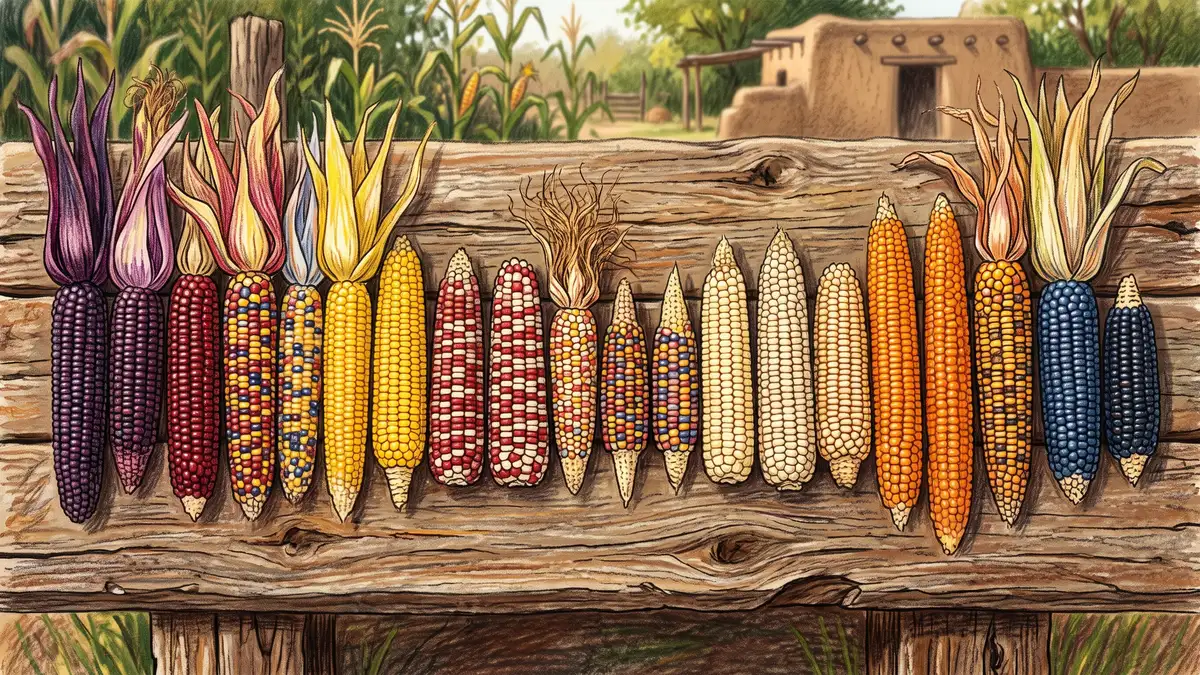
A landrace is a crop population that is genetically diverse on purpose. Unlike a modern cultivar bred for uniformity, a landrace carries wide variation within it: different plant heights, maturity dates, disease responses. When a season goes badly in one particular way, some fraction of the population handles it.
The evidence that this produces real local adaptation is solid. Mercer and colleagues, publishing in Evolutionary Applications in 2010, used reciprocal transplant experiments with maize landraces across an elevation gradient in southern Mexico and found greater local adaptation in highland landraces than lowland ones, with highland material performing poorly when moved to mid-elevation sites. The populations were not just diverse, they were tuned to place.
The honest trade-off shows up too. Ficiciyan and colleagues compared modern varieties against landraces of winter wheat, spelt and rye under organic management and found that modern varieties yielded significantly higher, while landrace varieties delivered more ecosystem services, including better support for associated biodiversity. If peak yield in a good year is your only metric, modern varieties win. If stability across variable years and ecological function matter, the picture changes.
Why This Works: Diversity as Redundancy
Permaculture design treats redundancy as a feature, not waste: every important function should be supported by more than one element. A genetically diverse seed population applies that principle at the level of the crop itself. You are not betting the season on one genotype performing under one set of conditions. You are holding a portfolio, and letting the weather decide which parts of it pay out.
How Many Plants Do You Need to Save From?
It depends entirely on how the crop pollinates itself. Self-pollinators are forgiving. Outcrossers are not, and small populations of outcrossing species show inbreeding depression fast: poor germination, weak plants, reduced fertility, within a few generations.
New Mexico State University Extension's seed-saving guide is direct that preserving variety integrity does not depend only on isolating varieties from one another, population size is pivotal in its own right. The Seed Matters isolation and population chart puts numbers on it.
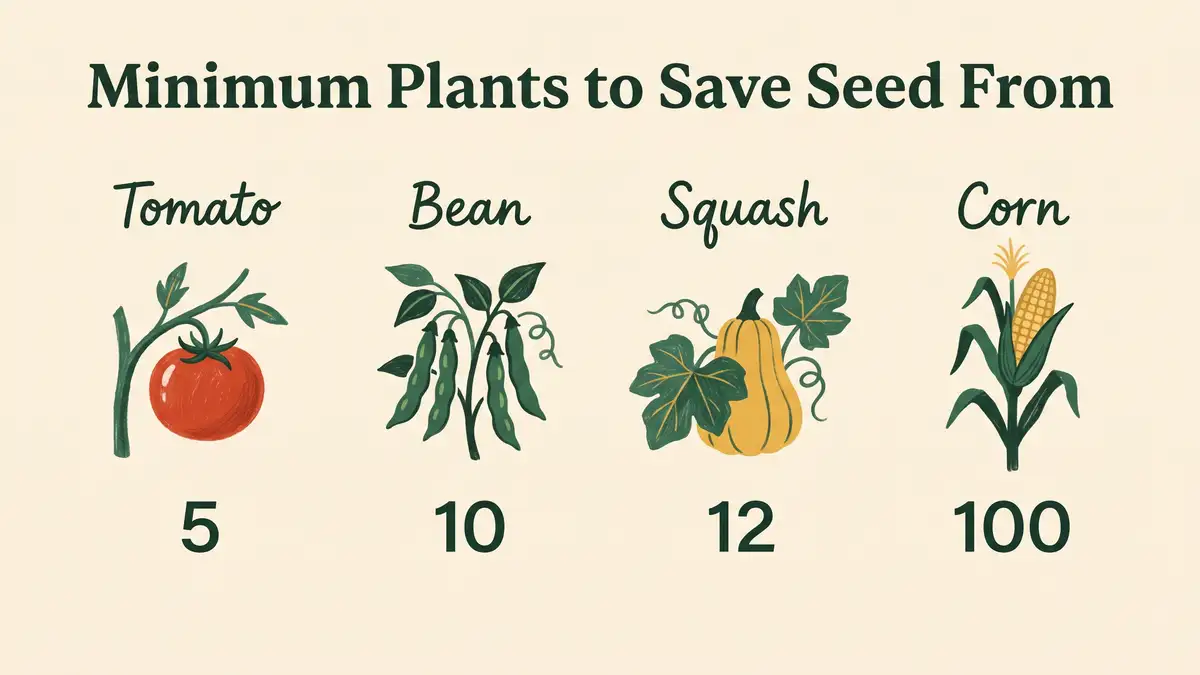
| Crop | Pollination | Min. Plants | Isolation | Seed Life |
| Bean (Phaseolus vulgaris) | Self | 10 | 20 ft. (6.1 m) | 4 yr. |
| Pea (Pisum sativum) | Self | 25 | 20 ft. (6.1 m) | 5 yr. |
| Fava bean (Vicia faba) | Self / insect | 20 | 50 ft. (15.2 m) | 4 yr. |
| Cucumber (Cucumis sativus) | Insect | 10 | 0.5 mile (0.8 km) | 8 yr. |
| Arugula, mustard greens | Insect | 40 | 0.5 mile (0.8 km) | 5 yr. |
| Beet and chard (Beta vulgaris) | Wind | 30 | 1 mile (1.6 km) | 6 yr. |
| Corn (Zea mays) | Wind | 100 | 1-2 miles (1.6-3.2 km) | 6 yr. |
Source: Seed Matters, Isolation Distance Seed Saving Chart (PDF)
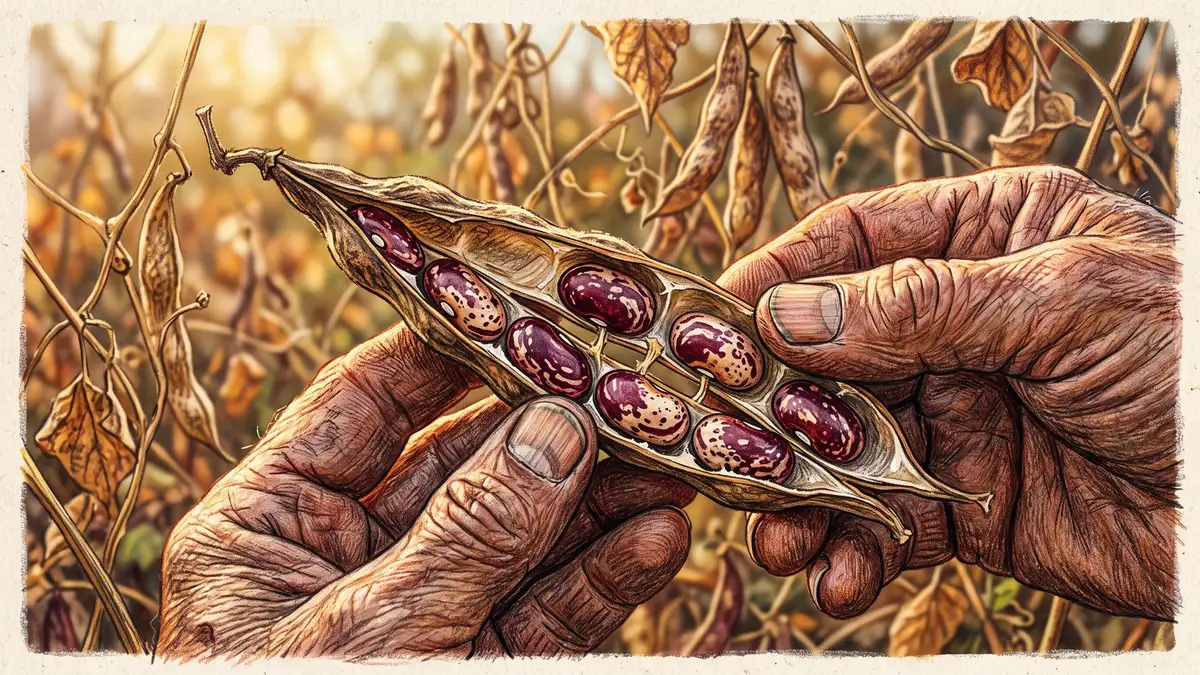
Those minimums are the reason most home gardeners quietly should not be saving corn seed. A hundred plants is a real planting, and anything less starts degrading within a few generations. Beans and peas, by contrast, are almost effortless: ten to twenty-five plants and twenty feet of separation covers it, which is why they are the right place to start.
Common Mistake to Avoid
Do not save seed only from your single best plant. It feels like good selection and it is actually a genetic bottleneck. Cull the obvious off-types and weaklings, then collect from as many of the remaining healthy plants as you can. Selection works through many small nudges across a population, not one dramatic choice.
How Do You Handle Isolation on a Small Lot?
Distance is one of three tools, and usually the least available one. Half a mile of isolation is not happening in a suburban backyard. Seed Savers Exchange's guidance covers the alternatives.
Their isolation methods guide notes that required distance depends largely on a species' mating system and ranges from around 10 feet for primarily self-pollinating crops up to several miles for strong outcrossers. When distance is not available, two other approaches work.
Start with self-pollinators
Tomatoes, beans, peas and lettuce need very little separation and modest populations. Get two or three seasons of practice here before attempting squash or brassicas.
Use containment for insect-pollinated crops
Isolation cages or blossom bags placed over individual flowers after hand-pollination. For squash, hand-pollinate in the morning and bag the flower. It takes minutes per fruit and replaces half a mile of land.
Use timing where flowering is short
Stagger planting dates so two varieties of the same species never flower together. This works well for corn, where tasselling can be scheduled, and poorly for crops with long flowering windows.
Or deliberately let them cross
If your goal is a locally adapted population rather than a preserved heirloom, mix several open-pollinated varieties of one species and let them intercross. Isolate from commercial fields, not from each other.
That last option is the permaculture-native approach, and it is worth being explicit about the choice. Preserving a named heirloom means keeping it genetically pure, which demands isolation discipline. Building a resilient population means the opposite: encouraging crossing among diverse open-pollinated parents, then selecting hard for what performs on your site. Both are legitimate. They are not the same project.
How Do You Store Seed So It Actually Lasts?
Cool and dry, quantified. Seed physiologist J.F. Harrington's rules from the mid-twentieth century still underpin every extension recommendation you will read, and they are documented in the USDA handbook Principles and Practices of Seed Storage.
The rules: seed life is halved for each 9°F (5°C) increase in storage temperature, and halved again for each 1% increase in seed moisture content. The practical version, for storage up to five years, is that the sum of the temperature in °F and the relative humidity in percent should not exceed 100. The same handbook reports that seeds stored at 50°F (10°C) and 50% relative humidity showed no viability loss over five years. Add those: exactly 100.
The failure case is equally well documented: seed held at around 90°F (32°C) and 90% relative humidity typically loses viability in under three months. A hot garage or a humid shed will destroy a season's work. The handbook also cautions that immature and mechanically damaged seed loses viability fastest, which is an argument for letting seed fully ripen on the plant and handling it gently during cleaning.
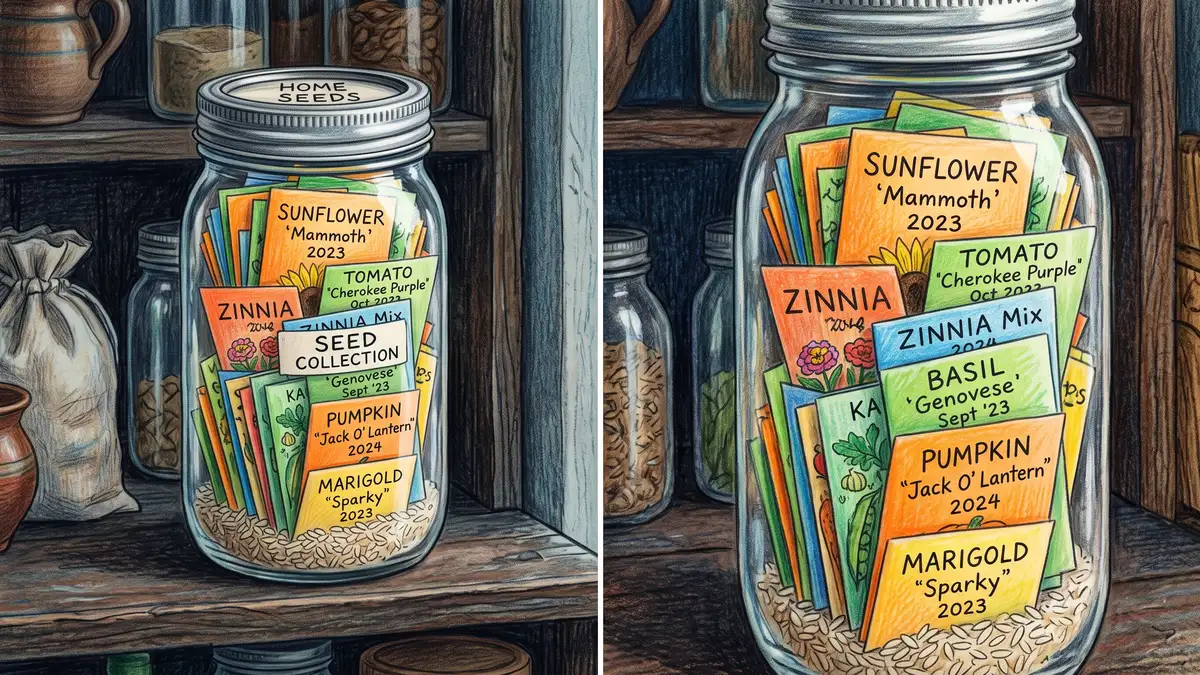
On drying, the same source notes most crop seeds tolerate drying to 2 to 3% moisture without injury, but advises against storing below 3 to 4% moisture. In practice, air-dry until brittle, then seal with a desiccant in a cool dark place. Label everything with species, variety, year and a note on how the parent plants performed. That last field is what turns a seed jar into a breeding record.
What Can You Legally Not Save?
Less than the internet suggests, but the restrictions are real. Two separate things get conflated: what will not work biologically, and what is legally restricted.
Biologically, F1 hybrid seed will not come true. The offspring segregate into a wide and mostly disappointing range because the parents were deliberately inbred lines crossed for hybrid vigour. Nothing illegal about saving it, it just will not give you the plant you had. Save from open-pollinated and heirloom varieties instead.
Legally, the relevant instruments are the Plant Variety Protection Act and utility patents. The Organic Seed Alliance's guide to seed intellectual property rights explains that the PVP Act prohibits growers from reproducing and marketing finished protected varieties, while explicitly allowing them to be used as parent lines in breeding. Federal law also carries a research exemption at 7 USC 2544: use and reproduction of a protected variety for plant breeding or other bona fide research is not an infringement. Utility patents are stricter than PVP and can restrict saving and replanting outright, which is why patented varieties are worth avoiding if seed saving is your intent. Check the packet.
Frequently Asked Questions
How long do seeds last in packets?
It varies widely by species and depends heavily on storage. Under reasonable conditions, expect roughly 4 years for beans, 5 for peas, lettuce and brassicas, 6 for corn and beets, and up to 7 or 8 for melon and cucumber. Onion and parsnip are notably short-lived, often just a year or two. The controlling variables are temperature and humidity: keep the sum of degrees F plus percent relative humidity under 100 and most seed will hold viability far longer than in a kitchen drawer.
Why is seed saving important?
Two reasons, one global and one local. Globally, crop genetic diversity has narrowed sharply: FAO documents that we rely on a handful of species for most calories despite more than 7,000 being used as food, and just nine crops account for about 66% of production. Locally, saving seed from plants that performed in your specific conditions produces measurable adaptation over generations, documented in landrace research. You end up with crops suited to your site rather than to a breeding station's.
Is seed saving illegal?
No, not as a general practice. Saving seed from open-pollinated and heirloom varieties for your own use is entirely legal in the United States. Restrictions apply to specific protected varieties: the Plant Variety Protection Act prohibits reproducing and marketing protected varieties, though it allows their use as breeding parents, and federal law includes a research exemption. Utility patents are more restrictive and can prohibit saving and replanting. The practical rule is to check the packet and stick to open-pollinated varieties.
How many plants do I need to save seed from?
Depends on pollination type. Self-pollinating crops are forgiving: 10 plants for common beans, 25 for peas. Insect-pollinated crops need more, around 40 for brassicas like arugula and mustard greens. Wind-pollinated outcrossers need the most: 30 for beet and chard, and 100 for corn. Saving from fewer plants than these leads to inbreeding depression, showing up as poor germination and weak plants within a few generations, and it hits outcrossing species hardest.
Can I save seed from hybrid tomatoes?
You can, but the results will not match the parent. F1 hybrids are produced by crossing two inbred lines, and the next generation segregates into a wide range of types, most of them worse than what you started with. It can be an interesting breeding project if you have space and patience, but for reliable results save from open-pollinated or heirloom varieties. Our guide to heirloom varieties in the garden covers choosing them.
How do I start if I have never saved seed before?
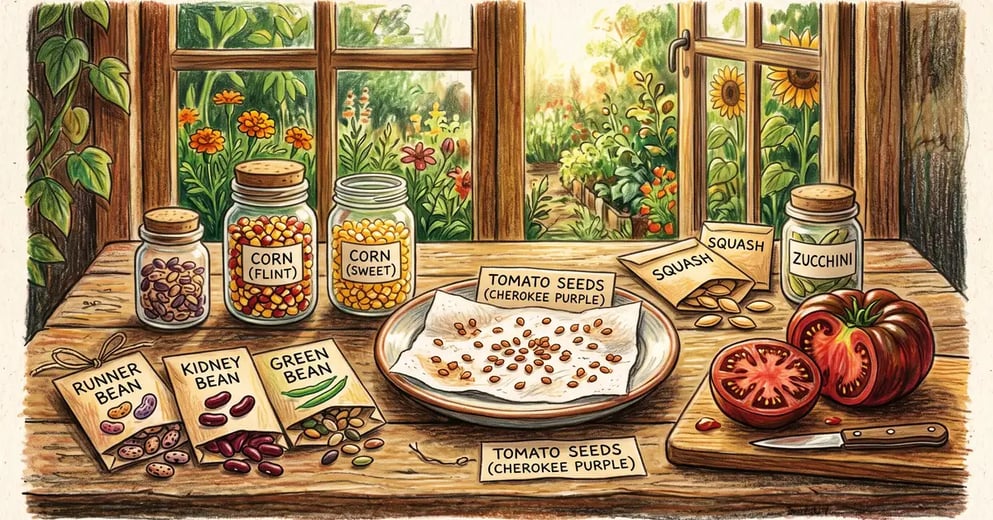
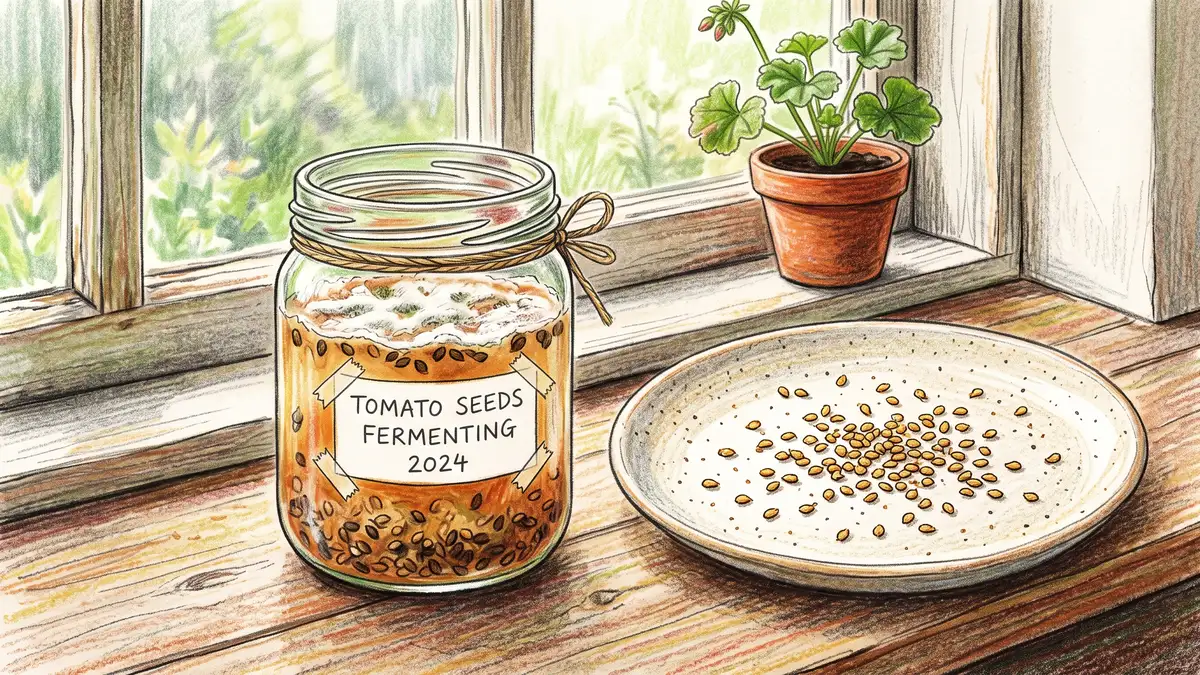
Beans, peas, tomatoes and lettuce, in that order. All are largely self-pollinating, so isolation is minimal and populations of 10 to 25 plants are enough. Let beans and peas dry fully on the plant before picking. Tomatoes need wet processing: scoop the seeds and gel into a jar of water and let it ferment for a few days, which breaks down the germination-inhibiting gel coat, then rinse and dry. Once those feel routine, move to squash with hand-pollination. For the wider design context, see our practical guide to permaculture and the 12 permaculture principles.
Get the Weekly Dig
One practical permaculture guide a week, written for gardeners who do this on weekends: permaculture design for real backyards. Free, no spam, unsubscribe any time.
Join the Weekly DigResources
- Seed Savers Exchange — Isolation Methods for Seed Saving
- Seed Matters — Isolation Distance and Population Size Chart (PDF)
- New Mexico State University Extension — Vegetable Seed Saving for Home Gardeners (H262)
- USDA — Principles and Practices of Seed Storage (Harrington's rules, PDF)
- Organic Seed Alliance — A Guide to Seed Intellectual Property Rights
- 7 U.S. Code § 2544 — Research Exemption
- Mercer et al. (2010), Evolutionary Applications — Evolutionary Response of Landraces to Climate Change
- Ficiciyan et al. (2018), Sustainability — Ecosystem Services of Traditional versus Modern Varieties
- FAO — What Is Happening to Agrobiodiversity?
- FAO — The Plants That Feed the World
- USDA Economic Research Service — Crop Genetic Resources: An Economic Appraisal