
How Do You Lower Soil pH Naturally?
Elemental sulfur, applied at a rate matched to your soil texture, worked into the top 6 to 8 inches, and given a full season to work. That is the whole answer. Everything else you have read about coffee grounds and pine needles will not move the needle, and there is measured research saying so.
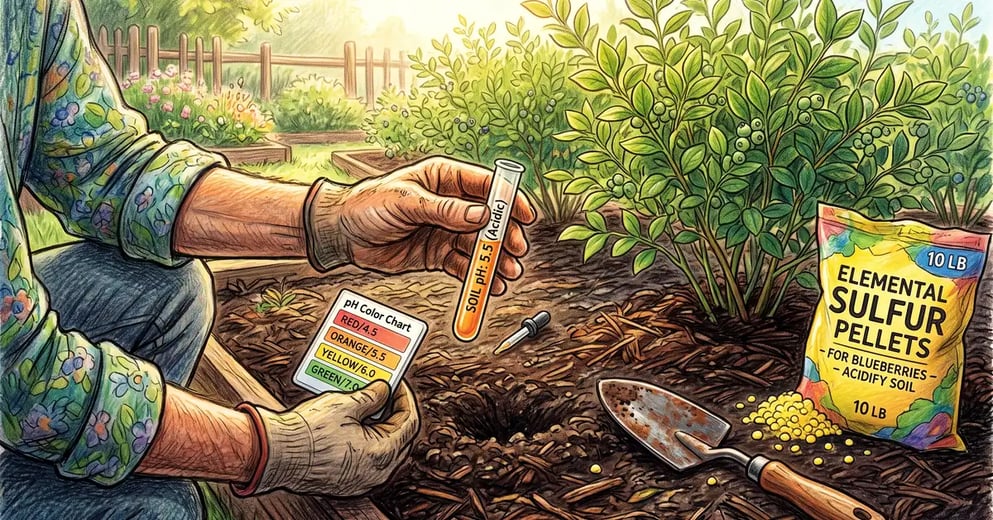
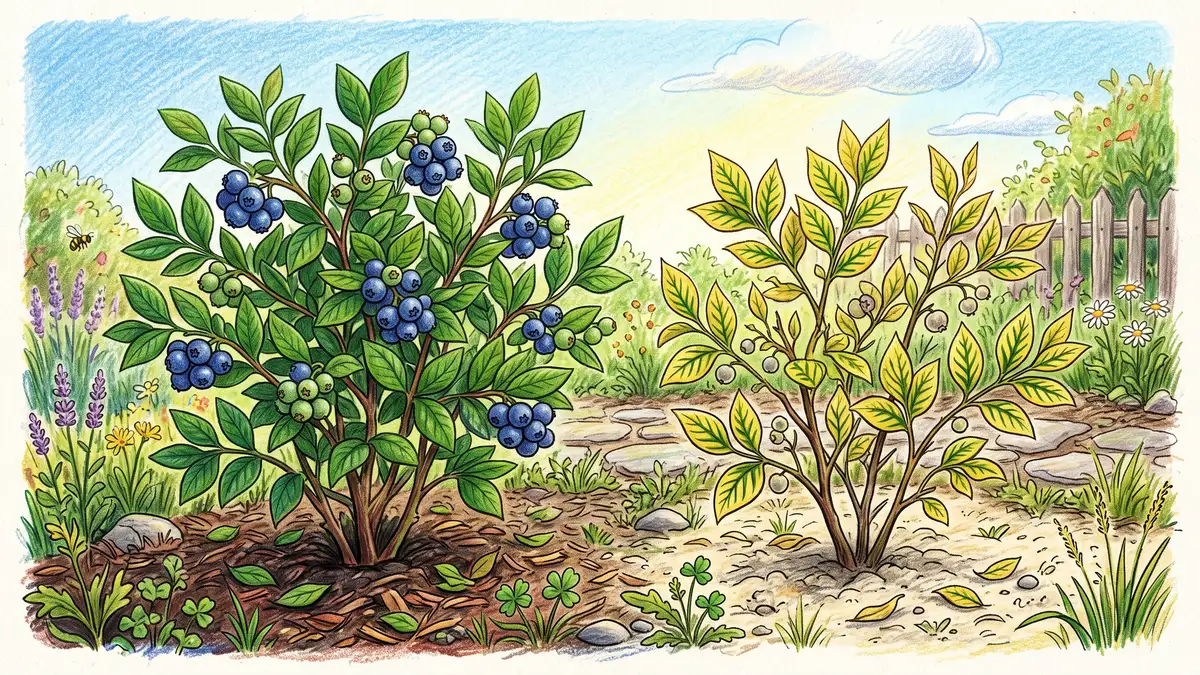
The reason this matters: once soil pH climbs above about 7.0, iron, manganese and zinc start locking up. North Carolina State Extension's handbook notes that decreasing soil pH directly increases the solubility of manganese, zinc, copper and iron. That is why your blueberries yellow between the veins while the soil test says the iron is right there.
What we will cover:
- The actual sulfur rate tables by soil texture
- How to check whether your soil will resist acidification entirely
- Which home remedies have been measured and found not to work
- Realistic timelines and when to stop trying
Key Takeaway
Test first, then apply elemental sulfur at the rate for your soil texture, then wait a full season and retest. Colorado State Extension advises retesting 3 to 4 months after application. Acidifying is a multi-year project, not a weekend fix.
What pH Are You Aiming For?
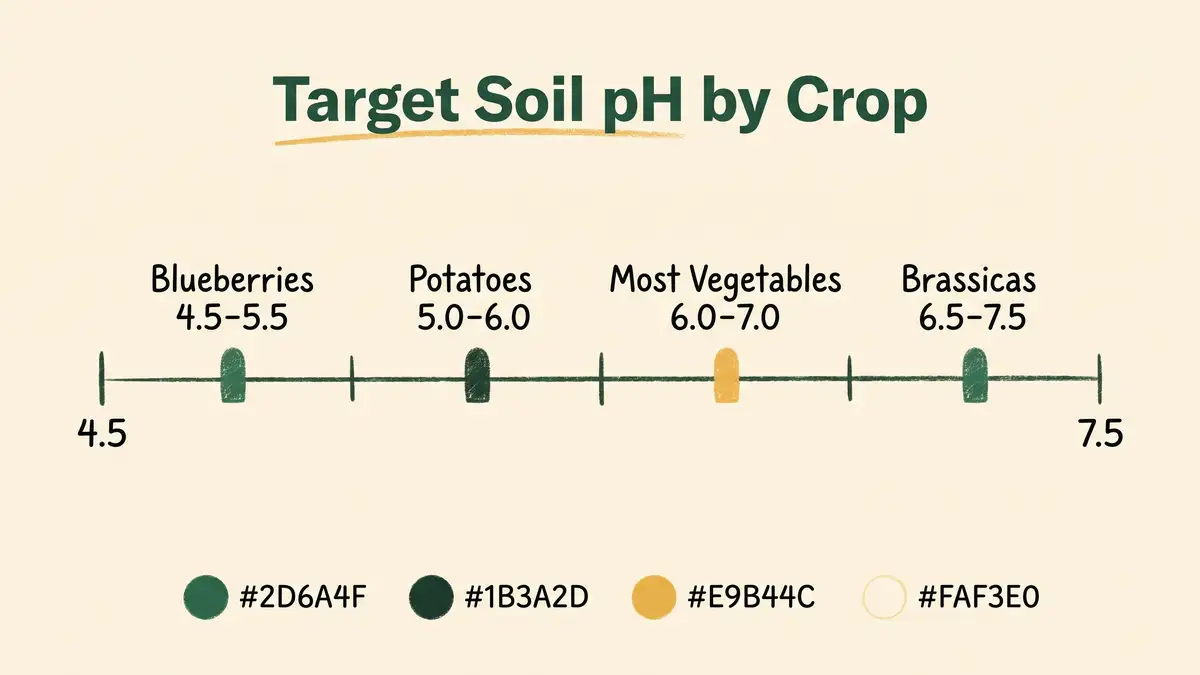
Do not acidify further than the crop needs. Overshooting causes its own problems. NC State warns that below roughly pH 5.5, toxic levels of manganese, zinc or aluminum can be released.
Clemson Extension puts the best range for most vegetables and ornamentals at 5.8 to 6.5, and acid-loving plants like azaleas and rhododendrons at 5.0 to 5.5. Oregon State's EC1585 bulletin lists blueberries and azaleas at 4.5 to 5.5. For potatoes, University of Minnesota Extension gives an ideal range of 6.0 to 6.5, tolerating down to 5.0, with the lower end helping suppress common scab.
How Much Elemental Sulfur Do You Need?
It depends entirely on your soil texture, and the difference is large. Clay soils hold far more exchange sites and buffer against pH change, so they need roughly two and a half times what sand does for the same result.
Oregon State's EC1585 bulletin, "Acidifying Soil", gives the clearest table for non-calcareous soils, in pounds of elemental sulfur per 1,000 square feet.
| pH Change | Sand | Loam | Clay |
| 7.0 to 6.5 | 2 lb. | 3 lb. | 5 lb. |
| 7.5 to 6.5 | 10 lb. | 15 lb. | 25 lb. |
| 8.0 to 6.5 | 25 lb. | 35 lb. | 45 lb. |
| 8.5 to 6.5 | 45 lb. | 55 lb. | 70 lb. |
Source: Oregon State University Extension, EC1585 — rates per 1,000 sq. ft. for non-calcareous soils
Colorado State's figures agree when converted: 1.5 pounds per 100 square feet to move pH from 7.5 to 6.6, 3.5 pounds per 100 square feet for 8.0 to 6.5, and 4 pounds per 100 square feet for 8.3 to 6.5, with the note that fine-textured clay soils need higher rates.
How Do You Apply It?
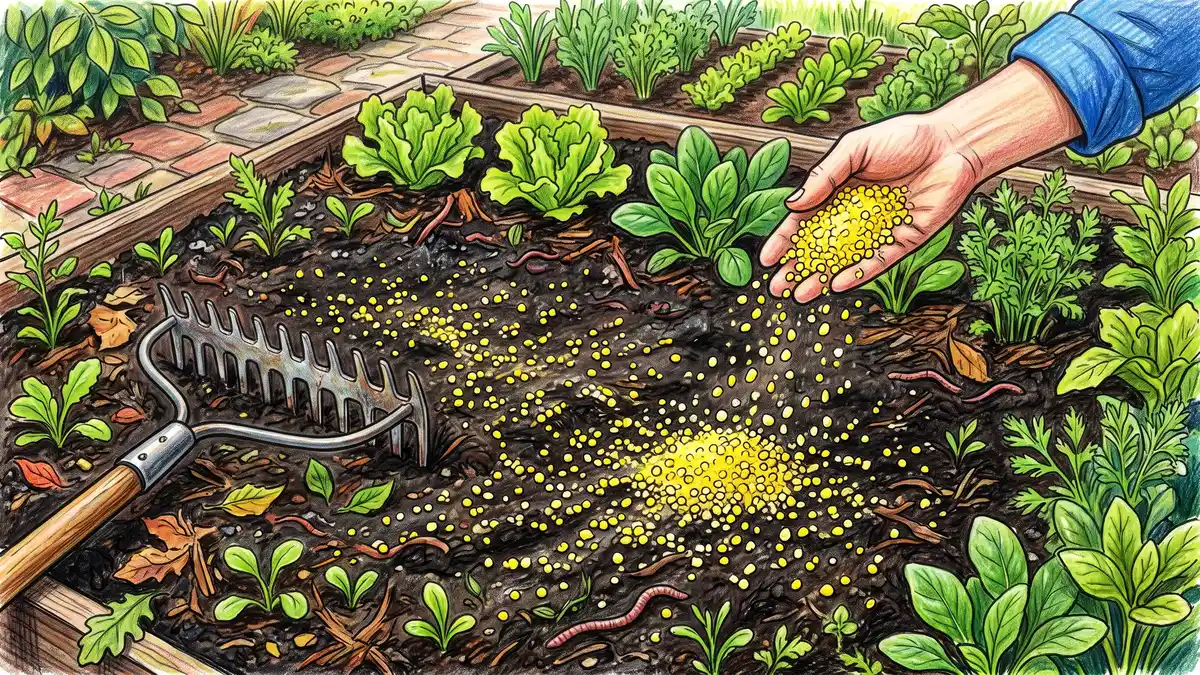
Fall application, worked in deep, then patience. Sulfur is not itself acidic. Soil bacteria in the Thiobacillus and Acidithiobacillus groups oxidize it into sulfuric acid, and that is what lowers pH. No bacteria, no result.
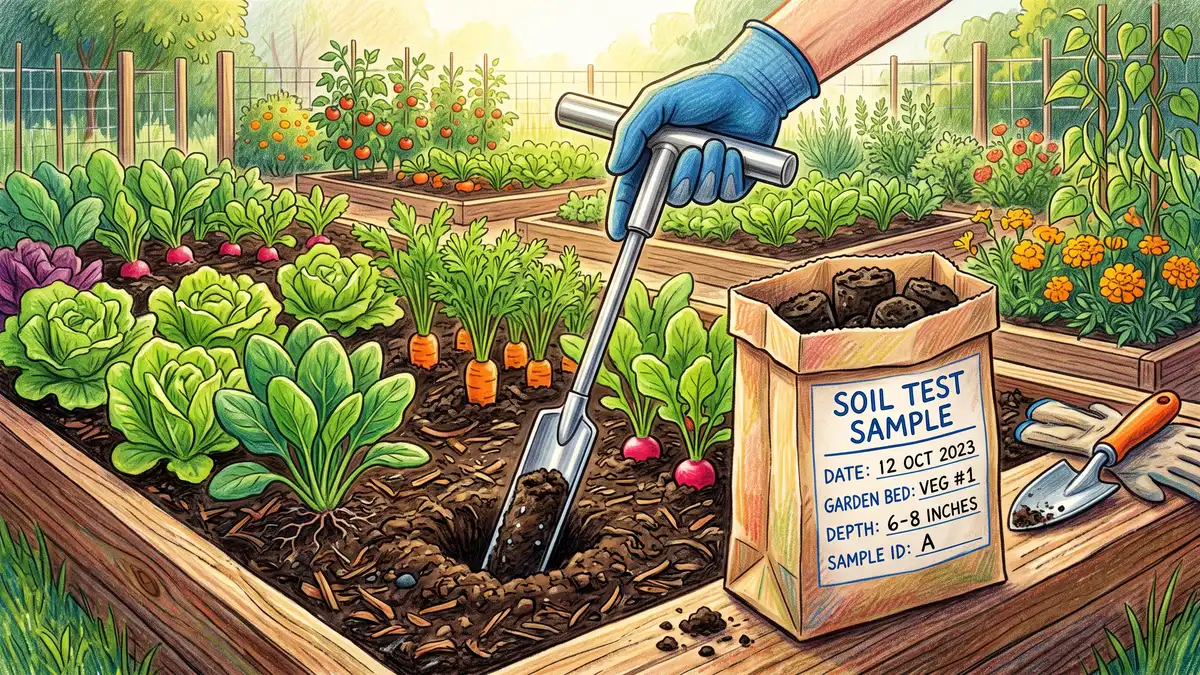
Get a lab soil test first
You need a starting pH and ideally a texture assessment to pick the right row in the table. A home probe is not accurate enough to plan a sulfur rate around.
Run the vinegar fizz test
Put 2 tablespoons of dry soil in a clean bowl and add 1 tablespoon of white vinegar. If it fizzes audibly or visibly, your soil contains free lime and everything below changes. Do this before you buy sulfur.
Apply in fall and incorporate 6 to 8 inches deep
Iowa State Extension notes sulfur is not water-soluble, so it must be mechanically mixed in to a depth of 6 to 8 in. (15 to 20 cm). Surface application barely works. Fall timing lets microbes go to work as soil warms in spring.
Retest at 3 to 4 months, then decide
Colorado State recommends retesting 3 to 4 months out. Oregon State suggests splitting the total into two smaller applications a year apart rather than one large dose, which reduces the risk of overshooting.
Iowa State Extension is blunt about the timeline: elemental sulfur must go through both a biological and a chemical process before soil pH decreases, and this often takes 3 to 6 months of warm, moist soil. Below roughly 55°F (13°C) the bacteria largely stop working, which is why nothing happens over winter.
Check for Free Lime Before You Start
If your soil fizzes with vinegar, it is calcareous and contains free calcium carbonate, which neutralizes the acid as fast as the bacteria make it. Oregon State's guidance for these soils is 50 lb. of sulfur per 1,000 sq. ft. and 1 to 3+ years before re-evaluating, depending on how vigorously it fizzes. On a vigorous fizz, growing acid-lovers in raised beds or containers is the realistic move, not remodeling the native soil.
What About Coffee Grounds and Pine Needles?
Measured, and they do not work. These are the two most repeated pieces of soil-acidifying folklore, and both have been tested.
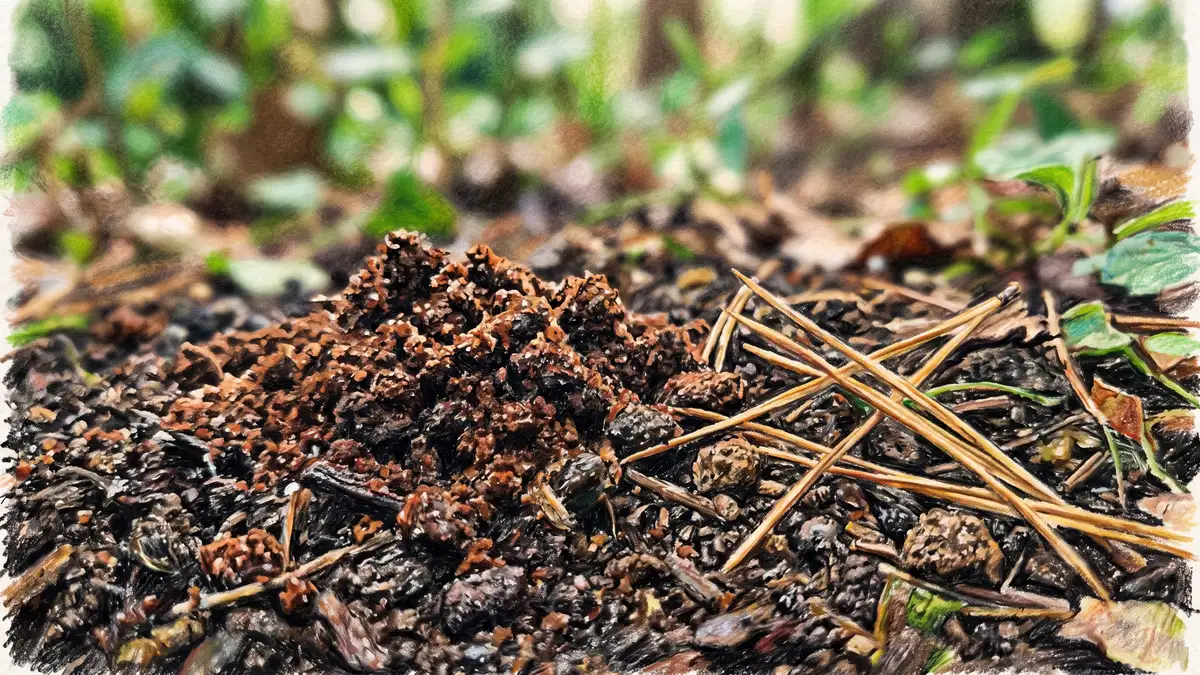
Oregon State addressed coffee grounds directly: it is a myth that coffee grounds are acidic and will lower soil pH. After brewing, the grounds sit close to neutral, between pH 6.5 and 6.8, and whatever change they do bring is short-lived. They are a fine source of organic matter, worked in as a half-inch layer to a depth of about 4 inches, but they are not an acidifier. University of Minnesota reaches the same conclusion and adds that heavy applications can suppress germination and cause compaction.
Pine needles get the same treatment from University of New Hampshire Extension: pine needles are acidic themselves but do not have the capacity to appreciably lower soil pH, and even a 2 to 3 inch layer of pine mulch will not change soil pH enough to measure. Soil under pines tends to be acidic because pines grow where soil was already acidic, not the other way around.
| Remedy | Does It Lower pH? | What the Research Says |
| Elemental sulfur | Yes | The extension-recommended method; 3-6 months in warm moist soil |
| Aluminum sulfate | Yes, but | ~6x the rate; aluminum toxic to all but the most acid-loving plants |
| Coffee grounds | No | Brewed grounds are pH 6.5-6.8, effect is short-lived |
| Pine needles | No | A 2-3 in. layer will not change pH enough to measure |
| Gypsum | No | Calcium sulfate is pH-neutral; supplies Ca and S only |
| Epsom salt | No | Use only for a confirmed magnesium deficiency |
Sources: Oregon State, UNH Extension, Penn State Extension, UMN Extension
Gypsum deserves its own note because the confusion is understandable. It contains sulfate, so it sounds like it should acidify. It does not. Penn State Extension explains that elemental sulfur significantly lowers soil pH because microbes oxidize it and release acidity, whereas gypsum supplies sulfate directly as a neutral salt. Gypsum is for calcium, sulfur nutrition and sodic soils, not pH.
Aluminum sulfate is real but comes with a catch. Clemson's tables show it needs roughly six times the rate of elemental sulfur for the same pH change: 1.2 pounds per 10 square feet versus 0.2 pounds of sulfur to move loam from 7.5 to 6.5. University of Minnesota warns that aluminum is toxic to nearly all but the most acid-loving plants and advises against it in vegetable gardens. It acts faster, which is its only real advantage.
Why This Works: Working With Soil Biology
Sulfur only lowers pH because bacteria do the conversion for you. That is why it needs warmth, moisture and physical incorporation, and why it is slow. In permaculture terms, you are not applying a chemical, you are setting conditions for an organism to do the work. Which is also why building organic matter alongside it helps: a biologically active soil converts sulfur faster than a dead one.
Frequently Asked Questions
How do you lower soil pH naturally and quickly?
There is no genuinely fast natural option. Elemental sulfur is the standard method and takes 3 to 6 months of warm, moist soil because bacteria have to oxidize it into sulfuric acid first. Aluminum sulfate acts faster but requires roughly six times the application rate and introduces aluminum, which University of Minnesota Extension warns is toxic to nearly all but the most acid-loving plants. If you need results this season, growing in containers or a raised bed with acidic mix is more realistic than acidifying in-ground soil.
What is the cheapest way to lower pH in soil?
Elemental sulfur, by a wide margin. It is inexpensive per pound, and the rates are modest for small pH changes: only 2 to 5 pounds per 1,000 square feet to move from 7.0 to 6.5, depending on texture. Aluminum sulfate is both more expensive per unit and needed at roughly six times the rate. Coffee grounds and pine needles are free, but they do not lower pH, so they are not a cheap alternative, just an ineffective one.
How much sulfur do I need per square foot?
Work from the per-1,000-square-foot figures and divide. For a loam soil going from 7.5 to 6.5, Oregon State's rate is 15 pounds per 1,000 square feet, which is about 1.5 pounds per 100 square feet, or roughly a quarter pound for a 4 by 4 foot bed. Sandy soil needs about a third less, clay about two-thirds more. Always incorporate to 6 to 8 inches rather than surface-applying.
Does gypsum lower soil pH?
No. Gypsum is calcium sulfate and is pH-neutral. Penn State Extension explains that elemental sulfur lowers pH because soil microbes oxidize it and release hydrogen ions, whereas gypsum supplies sulfate directly as a neutral salt without generating acidity. Gypsum is useful for supplying calcium and sulfur and for improving structure in sodic soils, but it will not acidify your garden. If you need pH down, use elemental sulfur.
How do I lower soil pH in potted plants?
Containers are much easier than in-ground soil because you control the entire volume. Start with an acidic potting mix rather than trying to correct a neutral one. Sphagnum peat-based mixes are naturally acidic and work well for blueberries and azaleas. If your irrigation water is alkaline and pushes pH back up over time, growers acidify irrigation water to around pH 5.8 for exactly this reason. Use an acidifying fertilizer formulated for acid-loving plants and check pH each season.
My soil is above pH 7.5. Is it worth trying?
Run the vinegar fizz test first. If it fizzes vigorously, you have a strongly calcareous soil, and Oregon State's guidance implies 3 or more years before you would even re-evaluate after a 50 pound per 1,000 square foot application. For growing blueberries in that situation, raised beds with imported acidic soil are the practical answer. For general vegetables, a modest reduction from 8.0 toward 7.0 is still worthwhile for micronutrient availability. If you are going the other direction, our guide to raising soil pH with lime covers that side.
Get the Weekly Dig
One practical permaculture guide a week, written for gardeners who do this on weekends: building living soil without buying it in bags. Free, no spam, unsubscribe any time.
Join the Weekly DigResources
- Oregon State University Extension — EC1585 Acidifying Soil (sulfur rate tables, PDF)
- Colorado State University Extension — Soil pH
- Iowa State University Extension — How to Change Your Soil's pH
- Clemson Cooperative Extension — Changing the pH of Your Soil
- NC State Extension — Soils and Plant Nutrients (Extension Gardener Handbook)
- Oregon State University — Used Appropriately, Coffee Grounds Improve Soil
- University of New Hampshire Extension — Do Pine Needles Make Soil More Acidic?
- University of Minnesota Extension — Do Common Soil Health Home Remedies Work?
- Penn State Extension — Sulfur Fertility Management
- Oregon State University — How to Acidify Soil for Rhododendrons, Azaleas and Other Acid-Loving Plants