
A food forest is not a garden you set up once and walk away from. It is a young ecosystem you intervene in heavily for three years, gently for the next four, and barely at all after year eight. The shape of that intervention changes every season. Get the seasonal rhythm right and the system becomes self-maintaining; get it wrong, even brilliantly designed forest gardens lose to brambles and water shoots within a few years. month-by-month harvest windows
This guide gives you a season-by-season maintenance calendar, the lifecycle phases you are working through, the most common mistakes that derail food forests at year three, and the evidence-backed pruning, mulching, and watering practices that university extensions and seasoned food forest practitioners recommend.
The Three Phases of Food Forest Maintenance
The biggest mistake gardeners make is treating a year-two food forest like a year-eight one. The workload curve is steep, and so is the disappointment when people walk away too soon. Practitioners like Martin Crawford at the Agroforestry Research Trust (2-acre Dartington site since 1994) and Ben Falk at Whole Systems Design in Vermont describe three distinct phases.
| Phase | Years | Workload | Focus |
| Establishment | 0-3 | High | Aggressive weeding, supplemental irrigation, formative pruning, deep mulch with clear trunk zones |
| Adolescent | 4-7 | Moderate | Canopy closure, succession plantings of shade-tolerant species, lighter pruning, mulch maintenance |
| Mature | 8+ | Low | Selective pruning (10-15% of canopy max), chop-and-drop biomass recycling, harvest, observation |
Sources:.
Key Takeaway
The first three years decide everything. Weed monthly, water weekly during dry spells, and prune for structure, and the system rewards you with low-maintenance abundance from year eight onward. Skip the establishment work and brambles win.
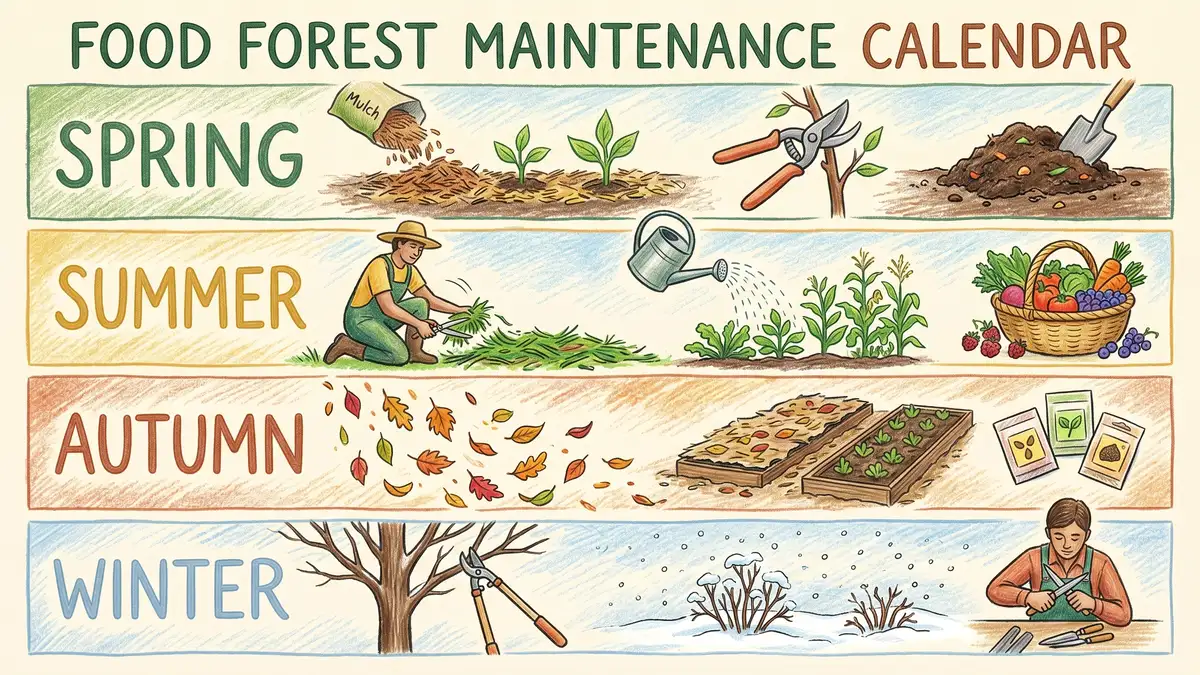
Spring (March to May): Set the Year Up
Spring is when the soil is workable but the trees still mostly dormant, which makes it the highest-leverage maintenance window of the year.
Finish dormant pruning before budbreak
The Royal Horticultural Society recommends pruning apples and pears between November and early March while trees are leafless, removing 10 to 20% of the canopy in a single winter and staggering renovation over several years to prevent the explosive water-shoot regrowth that follows hard pruning. Penn State Extension adds that pruning reduces cold hardiness for about 10 days after the cut, so push pruning as late as you can without missing budbreak.
Top up mulch to 2-4 inches
Penn State Extension sets the standard: 2 to 4 inches of organic mulch around trees, no more, and kept 3 to 4 inches clear of the trunk. Deeper than 4 inches harms roots; piled against the trunk it causes the volcano-mulching damage covered below.
Incorporate cover crops at early bloom
Cool-season cover crops like cereal rye and hairy vetch should be terminated just as flowering begins, two to three weeks before you plant into the bed. Penn State Extension documents the rye-and-vetch cycle.
Apply compost and run a soil test
One to two inches of finished compost spread under the drip line of each tree, then mulch over the top. Get a soil test every two to three years for pH, NPK, and micronutrients so you are not guessing. Our composting guide walks through building the compost you will apply here.
Summer (June to August): Manage Biomass and Water
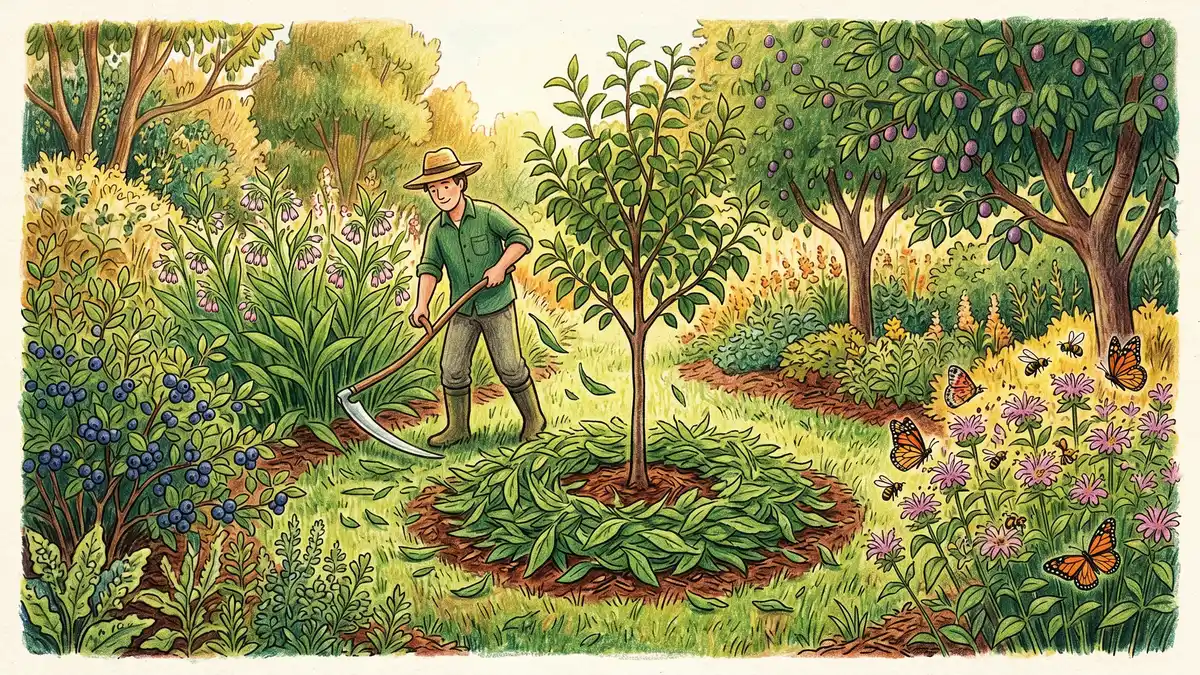
Summer maintenance is mostly about converting plant growth into soil, not removing it. Chop-and-drop, the practice of cutting back herbaceous understorey plants and dropping the biomass in place as in-situ mulch, returns nutrients to the soil immediately and invites fungal-dominated decomposition rather than the bacterial cycle of compost piles. Russian comfrey is the workhorse: tissue analyses have measured 52,959 ppm potassium in its foliage, making it one of the most effective dynamic accumulators you can grow.
Water deeply and infrequently. UC IPM recommends watering established trees every 2 to 3 weeks, deeply enough to wet soil to 3 to 6 feet, rather than daily shallow watering that trains surface roots and reduces drought tolerance. Most absorbing roots sit in the upper 18 to 24 inches under and just beyond the drip line, so that is where the water has to reach.
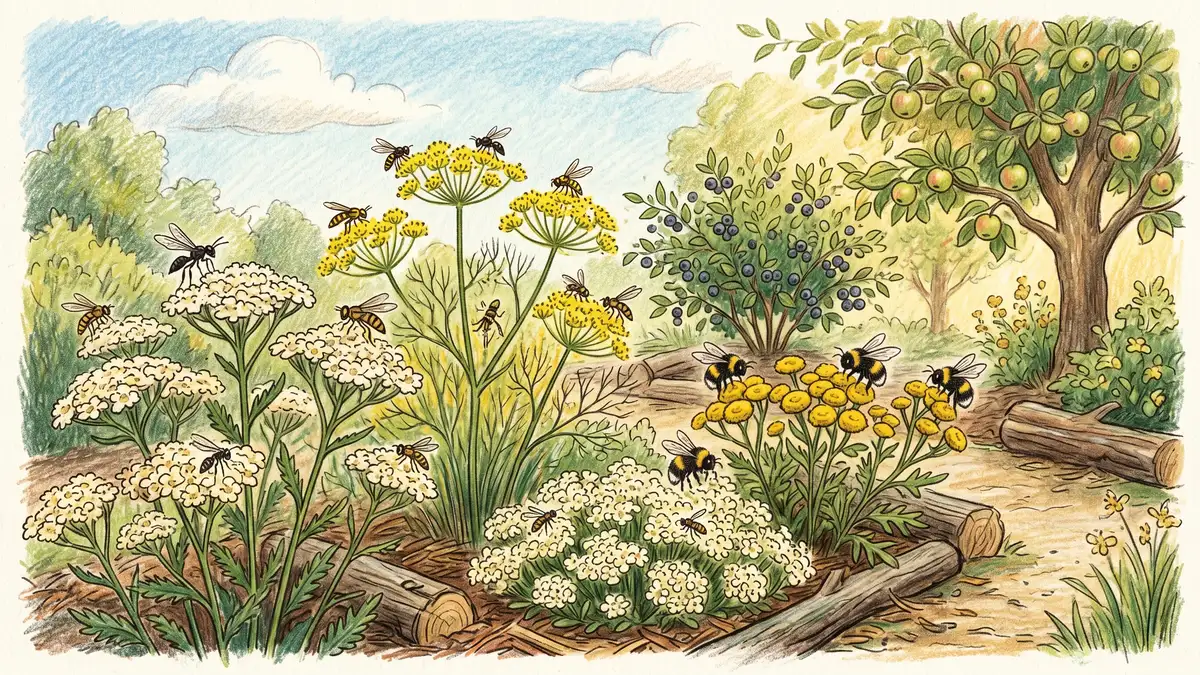
Selectively weed. Pull thistles, docks, and aggressive grasses before they seed. Leave the comfrey, clover, yarrow, and wild geranium, they are doing useful work for free. Keep an eye on insectary plants in flower: yarrow, dill, fennel, sweet alyssum, and tansy provide the nectar that parasitic wasps, lady beetles, and hoverflies need (Penn State Extension).
Be cautious with summer pruning of fruit trees. Penn State Extension notes that routine summer pruning is largely unnecessary for established apples; it is mainly useful to remove vigorous water shoots 3 to 4 weeks before harvest to improve fruit colour, and on peaches in June-July to maintain interior fruiting wood.
Why This Works: Catch and Store Energy
Chop-and-drop is Holmgren's "catch and store energy" principle applied to biomass. Every comfrey leaf you cut and drop is sunlight, minerals, and carbon that the plant captured for you. By cycling that biomass back into the soil instead of into a compost pile fifty feet away, you cut transport effort to zero and feed the exact mycorrhizal community supporting your fruit trees. The result is fewer external inputs every year as the system matures.
Autumn (September to November): Plant and Sheet Mulch
Autumn is the planting season. Bare-root fruit trees go in from December through March (UC Master Gardener Program of Sonoma County), and they outperform potted nursery stock because they develop native-soil root systems from day one and skip the potting-mix transition shock. Set the root collar at the soil surface and dig the hole twice the width of the root ball but no deeper.
This is also when you sheet-mulch new beds for next spring. UC Marin Master Gardeners describe the standard layer cake: cardboard or thick newspaper at the base, a nitrogen-rich green layer (manure, grass clippings), a carbon-rich brown layer (leaves or wood chips), and a top dressing of compost. A November sheet-mulched bed is biodegraded and plantable by May.
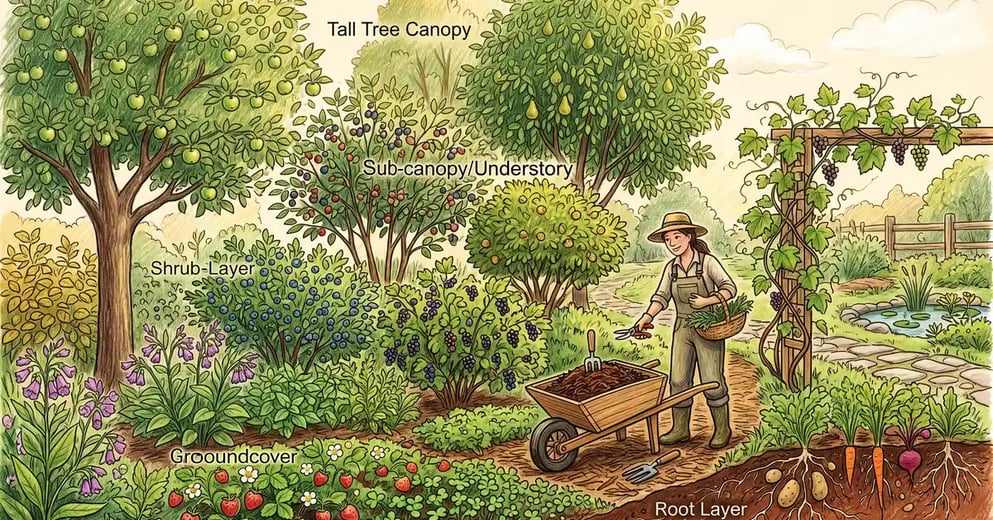
Seed cool-season cover crops by mid-October: cereal rye, hairy vetch, crimson clover. They will die back under winter snow and feed soil microbes in spring (Penn State Extension). Coppice hazel, alder, or chestnut stools if you grow them, and collect seed from your best-performing herbs and vegetables for next year. Autumn is also when the canopy and sub-canopy layers of a young food forest go in, so plan replacement and infill stock now.
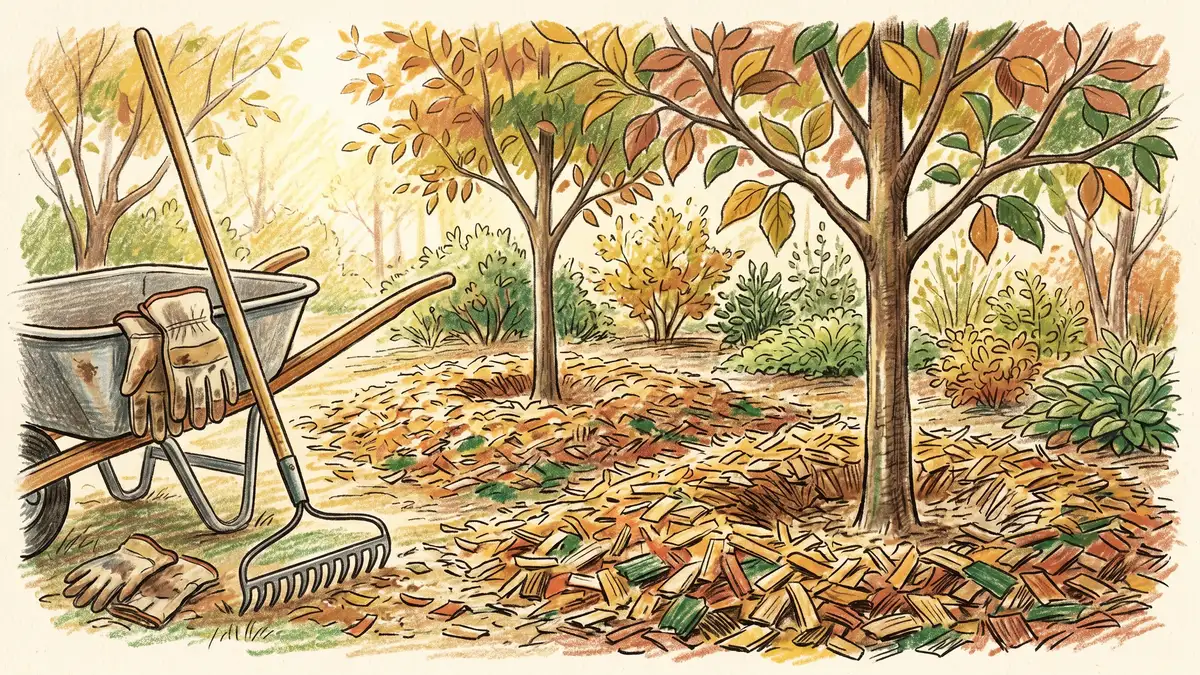
On wood chips: Dr Linda Chalker-Scott at WSU has documented that allelopathic and pathogenic warnings about arborist wood chips have virtually no scientific support, and WSU Extension's full guide shows arborist chips improve soil structure, conserve moisture, suppress weeds, and outperform most alternatives in long-term landscape trials.
Winter (December to February): The Quiet Year
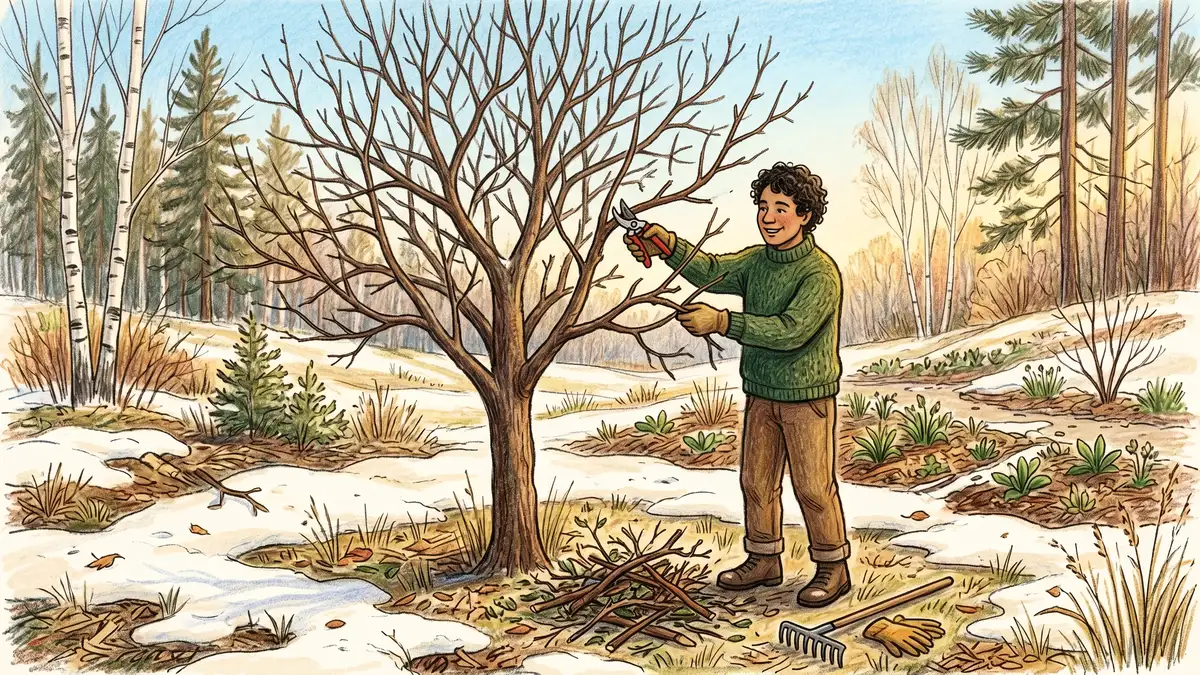
Winter is for major dormant pruning, infrastructure repair, and reading. With the leaves off, you can see the tree's actual structure: crossing branches, dead wood, suckers, water shoots. Remove no more than 10 to 20% of canopy in a single winter (RHS) and stagger renovation over several seasons.
Sharpen pruners, loppers, and pole saws. Inspect and repair fencing, drip irrigation lines, trellises, and swales. Build a hot compost pile in autumn so it can finish over winter under a tarp. Walk the bare site with a notebook, this is the only month of the year when the underlying structure is fully visible. Map what worked, what failed, and what to order. Bare-root nursery stock orders close fast.
Common Mistake to Avoid
Do not pile mulch against tree trunks. Penn State Extension's "Mulch Volcanoes Are Erupting Everywhere" documents the damage: bark rot from trapped moisture, stem-girdling roots from mulch-buried bark, rodent and borer habitat, and slow-strangulation tree death. Keep mulch 3 to 4 inches clear of the trunk, no matter how tidy the volcano shape looks.
Five Mistakes That Derail Food Forest Maintenance
| Mistake | Why It Fails |
| Volcano mulching | Bark rot, stem-girdling roots, rodent damage, eventual tree death. Keep mulch 3-4 in. clear of trunks. |
| Walking away after year 2 | Without sustained establishment-phase weeding and irrigation, brambles and aggressive perennials swamp the young system before canopy closes. |
| Removing more than 20% of canopy in one winter | Triggers explosive water-shoot regrowth and a tangled, unproductive canopy the following year. |
| Removing "all weeds" | Eliminates dynamic accumulators (comfrey, clover, yarrow) that mine subsoil minerals and feed beneficials. Distinguish problem perennials from useful companions. |
| Shallow daily watering | Trains surface roots, reduces drought tolerance. Deep infrequent irrigation builds resilient root systems. |
Sources:.
Why This Works: Observe and Interact
The first of Holmgren's twelve principles is "observe and interact". A food forest is alive and changing every week, which means maintenance is not a fixed checklist, it is a feedback loop. The gardeners who run productive year-fifteen food forests are not those with the most equipment, they are those who walked the site weekly for the first five years and learned where the wet spots are, which trees bloom early, where the deer break through, and which year-two seedling actually wants to be in this soil. Maintenance follows observation, not the calendar.
What a Mature Food Forest Looks Like
The exemplar models give you a sense of what you are working toward. Robert Hart's Shropshire forest garden on Wenlock Edge ran from the 1960s on just 500 m2 (0.12 acre), with a seven-storey design that influenced the entire modern forest gardening movement. Martin Crawford has been documenting his 2-acre Dartington site since 1994. Ben Falk's Whole Systems Research Farm in Vermont has spent 20+ years proving the model in zone 4 cold-climate conditions. The Beacon Food Forest in Seattle, envisioned in 2009 and planted from September 2012, sits on a 7-acre urban site (1.75 acres established in Phase 1, another 1.5 acres added in 2019) and is the largest publicly-accessible food forest in the United States. The principles are the same at 500 m2 and 7 acres; the maintenance cadence scales linearly with the area you plant.
Frequently Asked Questions
How much time does a food forest take to maintain each week?
In the establishment phase (years 0-3), plan on 2 to 4 hours per week per 500 m2 for weeding, watering, and pruning. In the adolescent phase (years 4-7), this drops to about 1 to 2 hours per week. In the mature phase (year 8+), most practitioners report under an hour per week, with seasonal pulses for spring mulching and winter pruning.
When should I prune fruit trees in a food forest?
Major structural pruning happens in late winter while trees are dormant, between mid-January and early March in temperate zones. RHS guidance is to remove no more than 10 to 20% of the canopy in a single winter and stagger renovation over several years. Light summer pruning is occasionally useful to remove vigorous water shoots 3 to 4 weeks before harvest or on peaches to maintain interior fruiting wood, but routine summer pruning of established apples is generally not recommended.
How deep should mulch be in a food forest?
Two to four inches of organic mulch, kept 3 to 4 inches clear of tree trunks. More than 4 inches harms roots. Mulch piled against trunks causes "volcano mulching" damage: bark rot, stem-girdling roots, and rodent habitat. Arborist wood chips are the best-evidenced mulch choice (WSU research).
What is chop-and-drop and how often should I do it?
Chop-and-drop is the permaculture technique of cutting herbaceous understorey plants (especially comfrey, clover, yarrow) and dropping the biomass in place as in-situ mulch. Comfrey can be chopped 2 to 4 times per season. The cut biomass returns nutrients to the soil immediately and invites fungal-dominated decomposition that mature food forests depend on.
How do you water a food forest?
UC IPM recommends watering established trees deeply and infrequently, every 2 to 3 weeks, irrigating long enough to wet soil to 3 to 6 feet depth. Most absorbing roots sit in the upper 18 to 24 inches under and just beyond the drip line, so that is where the water has to reach. Shallow daily watering trains surface roots and reduces drought tolerance.
Should I weed everything in my food forest?
No. Pull problem perennials (thistles, docks, couch grass) before they seed, and remove aggressive species that would smother young trees. Leave dynamic accumulators (comfrey, clover, yarrow, wild geranium) and beneficial-attracting plants (sweet alyssum, dill, fennel) in place. These species are doing useful work mining minerals and supporting biological pest control.
Can a food forest really be low-maintenance?
Yes, after about year 8. The first three years require sustained weekly attention; years 4 to 7 are moderate; year 8 and beyond becomes selectively-pruned, chop-and-dropped, and harvest-focused. Skipping the establishment work is the most common reason food forests fail before they mature.
Get the Weekly Dig
One practical permaculture guide a week, written for gardeners who do this on weekends: food forest and guild designs that produce. Free, no spam, unsubscribe any time.
Join the Weekly DigResources
- Penn State Extension, Mulching Landscape Trees
- Penn State Extension, Mulch Volcanoes Are Erupting Everywhere
- Penn State Extension, Tree Fruit Cold Hardiness Pruning Effects
- Penn State Extension, Summer Pruning Cautions
- Penn State Extension, Attracting Beneficial Insects
- Penn State Extension, Cereal Rye as a Cover Crop
- RHS, Apples and Pears Winter Pruning
- UC IPM, Irrigation of Trees and Shrubs
- UC Sonoma Master Gardeners, Planting Bare-Root Fruit Trees
- UC Marin Master Gardeners, Sheet Mulching
- WSU Extension, Using Arborist Wood Chips as a Landscape Mulch
- Linda Chalker-Scott (WSU), Wood Chip Mulch Fact Sheet (PDF)
- Permaculture Research Institute, Chop-N-Drop Mulching
- Permaculture Research Institute, Dynamic Accumulators Research
- Agroforestry Research Trust (Martin Crawford), Dartington Forest Garden
- Whole Systems Design (Ben Falk), Vermont
- Beacon Food Forest, Seattle
- National Forest Gardening Scheme, A Brief History of Forest Gardening (Robert Hart)