
If you live in USDA zone 10, 11, or 12 (south Florida, Hawaii, the Caribbean, Southeast Asia, Central and South America, northern Australia, the Pacific Islands, parts of southern Africa) your climate is the easy version of food forest design. No frost dates to plan around. No winter dormancy. Mango trees that fruit by year four. Banana clumps that double their biomass every six months. The catch: most permaculture writing assumes a temperate climate, and tropical gardeners often end up reverse-engineering it. This article gives you the tropical playbook directly.
Here's the short version. A tropical food forest uses the same seven-layer design as temperate systems but with different species, denser planting, faster maturation (3 to 5 years to full productivity instead of 7 to 10), and water-management strategies tuned for heavy rains and dry seasons. Lead with breadfruit, mango, coconut, banana, and papaya. Build the soil first because tropical rain leaches nutrients fast. Plant continuously rather than in spring waves. Manage the canopy aggressively to keep light reaching the lower layers.
Quick answer
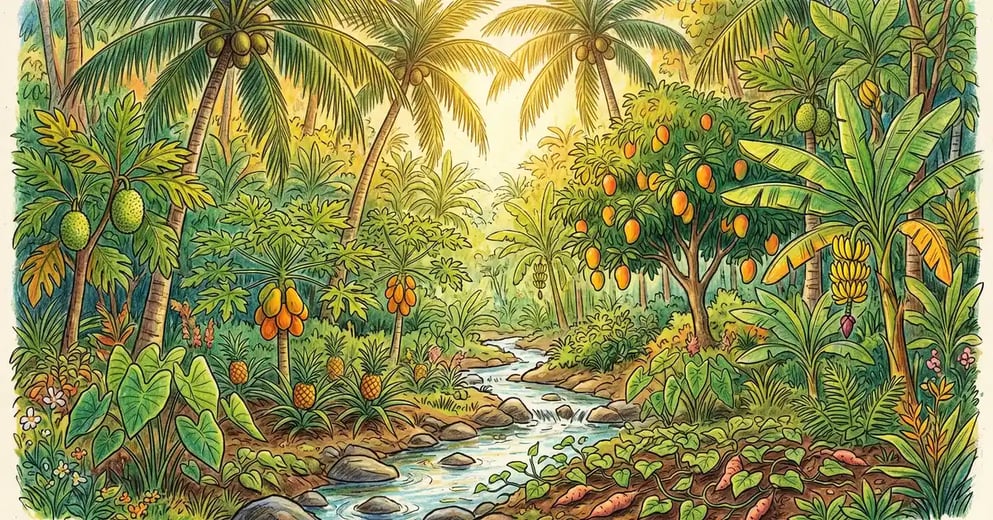
A tropical food forest is a multi-layered perennial polyculture sized for USDA zones 10-12. Build it around 7 layers: canopy (coconut, mango, breadfruit), sub-canopy (papaya, banana, citrus), shrub (moringa, pigeon pea, guava), herbaceous (pineapple, turmeric, ginger), ground cover (sweet potato, peanut, cowpea), root crops (yam, cassava, taro), and vines (passion fruit, vanilla, chayote). Reach full productivity in 3 to 5 years. Water management and aggressive succession planting matter more than annual planning calendars.
What makes tropical different
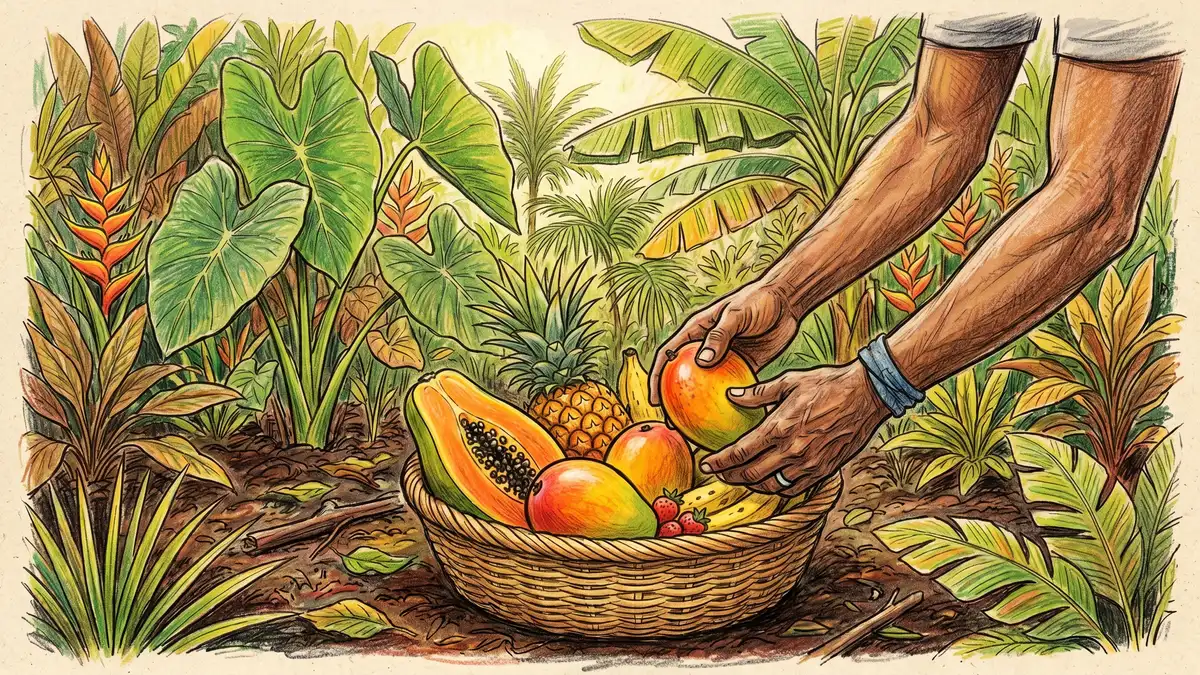
Temperate food forest design carries an assumption you can ignore in the tropics: that winter is the limiting factor. Cold tells you when to plant, when to prune, when growth slows. In zones 10-12, that constraint disappears. What replaces it: rainfall pattern, soil leaching, and sun intensity. Tropical regions typically receive 1,500 to 4,000 mm of rain a year (compared to 800 to 1,200 mm in temperate zones), often concentrated in wet seasons that can wash nutrients out of the topsoil if there's no living root system holding them.
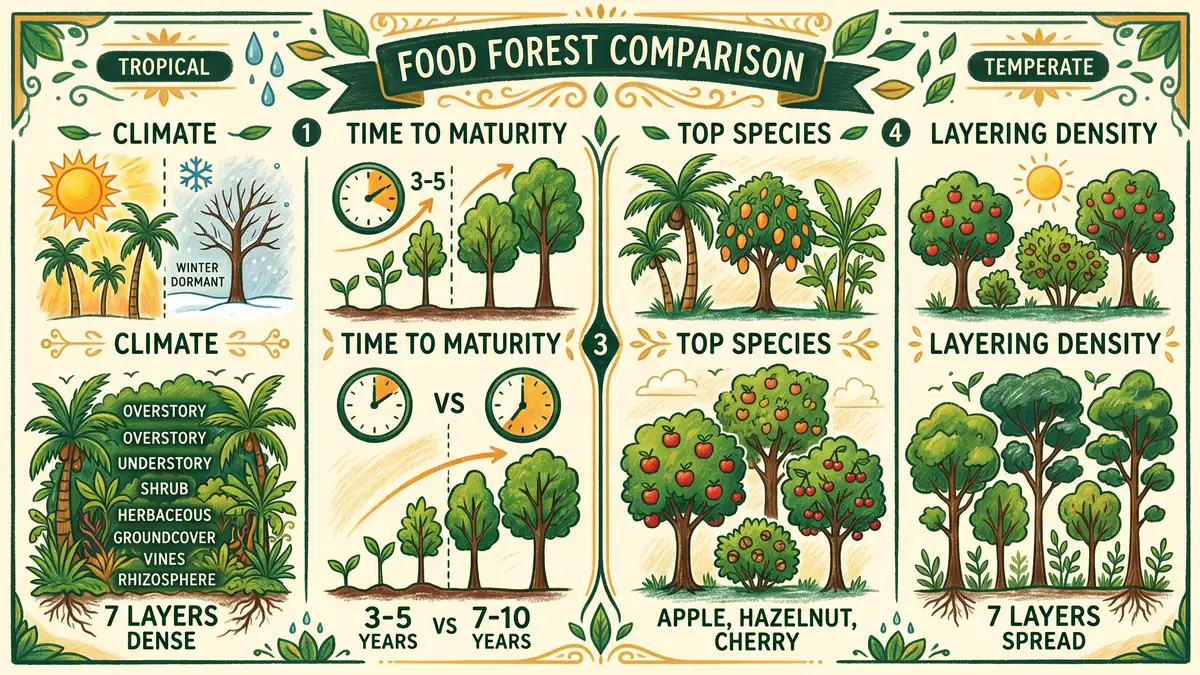
The result: tropical food forests need denser planting (you cannot leave bare soil for long), a heavier emphasis on water management (swales, ponds, soakage), and a more aggressive succession planting cycle (something is always being established as something else is being harvested). The Tropical Homegardens review (United Diversity, PDF) documents this pattern across dozens of traditional systems.
Why this works (the permaculture angle)
Tropical homegardens are among the oldest documented permaculture-style systems on earth. The Chagga homegarden of Kilimanjaro, the kebun-talun of Java, the Kerala kavu of southern India, and the chinampas of Mexico all operate on the same principle: stack vertically, use perennials for the structural plants, fold annuals into the gaps, and never leave the soil bare. Modern tropical food forest design is the explicit codification of those patterns into something a new gardener can build in 3 to 5 years.
The seven layers, tropical edition
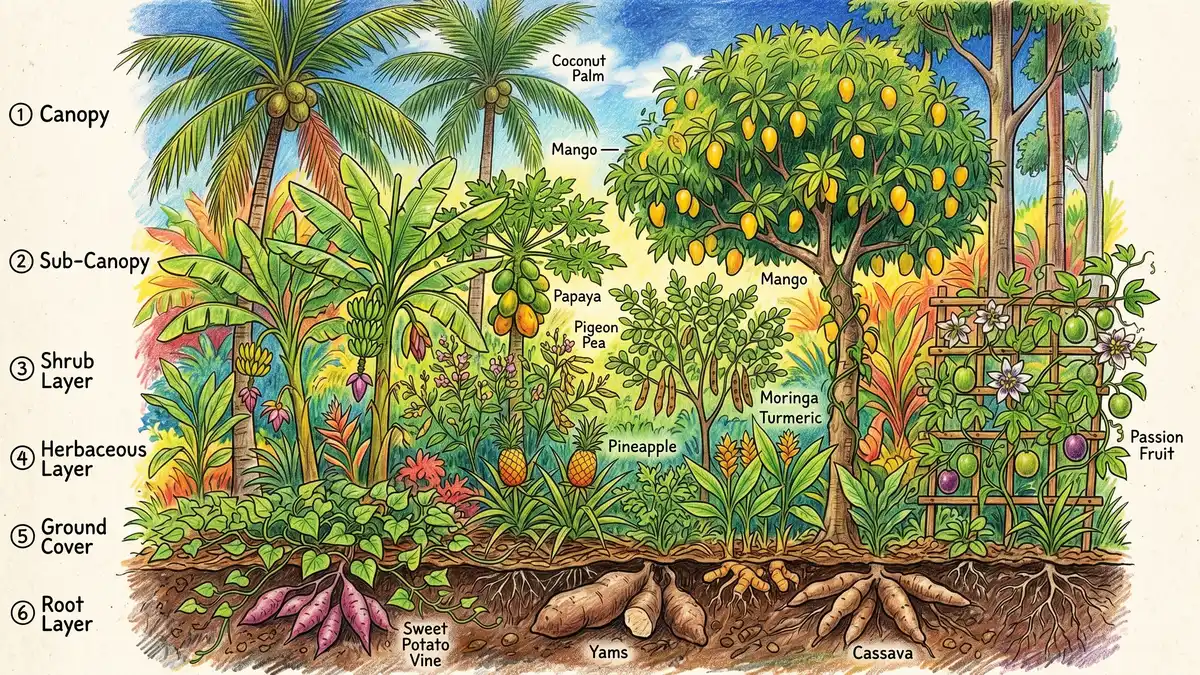
| Layer | Function | Top tropical species |
| 1. Canopy (overstory) | Shade structure, primary fruit/nut yield | Coconut, mango, breadfruit, jackfruit, avocado, mature citrus |
| 2. Sub-canopy | Mid-level fruit, fast canopy fill | Banana, papaya, plantain, guava, soursop |
| 3. Shrub | Nitrogen fixation, edible berries, biomass | Pigeon pea, moringa, hibiscus, cassava, dwarf banana |
| 4. Herbaceous | Aromatic, medicinal, dense edibles | Pineapple, turmeric, ginger, lemongrass, taro |
| 5. Ground cover | Living mulch, nitrogen, weed suppression | Sweet potato, peanut, cowpea, perennial lablab |
| 6. Root crops | Underground starches, drought reserves | Yam, cassava, malanga, taro, sweet potato |
| 7. Vines | Vertical climbers, fruit/spice | Passion fruit, vanilla orchid, black pepper, chayote, dragon fruit |
Sources:.
Compare this with the general 7-layer model and you'll notice the tropical version simply swaps in the tropical species set; the structural logic transfers directly.
Designing a small tropical food forest in 5 steps
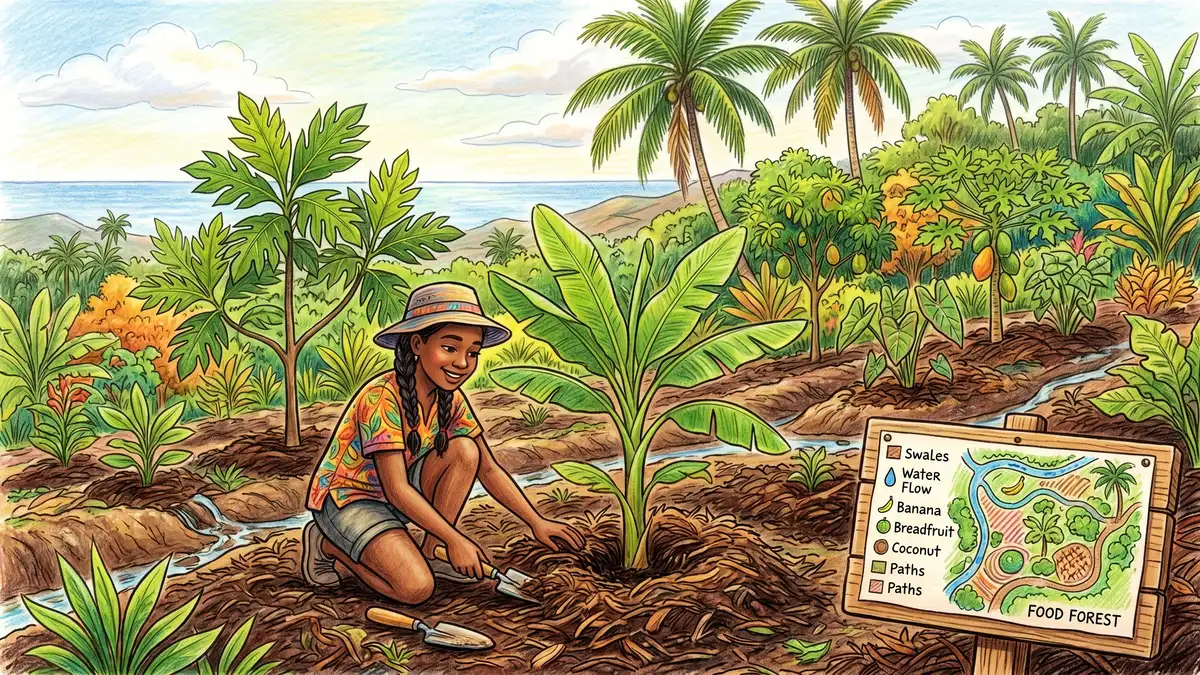
Map your site water flow
In the tropics, water management is the leading design driver. Watch where rainwater runs across your site during a heavy downpour. Plan swales (level ditches) on contour to slow and infiltrate water. Locate ponds at low points. Use mulch and ground cover aggressively to prevent erosion of the upper soil layer that monsoon rains will otherwise wash away.
Plant canopy trees first, on wide spacing
Set out coconut, mango, breadfruit, and jackfruit at 8 to 12 meter (25 to 40 ft) spacing, far wider than they appear to need. They will fill in. Most beginner tropical food forests are over-dense at canopy level by year 5 because the gardener planted to year-1 spacing. Use the extra space in years 1 to 3 for fast-cycling crops like papaya, banana, and pigeon pea that you can remove or thin as the canopy closes.
Fill the sub-canopy and shrub layers immediately
Bananas, papayas, and pigeon peas establish in 6 to 12 months and produce within 18 months. They serve as living scaffolding while the slower canopy trees mature. Plant them in clusters between the canopy trees so the ground stays covered and you get a yield in year one.
Cover the ground with vines, root crops, and living mulch
Sweet potato vines, perennial peanut, cowpea, and lablab will cover bare soil in 2 to 3 months in warm conditions. Underplant with taro, yam, and turmeric for harvestable root crops. The goal is zero bare soil within 6 months of planting.
Add vertical with vines on year 2
By year 2 your bananas and papayas can support climbing vines. Train passion fruit, chayote, and yam vines up established sub-canopy plants. Vanilla orchid prefers a partial-shade host tree; allow 3 to 5 years before expecting fruit.
Top 10 staple species for a productive tropical food forest
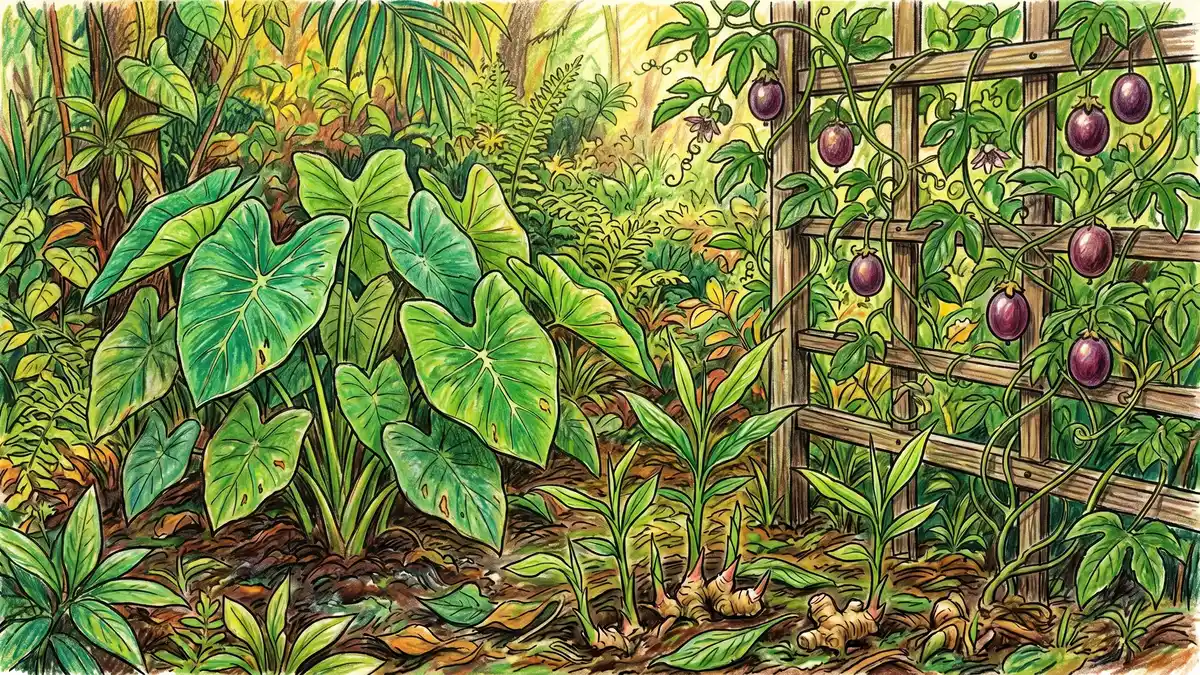
| Plant | Layer | Years to yield | Key strength |
| Coconut palm | Canopy | 6-8 | Caloric anchor, drought-tolerant, hurricane survivor |
| Banana / plantain | Sub-canopy | 1-2 | Continuous yield, biomass for chop-and-drop |
| Breadfruit | Canopy | 3-5 | One tree feeds a family year-round at maturity |
| Taro | Herbaceous / root | 0.5-1 | Wetland-tolerant, calorie-dense root staple |
| Sweet potato | Ground cover / root | 0.4 | Living mulch + tubers + edible leaves |
| Papaya | Sub-canopy | 0.75-1 | Pioneer species, fills bare ground in year 1 |
| Mango | Canopy | 4-7 | Long-lived high-yield fruit, drought-tolerant once established |
| Avocado | Canopy | 3-5 | Calorically dense, fat-rich, shade-tolerant when young |
| Pigeon pea | Shrub | 0.75-1 | Nitrogen fixer, edible legume, biomass |
| Moringa | Shrub | 0.5-0.75 | Extremely nutrient-dense leaves, very fast establishment |
Synthesized from, and FIU South Florida food forest plants guide.
Climate-conscious framing: the carbon and biodiversity case
Tropical food forests are one of the most concentrated climate solutions available to home gardeners in warm zones. Multi-strata tropical agroforestry sequesters 4 to 10 tons of CO2 per hectare per year above ground, plus additional belowground carbon in roots and soil. They reduce pressure on tropical primary forest by providing food and fiber on already-cleared land. They restore biodiversity that monoculture plantations destroyed. A 2022 review of homegarden agroforestry systems for SDG achievement documents these benefits across 40+ tropical case studies.
For a Climate-Conscious Gen Z gardener, this is the part of the work where personal action and planetary impact line up cleanly. A 1,000 m² tropical food forest, properly designed, can lock up 1 to 2 tons of carbon per year while feeding a family. Indigenous food forest traditions across the tropics show this approach has been doing exactly that, sustainably, for thousands of years.
Common mistakes to avoid
Importing temperate designs unchanged is the most common failure. Spacing fruit trees as a USDA Vermont guide recommends will leave you with congested, shaded, unproductive canopy by year 5. Other patterns to watch: relying on chop-and-drop mulch alone (heavy rain washes it; you need ground cover plus mulch), planting only single specimens of each species (tropical pests can wipe out a lone plant overnight), and underestimating the speed of growth (a moringa can hit 3 meters in 6 months; plan space accordingly).
Maintenance through the year
Tropical food forests have no off-season. Replace the temperate annual cycle of pruning, planting, harvesting, and mulching with continuous rolling work. A 1,000 m² (a quarter-acre) site typically needs 4 to 8 hours of work per week in year 1, dropping to 2 to 4 hours per week by year 3 as the system matures. Tasks rotate by month: prune in dry season, harvest banana clumps when ready, replace papayas at end-of-life every 4 to 5 years, chop-and-drop pigeon pea and moringa for biomass every 2 to 3 months.
For year-round productivity, stagger planting. Every 6 to 8 weeks, put in a fresh round of papayas, bananas, taro, sweet potato, and cowpea. The diversity of harvest dates across the year is the practical advantage of tropical climates over temperate ones. There's never a winter; there's also never a single peak harvest week. The work spreads.
Get the Weekly Dig
One practical permaculture guide a week, written for gardeners who do this on weekends: food forest and guild designs that produce. Free, no spam, unsubscribe any time.
Join the Weekly DigFrequently asked questions
What is a tropical food forest?
A tropical food forest is a multi-layered perennial polyculture food production system designed for frost-free climates (USDA zones 10-12). It uses seven vertical layers (canopy, sub-canopy, shrub, herbaceous, ground cover, root crops, vines) of tropical edible species like coconut, mango, banana, papaya, taro, and passion fruit. Tropical food forests reach full productivity in 3 to 5 years, much faster than temperate equivalents.
How is a tropical food forest different from a temperate one?
The structural logic (multi-layer, perennial-dominated polyculture) is identical. The differences are species (mango replaces apple, breadfruit replaces hazelnut), pace (3 to 5 years to maturity vs 7 to 10), density (tropical systems support more biomass per square meter), and water management (heavy rain leaches nutrients fast, so living ground cover is essential). Temperate cycles are organized around winter dormancy; tropical cycles are organized around wet and dry seasons.
What are the best plants for a tropical food forest?
Top staples: coconut, banana, breadfruit, taro, sweet potato, papaya, plantain, mango, avocado, pigeon pea. Add moringa and turmeric for nutrient density, passion fruit and vanilla for vines, and a generous mix of nitrogen-fixers (pigeon pea, perennial lablab) throughout to maintain fertility.
How long does a tropical food forest take to mature?
Sub-canopy species (banana, papaya) produce in year 1. Shrubs (moringa, pigeon pea) produce within 9 months. Mid-canopy (mango, avocado, breadfruit) fruit in years 3 to 5. Coconut and other slow-growing canopy trees mature in years 6 to 8. By year 3, most well-designed tropical food forests are producing more food than the household can eat.
How much space do I need?
A productive starter tropical food forest fits in 100 to 250 m² (1,000 to 2,500 sq ft). A 1,000 m² (quarter-acre) site can feed a family of four with substantial surplus. Larger sites add resilience and species diversity but are not required to start.
Can I create a tropical food forest if I live in a temperate zone?
Not directly. Most tropical staples need year-round warmth and cannot survive frost. You can build a temperate food forest using the same structural principles (multi-layer, perennial-dominated polyculture) with cold-hardy species. Our general food forest guide covers the temperate version.
Where can I see a working tropical food forest?
Geoff Lawton's Zaytuna Farm (Australia, subtropical), Finca Tierra and similar permaculture farms in Costa Rica, the Maui Farm in Hawaii, and Aranya Agricultural Alternatives in Andhra Pradesh, India are all open to visitors and have documented tropical food forest systems. Zaytuna Farm runs PDC courses and tours.
Resources
- Finca Tierra Journal, Tropical Food Forest Design
- Florida International University, Common Tropical Food Forest Plants of South Florida (PDF)
- Tropical Homegardens, A Time-Tested Example of Sustainable Agroforestry (PDF)
- World Agroforestry / ICRAF, Homegardens: A Traditional Agroforestry System
- PMC, Homegarden agroforestry for Sustainable Development Goals (2022)
- Zaytuna Farm, Geoff Lawton permaculture demonstration site
- The Growing Dutchman, Top 25 Tropical Permaculture Plants
- Chelsea Green, Seven Layers of A Forest Garden
- CRC Research, Seven Layers of a Food Forest
- School of Permaculture, 7 Layers of a Forest