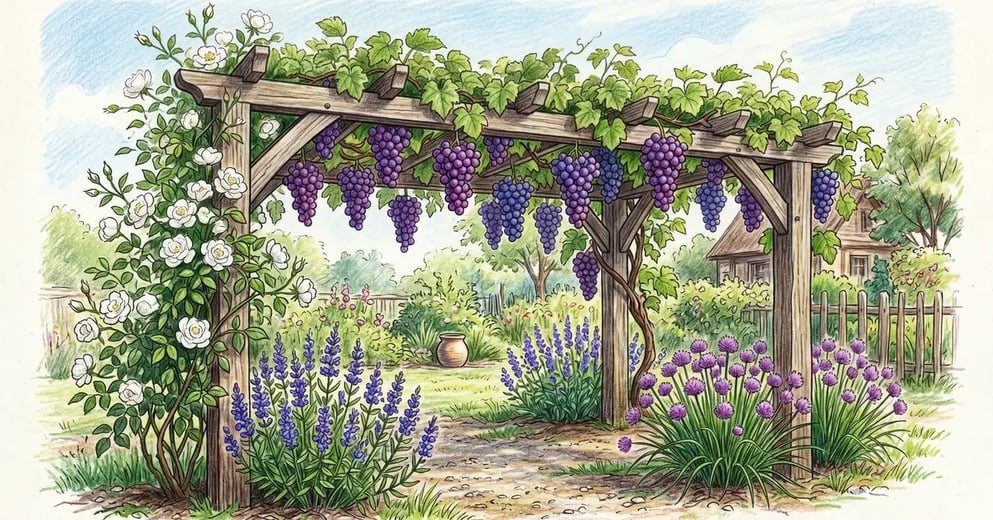

Walk into a traditional Burgundy vineyard and you will see a single red rose bush planted at the end of every row. The roses are not decoration. They are sentinels: roses catch downy mildew about 2 weeks before grapevines do, giving the vigneron early warning to act. This is companion planting at industrial scale, and it has been part of grape cultivation for at least 200 years.
For a backyard arbor or small home vineyard, the same logic applies. Grapes (Vitis vinifera or Vitis labrusca) live 30 to 100 years and put down roots 6 to 12 ft (1.8 to 3.6 m) deep, which means the surface soil is essentially free real estate for shallow-rooted companions that protect the vines and feed the system. This guide covers the best companion plants for grapes, the cover crops to grow between rows, the plants to keep away, and how to lay it all out.
Key Takeaway
The best companion plants for grapes are hyssop, chives, garlic, basil, oregano, thyme, yarrow, geraniums, white clover (Trifolium repens), buckwheat, and roses at row ends. Cover crops between vineyard rows (legumes, mustards, grasses) build soil and reduce mowing. Avoid brassicas, radish, walnut trees (juglone), and mature shade trees that compete for light. The science is solid: deep grape roots, shallow companion roots, complementary functions. The classic Old World vineyard tradition matches modern viticulture research.
Best companion plants for grapes
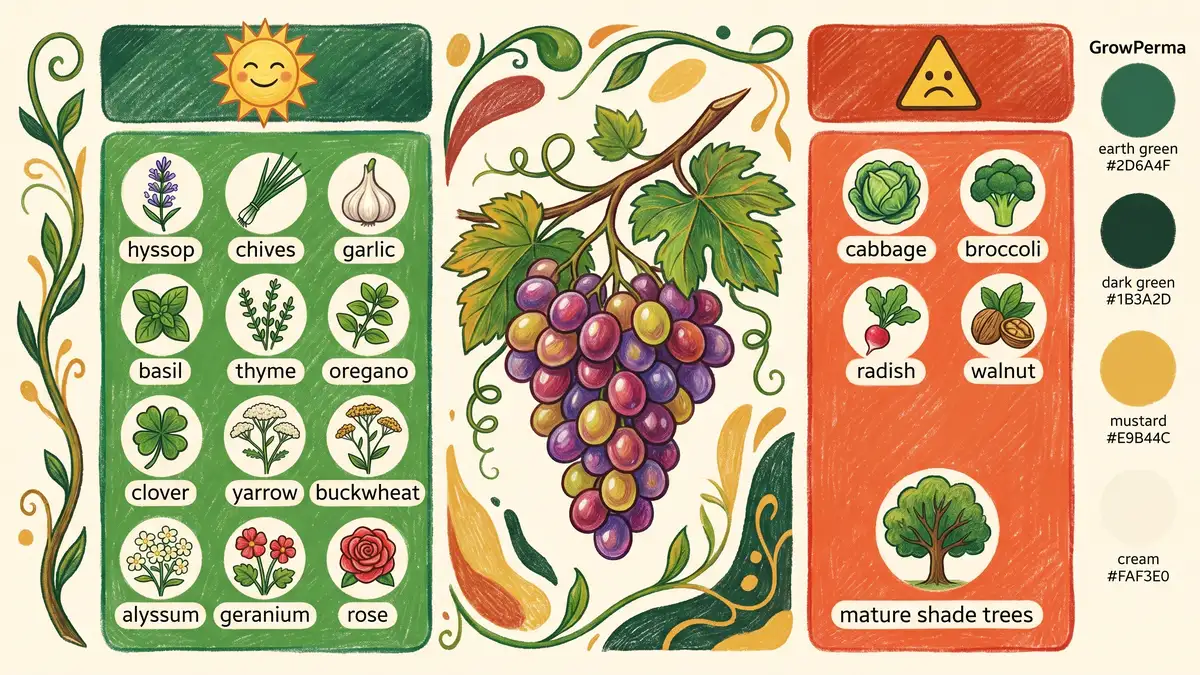
Source: Companion lists cross-referenced from Gardening Know How grape companion guide and Sloat Garden Center companion planting PDF.
| Companion | Function | Placement |
| Hyssop (Hyssopus officinalis) | Pollinator draw, deters cabbage moth, traditional grape companion | At base of posts and trellis ends |
| Chives, garlic (Allium spp.) | Aphid and Japanese beetle deterrence; sulfur volatiles confuse pests | Continuous strip at vine base |
| Basil, oregano, thyme | Aromatic confusion of grape leafhopper, beneficial insect support | Interplanted between vines |
| Yarrow (Achillea millefolium) | Mineral accumulator, hoverfly attractant, drought-tolerant | Row ends and bed margins |
| White clover (Trifolium repens) | Nitrogen fixation (40 to 100 lb N/acre), living mulch undervine | Undervine living mulch |
| Geraniums (Pelargonium and Geranium spp.) | Trap crop for Japanese beetles; beetles eat and become disoriented | Decorative perimeter plantings |
| Roses (sentinel) | Early warning for downy mildew; pollinator habitat | End of every vine row |
Source: Spacing and function data adapted from Cornell 2025 New York and Pennsylvania Grape Pest Management Guidelines PDF.
The rose-vine tradition
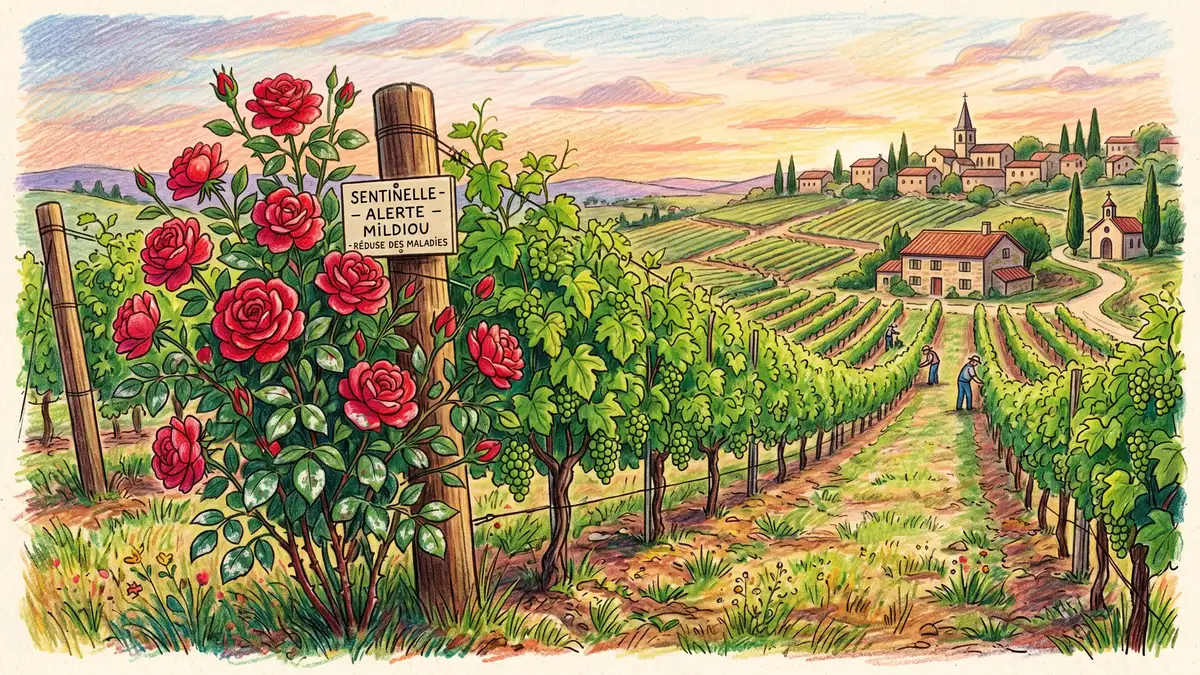
The story most often told is that roses warn of downy mildew (Plasmopara viticola) 1 to 2 weeks before grapes show symptoms. Vines by Rosa documents the tradition and notes that while modern fungicide programs have reduced the practical urgency, the early-warning function still works in low-spray and organic vineyards.
Roses also serve a second purpose: they support pollinators that visit nearby flowering companions, and the bushes provide aphid-eating ladybug habitat that helps keep vine pest pressure down. In a backyard setting, plant one rose at each end of a grape row, in soil that gets the same sun and irrigation as the vines. Hardy own-root varieties survive longer with no special care.
Why This Works (the permaculture lens)
Grapes are long-lived deep-rooted vines. The soil surface above their roots is unused by them, which means it can host shallow-rooted herbs, ground covers, and flowers without competition. Each surface plant adds something the vine cannot do for itself: nitrogen fixation, pest deterrence, beneficial insect habitat, soil cover. This is the same vertical stacking principle behind the 7-layer food forest design, compressed into the dimensions of a single trellis.
Cover crops between vineyard rows
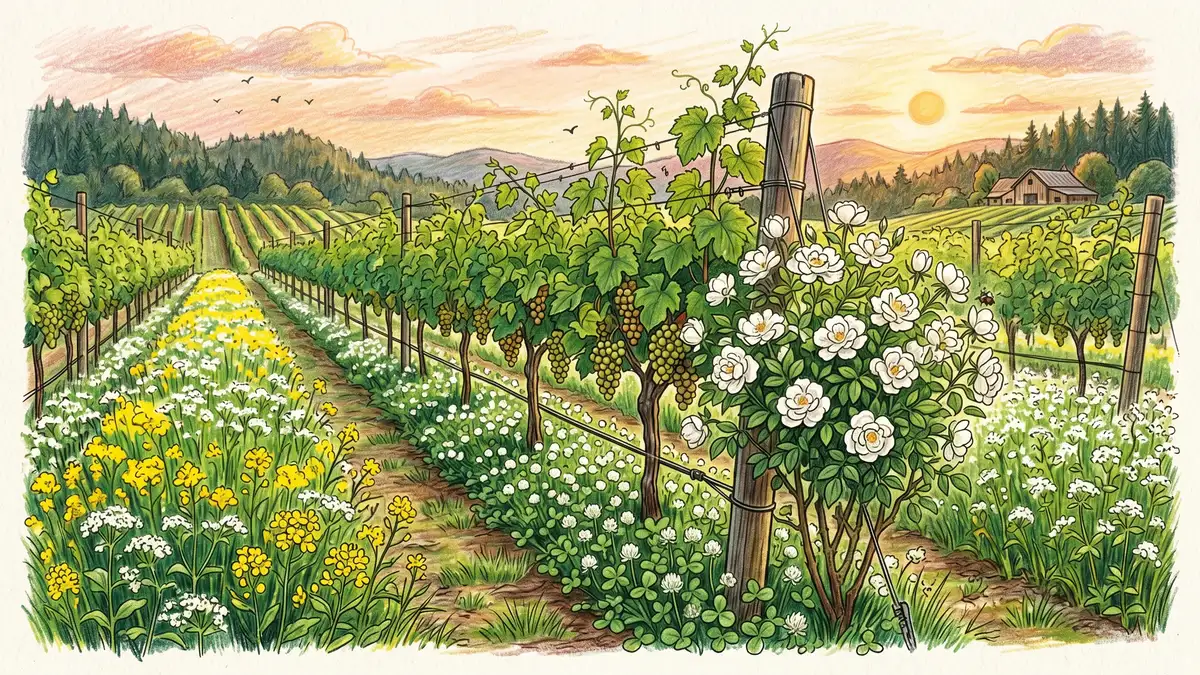
If you have more than 2 to 3 vines in rows, the soil between rows is the next decision. UC Davis SAREP's cover crop database for vineyards documents which species work in which conditions. The standard categories:
- Legumes (white clover, crimson clover, vetch, winter peas): fix nitrogen, attract pollinators when flowering. Best for soils with low organic matter.
- Grasses (annual ryegrass, oats, cereal rye): build biomass and soil structure. Best for soils prone to erosion or compaction.
- Mustards (white mustard, brown mustard): biofumigation against soil-borne pests. Best in rotation before replanting damaged sections.
- Buckwheat (Fagopyrum esculentum): fast biomass and pollinator support during summer gaps. Best for short-window improvement.
The classic vineyard pattern alternates: legume in even rows (year 1), then grass-legume mix (year 2), then mustard (year 3 if needed). Washington State University's organic vineyard cover cropping PDF recommends rotating the cover crop annually to prevent any one pest building up in the row middles.
Why deep grape roots make room for shallow companions
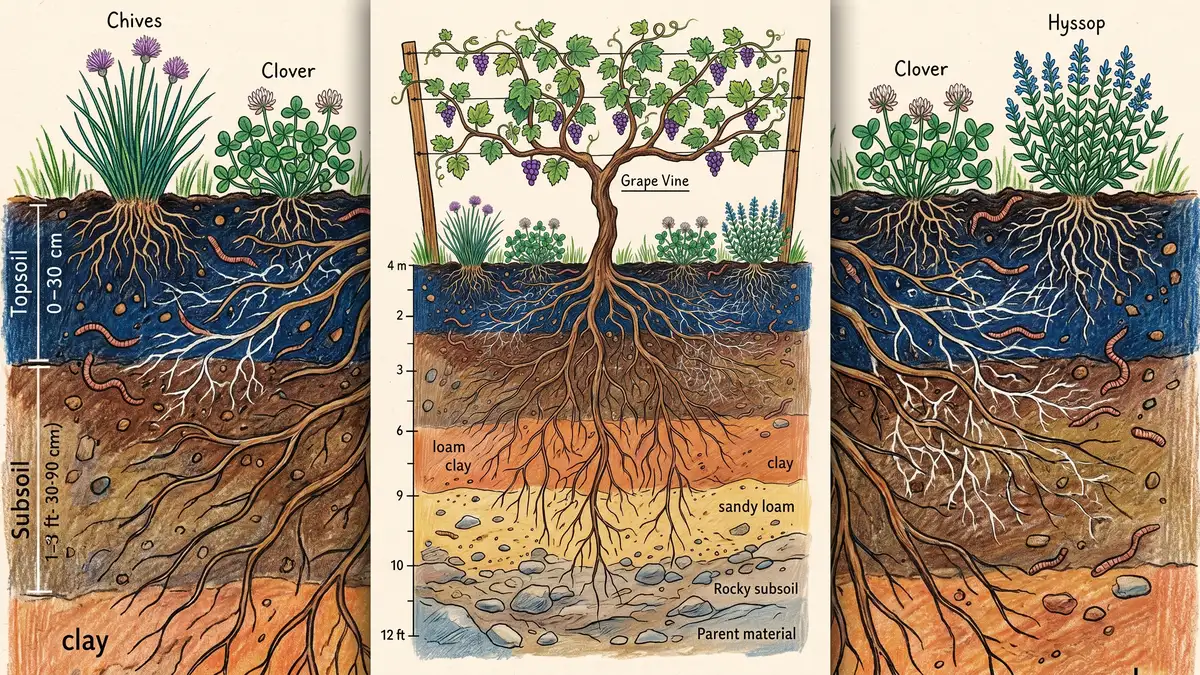
Grape vine root systems descend 6 to 12 ft (1.8 to 3.6 m) in deep soils, with most water and nutrient uptake happening at the deepest layers. UBC Botanical Garden documentation confirms the deep root pattern that has been observed in vineyards from Bordeaux to California.
That depth is the design opportunity. Shallow-rooted herbs (chives, basil, oregano) operate in the top 6 to 12 in (15 to 30 cm) and never compete with the vine. White clover roots reach 8 to 18 in (20 to 45 cm) and fix nitrogen in that zone that the vine roots passively benefit from over time.
Plants to keep away from grapes
Avoid These Near Grape Vines
Four categories cause real problems for grapes: brassicas (cabbage, broccoli, kale, radish) suppress mycorrhizal partners that grapes depend on; walnut trees produce juglone, which is toxic to grapes within 50 ft (15 m) per The Morton Arboretum's black walnut toxicity guide; mature shade trees compete for light and water; cucurbits (cucumber, melons, squash) can act as a vector for some grape viruses if planted too close.
Geraniums deserve a footnote. The "Japanese beetles eat geraniums and get paralyzed" trick is partially true: Garden Myths reviews the research showing that beetles fall off plants for 24 hours but recover and return. Useful as a trap crop, not a permanent solution.
Hyssop: the most overlooked grape companion
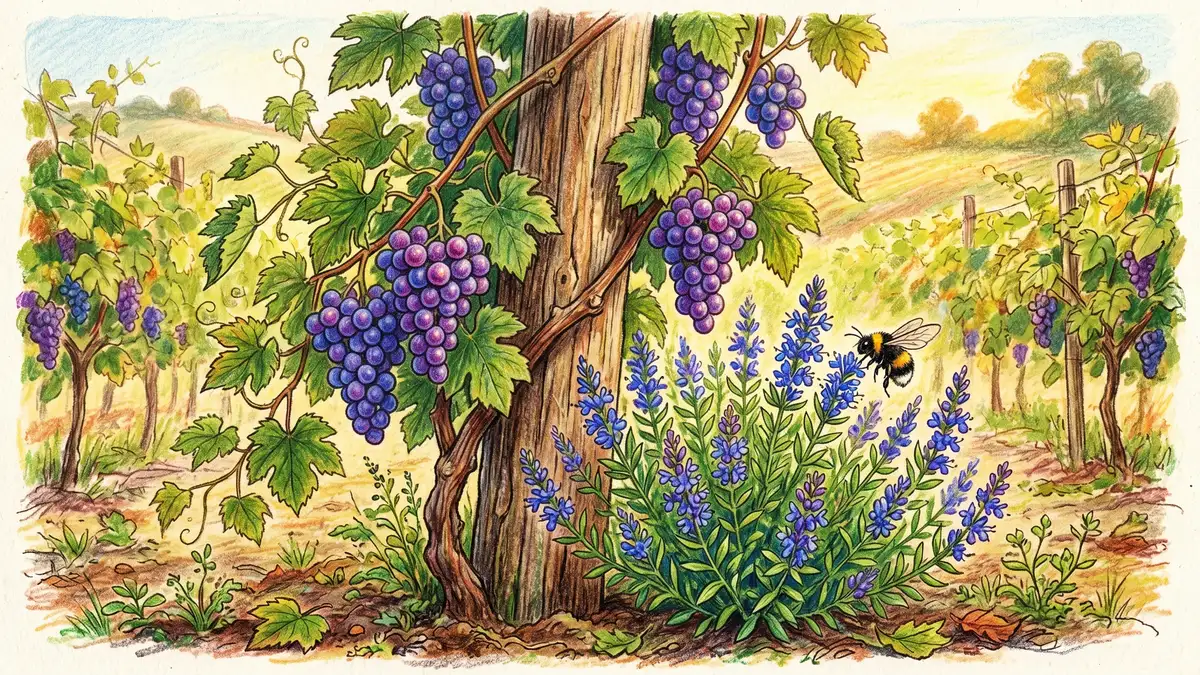
Hyssop (Hyssopus officinalis) is the herb most frequently cited in traditional European vineyard companion planting. It is hardy to USDA zone 4, drought-tolerant, perennial, attracts a wide range of pollinators when flowering, and discourages cabbage moths and flea beetles in the surrounding area.
For a backyard arbor, plant 2 to 3 hyssop plants at the base of each post or trellis support. They will grow into a 18 to 24 in (45 to 60 cm) wide cushion of foliage and flower spikes that bumblebees and honeybees work intensively in mid-summer.
A backyard arbor polyculture plan
The minimum viable grape companion design for a single backyard arbor or trellis:
Plant 1 to 2 grape vines
Choose disease-resistant varieties for your climate: 'Concord' for cold zones 4 to 7, 'Niagara' for table grapes in zones 5 to 8, 'Marquette' for wine in zones 3 to 7. Allow 6 to 8 ft (1.8 to 2.4 m) spacing between vines.
Add hyssop at the post bases
Plant 2 to 3 hyssop seedlings at each trellis post in spring. They establish in 1 season and bloom from year 2 onward, attracting the pollinators and beneficials that protect the vines.
Underplant with chives and garlic
Plant a continuous strip of chives at the base of vines (perennial) and a fall garlic planting underneath (annual). Both deter aphids and Japanese beetles through allium volatiles documented in PubMed entomology research on companion planting and non-host masking odors.
Establish white clover as living mulch
Direct sow white clover under the vines in spring. It will establish a 4 to 6 in (10 to 15 cm) ground cover that fixes nitrogen and prevents weeds. Mow once in summer to keep it from flowering excessively.
Plant a rose sentinel at each end
Add one own-root rose bush at each end of the trellis. Hardy varieties like 'Knockout' or rugosa types survive with no special care. Watch for downy mildew on the roses as early warning for the grapes.
Pest support: what companions actually do
The companion strategy works against three specific grape pests common in US backyards:
- Japanese beetle (Popillia japonica): chives, garlic, and geraniums all reduce beetle pressure. Geraniums act as a trap crop; alliums confuse host-finding through scent disruption.
- Grape leafhopper (Erythroneura spp.): hyssop, basil, and oregano attract parasitic wasps that lay eggs in leafhopper nymphs. Pacific Northwest Pest Management Handbook documents the biological control approach.
- Aphids: yarrow, alyssum, and dill attract hoverflies whose larvae eat aphids. Wisconsin Horticulture's beneficial insect guide confirms the umbel flower attraction.
Common mistakes
- Planting too close. Hyssop and chives go right at the vine base. Roses go at row ends, not between vines. Mature shrubs should not crowd the trellis.
- Letting cover crops compete during fruit set. Mow or terminate aggressive ground covers when the vines are setting fruit so the vines get full water and nutrient access at the critical moment.
- Skipping the rose sentinel. The early warning value alone is worth the small investment. One rose per row end is enough.
- Planting brassicas nearby. Mustard cover crops in the row middles between vines are fine, but cabbages or kale right next to vines suppresses mycorrhizal partnerships that grapes need.
For broader companion planting context see our complete companion planting chart, our herb companion planting guide, and our raspberry and blackberry companion guide.
Frequently Asked Questions
What is the best companion plant for grapes?
Hyssop is the most documented single companion plant for grapes in traditional European vineyard practice. It attracts pollinators and beneficial insects, deters cabbage moth, and survives the same climate range as most table and wine grapes. A close second is white clover (Trifolium repens) as undervine living mulch.
Why do vineyards plant roses at the end of rows?
Roses get downy mildew (Plasmopara viticola) 1 to 2 weeks before grapes do, giving the grower early warning to apply preventive treatment. The tradition dates to at least the 18th century in French and Italian vineyards. Roses also support pollinators and aphid-eating ladybugs that benefit the vines.
Can I plant grapes and strawberries together?
Yes, with caveats. Strawberries are shallow-rooted and do not compete with deep grape roots. The trade-off is shared susceptibility to powdery mildew. Plant strawberries 3 to 4 ft (0.9 to 1.2 m) from vine trunks and ensure good airflow between the two crops.
Can you plant grapes and tomatoes together?
Not recommended. Tomatoes are heavy nitrogen feeders and host several pests (whitefly, leafhopper) that also attack grapes. Both also compete for the same light and water during peak summer. Keep them at least 10 ft (3 m) apart.
What should you not plant near grapevines?
Avoid brassicas (cabbage family), radish, walnut trees (juglone toxicity within 50 ft / 15 m), mature shade trees that compete for light, and cucurbits planted close enough to share virus vectors. Cucumbers and squash can be grown in the same garden but should not be at the vine base.
What cover crop is best for a vineyard?
For most US backyards, white clover (Trifolium repens) is the easiest single choice: it fixes nitrogen, makes a low-mow living mulch, and survives mowing or grazing. For larger plantings, alternate annual legumes (vetch, peas) with grasses (annual ryegrass, oats) and occasional mustard for biofumigation.
Are chives good for grapes?
Yes. Chives are a strong grape companion because they deter aphids and Japanese beetles through allium volatiles, attract pollinators when flowering, and have a shallow root system that does not compete with deep grape roots. Plant a continuous strip at the base of vine trunks.
Get the Weekly Dig
One practical permaculture guide a week, written for gardeners who do this on weekends: companion pairings that hold up under scrutiny, and the ones that do not. Free, no spam, unsubscribe any time.
Join the Weekly DigResources
- Companion Planting With Grapes (Gardening Know How)
- Companion Planting Chart (Sloat Garden Center PDF)
- Cover Cropping Practices in Orchards and Vineyards (UC Davis SAREP)
- Cover Cropping in Vineyards (Washington State University PDF)
- 2025 NY and PA Grape Pest Management Guidelines (Cornell PDF)
- Grape Production (Penn State Extension)
- Grape Leafhopper Management (PNW Handbooks)
- The Mystery of Roses in the Vineyards (Vines by Rosa)
- Black Walnut Toxicity (Morton Arboretum)
- Plant Flowers to Encourage Beneficial Insects (Wisconsin Horticulture)
- Companion Planting and Non-Host Masking Odors (PubMed)
- USDA NRCS Cover Crop Chart (PDF)