
Watermelon vines spread 10 to 20 ft (3 to 6 m) before they set fruit. Cantaloupes nearly as far. That sprawl is the whole reason most home gardeners only grow one melon vine, even when they want three. The fix is companion planting: choose 4 to 6 plants that pair with melons to repel cucumber beetles, attract bees for pollination, and fill the spaces the vines have not reached yet. bacterial wilt spread by cucumber beetles which cucurbits borers leave alone
This guide covers the best companion plants for watermelon and cantaloupe, the trap-crop strategy that protects melons from striped cucumber beetles, what NOT to plant near melons, and the spacing math for a productive backyard plot. Numbers come from Lincoln University, UConn IPM, University of Minnesota Extension, Rodale Institute, University of Arizona Cooperative Extension, and Delaware Cooperative Extension.
Key Takeaway
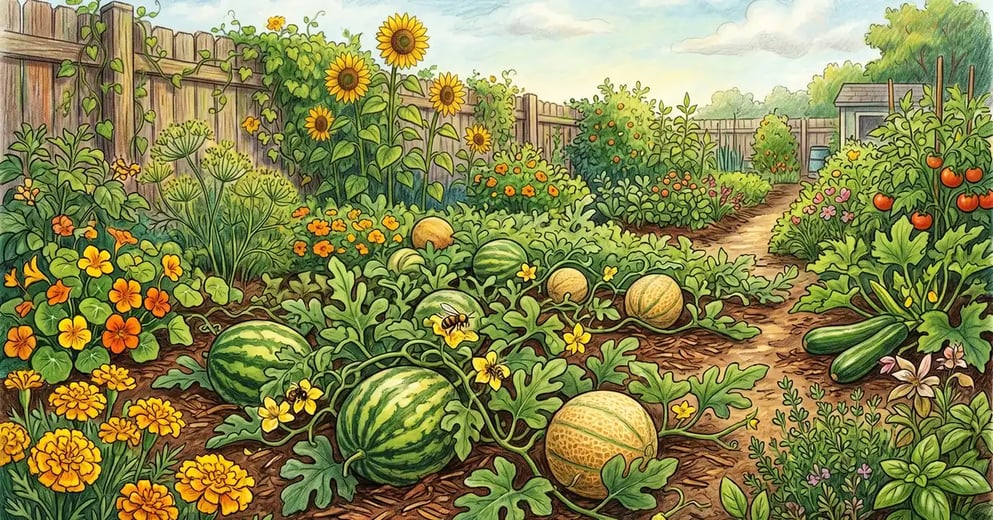
The best companion plants for watermelons and cantaloupes are nasturtium (Tropaeolum majus) and marigold (Tagetes patula) for pest repulsion, bush beans (Phaseolus vulgaris) and peas for nitrogen contribution, radish (Raphanus sativus) for early-season vacate-and-leave fill, dill and borage for pollinator attraction, and Blue Hubbard squash (Cucurbita maxima) as a perimeter trap crop for striped cucumber beetle. Avoid planting melons next to potatoes, cucumbers, or other melons (shared pest and disease pressure). Allow 10 to 20 ft (3 to 6 m) of vine sprawl per plant and position companions around the perimeter rather than between vines.
Why melons benefit from companion planting
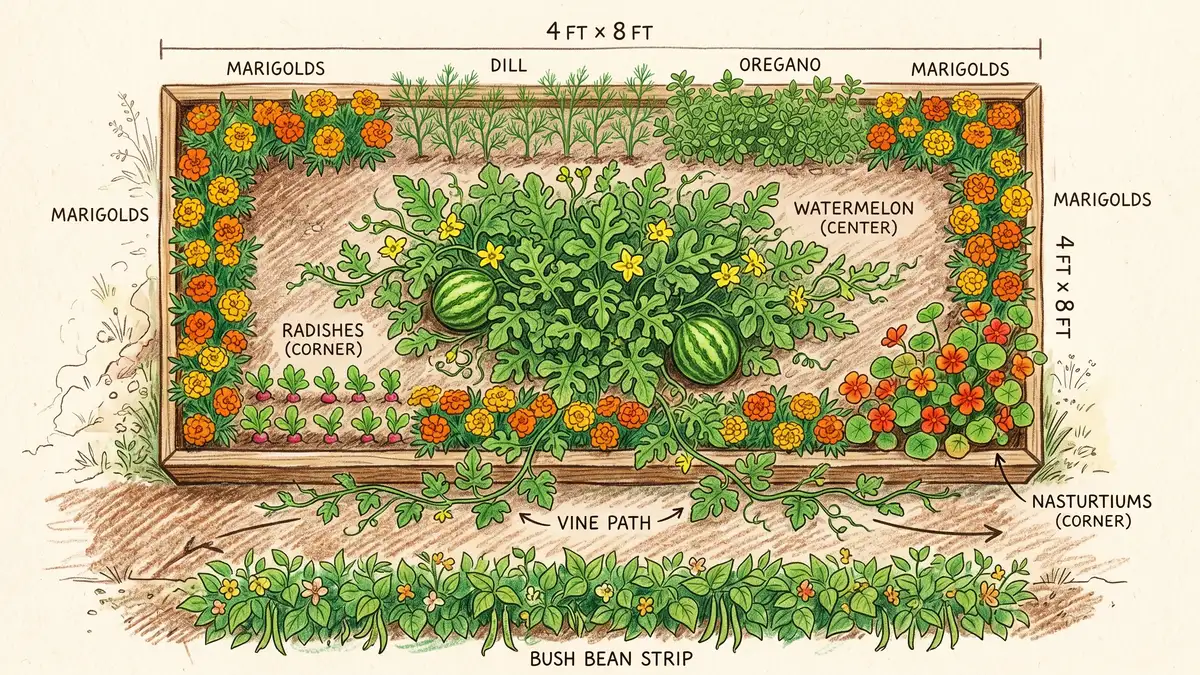
Melons (Citrullus lanatus watermelon, Cucumis melo cantaloupe and honeydew) face three reliable problems in a US home garden:
- Striped and spotted cucumber beetles (Acalymma vittatum, Diabrotica undecimpunctata) chew foliage and spread bacterial wilt
- Squash bug and squash vine borer attack the stems and crown
- Pollination shortfall because melon flowers need 8+ bee visits each to set full fruit
Lincoln University's trap cropping for cucurbits PDF documents that perimeter trap-cropping with Blue Hubbard squash reduces striped cucumber beetle pressure on the main melon planting by 50 percent or more. Companion planting addresses all three problems with a small set of friendly plants. For broader context, see our complete companion planting chart.
The top melon companions
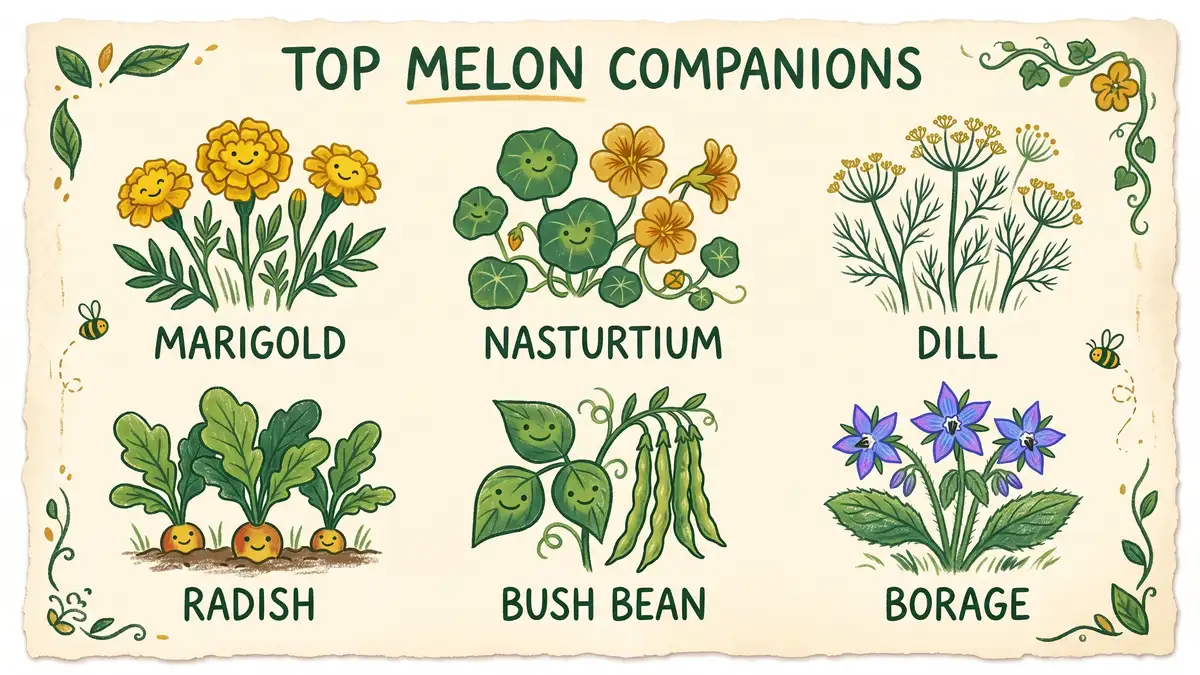
| Companion | Role | Where to plant |
| Nasturtium (Tropaeolum majus) | Aphid trap, beetle deterrent, pollinator forage | Border around bed, lets vines spread under |
| Marigold (Tagetes patula) | Nematode suppression, beetle deterrent | Throughout bed and at corners |
| Bush bean (Phaseolus vulgaris) | Nitrogen fixer, low height, fast maturity | Sunny strip on north side of melon bed |
| Radish (Raphanus sativus) | Early vacate-and-leave crop, soft soil for vine roots | Throughout bed, harvest before vines spread |
| Dill (Anethum graveolens) | Attracts beneficial parasitoid wasps and lacewings | Tall outer corner, away from vine path |
| Borage (Borago officinalis) | Heavy bee forage during melon bloom | Outer perimeter, 3 to 4 ft (0.9 to 1.2 m) from vines |
| Sunflower (Helianthus annuus) | Pollinator beacon, late-season shade | North side, where shade falls outside the bed |
| Blue Hubbard squash (Cucurbita maxima) | Perimeter trap crop for cucumber beetles | 10 to 20 ft (3 to 6 m) from main melon planting |
Source: Companion roles compiled from University of Arizona Cooperative Extension's companion planting PDF and University of Delaware Extension's diversity in the garden guide.
The Blue Hubbard trap-crop strategy
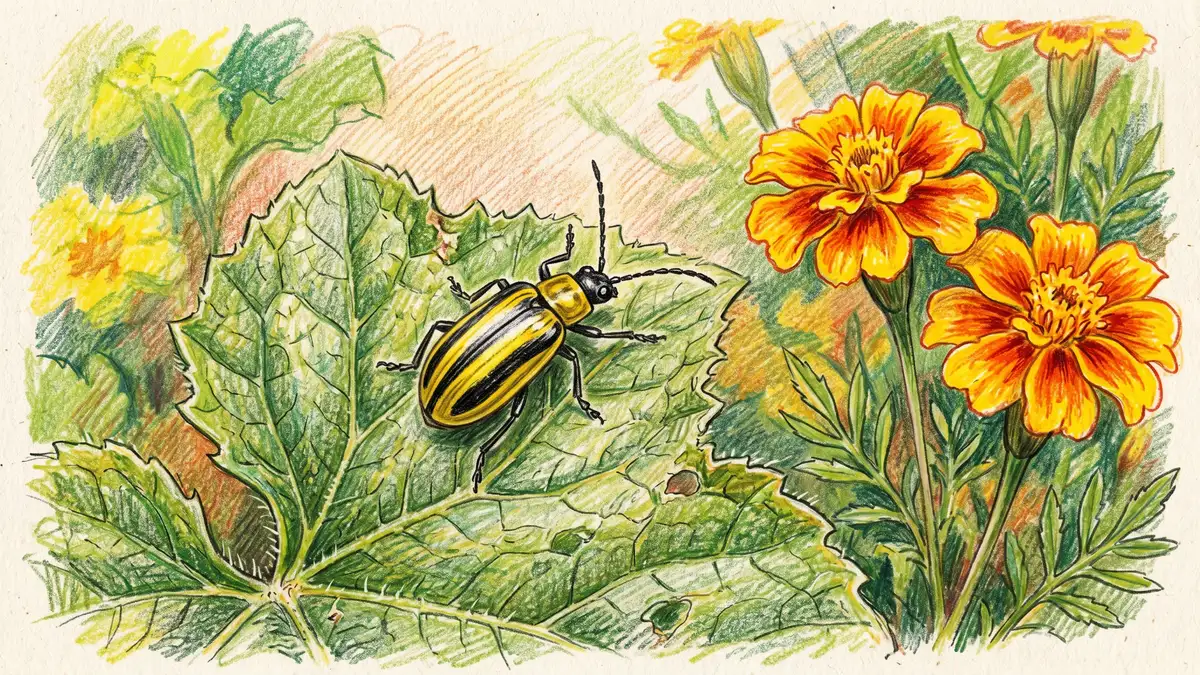
Striped cucumber beetle is the most damaging pest on US backyard melons. They emerge in May and June, chew melon foliage, and transmit Erwinia tracheiphila (bacterial wilt) that kills entire vines mid-season.
The fix is a perimeter trap crop. UConn IPM's perimeter trap cropping research shows Blue Hubbard squash (Cucurbita maxima) emits cucurbitacin compounds that are roughly 5 to 10 times more attractive to cucumber beetles than melons or summer squash. Plant a single ring of Blue Hubbard 10 to 20 ft (3 to 6 m) outside the melon patch. The beetles concentrate on the Blue Hubbard and you treat or remove that smaller area instead of spraying the entire crop.
Why This Works (the permaculture lens)
The permaculture move is to give pests something they like more than your crop. Blue Hubbard does not protect melons by repelling beetles; it attracts beetles away from the melon vines so the predators (and you) can deal with them on a concentrated, single-species patch. This is the same logic behind 12 permaculture principles applied at the bed scale: instead of fighting the pest, design the system so the pest behavior solves the problem for you.
Pollinator support during melon bloom
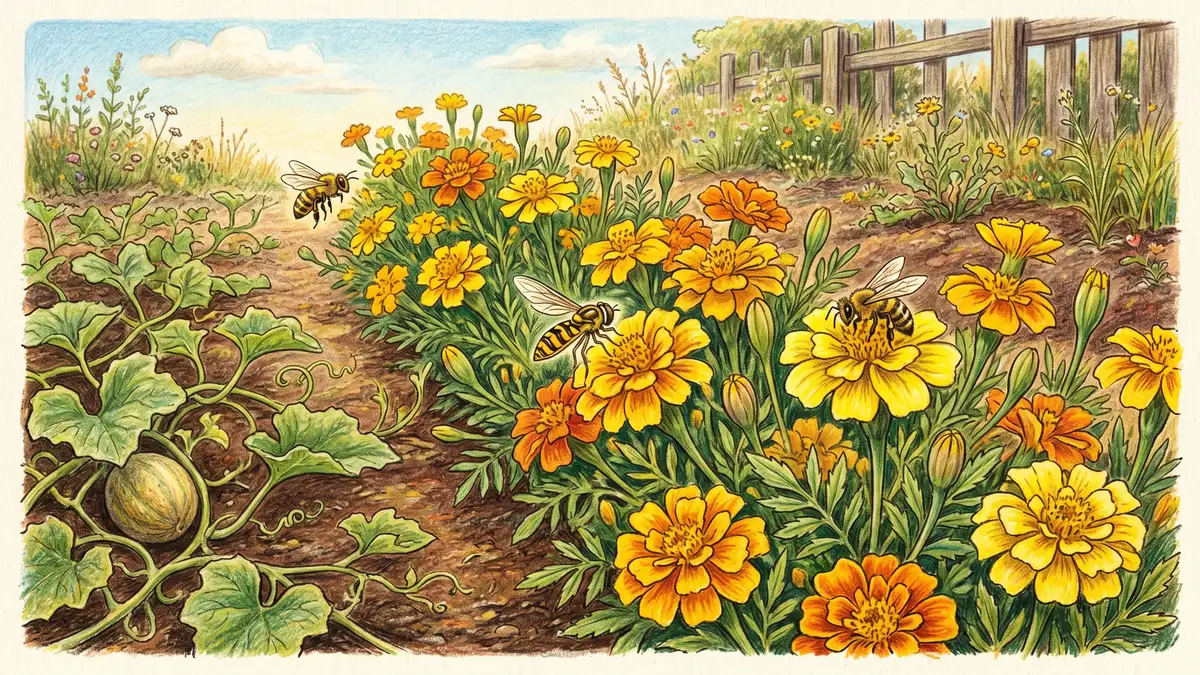
Melon flowers are short-lived (open for only one morning) and need at least 8 bee visits each to set full fruit with maximum sweetness. Misshapen or undersized melons are usually a pollination problem, not a soil or water problem.
Best pollinator-attracting companions to plant alongside melons:
- Borage (Borago officinalis): extremely high nectar production, refills nectar every 2 minutes
- Marigold (Tagetes patula): attracts hoverflies (pollinators and aphid predators)
- Calendula (Calendula officinalis): bee forage and edible petals
- Sunflower (Helianthus annuus): pollen-heavy beacon plant; native bees love it
- Sweet alyssum (Lobularia maritima): low-growing carpet of tiny flowers that fills gaps under sprawling vines
Plant pollinator companions on the perimeter of the bed, 3 to 6 ft (0.9 to 1.8 m) from the melon crown so the vines have somewhere to spread.
Nasturtium: the do-it-all border plant
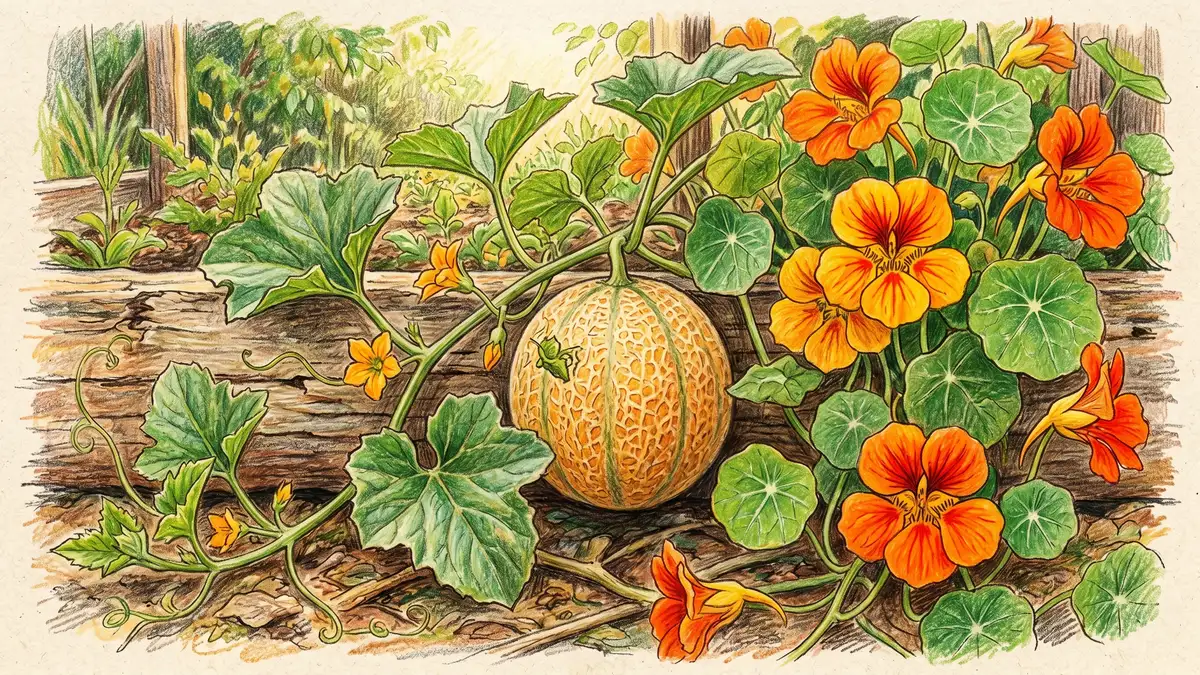
Nasturtium (Tropaeolum majus) is the single most useful flowering companion for melons. Rodale Institute's field guide on controlling striped cucumber beetles recommends nasturtium as part of the insectary border for cucurbit beds. It does four jobs at once:
- Aphid trap: aphids prefer nasturtium over melon foliage, concentrating the infestation away from the cash crop
- Cucumber beetle deterrent: reduces feeding on adjacent melons
- Pollinator forage: brilliant orange and yellow flowers draw bees and hoverflies
- Edible: peppery flowers and leaves for salads; spicy seed pods can be pickled as "poor man's capers"
Plant nasturtium as a continuous ring around the melon bed, 12 to 18 in (30 to 45 cm) outside the crown. It will trail outward and inward as the melons spread, sharing space without competing.
What NOT to plant with melons
Five Plants and Conditions to Avoid
Cucumbers and other melons. Same family; concentrate cucumber beetles, squash bugs, and bacterial wilt in the same area. Potatoes (Solanum tuberosum). Compete heavily for water and contribute to powdery mildew transmission. Tall heavy-shade crops (corn, pole beans, trellised tomatoes). Block sun melons need; only plant on the north side where shade falls away from the melon bed. Other heavy nitrogen feeders (cabbage, broccoli). Compete with melons during fruit set. Mint without containment. Will overrun the bed and outcompete the melon roots.
The 5-step backyard melon companion plan
Plot the vine sprawl first
Mark a 10 to 20 ft (3 to 6 m) circle from each melon crown. This is the future vine zone; do not plant anything tall or competitive inside it.
Plant the Blue Hubbard perimeter trap
Place 1 to 3 Blue Hubbard squash plants 10 to 20 ft (3 to 6 m) outside the melon patch, on the side closest to fence rows or weedy edges where beetles overwinter.
Edge with nasturtium and marigold
Plant a continuous ring of nasturtium and French marigold 12 to 18 in (30 to 45 cm) outside the melon crown. Mix the two for color and complementary pest activity.
Add pollinator forage and bush beans
Place borage, calendula, and bush beans on the north side of the bed. Sweet alyssum can fill gaps inside the bed under the spreading vines.
Interplant radishes for early harvest
Sow radishes between melon mounds at planting time. Radishes mature in 25 to 30 days, well before melon vines need the space, giving you an early harvest and softening the soil for the spreading roots.
Time to set up: about 2 to 3 hours for a 1 melon to 3 melon backyard plot. Cost: $15 to $30 in seeds and starter plants. The trap crop alone often pays for itself by avoiding 1 to 2 sprays of organic insecticide across the season.
Container and small-space adaptations
If you are growing a single watermelon or cantaloupe in a 20+ gallon (75+ L) container or a 4 by 4 ft (1.2 by 1.2 m) raised bed, the companion plan condenses:
- 1 melon vine planned to climb a trellis (vertical instead of sprawling)
- 3 nasturtiums planted around the container edge
- 2 marigolds in front of the trellis
- 1 borage plant on the north side
- 6 radish seeds direct-sown at planting time
Trellising changes the geometry: the vine grows up instead of out, so companions can occupy the ground space the vine would otherwise cover. Melons under 5 lbs (2.3 kg) like Sugar Baby watermelon or Minnesota Midget cantaloupe trellis successfully; larger melons need slings.
Cantaloupe vs watermelon companion differences
| Difference | Cantaloupe (Cucumis melo) | Watermelon (Citrullus lanatus) |
| Vine length | 6 to 10 ft (1.8 to 3 m) | 10 to 20 ft (3 to 6 m) |
| Pollination needs | Same: bee-dependent, 8+ visits per flower | Same: bee-dependent, 8+ visits per flower |
| Powdery mildew susceptibility | High | Moderate |
| Best added companion | Dill, more pollinator support | Sunflower trellis on north edge |
| Trellis-friendly cultivars | Minnesota Midget, Tigger | Sugar Baby, Bush Sugar Baby |
Source: Cultivar trellising and vine size data from extension service variety trials referenced in the UMN Extension cucurbit guides.
Frequently Asked Questions
What is the best companion plant for melons?
Nasturtium (Tropaeolum majus) is the most useful single companion for watermelons and cantaloupes. It deters cucumber beetles, attracts aphid-eating hoverflies, draws pollinators during melon bloom, and offers edible flowers and leaves. Marigold and borage are strong second picks.
What should you not plant near watermelon?
Avoid cucumbers and other melons (shared pests and bacterial wilt), potatoes (water competition and powdery mildew transmission), tall heavy-shading crops like corn and pole beans on the south side, and aggressive mints without root containment.
Can you plant cucumbers and melons together?
It is not recommended. Cucumbers and melons are both Cucurbitaceae and share major pests (striped cucumber beetle, squash bug) and diseases (bacterial wilt, powdery mildew, downy mildew). Planting them together concentrates pest pressure and disease incidence. Separate by 20 ft (6 m) minimum.
Does marigold help watermelon?
Yes. French marigold (Tagetes patula) helps watermelon in three ways: suppressing root-knot nematodes through compounds released by its roots, deterring some pest beetles, and attracting hoverflies that prey on aphids. Plant a row of marigolds around the melon bed perimeter.
Should I plant beans with melons?
Yes, bush beans work well as a companion. They fix nitrogen that benefits melons (which are heavy feeders), stay low so they do not shade the melon vines, and mature in 50 to 60 days from planting. Avoid pole beans, which would shade and tangle with the melon vines.
What is a perimeter trap crop for melons?
A perimeter trap crop is a more-attractive cucurbit (typically Blue Hubbard squash) planted in a ring 10 to 20 feet outside the main melon planting. Cucumber beetles are 5 to 10 times more attracted to Blue Hubbard than to melons, so they concentrate on the trap crop where you can manage them in one small area rather than across the whole bed.
How far apart should companion plants be from watermelon?
Plant low-growing companions (nasturtium, marigold, alyssum) 12 to 18 inches (30 to 45 cm) outside the melon crown. Taller companions (sunflower, borage, dill) go 3 to 6 feet (0.9 to 1.8 m) outside the crown on the north side. Trap crops like Blue Hubbard go 10 to 20 feet (3 to 6 m) outside the melon patch.
Do melons need pollinators?
Yes, heavily. Each melon flower needs 8 or more bee visits to set a fully developed, sweet fruit. Misshapen or undersized melons are usually a pollination problem. Plant borage, marigold, calendula, sunflower, and alyssum near the melon bed to draw bees and hoverflies during the bloom window.
Get the Weekly Dig
One practical permaculture guide a week, written for gardeners who do this on weekends: companion pairings that hold up under scrutiny, and the ones that do not. Free, no spam, unsubscribe any time.
Join the Weekly DigResources
- Trap Cropping to Control Cucumber Beetles and Squash Bugs in Cucurbits (Lincoln University PDF)
- Perimeter Trap Cropping for Yellow and Green Summer Squash (UConn IPM)
- Cucumber Beetles (University of Minnesota Extension)
- Companion Planting in Home Gardens (University of Minnesota Extension)
- The Art of Companion Planting (University of Arizona Cooperative Extension PDF)
- Adding Diversity to the Garden (University of Delaware Cooperative Extension)
- Companion Planting (West Virginia University Extension)
- Field Guide: Controlling Striped Cucumber Beetles (Rodale Institute)
- Watermelon Companion Plants, Plant Spacing and Growing Tips (Garden in Minutes)