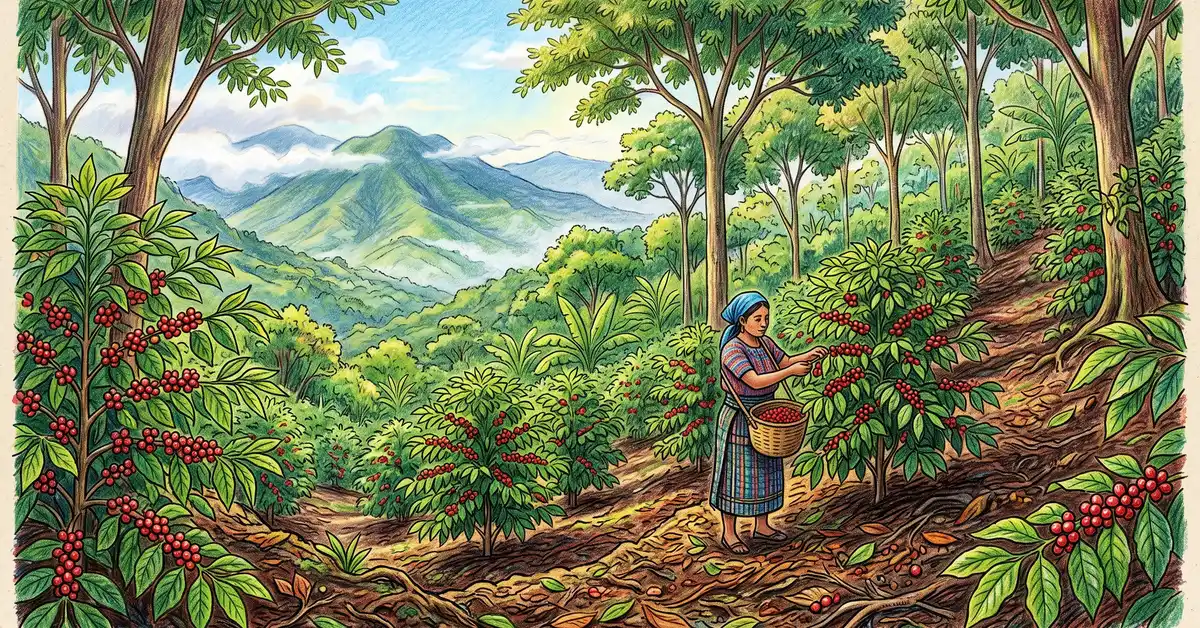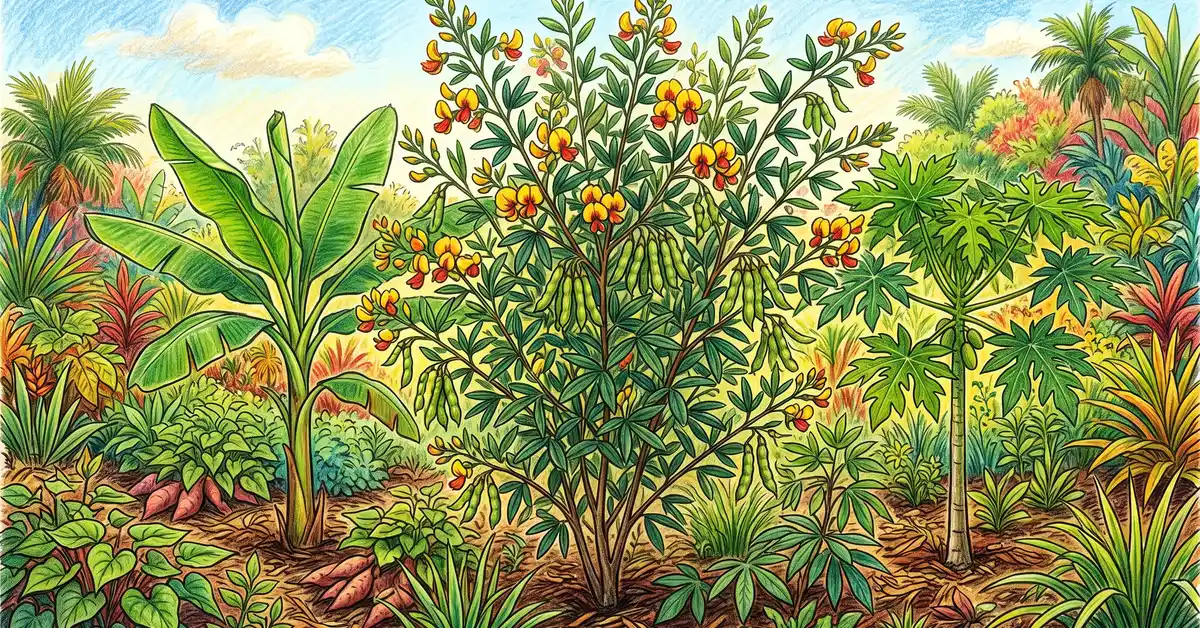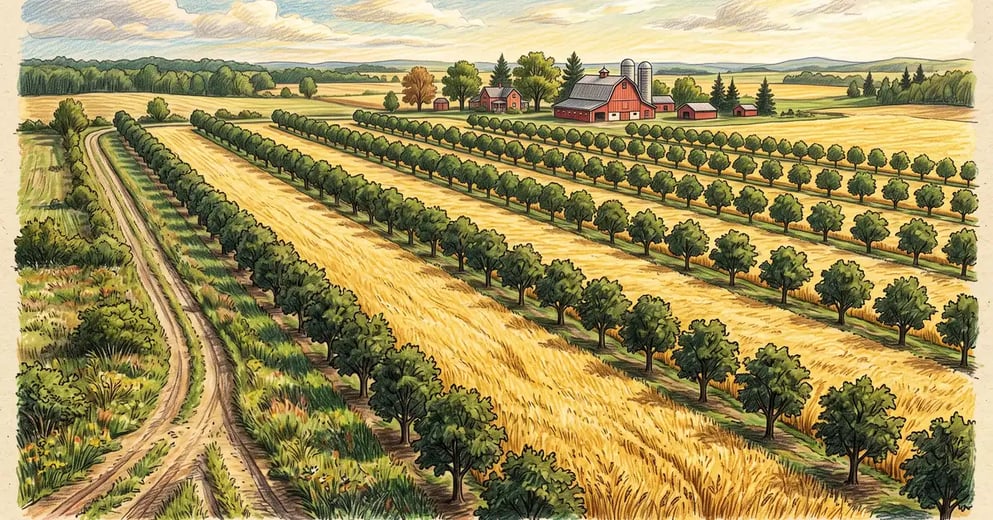

Trees and crops are usually treated as an either/or. Alley cropping treats the field as having two vertical layers instead of one: widely spaced rows of trees, with the crop you already grow running in the alleys between them. nitrogen-fixing pigeon pea hedgerows the shea tree
The USDA recognises it as a conservation practice with its own standard number, and Missouri has been running black walnut alley trials since the 1990s. Almost nobody in the US does it, because the design decisions are unforgiving and the payoff sits twenty years out. Here is what the research says, and how the geometry scales down to one acre.
What you'll find below:
- The alley width numbers from Missouri's long-running walnut trials, and why 40 ft was a mistake
- How much yield you actually lose near a tree row, measured
- The juglone problem with black walnut, and which crops shrug it off
- Carbon and soil figures from US agroforestry synthesis work
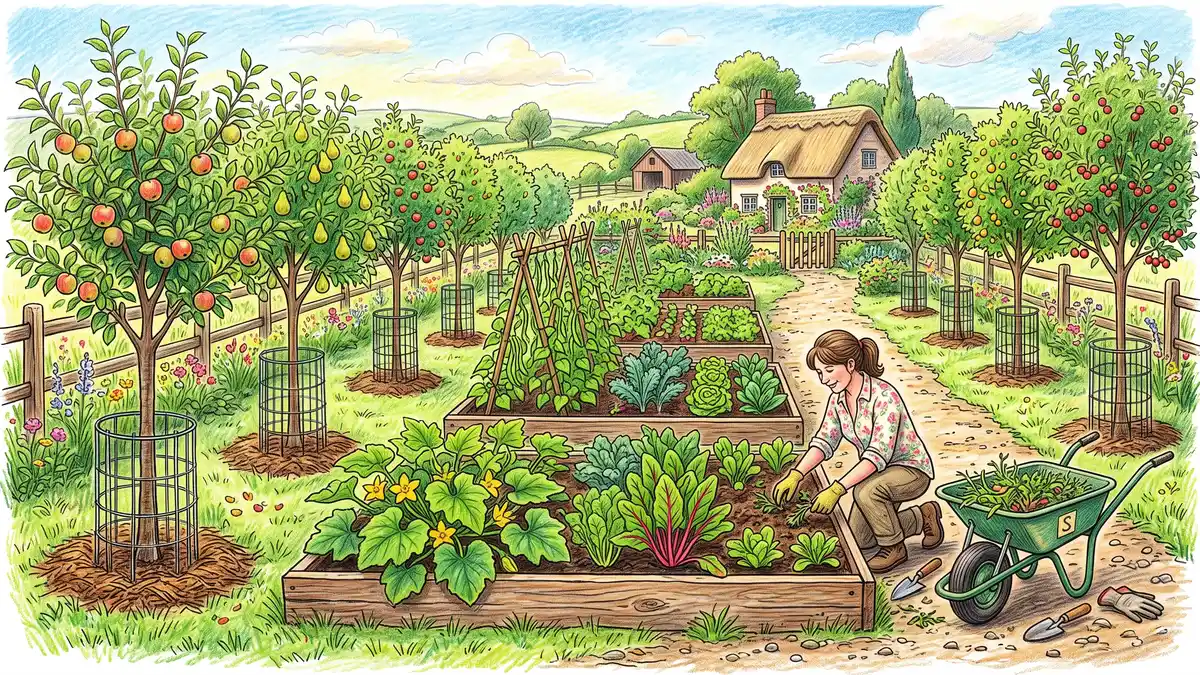
- What the whole thing looks like scaled to a quarter acre and a wheelbarrow
Key Takeaway
Alley width is the single decision that determines whether the system works. Too narrow and the crop alley shades out in a decade, which is how most abandoned alley plantings died. Missouri's revised guidance is 60 ft or wider if you want to keep growing sun-loving crops long term, and 40 to 50 ft only if you have a deliberate plan to switch to shade crops within 8 to 12 years.
What Is Alley Cropping, and How Is It Different From Silvopasture?
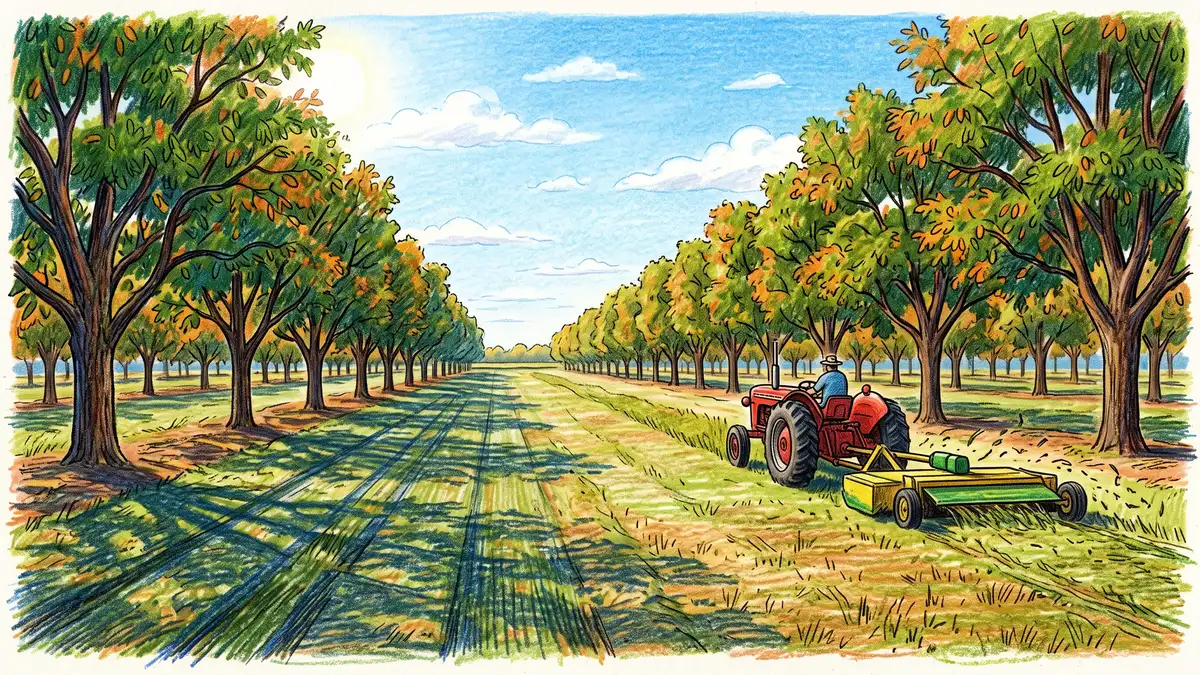
Alley cropping is planting rows of trees or shrubs to create alleys, then growing crops in those alleys. That is the definition the USDA National Agroforestry Center uses, and NRCS covers it under Conservation Practice Standard 311, whose stated purposes include improving microclimate for the crop and reducing surface runoff and erosion.
The distinctions between agroforestry practices are not academic. They determine which technical guidance and which cost-share programme applies to you.
| Practice | What Goes Between the Trees | Where the Trees Sit |
| Alley cropping (CPS 311) | Harvested crops, no livestock | In regular rows across the field |
| Silvopasture (CPS 381) | Forage grazed by livestock | In rows or clusters across pasture |
| Windbreak | Nothing, rows are close together | Field edge or across prevailing wind |
| Riparian buffer | Nothing, buffer is the point | Along a watercourse |
| Forest farming | Shade crops like ginseng, mushrooms | Existing forest canopy |
| Hedgerow | Nothing, it is a boundary | Field margin |
Sources: USDA National Agroforestry Center, Alley Cropping, USDA NRCS Conservation Practice Standard 381, Silvopasture
The practical line: if animals graze the understory regularly, design it as silvopasture, not alley cropping. Even if the row spacing looks identical.
How Wide Should the Alleys Be?
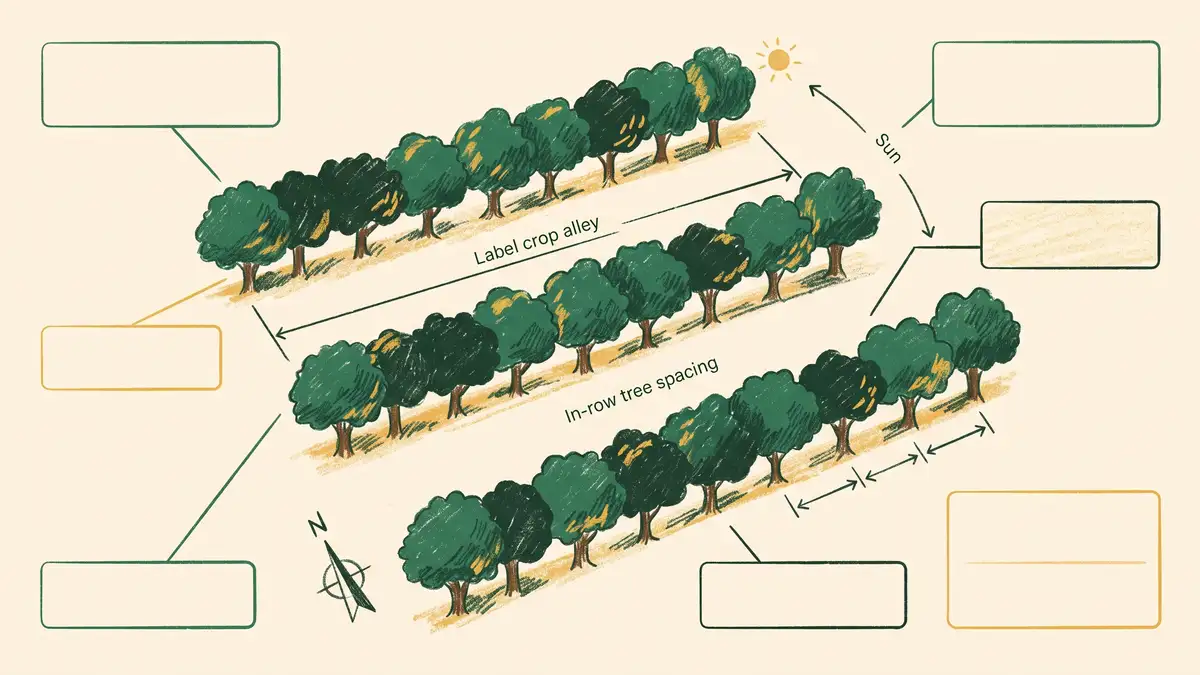
The University of Missouri Center for Agroforestry started its black walnut alley trials with 40 ft alleys and later concluded that was too narrow. Sun-loving annuals ran out of light as the canopies filled in. Current guidance splits by intent: 40 to 50 ft works if you plan a deliberate transition from corn and soybeans to shade-tolerant crops within roughly 8 to 12 years, but 60 ft or wider is the number for keeping full-sun crops going long term.
Three other parameters follow from that.
| Parameter | Typical Range | What Sets It |
| Alley width, shrubs (elderberry, aronia) | 15-20 ft | Limited canopy spread |
| Alley width, nut trees (chestnut, walnut) | 40-60+ ft | Mature canopy plus equipment width |
| Tree row spacing, hazelnut | ~20 ft | Orchard practice |
| Tree row spacing, chestnut | ~30 ft | Orchard practice |
| In-row tree spacing | 15-25 ft | Cultivar and target crown size |
| Row orientation, sun-loving crops | East to west | Shade sweeps across rather than sitting |
Sources: University of Missouri Center for Agroforestry, Alley Cropping: Farming Between the Trees, WSU Extension, Alley Cropping
Equipment width sets the floor. A combine wants 20 to 30 ft of working room, so add canopy encroachment on top of that. On a homestead where the widest thing entering the alley is a walk-behind tiller, the floor drops dramatically and you can fit far more tree rows per acre.
Why This Works: Stacking in Time as Well as Space
Most people read alley cropping as a spatial pattern, trees here, crops there. The more useful reading is temporal. Year one you are effectively still a row-crop farm with some sticks in it. Year fifteen the alley is narrowing and the crop mix has to shift toward shade tolerance. Year forty you may be harvesting timber and starting again. Permaculture calls this succession, and it is exactly what syntropic agriculture formalises with its strata and consortia. Designing the alley without designing the decade-by-decade crop transition is the most common way these systems fail.
What Does the Data Say About Yields, Soil and Carbon?
Yield loss near tree rows is real and steep. Udawatta and colleagues measured corn in a mature silver maple alley system and found yields 86 percent lower at 3.3 ft (1 m) from the tree row and 24 percent lower at about 22 ft (6.7 m), recovering to open-field levels beyond that. This is the single most important number in alley cropping design, because it tells you the suppression zone is roughly 20 ft wide on each side.
Run the arithmetic. In a 40 ft alley the entire width sits inside the suppression zone. In a 60 ft alley you get 20 ft of unaffected ground down the middle. That is the whole argument for wide alleys.
Whole-system productivity can still come out ahead. Croatian walnut research using Land Equivalent Ratio found an LER of 1.05 for walnut and buckwheat, meaning the intercropped land produced 5 percent more than the same crops grown separately.
On carbon, a 2022 synthesis by Udawatta and colleagues put mean accrual in US alley systems at 26 Mg C per hectare above ground and 41 Mg C in soil over ten years, roughly 30 tons of carbon per acre. The range across sites is enormous, so treat that as an order of magnitude, not a planning figure.
Economically, Wolz and DeLucia found black walnut alley cropping competitive with continuous corn and soybean across much of the Midwest. Read that closely: the result is modelled over full rotations at particular discount rates, not observed cash flow from working farms. The economics look defensible and the evidence base is thin.
Black Walnut and Juglone
Black walnut roots, hulls and leaves release juglone, which is toxic to a specific list of plants. University of Wisconsin Horticulture lists tomatoes, potatoes, eggplant, peppers, cabbage and asparagus among the sensitive ones, with blueberries, azaleas and many conifers also affected. Tolerant alley crops include most grasses and small grains, corn, beans, squash, melons, carrots, beets and onions. If your intended alley crop is a nightshade, choose a different tree. Sensitivity extends roughly to the drip line and beyond as roots spread.
| Juglone Sensitive (avoid near walnut) | Juglone Tolerant (safe in the alley) |
| Tomato, potato, pepper, eggplant | Corn, beans, squash, melon |
| Cabbage and other brassicas | Carrot, beet, onion, parsnip |
| Asparagus | Most grasses and small grains |
| Blueberry, azalea, rhododendron | Raspberry, black raspberry |
| Most pines, spruces and firs | Maple, oak, hickory, elm |
Sources: University of Wisconsin Horticulture, Black Walnut Toxicity
How Would You Do This on One Acre?
Everything above assumes a tractor. Take the tractor away and the numbers change in your favour, because the alley only needs to be as wide as the light demand plus your working space.
Run the rows east to west
On a small site this matters more, not less, because you have fewer rows and no room to waste. East-west rows sweep shade across the alley through the day instead of parking it permanently on the north side.
Choose shrubs or small trees, not timber species
Elderberry, aronia and hazelnut allow alleys of 15 to 20 ft, which fits a one-acre plot several times over. A single black walnut needs more room than most homesteads can give it before the shade problem arrives.
Put the shade-tolerant crops nearest the rows
Since yield suppression is spatial, plan for it. Lettuce, chard, brassicas and currants go within 6 ft of the tree row. Tomatoes, squash and beans go down the middle. This turns a design flaw into a planting plan.
Protect the trees and keep the tree row clear
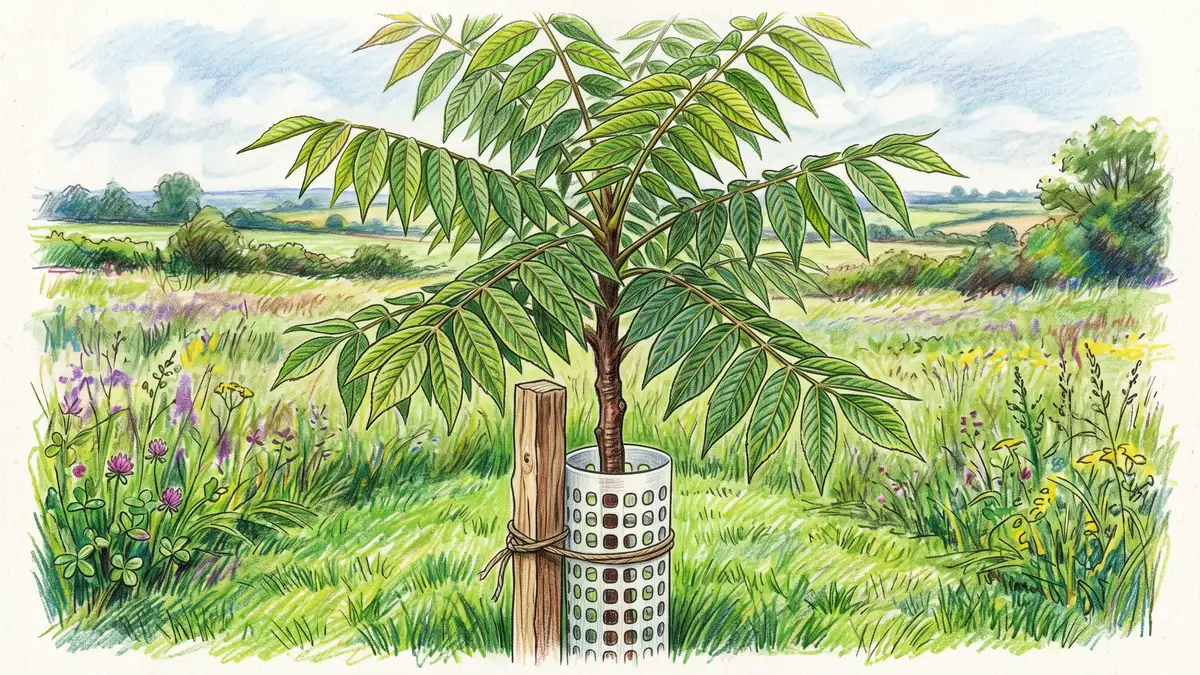
Tree tubes or wire cages against deer and voles, and a weed-free strip 3 ft (0.9 m) wide either side of each tree for the first three years. Grass competition in the establishment years kills more young trees than drought does.
Write down the year-15 plan now
Which trees get thinned, which alley crops replace the current ones, and at what canopy width you act. Systems die by drift, not by decision. Note it on the plan and revisit it every third year.
Why This Works: Turn the Problem Into the Pattern
The shade gradient across an alley is not a defect, it is free zoning. You have a strip of deep shade beside the trees, a bright middle, and a transition between them, which is three growing conditions on ground that used to offer one. Permaculture calls this reading the site rather than fighting it. Plant currants and salad greens where the corn would have failed, and the 24 percent yield penalty at 22 ft stops being a penalty at all. This is the same instinct behind syntropic row design, which assigns each species a stratum rather than treating light as uniform.
Funding Note
Because alley cropping has an NRCS practice standard, establishment can be eligible for cost-share through programmes such as EQIP and CSP. Availability varies by state and year. Talk to your local NRCS field office before you buy trees, not after.
Frequently Asked Questions
What is alley cropping?
Alley cropping is planting rows of trees or shrubs to create alleys, then growing agricultural or horticultural crops in those alleys. The USDA National Agroforestry Center defines it that way and NRCS covers it under Conservation Practice Standard 311. It differs from an orchard in that the crop between the trees is a primary product, not an afterthought, and from silvopasture in that no livestock graze the understory. Rows are usually 40 to 60 ft apart with trees spaced 15 to 25 ft within the row.
What is another name for alley cropping?
Alley farming is the most common alternative, particularly in older and tropical literature where the practice was developed with fast-growing nitrogen fixers like Leucaena and Gliricidia. Some sources call it intercropping with trees or row intercropping. Be careful with the tropical alley farming research: the species, cutting cycles and results do not transfer to temperate US conditions, where the trees are slower, the growing season shorter, and the economics dominated by timber or nut value rather than green manure.
How wide should alley cropping rows be?
For long-term production of sun-loving crops such as corn, soybeans or vegetables, 60 ft or wider. The University of Missouri revised its guidance upward after early black walnut trials at 40 ft proved too narrow as canopies expanded. Alleys of 40 to 50 ft are workable only with a plan to shift to shade-tolerant crops within 8 to 12 years. Shrub-based systems using elderberry or aronia can work at 15 to 20 ft. Whatever you choose must also clear your widest piece of equipment.
How much yield do you lose in an alley cropping system?
Close to the tree row, a lot. Research on a mature silver maple system measured corn yields 86 percent lower at 3.3 ft from the row and 24 percent lower at about 22 ft, recovering to normal beyond that. So the suppression zone extends roughly 20 ft either side. Whether the system nets out ahead depends on alley width, the value of the tree crop, and whether you plant shade-tolerant species in the affected strip instead of fighting the shade.
Can you grow vegetables between black walnut trees?
Some, not all. Black walnut releases juglone, which damages tomatoes, potatoes, peppers, eggplant, cabbage and asparagus, along with blueberries and many conifers. Corn, beans, squash, melons, carrots, beets, onions, most grasses and small grains tolerate it. If your alley crop plan is nightshade-heavy, pick a different tree species such as pecan, chestnut or hazelnut, all of which pair well with nut production in a wider planting without the allelopathy problem.
Is alley cropping the same as agroforestry?
Alley cropping is one of five practices the USDA recognises as agroforestry, alongside silvopasture, windbreaks, riparian forest buffers and forest farming. Agroforestry is the category, alley cropping is one member of it. In practice many farms combine several: alley cropping in the field, a windbreak on the exposed edge, a riparian buffer along the creek. The shared principle is that woody perennials do work that annual systems cannot, which is also the foundation of syntropic agroforestry and of long-term soil building.
Get the Weekly Dig
One practical permaculture guide a week, written for gardeners who do this on weekends: food forest and guild designs that produce. Free, no spam, unsubscribe any time.
Join the Weekly DigResources
- USDA National Agroforestry Center, Alley Cropping: the federal definition and overview of the practice
- USDA NRCS Conservation Practice Standard 311, Alley Cropping: the technical standard used for cost-share eligibility
- USDA NRCS Conservation Practice Standard 381, Silvopasture: for comparison when livestock are involved
- University of Missouri Center for Agroforestry, Alley Cropping: Farming Between the Trees: the revised alley width guidance from the black walnut trials
- WSU Extension, Alley Cropping: design components, row spacing and orientation
- Udawatta et al. (2014), Agronomy Journal: Crop Yields in a Mature Silver Maple Alley Cropping System: the measured yield suppression figures
- Žalac et al. (2022), Sustainability: Land and Water Productivity in Intercropped Walnut Systems: Land Equivalent Ratio results
- Udawatta et al. (2022), Carbon Footprints: Carbon Sequestration by Forests and Agroforests: US carbon accrual ranges for alley systems
- Wolz and DeLucia (2018), Ecological Applications: Black Walnut Alley Cropping Economics: modelled returns against continuous row crops
- University of Wisconsin Horticulture, Black Walnut Toxicity: juglone-sensitive and tolerant species lists
- Iowa State University STRIPS Programme: prairie strip research on runoff and nutrient loss in row-crop fields
- Savanna Institute, Alley Cropping Resources: practitioner guides for midwestern systems