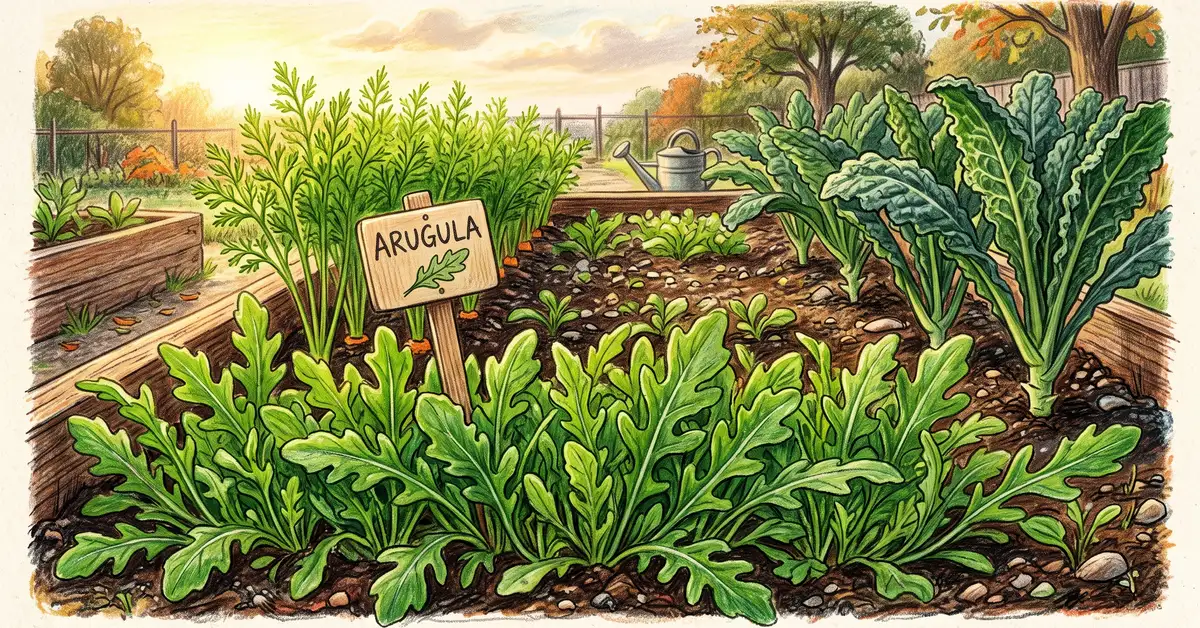

Empty garden beds from November to March are wasted real estate. Snow and rain pound bare soil into a crust, weeds get a 6-week head start in spring, and the microbial life you spent all summer building goes hungry. The fix is winter companion planting, where cover crops and green manures share the bed with overwintering garlic, brassicas, and spinach to protect soil while building it. This guide gives you the species, the seeding rates, the planting windows by USDA zone, and the termination plan that has you ready to plant tomatoes in May.
Quick takeaway
Broadcast a cereal rye plus crimson clover mix at 2 lb plus 0.5 lb per 1,000 sq ft (90 m2) by mid-October in zones 5 to 7 and undersow garlic, fall brassicas, or overwintering spinach into the same beds. The rye holds the soil and scavenges nitrogen. The clover fixes new nitrogen and feeds early spring pollinators. Mow at flowering in May, wait 2 to 3 weeks for allelopathic compounds to break down, then transplant tomatoes, peppers, and squash.
Cover crop or green manure: the working difference
Both are crops grown to feed the soil rather than the kitchen. The label depends on what you do with the biomass. A cover crop is grown primarily to protect the soil surface during a season when no cash crop is in the ground. A green manure is a cover crop you terminate and incorporate into the soil specifically to release nutrients for the next crop. The same species (cereal rye, hairy vetch, crimson clover, buckwheat) can play either role. In a winter backyard garden, most plantings serve both functions simultaneously.
Penn State Extension and SARE both treat the two terms as overlapping rather than separate. If you mow it at flowering and leave the residue on the surface as mulch, lean on the cover crop label. If you crimp it down and lightly till it in 3 weeks before planting, lean on the green manure label. The species choices are identical.
The five winter cover crops that work in US backyards
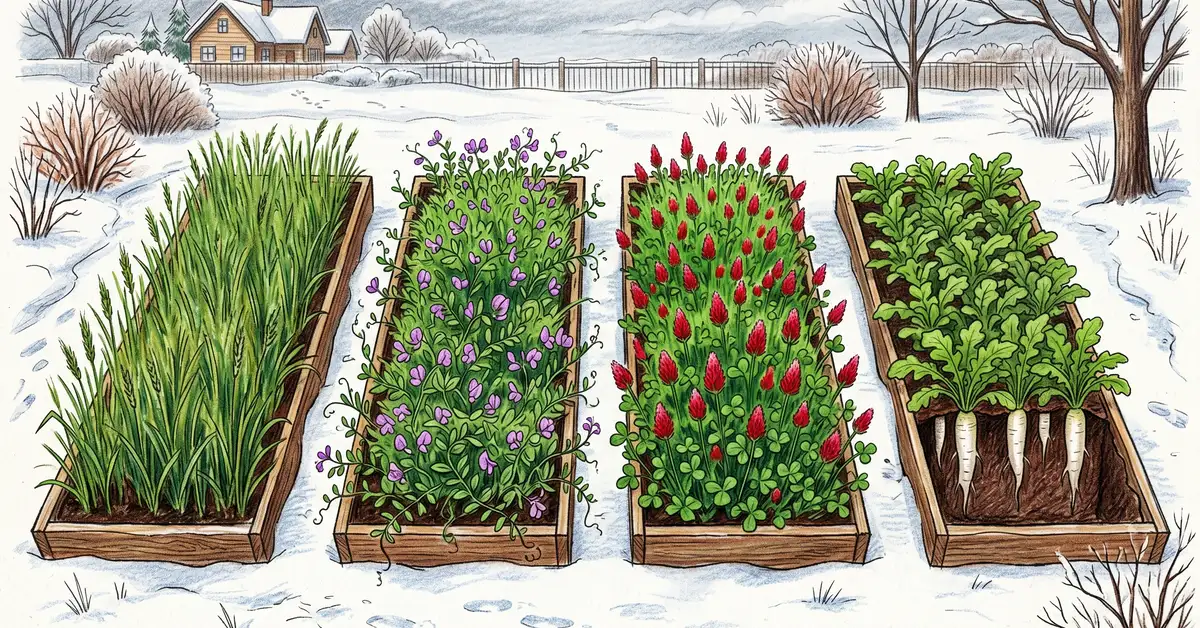
Cereal rye (Secale cereale)
The most cold-hardy. Germinates at 33 F (0.5 C) and survives -30 F (-34 C). Grows 3,000 to 8,000 lb (3,360 to 9,000 kg) biomass per acre by termination. Suppresses weeds via allelopathy. Best for zones 3 to 9. Drawback: 2 to 4 week wait after termination before direct-seeding small crops.
Hairy vetch (Vicia villosa)
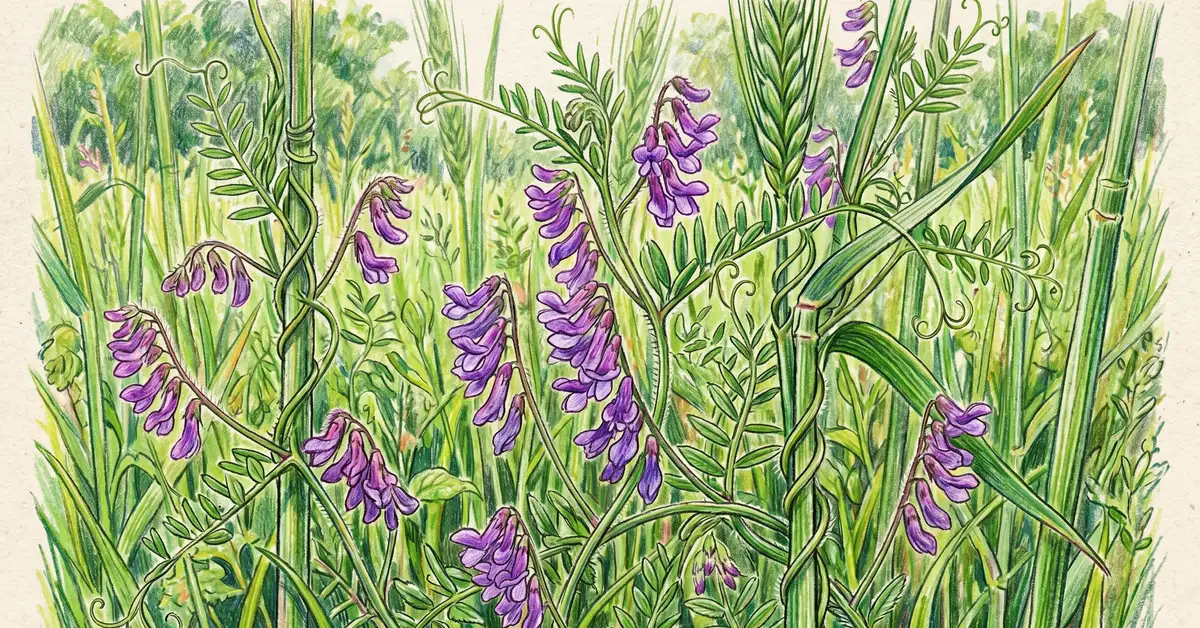
The nitrogen heavyweight. Fixes 90 to 200 lb of nitrogen per acre (101 to 224 kg per ha) according to SARE. Cold-hardy to zone 4 if planted by mid-September. Mixes beautifully with cereal rye, which scaffolds the vetch upright. Drawback: can become a volunteer weed if allowed to set seed.
Crimson clover (Trifolium incarnatum)
Fixes 70 to 130 lb N per acre (78 to 146 kg per ha) and produces vivid red spring blooms that feed early bumblebees. Hardy to about 5 F (-15 C), so reliably overwinters in zones 7 to 9. Often winter-kills in zones 5 to 6 and acts as a winter-kill green manure there.
Daikon radish (Raphanus sativus, tillage radish)
The bio-driller. Sends an 18 inch (45 cm) taproot through compaction layers. Winter-kills cleanly at 20 F (-7 C) and rots in place by spring, leaving channels for water and roots. Best in zones 5 to 7 where winter consistently kills it.
Austrian winter peas (Pisum sativum subsp. arvense)
Fixes 90 to 150 lb N per acre. Hardy to about 0 F (-18 C) when established 4 to 6 weeks before frost. Best in zones 6 to 9. Excellent winter companion for overwintering garlic because it scavenges fall nitrogen while the garlic is dormant.
Why this works (the permaculture angle)
The permaculture principle is "make every square foot work double." A bare bed in winter does one job (storing water). A bed under cereal rye plus hairy vetch does six: blocks erosion, scavenges leftover nitrogen, fixes new nitrogen, builds organic matter, feeds soil microbes, and suppresses weeds. Each species fills a niche the other cannot. The mixed planting outperforms a monoculture cover crop by 30 to 60 percent in trials at the Rodale Institute, USDA NRCS, and SARE.
Seeding rates and timing by USDA zone

Backyard seeding rates run 2 to 3 lb per 1,000 sq ft (90 m2) for cereal rye, 1 lb per 1,000 sq ft for hairy vetch, 0.5 to 1 lb for crimson clover, 0.5 lb for daikon radish, and 2 lb for Austrian winter peas. Broadcast by hand and rake lightly to bury the seed 0.25 to 0.5 inches (0.6 to 1.3 cm) deep. Water once thoroughly, then leave the bed alone until spring.
| USDA Zone | Optimal seeding window | Best species |
| 3 to 4 | Aug 25 to Sep 30 | Cereal rye, winter wheat, oats (winter-kill) |
| 5 | Sep 5 to Oct 15 | Cereal rye plus hairy vetch, daikon |
| 6 | Sep 15 to Oct 30 | Cereal rye plus hairy vetch, Austrian winter peas, daikon |
| 7 | Oct 1 to Nov 15 | Cereal rye plus crimson clover, hairy vetch, Austrian peas |
| 8 | Oct 15 to Dec 1 | Crimson clover, hairy vetch, Austrian peas, daikon |
| 9+ | Nov 1 to Jan 15 | Crimson clover, hairy vetch, Austrian peas |
Sources: USDA NRCS Plant Materials Centers, SARE Managing Cover Crops Profitably, Penn State, UMN Extension, NC State Extension.
Companion planting cover crops with overwintering vegetables
The strongest winter companion plantings combine a cover crop with a cash crop that uses the same bed. Three combinations consistently outperform separate beds.
Garlic plus Austrian winter peas
Plant garlic cloves in October. Broadcast Austrian winter peas at the same time. The peas fix nitrogen all winter while the garlic is dormant. Crimp peas in April when garlic puts on rapid growth. Garlic harvest in July, then plant a buckwheat or cowpea summer cover.
Fall brassicas plus crimson clover undersow
Transplant fall kale, collards, or broccoli in August. Broadcast crimson clover seed 4 to 6 weeks later when brassicas are 8 inches tall. Clover establishes under the canopy without competing. Harvest brassicas through frost, leave the clover, terminate the clover in May before tomatoes.
Overwintering spinach plus winter rye edge
Sow spinach in September in the center of the bed. Plant a 12 inch (30 cm) rye border around the bed edges. The rye blocks wind and snow drift, the spinach overwinters in the protected core. Harvest spinach all winter and into May.
Need the gear for this?
Bins and tumblers picked by yard size, with the honest trade-offs for each.
See the compost bin picksThe bio-drilling daikon radish trick
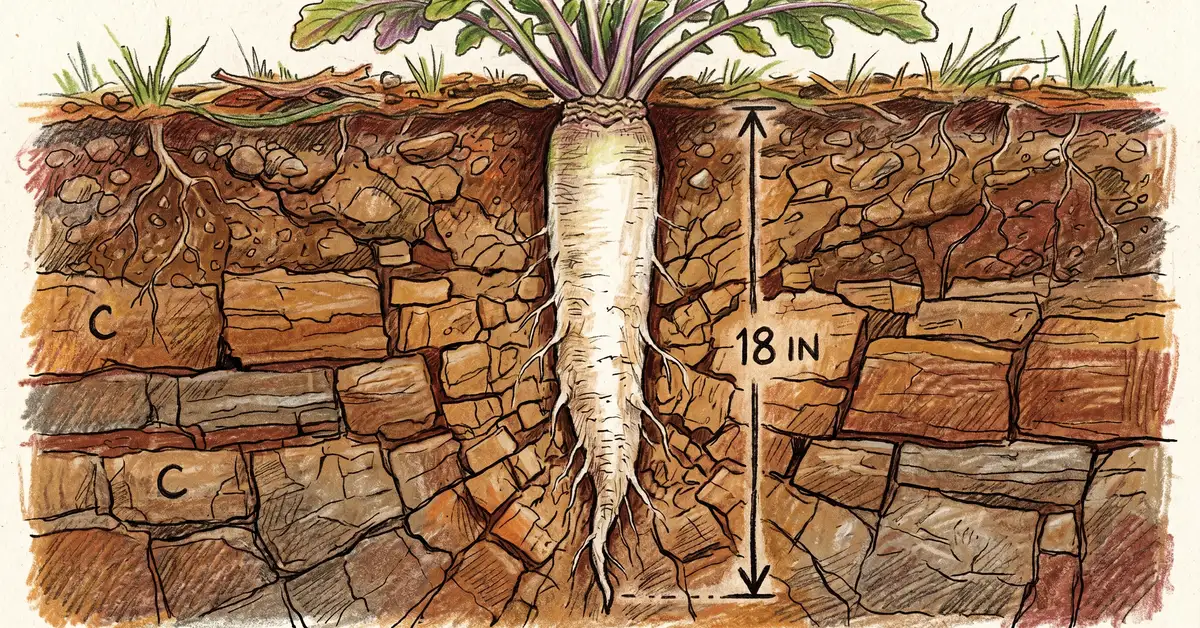
If your beds have a compaction layer, daikon radish (sold as Tillage Radish or Groundhog Radish in the cover crop trade) is the cheapest aerator you can buy. The taproot punches through plow pans, hardpan, and the compacted soil under raised beds at 12 to 18 inches (30 to 45 cm) depth. Cornell research and University of Maryland Extension trials document 30 to 40 percent improvement in water infiltration in compacted soils after a single radish cover crop cycle.
The radish winter-kills at 20 F (-7 C) and rots in place. By March the bed has tubes of organic matter and air channels where the roots were. Penn State Extension calls this "biological tillage." The trick only works in zones 5 to 7. In zones 8 plus, the radish does not reliably die and turns into a 4 ft (1.2 m) flowering monster the next spring.
The cereal rye plus hairy vetch mix (the gold standard)
The single most studied and most effective winter cover crop combination in US agriculture is cereal rye plus hairy vetch, originally pioneered for organic vegetable systems by the Rodale Institute in the 1980s and validated by USDA NRCS, SARE, Cornell, and Iowa State.
| Backyard rate per 1,000 sq ft | Function |
| 1.5 lb cereal rye plus 0.5 lb hairy vetch | Standard mix, balanced biomass and nitrogen |
| 1 lb rye plus 1 lb vetch | Nitrogen-heavy, for beds heading into heavy feeders like sweet corn, tomatoes, brassicas |
| 2 lb rye plus 0.25 lb vetch | Biomass-heavy, for beds heading into root crops, carrots, lettuce |
Sources: SARE Managing Cover Crops Profitably, Rodale Institute Research Farm trials, Iowa State Crop News.
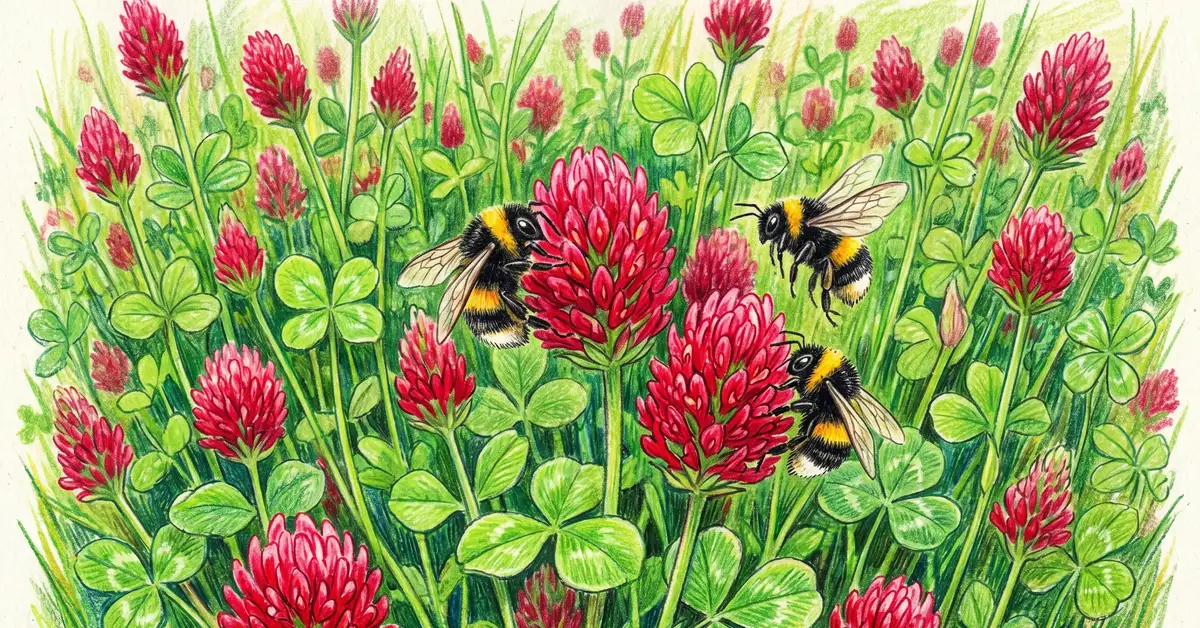
Why the mix works: the rye provides upright structure that lets the vetch climb instead of sprawling on the ground (vetch is a clinging vine). The combination produces more total biomass and more nitrogen than either species alone. Mowing or crimping at full bloom in May terminates both. Leave the residue on the surface as mulch.
Termination, timing, and the allelopathy wait
Wait 2 to 3 weeks after terminating cereal rye before direct-seeding small crops
Cereal rye releases benzoxazinoids (BOA and DIBOA) that suppress germination of small-seeded crops including carrots, lettuce, spinach, beets, and dill. Iowa State Extension and SARE recommend a 2 to 4 week wait before direct-seeding these crops in beds that just held rye. Transplants are unaffected and can go in immediately after termination.
Termination options ranked by practicality for a backyard:
- Mow at flowering with a string trimmer or push mower. Set blade as low as it goes. Leave the residue in place as mulch. Works on every backyard scale.
- Crimp with a 2x4 board. Walk a board flat across the bed under foot pressure to crush stems at the bottom node. Only works at full flowering.
- Let it winter-kill. Oats, buckwheat, daikon, and crimson clover in cold zones die over winter and need no intervention. Simply rake the residue aside in spring.
- Solarize with clear or black plastic. 3 to 4 weeks of plastic tarp finishes any cover crop in spring.
Aim to terminate roughly 3 weeks before you want to plant your spring transplants. For zones 5 to 7 with a mid-May tomato transplant target, mow rye at flowering in late April. For more depth on the rye-specific termination workflow, read our winter rye cover crop guide.
What to plant after a winter cover crop
| Spring crop | Wait after termination | Notes |
| Tomato, pepper, eggplant transplants | 0 to 7 days | Transplants unaffected by allelopathy |
| Squash, melon, cucumber transplants | 0 to 7 days | Transplant straight into residue mulch |
| Beans, peas (direct-seed) | 10 to 14 days | Small enough seed to feel some inhibition |
| Sweet corn (direct-seed) | 10 to 14 days | Iowa State Extension protocol |
| Carrot, lettuce, spinach, beet (direct-seed) | 21 to 28 days | Most vulnerable to BOA, DIBOA from rye |
| Mixed direct-seeded greens | 21 to 28 days | Or skip rye cover in those beds |
Sources: SARE Managing Cover Crops Profitably, Iowa State Crop News, USDA NRCS Allelopathy and Cover Crops.
Five common mistakes
- Confusing cereal rye with annual ryegrass. Cereal rye (Secale cereale) is the cover crop. Annual ryegrass (Lolium multiflorum) is a forage grass that is much harder to kill and produces less biomass. Read the Latin name on the seed bag.
- Planting too late. Cover crops need 4 to 6 weeks of growth before deep cold to establish. Late planting fails to provide winter protection.
- Direct-seeding carrots two weeks after rye termination. Allelopathy will gut germination. Wait the full 3 to 4 weeks or use transplants.
- Letting cover crops go to seed. Rye, vetch, and clover all become next year's weed problem if allowed to mature seed. Terminate at flowering, never after.
- Skipping the inoculant for legumes. Hairy vetch, clover, and Austrian peas need the right Rhizobium bacteria to fix nitrogen. Buy pre-inoculated seed or apply garden-store inoculant before sowing.
Where this fits in a permaculture rotation
Winter cover cropping is the cold-season half of a year-round living-soil garden. Pair it with a warm-season cover (buckwheat, cowpea, sun hemp, or tillage radish summer mix) and your beds carry roots 11 months of the year. The cash crops fit between covers.
The Rodale Institute Farming Systems Trial, the longest running cover-cropping experiment in North America (started 1981), documents that organic systems with continuous cover cropping match or exceed conventional yields after a 3 year transition while building soil organic matter at 0.5 to 1.2 percent per year. The same principles scale down to a backyard.
For the broader rotation context, read our guides on 12 permaculture principles explained with garden examples and building living soil for a thriving garden.
Get the Weekly Dig
One practical permaculture guide a week, written for gardeners who do this on weekends: composting that actually finishes and soil that feeds itself. Free, no spam, unsubscribe any time.
Join the Weekly DigFrequently asked questions
What is green manure?
Green manure is a cover crop terminated and incorporated into the soil specifically to release nutrients for the next cash crop. The most common backyard green manures are hairy vetch, crimson clover, Austrian winter peas, and field peas, all legumes that fix atmospheric nitrogen. Mowing and surface-mulching is the simplest approach. Light incorporation 2 to 3 weeks before planting is the alternative.
When should I plant winter cover crops?
Plant 4 to 6 weeks before your first hard freeze. That is late August to mid-October in USDA zones 3 to 4, September to early November in zones 5 to 6, October to early December in zones 7 to 8, and November to mid-January in zone 9 and warmer. Cereal rye broadcast as late as November in cold zones still germinates the following spring if seed-to-soil contact is reasonable.
What is the best cover crop for a vegetable garden?
For backyard vegetable gardens, the cereal rye plus hairy vetch mix is the best all-around choice. Rye provides biomass and weed suppression. Vetch fixes 90 to 200 lb of nitrogen per acre. The two species support each other physically and chemically. For zones 7 and warmer, swap hairy vetch for crimson clover which produces showy red blooms that feed early pollinators.
When to plant buckwheat cover crop?
Buckwheat is a warm-season cover crop, not a winter cover crop. Plant after the last frost in spring and any time through about 75 days before first frost in fall. Buckwheat winter-kills cleanly and is excellent for filling a 6 to 8 week gap between spring and fall cash crops.
Should I cover my raised beds with plastic in winter?
Plastic tarps suppress weeds and warm the soil for an early spring start, but they starve soil microbes by blocking living roots and rainfall. A winter cover crop accomplishes the weed-suppression goal while feeding the soil. Plastic is a reasonable fallback only when you missed the cover crop planting window.
Do cover crops need fertilizer?
Legume cover crops (vetch, clover, peas) need no nitrogen because they fix their own from the air via Rhizobium bacteria. Grass cover crops (rye, wheat, oats) benefit from any residual nitrogen from the previous crop but do not need new fertilizer. Buy or apply Rhizobium inoculant matched to the legume species the first time you grow each one.
Can I plant a winter cover crop with my garlic?
Yes. Austrian winter peas, crimson clover (zones 7 plus), and hairy vetch (zones 6 plus) interplant well with fall-planted garlic. The legumes fix nitrogen all winter while the garlic is dormant, then terminate in April before garlic puts on rapid spring growth. Avoid cereal rye over garlic because the rye outgrows and shades the garlic shoots.
How much cover crop seed do I need for a backyard garden?
For a 4 ft by 8 ft (1.2 m by 2.4 m) raised bed (32 sq ft / 3 m2), you need roughly 1 oz (28 g) of cereal rye, 0.5 oz (14 g) of hairy vetch, or 0.5 oz of crimson clover. A 200 sq ft (19 m2) section of an in-ground garden needs about 6 oz (170 g) of mixed cereal rye plus hairy vetch.
Resources
- SARE: Managing Cover Crops Profitably (full book)
- Penn State Extension: Cereal Rye as a Cover Crop
- Iowa State Extension: Cereal Rye Cover Crops, Allelopathy and Corn
- University of Minnesota Extension: Maximize Cover Crop Benefits
- Rodale Institute: Farming Systems Trial
- SARE: Hairy Vetch
- SARE: Crimson Clover
- USDA NRCS: Allelopathy and Cover Crops