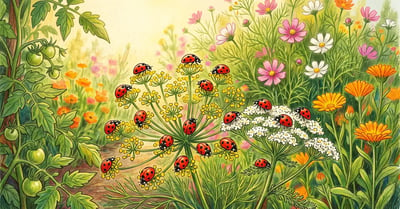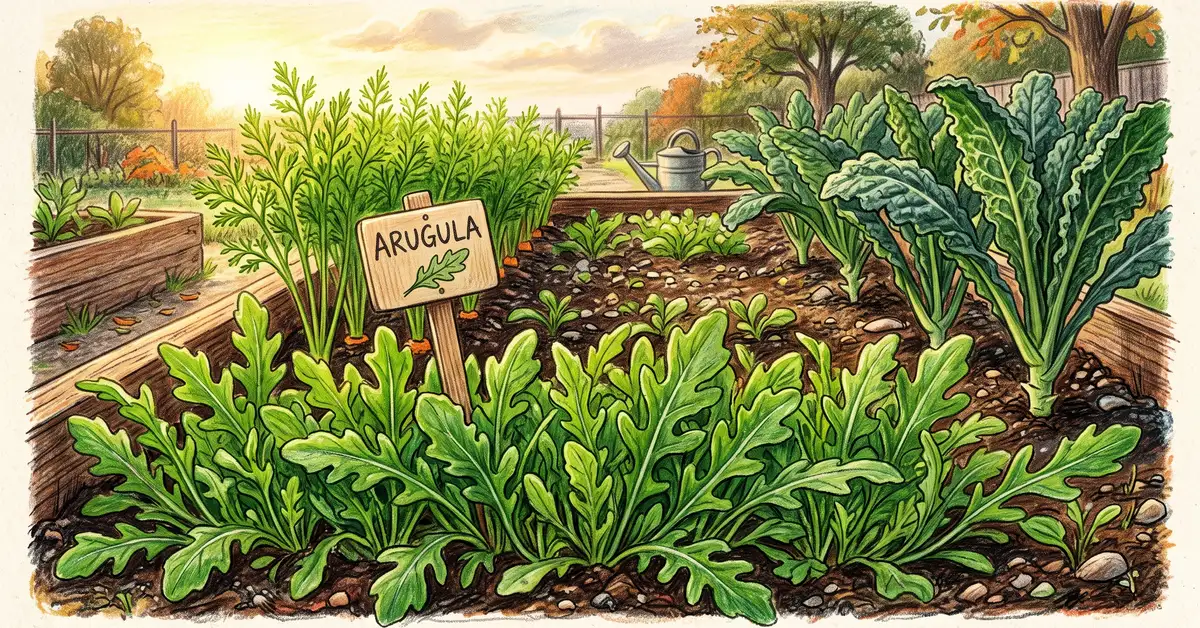

If you have spent any time gardening, you have seen the charts: plant basil with tomatoes, keep beans away from onions, marigolds repel everything. Most of that advice is passed hand to hand as folk wisdom, and when researchers actually test it, the picture splits sharply in two. A handful of companion-planting mechanisms are strongly, reproducibly supported. Many popular pairings have little or no controlled evidence at all.
This is an honest walk through what the peer-reviewed literature and university extension services actually show. The good news for anyone willing to think ecologically: the mechanisms that do hold up, trap cropping, push-pull habitat management, marigold nematode suppression, and insectary planting, are powerful, and far more useful than any good-neighbor chart.
What you'll learn:
- Why traditional companion charts lack scientific support
- The mechanisms with strong, reproducible evidence
- How marigolds really suppress nematodes, and how they don't
- Which popular claims the research does not back up
Key Takeaway
The science supports companion planting when it is understood as intercropping, trap cropping, habitat management, and allelopathy, not as magic pairings. Trap crops, push-pull systems, marigold nematode rotations, and insectary flowers have strong data behind them. Broad "repellent herb" and "improves flavor" claims are weakly supported or purely anecdotal.

Why Most Companion Planting Charts Aren't Backed by Science
The familiar good-neighbor charts are mostly tradition, not data. Mississippi State University Extension's review, Companion Planting: Myth or Truth?, is blunt that many charted pairings rest on anecdote rather than controlled trials. Part of the problem is definitional: "companionship" is fuzzy, so scientists tend to study specific mechanisms, nematode suppression, volatile emissions, natural-enemy habitat, rather than the vague idea that two species simply like each other.
That does not make companion planting worthless. It means the real benefits live in ecology, not in a lookup table. Once you reframe a companion planting plan as intercropping and habitat management, the evidence gets a lot more interesting, and a lot more actionable.
What's Strongly Proven: Trap Cropping and Push-Pull
This is the best-supported territory in the whole field. A trap crop is a more attractive plant placed to lure pests off your main crop. USDA entomologists frame trap crops as a core integrated pest management tool, and the numbers are striking. In field demonstrations of Blue Hubbard squash (Cucurbita maxima) as a perimeter trap for squash bugs and cucumber beetles, 60 to 80 percent or more of the pests aggregate on the trap rows, leaving the protected zucchini or pumpkin crop largely alone.

The most rigorously studied example is the African push-pull system, which pairs desmodium (Desmodium uncinatum) between maize rows to "push" stem-borer moths away, with Napier grass (Pennisetum purpureum) around the border to "pull" them in as a dead-end trap. On-farm trials with over 2,000 farmers in Kenya report maize yield increases often exceeding 100 percent, alongside major reductions in stem borers and parasitic Striga weed.
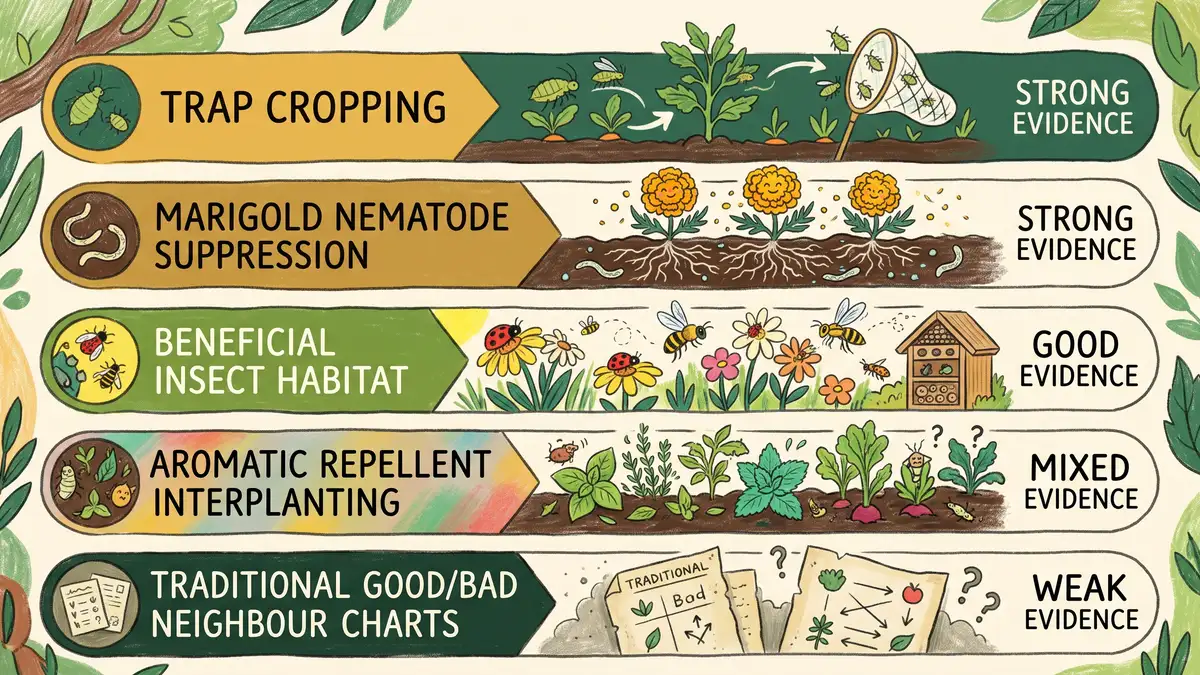
| Strategy | Documented Effect | Evidence |
| Blue Hubbard trap crop | 60-80%+ of pests move to trap rows | Strong (field IPM) |
| Push-pull (desmodium + Napier) | Maize yields up >100%; Striga suppressed | Strong (peer-reviewed) |
| Good/bad neighbor charts | No consistent controlled support | Weak |
Sources:
Do Marigolds Actually Work Against Nematodes?
Yes, but not the way most gardeners plant them. French marigold (Tagetes patula) has a genuinely well-documented effect against root-knot nematodes (Meloidogyne). A 2010 review in Crop Protection found marigold rotations frequently cut nematode populations by more than 50 percent, and in some trials over 90 percent, occasionally outperforming chemical nematicides. The mechanism is real chemistry: marigold roots exude alpha-terthienyl, which a 2019 study showed penetrates the nematode cuticle and kills via oxidative stress, and it works even in the dark.
The Catch Most Gardeners Miss
Dotting one or two marigolds beside a tomato plant does almost nothing for nematodes. Mississippi State and the Crop Protection review agree that suppression requires marigolds grown as a dense cover crop or full-season rotation, then incorporated into the soil before you plant the susceptible crop. As an above-ground insect repellent, marigold evidence is mixed at best. Grow them as a rotation, not a garnish.
Insectary Plants: The Beneficial-Insect Evidence
Feeding the predators is one of the surest wins. Flowering "insectary" plants supply nectar and pollen that sustain the natural enemies of pests. USDA Agricultural Research Service work in organic lettuce found that sweet alyssum (Lobularia maritima) planted on roughly 10 percent of the field maintained effective aphid control through the hoverflies it attracts, whose larvae devour aphids.
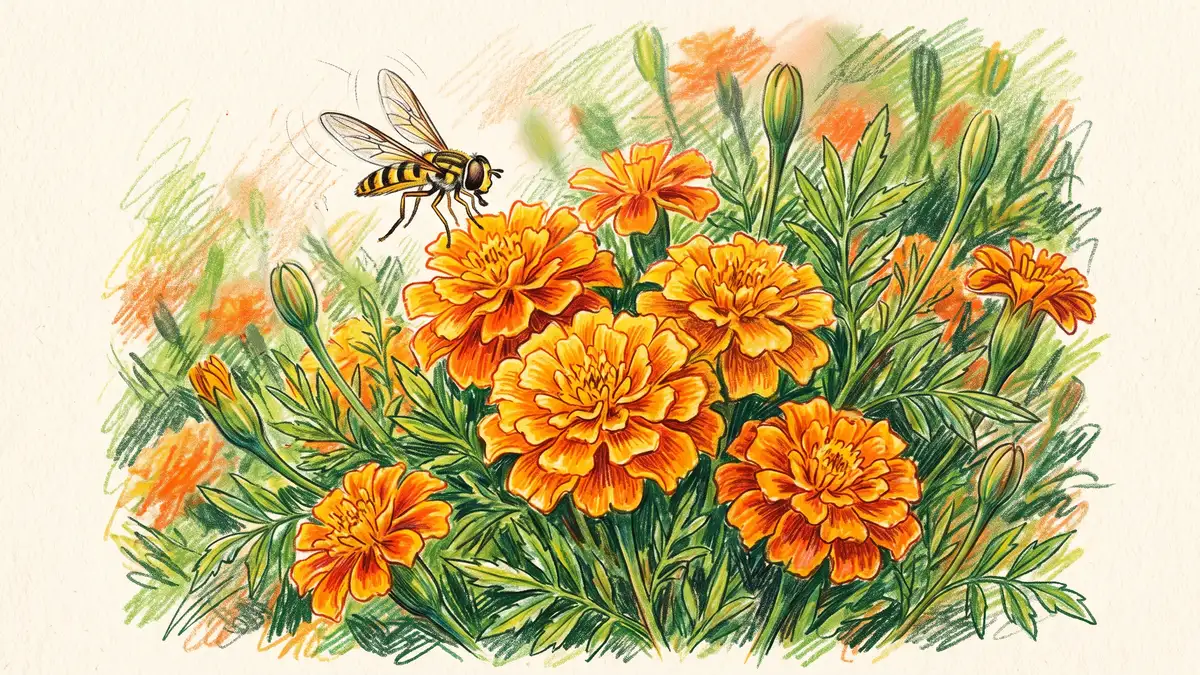
Buckwheat (Fagopyrum esculentum) shows a similar effect: a study in PMC found its flower volatiles attract the parasitoid Peristenus spretus and enhance biological control. This is the same logic that makes a diverse companion-planted bed more resilient than a monoculture, less about repelling pests, more about hosting the insects that eat them.
Why This Works: Building a Standing Army
Insectary flowers work by supporting biodiversity, not by chemical warfare. Keeping something in bloom through the season gives predators and parasitoids the nectar they need to stick around and reproduce. This is permaculture's principle of using biological resources and encouraging diversity, the practical core of designing with nature rather than against it.
What's Weak, Mixed, or Unproven
Honesty matters as much as enthusiasm here. Some classic claims have real but limited support, and some have essentially none.
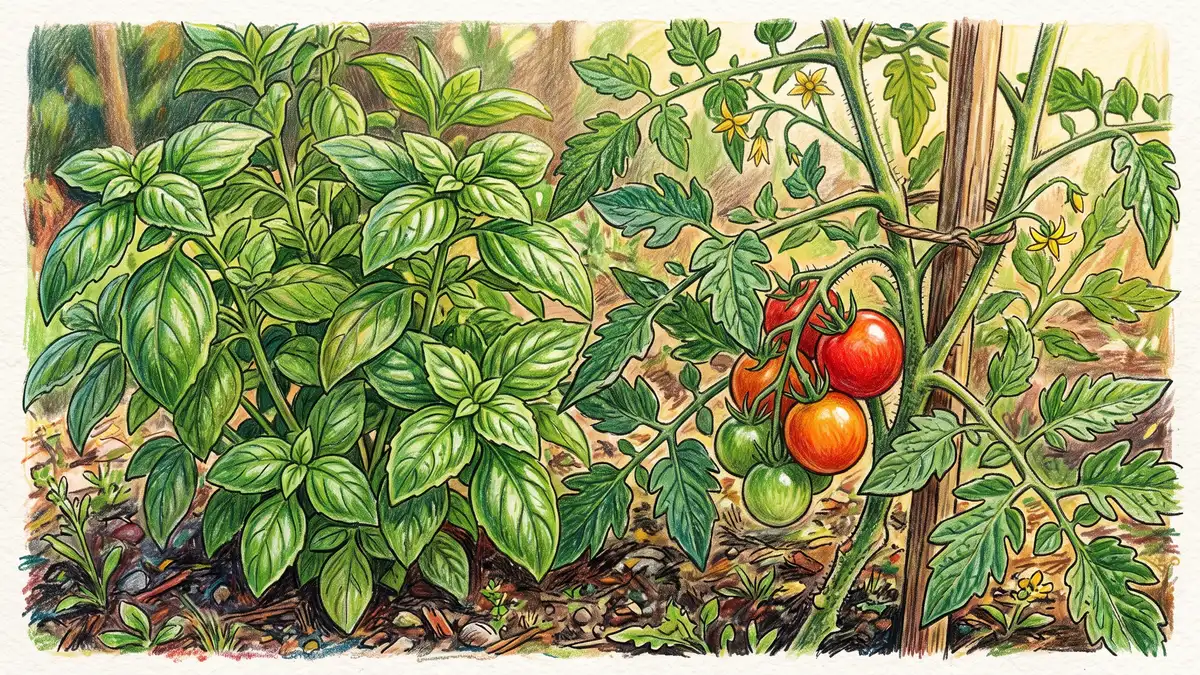
Aromatic confusion, the idea that strong-smelling herbs mask crops from pests, is genuinely mixed. A classic 1984 study on mixed cropping of carrots and onions found some interference with pest colonization, but results across the repellent-herb literature are inconsistent. The famous basil-and-tomato pairing (Ocimum basilicum with Solanum lycopersicum) has some emerging plant-signalling research behind it, but the beloved claim that basil "improves tomato flavor" has no solid support.
Allelopathy, by contrast, is well documented on the negative side. Fennel (Foeniculum vulgare) chemically suppresses many neighboring plants, as a 2002 study on its dominance over native vegetation shows, and black walnut's juglone is a textbook case. So the "bad neighbor" half of the charts occasionally reflects real chemistry, even where the "good neighbor" half does not.
Frequently Asked Questions
Does companion planting actually work?
Parts of it work very well, and parts are folklore. The mechanisms with strong scientific support are trap cropping, push-pull habitat management, marigold cover-cropping against nematodes, and insectary flowers that feed beneficial insects. These are backed by peer-reviewed studies and USDA research. What lacks support is the traditional good-neighbor chart, the notion that specific plant pairs help each other through vague "companionship." The most useful way to think about it is ecological: you are managing pests, predators, and soil organisms, not matchmaking plants. Approached that way, companion planting is a legitimate, evidence-based tool rather than garden superstition.
Do marigolds keep bugs away from my vegetables?
Not really as an above-ground insect repellent, where the evidence is weak and mixed. Where marigolds genuinely shine is against root-knot nematodes in the soil. French marigold (Tagetes patula) roots release alpha-terthienyl, which kills nematodes, and rotation studies show population reductions frequently over 50 percent and sometimes over 90 percent. The critical detail is that you must grow marigolds densely as a cover crop for a season and then work them into the soil before planting a susceptible crop like tomatoes. Scattering a few marigolds among your vegetables looks cheerful but does little measurable pest control.
What is the strongest scientific evidence in companion planting?
Trap cropping and the push-pull system. In trap cropping, a highly attractive plant like Blue Hubbard squash draws 60 to 80 percent or more of pests such as cucumber beetles and squash bugs onto perimeter rows, sparing the main crop. The push-pull system developed in Africa, which pairs desmodium between maize rows with Napier grass around the border, has produced maize yield increases exceeding 100 percent across trials with thousands of farmers, while suppressing stem borers and Striga weed. Both are structured spatial designs studied in controlled and on-farm research, which is exactly why they hold up where casual pairings do not.
Should I plant flowers in my vegetable garden?
Yes, this is one of the better-supported companion strategies. Flowering insectary plants such as sweet alyssum (Lobularia maritima) and buckwheat (Fagopyrum esculentum) supply nectar and pollen that sustain hoverflies, parasitoid wasps, and other natural enemies of pests. USDA research in organic lettuce found alyssum on about 10 percent of the field maintained effective aphid control through the hoverflies it drew in. Keeping something in bloom across the season gives beneficial insects the fuel to stay and reproduce, building a resident population of pest predators. It is a reliable, research-backed way to reduce pest pressure without chemicals.
Are any companion planting combinations actually harmful?
Some are, through allelopathy, where one plant chemically suppresses another. Fennel (Foeniculum vulgare) is a well-documented offender that inhibits many neighboring plants, and black walnut releases juglone, which harms tomatoes and other sensitive species nearby. These negative interactions are better supported by science than most of the positive pairings on companion charts, because the chemistry is measurable. So while you can be skeptical of many "good neighbor" claims, the "keep these apart" warnings for known allelopathic plants like fennel and walnut are worth taking seriously in your garden layout.
Get the Weekly Dig
One practical permaculture guide a week, written for gardeners who do this on weekends: companion pairings that hold up under scrutiny, and the ones that do not. Free, no spam, unsubscribe any time.
Join the Weekly DigResources
- Mississippi State University Extension — Companion Planting: Myth or Truth?
- Global Plant Council — The Push-Pull Strategy
- Khan et al. (Crop Protection) — Economic Performance of Push-Pull
- Hooks et al. (2010, Crop Protection) — Marigold as a Cover Crop Review
- Nematicidal Actions of the Marigold Exudate Alpha-Terthienyl (PMC, 2019)
- USDA AgResearch Magazine — Flower Power Protects Organic Lettuce
- Buckwheat Flower Volatiles Attract Peristenus spretus (PMC)
- USDA — Pairing Plant "Buddies"