A backyard food forest in USDA zone 9 can grow real mangoes, real avocados, real citrus, and real bananas at the same time. The growing season runs 9 to 11 months. The hard part is choosing the right species for your specific zone 9 climate, because the Florida Gulf Coast, the southern California Mediterranean strip, the Arizona desert lowlands, and the southern Texas plains all sit inside the same USDA hardiness band but ask the gardener for completely different designs.
Understanding USDA zone 9
USDA zone 9 has an average annual minimum winter temperature of 20 to 30 F. Subzone 9a covers 20 to 25 F. Subzone 9b covers 25 to 30 F. Per the USDA Plant Hardiness Zone Map, zone 9 includes most of peninsular Florida, the Gulf Coast strip across Mississippi, Alabama, and southern Louisiana, southern Texas including Houston south to Brownsville, the Phoenix-Tucson corridor in Arizona, the Sonoran and Mojave desert lowlands, and the coastal southern California strip from Santa Barbara south to San Diego.
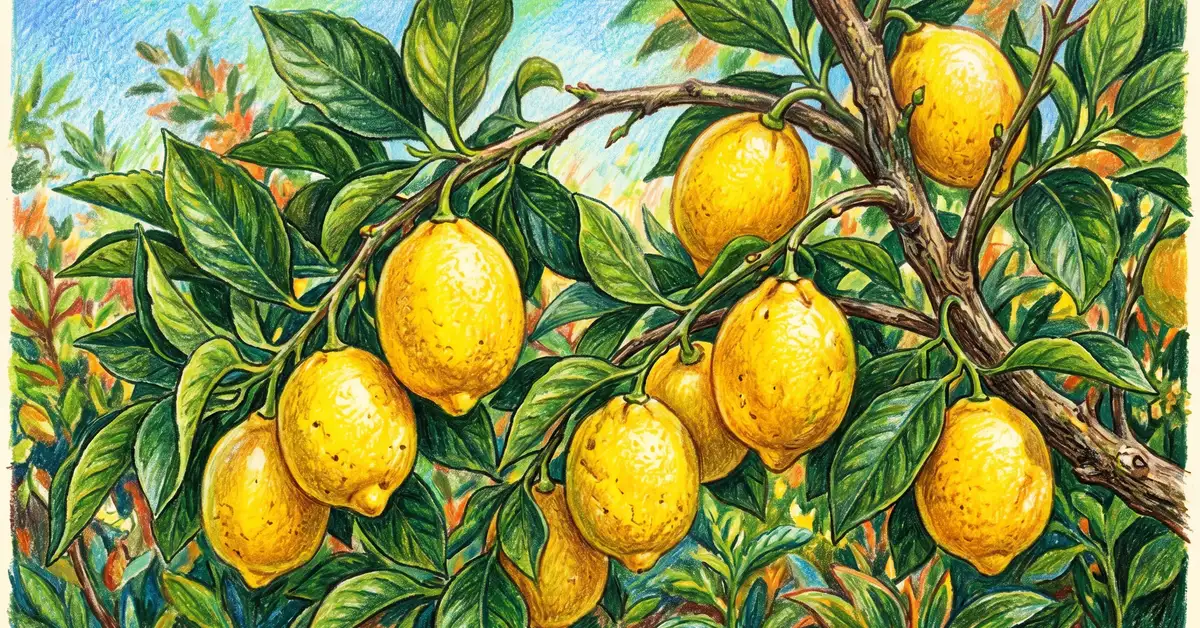
Within that single hardiness band the climate varies dramatically:
Florida and Gulf Coast. 50 to 65 in annual rainfall, high humidity, hurricane season June through November, sandy acid soil, summer storms.
Coastal southern California. 10 to 15 in annual rainfall, dry summer Mediterranean pattern, mild winters, clay-loam soil.
Arizona desert lowlands. 8 to 12 in annual rainfall, extreme summer heat above 110 F, alkaline mineral soil, monsoon storms July through September.
Southern Texas. 25 to 50 in annual rainfall east to west, hot summers, occasional hurricanes on the Gulf side, mix of clay and sandy soils.
The species that thrive in a Florida food forest will burn out in Phoenix. The Mediterranean plants that succeed in Los Angeles will rot in Houston. Zone 9 is not one zone; it is four different food forest climates wearing the same USDA label.
The 7-layer food forest model in zone 9
Why this works (the permaculture principle)
The food forest model from Robert Hart and Bill Mollison stacks plants in vertical layers so every square foot produces from canopy down to roots. In zone 9 the long warm season pushes this stack toward subtropical species that simply will not survive further north. Cocoa, mango, and avocado join the more familiar pecan and persimmon. The same logic underpins our broader food forest design guide and our 7 layers of a food forest companion piece.
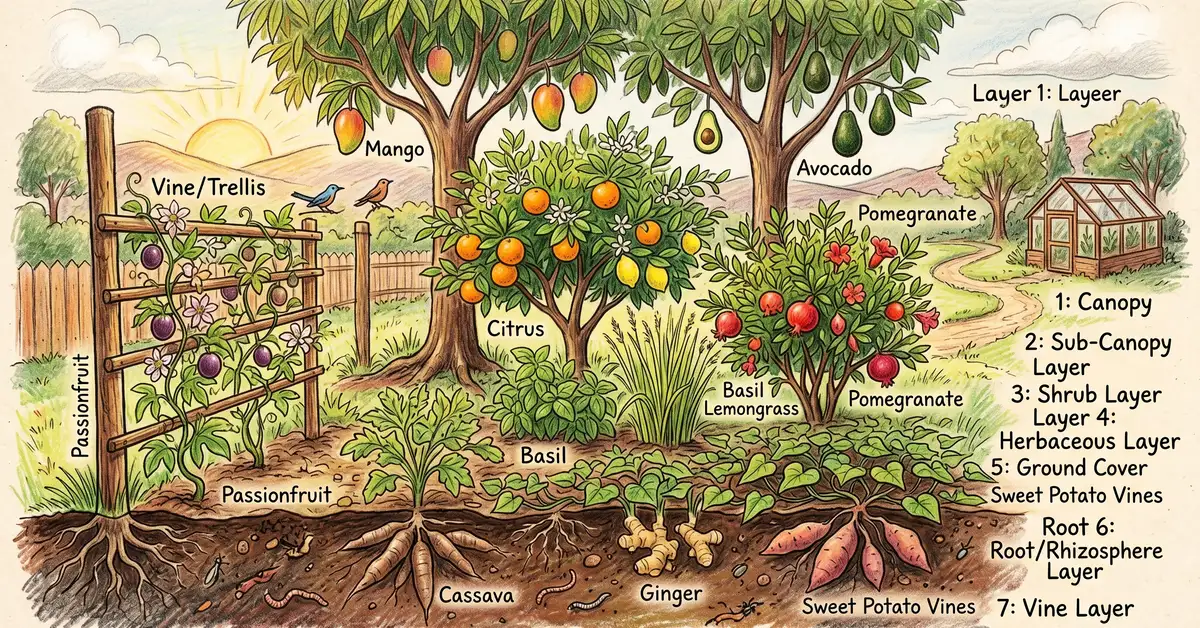
| Layer | Height | Florida and Gulf Coast | California and Arizona |
| Canopy | 30 ft+ | Mango (9b), avocado, pecan, mulberry, persimmon, sugar cane | Mexican avocado, olive, pecan, jujube, date palm (9b) |
| Sub-canopy | 15-30 ft | Citrus (orange, grapefruit, lemon, lime), loquat, papaya, banana | Citrus, loquat, fig, pomegranate (tree form) |
| Shrub | 4-15 ft | Rabbiteye blueberry, elderberry, pineapple guava, jaboticaba | Pomegranate, fig, goji berry, prickly pear |
| Herbaceous | 1-4 ft | Basil, oregano, rosemary, lemongrass, society garlic, pineapple | Lavender, rosemary, sage, thyme, oregano, artichoke |
| Ground cover | Under 1 ft | Sweet potato vine, strawberry, perennial peanut, oxalis | Strawberry, creeping thyme, perennial peanut, ice plant (edible) |
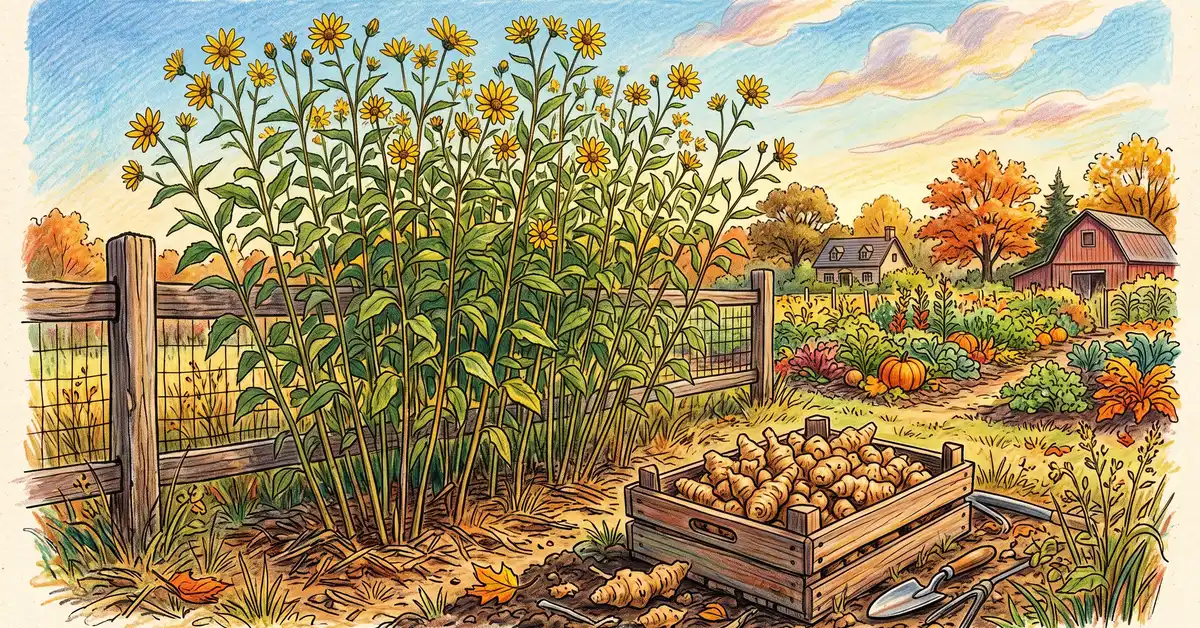
| Root | Underground | Cassava, ginger, turmeric, malanga, taro, sweet potato, sunchoke | Sweet potato, sunchoke, garlic, onion, daikon, yacon |
| Vine | Climbing | Passionfruit, chayote, Muscadine grape, dragon fruit, vanilla (9b) | Grape (table and wine), passionfruit, chayote, kiwi (Arctic in 9a) |
Source:.
The zone 9 canopy backbone
Avocado. The Mexican varieties (Stewart, Mexicola, Bacon, Topa Topa) survive 9a winters down to 18 F. The more popular Hass (Guatemalan-Mexican hybrid) needs 9b and protection during occasional cold snaps. Grafted trees produce in 3 to 4 years, seedlings take 7 to 15.
Mango. Tropical and frost-sensitive. Generally needs zone 10 (above 30 F). In warm pockets of zone 9b, cold-tolerant varieties like Manilita and Carrie can survive with frost protection. Pat Robinson's south Florida designs include mango as canopy.
Pecan. Native to the southern US, perfectly adapted to zone 9 from Houston to Phoenix. 50+ ft canopy, 80+ year productive life.
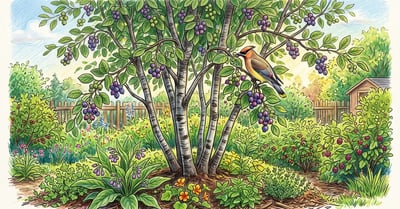
Mulberry. Black, white, and red mulberry all thrive in zone 9. Heavy bearing in 3 to 5 years. Drought tolerant once established.
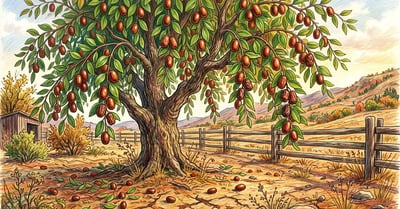
Persimmon. Both American (Diospyros virginiana) and Asian (D. kaki) persimmons grow in zone 9. Fuyu and Hachiya are common Asian cultivars.
Olive. Mediterranean canopy for California and Arizona food forests. 9b confidence, drought-adapted, 100+ year productive life.
Date palm. Arizona and Coachella Valley zone 9b specialty. Highly drought-tolerant, fruit ripens in dry desert summers.
Citrus and the HLB consideration
Citrus is the foundation of every zone 9 food forest. Sweet orange, grapefruit, lemon, lime, tangerine, kumquat, and calamondin all thrive in 9b and most of 9a. Meyer lemon is particularly cold-hardy down to 9a.
Region-by-region design
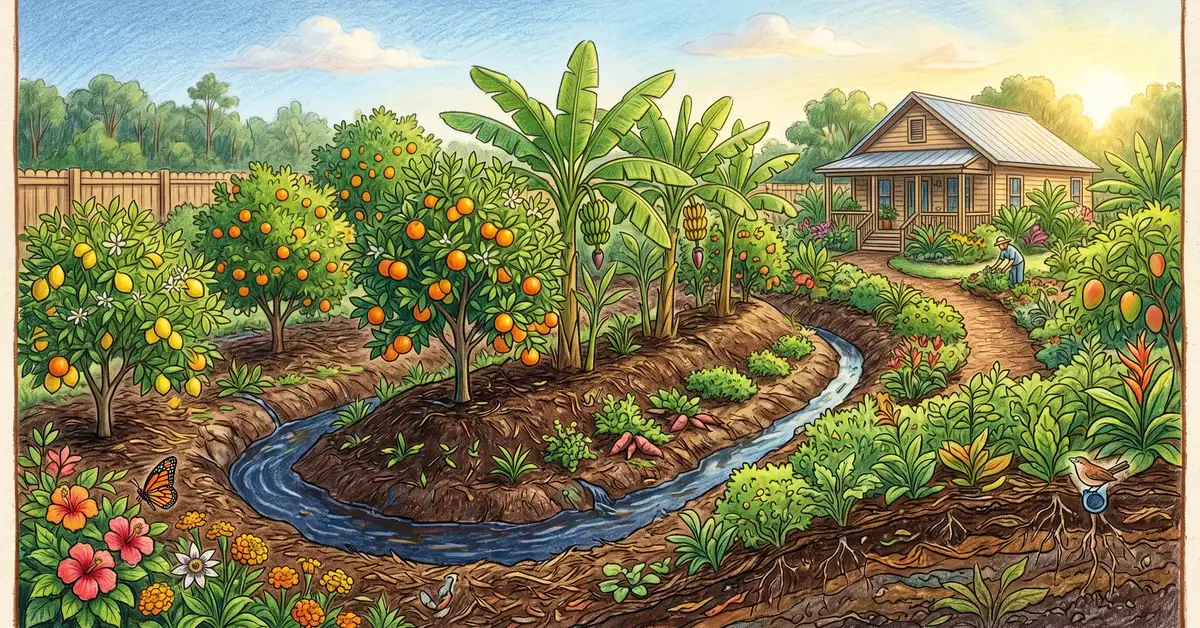
Florida and the Gulf Coast: water management is everything. Heavy summer rain (50 to 65 in) means swales and berms capture and slow runoff. Sandy soil dries out fast despite the rain because water moves through quickly. Plant canopy trees on the downhill side of berms so they catch infiltration. Citrus, banana, papaya, and pineapple all thrive. Hurricane prep means pruning canopy trees to reduce sail, choosing wind-resistant species, and accepting that occasional losses are part of the climate. Sandy soil benefits massively from 2 to 4 in compost annually.
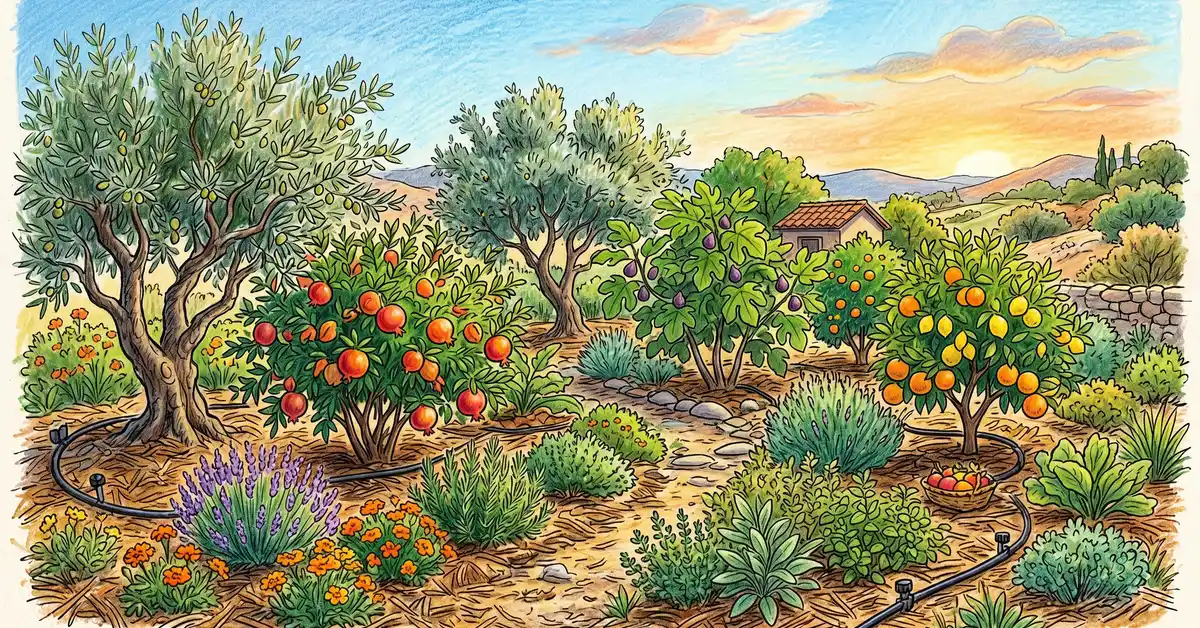
Coastal southern California: Mediterranean restraint. 10 to 15 in annual rainfall, dry summer, mild winter. Drip irrigation is essential through the dry season. Mulch 3 to 4 in deep to slow evaporation. Mediterranean species (olive, fig, pomegranate, citrus, herbs) are the natural choice. Avocado, especially Mexican varieties, anchors the canopy. Greywater systems and rainwater catchment from winter storms are critical infrastructure.
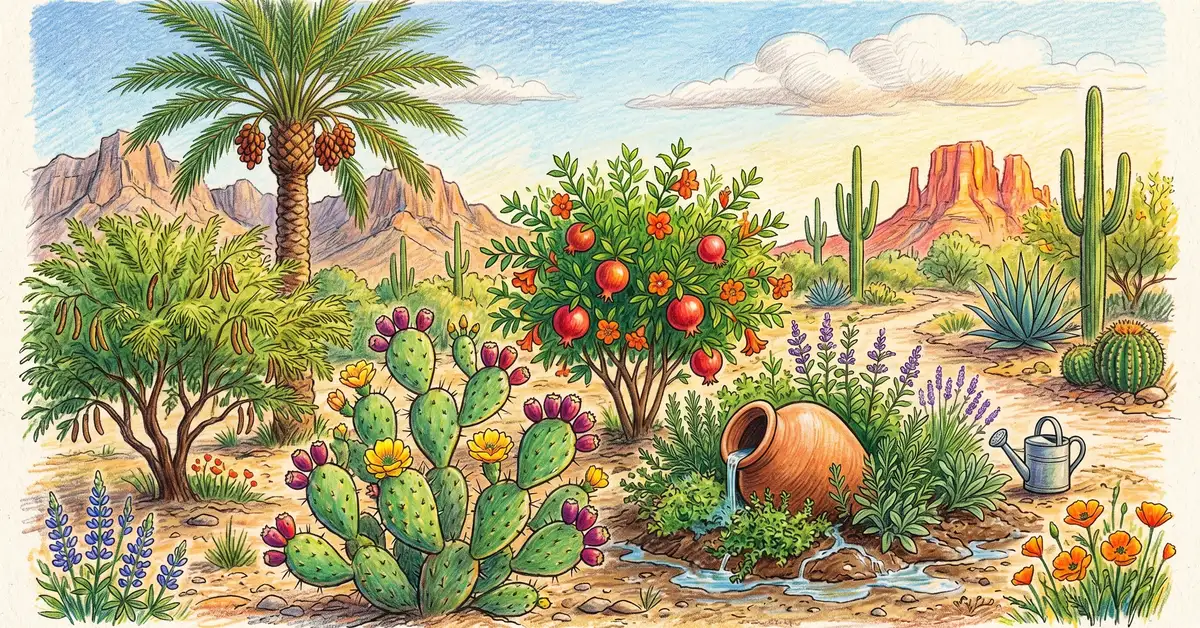
Arizona desert lowlands: heat and water adaptation. Extreme summer heat above 110 F, only 8 to 12 in annual rainfall. Desert-adapted species (date palm in 9b, pomegranate, fig, jujube, mesquite, prickly pear) carry the load. Buried clay ollas, deep drip irrigation, and shaded microclimates extend the species range. Plant canopy trees on the northeast side of buildings to shade understory through the afternoon. Mulch with 4 to 6 in of wood chip or gravel.
Southern Texas: hybrid design. Houston east is humid subtropical. San Antonio west becomes semi-arid. Citrus, pecan, mulberry, fig, and pomegranate work across both. Hurricane prep matters on the Gulf side; deep-rooted xeric species matter on the west.
Cold-snap protection in zone 9
Zone 9 looks subtropical until a polar vortex drops to the teens for 48 hours, which happens roughly every 5 to 15 years in most of zone 9. The February 2021 Texas freeze hit Houston at 13 F and killed many established citrus and avocado. Design for the occasional freeze by:
Choosing the right cultivars. Cold-hardy avocado varieties survive 9a; cold-hardy citrus (kumquat, calamondin, Meyer lemon, Satsuma mandarin) better than Eureka lemon or grapefruit.
Planting in microclimates. South-facing walls, downhill from cold-air drainage, near concrete that absorbs daytime heat.
Frost protection equipment. Frost cloth, Christmas-style incandescent bulbs (not LED) under the canopy, irrigation running through the freeze (water releases heat as it freezes).
Accepting losses. Bananas and papayas freeze to the ground at 28 F and regrow from the root. Mango and Hass avocado may die outright. Build redundancy.
Year-round harvest calendar in zone 9
One of zone 9's hidden advantages is harvest spread. With the right species mix, something is producing nearly every month of the year. A typical Florida or southern California zone 9 backyard harvest pattern:
January to March. Citrus peak (orange, grapefruit, mandarin, lemon), kumquat, kale, lettuce, peas.
April to June. Mulberry, loquat, late citrus, blueberry (rabbiteye), peach in cold pockets, early avocado.
July to September. Mango (9b), avocado, fig, passionfruit, papaya, peppers, basil, tomato continuing.
October to December. Persimmon, pomegranate, jujube, early citrus, sweet potato, winter herbs.
Water harvesting and swales
Florida and Gulf Coast zone 9 designers use swales (level contour ditches with downhill berms) to catch heavy summer rain and slow it into the soil. Trees planted on the berm root into the saturated zone and access water for weeks after the rain. Coastal California and Arizona designers use the same swale principle for the rare heavy storms, plus rainwater tanks for dry-season storage. The same logic underpins permaculture garden design at scale.
Get the Weekly Dig
One practical permaculture guide a week, written for gardeners who do this on weekends: food forest and guild designs that produce. Free, no spam, unsubscribe any time.
Join the newsletterFrequently asked questions
What fruit trees grow in zone 9?
The zone 9 fruit tree list is the longest of any US zone: citrus (orange, grapefruit, lemon, lime, tangerine, kumquat, calamondin), avocado (Mexican varieties hardy to 9a, Hass requires 9b), olive, pomegranate, fig, loquat, persimmon, mulberry, pecan, jujube, date palm (9b), papaya, banana, mango (9b warm pockets), pineapple guava, and rabbiteye blueberry. Choose species by your specific region within zone 9.
What is the best food forest design for Florida?
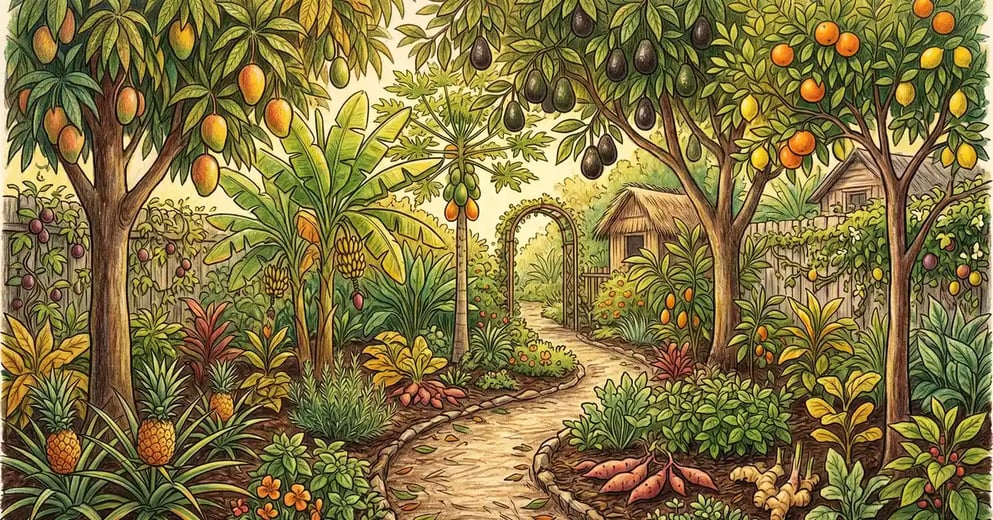
Florida food forests need swale-based water management, hurricane-tolerant tree selection, and a canopy that handles humidity. A typical Florida 1/4 acre design includes 2 to 3 mango or avocado as canopy, 4 to 6 citrus as sub-canopy, banana and papaya understory, rabbiteye blueberry shrub layer, pineapple and sweet potato ground cover, ginger and turmeric roots, and passionfruit on a trellis. UF IFAS Extension publishes design templates by Florida county.
Can you grow avocados in zone 9?
Yes. Mexican varieties (Stewart, Mexicola, Bacon, Topa Topa) survive 9a winters down to 18 F. Hass needs 9b and frost protection. Grafted trees produce in 3 to 4 years. Plant in spring after the last expected freeze, in well-drained soil, with mulch and consistent water through the first 2 years.
How long does a zone 9 food forest take to establish?
Year 1 plant ground cover, herbs, and nursery trees. Year 2 trees set roots. Year 3 first significant harvest from fast producers (papaya, banana, citrus). Year 5 system reaches roughly half maturity. Year 8 to 10 the canopy closes and the system is fully productive.
Is zone 9 the best zone for a food forest?
Zone 9 is the most productive temperate-to-subtropical zone for backyard food forests in the contiguous US because the long warm season supports subtropical fruits while still allowing temperate species like pecan and persimmon. Only zone 10 and 11 (south Florida and Hawaii) exceed zone 9 in species range, but those zones lose temperate species that need winter chill.
What is the difference between zone 9a and 9b?
Zone 9a has average annual minimum winter temperatures of 20 to 25 F. Zone 9b has 25 to 30 F. The 5 F difference matters for species selection. Hass avocado, mango cold-tolerant varieties, and date palm need 9b. Mexican avocado, Meyer lemon, kumquat, and cold-hardy citrus survive 9a.
How big a yard do you need for a zone 9 food forest?
A productive zone 9 backyard food forest fits in 1/8 to 1/2 acre. 1/8 acre (5,400 sq ft) supports 2 canopy trees, 4 sub-canopy, 8 to 12 shrubs, plus understory layers. 1/4 acre (10,800 sq ft) is the most common backyard scale. Larger sites scale up the canopy and add zones for grain, livestock, or commercial production.
What plants should I avoid in a zone 9 food forest?
Avoid curry leaf plant and orange jessamine near citrus (psyllid and HLB risk). Avoid black walnut due to juglone allelopathy. Avoid invasive species per state lists (Florida lists camphor tree, Brazilian pepper, Asian jasmine; California lists pampas grass and other escapees). Avoid mango in 9a (insufficient warmth) and Hass avocado in cold pockets of 9a.