
What Does "Northern Maritime" Actually Mean for a Garden?
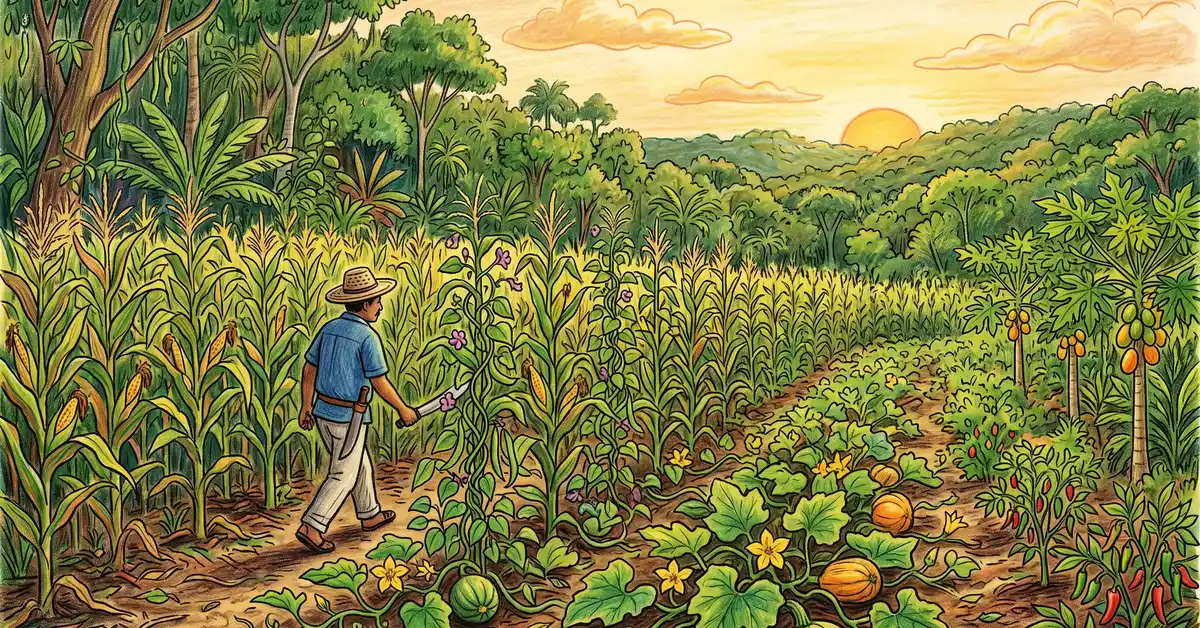
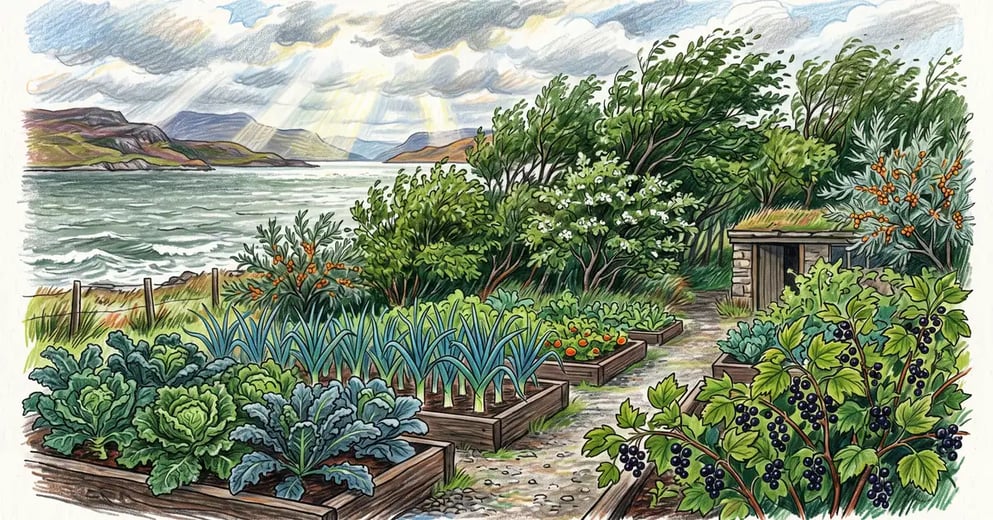
If your summers top out in the mid-60s Fahrenheit, the rain never really stops, and the wind flattens anything taller than your knee, you are gardening in a northern maritime climate. Scotland is the textbook case, and Scottish growers have spent four centuries working out what to do about it. the southern hemisphere version of the same problem
The numbers are blunt. At Leuchars on the east coast, the Met Office 1991 to 2020 averages put the mean July daytime high at 65.3°F (18.5°C), with June at 62.3°F. July nights average 50.3°F (10.2°C). That is the warmest month, on the drier coast. Tomatoes outdoors are a gamble. Kale is not.
This matters well beyond Scotland. If you garden on the Oregon or Washington coast, in Downeast Maine, or in southeast Alaska, you face the same problem: enough winter mildness to keep perennials alive, not enough summer heat to ripen much, and weather that arrives sideways. The RHS hardiness ratings map an H5 plant to roughly USDA zone 7b/8a and H6 to 6b/7a, the band most of lowland Scotland sits in.
What this guide covers:
- The three constraints of a cool maritime site, in numbers
- How to build a shelterbelt that cuts wind 30 to 47 percent
- What to do with ground that stays saturated from October to April
- How walled gardens buy an extra hardiness zone from stone alone
- The crops that produce when summer never arrives
Key Takeaway
Scottish permaculture is not about pushing warm-season crops through a cold summer. It is three design moves that change the site itself: shelter, drainage and thermal mass. Get those right and the plant list takes care of itself.
What Are the Three Constraints of a Cool Maritime Site?
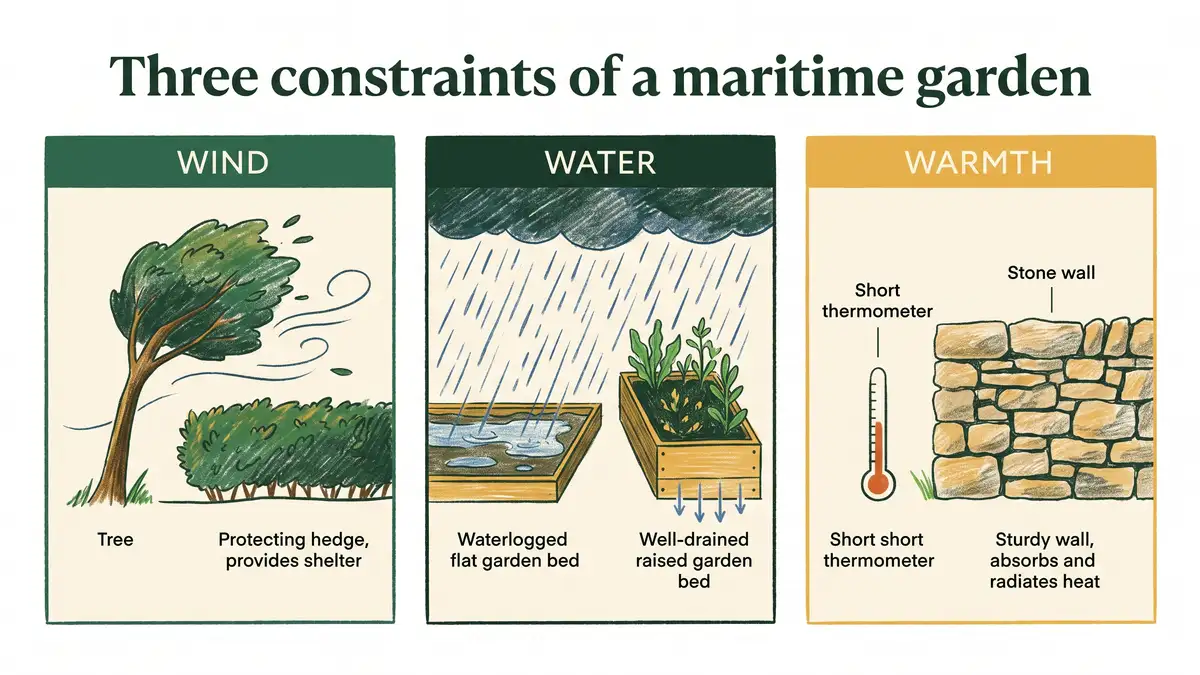
Cool, wet and windy, in that order. Each has a number attached and a design answer.
Heat is the binding constraint. The Met Office defines a growing degree day against a base of 41.9°F (5.5°C) in its projections dataset, so a day averaging 50°F contributes about 8 degree days and one averaging 39°F contributes nothing. In Scotland a huge number of days sit within a few degrees of that line, which is why two weeks of spring soil warming changes the whole season.
Water is second. Leuchars records 25.8 inches (654 mm) of rain across 116 rain days. The total is unremarkable. The distribution is the problem: roughly 2 inches every summer month, over and over, on soils that cannot shed it.
| Measure | Leuchars, east Scotland | What it means for growing |
| July mean high | 65.3°F (18.5°C) | Cool-season crops thrive, heat-lovers need cover |
| July mean low | 50.3°F (10.2°C) | Slow night growth, low heat-driven disease |
| Annual rainfall | 25.8 in (654 mm) | Moderate total spread over 116 days |
| Annual sunshine | 1,483 hours (4.1 hrs/day) | Long days, frequent cloud, slow ripening |
| Frost-free season | ~130 days lowland, ~100 upland | Comparable to a USDA zone 5 season length |
| UK mean wind speed | 9.55 mph (4.27 m/s) | Chronic stress, high evaporative loss |
Sources: Met Office Leuchars long-term averages 1991-2020, Met Office UK and regional series
Wind is third and most underrated. The UK average was 9.55 mph (4.27 m/s) in 2023, and exposed Scottish coasts run well above that. Wind does not just snap stems. It strips moisture from leaves and soil faster than the plant can replace it, which is how a windy site shows drought stress in a wet climate.
How Do You Build Shelter That Actually Works?
The highest-return move on an exposed maritime site is a permeable shelterbelt, not a solid fence. Solid barriers create a short calm zone, then a band of damaging turbulence beyond it. A hedge that lets some air through slows the whole airstream instead.
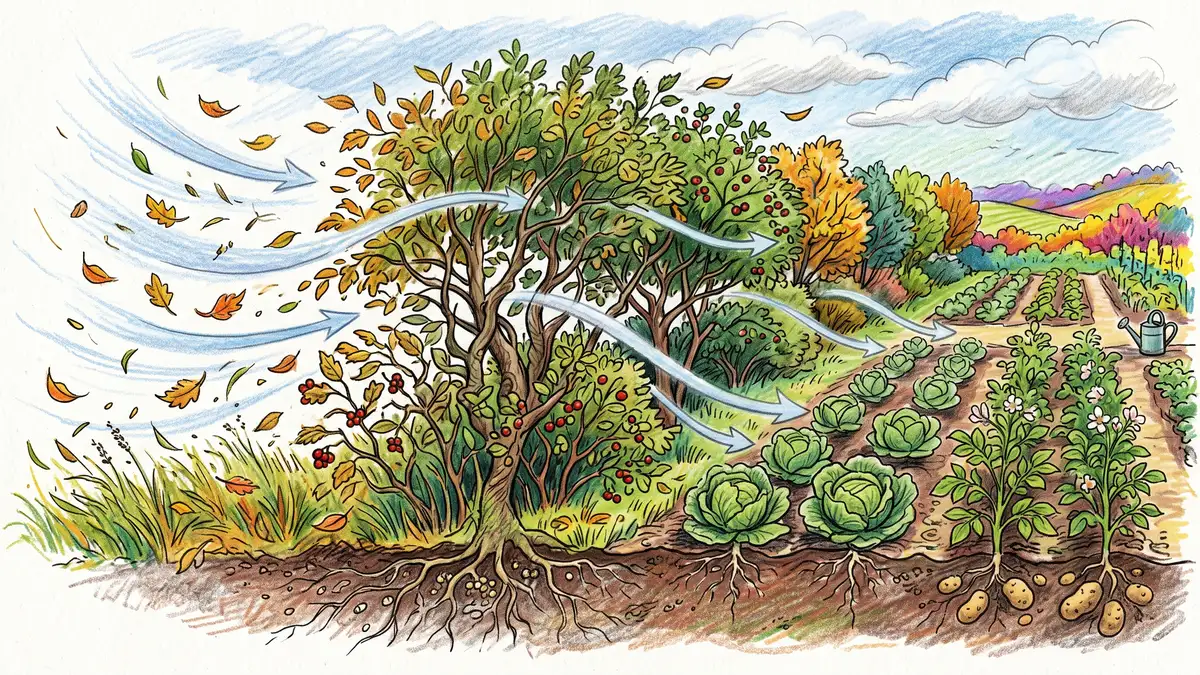
A 2024 study on windbreak structural optimisation found the best mixed tree and shrub configuration cut wind by 27.1 percent on average, peaking at 47.13 percent at seven times the barrier height and holding above 32 percent out to fifteen times the height. Single-species stands underperformed. In practice, a belt 10 feet (3 m) tall protects out to roughly 100 to 150 feet, with the calmest ground about 70 feet downwind. Put your beds there.
Find your worst wind, not your prevailing wind
Watch which direction damages plants, not which blows most often. On Scottish and US Atlantic coasts these differ.
Plant mixed rows, not a single-species line
Two or three staggered rows, a tall tree layer over a dense shrub layer. Alder, hawthorn and sea buckthorn handle Scottish exposure. In the Pacific Northwest, substitute shore pine, red alder and Nootka rose.
Aim for roughly half-open
You should see daylight through the belt in winter. If you cannot, thin it. A solid barrier moves the problem downwind, it does not solve it.
Give it three years before judging it
A shelterbelt is useless until it has height. Windbreak mesh on posts covers the gap for about $60 per 30-foot run.
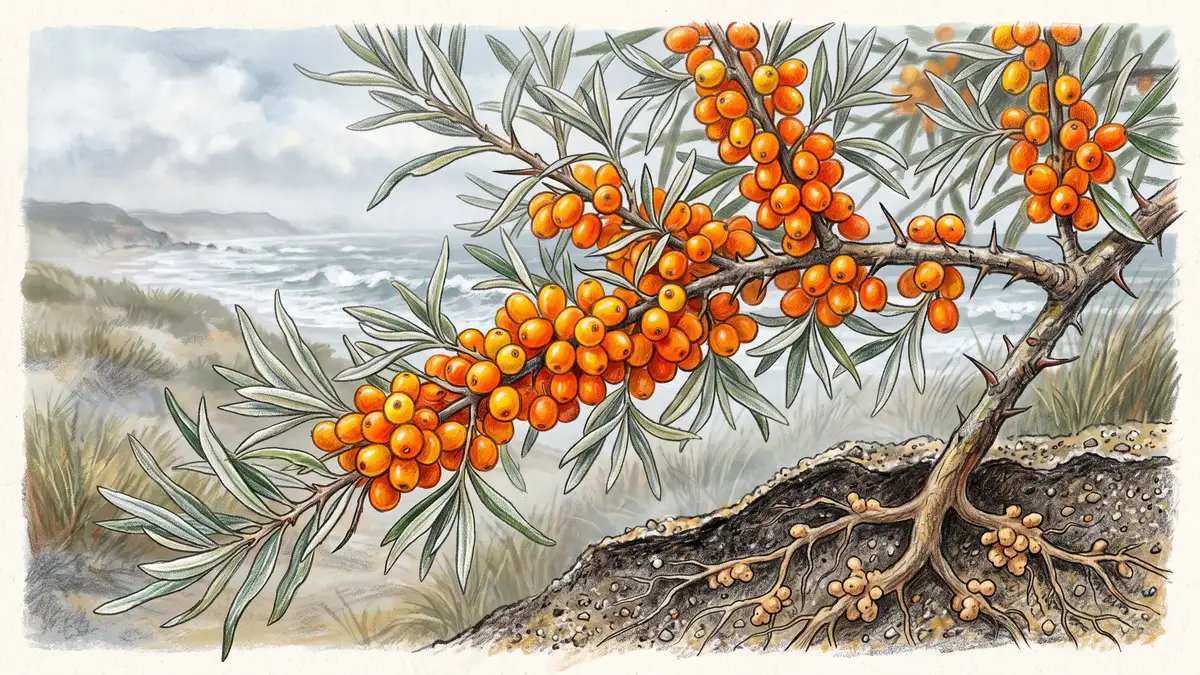
Sea buckthorn (Hippophae rhamnoides) earns its place twice over. It tolerates salt spray well enough for dune stabilisation on both sides of the Atlantic, and it forms nitrogen-fixing root associations that feed the soil around it. Alders do the same in wetter ground. Being honest: the peer-reviewed Scottish sources give no defensible nitrogen-per-acre figure, so treat the fertility benefit as real but unquantified.
Why This Works: Stacking Functions
A permeable shelterbelt does five jobs at once. It cuts wind speed, reduces evaporative loss, raises the sheltered zone's temperature, fixes nitrogen if you chose the right species, and houses the predators that eat your aphids. Mollison called this stacking functions. A fence panel does one job and rots.
What Do You Do About Ground That Never Dries Out?
You stop trying to drain it and start growing above it. Scotland's dominant soils are gleys, podzols and peats, mapped by the James Hutton Institute's national soil survey. Gleys hold a high water table and stay saturated for months. That grey-blue mottled subsoil is oxygen starvation made visible.
The cost is documented. A 2024 study on weather patterns and crop yield variability found excessive rainfall cuts yields through waterlogging: roots lose oxygen, microbial communities shift, nitrogen is lost to denitrification. Carrots, parsnips and potatoes suffer worst.
Common Mistake to Avoid
Digging drainage trenches through gley soil on flat ground usually fails, because the water has nowhere to go. Unless you have a genuine fall of several feet to daylight, the trench fills and stays full. Raising the growing surface is cheaper and more reliable than lowering the water table.
Practical answers, in rough order of cost. Build raised beds at 10 to 12 inches (25 to 30 cm) rather than the usual 6, since on saturated ground the height is the entire point. Use hugelkultur mounds where you have woody material. Plant into ridges rather than furrows, the way Highland lazy beds did for three centuries. And run a drainage test first, because plenty of ground that looks hopeless in February drains fine by May.
Where Does the Extra Warmth Come From?
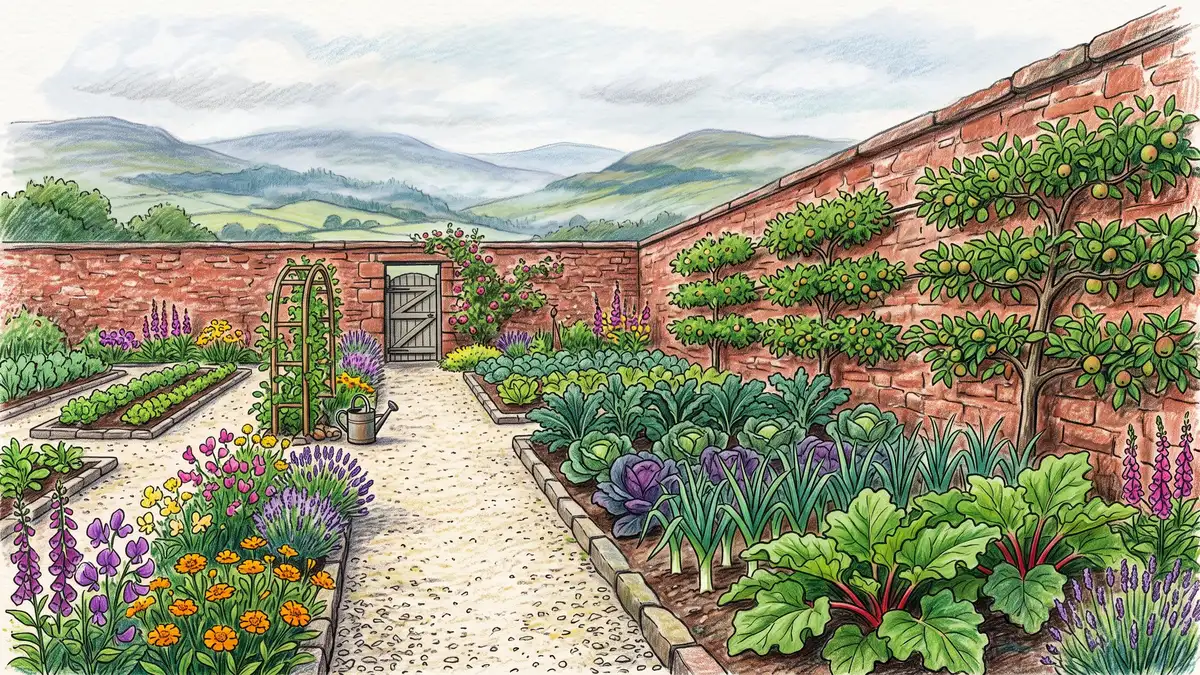
From stone, from orientation, and from cutting the wind. Scotland's walled gardens are the most complete answer anyone has built to a cool maritime climate, and the physics transfers to a suburban lot.
Masonry absorbs solar radiation by day and re-radiates it overnight, lifting the night-time minimum beside it and cutting radiative frost risk. Add wind removal and a south-facing wall behaves like somewhere further south. Scottish estates used this to ripen apples, pears and even peaches at latitudes north of Moscow.
You do not need Victorian brickwork. A dark-painted south wall, a run of water butts, or a stone path that holds heat each buy you something. Deliberately building microclimates is the most useful skill in a cool climate, and it costs almost nothing.
Why This Works: Edge Effect
The strip along a wall is an edge, and edges are where designed systems get productive. Two conditions meet: the wall's stored warmth and the garden's open light. Scottish head gardeners understood this two centuries before anyone wrote it down, which is why the tender fruit went on the wall and the cabbages went in the middle.
What Actually Crops Reliably in a Cool Maritime Garden?
Soft fruit, brassicas, roots and potatoes carry the system. That is not a consolation prize. Scotland grows soft fruit commercially at scale, which tells you more than any gardening blog can.
The Scottish Government's soft fruit survey for the 2021 season recorded 2,198 hectares (5,431 acres) in production: strawberries 56 percent, blackcurrants 14 percent, raspberries 11 percent. That is roughly 761 acres of blackcurrants in a country where July averages 65°F. If it pays at that scale, it will work in your garden.
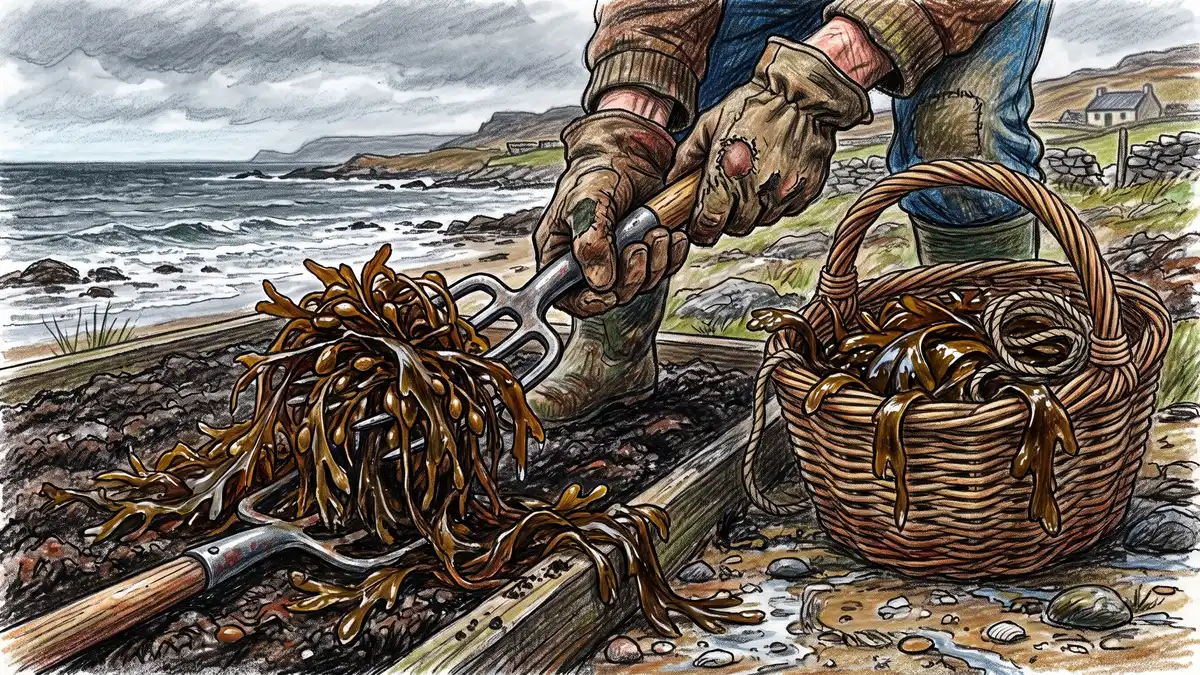
Coastal growers also have a free amendment. A 2024 analysis of seaweed composition measured protein from 4.97 percent in Ascophyllum nodosum (knotted wrack) to 25.78 percent in Palmaria palmata, plus high potassium and magnesium. Check local rules first, since collection is regulated in most US coastal states, and see what the evidence says about seaweed as a fertilizer.
| Crop group | Reliability | Design note |
| Blackcurrants, raspberries, gooseberries | Excellent | Grown commercially at scale in Scotland |
| Kale, cabbage, leeks, sprouts | Excellent | Overwinter outdoors in most lowland sites |
| Potatoes | Very good | Ridge or raise to avoid tuber rot in wet ground |
| Carrots, parsnips, beets | Good with drainage | Most sensitive group to waterlogging |
| Apples on hardy rootstock | Good in shelter | Choose scab-resistant, cool-ripening cultivars |
| Pears, plums | Marginal, wall-dependent | Early flowering, vulnerable to spring frost |
| Tomatoes, peppers, squash | Poor outdoors | Polytunnel or greenhouse only |
Sources: Scottish Government soft fruit survey 2022, RHS hardiness ratings
Key Takeaway
Read the climate rather than fighting it. A cool maritime garden producing 200 pounds of blackcurrants, kale and potatoes is a functioning food system. One producing six disappointing tomatoes is not. Same logic in Aberdeenshire or Astoria.
Frequently Asked Questions
What USDA zone is Scotland equivalent to?
Most of lowland Scotland sits around USDA zone 7 to 8 on winter minimums, which surprises people. The RHS system maps H5 to USDA 7b/8a and H6 to 6b/7a. The catch is that USDA zones only measure winter cold, and Scotland's real constraint is summer heat. A zone 8 site in coastal Georgia and one in Argyll share a winter minimum and nothing else. Use the USDA map for perennial survival, and frost-free day counts for cropping.
Can you actually grow fruit trees in Scotland?
Yes, with two conditions: shelter and cultivar choice. Apples on hardy rootstocks rated RHS H5 to H6 crop reliably in sheltered lowland sites, especially scab-resistant varieties bred for cool, damp summers. Pears and plums are harder because they flower early and Scottish spring frosts are unforgiving, which is why walled gardens trained them flat against south-facing stone. Choose late-flowering varieties and expect ripening two to three weeks later than the catalogue says.
What is the best windbreak for an exposed coastal garden?
A mixed, permeable planting rather than a solid fence. Research on windbreak structure found mixed tree and shrub plantings averaged 27 percent wind reduction with peaks near 47 percent, beating single-species stands. Combine a tall layer such as alder or shore pine with a dense shrub layer such as sea buckthorn, in two or three staggered rows, left half-open. Our guide to windbreaks and shelterbelts covers species and spacing.
How do I garden on soil that stays waterlogged all winter?
Grow above it rather than draining it. On gley and peat soils the water table is the problem, and trenching on flat ground rarely helps because the water has nowhere to run. Build beds 10 to 12 inches high, use hugelkultur mounds where you have logs, and plant into ridges instead of furrows. Add organic matter continuously: it improves infiltration even when the subsoil stays impermeable.
Does any of this apply if I do not live on a coast?
The shelter and drainage principles apply anywhere exposed or wet. What is specific to maritime sites is mild winters paired with cool summers, which shifts the crop list toward perennials, brassicas and soft fruit. Inland cool climates get colder winters but warmer, drier summers. Our guide to permaculture in cold climates covers the continental version, and the wider look at how different cultures grow puts both in context.
Get the Weekly Dig
One practical permaculture guide a week, written for gardeners who do this on weekends: permaculture design for real backyards. Free, no spam, unsubscribe any time.
Join the Weekly DigResources
- Met Office Leuchars Averages 1991-2020
- Met Office Growing Degree Days Projections
- RHS Hardiness Ratings
- USDA Plant Hardiness Zone Map
- Structural Optimization of Windbreak Forests, 2024
- Trees Against the Wind, OSU Extension PNW 5
- James Hutton Institute Scottish Soils
- Pesticide Usage in Scotland: Soft Fruit Crops 2022
- Seaweed Nutritional Value, 2024
- Weather Patterns and Crop Yield Variability, 2024