
If you garden in Saskatoon, Stockholm, Vermont, or anywhere the soil freezes solid for four months a year, most of the permaculture literature feels written for someone else. Bill Mollison's foundational books were grounded in subtropical Tasmania. Toby Hemenway's Gaia's Garden assumed a temperate Oregon climate. Yet some of the most innovative regenerative practitioners in the world are working in zones 2, 3, and 4, where winter temperatures hit minus 40 and the frost-free window can be as short as 100 days. Their methods are different, but the principles are the same. a nitrogen-fixing berry for cold gardens growing haskap in cold gardens northern maritime design Maori soil engineering using the cold as an input how hardy perennial kale really is
This guide draws together what Scandinavian and Canadian practitioners have learned about applying permaculture to cold climates: the plants that thrive, the microclimates you can engineer, the season-extension tools that buy you another two months, and the Indigenous practices that quietly solved most of these problems centuries ago.
What Makes Cold-Climate Permaculture Different
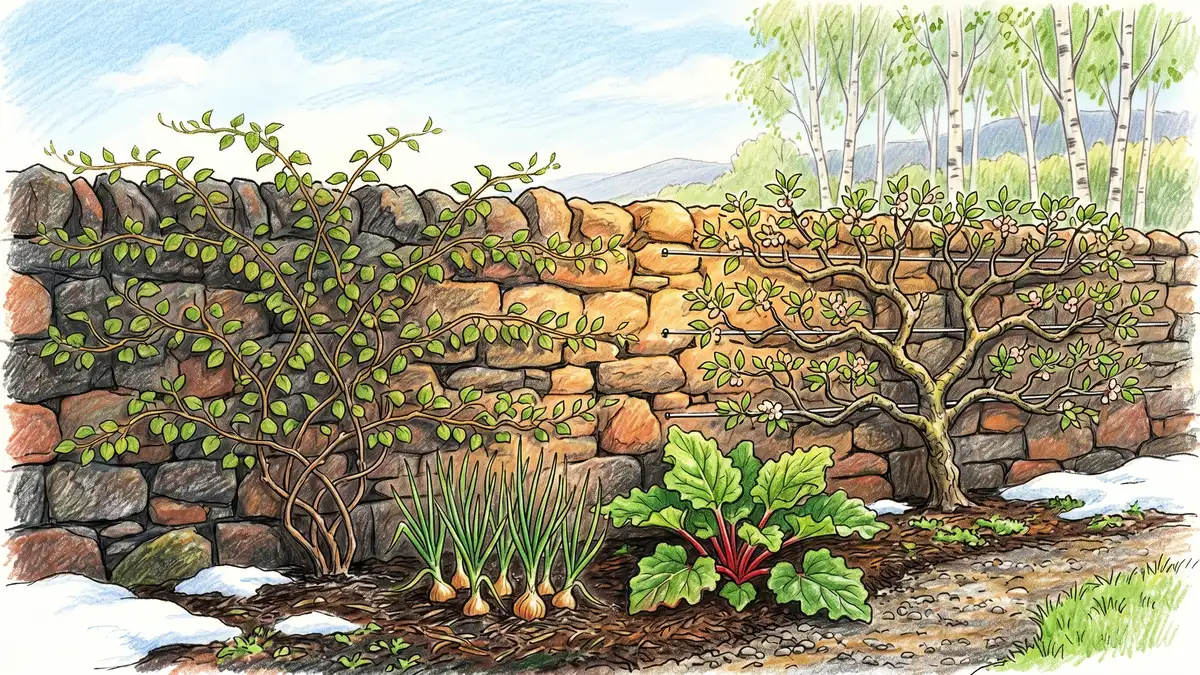
The two limiting factors are heat and time. Growing degree days (GDD), the running total of daily warmth above 10 °C, decide whether a tomato or melon will actually ripen before autumn frost. The USDA Plant Hardiness Zone Map and Canada's Plant Hardiness Zones tell you which perennials will survive the deep cold; together they bracket what is biologically possible on your land.
Canadian frost-free windows show the spread inside a single country: Toronto has roughly 180 frost-free days, Winnipeg about 120, Calgary about 116, and northern prairie sites considerably fewer (Canadian Gardening frost dates). Natural Resources Canada's 2024 hardiness update shows zones shifting north, with Yellowknife jumping from 0b to 1b in a single update.
Cold-climate permaculture answers this with two strategies running in parallel: engineer warmer microclimates where you can, and choose plants and patterns that don't need warming for everything else.
Key Takeaway
Don't try to grow a Mediterranean garden in Manitoba. Cold-climate permaculture works when you accept the zone, then stack every available technique on top of it: hardy species, thermal mass, windbreaks, hugelkultur, cold frames, and snow as insulation. Every degree of microclimate is borrowed time.
The Practitioners Who Wrote the Playbook
Five names cover almost everything worth knowing about cold-climate permaculture today. Each operates in a different hard winter, and each has documented their methods well enough that you can follow along.
| Practitioner | Site and Location | What They're Known For |
| Sepp Holzer | Krameterhof, Austrian Alps, 1,100 to 1,500 m | High-altitude hugelkultur, terraces, dozens of ponds, microclimate engineering on steep mountain ground |
| Richard Perkins | Ridgedale, Sweden, 59 °N | Whole-farm design, keyline plowing, pastured broilers and grassfed beef, no-dig market gardening in a short Swedish season |
| Ben Falk | Whole Systems Design, Vermont | Cool-temperate land design, perennial polyculture, 20+ years of New England winter testing |
| Rob & Michelle Avis | Verge Permaculture, Calgary, AB (zone 3b-4a, winter lows near −30 °C) | Urban prairie permaculture, engineering-led design, commercial viability proof on the Canadian Plains |
| Eliot Coleman | Four Season Farm, Harborside, Maine (zone 5-6) | Year-round market gardening with cold frames and low tunnels, the +1.5 zone rule |
Sources:.
Plants That Actually Like the Cold
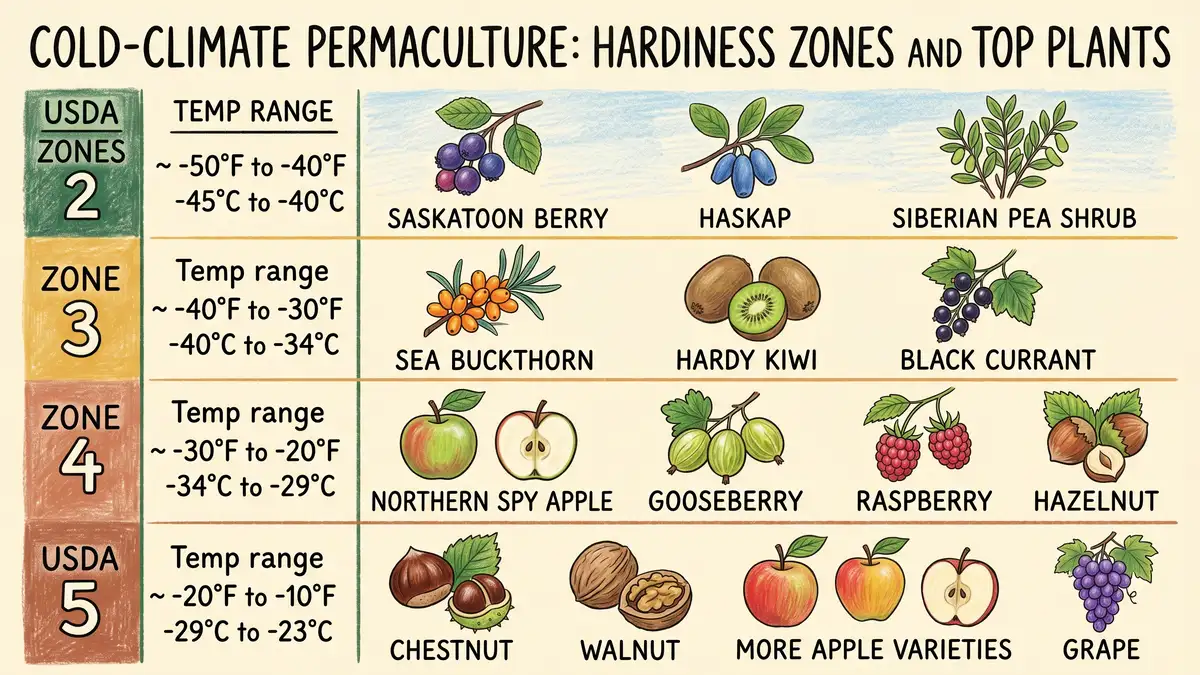
The shortlist below is biased toward plants that pull two or three duties at once: nitrogen fixers that also produce food, windbreaks that also feed birds, perennials that also accumulate minerals. Function-stacking matters everywhere, and it matters more in places where the growing window is short.
| Zone | Min Temp | Recommended Species |
| Zone 2 | −46 to −40 °C | Saskatoon berry (Amelanchier alnifolia); haskap / honeyberry (Lonicera caerulea); Siberian peashrub (Caragana arborescens, N-fixer) |
| Zone 3 | −40 to −34 °C | Sea buckthorn (Hippophae rhamnoides, N-fixer, high vitamin C); black currant; gooseberry; cold-hardy raspberry; hardy kiwi with frost-pocket care |
| Zone 4 | −34 to −29 °C | Northern Spy apple; Arctic kiwi (Actinidia kolomikta); hardy hazelnut; cold-hardy plum, sour cherry, pear; witch hazel; cold-hardy blueberries |
| Zone 5 | −29 to −23 °C | Wider apple, pear, and stone-fruit selection; cold-hardy grape; full perennial vegetable palette (asparagus, rhubarb, sea kale) |
Sources:.
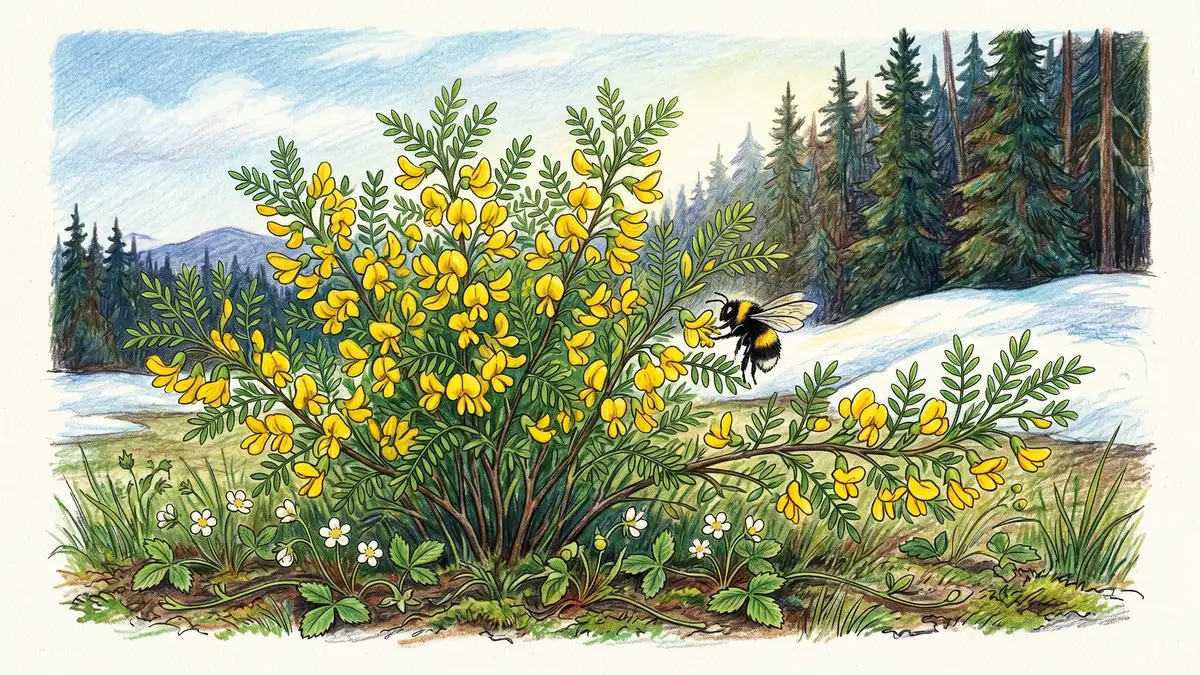
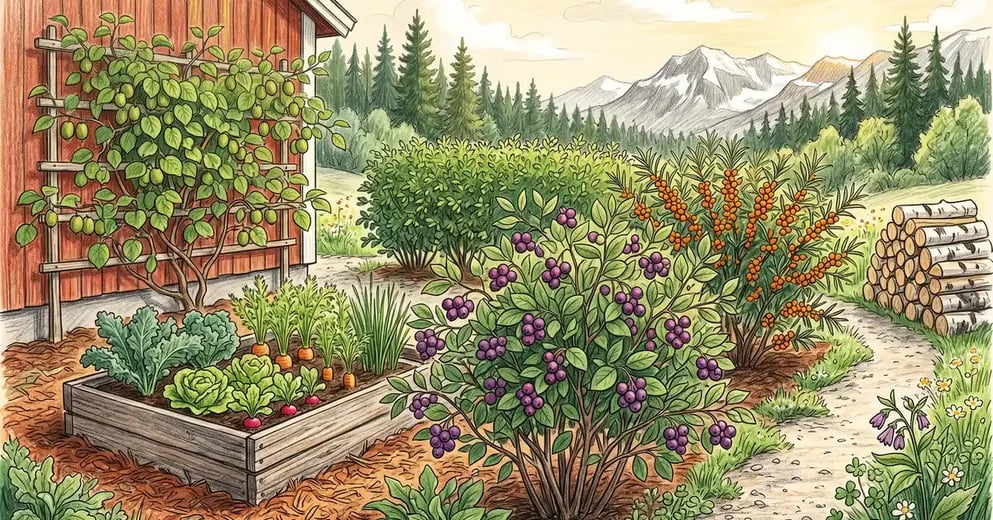
Siberian peashrub (Caragana arborescens) is the keystone nitrogen-fixer of the cold permaculture playbook. Hardy to zone 2, recommended by USDA for agroforestry windbreaks, it produces yellow flowers in spring (excellent for native bees and bumblebees), edible legumes that domestic poultry will eat eagerly, and a dense thorny structure that doubles as a wildlife corridor and snow-trapping hedge. Sea buckthorn (Hippophae rhamnoides) does similar work in zone 3 and produces berries with exceptional vitamin C content (Winrock International data).
Why This Works: The Guild Principle, Cold Edition
A cold-climate guild leans even harder on stacking functions than a warm one, because every species has to earn its place against a brutal winter. Siberian peashrub fixes nitrogen, feeds bees, blocks wind, and produces forage. Sea buckthorn fixes nitrogen, produces fruit, holds soil, and feeds wildlife. Saskatoon berry feeds you, pollinators, birds, and ties into First Nations food traditions. None of these plants is one-trick. That density is what makes a 100-day season productive.
Engineering Warmer Microclimates
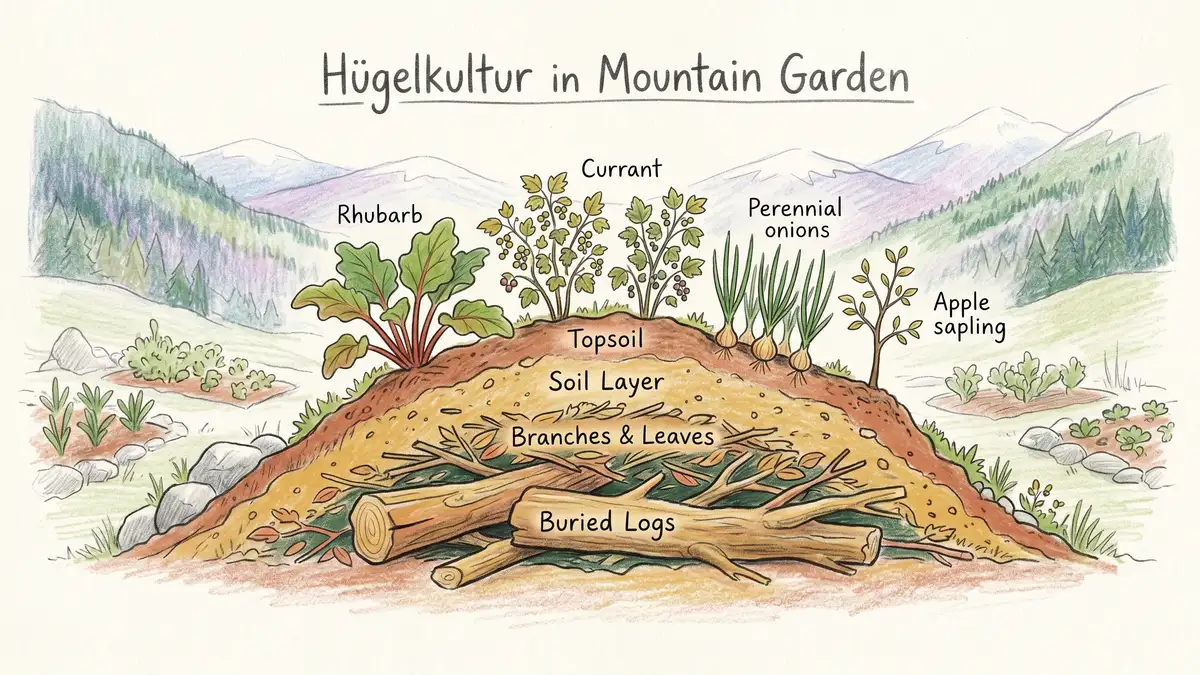
Sepp Holzer's Krameterhof runs at 1,100 to 1,500 m elevation in the Austrian Alps, on terrain that conventional Alpine farmers had abandoned. His tools were terraces, ponds (dozens of them, reflecting sun back onto crops), and hugelkultur mounds: long wood-cored beds that compost from the inside out, holding moisture and generating slow heat for years. A well-built mound also gives you two microclimates in one bed: a cooler north slope for greens, a warmer drier south slope for Mediterranean herbs.
Thermal mass is the next lever. A south-facing stone or brick wall absorbs daytime sun and releases it overnight, lifting microclimate temperatures by several degrees and ripening fruit a week or two earlier. Espaliered apples, hardy kiwi vines, and trained pear trees against such a wall outperform the same species in open ground. Ponds amplify the effect by reflecting sun and stabilising temperature near their surface.
And snow is your friend. North Dakota State Extension documents that snow cover traps soil heat, holds moisture, and limits frost penetration depth. Design your windbreaks so they drift snow onto priority perennial beds rather than scour them bare.
Season Extension: How to Steal Another Two Months
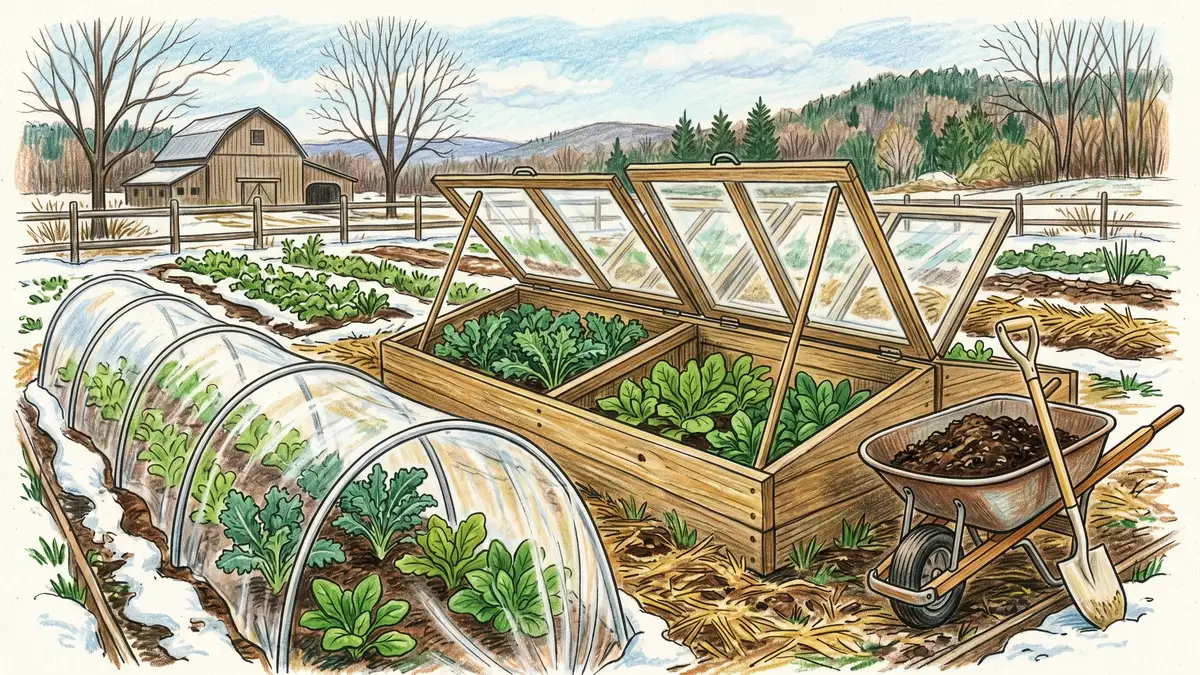
Eliot Coleman's research at Four Season Farm in Maine produced one of the most useful rules of thumb in cold gardening: a cold frame creates a microclimate equivalent to 1.5 hardiness zones, or roughly 500 miles of southward displacement. That is enough to harvest lettuce, kale, spinach, and mâche through a zone 5-6 winter.
Stack the tools. A cold frame inside an unheated greenhouse moves the calendar another zone. A low tunnel over a hugelkultur mound buys you weeks. Walipinis, partially buried greenhouses that exploit the earth's near-constant subsoil temperature, work in subarctic zones with zero supplemental heat (Charley's Greenhouses guide).
Common Mistake to Avoid
Do not site hardy kiwi (Actinidia kolomikta) in a frost pocket. The plant tolerates winter cold down to −34 °C when fully dormant, but its early-spring leaf-out is fragile. A late frost in a low-lying cold pocket will kill the new growth and cost you the year's vine production. Pick a south-facing slope with cold-air drainage instead (Gardenia plant data).
Indigenous Knowledge Was Already Solving This
Building on traditions explored in our look at permaculture around the world, the Sami of northern Scandinavia developed a millennia-old cold pastoral system around reindeer, fermented and smoked meats (suovas, gurpi), mountain fish, and wild berries (documented in Remitly's overview of Sami cuisine). On the other side of the Atlantic, First Nations communities in the Pacific Northwest deliberately planted "forest gardens" of fruit trees and berry bushes inside hemlock and cedar forests, and recent Science magazine reporting shows those gardens remained productive for more than a century after abandonment.
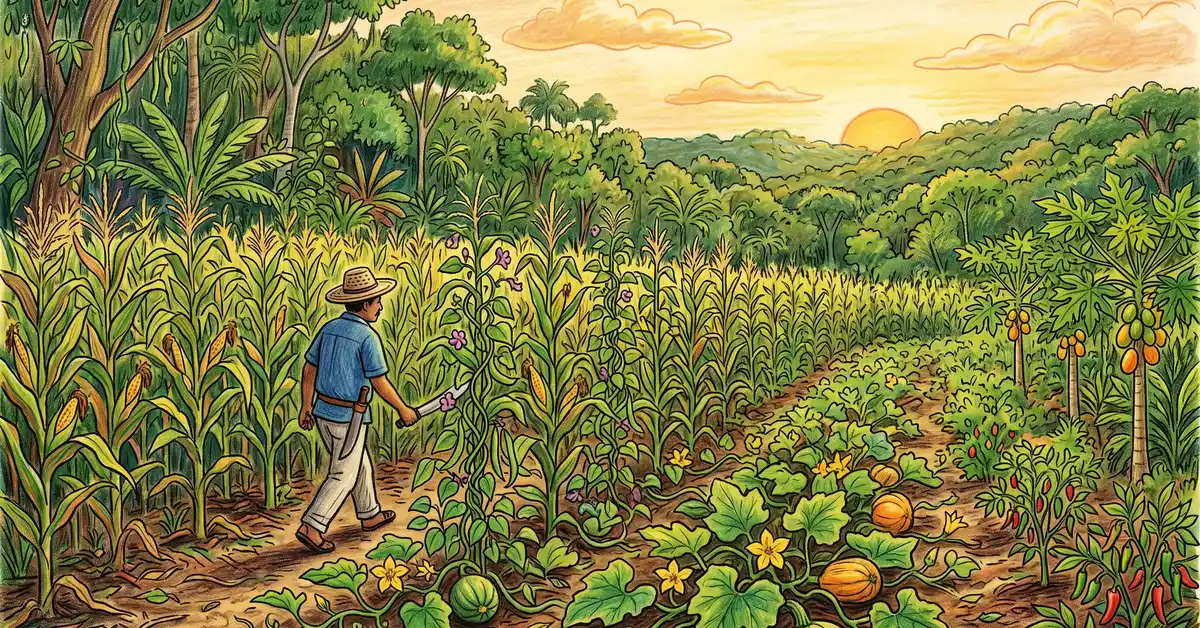
The Three Sisters polyculture of corn, beans, and squash, a foundational Indigenous practice across what is now Canada and the northern US, packs a remarkable amount of design wisdom into three plants: the corn supports the bean vines, the beans fix nitrogen for the corn and squash, the squash shades the soil and suppresses weeds. Short-season Indigenous varieties of all three exist for cold zones (Indigenous Climate Hub).
Scandinavian root cellars solve the storage half of the equation. Earth-banked stone or timber structures, sometimes built into a hillside, hold potatoes, carrots, beets, cabbage, and apples for 8 to 10 months without mechanical refrigeration (Hobby Farms profile). If you grow more than you can eat fresh, the root cellar is what makes the surplus matter.
A Five-Step Cold-Climate Design Pass
Map your real microclimate, not the regional zone
A south-facing slope sheltered from prevailing wind can run a full zone warmer than the rest of your land. A frost pocket at the bottom of the same property can run a zone colder. Stake out where snow drifts, where frost forms first in autumn, and where the last patches of snow linger in spring. Plant accordingly.
Build windbreaks before anything else
In prairie or boreal zones with regular 30 km/h winds, no windbreak means constant desiccation and frost damage. Layer a multi-row shelterbelt: tall conifers on the outside, mid-height Siberian peashrub or sea buckthorn next, fruit shrubs on the inside. The effective zone shift behind a mature shelterbelt is often equivalent to moving 100 km south.
Choose hardy, multi-function species
Use the zone table above. Lead with Saskatoon, sea buckthorn, haskap, Siberian peashrub, and a cold-hardy apple cultivar. Add black currant, gooseberry, raspberry, rhubarb, and asparagus. These give you food, nitrogen, wildlife habitat, and structure with zero winter loss.
Stack season-extension tools
Cold frame for late-fall and early-spring greens (the +1.5 zone trick), low tunnels for shoulder-season harvests, an unheated greenhouse for tomatoes and peppers, and a walipini or root cellar for storage. Each tool buys you weeks. Together they can double your productive season.
Plan for snow and cold composting
Build hugelkultur mounds in fall so they begin breaking down under snow. Set up a bokashi system indoors for winter food scraps. Plant winter cover crops (clover, vetch, winter rye) where the season allows; let them die back under snow and feed soil microbes the following spring.
Why This Works: Catch and Store Energy
The second of Holmgren's twelve principles, "catch and store energy", is the entire game in cold permaculture. Stone walls store heat. Hugelkultur stores moisture and slow compost heat. Root cellars store summer harvests. Bokashi stores winter scraps until spring. Snow stores soil warmth. Every element in a cold-climate design is doing some form of energy storage, because the cold winter is the energy gap that the storage spans.
Frequently Asked Questions
Can you really do permaculture in a cold climate?
Yes. Practitioners like, and Eliot Coleman in Maine all run productive permaculture operations in zones 3 to 6. The principles do not change; the plant lists and microclimate tools do.
What is the coldest USDA hardiness zone permaculture works in?
Zone 2 (down to −46 °C) supports a real perennial guild: Saskatoon berry, haskap, Siberian peashrub, and selected gooseberry, currant, and raspberry cultivars. Zone 1 is functionally limited to annual gardens, hardy berries, and very short-season cold frame production.
What are the best fruit trees and shrubs for zone 3?
Saskatoon berry (Amelanchier alnifolia) and haskap (Lonicera caerulea) are the most reliable. Add sea buckthorn for nitrogen fixation and vitamin-C-rich berries, black currants and gooseberries for heavy yields, and one or two cold-hardy apple cultivars such as Norkent or Honeycrisp on hardy rootstock.
How does a cold frame extend the growing season?
Eliot Coleman's measurements at Four Season Farm in Maine show that a well-built cold frame creates a microclimate equivalent to 1.5 USDA hardiness zones, or roughly 500 miles of southward displacement. That is enough to harvest lettuce, kale, spinach, and mâche through most of a zone 5-6 winter.
What is hugelkultur and does it actually help in cold climates?
Hugelkultur is a Sepp Holzer technique: long mounds with a buried core of logs and branches that slowly compost from the inside out. The decomposition generates gentle warmth, the mounds hold moisture, and their height lifts crops above frost-pocket cold air. They also give you two microclimates in one bed, a cooler shaded north slope and a warmer drier south slope.
How do you compost in winter?
Bokashi (a Japanese anaerobic fermentation system in a sealed indoor bucket) works year-round, including during deep freezes when outdoor piles stall. The same principles apply to cold-climate composting more broadly. Alternatively, build a large enough hot-compost pile in autumn that core temperature stays above freezing under snow. Winter food scraps go indoors to the bokashi bucket; finished bokashi pre-compost buries into the garden the following spring.
What Indigenous practices apply to cold-climate permaculture?
The Three Sisters polyculture (corn, beans, squash) has short-season Indigenous varieties suited to cold zones. First Nations forest gardens in the Pacific Northwest demonstrate cold-temperate forest garden design that remained productive a century after abandonment. Sami pastoral traditions show a complete cold-climate food system built around reindeer, fish, fermentation, and wild berries.
Get the Weekly Dig
One practical permaculture guide a week, written for gardeners who do this on weekends: permaculture design for real backyards. Free, no spam, unsubscribe any time.
Join the Weekly DigResources
- USDA Plant Hardiness Zone Map
- Natural Resources Canada, Plant Hardiness Zones 2024 Update
- European Environment Agency, Growing Degree Days
- Sepp Holzer, Krameterhof, Austrian Alps
- Richard Perkins, Ridgedale Permaculture, Sweden
- Ben Falk, Whole Systems Design, Vermont
- Eliot Coleman, Four Season Farm, Maine
- USDA Plants Database, Siberian Peashrub (PDF)
- Winrock International, Sea Buckthorn
- Native Foods Nursery, Saskatoon Serviceberry
- Gardenia, Arctic Kiwi (Actinidia kolomikta)
- Stark Bro's, Northern Spy Apple
- NDSU Extension, Winter Insulation
- Charley's Greenhouses, Walipini Underground Greenhouses
- Science.org, Pacific Northwest Indigenous Forest Gardens
- Indigenous Climate Hub, Three Sisters Polyculture
- Hobby Farms, Scandinavian Root Cellars
- Holma folkhögskola, Permaculture Teachers Training (Sweden)
- University of Saskatchewan, Chickpea Cold Research (2025)