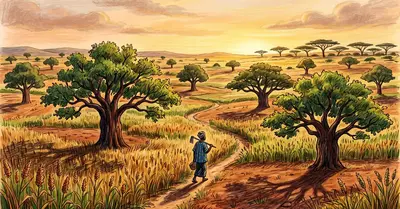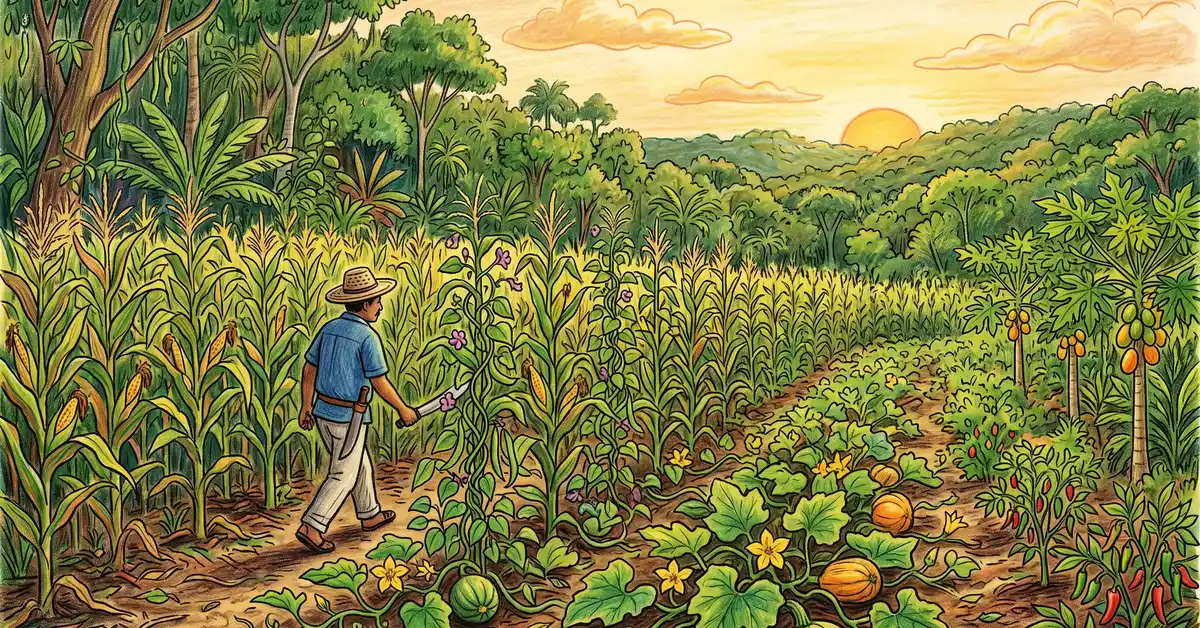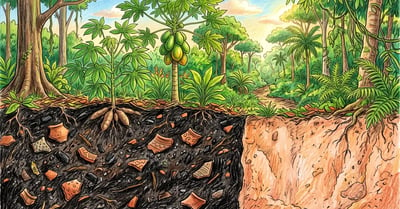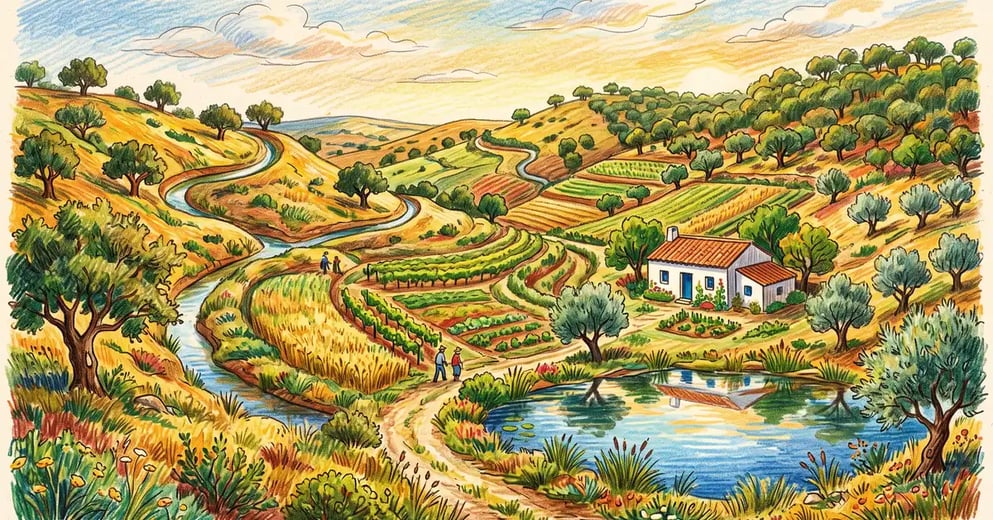

Drive through the Alentejo in southern Portugal in August and you see two futures side by side. On one hill, bare cracked earth and dead grass, the land quietly turning to dust. On the next, widely spaced oaks throw shade over golden pasture, a pond holds water through the drought, and pigs root for acorns in the cool. Same climate, same rainfall. The difference is design.
Portugal is one of Europe's clearest laboratories for regenerating dry land, because it has to be. More than half of mainland Portugal is now at risk of desertification. Yet the country also holds one of the oldest working models of drought-resilient farming on the continent, the montado, alongside bold modern experiments in rehydrating whole landscapes. For anyone gardening in a drying climate, from California to Australia, Portugal is worth studying, and it is one of the most instructive stops in any tour of permaculture around the world. Here is what its permaculture and traditional systems actually do, grounded in EU agency data and peer-reviewed research.
What you'll learn:
- Why the montado is a 1,000-year-old permaculture system hiding in plain sight
- How Tamera rebuilt its water cycle with lakes instead of dams and pipes
- The dryland techniques you can borrow: swales, ponds, oaks, mulch
- What Portugal's drylands teach gardeners in any Mediterranean climate
Key Takeaway
Portugal fights desertification with two complementary tools: the traditional montado, a tree-pasture savanna that keeps soil covered and stores carbon, and modern water retention landscapes that slow, spread, and sink winter rain so it lasts through summer. Both work by keeping water and life in the land instead of letting them run off. The techniques scale down to any dry garden.
Why Is Portugal's Dry Land in Trouble?
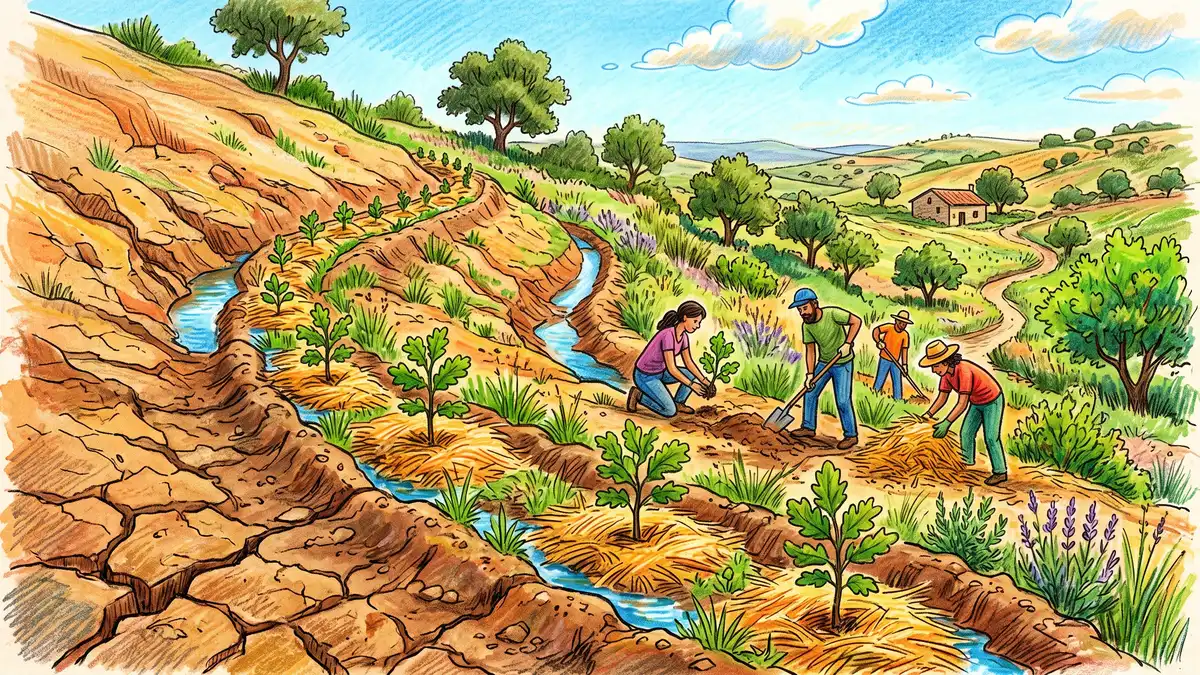
Because a Mediterranean climate stacks the deck, and modern land use made it worse. Most of mainland Portugal has cool, wet winters and hot, nearly rainless summers, with average temperatures around 57 to 61°F (14 to 16°C). That means the rain arrives when plants least need it and vanishes when they most do. Layer on rising drought frequency and you get land degradation at scale.
The numbers are stark. A 2026 assessment reports that more than 5.5 million hectares, over half of mainland Portugal, are at risk of desertification, with more than 30% of the territory classed as high or very high vulnerability. In the Baixo Alentejo, official data cited by Sul Informação put 94% of the region as susceptible and 38% as critically so. The 2018 European Court of Auditors report named Portugal among the EU countries most exposed. This is not a distant risk; it is happening now.
What Is the Montado, and Why Does It Work?
It is an agro-silvo-pastoral savanna that has quietly practiced permaculture for centuries. The montado (called dehesa in Spain) spreads cork oak (Quercus suber) and holm oak (Quercus rotundifolia) widely over grazed pasture and rotational crops. A landmark study by Pinto-Correia and colleagues describes about 800,000 hectares (roughly 2 million acres) of montado in Portugal, mostly in the Alentejo.
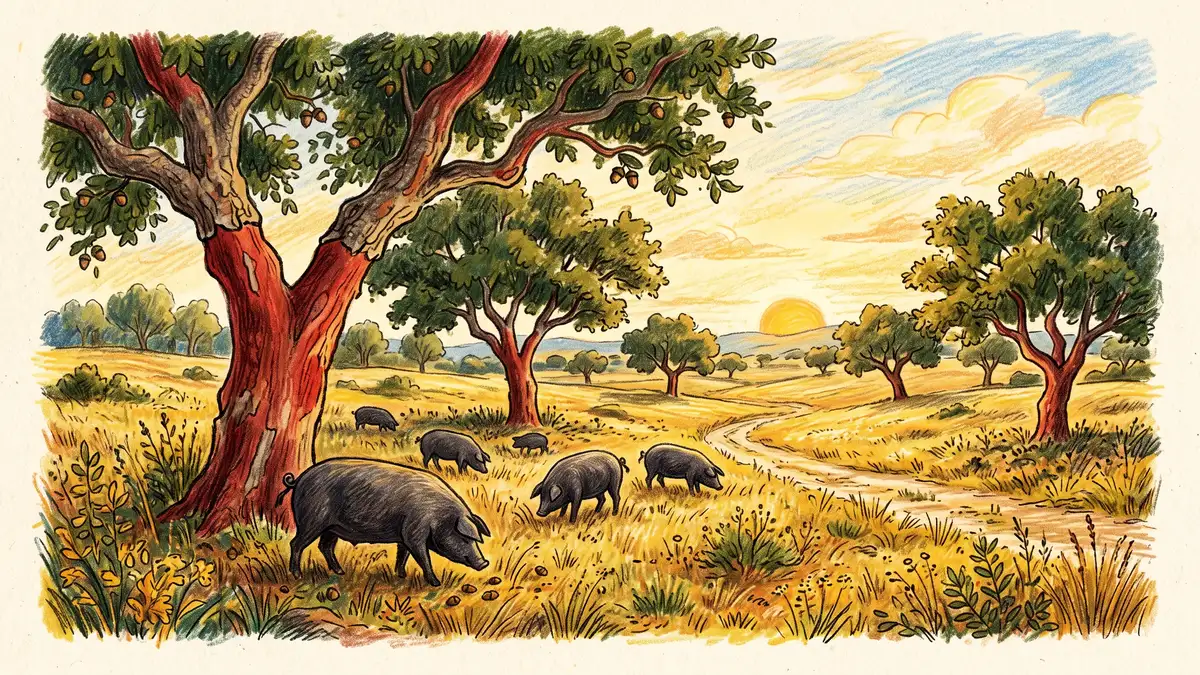
The genius is stacked yields from one system. The AGFORWARD agroforestry project records the 2010 forest inventory at 736,775 hectares of cork oak and 331,179 hectares of holm oak. Those oaks give cork, shade, and acorns; the acorns fatten Iberian pigs for prized cured ham; the pasture grazes cattle, sheep, and goats; and the whole mosaic keeps soil covered year-round.
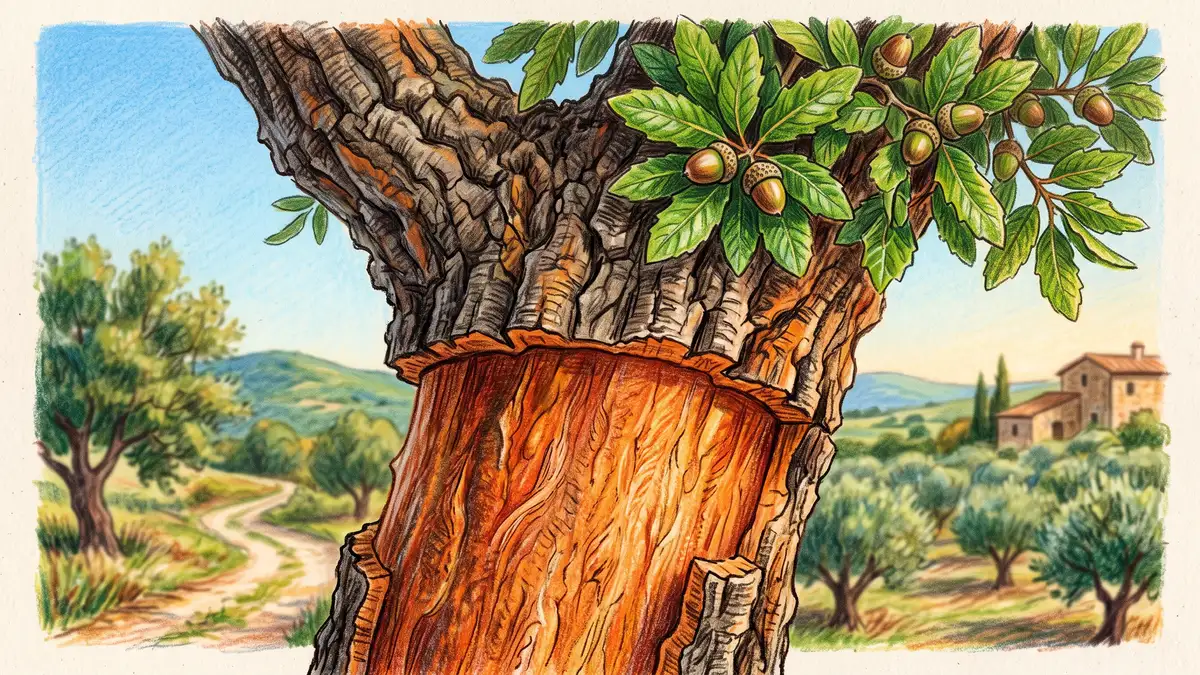
Cork is the standout yield because it is genuinely regenerative. Portugal holds about 737,000 hectares of cork oak, roughly 34% of the world's cork forest, and produces around 100,000 tonnes of cork a year, close to half of global production. The bark is stripped by hand roughly every nine years and the tree lives on, regrowing its bark for the next harvest. Cork oak forests across the Mediterranean hold an estimated 14 million tonnes of CO2 a year while doing it. A crop you harvest without killing the plant, for decades, is permaculture in its purest form.
Why This Works: Stacking Functions and Perennial Cover
The montado never leaves soil bare and never relies on a single product. Deep-rooted evergreen oaks pull moisture from subsoil, shade the ground to cut evaporation, and drop leaves that build organic matter, while the pasture and animals cycle nutrients. Research finds montado agroforestry stores substantial soil carbon compared with cleared land. Permanent cover plus stacked functions is exactly what makes a system drought-tough.
How Did Tamera Rebuild Its Water Cycle?
By treating water as something to keep, not drain. Tamera, an eco-village in the Alentejo, sat on eroding, drought-stricken land until it built a chain of lakes and retention basins designed with permaculture teacher Sepp Holzer. The European Environment Agency's Climate-ADAPT platform features it as a case study in restoring the water cycle, combining lake creation with reforestation to counter erosion and drought.
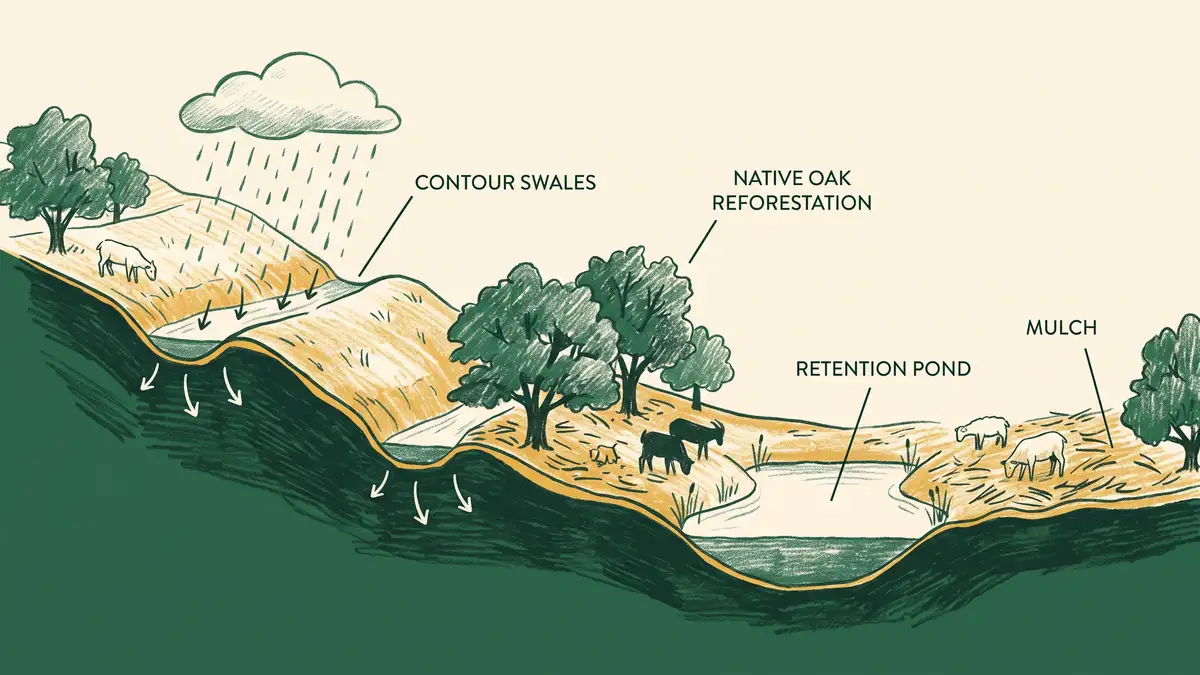
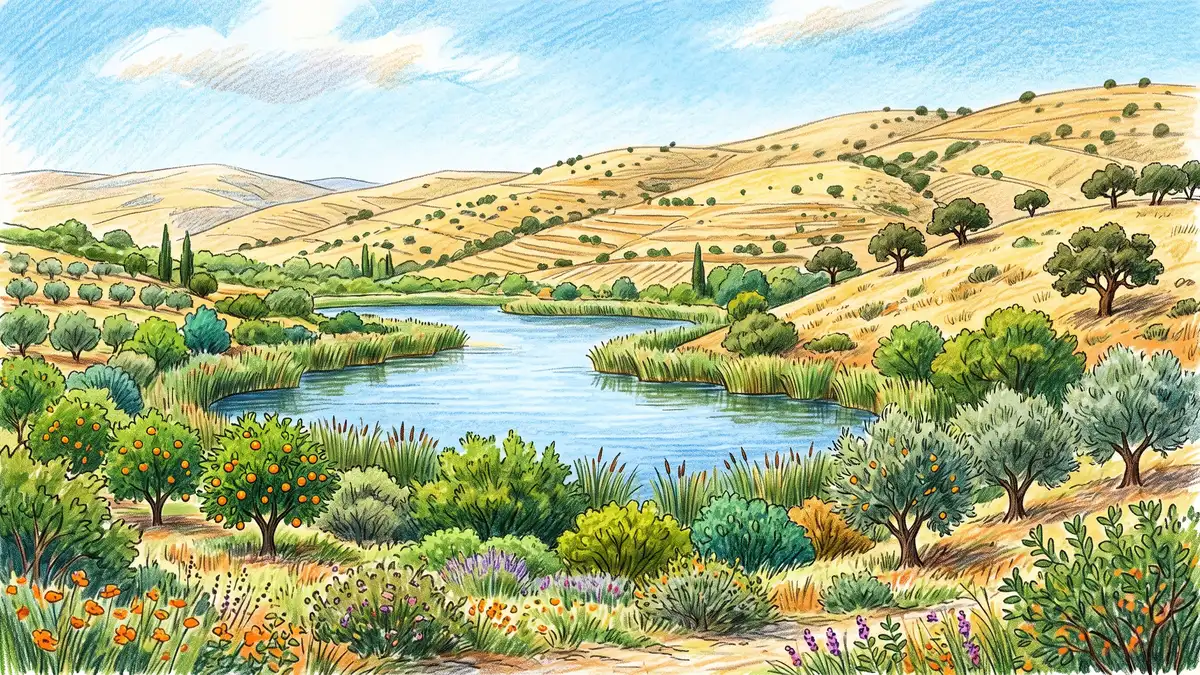
The method is low-tech and repeatable. Earth dams built from compacted local clay, placed at the narrow points of valleys, catch winter runoff before it races downhill. The lakes have irregular banks and shallow and deep zones for habitat, and trees planted around them stabilize soil and cut evaporation. Water that once flashed off the land now soaks in, feeds the aquifer, and, by project accounts, brought dried-up springs back to life. It is the same water-first logic behind good whole-property design, scaled to a valley.
A Note on Copying Techniques
Do not bulldoze swales or dam a valley because it worked at Tamera. Earthworks that ignore local soil, slope, and water rights can erode, fail, or starve downstream neighbors of water. Much of the evidence for these landscapes is still qualitative rather than peer-reviewed measurement. Observe your own land across a full year first, start small, and where you are moving real volumes of water, get local hydrological and legal advice before you dig.
Which Techniques Can You Actually Borrow?
The core dryland toolkit is simple, and it works anywhere summers are dry. Portuguese practitioners combine a handful of moves that reinforce each other. Here is the sequence, from catching water to building the soil that holds it.
Slow and sink the rain
Swales dug on contour and small ponds catch winter runoff and let it infiltrate instead of eroding downhill. This is the first move, because water shapes everything else.
Get trees back on the land
Native cork and holm oaks, plus fruit and nitrogen-fixing species, provide shade, deep roots, and leaf litter. Assisted natural regeneration protects seedlings from grazing so new oaks replace ageing ones.
Build soil that holds water
Mulch, cover crops, and diverse pastures raise soil organic matter, which lifts water-holding capacity. Portuguese sown biodiverse pastures are documented to increase soil carbon.
The frontier technique is syntropic agroforestry, Ernst Gotsch's method of dense, successional, heavily mulched plantings. Projects like Quinta das Abelhas in the Alentejo use it to rebuild strongly degraded oak pasture, and it is spreading across the region. If you want to go deeper on that approach, see our guide to syntropic agroforestry. The point of all of it is one thing: keep more water and life in the ground.
| Technique | What It Does |
| Contour swales and ponds | Catch and infiltrate winter rain, refill aquifers |
| Native oak reforestation | Shade, deep roots, leaf litter, acorns, cork |
| Mulch and cover crops | Cut evaporation, feed soil life, raise organic matter |
| Managed grazing | Cycle nutrients, keep cover, avoid compaction |
Sources:
Key Takeaway
You do not need Portugal's climate to use its lessons. In any dry-summer garden, the order is the same: catch water first, then get perennials and trees established, then build living soil that holds moisture. Small swales, a pond, mulch, and drought-hardy trees turn a garden from a place that sheds water into one that stores it.
Frequently Asked Questions
What is the montado in Portugal?
The montado is a traditional agro-silvo-pastoral system of southern Portugal, essentially a managed savanna of widely spaced cork oak and holm oak trees over grazed pasture and rotational crops. It covers roughly 800,000 hectares, about 2 million acres, mostly in the Alentejo. The system produces several yields at once: cork stripped from the oaks every nine years or so, acorns that fatten Iberian pigs for cured ham, grazing for cattle, sheep and goats, plus honey and mushrooms. Because the trees keep soil shaded and covered year-round and their deep roots reach subsoil moisture, the montado is remarkably drought-resilient and stores substantial soil carbon. It is often described as a living example of permaculture principles, developed over centuries of working with a hot, dry Mediterranean climate rather than against it.
How does a water retention landscape work?
A water retention landscape reshapes the land so that rainfall is slowed, spread, and sunk into the soil and aquifer instead of running off and eroding the surface. At Tamera in the Alentejo, designers built a chain of lakes and basins using earth dams made from compacted local clay, placed at the narrow points of valleys to catch winter runoff. The lakes have irregular banks with shallow and deep zones for wildlife, and trees planted around them stabilize soil and reduce evaporation. Over time, water that once flashed off the hills soaks in, recharges groundwater, and keeps the landscape green deeper into the dry season. The European Environment Agency features Tamera as a case study in restoring the water cycle and reducing drought vulnerability, using natural materials rather than concrete and pipes.
Why is Portugal at risk of desertification?
Portugal sits at the western edge of the Mediterranean climate belt, with rain concentrated in cool winters and long, hot, nearly rainless summers, especially in the south. That mismatch between when rain falls and when plants need it, combined with more frequent droughts, vulnerable soils, and land-use changes like overgrazing and loss of tree cover, drives land degradation. More than 5.5 million hectares, over half of mainland Portugal, are now considered at risk of desertification, and more than 30% of the territory is rated as high or very high vulnerability. The Baixo Alentejo is a hotspot, with 94% of the region susceptible and 38% critically so. Wildfire risk compounds the problem, which is why landscape rehydration, reforestation, and mosaic land use are central to Portugal's response.
Can I use these Portuguese techniques in my own garden?
Yes, scaled appropriately. The core dryland toolkit, catching water with swales and small ponds, planting drought-hardy trees for shade and deep roots, and building soil with mulch and cover crops, works in any climate with dry summers, including much of the US Southwest, Mediterranean California, and parts of Australia. Start by observing where water flows and pools on your land across a full year, then catch it high in the landscape before it runs off. Add perennials and trees suited to your region, and keep soil covered to cut evaporation. The one caution is scale: large earthworks or dams need attention to local soil, slope, and water rights, so start small, and get professional advice before moving significant volumes of water.
Is cork production actually sustainable?
Cork is one of the better examples of a genuinely regenerative harvest. The bark is stripped by hand from living cork oaks roughly every nine years, and the tree survives and regrows its bark for the next cycle over a lifetime that can span well over a century. That means the forest stays standing, continuing to shade soil, store carbon, and support biodiversity, while still producing a valuable crop. Portugal produces close to half the world's cork from about 737,000 hectares of cork oak, and Mediterranean cork oak forests are estimated to hold around 14 million tonnes of CO2 a year. The economic value of cork, especially wine stoppers, gives landowners a financial reason to keep the montado intact rather than clearing it, aligning conservation with livelihood, which is exactly what makes tree-based dryland systems durable.
Get the Weekly Dig
One practical permaculture guide a week, written for gardeners who do this on weekends: permaculture design for real backyards. Free, no spam, unsubscribe any time.
Join the Weekly DigResources
- EEA Climate-ADAPT — Tamera Water Retention Landscape Case Study
- Pinto-Correia et al. — Introducing the Montado Agroforestry System
- AGFORWARD — Montado in Portugal
- Natural Cork Council — Cork Reports and Statistics
- Amorim — Sustainability and the Cork Oak Forest
- European Court of Auditors — Combating Desertification in the EU
- Ferreiro-Dominguez et al. (2022) — Soil Carbon in Montado Agroforestry
- reNature — Quinta das Abelhas Syntropic Agroforestry, Alentejo