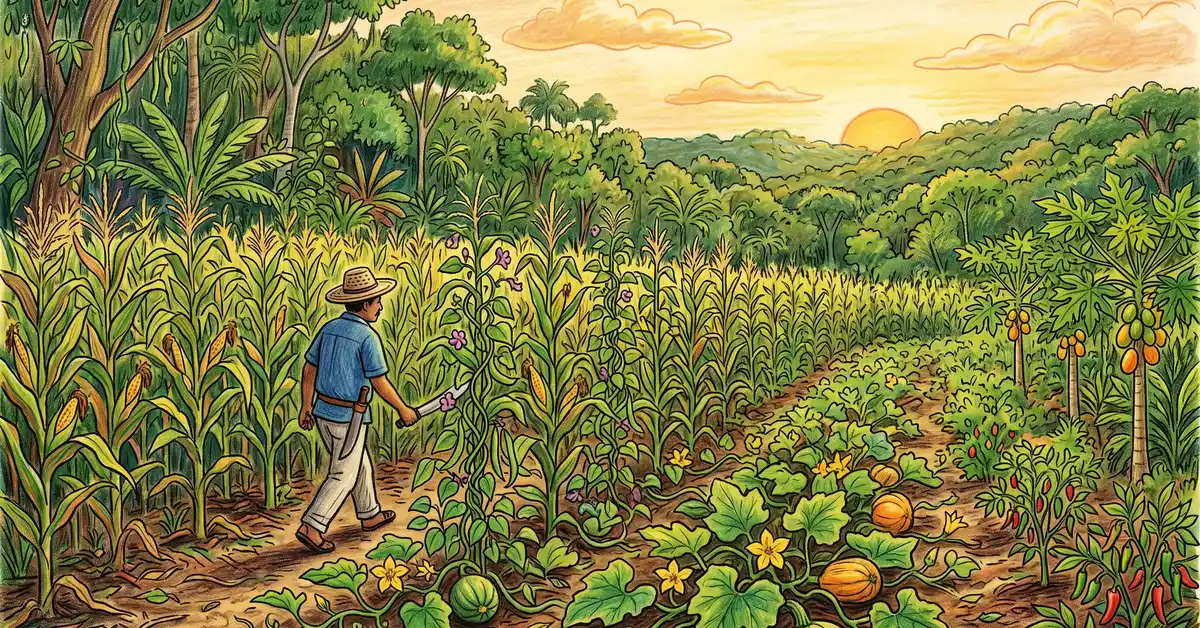

Your soil looks tired, a 50-pound bag of balanced fertilizer now costs more than a decent dinner, and spraying synthetic inputs onto a garden full of worms and fungi feels like the wrong answer. There is a well-documented alternative refined on real farms since 1966: Korean Natural Farming (KNF) — a system built around capturing the microbes already living in the forest next to your garden and turning them, for pennies, into a living fertilizer you make yourself.
This guide covers the core inputs, the four-stage Indigenous Microorganism (IMO) protocol, what the science does and doesn't support, and how to start with just rice, brown sugar, and a patch of forest soil.
The 30-second version
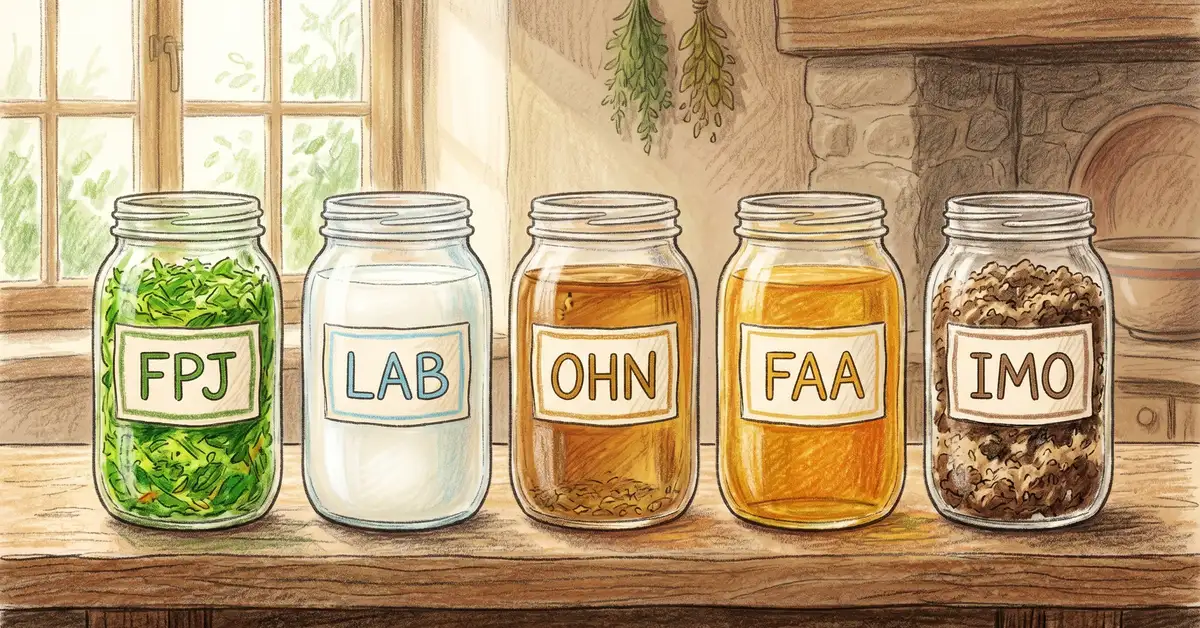
KNF captures native microbes from undisturbed forest soil on cooked rice, multiplies them through four fermentation stages (IMO 1 → IMO 4), and combines them with four low-cost fermented inputs — Fermented Plant Juice, Lactic Acid Bacteria, Oriental Herbal Nutrient, and Fish Amino Acid — to replace most of what you would otherwise buy in a bag. Start with Fermented Plant Juice and Lactic Acid Bacteria; you can make both this week for under $10.
What Korean Natural Farming actually is
Korean Natural Farming was developed by Master Cho Han-Kyu in 1966 after years studying with Japanese natural farmer Yasushi Oinoue. Instead of treating soil as an inert medium you dose with chemicals, KNF treats soil as a living community you feed. The premise: the microbes best adapted to your garden aren't in a sachet from a garden center — they're living in the leaf litter 50 yards away, and a jar of cooked rice plus five days is enough to collect them.
Since founding the Janong Natural Farming Life School in 1995, Cho and his students have trained more than 18,000 farmers. The method is now practiced in South Korea, the Philippines, India, and Southeast Asia, and — most visibly in the US — in Hawaii, where the University of Hawaii CTAHR has run formal KNF trials since the late 1990s. If you've read our overview of permaculture around the world, KNF sits in the same family as Fukuoka's Japanese natural farming — but where Fukuoka is famously hands-off, KNF is a precise, repeatable fermentation protocol you can copy onto a notecard.
Why This Works: Use and value biological resources already on site
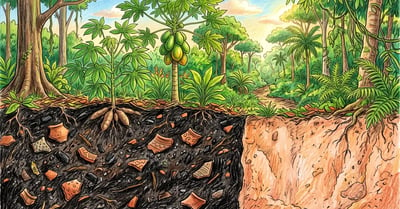
David Holmgren's third permaculture principle — use and value renewable resources and services — is the engine under KNF's hood. A healthy rhizosphere already holds roughly 7 million organisms per gram of soil, about 70 kg of carbon and 11 kg of nitrogen per hectare — essentially a season's worth of fertilizer, already present, already free. KNF doesn't import biology; it wakes up what's there and feeds it until it's working for you.
The core KNF inputs (and what each one does)
Most home gardeners never make all of the fermented inputs — two or three carry most of the benefit.
| Input | What it is | What it does | Typical dilution |
| Fermented Plant Juice (FPJ) | Rapid-growing plant tips + brown sugar, 7 days | Plant-derived enzymes, growth hormones, chlorophyll | 1:500 foliar / soil |
| Lactic Acid Bacteria (LAB) | Rice wash + unpasteurized milk, 3–5 days | Suppresses pathogens, accelerates decomposition | 1:1000 foliar / soil |
| Oriental Herbal Nutrient (OHN) | Garlic, ginger, angelica, cinnamon, licorice in alcohol | Antimicrobial, stress-tolerance booster | 1:1000 foliar |
| Fish Amino Acid (FAA) | Fish scraps + brown sugar, 3–6 months | High-nitrogen liquid feed, amino acids | 1:1000 soil drench |
| Water-Soluble Calcium (WCA) | Roasted eggshells in brown rice vinegar | Flowering trigger, cell-wall strength | 8 ml / gallon, once |
| Brown Rice Vinegar (BRV) | Rice vinegar, aged | pH buffer, carrier, foliar protectant | 8 ml / gallon |
Source: Rogue Natural Farming — KNF Inputs Reference and CTAHR Bulletin SA-19, University of Hawaii.
Capturing indigenous microorganisms: IMO 1 through IMO 4
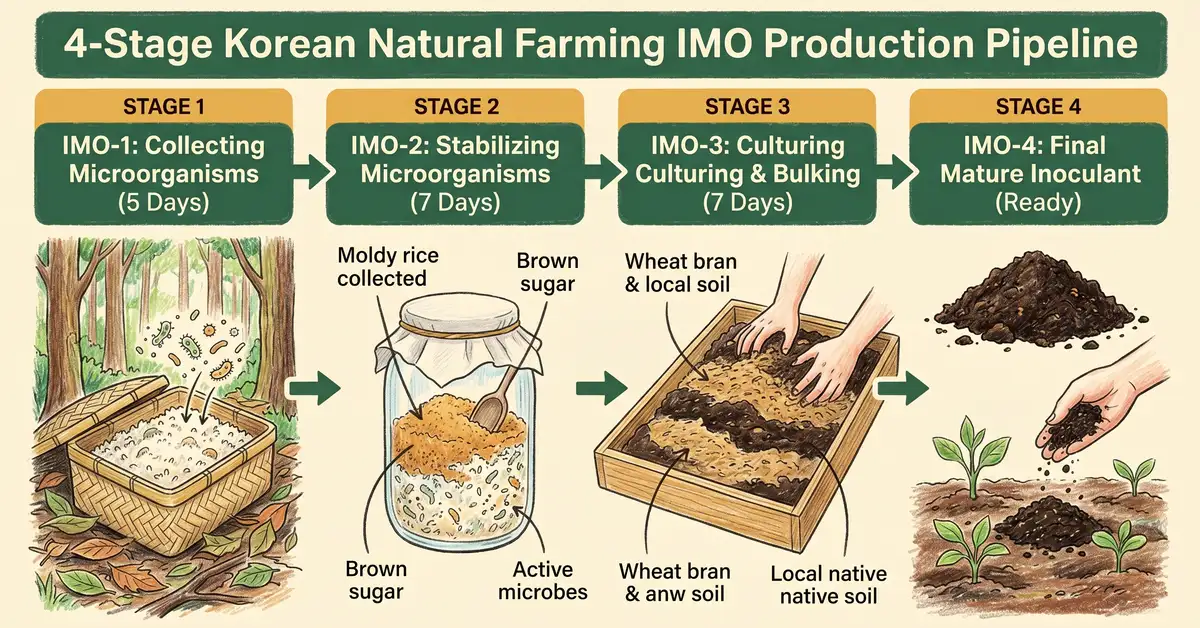
The IMO protocol is the heart of KNF: four quiet fermentation steps over about 25 days. Temperature matters, cleanliness matters, and — crucially — where you collect matters, because a 2018 University of Hawaii study found the collection site meaningfully changed the growth-promoting bacteria in the finished inoculant.
IMO 1: Capture (4–5 days)
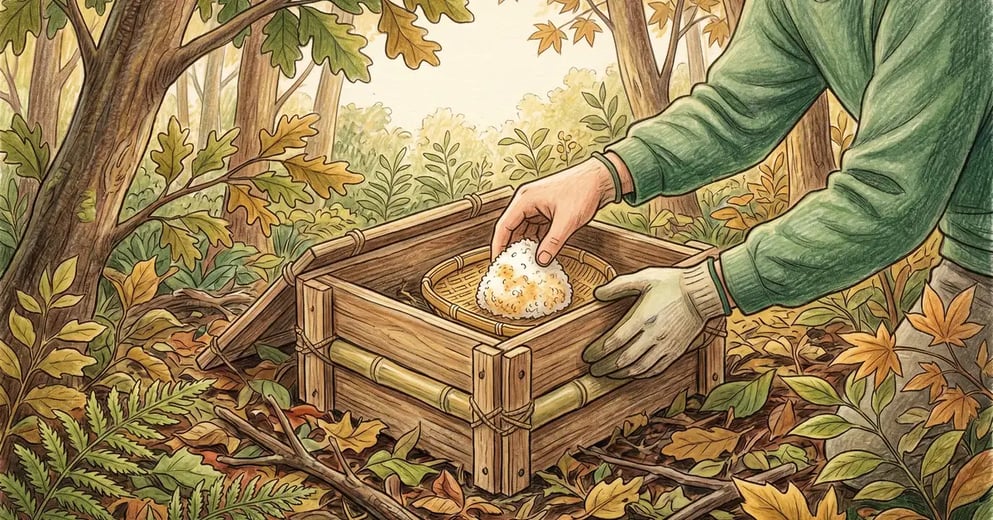
Fill a shallow untreated cedar box two-thirds with cooked brown rice, cover with breathable cloth, bury just under the leaf litter of undisturbed forest floor near sugar-rich roots (bamboo is ideal). Wait for white mycelium; green or blue mold means contamination — discard and start again. Process within 20–30 minutes of collection. Source: Griffin Family Farm.
IMO 2: Preserve in sugar (7 days)
Mix the mycelium-covered rice 1:1.7 by weight with brown sugar (12 oz rice to 20 oz sugar). Sugar drives the microbes into osmotic dormancy. After 7 days you have stable foundation stock that keeps for months at 34–59°F (1–15°C) — one batch seeds many future IMO 3 runs.
IMO 3: Multiply on bran (8 days)
Combine 15 ml of IMO 2 with 50 lbs (22.7 kg) wheat mill run or rice bran, 5.3 gallons (20 L) pond water, and a tablespoon each of FPJ, LAB, OHN, FAA, and WCA. Pile on bare soil 14–16 inches (35–40 cm) deep under 70% shade, cover with leaves. Hold at 104–122°F (40–50°C) for 8 days.
IMO 4: Finish with soil + biochar (5 days)
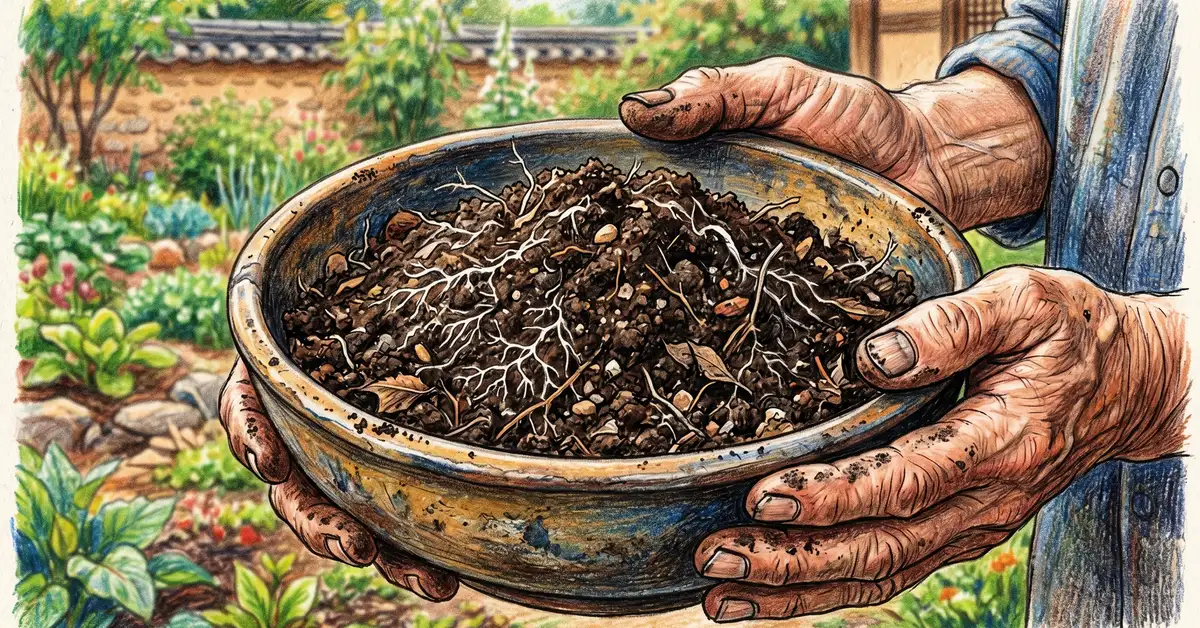
Break IMO 3 apart and combine 1:1 by volume with your own native soil, plus about 2.6 gallons (10 L) of biochar. Bring to field capacity — a squeeze should release only one or two drops. Cover the pile for 5 final days. The end product is dark, crumbly, and ready to apply at 0.4–1 lb per square foot (2–5 kg/m²), worked into the top 2–3 inches of soil.
Source: CTAHR Bulletin SA-19 — Natural Farming: Development of Indigenous Microorganisms.
What the science actually shows
KNF has accumulated real peer-reviewed support alongside legitimate skepticism. USDA SARE grant FNE22-001 found KNF-style IMO matched compost for phosphorus and potassium but ran lower on nitrogen. The University of Hawaii's 2018 KNF study isolated Bacillus megaterium, B. subtilis, and B. licheniformis as dominant nitrogen-fixing and phosphorus-solubilizing bacteria in KNF soils, and showed that a second IMO application 14 days after the first measurably lifted yields. A 2023 study of zero-budget natural farming in southeastern India — a close cousin of KNF — found ZBNF plots outyielded conventional and organic plots (z = 0.58 ± 0.08), though much of the advantage came from companion mulching rather than IMO alone.
What the research does not support
A University of Hawaii thesis on IMO 4 found no evidence that captured microbes survive once tipped into a different soil — native microbes outcompete them. That study concluded IMO 4 works largely as a "substrate effect," i.e. as a compost. Practical takeaway: treat KNF as an excellent compost-plus-biostimulant system, not a miracle. Never use manure-based variants on leafy greens within 60 days of harvest.
Applying KNF inputs in a home garden
At home garden scale, you rarely need the full IMO 4 pile. Most of the benefit shows up from two practices run weekly through the growing season.
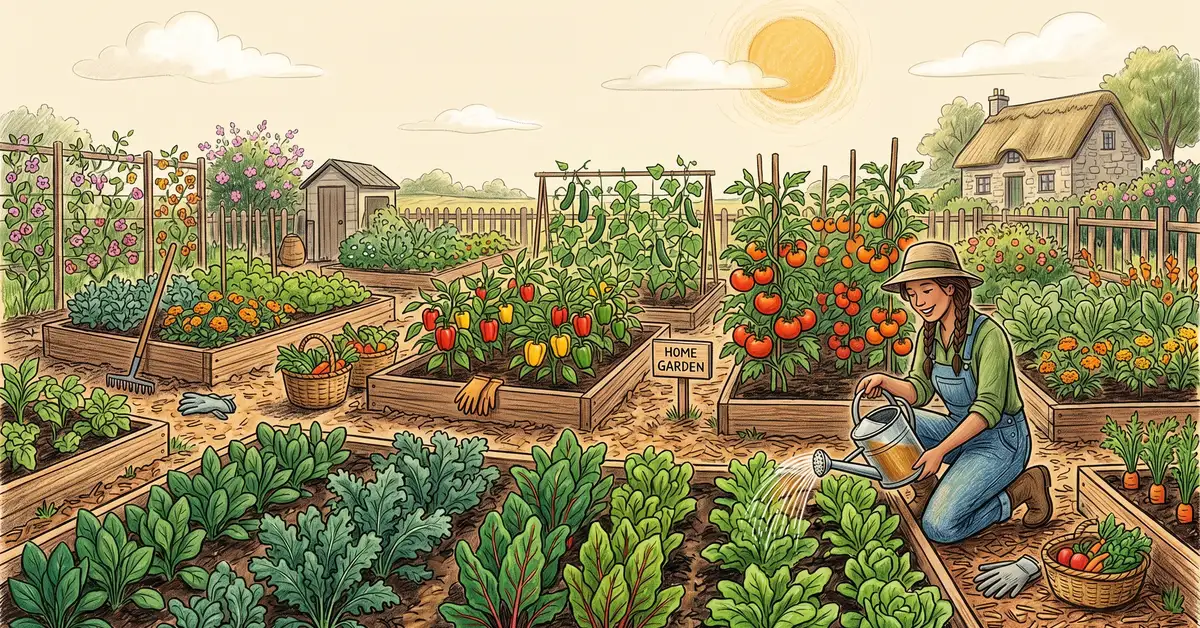
Foliar sprays — mix 8 ml FPJ + 8 ml OHN + 8 ml BRV per gallon of dechlorinated water and apply in early morning or late evening (never in direct sun — UV kills the microbes). At flower set, swap in 8 ml of WCA once to support fruit development.
Soil drenches — 1:500 to 1:1000 dilutions of FPJ, LAB, or FAA watered into moist soil every 10–14 days. Pair with a mulch layer so the microbes you just added aren't fried by direct sun. This is where KNF meets standard mulching practice and no-dig bed management — all three are doing the same job, which is protecting the biology you want to keep.
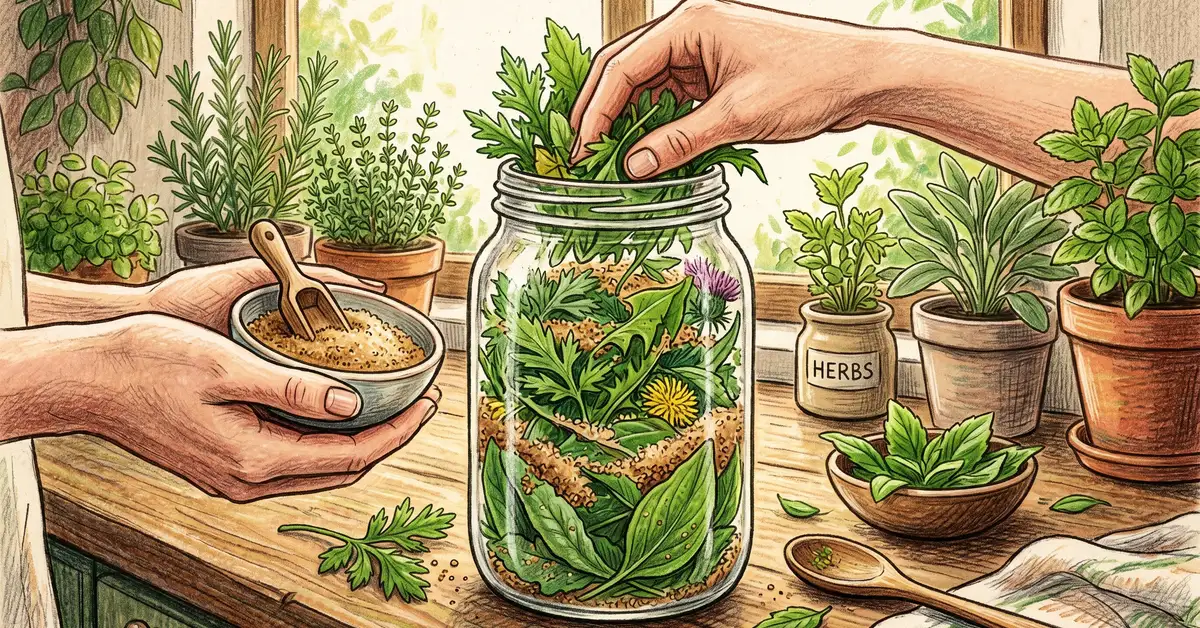
If you only have bandwidth for two inputs, make FPJ from fast-growing weeds and LAB from rice wash and unpasteurized milk. That covers plant-growth hormones and pathogen suppression in one afternoon of prep.
Not sure your soil is ready for biological inputs?
Start with our — if your soil is compacted, anaerobic, or very low in organic matter, adding microbes won't stick until you fix those first.
Check soil basics firstWhat KNF actually costs
The University of Hawaii costing put IMO 4 production at roughly $0.14 per square meter on the first batch, dropping to $0.13 once a shelf of IMO 2 is on hand. A typical home batch of FPJ — about a quart — costs under $2 in brown sugar, and diluted 1:500 makes 125 gallons of foliar spray. Compared to commercial biostimulants at $15–35 per liter, a season's worth of home-made KNF inputs runs $20–40 instead of $200–400. If you're already running a compost tea setup, you have 90% of the equipment.
How KNF fits the permaculture principles
If you've internalized the 12 permaculture principles, KNF will feel familiar. Produce no waste shows up in fermenting kitchen scraps and weeds instead of binning them. Observe and interact is encoded in the IMO 1 site-selection rule — your microbes have to come from your bioregion. Integrate rather than segregate appears in the four-input stack that builds microbial diversity rather than betting on a single lab strain. For gardeners who want an even lower-friction entry point, JADAM replaces the 25-day IMO pipeline with a single anaerobic bucket of leaf mold, weeds, and water for 10–14 days.
Get the Weekly Dig
One practical permaculture guide a week, written for gardeners who do this on weekends: permaculture design for real backyards. Free, no spam, unsubscribe any time.
Join the Weekly DigFrequently asked questions about Korean Natural Farming
What is Korean Natural Farming in simple terms?
KNF is a fermentation-based soil system developed by Cho Han-Kyu in 1966. You capture native microbes from your local forest on cooked rice (IMO 1), multiply them through three more stages (IMO 2, 3, 4), and combine them with fermented plant juice, lactic acid bacteria, and other low-cost inputs to replace most synthetic fertilizers and pesticides.
How do I make indigenous microorganisms (IMO 1) at home?
Fill a shallow untreated cedar box two-thirds with cooked brown rice, cover with breathable cloth, and bury it just under the leaf litter in undisturbed forest soil — ideally near bamboo. After 4–5 days at 68°F (20°C) or warmer, the rice should be covered in white mycelium. White means success, green or blue means contamination — start over. Process within 20–30 minutes of retrieval.
Does Korean Natural Farming actually work?
The evidence is mixed but real. University of Hawaii trials have shown measurable increases in soil stability, nematode diversity, and growth-promoting bacteria on KNF plots, and a 2023 Indian study of related zero-budget natural farming found higher yields than conventional or organic methods. However, a separate Hawaii thesis found captured microbes rarely survive inoculation into a new soil — suggesting much of the benefit comes from organic matter and nutrients. Practical translation: KNF works as a high-quality fermented compost and biostimulant; treat exaggerated claims with skepticism.
Difference between Fermented Plant Juice and Lactic Acid Bacteria?
FPJ is made from rapid-growing plant tips plus equal-weight brown sugar, fermented 7 days; it delivers plant-derived growth hormones. LAB is rice wash and unpasteurized milk in a 1:10 ratio, fermented 3–5 days; it suppresses pathogens. Most gardeners apply both weekly as a foliar spray at 1:500.
Is KNF safe for vegetables I'll eat?
Plant- and dairy-based inputs (FPJ, LAB, OHN) are low-risk when fermentation is followed correctly. Fish Amino Acid and manure-containing variations carry real pathogen risk — don't apply within 60 days of harvest on leafy greens, and avoid them entirely for immunocompromised households.
How is KNF different from JADAM?
JADAM was developed by Jo Young-sang (Cho's son) as a simplified, ultra-low-cost version. Instead of capturing microbes on rice over 25 days of staged aerobic fermentation, JADAM uses leaf mold soil in a sealed anaerobic bucket for 10–14 days. JADAM is cheaper and simpler; KNF is more precise and better documented.
Resources
- Master Cho Han-Kyu biography — Garden Culture Magazine
- CTAHR Bulletin SA-19: Natural Farming — Development of Indigenous Microorganisms — University of Hawaii CTAHR
- Indigenous Microorganism 4 (IMO 4) as a Soil Inoculant — University of Hawaii dspace
- Unraveling the Mystery of the Natural Farming System (Korean) — ScholarSpace, UH Manoa
- SARE Grant FNE22-001: IMO vs compost vs commercial inoculants — USDA SARE
- SARE Project FNC22-1319: KNF fungicide trial — USDA SARE
- Enhancing soil function with locally available resources (Radovich et al.) — University of Hawaii
- Soil microbial diversity transitions — Frontiers in Plant Science, 2023
- Zero-budget natural farming yield study, southeastern India — PubMed, 2023
- KNF Inputs quick reference — Rogue Natural Farming
- Griffin Family Farm — First IMO 1 collection — thegriffinfamilyfarm.com
- JADAM Liquid Fertilizer overview — The FigJam