
How Do You Tell Which Nutrient Your Plants Are Missing?
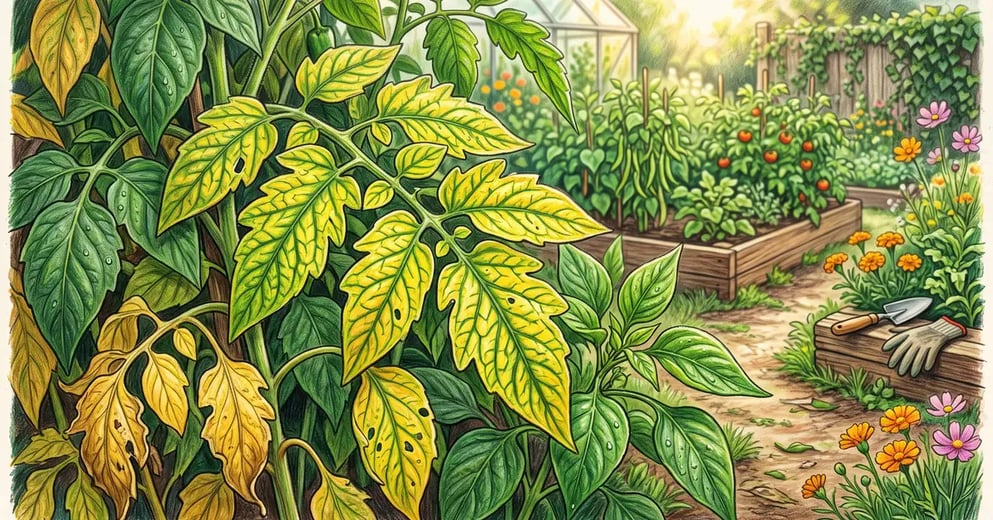
Yellow leaves cost you yield. But yellow leaves are also the least specific symptom in gardening, and most people guess wrong, throw a general-purpose fertiliser at it, and lose half a season finding out it did not help.
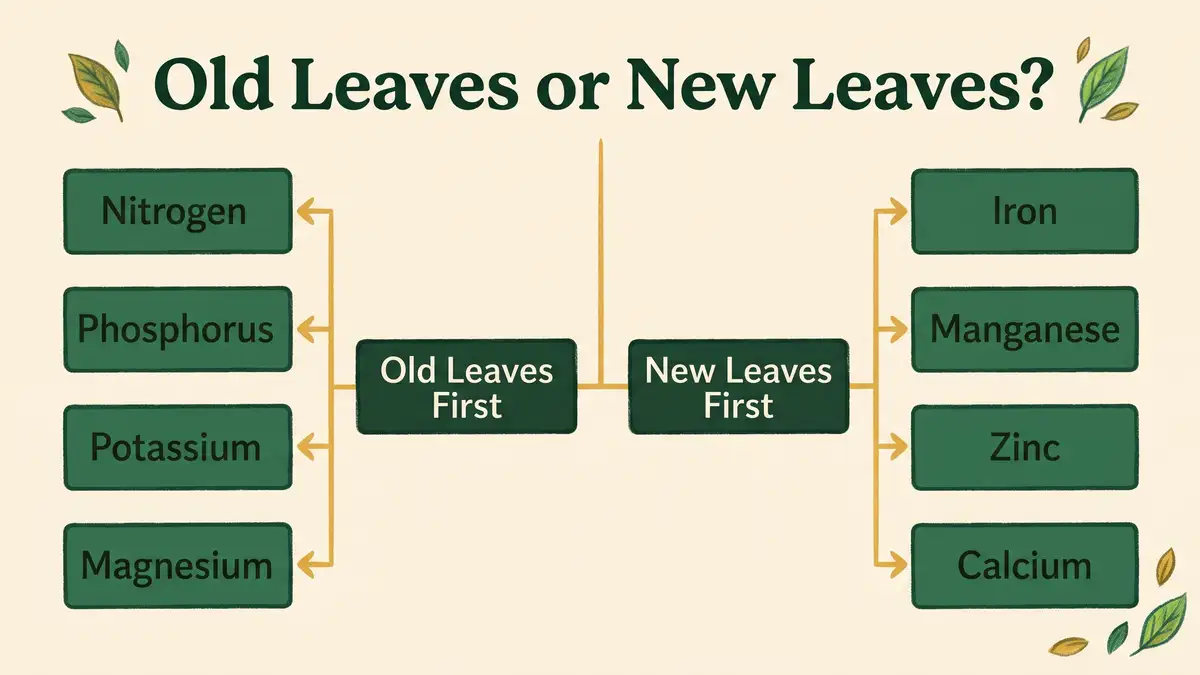
There is one diagnostic rule that narrows the field faster than anything else, and it is free. Look at where the symptom starts: old leaves or new leaves.
Plants have 17 essential elements, according to the NC State Extension Gardener Handbook. Some of them move around inside the plant. Some do not. That single distinction tells you which half of the list to investigate.
Key Takeaway
Mobile nutrients (nitrogen, phosphorus, potassium, magnesium) show symptoms on OLD leaves first, because the plant strips them out of older tissue to feed new growth. Immobile nutrients (calcium, sulfur, boron, iron, manganese) show on NEW leaves first, because once they are placed they cannot move. Michigan State University Extension calls this the most useful starting point in deficiency diagnosis, and it is right.
Old Leaves or New Leaves? Start Here
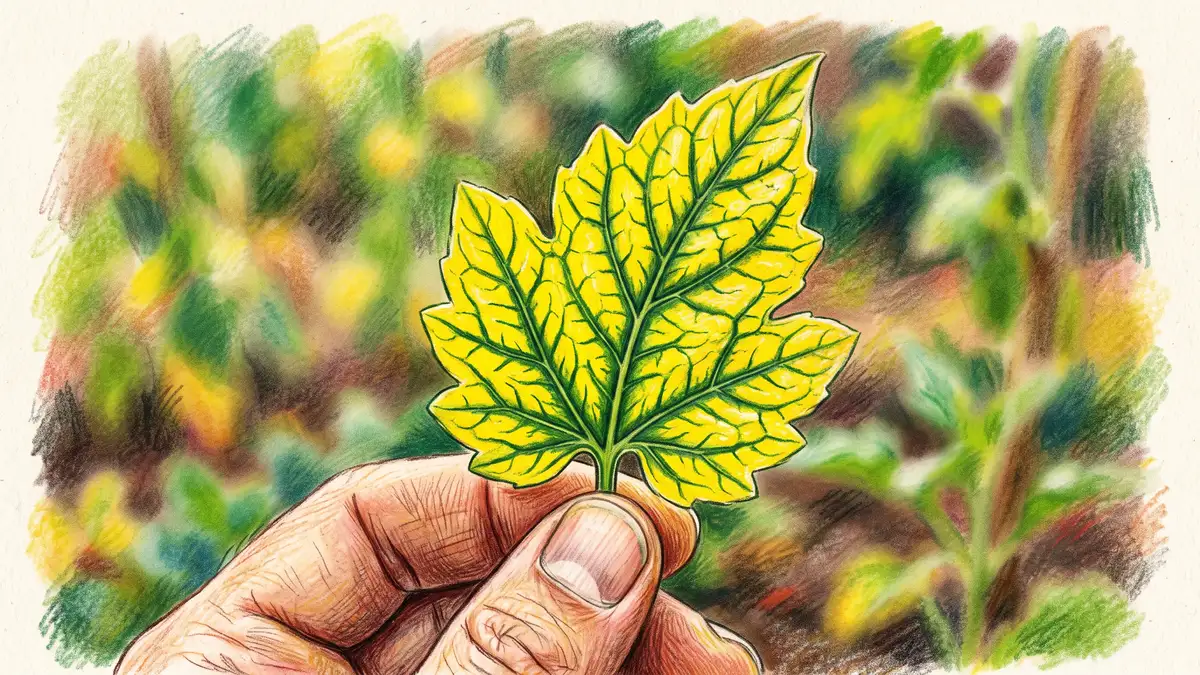
Michigan State University Extension illustrates the rule with paired photos: iron deficiency hits the newest leaves while the old ones stay green, whereas nitrogen deficiency starts at the bottom of the plant and works upward.
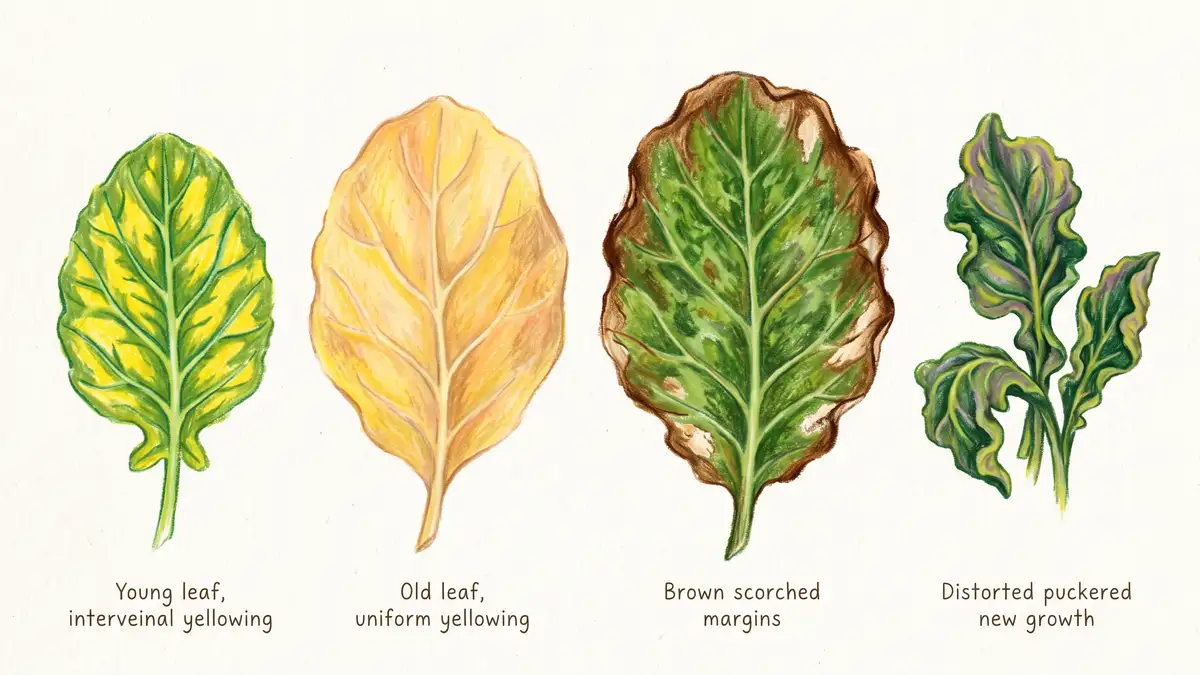
Then look at the pattern. Uniform yellowing across the whole leaf points one way. Yellow between green veins, called interveinal chlorosis, points another. Scorched margins, distorted growing tips, and dead terminal buds are each their own signal.
| Symptom | Where It Starts | Likely Nutrient |
| Uniform pale yellowing, whole plant pale | Old leaves, bottom up | Nitrogen |
| Yellow between veins, veins stay green | Old leaves | Magnesium |
| Yellow between veins, sharply defined | New leaves | Iron |
| Yellow between veins plus brown speckling | Mid-age leaves | Manganese |
| Scorched or browning leaf margins | Old leaves | Potassium |
| Purple or reddish tints, stunting | Old leaves | Phosphorus |
| Growing tip dies, hollow or brown stems | New growth | Boron |
| Small, narrow, bunched new leaves | New growth | Zinc |
| Sunken black patch on fruit base | Fruit | Calcium in fruit |
Sources: Michigan State University Extension, NC State Extension Gardener Handbook, UF/IFAS EP081, Plant Tissue Analysis for Vegetable Crops.
Why Soil pH Is the Real Culprit Most of the Time
Here is what catches most homesteaders out. Your soil usually has the nutrient. Your plant just cannot reach it.
Soil pH controls which form each element takes, and therefore whether roots can absorb it. Purdue Extension's availability chart shows iron, manganese, zinc, and copper availability dropping sharply as pH climbs above about 7.5.
Iron chlorosis is the textbook case. Utah State University Extension calls it the most common micronutrient problem of shrubs, vines, small fruits, and trees in Utah, and it is most prevalent on calcareous soils in the pH 7.5 to 8.5 range. Texas A&M puts it bluntly in Straight Talk About Iron Deficiency: it is rarely an absolute lack of iron. High pH ties the iron up.
Do Not Fix a pH Problem With Fertiliser
Adding more iron to an alkaline soil mostly wastes money, because the new iron gets locked up the same way. Correct the pH first, or use a chelate designed to survive it. Utah State recommends 6 to 10 lb of elemental sulfur per 1,000 sq ft annually to lower high pH, and warns that this is a multi-season project, not a quick fix. The reverse mistake is just as common: over-liming past pH 7.0 induces iron, manganese, and zinc deficiencies in soil that had none.
If you do use chelated iron, the chelate type matters. Texas A&M advises EDDHA and EDDHMA chelates for alkaline soils, while HEDTA, DTPA, and EDTA formulations only hold together in less alkaline or slightly acidic conditions. Buying EDTA iron for a pH 7.8 soil is money burnt. Our soil pH guide covers testing and adjustment in detail.
The Three Deficiencies Homesteaders Actually Hit
Magnesium: Yellow Between Veins on Older Leaves
Common on sandy soils, in heavy-rainfall regions where it leaches, and where you have been applying a lot of potassium. Tomatoes and peppers show it first, usually mid-season, on the lower leaves.
Epsom salt does correct it, at roughly 1 teaspoon per gallon of water, twice a season. But read the caveat carefully. University of Minnesota Extension is explicit that you should not use Epsom salts unless a soil test confirms magnesium is short, because excess magnesium in soil that already has enough blocks calcium uptake and makes blossom end rot worse. For in-ground beds, dolomitic limestone is usually the better choice since it supplies calcium and magnesium together while adjusting pH.
Iron: Sharp Interveinal Chlorosis on New Growth
Almost always a pH problem, as above. A useful field diagnostic from Utah State: spray a small patch of affected leaves with a 0.1% ferrous sulfate solution. If green spots appear within a few days, iron was the limiting factor. The effect is temporary, but it confirms your diagnosis before you spend on soil treatment.
Calcium in Fruit: Blossom End Rot
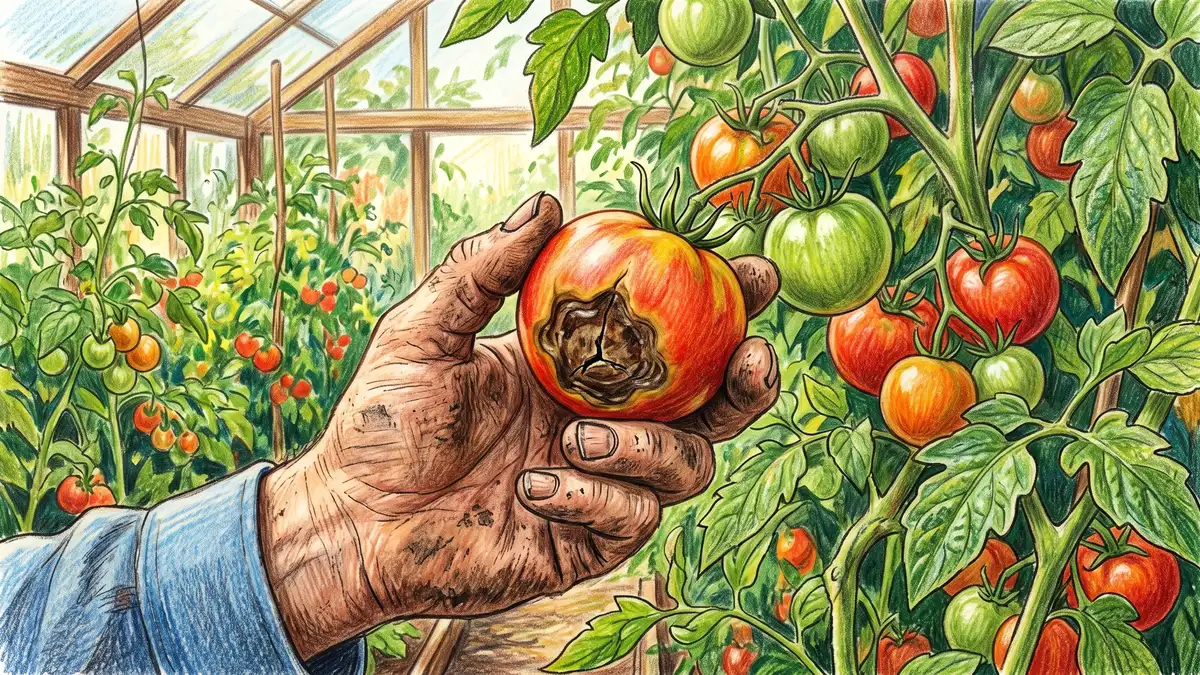
This one is worth getting right because the folk remedies are wrong. University of Minnesota Extension states plainly that most soils already have plenty of calcium, and that blossom end rot signals a water transport problem, not a soil shortage.
Calcium enters only through actively growing root tips and rides into the fruit with water via transpiration. Irregular watering, damaged roots, or competition from excess magnesium or ammonium all cut off delivery. Consistent moisture and mulch fix far more cases than any calcium product.
And eggshells do not work. UMN found they decompose far too slowly to be an effective short-term calcium source. Put them in the compost as organic matter, not around your tomato plantings, and expect nothing from them this season.
Why This Works: Feed the Soil, Not the Plant
Nearly every deficiency above traces back to soil chemistry and soil biology rather than a missing input. Organic matter buffers pH, holds micronutrients in exchangeable form, and feeds the mycorrhizal fungi that extend a plant's effective root reach many times over. That is why permaculture treats building living soil as the primary intervention and targeted amendments as the exception. A soil rich in organic matter rarely produces the deficiencies this article is about.
What Rates Actually Correct a Confirmed Deficiency?
Only apply these after a soil or tissue test. Micronutrients have narrow windows and several are toxic at modest excess.
| Nutrient | Amendment | Rate | Toxic Above |
| Zinc | Zinc sulfate, broadcast | 6 lb/acre (about 2.2 oz per 1,000 sq ft) | 10 ppm soil |
| Manganese | Manganese sulfate, broadcast | 20-25 lb/acre (about 7.4 oz per 1,000 sq ft) | 200-300 ppm leaf |
| Boron | Borax, incorporated | 0.5-2 lb actual boron/acre | 5 ppm soil |
| Magnesium | Epsom salt, drench | 1 tsp per gallon, twice a season | Blocks calcium uptake |
| Iron | EDDHA chelate (alkaline soil) | Per label, root zone, spring | Rarely toxic in soil |
| Iron (diagnostic) | Ferrous sulfate, foliar | 0.1% solution | Leaf staining |
Sources: NC State Extension: Zinc in Vegetable Crop Nutrition, NC State Extension: Manganese in Vegetable Crop Nutrition, University of Wisconsin A2522: Soil and Applied Boron, University of Minnesota Extension.
Boron deserves special caution. University of Wisconsin reports that soils typically hold 0.5 to 2.0 ppm of available boron, while more than 5.0 ppm is toxic to many crops. That is a very narrow range. On a home-garden scale the difference between a helpful dose and a damaging one is a matter of ounces per 1,000 sq ft. Never broadcast borax on a hunch.
Should You Test the Soil or the Leaves?
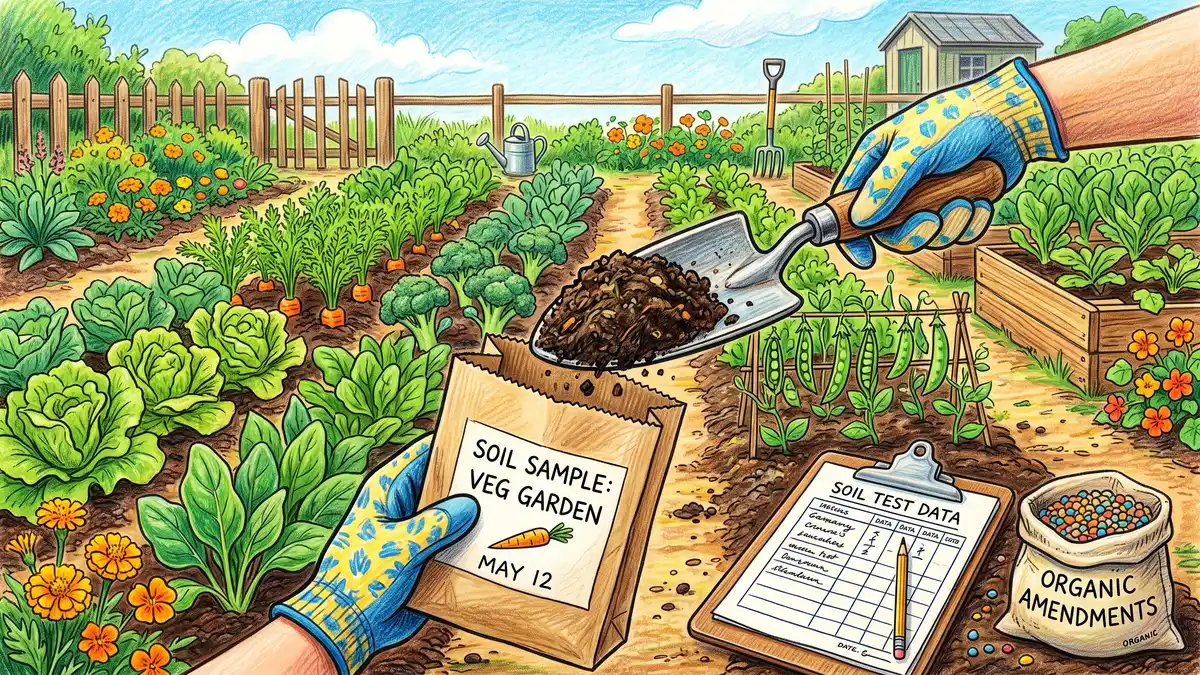
Both, in that order. A standard extension soil test runs about $10 at Penn State's Agricultural Analytical Services Lab and $25 for a routine test or $35 for the micronutrient package at Utah State's Analytical Laboratories. Either is cheaper than one wasted season.
Two things to understand about what you are buying. Standard tests generally do not measure nitrogen, because nitrate and ammonium levels swing too fast to be meaningful; nitrogen recommendations get derived from crop demand and organic matter instead. And most basic home-garden packages do not include micronutrients unless you pay for the extended panel. If you suspect iron, zinc, or boron, order the panel that actually tests for them.
A tissue test answers a different question: not what is in the soil, but what the plant has managed to absorb. UF/IFAS gives sufficiency ranges for vegetables including iron at 50 to 200 ppm, manganese at 20 to 100 ppm, and magnesium at 0.3 to 0.6% of dry matter. Sample the most recently matured leaf, except when you suspect calcium, copper, boron, or sulfur, in which case sample immature leaves.
Key Takeaway
UF/IFAS notes that nutritional disorders of vegetables are rare in well-managed crops, and that deficiency symptoms are routinely mimicked by other problems. Before you buy an amendment, rule out herbicide drift, root damage, compaction, waterlogging, spider mite stippling, and virus mottling. Those cause far more yellow leaves in home gardens than genuine micronutrient shortage.
Frequently Asked Questions
How do I treat magnesium deficiency in plants?
Confirm it first with a soil test, then apply Epsom salt at about 1 teaspoon per gallon of water, as a drench or foliar spray, twice a season. For in-ground beds a better long-term fix is dolomitic limestone, which supplies calcium and magnesium together and raises pH at the same time. University of Minnesota Extension warns against routine Epsom use, because excess magnesium in soil that already has enough will interfere with calcium uptake and can trigger blossom end rot. Foliar sprays applied too strong also scorch leaves.
What causes magnesium deficiency in plants?
Three main causes. Sandy soils hold magnesium poorly and lose it to leaching, particularly in high-rainfall regions. Heavy potassium fertilisation creates cation competition, where abundant potassium outcompetes magnesium at root uptake sites. And very acidic soils below about pH 5.5 have low magnesium availability to begin with. Tomatoes, peppers, and roses are the usual first casualties, showing yellowing between the veins on lower, older leaves while the veins themselves stay green.
Why do my new leaves turn yellow but the old ones stay green?
That pattern points to an immobile nutrient, most often iron, and occasionally manganese, zinc, or calcium. Because these elements cannot be relocated once the plant has placed them, a shortage shows up only in tissue formed after the supply ran short. Iron is the most common culprit, and it is nearly always a soil pH issue rather than an absence of iron. Test your pH before buying anything. Above about 7.5, iron becomes chemically unavailable no matter how much is present.
Can I fix nutrient deficiencies organically?
Partly. Compost, kelp meal, and rock dust supply a broad spread of micronutrients and are excellent preventatively, but their nutrient concentration is low, so they correct an acute deficiency slowly if at all. Rock dust is typically applied at around 10 lb per 100 sq ft, and the evidence for its benefits in home gardens remains largely anecdotal. For a confirmed acute deficiency mid-season, a targeted mineral amendment or foliar feed acts far faster. Use organic matter to prevent, targeted inputs to rescue. Our organic fertilizer guide covers which amendments release fast and which release slowly.
How often should I test my garden soil?
Every three years for established beds and perennial plantings is the standard extension recommendation, and annually if you are actively correcting a problem or breaking new ground. Take a composite sample from 8 to 10 spots across the bed at root depth, mix them, and send that. Testing a single spot gives you one spot's answer. Also retest a year after any significant pH amendment, since sulfur and lime both work slowly and you want to know where you actually landed.
Get the Weekly Dig
One practical permaculture guide a week, written for gardeners who do this on weekends: building living soil without buying it in bags. Free, no spam, unsubscribe any time.
Join the Weekly DigResources
- NC State Extension Gardener Handbook: Soils and Plant Nutrients
- Michigan State University Extension: Nutrient Mobility in Deficiency Diagnosis
- University of Minnesota Extension: Coffee Grounds, Eggshells and Epsom Salts
- Utah State University Extension: Iron Chlorosis
- Utah State University Extension: Solutions to Soil Problems, High pH
- Purdue Extension HO-240-W: Soil pH and Nutrient Availability
- UF/IFAS EP081: Plant Tissue Analysis for Vegetable Crops
- NC State Extension: Zinc in Vegetable Crop Nutrition
- NC State Extension: Manganese in Vegetable Crop Nutrition
- University of Wisconsin A2522: Soil and Applied Boron
- Penn State Agricultural Analytical Services Lab: Soil Fertility Testing
- Utah State Analytical Laboratories: Home Soil Testing