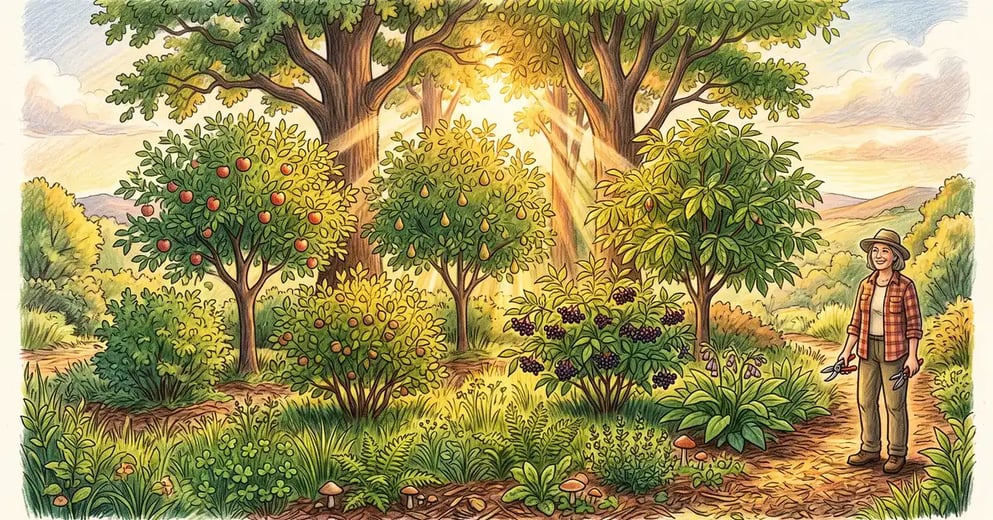

In Ernst Gotsch's syntropic agriculture, the farmer is not just a planter. The farmer is a light manager. Every pruning cut decides which species gets sun and which sits in dappled shade, and that decision determines what the system becomes. This guide explains the four strata, the succession classes, and the pruning calendar that turns light management into the most powerful design tool in a temperate backyard food forest. coffee grown under a tree canopy
Why light is the master variable
Ernst Gotsch developed syntropic agriculture starting in the 1980s on his Olhos d'Agua farm in Bahia, Brazil, where he turned 1,200 acres of degraded pasture into productive forest growing cocoa, coffee, bananas, citrus, and timber. The technical work has been documented through Agenda Gotsch (the educational platform that translates his methods for a global audience) and by researchers like Andrade and colleagues whose 2020 study quantified the soil carbon and productivity gains.
The defining insight of syntropic agriculture is that the farmer manages three variables that ecosystems normally manage themselves: light, succession, and biomass. Of these three, light is the master variable. Every plant has a specific light requirement at each life stage. Position a species where it gets the wrong light and it stalls or dies. Get the light right and the species thrives, photosynthesises hard, and pumps biomass and root exudates into the system, which then drives the next phase of succession.
Why this is different from classic permaculture
Bill Mollison's permaculture and Gotsch's syntropic agriculture both build multi-layer food forests. The difference is the active role of the farmer. Classic permaculture often emphasises passive design (set it up well and let nature run it). Syntropic agriculture emphasises active management: continuous, planned pruning to redirect light, accelerate succession, and produce biomass. Think of the syntropic farmer as a conductor, and the orchestra is the food forest. Without conducting, the orchestra still makes music, but with conducting, it makes a symphony.
The four strata of a syntropic system
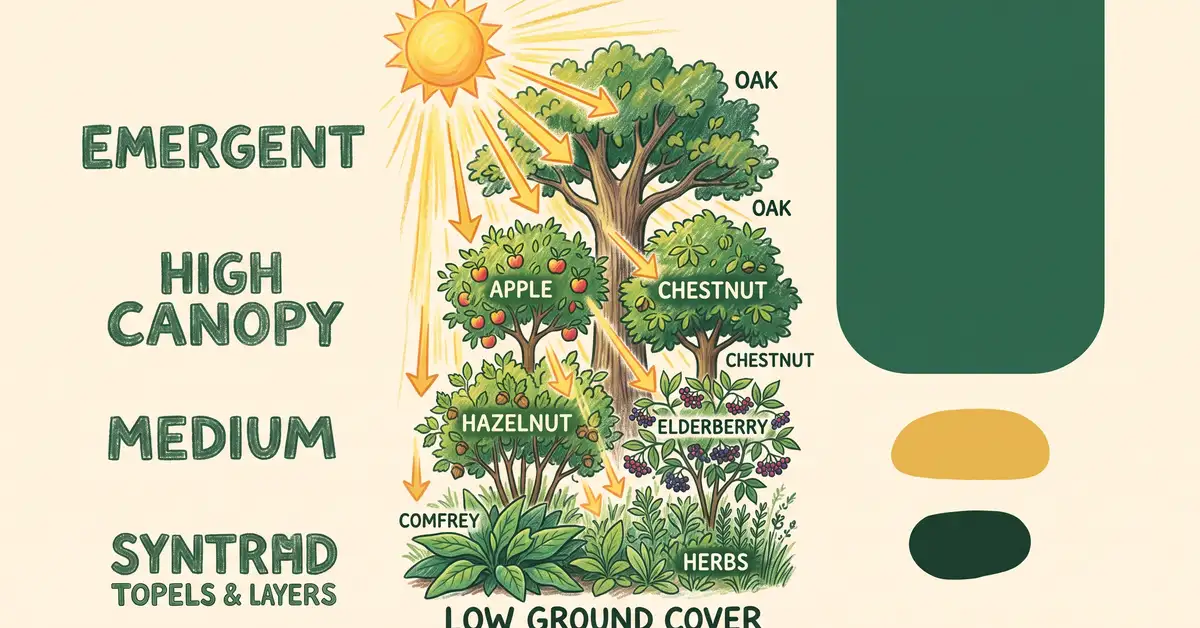
Gotsch classifies every plant in a syntropic system into one of four strata based on its mature position in the vertical column of the canopy. Each stratum receives a different intensity of light, and each species is selected so that the light it needs matches the light it gets at that stratum.
| Stratum | Light level | Tropical example (Gotsch) | Temperate adaptation |
| Emergent | 100% sun, above all others | Brazilian peroba, ipe | Bur oak, white oak, black walnut, sugar maple |
| High | 80-100% sun, top of the working canopy | Banana, papaya, cocoa-shade timber | Apple, pear, sweet chestnut, pecan |
| Medium | 40-70% sun, dappled light | Cocoa, coffee, citrus | Hazelnut, elderberry, serviceberry, pawpaw |
| Low | 10-40% sun, mostly shade | Cassava, pineapple, sweet potato | Comfrey, mint family, currants, wild ginger, ramps |
Sources: Ernst Gotsch educational materials (Agenda Gotsch); Eric Toensmeier, Carbon Farming Solution; Mark Shepard, Restoration Agriculture (temperate adaptation)
A few species shift strata as they mature. A young oak (Quercus) lives in the low or medium stratum for its first 10 to 20 years (a forest seedling tolerating shade), then breaks through into the high stratum, and finally settles into the emergent stratum at maturity. The syntropic designer needs to think about where each species will be at year 5, year 20, and year 100, not just the day of planting.
Succession classes: when light matters
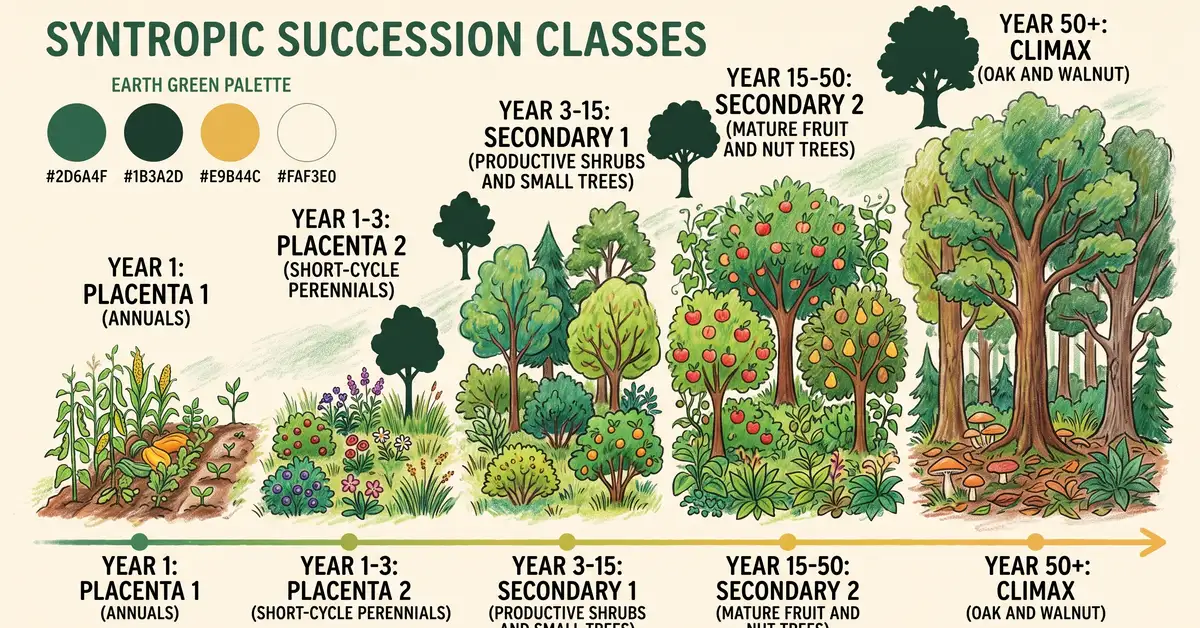
Layered onto the four strata is a second classification: succession. Gotsch divides species into classes by life span and the timing of their peak biomass production.
Placenta 1 (under 1 year)
Annuals that establish the system in year one and produce food, biomass, and ground cover while the perennials get going. Temperate examples: lettuces, brassicas, summer squash, beans, sunflowers, buckwheat. Light needs: full sun. Role: hold the soil, suppress weeds, produce harvest while you wait.
Placenta 2 (1-3 years)
Short-cycle perennials that bridge from year one to the productive phase. Temperate examples: comfrey, sorrel, strawberry, raspberry, perennial herbs. Light needs: full sun to part shade. Role: build soil with deep roots, hold the soil, start producing.
Secondary 1 (3-15 years)
Productive shrubs and small trees that become the working economic species. Temperate examples: black locust (nitrogen-fixing pioneer), elderberry, hazelnut, currant, apple, pear, peach, pawpaw, serviceberry. Light needs: full sun for fruit. Role: produce the bulk of the harvest in years 3 to 15.
Secondary 2 (15-50 years)
Larger productive trees and nut trees that mature into the high canopy. Temperate examples: chestnut, pecan, hickory, persimmon, mature apple varieties on standard rootstock. Light needs: full sun. Role: long-term production and structural canopy.
Climax (50+ years)
Long-lived trees that anchor the emergent layer at maturity. Temperate examples: white oak, bur oak, black walnut, sugar maple, beech. Light needs: tolerate shade as juveniles, demand full sun as mature canopy. Role: define the climax community, store deep carbon, deliver nuts or timber.
The point of these classes is timing. A placenta 1 lettuce and a climax oak both go in the ground in year one. The lettuce needs 100% sun immediately and is done in 90 days. The oak needs partial shade as a seedling and will not reach full canopy for 50+ years. Knowing which is which lets you plan the light cycle of the entire system.
Pruning as the light-management tool
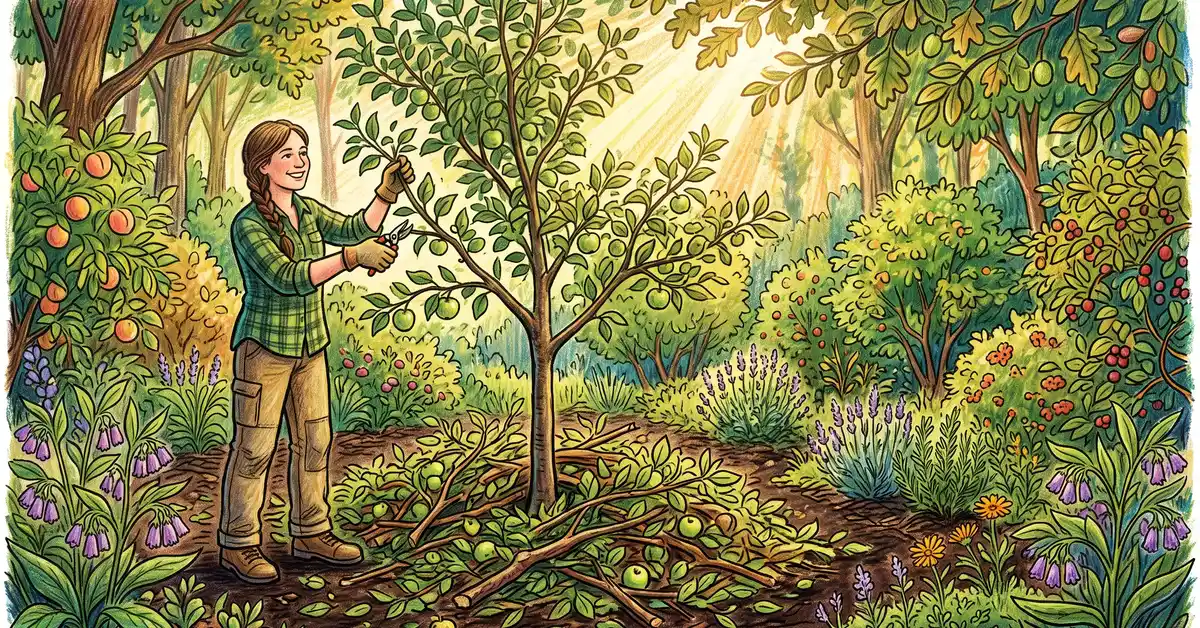
In syntropic agriculture, pruning is not occasional maintenance. It is the primary, continuous tool that drives the system. Pruning does three things simultaneously: it redirects light to lower strata that need it, it produces biomass that becomes mulch on the ground, and it stimulates the cut plant to grow back more vigorously (a phenomenon Gotsch calls "rejuvenation pruning").
The biomass-to-soil pipeline
Every prune sends pruned material onto the ground where it becomes chop-and-drop mulch. As it decomposes, it feeds the soil food web. Carbon and nitrogen flow into the soil. Microbial biomass increases. Soil structure improves. Water-holding capacity rises. The whole system gets a metabolic boost. Gotsch's farm produces 5 to 10 t of pruned biomass per acre per year in mature systems, which is more biomass production than most conventional pasture. That biomass is what builds the soil that drives the next stratum of growth.
A pruning calendar for a temperate backyard syntropic system
| Window | What to prune | Why | Intensity |
| January-February (dormant) | Apple, pear, hazelnut, elderberry structural cuts | Shape the tree, remove crossing branches, reduce canopy density before spring leaf-out | 20-30% removal |
| April-May (early growth) | Comfrey, herbaceous ground cover first chop | Free light for emerging summer crops, generate first mulch flush | Cut to ground |
| June-July (summer canopy peak) | Black locust, willow, alder, fast pioneers | Reduce canopy at peak shading to free light for understorey fruit set | 30-50% removal |
| August-September (post-fruit) | Aggressive pruners (black locust, elderberry second flush, comfrey) | Build mulch into the dormant season, prevent winter shade | 40-60% removal |
| October-November (pre-dormancy) | Final comfrey chop, light shrub tidy | Lay down protective mulch layer for winter, set up clean spring start | To ground |
Source: Agenda Gotsch pruning protocols adapted for temperate climates; Eric Toensmeier; Mark Shepard's experience at New Forest Farm, Wisconsin
Designing the light cycle: a 1/4-acre temperate example
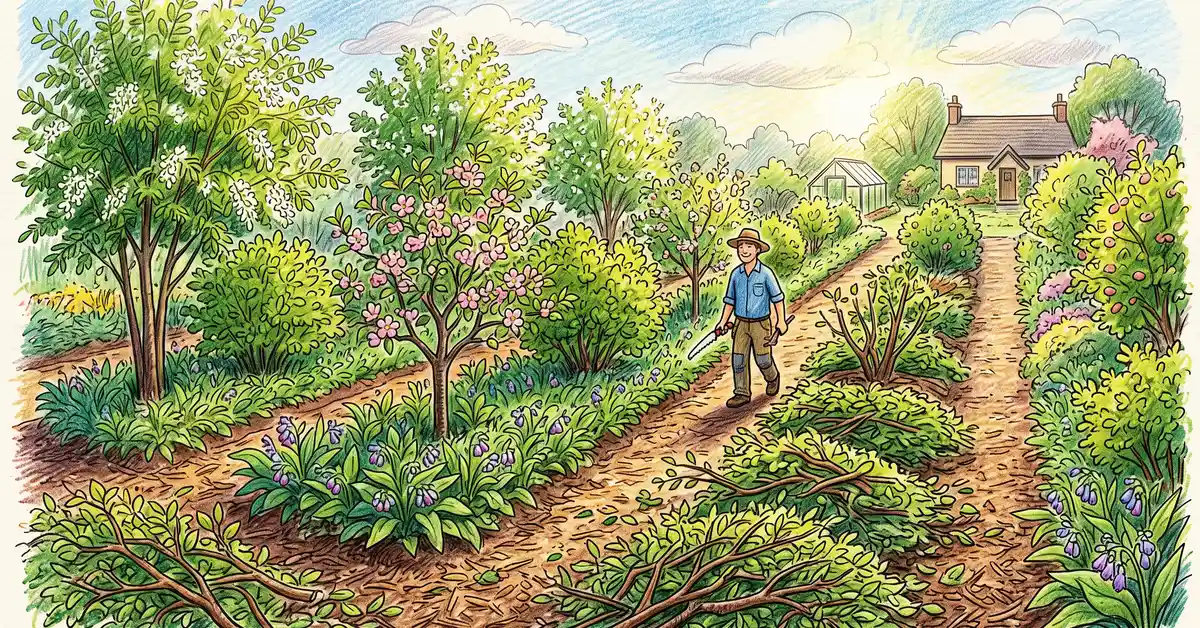
A 1/4-acre temperate syntropic system typically uses row spacing of 8 to 15 ft (the row corridor) with high in-row density (1 to 3 ft between plants in the row). The rows run north-south where possible so the working corridor stays well-lit through the day.
Layout: rows with mixed stratum stacking
Each row contains a stacked succession: an emergent tree (oak, walnut) every 30 to 40 ft, secondary 2 trees (chestnut, mature apple) every 15 to 20 ft, secondary 1 shrubs (elderberry, hazelnut) every 6 to 8 ft, and continuous placenta 2 ground cover (comfrey, strawberry) in between.
Year 1: Pioneers do the work
Plant fast-growing pioneers (black locust, willow, elderberry) plus all your placenta 1 annuals between rows. The locust will be 8 to 12 ft tall by end of year 1, casting partial shade. Annuals harvest fast. Soil starts building from chop-and-drop comfrey and locust prunings.
Year 2-5: Aggressive pruning of pioneers
Prune black locust hard every June and August. This redirects light down to the apple, hazelnut, and chestnut you also planted in year 1. The locusts respond with vigorous regrowth and continue fixing nitrogen. Apples begin fruiting in year 3 to 4. Chop-and-drop mulch builds soil rapidly.
Year 5-15: Phase out pioneers
As apple, chestnut, and hazelnut establish, the black locust pioneers can be increasingly removed (final harvest as durable fence posts or biomass). Their role is done. The system transitions to its secondary 1 and secondary 2 species at full production.
Year 15+: Climax begins to emerge
The oak you planted in year 1 has been quietly growing in the partial shade of the productive canopy. Around year 15 to 20 it begins breaking through. Continue pruning the surrounding apple and hazelnut as needed to give the oak its sun. Over the next 30 years the system shifts toward its climax form.
The light-cycle clock: a mental model
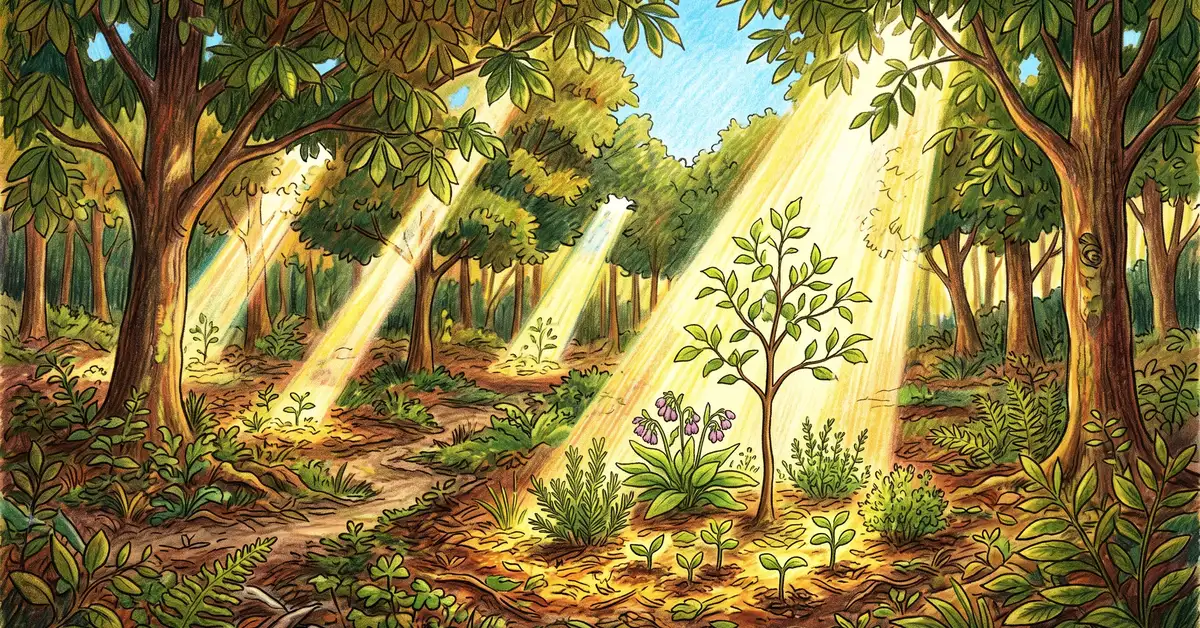
Every species follows the same arc
Gotsch teaches that every living thing follows the same cycle: a phase of expansion (when light and energy are abundant and the organism grows), a phase of maturity (when it reproduces), a phase of senescence (when energy use exceeds production), and then it dies and feeds the next cycle. An annual lettuce runs this cycle in 90 days. A 5-year shrub runs the same cycle over 5 years. A 100-year oak runs the same cycle over 100 years. Recognising which phase a plant is in lets you prune to support that phase. A vigorous expanding plant tolerates and even welcomes heavy pruning; a senescent plant should be allowed to finish and feed the system.
Common mistakes that break syntropic light management
For a broader look at how syntropic differs from classic permaculture, see syntropic agriculture vs permaculture: key differences. For the chop-and-drop technique that drives soil-building, see chop-and-drop mulching: the syntropic method. For full system context, see what is syntropic agriculture: a complete introduction.
Get the Weekly Dig
One practical permaculture guide a week, written for gardeners who do this on weekends: food forest and guild designs that produce. Free, no spam, unsubscribe any time.
Join the Weekly DigThe 30-minute exercise: find your light bottleneck
Minute 0-10: Walk the system at midday on a sunny day
Walk through your existing food forest or planned site at solar noon on a sunny day. Note where light reaches the ground (bright spots) and where it does not (deep shade). A handheld light meter or even a phone app works for spot checks.
Minute 10-20: Map the bottleneck
Identify the single biggest light bottleneck. Usually it is one species in the medium or high stratum that has been allowed to expand unpruned and is now shading out a productive layer below. Mark it on a quick sketch.
Minute 20-30: Plan the next pruning
Decide when (next dormant window or next summer canopy event) and how much (30-50% canopy reduction for a productive species, harder for a pioneer ready to phase out). Schedule it. That single pruning cut, executed well, often releases the entire system to its next phase.
FAQ
What is syntropic agriculture?
Syntropic agriculture is a regenerative agroforestry system developed by Swiss-Brazilian farmer Ernst Gotsch starting in the 1980s on his Olhos d'Agua farm in Bahia, Brazil. It uses high-density multi-species plantings, active pruning to manage light and biomass, and continuous succession management to accelerate ecosystem maturation while producing food, fiber, and timber.
Why is light the central variable in syntropic systems?
Every plant species has a specific light requirement at each life stage. Syntropic design positions species so each receives the light it needs when it needs it. Without active light management (through pruning), upper strata close over and lower strata starve. With it, every layer thrives in sequence.
What are the four syntropic strata?
Emergent (top, 100% sun, climax trees like oak), high (top of working canopy, 80-100% sun, apple, chestnut), medium (40-70% sun, shrubs like hazelnut, elderberry), and low (10-40% sun, ground cover like comfrey, herbs, currants).
What are the syntropic succession classes?
Placenta 1 (annuals, under 1 year), placenta 2 (1-3 year perennials), secondary 1 (3-15 year productive shrubs and trees), secondary 2 (15-50 year fruit and nut trees), climax (50+ year long-lived canopy). Each class has different light needs and a specific role in driving succession.
How does pruning manage light in a syntropic system?
Pruning physically removes canopy material to redirect light to lower strata. A typical major pruning removes 30-50% of canopy at peak summer or in dormant season. The pruned material becomes chop-and-drop mulch on the ground. The cut plant responds with vigorous regrowth (Gotsch calls this rejuvenation pruning).
When should I prune a temperate syntropic system?
Two main windows: January-February for structural dormant pruning (20-30% removal) and June-July for summer canopy reduction (30-50% removal on fast pioneers). A third lighter pass in August-September builds mulch and prevents winter shade.
Can syntropic agriculture work in temperate US climates?
Yes, with adaptation. Tropical syntropic systems run 60-100 species per acre at very high density. Temperate adaptations work in 15-30 species per acre at slightly lower density but follow the same light-management logic. Mark Shepard's New Forest Farm in Wisconsin and Eric Toensmeier's Paradise Lot in Massachusetts are documented temperate examples.
What is the difference between syntropic agriculture and permaculture?
Both build multi-layer food forests. Permaculture often emphasises passive design (set up well, let it run). Syntropic emphasises active management with continuous, planned pruning to drive light, succession, and biomass. The syntropic farmer is much more involved year-round than a typical permaculture practitioner.
How much biomass does a syntropic system produce?
Mature syntropic systems produce 5-10 t of pruned biomass per acre per year, all of which goes back into the soil as chop-and-drop mulch. This is the carbon-and-nitrogen pipeline that drives soil-building and powers the next stratum of growth.
What temperate species work as syntropic pioneers?
Black locust (nitrogen-fixing, fast, durable wood), willow (rapid growth, easy propagation, biomass), elderberry (fast, productive, easy chop), comfrey (deep tap root, soil mining, hard to kill). These get the system going in years 1-5 then are progressively phased out as productive species establish.
Resources
- Agenda Gotsch - Ernst Gotsch educational platform
- Agenda Gotsch English portal
- Agenda Gotsch YouTube channel (pruning demonstrations)
- Mark Shepard - Restoration Agriculture (temperate adaptation)
- Eric Toensmeier - Perennial Solutions and Carbon Farming Solution
- USDA Forest Service - Agroforestry research
- USDA NRCS - Agroforestry conservation practices
- University of Missouri Center for Agroforestry
- Savanna Institute - Midwest temperate agroforestry research