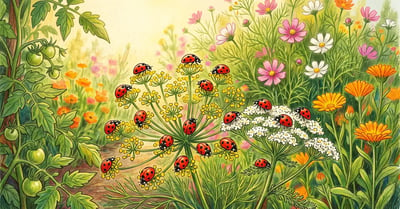

Buying a tub of ladybugs and tipping it onto your aphids is the wrong move. Most of them fly away within days. The version that works is slower and much cheaper: plant the flowers that keep predators fed between meals, so the population is already there when the aphids arrive.
Those flowers are called insectary plants, and the list is shorter and more specific than most garden advice suggests. Flower shape matters more than flower colour, and most of the pretty things in a pollinator mix are useless for this job.
What you'll find below:
- Why a parasitoid wasp can feed on dill but not on a foxglove
- The named species that show up repeatedly in the research, not the generic lists
- How much space to give them, and how close to the crop
- Which recommended insectary plants also feed pests
- Why released ladybugs leave, in the words of the people who studied it
Key Takeaway
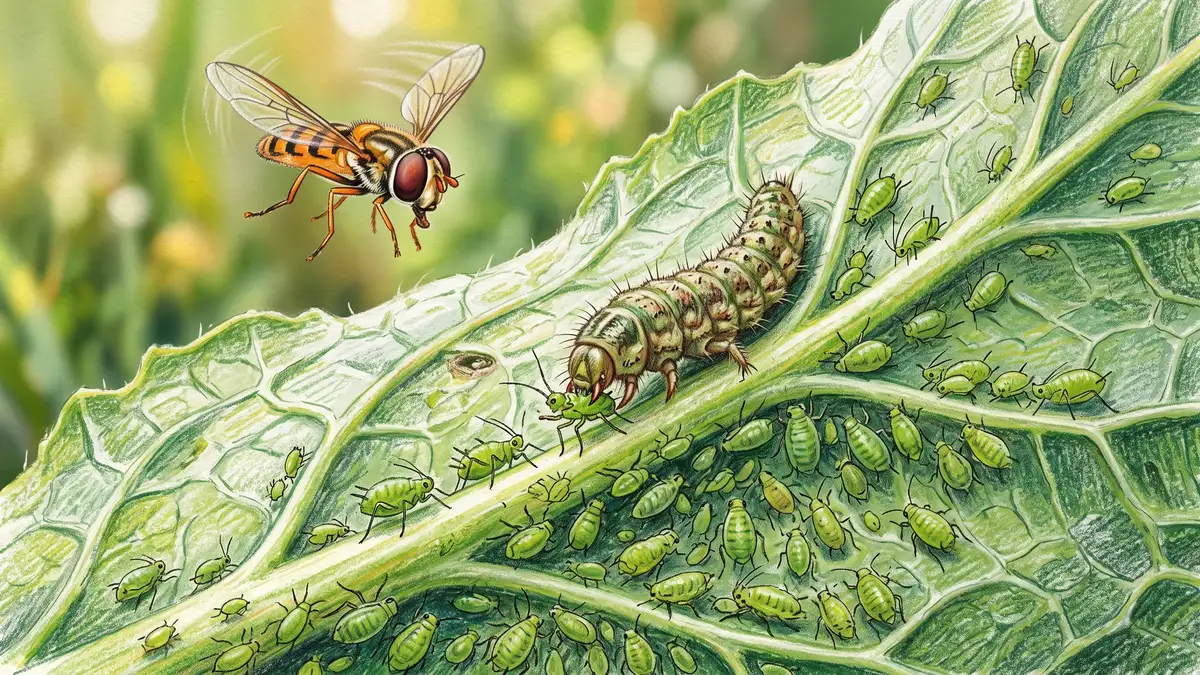
The larvae eat pests. The adults eat nectar and pollen. That single fact drives the whole practice: if adult hoverflies, lacewings and parasitoid wasps cannot find flowers, they do not stay, do not live long, and do not lay eggs where your aphids are. Insectary plants feed the parent so the offspring can do the work.
Why Does Flower Shape Matter So Much?
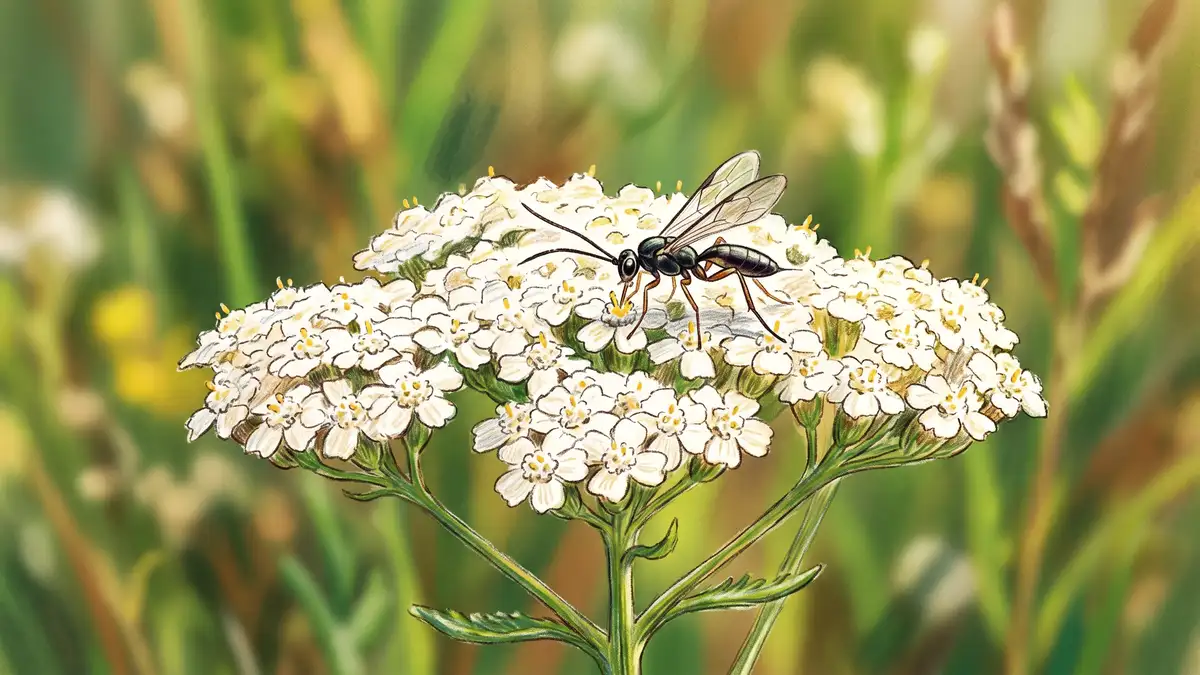
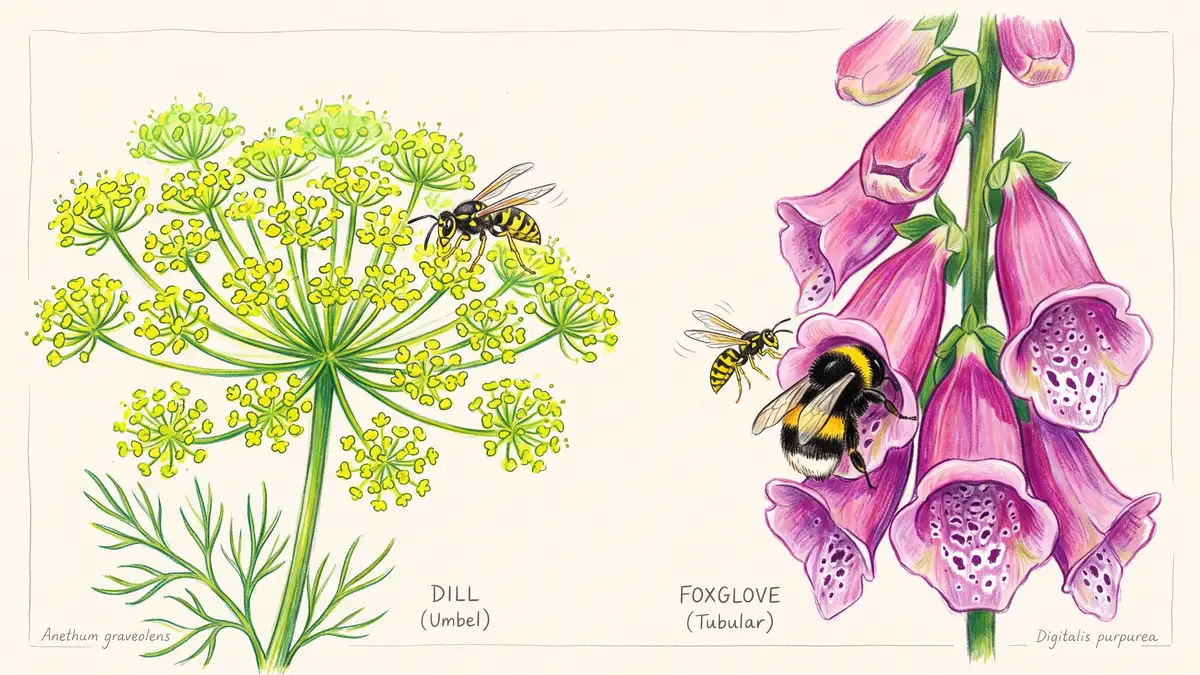
Most parasitoid wasps have short mouthparts. They can drink exposed nectar but cannot reach down a tube. A 2010 study in the Annals of the Entomological Society of America analysed pollen from museum specimens and found Asteraceae and Apiaceae pollen turning up again and again on parasitic wasps, because those two families offer shallow florets with nectar near the surface.
That is why an umbel of dill works and a foxglove does not. The umbel is also a landing platform, which matters for an insect the size of a comma.
| Beneficial | What the Larva Eats | What the Adult Eats |
| Hoverfly (Syrphidae) | Aphids, up to hundreds each | Nectar and pollen only |
| Green lacewing (Chrysopidae) | Aphids, thrips, mites, eggs | Mostly nectar, pollen, honeydew |
| Parasitoid wasp (Braconidae, Ichneumonidae) | Develops inside the host | Nectar, sometimes pollen |
| Tachinid fly | Develops inside caterpillars | Nectar and pollen |
| Ladybug (Coccinellidae) | Aphids and scale | Aphids plus pollen when prey is scarce |
| Minute pirate bug (Orius) | Thrips, mites, small eggs | Prey plus pollen as protein source |
Sources: UC IPM, Insectary Plants, Xerces Society, Conservation Biological Control
The effect is measurable. Vattala and colleagues tested several flowers with the parasitoid Dolichogenidea tasmanica and found that only buckwheat and coriander increased its longevity, with corolla aperture and depth determining access. A later study by Araj and colleagues found every tested species increased parasitoid longevity, egg load and realised fecundity compared with a nectarless control, buckwheat most of all.
Why This Works: Every Element Needs Its Own Support System
Conventional pest control treats the predator as a tool you deploy. Permaculture treats it as an organism with its own requirements, which are mostly not the pest. Once you ask what a hoverfly needs across its whole life rather than just its hungry larval stage, the answer stops being "release more hoverflies" and becomes "grow the thing the adults eat". This is the same shift that turns companion planting from folklore into ecology: you are not pairing plants, you are building the food web that keeps the pairing working.
Which Plants Actually Work?
Skip the generic pollinator list. These are the species that appear repeatedly in extension guidance and in the biological control literature.
| Plant | Type | Bloom | Who It Feeds |
| Sweet alyssum (Lobularia maritima) | Annual, 4-8 in. | Spring to frost | Hoverflies, parasitoid wasps |
| Buckwheat (Fagopyrum esculentum) | Annual, 2-3 ft | 5 weeks from sowing | Parasitoid wasps, hoverflies |
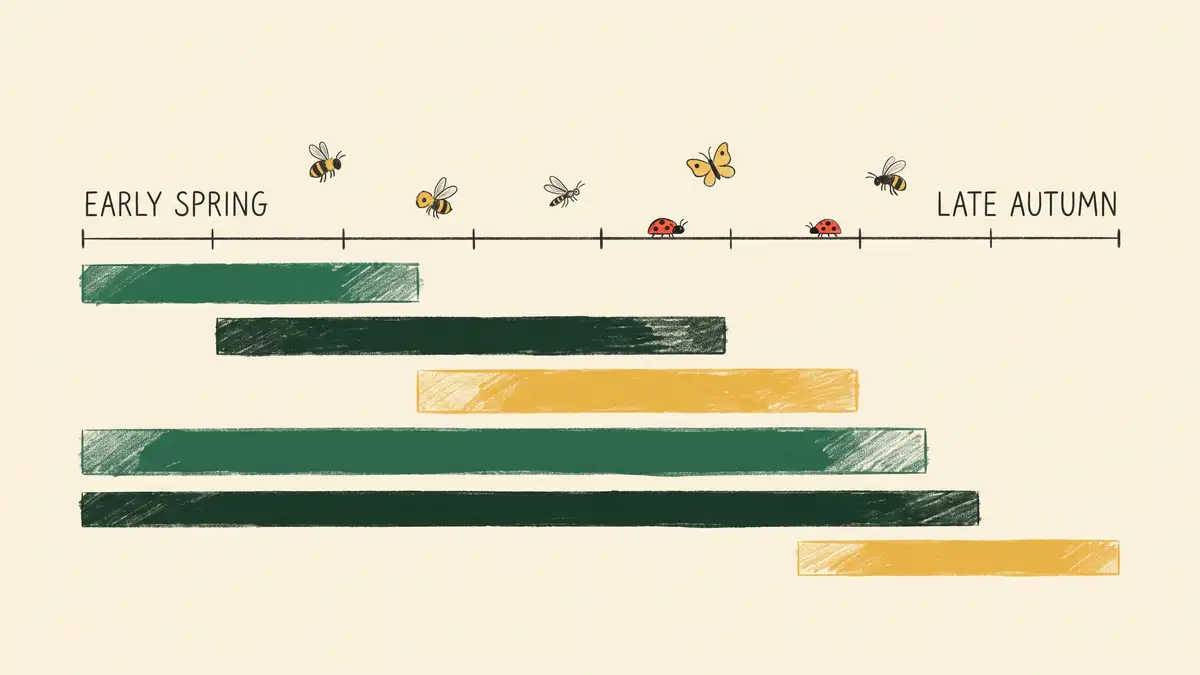
| Dill, cilantro, fennel (Apiaceae) | Annual or biennial | Early to midsummer | Parasitoid wasps, tachinid flies |
| Yarrow (Achillea millefolium) | Perennial, 12-24 in. | Early to late summer | Small wasps, hoverflies, bees |
| Cosmos | Annual, 3-4 ft | Midsummer to frost | Hoverflies, lacewings, bees |
| Phacelia (Phacelia tanacetifolia) | Annual, 2-3 ft | 6-8 weeks from sowing | Hoverflies, bees, parasitoids |
| Mountain mint (Pycnanthemum) | Perennial, 2-3 ft | Mid to late summer | Small wasps and flies |
| Goldenrod (Solidago) | Perennial, 2-5 ft | Late summer to fall | Late-season wasps, flies, beetles |
| Native asters (Symphyotrichum) | Perennial, 1-3 ft | Late summer to fall | Hoverflies, parasitoids |
| Sunflower | Annual, 3-10 ft | Mid to late summer | Nectar plus extrafloral nectaries |
Sources: UC IPM, Insectary Plants, Rodale Institute, How to Plant Insectary Strips, Xerces Society, Conservation Biological Control
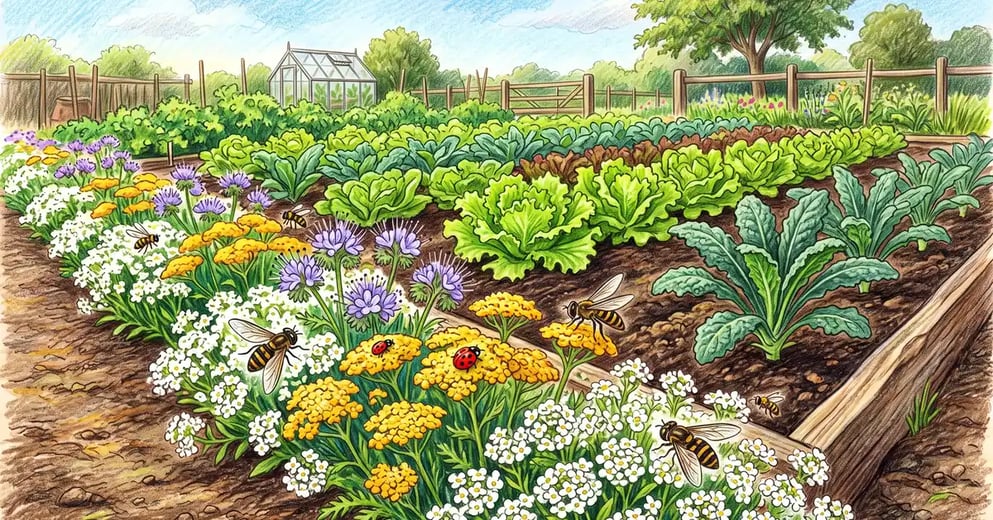
Two documented performers deserve singling out. Sweet alyssum intercropped in lettuce is the best-evidenced example in US organic vegetable production: USDA ARS research by Brennan on strip intercropping lettuce with alyssum found hoverfly larvae reduced aphid populations below economic thresholds. And buckwheat improved parasitism of lepidopteran cabbage pests across a four-year trial, as well as increasing parasitism of leafhopper eggs in grapes.
Check Before You Plant Two of These
Tansy appears on older insectary lists and is invasive across much of the Pacific Northwest and northern states. Fennel is a serious invasive in California. Both are excellent insectary plants and both can be a genuine problem depending on where you garden. Check your state's noxious weed list, and substitute yarrow or native asters where they are a concern. Sunflowers also attract tarnished plant bug, which is a pest in its own right.
How Much Should You Plant, and Where?
Rodale Institute's practical figure is a strip 3 to 5 ft (0.9 to 1.5 m) wide for every 6 to 8 rows of crop, or a flowering border along one side of the growing area. In most layouts that puts insectary plants at roughly 5 to 15 percent of the growing space.
Distribution beats concentration. A single flower bed in the far corner does much less than the same total area spread as edging along every vegetable bed, because these are small insects and the distance from nectar to prey has to be short.
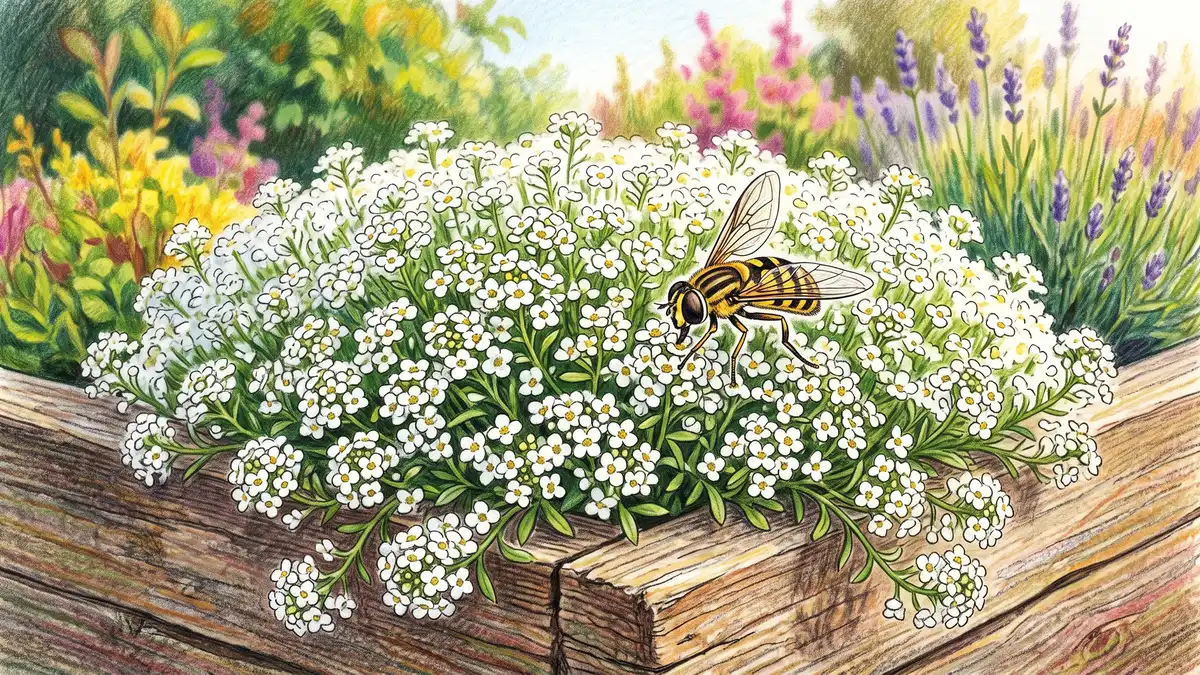
Edge your beds with alyssum
Cheapest, fastest, best-evidenced starting move. Alyssum is 4 to 8 in. tall, will not shade anything, self-seeds, and blooms from spring until hard frost. A packet of seed does a lot of bed edge.
Let some herbs bolt on purpose
Dill, cilantro and parsley become insectary plants the moment they flower. Sacrifice one plant in three to bolting rather than pulling them all. It costs nothing and puts umbels directly inside the crop.
Sow buckwheat into any gap
It flowers about five weeks from sowing and dies at first frost, so it fits any bed between crops. Sow a fresh patch every three weeks through summer for continuous bloom. Be aware it self-seeds readily.
Add perennials for the shoulders of the season
Yarrow for early summer, mountain mint for midsummer, goldenrod and native asters for autumn. Perennials are what carry the population through the periods when your annuals are not flowering, which is where most insectary plantings fail.
Stop spraying broad-spectrum insecticides
This step is not optional. A single broad-spectrum application resets the predator population, and predators recover more slowly than pests because they need prey to rebuild. You can have insectary plants or you can have the spray. Not both.
What Should You Realistically Expect?
Not zero pests. That is not the goal and it is not achievable. What habitat manipulation reliably delivers is a shorter, shallower pest outbreak, because predators are present when populations start climbing rather than arriving three weeks later.
The evidence base is genuinely mixed. Some trials show clear reductions in pest damage, the alyssum and lettuce work being the strongest US example. Others find higher natural enemy numbers with no measurable change in crop damage. Anyone promising you a certain outcome has not read the papers.
Expect a lag. Perennials take two seasons to establish and start pulling their weight. Annual insectary plants can shift things within the same season, but the population response builds year over year as overwintering habitat accumulates.
The Honest Version
Insectary plants are not a pest control product. They are a way of tilting the odds so that the natural enemies already in your area have a reason to stay in your garden instead of a neighbour's. Combine them with trap cropping, healthy living soil and reasonable expectations, and the whole system gets easier every year.
Frequently Asked Questions
What are insectary plants?
Insectary plants are flowering plants grown deliberately to feed and shelter beneficial insects, particularly the adult stages of predators and parasitoids whose larvae attack pests. UC IPM defines them as plants providing the nectar and pollen that adult natural enemies need, noting that beneficials may not stay in a garden even when pests are abundant if those floral resources are missing. The most effective species have shallow, exposed flowers, chiefly in the carrot and daisy families.
What plants attract ladybugs?
Flat, open flowers with accessible pollen: yarrow, dill, cilantro, fennel, cosmos, sunflowers and native asters. Adult ladybugs eat pollen as well as aphids, and pollen sustains them when prey is scarce. Planting for them works considerably better than buying them. Released convergent ladybugs are typically collected while in migratory condition and disperse within days of release, so most of what you paid for ends up in a neighbouring yard.
What is the difference between insectary plants and pollinator plants?
The lists overlap but are not the same. Pollinator plants are chosen for bees and butterflies, many of which have long tongues and can work deep tubular flowers. Insectary plants are chosen for predators and parasitoids, most of which have short mouthparts and need shallow, exposed nectar. A bed of penstemon and salvia is excellent for bees and close to useless for parasitoid wasps. Plant both, but do not assume one list covers the other job.
How much of my garden should be insectary plants?
Rodale Institute suggests strips 3 to 5 ft wide every 6 to 8 crop rows, which works out to roughly 5 to 15 percent of the growing area in most layouts. For a home garden, edging beds with alyssum and letting some herbs bolt gets you into that range without giving up a whole bed. Spread the plantings across the garden rather than concentrating them in one corner, because these insects do not travel far between nectar and prey.
Does buckwheat really work as an insectary plant?
It has the best evidence of the annuals. Buckwheat produced the greatest increase in parasitoid longevity, egg load and fecundity in a comparative trial, improved parasitism of cabbage caterpillars across four years, and increased parasitism of leafhopper eggs in grapes. It flowers about five weeks from sowing and dies at frost, so it slots into gaps easily. Watch for self-seeding, and cut it before seed set if volunteers would be a nuisance.
Do I still need to control pests if I plant insectary plants?
Yes, sometimes. Habitat manipulation shortens and flattens outbreaks rather than eliminating them, and some trials show more natural enemies with no measurable reduction in crop damage. Treat insectary plants as one layer alongside companion herbs, row cover, hand removal and crop rotation. The one thing you cannot combine them with is broad-spectrum insecticide, which removes the predators faster than the pests.
Get the Weekly Dig
One practical permaculture guide a week, written for gardeners who do this on weekends: pest control that works without a spray bottle. Free, no spam, unsubscribe any time.
Join the Weekly DigResources
- UC IPM, Insectary Plants: the definition and the core recommended species list
- UC IPM, Protecting Natural Enemies and Pollinators: pesticide effects on beneficial populations
- Rodale Institute, How to Plant Insectary Strips and Which Plants to Use: strip width, spacing and species selection
- Xerces Society, Conservation Biological Control: habitat design for natural enemies
- Brennan (2013), Biological Control: Strip Intercropping Lettuce with Alyssum: the hoverfly and aphid results
- Vattala et al. (2006), Biological Control: Flower Morphology and Nectar Quality: why corolla depth determines parasitoid access
- Araj et al. (2015), Biological Control: Comparing Weeds and Insectary Plants: longevity and fecundity effects by species
- Lee (2005), Biological Control: Flowering Buckwheat and Cabbage Pests: four-year parasitism trial
- Pucci (2010), Annals of the Entomological Society of America: Mouthpart Length and Floral Visitation: why Apiaceae and Asteraceae dominate
- Influence of Flowering Cover Crops on Anagrus Parasitoids: buckwheat and leafhopper egg parasitism in grapes
- Jachowicz et al. (2025), Agriculture, Ecosystems and Environment: Diverse Flower Strips: natural enemy response and the limits of the effect
- Mondor et al. (2006): Extrafloral Nectary Plasticity in Fava Bean: damage-induced nectaries that recruit natural enemies