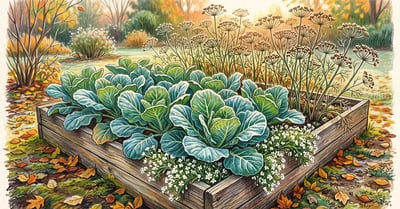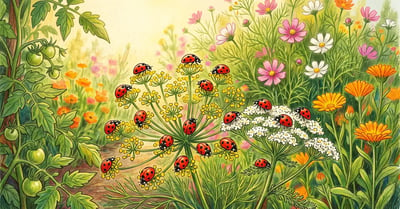

Companion planting tells you basil grows well with tomatoes. Guild planting tells you how to design a 7-function perennial polyculture around an apple tree that nitrogen-fixes, accumulates minerals, repels pests, attracts pollinators, suppresses weeds, mulches itself, and gives you fruit for 30 years. Same logic, different scale. If you have mastered the basics of companion pairs and are ready for the perennial system that produces yield for decades on the same square footage, guild planting is the next step. building a guild around a cherry perennial brassicas like Daubenton kale
This guide covers the 7 functional roles every guild needs, the classic recipes (apple, peach, Three Sisters), the mycorrhizal science that makes guilds work, the allelopathy pitfalls that break them, and a step-by-step design protocol you can apply to any anchor species in any climate.
What "guild planting" actually means
Toby Hemenway's Gaia's Garden defines a guild as "a group of plants and animals that work harmoniously in a living system to support a central element." In practice, a guild is built around an anchor (almost always a tree or large shrub), with each other plant in the guild filling a specific functional role. Dave Jacke and Eric Toensmeier's two-volume Edible Forest Gardens formalizes the framework with a "functions matrix" for each species: what does this plant produce, what does it accumulate, what does it attract, what does it tolerate.
The crucial distinction from companion planting:
| Approach | Time horizon | Structure | Typical example |
| Companion planting | 1 season | Annual pairs in vegetable beds | Tomato + basil; carrot + onion |
| Guild planting | 5-30+ years | Perennial polyculture around an anchor | Apple tree + comfrey + clover + chives + yarrow |
Sources:.
Why this works (the niche-stacking principle)
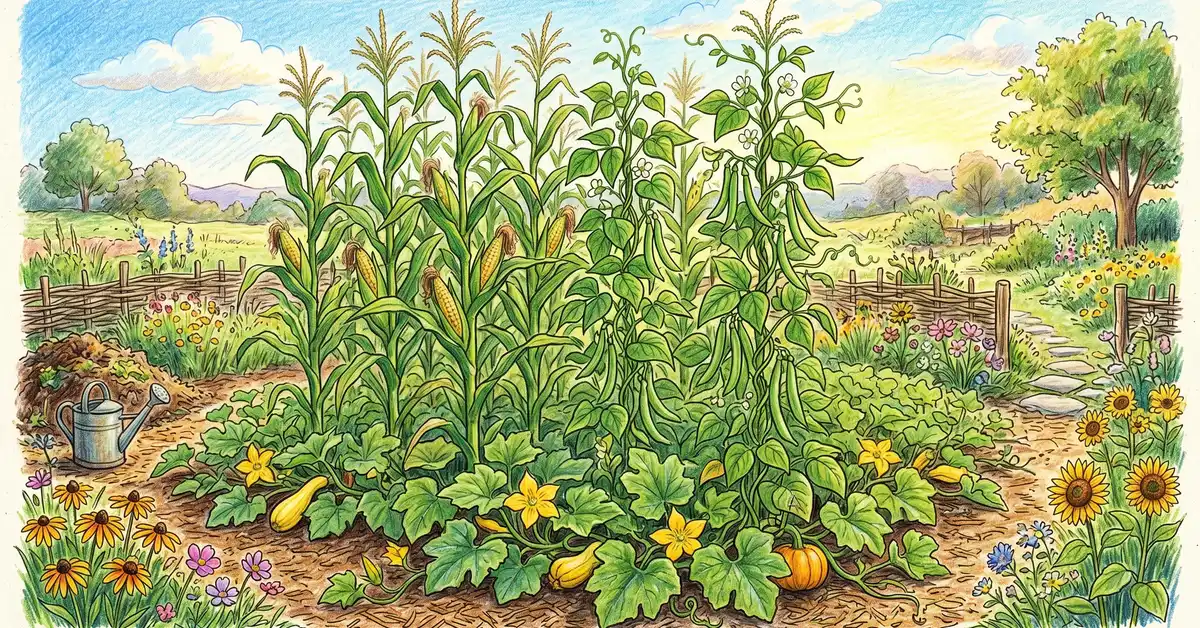
Bill Mollison's permaculture design principle is that every element should serve multiple functions and every function should be served by multiple elements. A guild operationalizes this. Each plant occupies a distinct niche (deep root vs shallow, nitrogen fixer vs nitrogen consumer, spring bloomer vs autumn bloomer, tap root vs fibrous root), so they cooperate rather than compete for the same resources. The mature guild produces more total biomass and yield from the same footprint than the anchor tree growing alone, while requiring less external input. This is the same logic behind the Three Sisters polyculture documented in USDA's National Agricultural Library Three Sisters story: corn provides the trellis, beans fix nitrogen the corn needs, squash shades the soil and suppresses weeds.
The 7 functional roles every guild needs
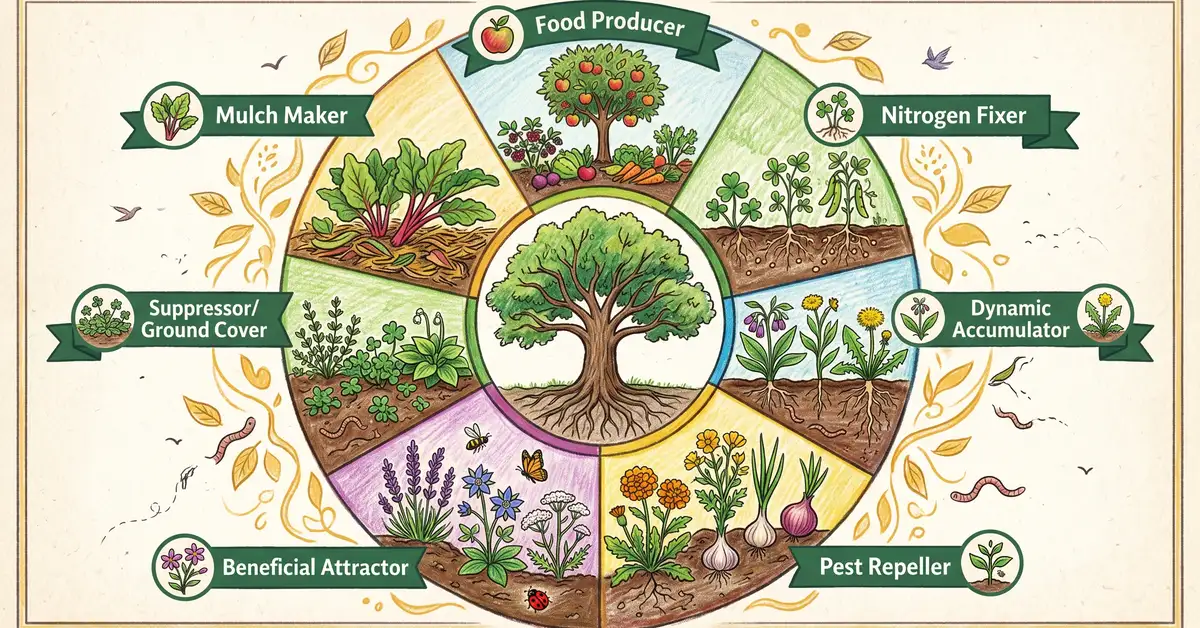
Hemenway's 7-role framework gives you a checklist for any guild you design. A complete guild fills every role; an incomplete guild leaves work for you to do externally.
| Role | Function | Example species |
| 1. Food / yield producer | The anchor and any other edible plants | Apple, pear, hawthorn, currant, asparagus |
| 2. Nitrogen fixer | Pulls N from air via rhizobial symbiosis | White clover, red clover, lupine, Siberian pea shrub, false indigo, alder |
| 3. Dynamic accumulator | Deep roots pull minerals from subsoil, cyclable as mulch | Comfrey (Bocking 14), dandelion, yarrow, dock |
| 4. Pest repeller | Aromatic oils or root exudates that deter pests | Chives, garlic, alliums, marigold (with caveat), tansy |
| 5. Beneficial insect attractor | Nectar/pollen for predators of pests and pollinators | Dill, yarrow, native asters, calendula, mountain mint |
| 6. Suppressor / ground cover | Covers bare soil; suppresses weeds; retains moisture | White clover, strawberry, creeping thyme, sweet woodruff |
| 7. Mulch maker | Produces high biomass for chop-and-drop mulching | Comfrey, false indigo, Siberian pea shrub |
Sources: Toby Hemenway,.
Some species fill multiple roles (comfrey is dynamic accumulator + mulch maker + beneficial insect attractor at once), which is why permaculture practitioners reach for it so often. The Hemenway shortcut: if you can only plant 3 species in your guild, plant comfrey, clover, and chives. You will hit 5 of the 7 roles with those three.
The classic apple tree guild (recipe)
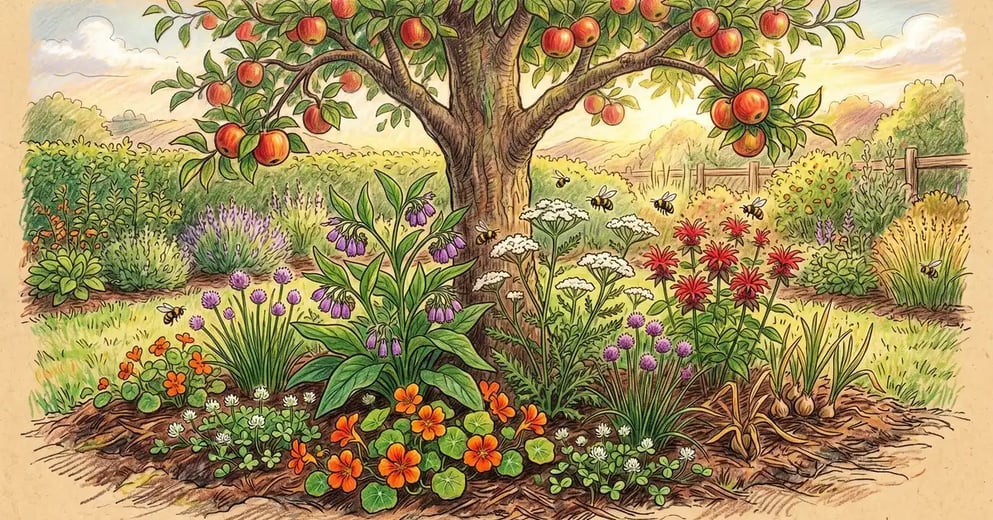
The apple tree guild is the textbook example because almost every temperate-climate gardener has either grown apples or wanted to. Here is the standard recipe, working outward from the trunk:
Anchor: 1 dwarf or semi-dwarf apple tree
Mature size 8 to 15 ft (2.4 to 4.5 m). Disease-resistant cultivars (Liberty, Enterprise, Williams Pride, Goldrush). Keep bare soil for 4 to 6 in (10 to 15 cm) directly at the trunk.
Inner ring (1 to 2 ft / 30 to 60 cm from trunk): bulbs
Daffodils, alliums, or garlic. The strong-smelling foliage deters voles and rabbits that would otherwise chew bark at ground level.
Middle ring (2 to 4 ft / 60 to 120 cm): dynamic accumulators + pest repellers
2 to 3 Bocking 14 comfrey plants (mineral accumulator, chop-and-drop mulch). Chives all the way around (repel aphids, deter codling moth). 1 to 2 yarrow plants (accumulator + beneficial insect attractor).
Outer ring (4 to 6 ft / 1.2 to 1.8 m): N-fixers + pollinator attractors
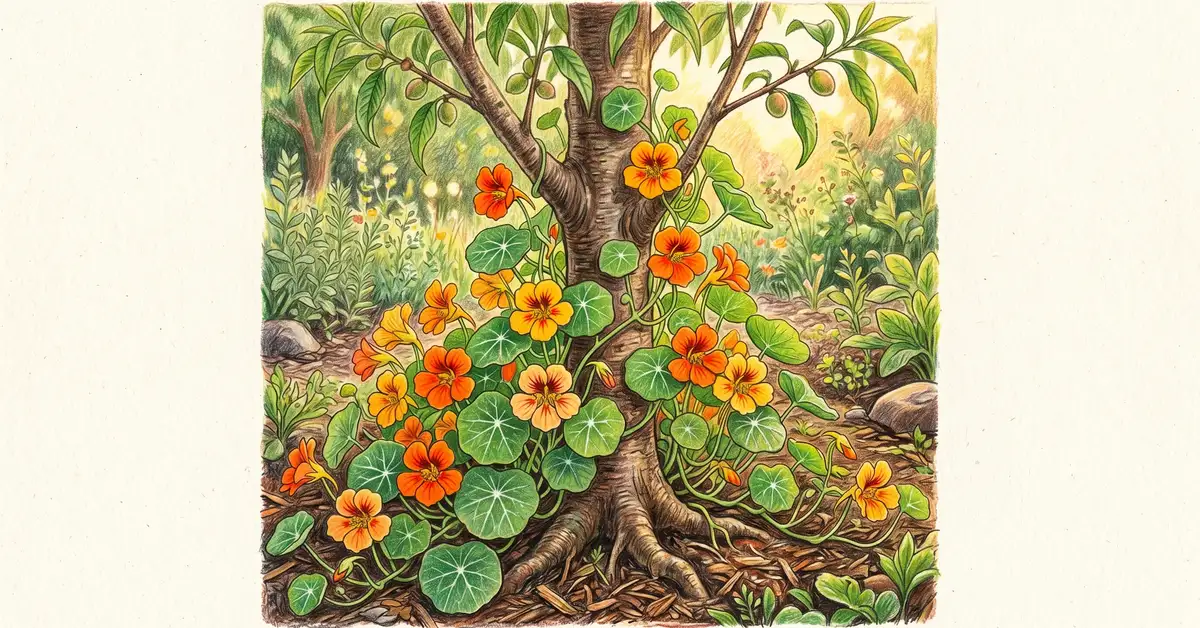
White clover ground cover (nitrogen fixer + suppressor). Bee balm and calendula (pollinator + secondary insect attractor). Nasturtium climbing up the lower trunk in summer (pest repeller + edible flower + soft mulch as it dies back).
Drip line: ground cover + soft fruit
Strawberry runners, more clover, low creeping thyme. Add a currant or gooseberry bush at the outer edge to use the dappled shade that the apple casts in late afternoon.
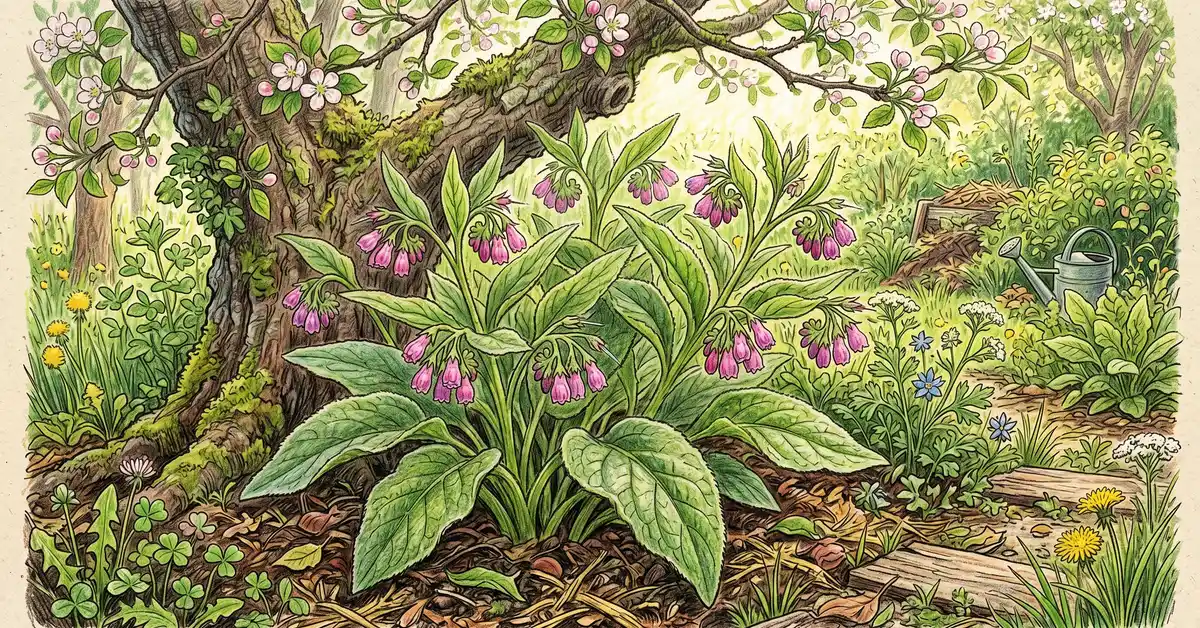
Total plants for one apple guild: roughly 12 to 20 species across 80 to 150 sq ft (7 to 14 m²). Full establishment takes 2 to 3 seasons; the apple itself takes 4 to 7 years to meaningful fruit production. For the deep-dive on this specific recipe, see our apple tree guild walkthrough.
The peach tree guild (warm-climate alternative)
For USDA zones 6 to 9 where peaches thrive, the guild structure changes slightly. Gardenia.net's peach companion plant guide emphasizes the borer-and-leaf-curl pressure peaches face, so the guild leans heavier on aromatic pest deterrents.
Peach guild recipe: anchor (semi-dwarf peach), allium ring (chives + garlic) at 1-2 ft, comfrey + tansy + yarrow at 2-4 ft, white clover + strawberry + crimson clover ground cover at the drip line, with bee balm and dill placed in sunny gaps as borer-attracting wasps love them. Skip the bulb ring if voles are not a problem in your area; the southern peach grower's problem is more often peach tree borer (a clearwing moth larva), which the allium ring helps suppress by masking the peach's scent.
Three Sisters: the annual guild
Not every guild needs a tree. The Three Sisters (corn, beans, squash) is the most-studied annual polyculture in North America. The Wikipedia entry on Three Sisters and the USDA National Agricultural Library essay document the indigenous Haudenosaunee, Anishinaabe, and Cherokee origins (predating European contact by at least 500 years). The mechanism:
- Corn provides a living trellis for the beans (no stakes needed).
- Beans fix nitrogen via Rhizobium symbiosis, feeding the heavy-N-feeding corn.
- Squash sprawls between the corn hills, shading the soil, suppressing weeds, and discouraging raccoons with its prickly vines.
A 2018 Low Tech Institute proposal for market-farm Three Sisters intercropping documents yield improvements of 15 to 30 percent over monoculture corn, plus reduced fertilizer and weed-management cost. The principles transfer to any annual garden: pair a tall heavy-feeder with a climbing N-fixer and a sprawling ground-cover species. Tomato + pole bean + winter squash works on the same logic for hot-summer climates.
The mycorrhizal layer: why guilds outperform isolated plants
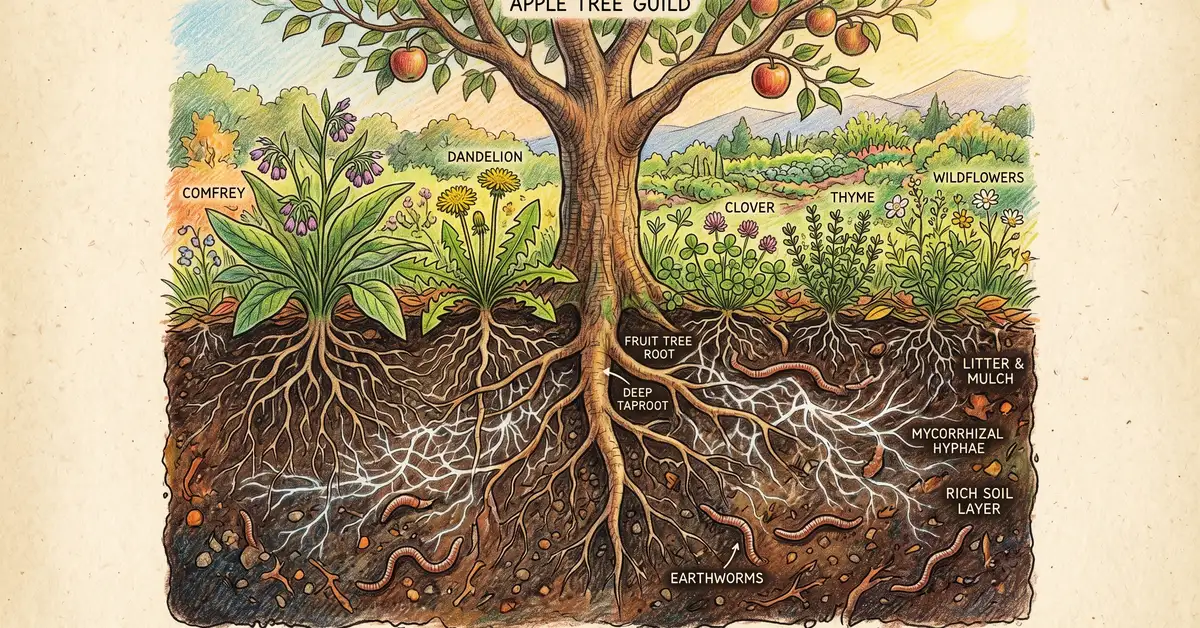
The visible part of a guild is just the canopy. The functional engine is underground: a mycorrhizal network connecting the roots of every plant in the guild. Suzanne Simard's lab at the University of British Columbia (Simard research page) documented in a series of peer-reviewed studies that trees connected by ectomycorrhizal networks share carbon, nitrogen, and defensive signals. A PMC-hosted study on inter-plant communication through mycorrhizal networks demonstrated that plants under aphid attack signal neighboring plants via fungal hyphae, triggering defensive chemical production in the neighbors before the aphids arrive.
Practical implication for your guild: do not till. Once you establish the guild, leave the soil structure intact. The mycorrhizal network takes 2 to 3 years to mature and is destroyed by even shallow tillage. Top-dress with mulch and compost; let the worms and fungi do the integration.
Allelopathy: the silent guild-killer
Allelopathy mistakes that break guilds
Black walnut (Juglans nigra) produces juglone that inhibits tomatoes, blueberries, apples, and most Solanaceae within 50-80 ft (15-25 m) of the canopy. Per Garden Professors analysis of walnut allelopathy, this is a real measurable effect. Fennel inhibits most other plants including tomatoes, beans, and lettuce; isolate it. Sunflower exudates can inhibit germination of small-seeded crops. Penn State Extension's allelopathy in the home garden guide covers the full list. Never plant a guild under a black walnut.
Dynamic accumulators: the contested role
The "dynamic accumulator" idea, popularized by Lawrence D. Hills and the Henry Doubleday Research Association in the mid-20th century (full text at the Hills comfrey book PDF), claims that certain plants concentrate specific minerals from deep soil layers and make them available to the surface via leaf litter. Comfrey is the most famous example, said to accumulate potassium at 3 to 5 times soil concentration.
Modern science is mixed on the claim. A long-running Permies discussion summarizing the available evidence notes that many "dynamic accumulator" lists in permaculture books trace back to unsourced 1970s-era claims, not peer-reviewed measurements. Comfrey's mineral accumulation is documented (Garden Organic comfrey vs nettle feeds PDF) and the leaves do test high in K. Other species on the standard accumulator list (yarrow, dandelion, dock) have less rigorous documentation. The honest position: comfrey works, the rest are probable-but-not-proven. Plant them anyway, they fill other guild roles regardless.
Designing your own guild: a 6-step protocol
Pick your anchor first
The anchor determines everything downstream. Fruit tree, large nut tree, large shrub. Choose a cultivar adapted to your USDA zone (verify with the USDA Plant Hardiness Zone Map) and pick disease-resistant varieties.
Map the 7 functions on paper
List each role and pick 1 to 2 species per role. Cross out conflicts (allelopathy, water needs mismatch, sun/shade mismatch).
Match water needs across the guild
All plants in a guild should want the same moisture range. Don't put drought-tolerant lavender into an apple guild that wants steady moisture. Group similar water needs together.
Plant from the trunk outward
Plant the anchor first in year 0. Add the inner-ring bulbs and herbs in year 1. Add the outer-ring N-fixers and ground cover in year 1 or 2. Don't try to plant everything in the first season.
Maintain the bare-soil ring at the trunk
Keep 4 to 6 in (10 to 15 cm) bare soil at the trunk to prevent rot, vole damage, and crown girdling. Mulch the rest of the guild heavily.
Chop-and-drop the comfrey 3 to 5 times a year
Cut comfrey to 4 in (10 cm) above the crown 3 to 5 times during the growing season. Spread the leaves as mulch under the anchor tree. This is how nutrients cycle from deep soil to the canopy.
Common mistakes
- Spacing too tight. Beginners plant the entire guild within 3 ft (0.9 m) of the trunk. The outer ring needs to extend to the eventual drip line, often 6 to 10 ft (1.8 to 3 m) for mature dwarf trees.
- Choosing aggressive natives that take over. Mint, comfrey from seed (rather than sterile Bocking 14 cuttings), and creeping jenny all sound great until they smother the guild.
- Water-needs mismatch. A drought-tolerant rosemary in a wet-meadow apple guild will rot. Match moisture preferences.
- Forgetting succession. The guild changes shape over time as the anchor matures. Sun-loving plants in year 1 may be shaded out by year 5. Plan for shade-tolerant successors.
- Skipping the bare-soil ring at the trunk. Vole damage and crown rot are the two most-common ways guild trees die. Both are prevented by 4-6 inches of bare soil at the trunk.
Climate adaptations
The framework is universal; the species are regional. Good Earth Design's Colorado permaculture plant list documents arid-cold substitutions: Siberian pea shrub instead of clover, sea buckthorn instead of currant, drought-tolerant penstemon for nectar. Living Agrolab's Mediterranean food forest guilds documents olive-and-almond-anchor guilds with rosemary, lavender, and Italian arum.
The rule: keep the 7 functions, swap the species. A western desert guild looks nothing like a Pacific Northwest apple guild but follows the same functional logic.
The bottom line
Pick one anchor (apple, peach, pear, hazelnut, or any tree you actually want fruit from). Plant 3 to 5 species in the first season covering the 7 functions: comfrey, white clover, chives, yarrow, bee balm. Add 2 to 3 more in year 2 (bulbs, nasturtium, strawberry). Keep 4 to 6 in of bare soil at the trunk forever. Chop-and-drop the comfrey 3 to 5 times a year. By year 3 you have a self-mulching, self-fertilizing, pollinator-buzzing food production system that will run for 30+ years on its own.
FAQ
What is a tree guild?
A tree guild is a permaculture polyculture built around a central tree, where each surrounding plant fills a specific functional role (nitrogen fixer, dynamic accumulator, pest repeller, beneficial insect attractor, suppressor/ground cover, mulch maker) so the entire system supports the tree and produces yield with minimal external input. Distinct from companion planting in that it is perennial and multi-functional rather than seasonal and pairwise.
What is the difference between guild planting and companion planting?
Companion planting pairs annual species for one season in a vegetable bed (tomato + basil). Guild planting designs a perennial polyculture around a long-lived anchor (apple tree + comfrey + clover + chives + yarrow) that runs for years to decades. Companion planting is tactical; guild planting is structural.
What not to plant near apple trees?
Black walnut (juglone toxicity reaches 50 to 80 ft / 15 to 25 m). Brassicas (heavy nitrogen feeders that compete with the apple for N). Potatoes (susceptible to many of the same fungal pests). Mature shade trees that block sun. Lawn grass right under the canopy (competes for water and nutrients without giving anything back). Allium-family bulbs are fine and recommended.
What are the 7 functions of a guild?
Food producer (the anchor and edible companions); nitrogen fixer (clovers, alders, false indigo); dynamic accumulator (comfrey, yarrow, dock, dandelion); pest repeller (chives, garlic, marigold); beneficial insect attractor (dill, yarrow, mountain mint, asters); suppressor or ground cover (white clover, strawberry, creeping thyme); mulch maker (comfrey, Siberian pea shrub). Some species fill multiple roles.
How big does a tree guild need to be?
For a dwarf fruit tree (8 to 10 ft / 2.4 to 3 m mature canopy), allow roughly 80 to 150 sq ft (7 to 14 m²) total guild footprint, extending out to the expected mature drip line. Semi-dwarf trees (12 to 15 ft / 3.6 to 4.5 m canopy) need 150 to 300 sq ft (14 to 28 m²). Standard trees need 300 to 600 sq ft (28 to 56 m²) or more.
Are guilds the same as Three Sisters?
Three Sisters is a guild, specifically an annual one. Corn (food + trellis) + beans (food + nitrogen fixer) + squash (food + ground cover) is a three-species polyculture meeting the same niche-stacking logic that perennial guilds use, just on a one-season cycle.
Does guild planting actually work or is it permaculture folklore?
The Three Sisters has peer-reviewed yield documentation showing 15 to 30 percent improvement over monoculture. Nitrogen fixation by clovers and other legumes is well documented (Oklahoma State Extension records 50 to 150 lb N/acre per year for white clover). Mycorrhizal network effects are documented by Suzanne Simard and others. The dynamic accumulator claim for many species is less well documented, but the broader guild logic (functional diversity, niche stacking, perennial cover) is supported by ecological theory and on-farm trials.
What if I have limited space?
The smallest viable guild fits around a single 5-gallon (19 L) potted dwarf citrus or fig: 5 to 6 species in a 36-inch (90 cm) container including the anchor, white clover, chives, and a comfrey or yarrow in a nested smaller pot. Not as productive as in-ground but proves the principle and gives you a working test bed.
Get the Weekly Dig
One practical permaculture guide a week, written for gardeners who do this on weekends: food forest and guild designs that produce. Free, no spam, unsubscribe any time.
Join the Weekly DigResources
- Permaculture Association: Permaculture Guilds with Toby Hemenway
- Dave Jacke and Eric Toensmeier: Edible Forest Gardens Vol 1 (PDF)
- Bill Mollison: Introduction to Permaculture (PDF)
- Suzanne Simard: Mycorrhizal Network Research
- PMC: Inter-plant Communication through Mycorrhizal Networks
- Penn State Extension: Allelopathy in the Home Garden
- USDA National Agricultural Library: Three Sisters
- Low Tech Institute: Three Sisters Intercropping Trial
- Oklahoma State Extension: Forage Legumes and Nitrogen Production
- USDA Plant Hardiness Zone Map