
The soil is just barely workable, frost is still in the forecast, and you're itching to plant something. Peas are the answer. They germinate when the soil hits 40 F (4 C), they fix their own nitrogen from the air, they share a bed beautifully with carrots, lettuce, and radishes, and they finish in time for tomatoes to take their place. The catch: there is one well-documented combination peas absolutely will not tolerate, and there are two or three pairings that double your yield if you get them right.
This guide gives you the practical answer for spring peas. Which companions actually help, which to keep far away (and why), the spacing and timing that matter, and what to do with the nitrogen-rich roots when the harvest is over. Most of this comes from university extension and peer-reviewed legume research, with the folklore claims flagged.
The Short Answer: What to Plant With Peas
If you only have time for the headline list, here it is. Plant with peas: carrots, radishes, lettuce, spinach, brassicas (cabbage, broccoli, kale), turnips, beets, corn (as a succession partner), nasturtium, sweet alyssum, mint, parsley, and cilantro. Keep away from peas: onions, garlic, leeks, chives, shallots, and any other allium; gladiolus; fennel.
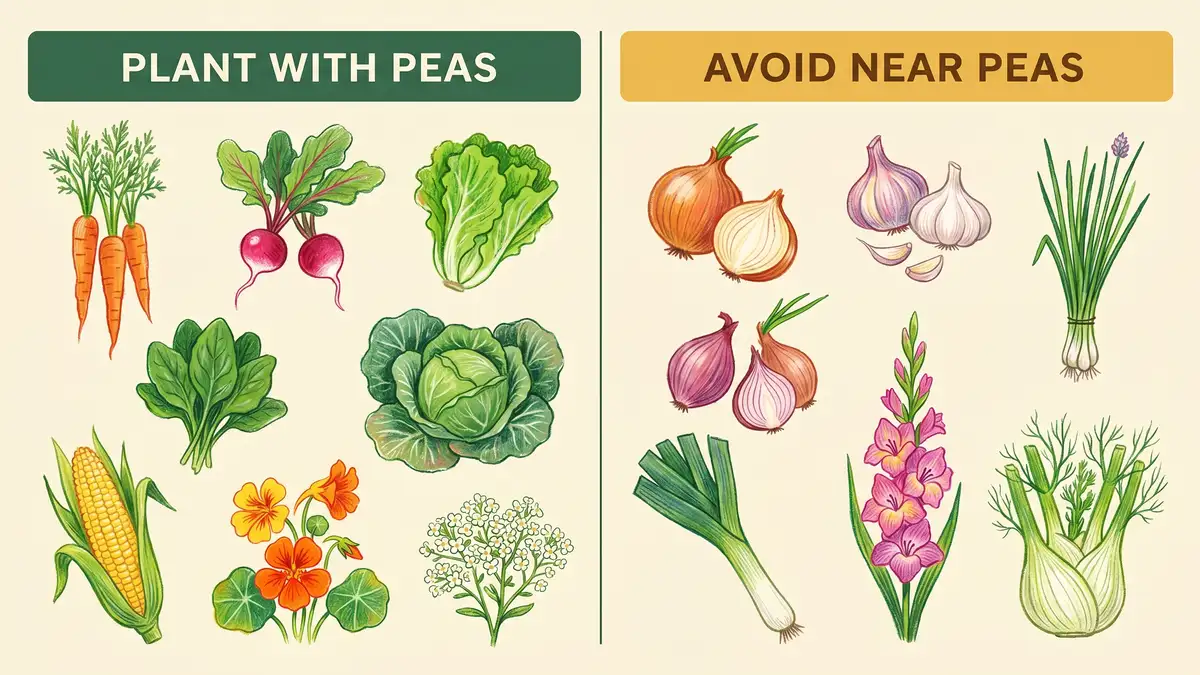
The reasoning behind each entry matters, because peas are the rare crop where one of the rules (avoid all alliums) is backed by real plant-microbiology evidence, not folklore. Our broader companion planting chart for every vegetable covers the full matrix; this guide goes deep on Pisum sativum.
Why Peas Are the Best Spring Crop to Plant First
Three reasons. First, peas are unreasonably tough early in the season. Oregon State Extension's soil temperature data shows peas germinate at soil temperatures as low as 40 F (4 C) and continue producing in temperatures that stop most warm-season crops dead. You can sow peas in March in zones 5-7, in February in zones 8-9, and in many climates before you've even started your tomato seeds indoors.
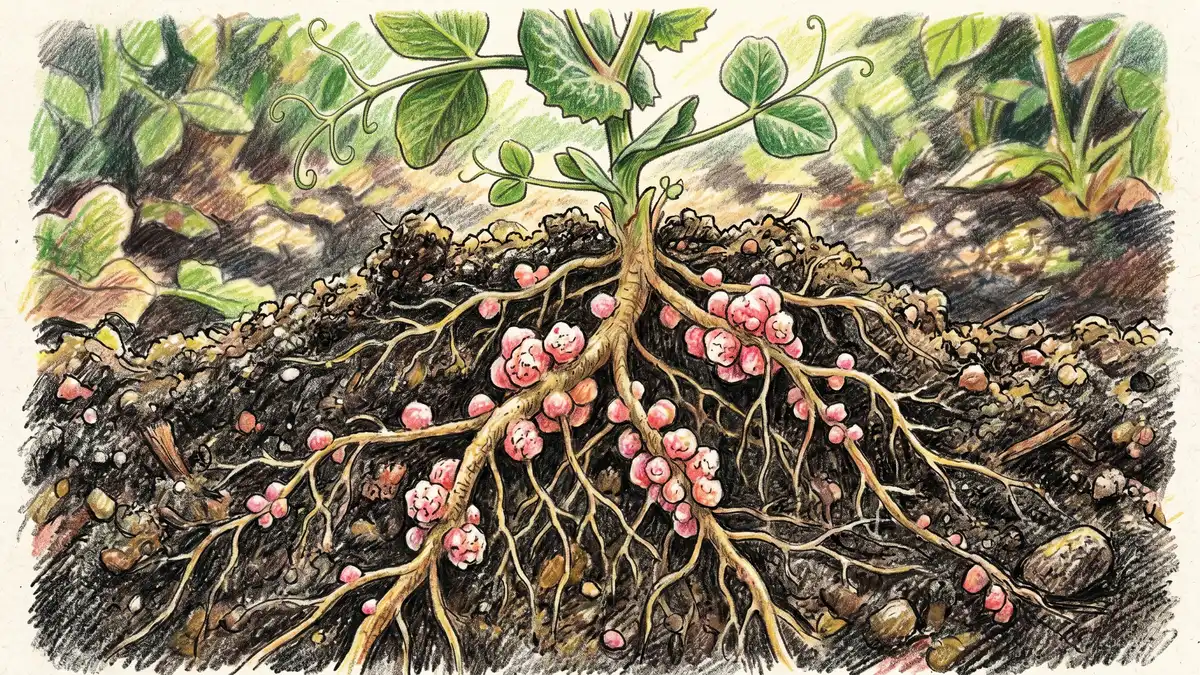
Second, the nitrogen fixation isn't a marketing claim. Peas form a symbiotic relationship with the soil bacterium Rhizobium leguminosarum biovar viceae. The bacteria colonise the pea roots and form pink and white nodules where they convert atmospheric nitrogen (N2) into ammonia the plant can use. NDSU's Field Pea Production guide documents that field peas typically fix 60 to 90 pounds of nitrogen per acre per season under good conditions, much of which stays in the soil for the next crop. A 2020 peer-reviewed analysis of the Pisum-Rhizobium interaction walks through the molecular mechanisms.
Third, peas vacate the bed at the right time. Most varieties finish in 55 to 70 days, which means a March or April sowing finishes by mid-June and clears the space for tomatoes, peppers, cucumbers, squash, or beans. UMD Extension's pea guide covers the timing.
Why This Works: Plants Talking to Bacteria
The Rhizobium-pea relationship is one of the clearest examples of cross-kingdom signalling in permaculture-friendly biology. Pea roots release flavonoid compounds into the soil; Rhizobium bacteria detect them, signal back with "Nod factors," and the pea root responds by forming a nodule that hosts the bacteria. Both sides gain something the other can't make alone. When you plant carrots, lettuce, and brassicas next to peas, you're piggybacking on this conversation: the nitrogen the bacteria fix flows out into the surrounding soil and feeds the whole neighbourhood. This is the same principle that makes a healthy ecosystem run on no external inputs.
The Best Pea Companions
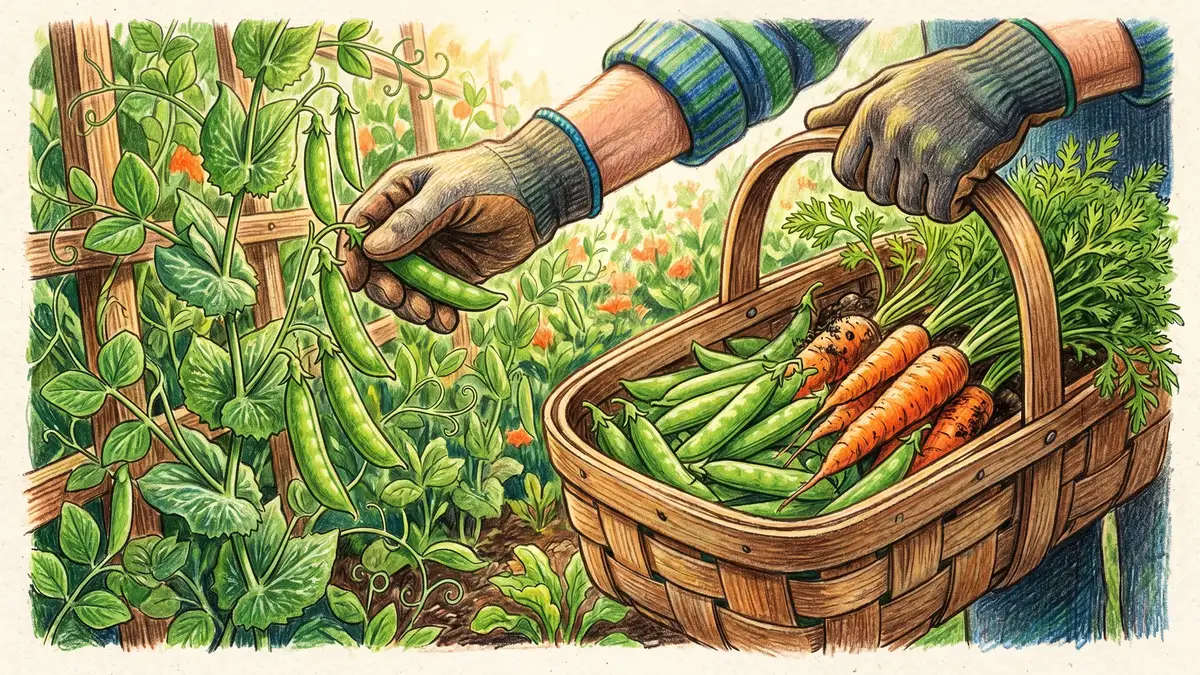
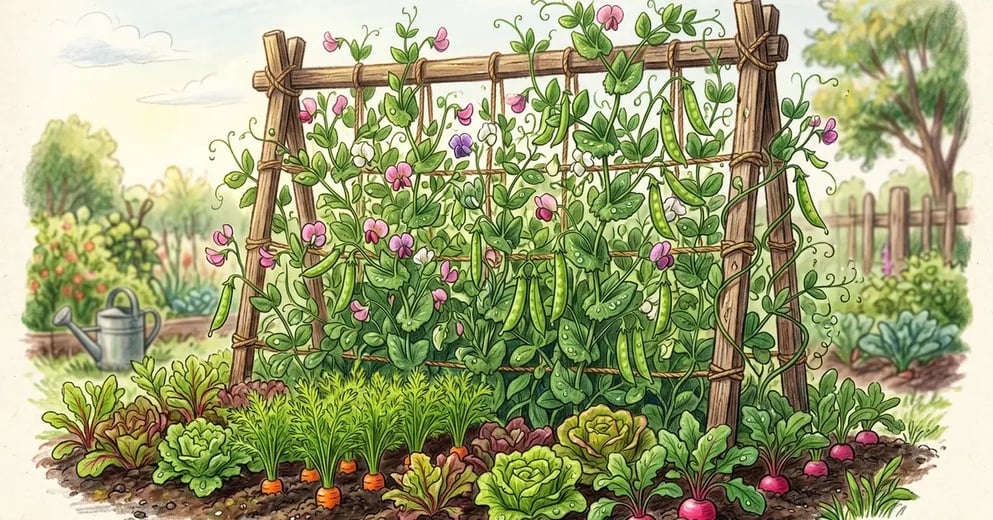
Carrots. The classic pairing. Carrots and peas occupy different root zones (carrots reach 12-18 in / 30-45 cm deep, peas spread laterally in the upper 6-12 in / 15-30 cm), they harvest at similar times, and the peas pump nitrogen into the upper soil layer where the carrot's feeder roots can use it. Cornell's companion planting reference (K-State mirror, PDF) lists this combination among the most reliable in the home garden. Our companion planting carrots guide covers the rest of the carrot side.
Radishes. Radishes mature in 25-30 days, well before peas need the space. Sow them in the same row as pea seeds and harvest before the pea vines have closed the canopy. They mark the row visually while you wait for peas to emerge.
Lettuce and spinach. Cool-season crops with shallow roots and modest needs. A row of lettuce or spinach planted in the partial shade of a pea trellis stays cooler and bolts later than lettuce in full sun, extending the salad season by 2-3 weeks. RHS's companion planting guide recommends this layered approach.
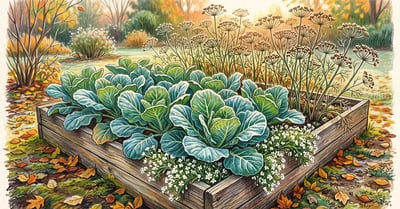
Brassicas (cabbage, broccoli, kale, cauliflower). Heavy nitrogen feeders that benefit directly from the residual N peas leave in the soil. Plant brassica transplants between pea rows or sow them after pea harvest in the same bed. Our broader companion planting chart covers brassica matches in depth.
Corn. Not concurrent (corn would shade the peas), but sequential. Peas harvested in June clear the way for corn sown in late June or early July. The peas leave behind 30-50 pounds of plant-available nitrogen per acre, which corn (a heavy nitrogen feeder) consumes. This is part of the logic behind the three sisters planting tradition, where legumes feed the corn.
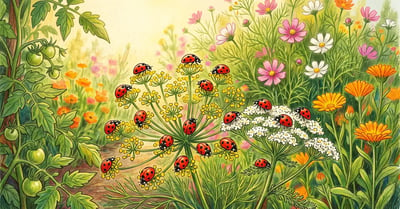
Nasturtium and sweet alyssum. Nasturtium acts as a trap crop for the pea aphid (Acyrthosiphon pisum), which is the dominant spring pea pest. Aphids strongly prefer nasturtium foliage to peas, so a row of nasturtium at the edge of the pea bed draws the pressure away. GrowVeg's trap cropping guide covers the mechanism. Sweet alyssum, meanwhile, attracts hoverflies whose larvae eat aphids. Plant both and you stack the defense.
Aromatic herbs (mint, parsley, cilantro). Mild pest deterrents through their volatile oils, plus pollinator attractors when they flower. Mint in particular needs a pot, not the open bed, because it spreads aggressively.
What Not to Plant Near Peas
The Single Most Important Rule: No Alliums Near Peas
Onions, garlic, leeks, shallots, chives, and ornamental alliums all release sulfur compounds (allyl sulfides) into the surrounding soil. These compounds suppress the Rhizobium bacteria that peas rely on for nitrogen fixation. The result: peas planted near alliums produce fewer root nodules, fix less nitrogen, and yield smaller harvests. Gardenia's incompatibility guide and WVU Extension's companion planting guide both confirm this. Keep at least 3-4 ft (90-120 cm) between any allium and your pea row.
Gladiolus. Bulbs in the iris family that are documented to suppress pea and bean growth through allelopathic root exudates. If you grow cut flowers, keep gladiolus in a separate bed.
Fennel. Allelopathic to almost every neighbor through bulb-released compounds. Give fennel its own pot or its own bed; it should never share space with peas or most other vegetables.
Late-season heat crops, planted too early. Tomatoes, peppers, and eggplant don't compete chemically with peas, but they will out-compete for sunlight if interplanted at the same time. Peas finish before these crops need full space, so use them sequentially: peas first, then transplant tomatoes into the cleared bed.
Timing, Spacing, and How to Sow Peas Right
Sow 4-6 weeks before your last frost
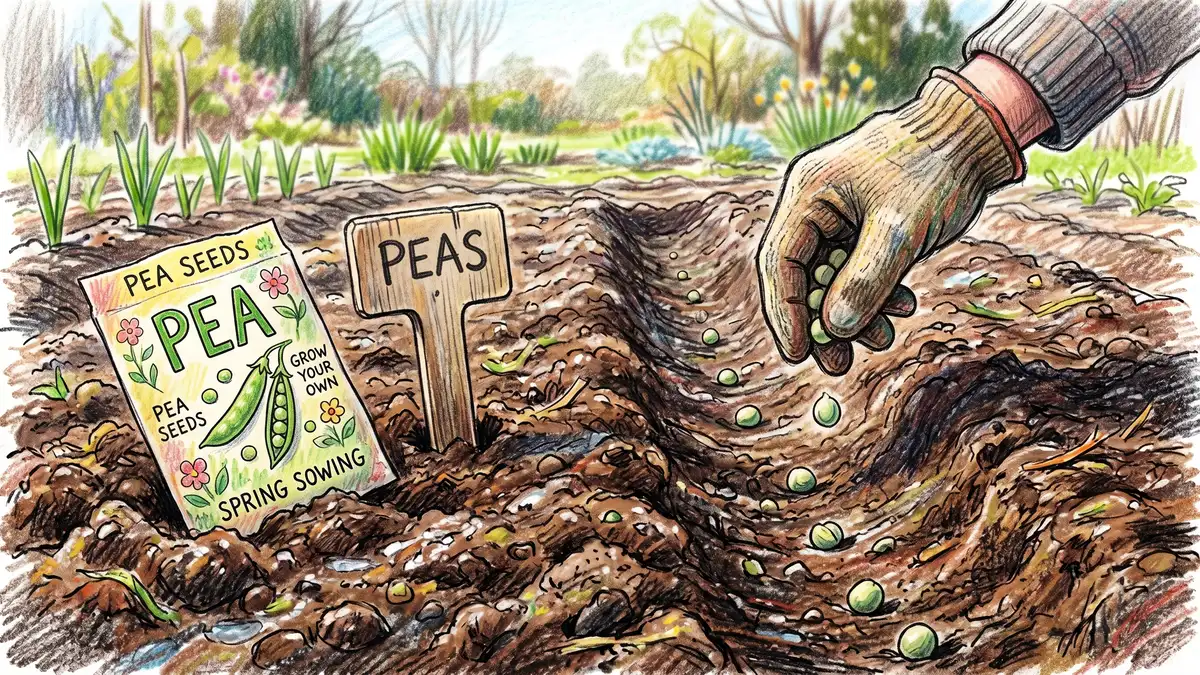
Illinois Extension's when-to-plant guide and Cornell Cooperative Extension's first planting dates agree on 4-6 weeks before the last expected frost. For zones 5-7, that's roughly mid-March to early April. Soil should be workable (not muddy when squeezed) and at least 40 F (4 C).
Inoculate seed with Rhizobium leguminosarum
If this is your first time planting peas in a given bed, dust the seed with a commercial pea/vetch inoculant before sowing. USDA NRCS guidance on legume inoculants (PDF) walks through species matching: peas need Rhizobium leguminosarum biovar viceae specifically, not the generic "garden inoculant." If you've grown peas in the same bed before, soil populations are usually adequate.
Space 1-2 inches apart in rows 18-24 inches apart
UMD Extension recommends 1-2 inches (2.5-5 cm) between seeds within a row and 18-24 inches (45-60 cm) between rows. Plant 1 inch (2.5 cm) deep in heavy soil, 1.5 inches (4 cm) in light or sandy soil. Don't bother thinning; peas tolerate close spacing and the dense canopy helps suppress weeds.
Install the trellis before they need it
Vining types (most snap peas, English peas) need a 4-6 ft (1.2-1.8 m) trellis. Bush types (Tom Thumb, Little Marvel) need a small support or nothing at all. Get the trellis in place before the vines reach 6 inches tall; retrofitting a trellis around tangled vines is miserable.
Cut at soil level after harvest, leave the roots
This is the single biggest yield-boost most home gardeners miss. When the pea harvest finishes, don't pull the plants. Cut them off at soil level with shears or scissors and lay the tops on the bed as mulch. The nitrogen-rich root nodules stay underground and feed your next crop. Permies' discussion of chop-and-drop edible cover crops reinforces this practice.
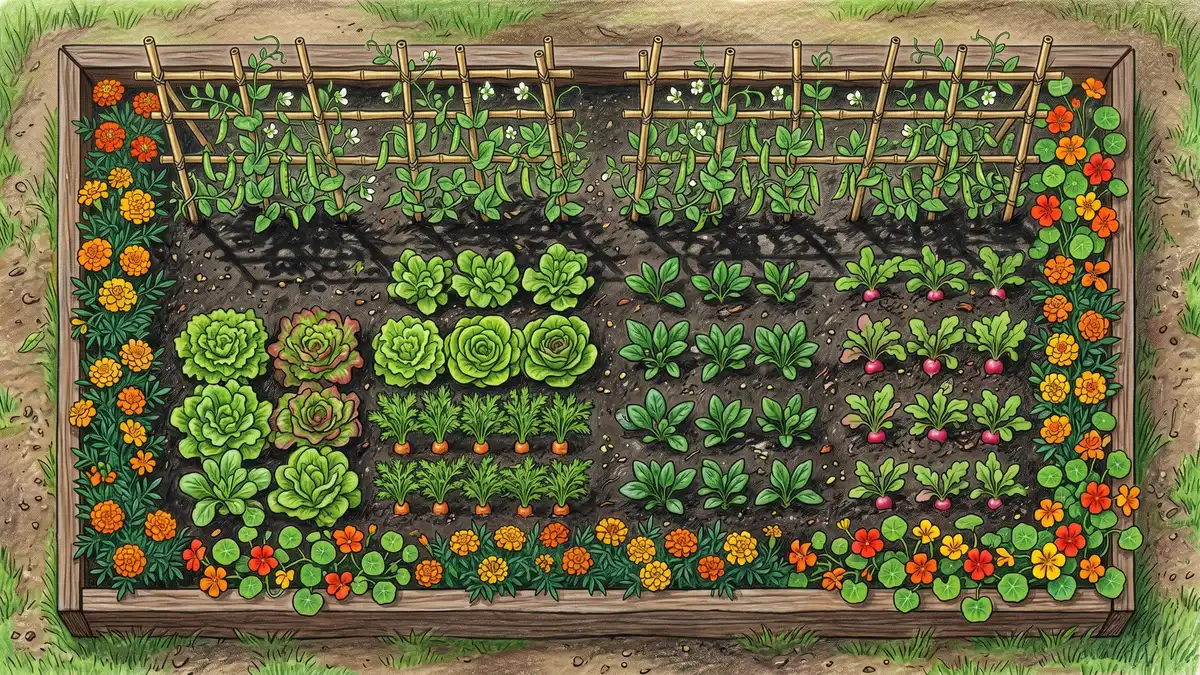
Companion Planting Peas in Raised Beds and Containers
In a 4-foot by 4-foot (1.2 m by 1.2 m) raised bed, peas occupy a single row along one side with a trellis. Carrots and radishes fill the middle. Lettuce and spinach take the front edge where they get the shade from the trellis in the afternoon. A short row of nasturtium along the outer perimeter draws aphid pressure away. Our raised bed companion planting guide covers tighter layouts for dense polyculture.
For containers, choose bush varieties. 'Tom Thumb' and 'Little Marvel' top out at 12-18 in (30-45 cm) tall and fit in a 5-gallon container alone or in a 15-gallon container with carrots and lettuce. Skip the trellis. Smart Gardener's Little Marvel overview covers the dwarf option in detail.
| Companion | Why It Works | When to Plant | Placement |
| Carrots | Different root depths, share nitrogen | Same time as peas | Between or adjacent to pea rows |
| Radishes | Quick harvest before peas need space | Same time as peas | In the pea row itself |
| Lettuce / spinach | Benefits from pea trellis shade | Same time as peas | Front edge of bed |
| Brassicas | Use pea-fixed nitrogen | Transplants 2-3 wks after peas, or after pea harvest | Adjacent rows or follow-on crop |
| Corn | Sequential, uses residual nitrogen | After pea harvest (June) | In the cleared pea bed |
| Nasturtium | Aphid trap crop | After last frost | Border of pea bed |
| Sweet alyssum | Hoverfly attractor (aphid predator) | After last frost | Front edge |
Sources:.
Want a one-page reference for every common vegetable?
Our companion planting chart covers carrots, tomatoes, potatoes, brassicas, beans, squash, and 40+ more crops with quick DO and DON'T lists.
View the Full ChartCommon Pea Pests and the Companions That Help
Pea aphid (Acyrthosiphon pisum). The dominant spring pest. University of Idaho Extension's pea aphid fact sheet documents that aphid populations build rapidly in cool wet springs and can cause significant yield losses if uncontrolled. Nasturtium as a trap crop, sweet alyssum to attract hoverflies, and a strong jet of water from a hose are the practical home-garden controls.
Powdery mildew. A late-season concern as temperatures climb. PNW Handbooks' pea powdery mildew page recommends choosing mildew-resistant varieties (look for "PM" or "MR" on seed packets) and good air circulation. Companion planting doesn't help here; variety choice does.
Pea weevil and pea moth. Less common in home gardens than commercial fields. PNW Handbooks' pea weevil page covers identification and control.
Common Pea Myths Worth Correcting
Myth 1: "Peas need fertiliser to grow well." They don't, and adding nitrogen fertiliser actively reduces nodule formation because the plant has no incentive to invest in the bacterial relationship. Montana State Extension's nitrogen and sulfur publication covers the trade-off. A light phosphorus amendment at planting is fine; nitrogen is counterproductive.
Myth 2: "Pull the whole plant up after harvest to clear the bed." Wrong. Pulling removes the nitrogen-rich root nodules with the plant, taking 30-50 pounds of free nitrogen per acre with them. Cut at soil level and leave the roots to decompose in place.
Myth 3: "Peas and beans are basically interchangeable as nitrogen fixers." Both are legumes, but they partner with different Rhizobium species. Peas pair with R. leguminosarum biovar viceae; common beans pair with R. leguminosarum biovar phaseoli or R. etli. Use the right inoculant for the right crop. Alberta Pulse Growers' inoculation guide covers species matching.
The Bottom Line
Sow peas 4-6 weeks before your last frost, in rows with carrots, radishes, lettuce, spinach, or brassica transplants. Add nasturtium and sweet alyssum at the edge for aphid control. Keep all alliums (onion, garlic, leek, chive, shallot) at least 3-4 ft away because they suppress the nitrogen-fixing bacteria peas depend on. Inoculate seed with Rhizobium leguminosarum on first plantings. When the harvest is over, cut at soil level and leave the roots in place so the next crop benefits from the fixed nitrogen.
Get the Weekly Dig
One practical permaculture guide a week, written for gardeners who do this on weekends: companion pairings that hold up under scrutiny, and the ones that do not. Free, no spam, unsubscribe any time.
Join the Weekly DigFrequently Asked Questions
What should you not plant with peas?
Avoid all alliums: onions, garlic, leeks, shallots, chives, and ornamental alliums. Their sulfur compounds suppress the Rhizobium leguminosarum bacteria peas rely on for nitrogen fixation, reducing nodule formation and yield. Also avoid gladiolus (allelopathic to legumes) and fennel (allelopathic to most vegetables). Late-season heat crops like tomatoes and peppers are not harmful but should be planted as a follow-on crop, not concurrently.
What to plant with peas in a raised bed?
In a 4-foot by 4-foot raised bed: one row of peas on a 4-6 ft trellis along one side; carrots and radishes through the middle; lettuce or spinach along the front edge where they get afternoon shade; nasturtium along the outer perimeter for aphid control. Skip any alliums in the same bed.
Can you plant peas and carrots together?
Yes. This is the most reliable pea companion pairing. Peas and carrots occupy different root zones (carrots reach down 12-18 in; peas spread laterally in the upper 6-12 in), they harvest at similar times, and pea-fixed nitrogen benefits carrot growth. Plant carrots in rows between or adjacent to pea rows.
How far apart should you plant peas?
1 to 2 inches (2.5-5 cm) between seeds within a row, and 18 to 24 inches (45-60 cm) between rows. Plant 1 inch (2.5 cm) deep in heavy soil and 1.5 inches (4 cm) deep in light or sandy soil. Don't thin; peas tolerate close spacing and the dense canopy helps suppress weeds.
When should you plant peas?
4 to 6 weeks before your last expected frost, as soon as the soil is workable and reaches at least 40 F (4 C). For USDA zones 5-7, that's typically mid-March to early April. For zones 8-9, late February to early March. Peas tolerate light frosts after germination, so erring on the early side rarely backfires.
Should you inoculate pea seed with Rhizobium?
Yes if this is the first time you've planted peas in a given bed. Use a pea/vetch-specific inoculant containing Rhizobium leguminosarum biovar viceae. Dust the seed lightly just before sowing. If peas (or vetch) have been grown in the same soil within the past 2-3 years, native populations are usually adequate without supplementation.
What can I plant after peas?
Almost anything that wants nitrogen, especially summer-heat crops: tomatoes, peppers, eggplant, beans, cucumbers, summer squash, zucchini, basil, and brassicas. Peas leave behind 30 to 50 pounds of plant-available nitrogen per acre, much of which the next crop can use directly. Cut the pea plants at soil level (leaving the root nodules in place) and transplant or sow the follow-on crop immediately.
Do peas need a trellis?
Vining varieties (most English peas, sugar snap peas, and snow peas) need a 4-6 ft trellis to climb. Bush or dwarf varieties (Tom Thumb, Little Marvel, Knight, Maestro) reach only 12-18 inches and need minimal or no support. Read the variety description before buying seeds, and install the trellis before vines reach 6 inches tall.
Resources
- University of Maryland Extension, Growing Green Peas in a Home Garden
- Cornell Garden-Based Learning, Peas
- Cornell Cooperative Extension Tompkins, First Planting Dates
- University of Illinois Extension, When to Plant
- Oregon State Extension, Soil Temperature for Vegetable Seed Germination
- NDSU Extension, Field Pea Production
- Penn State Extension, Getting Your Vegetable Garden Ready for Spring
- UMaine Extension, Cover Cropping for Success
- University of Idaho Extension, Pea Aphid
- PNW Handbooks, Pea Powdery Mildew
- PNW Handbooks, Pea Weevil
- SDSU Extension, Powdery Mildew in Field Peas
- WVU Extension, Companion Planting
- Cornell Companion Planting (PDF mirror)
- RHS, Three Ways to Use Companion Planting
- USDA NRCS, Using the Appropriate Legume Inoculant (PDF)
- Alberta Pulse Growers, Field Pea Inoculation
- PMC, Analysis of the Pisum-Rhizobium Interaction
- PMC, Effectiveness of Nitrogen Fixation in Rhizobia
- University of Arkansas Extension, Differences Between Pea Types