
In 1984, a Swiss farmer named Ernst Gotsch bought 1,200 acres of bedrock-exposed cattle pasture in the Atlantic Forest belt of Bahia, Brazil. The land was finished. No topsoil, no springs, no shade. Forty years later that same property, Olhos d'Agua, has 14 springs running again, eight percent soil organic matter, and a closed canopy of cacao, fruit, and timber trees producing food year-round. The method that did it has a name: syntropic agriculture. Here is what it is, why it works, and how it translates to a small US site.

Ernst Gotsch and the syntropic premise
Ernst Gotsch was born in Switzerland in 1948, trained as a researcher, and emigrated to Brazil in 1984 to put forty years of theory into practice on the worst land he could afford. He chose the abandoned cattle ranch Olhos d'Agua because nobody else wanted it. Over the next four decades he developed what he calls "agricultura sintrópica," syntropic agriculture, by direct experiment on land that everyone else had written off. His work is documented in the 2015 film Life in Syntropy and on his platform Agenda Gotsch.
Why this works
The name comes from a thermodynamic argument. Conventional agriculture is entropic: it draws energy out of a system (fossil fuels, soil minerals, irrigation water) faster than the system can replenish itself. Forests do the opposite: they accumulate energy, complexity, and biomass over time. Gotsch's claim is that humans can intentionally design farms that behave like young forests. We add energy in (planting, pruning, seeds) and the system stacks complexity back faster than it loses it. Embrapa, the Brazilian agricultural research corporation, has measured the result: 1 to 3 percent soil organic matter gain per year in well-managed syntropic systems versus 0.1 to 0.3 percent in standard regenerative practice.
The four principles, in plain English
Strip the jargon and syntropic agriculture is governed by four operational rules.
| Principle | What it means on the ground |
| Stratification | Multiple canopy layers from groundcover to overstory all planted simultaneously, not sequentially |
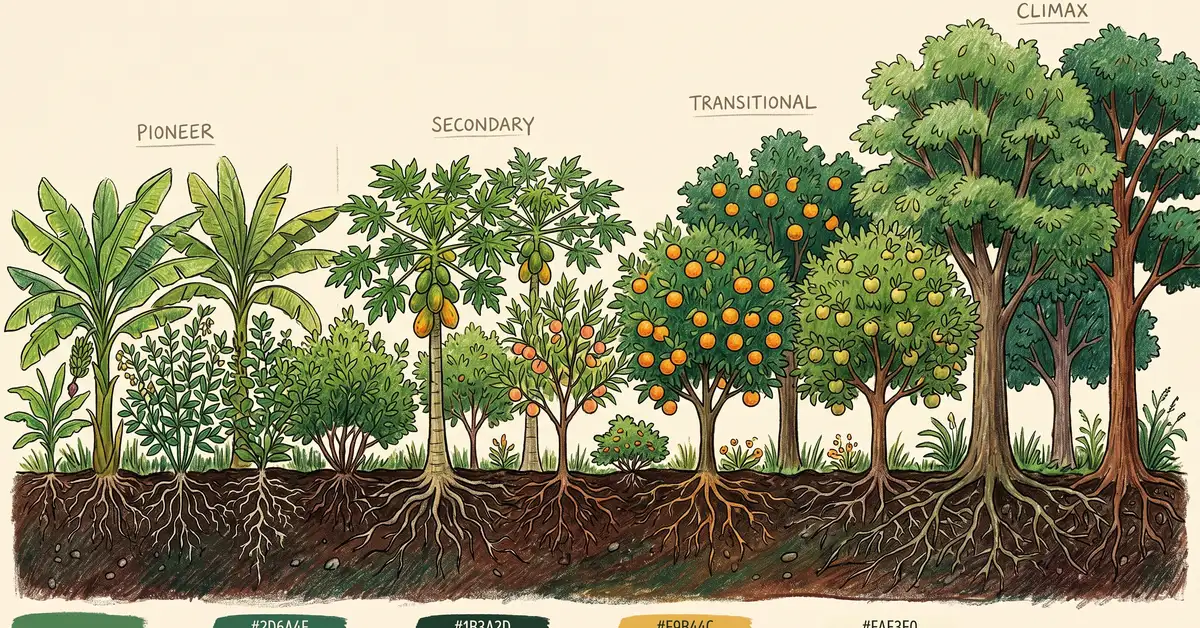
| Succession | Placeholder, secondary, transitional, and climax species planted in the same row at the same time |
| High density | Plants packed 2 to 4 times tighter than conventional spacing; the canopy closes within 18 to 36 months |
| Strategic pruning | Aggressive 2 to 3 times per year chop-and-drop of placeholder species feeds the soil and signals fruiting |
Sources: Ernst Gotsch interviews on Agenda Gotsch; Andrew Millison's syntropic series at Oregon State University Extension.
The Olhos d'Agua transformation
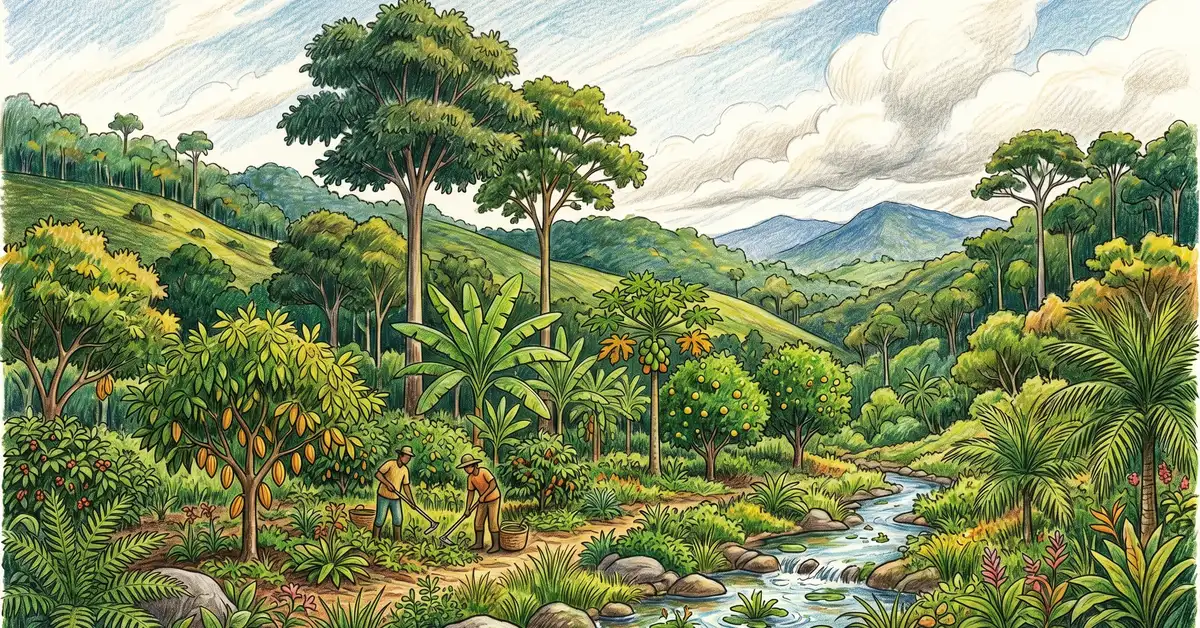
The before and after numbers from Olhos d'Agua are not subtle. When Gotsch arrived, the land had less than 1 percent organic matter, no perennial springs, no shade, and produced approximately zero kilocalories per acre. Today the same property runs at 8 percent organic matter, has 14 springs flowing year-round, hosts a closed canopy of cacao under fruit trees under timber trees, and produces commercial-volume cacao, citrus, banana, papaya, and timber. Surface temperatures during the dry season run 7 to 10 degrees C cooler than neighbouring conventional farms. Life in Syntropy documents this in detail; a shorter introduction is the free film "Life in Syntropy" on YouTube.
The four succession layers (with US species)
Syntropic restoration depends on planting all four succession layers at the same time. Here is the layer model with placeholder species suited to temperate US sites.
| Layer | Tropical example | US temperate example | Job in the system |
| Placeholder / pioneer | Banana, pigeon pea, mucuna, gliricidia | Black locust, alder, elderberry, comfrey, sunflower | Build biomass fast; sacrifice through pruning |
| Secondary | Papaya, hibiscus, fast bamboos | Peach, plum, hazelnut, aronia | Mid-lived productive species |
| Transitional | Citrus, mango, avocado, cacao | Apple, pear, cherry, persimmon, pawpaw | Long-lived productive species |
| Climax | Mahogany, jackfruit, jatobá | Chestnut, oak, walnut, hickory | Multi-generational overstory and timber |
Sources: Akiva Silver's Trees of Power (Chelsea Green, 2019); Richard Perkins' Regenerative Agriculture; Andrew Millison's Oregon State syntropic playlist.
The counterintuitive secret: aggressive pruning
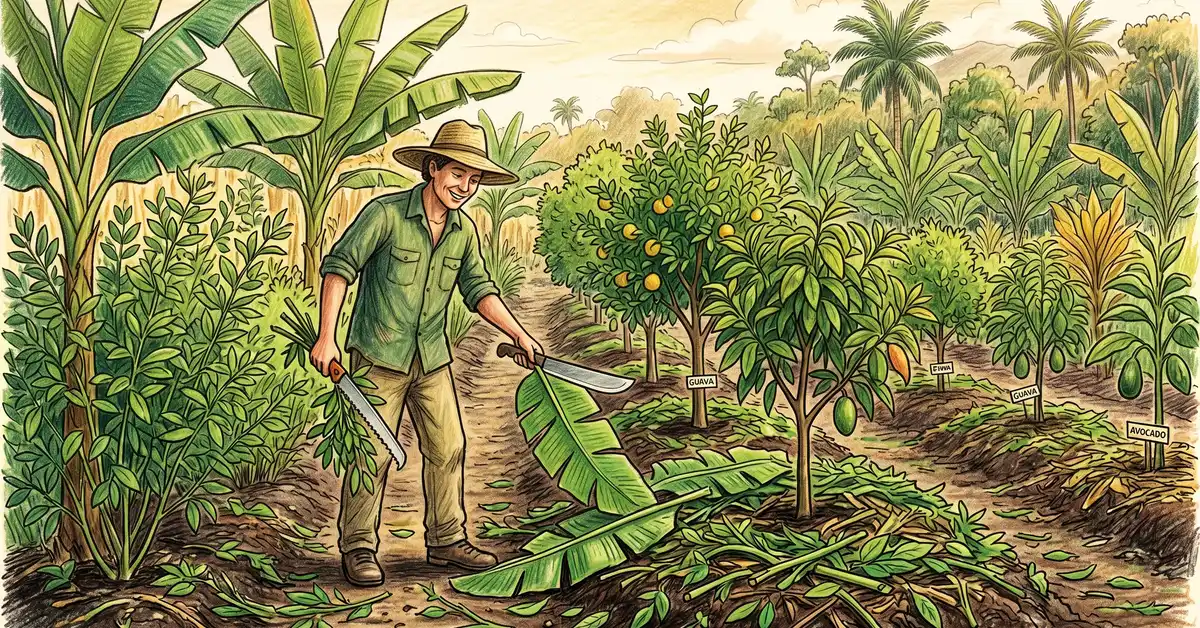
The single hardest part of syntropic practice for new growers is the pruning. Gotsch's teaching is blunt: the placeholders are there to be cut down. Every 4 to 6 months you chop pigeon peas, comfrey, banana, alder, locust, or whatever pioneers fit your climate, down to knee height. The cut biomass goes straight onto the ground around the productive species. This single act does three things at once: it feeds the soil microbiome with fresh ramial material, it triggers fruiting in the longer-lived species (a survival response to perceived canopy opening), and it creates a continuous mulch layer that holds water and suppresses weeds.
Tropical method, temperate adaptation
Gotsch's original system was designed for the humid tropical Atlantic Forest with year-round growing weather. Translating to US temperate zones (most of the country) requires three adaptations.
First, the species swap above (placeholder banana becomes placeholder black locust). Second, the pruning calendar shifts to spring and late summer (never winter; cold-weather wounds invite borers). Third, the canopy-closure timeline doubles: tropical syntropic systems close canopy in 18 to 24 months; temperate systems take 36 to 48. Richard Perkins at Ridgedale Permaculture in Sweden has documented the cold-climate adaptation; Andrew Millison at Oregon State publishes the US-applicable version through the Oregon State Extension.
Seven-step starter for a small US restoration site
Diagnose what is missing
Walk your degraded site in winter. Identify what is gone: topsoil, springs, shade, perennials, pollinators. The restoration design replaces these in roughly that order.
Design lines on contour
Mark planting lines on contour with garden hose or A-frame level. Each line will hold all four succession layers, planted as a dense strip. Aim for 12 to 15 ft (3.7 to 4.6 m) between lines for a small site.
Source your species kit
For a US temperate quarter-acre: 30 to 50 placeholder seedlings (black locust, comfrey crowns, elderberry, pigeon pea seed), 10 to 15 secondary fruit trees (peach, plum, hazelnut), 5 to 8 transitional fruit trees (apple, pear, pawpaw), 1 to 3 climax trees (chestnut, oak, walnut).
Mass-plant in one weekend
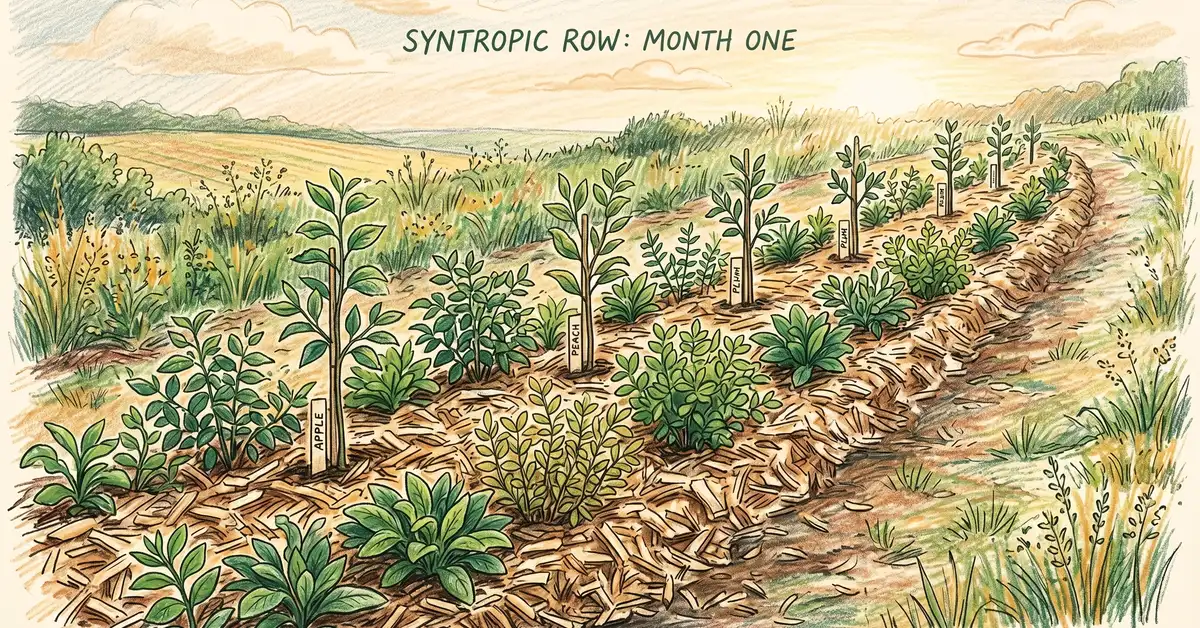
Plant all four layers simultaneously along each line. Spacing is intentionally tight (1 to 2 ft / 30 to 60 cm between placeholders, 6 to 8 ft / 1.8 to 2.4 m between productive species). The density is the point.
Mulch heavy
4 to 6 in (10 to 15 cm) of arborist wood chips along the entire planted strip. This is the only purchased input; everything after this comes from the system pruning itself.
First pruning at month 4
Once placeholders reach 4 to 5 ft (1.2 to 1.5 m), chop them all back to knee height. Drop the biomass on the line. The fruit trees will respond visibly within two weeks.
Repeat pruning every 4 to 6 months
Spring and late summer in temperate zones. Each pruning event adds 2 to 4 inches of fresh biomass mulch and triggers a growth response in the productive species.
What it costs and what it pays
| Year | Cost per acre (US 2026) | Yield |
| Year 0-1 | $2,000 to $5,000 (seedlings, chips, fence) | 0 (build phase) |
| Year 2-3 | $200 to $500 + 40 to 80 hr pruning labor | First berries, herbs, biomass |
| Year 4-7 | $0 to $200 + 30 to 60 hr labor | First commercial fruit, mushroom logs |
| Year 8+ | $0 to $100 + 20 to 40 hr labor | Closed-canopy productive system |
Soil rebuilds faster than you think
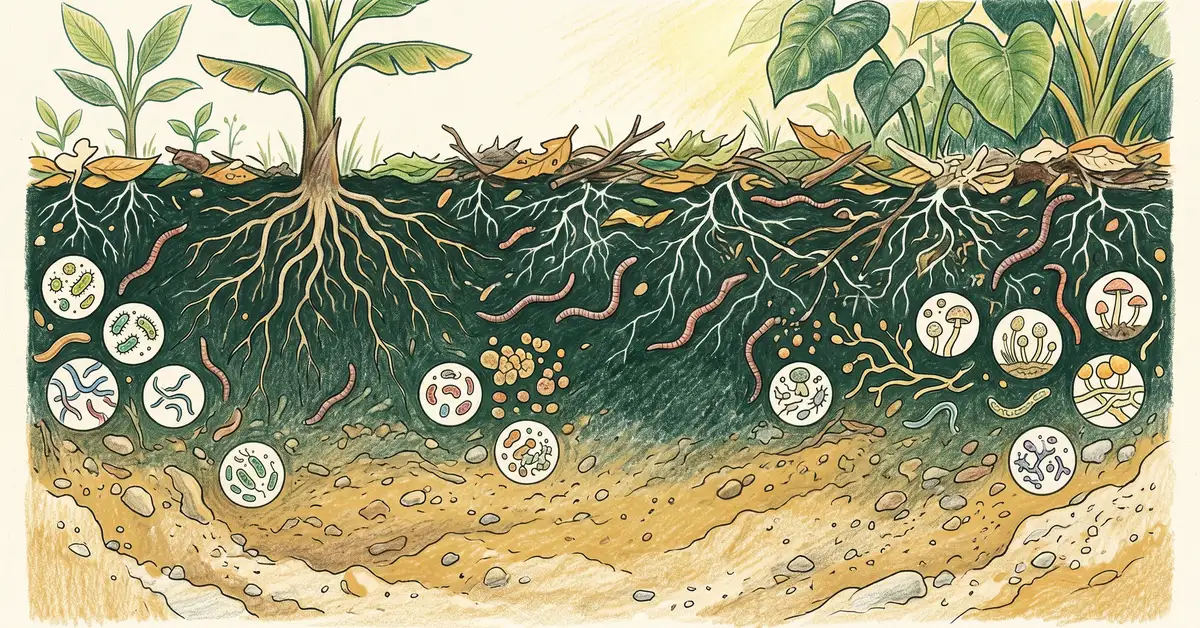
The most surprising result of syntropic restoration is the speed of soil recovery. Embrapa research and on-farm data from Olhos d'Agua and Fazenda da Toca (a 3,500-acre syntropic conversion in São Paulo, Brazil) show 1 to 3 percent organic matter gain per year for the first five years on degraded sites. Standard regenerative annual cropping builds at 0.1 to 0.3 percent per year. The biomass returns from frequent pruning explain most of the gap. Andrew Millison's Oregon State Extension video series shows the same effect on Oregon trial sites.
How syntropic relates to other restoration methods
Syntropic agriculture sits alongside several other proven restoration approaches. They are complementary, not competitive.
- Farmer Managed Natural Regeneration (FMNR): Tony Rinaudo's work in Niger has restored over 5 million hectares by protecting and pruning existing tree stumps. The principle of strategic pruning is shared; FMNR works on land that still has root systems.
- Holistic planned grazing: Allan Savory's method moves animals across grasslands to build soil. Best on rangeland; syntropic best on woodland-suitable sites.
- Multistrata agroforestry: Project Drawdown ranks this in its top 100 climate solutions; syntropic is a specific high-management variant of multistrata.
- Permaculture food forests: Lower management intensity, slower canopy closure, similar species palette to syntropic but without the aggressive pruning.
US practitioners doing syntropic-adjacent work
Three US-based farms publish openly on their syntropic-style restoration: Twisted Tree Farm in zone 4 New York (Akiva Silver's tree nursery), Wellspring Forest Farm in New York (Cornell silvopasture research site), and the Project Bona Fide network in Nicaragua with US partners. Andrew Millison's YouTube channel remains the single best free US-applicable syntropic education available.
Get the Weekly Dig
One practical permaculture guide a week, written for gardeners who do this on weekends: food forest and guild designs that produce. Free, no spam, unsubscribe any time.
Join the Weekly DigFrequently Asked Questions
What is syntropic agriculture?
Syntropic agriculture is a system developed by Ernst Gotsch in Bahia, Brazil starting in 1984 that restores degraded land by planting all four forest succession layers (placeholder, secondary, transitional, climax) simultaneously, at high density, and managing the system through aggressive strategic pruning. The name comes from "syntropy," the opposite of entropy: an intentional design that accumulates complexity and biomass over time.
Who is Ernst Gotsch?
Ernst Gotsch is a Swiss-born farmer who emigrated to Brazil in 1984 and bought the abandoned, completely degraded cattle ranch Olhos d'Agua in Bahia. Over forty years he developed and demonstrated syntropic agriculture, restoring the land from less than 1% soil organic matter to 8%+, bringing back 14 dried springs, and producing commercial-volume cacao, fruit, and timber. His work is documented in the 2015 film "Life in Syntropy" and on the Agenda Gotsch platform.
Can syntropic agriculture work in cold climates?
Yes, with species adaptations. The four-layer succession model translates directly: tropical placeholders (banana, pigeon pea) become temperate placeholders (black locust, comfrey, elderberry). Canopy closure takes twice as long (36 to 48 months versus 18 to 24 in the tropics), and pruning is done in spring and late summer rather than year-round. Richard Perkins at Ridgedale Permaculture (Sweden) and Andrew Millison (Oregon State) are the lead US/Northern Europe documentarians.
How much does it cost to start a syntropic restoration?
Year 1: approximately $2,000 to $5,000 per acre in 2026 US dollars (seedlings, wood chip mulch, deer fencing if needed). Years 2 to 3: $200 to $500 in materials plus 40 to 80 hours of pruning labor per acre. By year 4 the system is largely self-feeding through pruning biomass, with very low ongoing cost.
What is the most important thing to get right?
The pruning schedule. New syntropic practitioners almost always under-prune. Placeholder species (banana, comfrey, locust, elderberry) are planted specifically to be chopped down every 4 to 6 months; cutting them is what feeds the soil and triggers fruiting in the longer-lived species. If you cannot commit to aggressive twice-yearly pruning, choose a less intensive method.
How long until I see results?
Visual change in 6 to 12 months (placeholders fill in, soil cover establishes). Soil organic matter gains of 1 to 3 percent per year measurable from year 2. First commercial fruit harvests in year 4 to 7 depending on species. Closed canopy in 36 to 48 months in temperate zones. Mature productive system in year 7 to 10.
What is the difference between syntropic and permaculture?
Permaculture is a broad design philosophy covering everything from waste-water systems to housing layouts. Syntropic agriculture is a specific high-density, high-pruning agroforestry method. Most permaculture food forests use simpler 7-layer designs and far less aggressive pruning. Syntropic systems are higher-management and faster-producing; permaculture food forests are lower-management and slower.
Can I do this on a quarter-acre backyard?
Yes. The smallest documented working syntropic system is about 1/10th acre (a 30 ft x 100 ft strip). The four-layer principle and pruning schedule do not change with scale. A quarter-acre site can hold three to four full syntropic lines and produce significant fruit, biomass, and timber within 7 years.
Resources
- Agenda Gotsch (Ernst Gotsch's official platform)
- Life in Syntropy (2015 film)
- Andrew Millison at Oregon State University Extension
- Andrew Millison YouTube channel (free US syntropic education)
- Ridgedale Permaculture (Richard Perkins, Sweden)
- Twisted Tree Farm (Akiva Silver, NY zone 4)
- Wellspring Forest Farm (Steve Gabriel, NY)
- Project Drawdown: Multistrata Agroforestry
- FAO: Farmer Managed Natural Regeneration (Tony Rinaudo)
- Akiva Silver: Trees of Power (Chelsea Green, 2019)