
You planted your first fruit trees this spring, spread a mountain of wood chips, and now you are staring at a patch of mulch with a few knee-high saplings poking out of it. Where are the apples? The short answer: not this year, and that is completely normal. A backyard food forest spends its first year building roots, soil, and structure underground, not filling baskets with tree fruit. But that does not mean year one is a waiting game. Done well, your first season can hand you armloads of vegetables, herbs, and even a few berries while the slow perennial framework quietly establishes beneath the surface.
Here is exactly what to expect in year one, what to plant, what you can actually harvest, and how to keep your young trees alive so year five looks the way you pictured it. If you are still choosing a layout, start with our full food forest design guide and come back here to plan the first season.
Year one is mostly underground
The biggest mental shift for a new food forest gardener is accepting that most of the important work in year one happens where you cannot see it. Your trees are pushing out roots, mycorrhizal fungi are colonizing the soil, and the thick mulch you laid down is being pulled apart by earthworms and soil life into a living topsoil layer. Above ground, your canopy trees are just whips or small saplings two to six feet tall, casting almost no shade and exerting very little influence on the system yet.
This is why permaculture designers treat the first year as the establishment phase rather than the harvest phase. Oregon State University's home orchard guidance is blunt about it: fruit trees take many years to come into bearing, and newly planted apple trees simply will not have a crop on them in year one. Cornell University's tree fruit specialists go further, noting that growers who rush to plant without first investing a season or two in observing their site and improving the soil often regret it, because early choices about drainage and fertility echo for decades.
If your soil is poor or compacted, do not panic that you are behind. Spending part of year one on soil building and composting through sheet mulching and cover crops is not a delay, it is the foundation that lets everything else accelerate later.
What you can actually harvest in year one
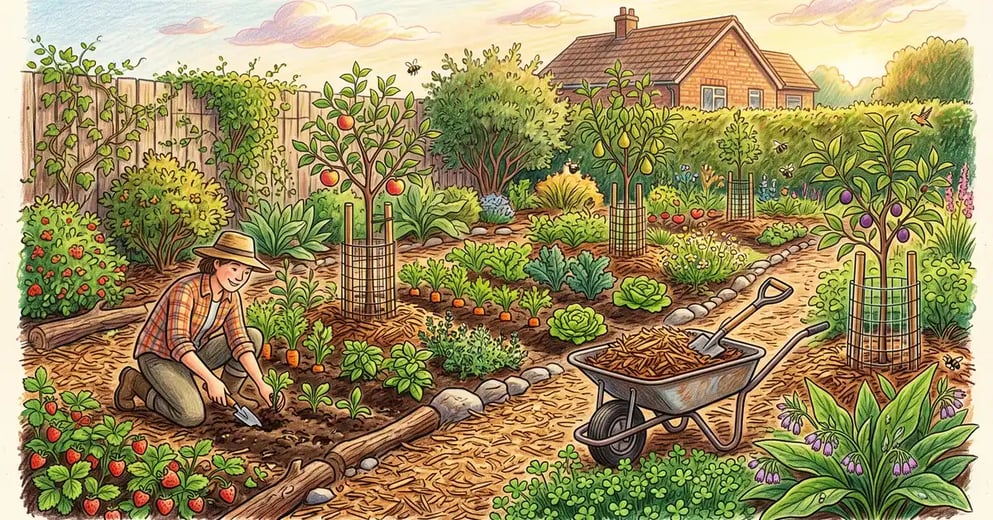
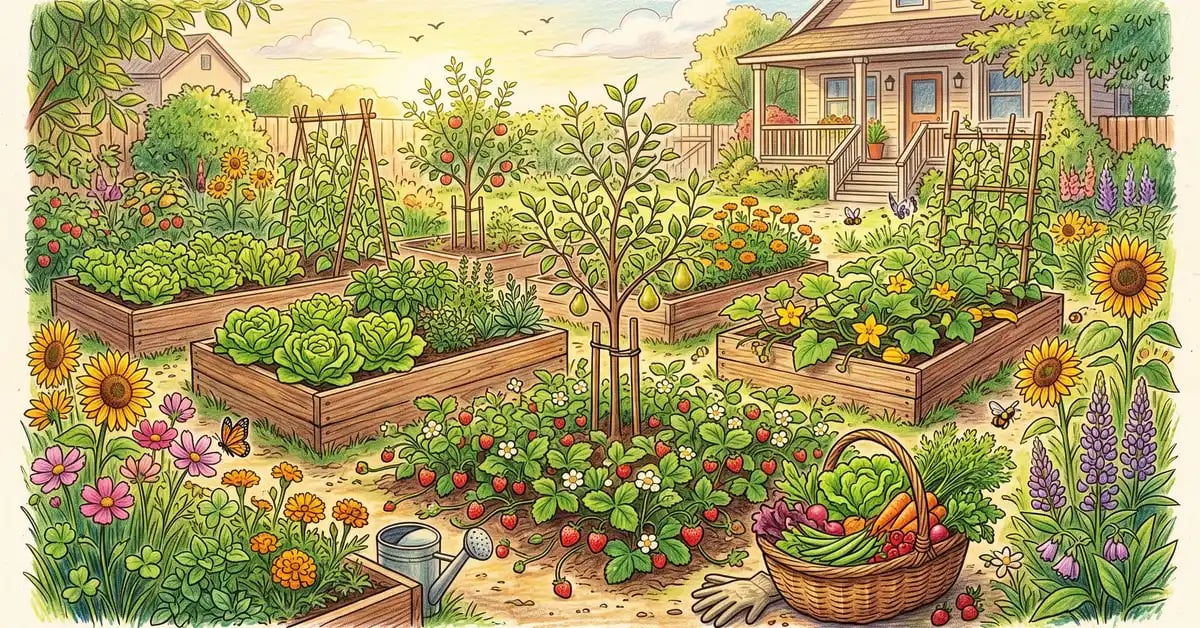
Here is the good news that stops beginners from giving up: while your trees sleep, your annual vegetables can produce heavily. The winning strategy every practitioner recommends is to overlay fast annual crops in the sunny gaps between your young trees. Because the saplings are small, your site gets nearly full sun in year one, which is perfect for sun-loving, high-yield vegetables that will later struggle once the canopy closes.
Plant that space like a vegetable garden inside a scaffolding of young perennials. Lettuce, radishes, beans, squash, potatoes, and winter squash all deliver a genuine harvest in the first season. Strawberries and everbearing small fruits planted early can give you a modest crop, and perennial herbs like kale, chives, thyme, and oregano start producing leaves within weeks. The table below shows a realistic year-one harvest picture.
| Plant type | First harvest | Year-one expectation |
| Annual vegetables (lettuce, beans, squash) | 4-12 weeks | Full, heavy harvest if soil and water are good |
| Herbs (thyme, chives, kale) | 4-8 weeks | Steady leaf harvests through the season |
| Strawberries and everbearing berries | Same season | Modest crop; full production in year two |
| Bush fruit (currants, raspberries) | Year 2-3 | Little to none; plants sizing up |
| Tree fruit (apple, pear, plum) | Year 3-5+ | No crop; any early blossom should be removed |
Source: Thrive Lot food forest timeline data; Oregon State University Extension fruit tree guidance.
The year-one harvest rule
Expect a kitchen full of vegetables, herbs, and a few berries in year one, not tree fruit. Your apples and pears are an investment that pays out in years three to five and beyond.
The seven layers, and which ones show up first
A food forest is designed as seven stacked layers that mimic a natural woodland: canopy trees, low or sub-canopy trees, shrubs, herbaceous plants, groundcovers, root crops, and climbing vines. This vertical stacking, described in Dave Jacke and Eric Toensmeier's Edible Forest Gardens, is what lets a small backyard produce so much: each species exploits a different slice of light and root space instead of competing head to head.
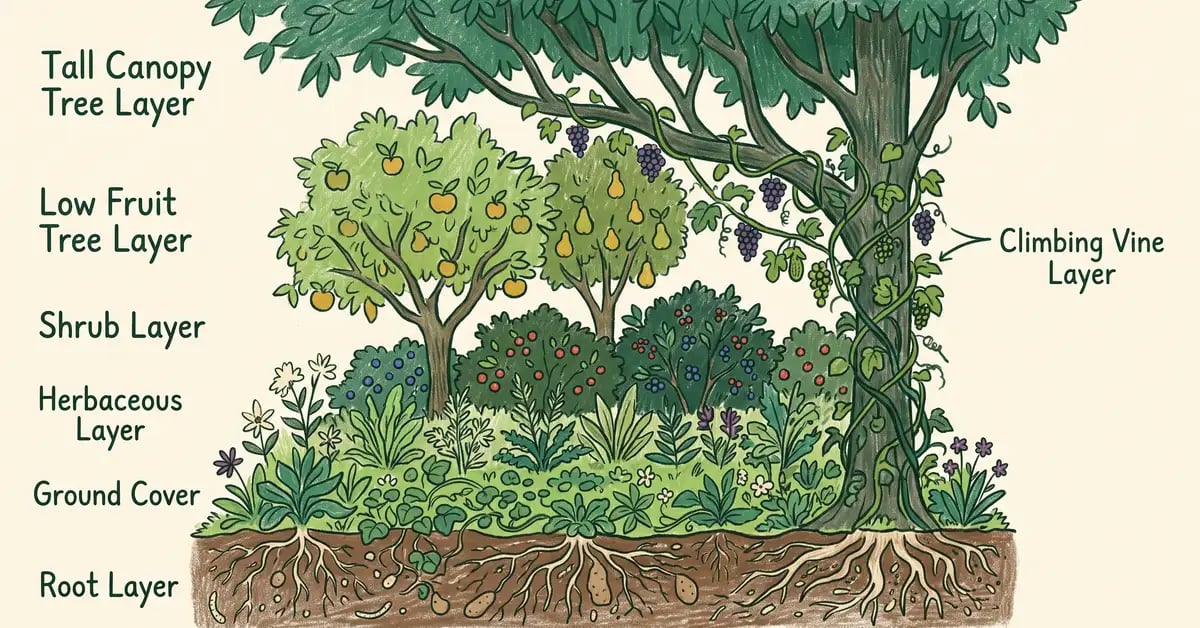
In year one, though, these layers are wildly uneven. The lower layers do almost all the visible work while the tree layers are just placeholders marking where the forest will eventually be:
Herbaceous and groundcover layers (fully active)
Annual vegetables, perennial herbs, strawberries, clover, and creeping thyme can reach full size within weeks and carry your year-one harvest.
Shrub layer (sizing up fast)
Berry bushes and nitrogen-fixing shrubs can reach two to three feet by season's end and start shading the soil.
Canopy and sub-canopy trees (structural markers only)
Your fruit and nut trees are small whips holding their future positions. They grow roots now and canopy later.
Why this works
You are working with ecological succession instead of against it. In nature, fast pioneer plants cover bare ground first and protect the soil while slow trees establish underneath. By filling year one with annuals, groundcovers, and support species, you are copying that pattern: catching sunlight and building soil in the open early phase, then letting the system shift toward perennials as the canopy fills in. Nothing is wasted, and the soil is never left bare.
Your year-one month-by-month plan
You do not plant a whole food forest in a weekend. Spreading the work across the season protects your back and your budget, and gives you time to observe how water and sun move across your site before committing every tree. A workable rhythm for a temperate US backyard looks like this.
Late winter: order and observe
Order bare-root trees to arrive in dormancy (Oregon State suggests ordering in December for February planting). Watch where snow melts last and water pools. Test your soil pH and drainage.
Early spring: sheet mulch and plant trees
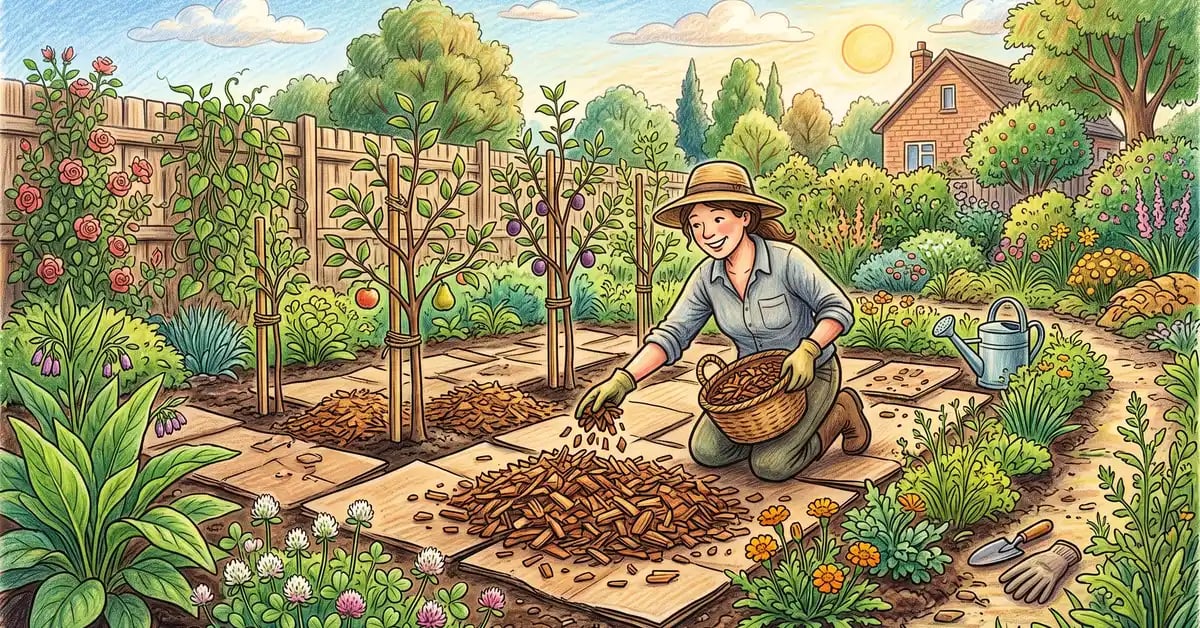
Lay cardboard over grass and cover it with wood chips. Plant dormant bare-root trees as early as the soil can be worked, spreading roots wide in a hole 1.5 to 2 feet across.
Mid spring: add shrubs, support species, and annuals
Plant berry bushes, nitrogen fixers like clover and comfrey, and fill sunny gaps with vegetables and herbs. Install drip lines or soaker hoses now.
Summer: water, weed, and watch
Water deeply and consistently, keep weeds off your young trees, and remove any fruit blossoms so the trees put energy into roots. Harvest vegetables and herbs as they mature.
Fall: refresh mulch and plant more perennials
Top up settled mulch, add cool-season perennials, and sow a cover crop in any bare beds to feed the soil over winter.
Keeping your young trees alive
The difference between three trees surviving and all four thriving comes down to a handful of specific practices, not luck or a green thumb. When gardeners follow the guidance, survival on the order of 80 to 90 percent is realistic; when they ignore it, losses climb fast. Oregon State's extension specialists find that first-year tree death is almost always traceable to a short list of avoidable causes: roots planted too deep, water standing in the planting hole, planting too late so the top grows before the roots, not enough water, or weed and grass competition choking the young tree.
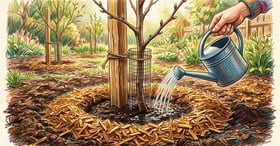
Get the planting depth right. Set the tree so the uppermost root sits no more than two inches below the surface, and keep any graft union two to four inches above ground. Do not add fertilizer or compost to the planting hole, which can burn roots and discourage them from spreading into the surrounding soil. Water newly planted trees every two to three days for the first few weeks, then regularly whenever the topsoil feels dry through the first couple of years, as Better Homes & Gardens stresses in its rundown of tree-killing mistakes. And protect the trunks: rabbits, voles, and deer will girdle or browse an unguarded sapling, so tree guards and fencing are a year-one job, not a someday job.
Avoid the mulch volcano
Piling mulch high against the trunk is one of the most common ways to slowly kill a young tree. It traps moisture against the bark, inviting rot and rodents. Spread wood chips three to six inches deep across the root zone but pull them back to leave a bare ring of two to four inches around the trunk. Think doughnut, not volcano.
Mulch and support species: the year-one engine
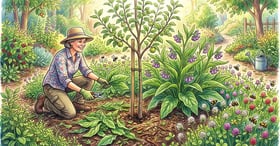
Wood chips do more heavy lifting in year one than almost anything else you plant. Fruit-growing writer Greg Alder recommends applying wood chip mulch at least three inches deep, with six to eight inches being ideal, spreading it from a couple of inches away from the trunk out to the canopy edge. It suppresses weeds, holds moisture so you water less often, feeds soil life, and moderates soil temperature. A six-to-eight-inch layer settles to three or four inches within a month or two as soil organisms pull the carbon down, which is exactly what you want: that is organic matter building in real time.
Alongside mulch, lean heavily on support species. In the early years, nitrogen fixers and dynamic accumulators like clover, vetch, comfrey, peas, and beans should make up a large share of your planting, sometimes half or more on poor soils. They pull nitrogen out of the air, feed your trees, and provide biomass for chop-and-drop, where you cut back the support plants and leave the leaves on the soil as free mulch and fertilizer. This is a core permaculture principle in action: stacking functions so a single plant fertilizes, mulches, and feeds pollinators all at once. Pairing support plants with your trees is a form of companion planting scaled up to a whole system.
What it costs and how much time it takes
A DIY backyard food forest is far cheaper to start than most people fear, especially if you source mulch for free from local tree services. For a 1,000 square-foot project in year one, a realistic budget runs roughly 1,000 to 2,000 dollars if you are frugal and reuse tools, climbing higher only if you buy large container-grown trees or hire a designer. The trees themselves are a surprisingly small slice; tools, irrigation, and soil amendments make up the bulk. For a fuller breakdown, see our guide to food forest costs from year 1 through year 5.
| Year-one cost category | Typical range (1,000 sq ft) |
| Trees and shrubs (10-15 trees, 10-20 shrubs) | $200-$400 |
| Herbaceous perennials and groundcovers | $100-$300 |
| Compost and soil amendments | $100-$300 |
| Mulch (free wood chips to purchased) | $0-$200 |
| Irrigation (drip lines, soaker hoses) | $100-$300 |
| Additional tools | $100-$300 |
Source: Thrive Lot cost data and Oregon State University Extension fruit tree cost analysis, adjusted for mid-2020s prices.
On time, year one is the most demanding season by far, with lots of planting and setup work concentrated in spring. Once established, a 1,000 square-foot system settles down to roughly two hours a week of watering and harvesting in the growing season, dropping further from year five as the canopy closes and the forest starts maintaining itself.
Get the Weekly Dig
One practical permaculture guide a week, written for gardeners who do this on weekends: food forest and guild designs that produce. Free, no spam, unsubscribe any time.
Join the Weekly DigCommon year-one mistakes to sidestep
Most first-year disappointment traces back to a few predictable errors. Planting canopy trees too close together feels productive but creates a crowded, disease-prone tangle in a few years, so give each tree the 15 to 18 feet a semi-dwarf apple actually needs. Ignoring pollination requirements means beautiful blossoms and no fruit later. Neglecting consistent watering after the first enthusiastic few weeks is the classic tree killer. And expecting tree fruit in year one leads people to abandon a perfectly healthy young forest right before it starts to pay off. Manage your expectations, cover your soil, and keep your trees watered and guarded, and year one becomes a strong foundation rather than a frustration.
Frequently asked questions
How long does a food forest take to establish?
A temperate backyard food forest generally needs three to five years to start behaving as a semi self-maintaining system with reliable perennial yields, and closer to seven to ten years for full canopy and mature productivity. That said, you can harvest annual vegetables, herbs, and some berries in the very first growing season, so you are never waiting years for your first food. Year one is about establishing roots, soil, and structure; the tree fruit follows later.
What can I harvest from a food forest in the first year?
Expect annual vegetables like lettuce, beans, squash, and potatoes, plus herbs and possibly a modest crop of strawberries or everbearing small fruits. You will not get apples, pears, or plums in year one, and any blossoms that appear on young trees should be removed so the tree invests its energy in building roots rather than ripening fruit it cannot yet support.
How much does it cost to start a backyard food forest?
A DIY 1,000 square-foot food forest typically costs about 1,000 to 2,000 dollars in year one if you reuse tools and source mulch for free, covering trees, shrubs, groundcovers, irrigation, and soil amendments. Costs climb if you buy large container-grown trees or hire a professional designer. The trees themselves are a small part of the budget; tools and irrigation make up more of it.
Should I plant fruit trees or vegetables first in a food forest?
Do both in year one. Plant your dormant bare-root fruit trees in early spring as the structural backbone, then fill the sunny gaps between them with annual vegetables and herbs. The young trees cast almost no shade in year one, so that open space is ideal for sun-loving crops that give you an immediate harvest while the trees slowly establish. As the canopy fills in over later years, you shift toward shade-tolerant perennials.
Why aren't my food forest trees producing fruit?
If your trees are one to two years old, no fruit is exactly what you should expect. Fruit trees take several years to come into bearing: dwarf apples on precocious rootstocks may fruit in about three years, while semi-dwarf and standard trees often take five or more. Removing early blossoms in the first couple of years actually speeds long-term production by letting the tree build a strong root system and branch structure first.
Resources
- Oregon State University Extension: Permaculture Basics for Home Gardeners (PDF, 2018)
- Oregon State University Extension: Growing Tree Fruits and Nuts in the Home Orchard
- Oregon State University Extension: How Much Does It Cost to Grow and Raise a Fruit Tree?
- Washington State University Extension: Training and Pruning Your Home Orchard
- Greg Alder's Yard Posts: Using Wood Chips as Mulch for Fruit Trees
- Better Homes & Gardens: Fruit Tree Planting Mistakes to Avoid
- Edible Forest Gardens, Volume 1 by Dave Jacke with Eric Toensmeier
- USDA: Agroforestry Overview