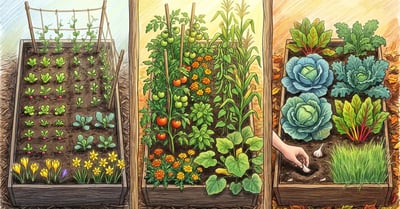

Most American gardeners treat the first frost like an end-of-season cliff. It is not. In every climate zone except the deepest subarctic, fall is the second-best planting window of the year. The soil is still warm from summer, the air is cooling toward what most cool-season crops actually prefer, pest pressure is dropping, and a handful of carefully chosen plant partnerships will give you fresh greens through winter, fat garlic bulbs by July, and the strongest spring soil you have ever had. the all-seasons companion planting playbook
This guide gives you the cool-season vegetable list, the classic companion planting pairs that actually work in fall, the pairs to avoid, the cover crops that protect bare beds, and a US regional planting calendar so you know when to start.
Why Fall Is the Second Spring
Penn State Extension makes the case in one sentence: planting in mid- to late summer for fall harvest takes advantage of warm soil and cooler air temperatures. Translated, that means brassicas and greens that bolted in July germinate fast and grow steadily once the heat breaks. Pest pressure also drops as days shorten. Cabbage moths peak in midsummer, slow with the first frost. Aphid populations crash. Slugs persist in wet weather, but row covers solve that.
The catch is timing. Old Farmer's Almanac gives the rule that experienced fall gardeners live by: count backward from your first frost date using the seed packet's days-to-maturity, then add 14 days as a "fall factor" because plants grow more slowly in shortening daylight. Miss this and your broccoli will set heads in December under snow.
Key Takeaway
Fall gardening is not a smaller, slower spring. It is a shrinking-window game. Backward-count from your first frost, add 14 days for slowing growth, and plant when the calendar tells you, not when the weather feels right.
The Cool-Season Lineup
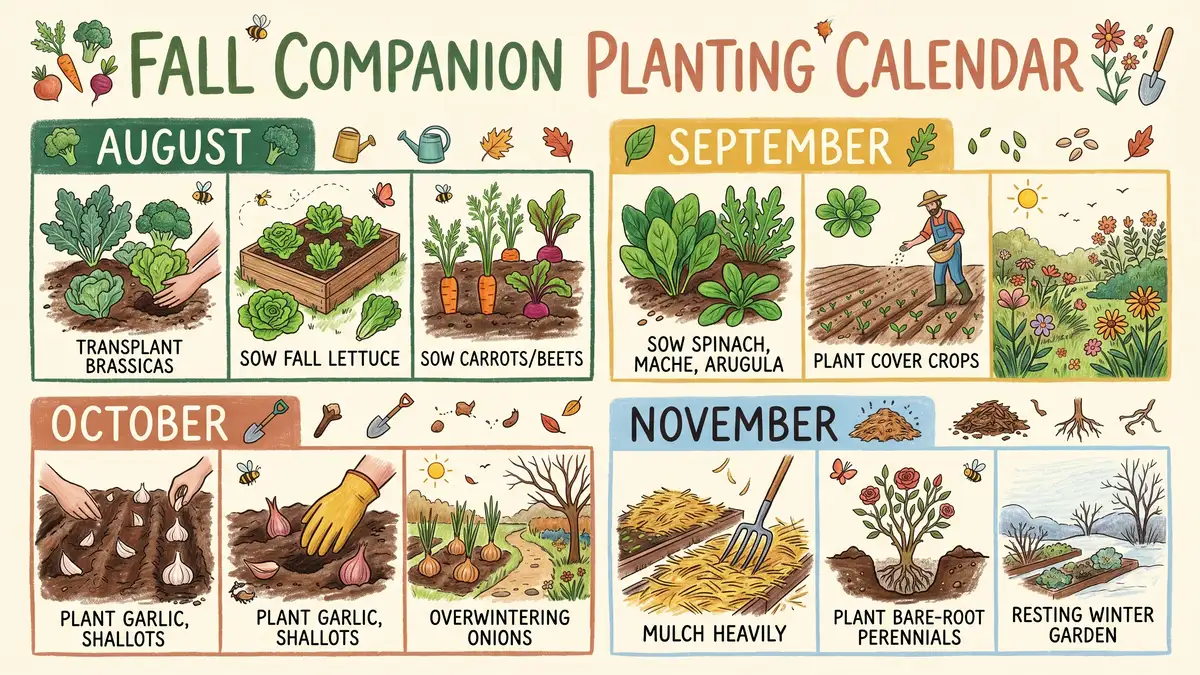
University of Maryland Extension catalogs nine families that qualify as cool-season: brassicas, alliums, root crops, leafy greens, hardy herbs, peas, asparagus, cool-season Asian greens, and fall-planted strawberries. Each group works differently in a fall garden.
| Family | Crops | Frost Tolerance |
| Brassicas | Broccoli, cauliflower, cabbage, Brussels sprouts, kale, collards, kohlrabi, bok choy | Most hardy to about 20 °F; kale and collards go lower |
| Alliums | Garlic, shallots, leeks, multiplier onions, scallions, chives | Very hardy; overwinter reliably |
| Root crops | Carrots, beets, radishes, turnips, rutabaga, parsnips | Hardy to about 25 °F; mulched roots can hold in ground through winter |
| Leafy greens | Spinach, lettuce, arugula, mache, mizuna, tatsoi, chard, mustards | Spinach and mache very hardy; lettuce semi-hardy |
| Hardy herbs and peas | Cilantro, parsley, dill, chervil, fall snow peas in mild zones | Frost tolerant; umbel herbs feed parasitoid wasps |
Sources: UMD Extension Vegetable Planting Calendar, NC State Extension, Growing a Fall Vegetable Garden, Penn State Extension, Season Extenders and Fall Vegetables.
The Fall Pairs That Actually Work
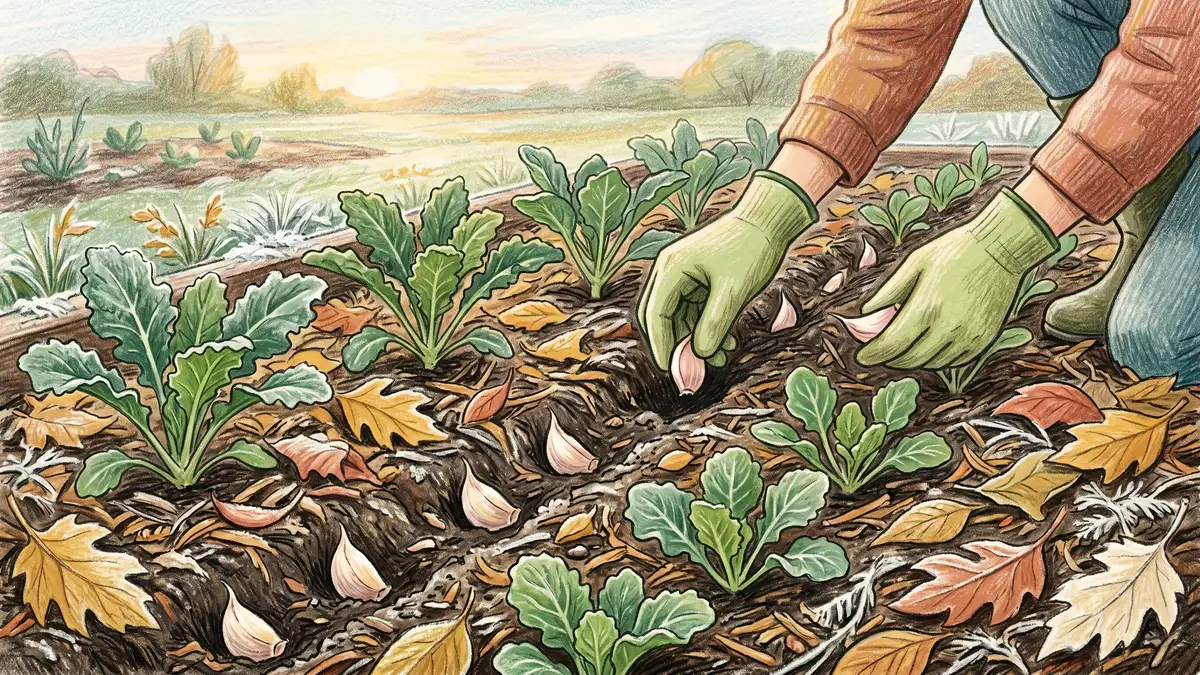
Fall companion planting leans on three mechanisms: scent confusion (volatile compounds from alliums or aromatic herbs mask the host crops pests hunt by smell), visual confusion (a green undercover breaks up the bare-soil pattern that cabbage root fly looks for), and resource stacking (plants of different root depths, leaf heights, and growing rates fit in the same bed without competing).
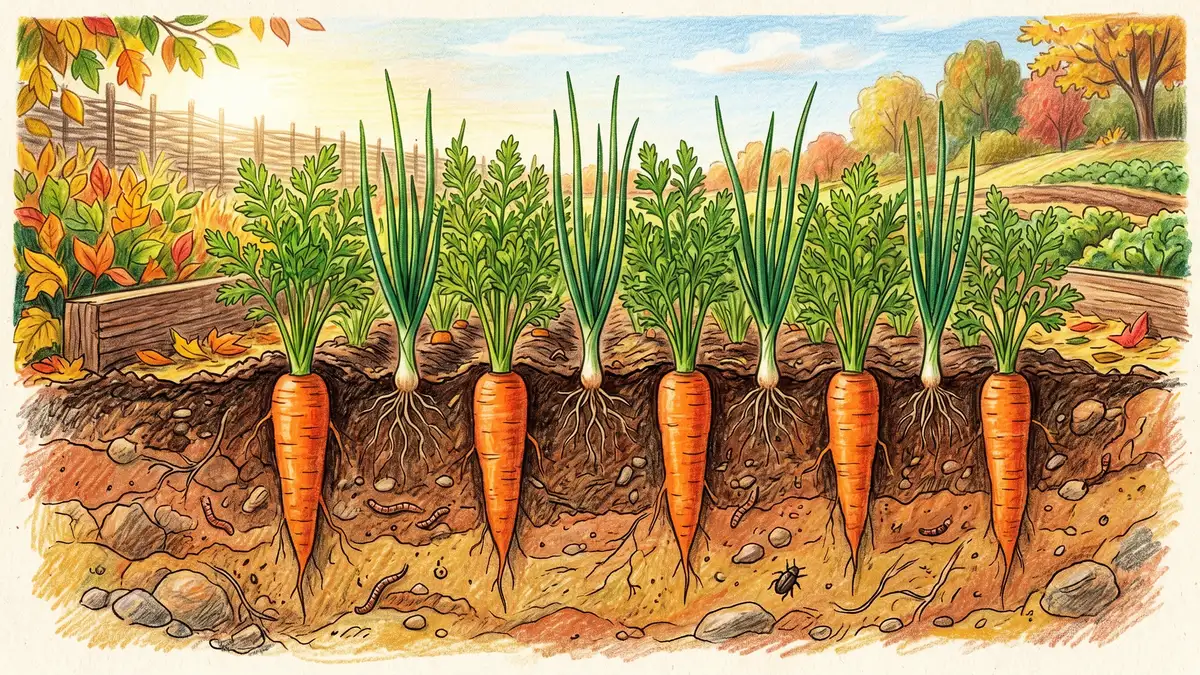
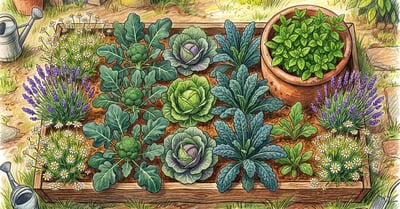
Brassicas plus alliums. Plant garlic, onions, or leeks alongside cabbage, kale, broccoli, and Brussels sprouts. Oregon State Extension documents that garlic deters aphids, cabbage looper, snails, carrot root fly, and cabbage maggots through allium sulfur volatiles. The pair also stacks roots, garlic feeds shallow, brassicas pull deeper.
Carrots plus onions. The most classic interplant in northern Europe. Royal Horticultural Society notes that onion scent masks the carrot volatiles that carrot rust fly uses to home in on its host. Plant alternating rows or scatter the bed.
Lettuce, radishes, and carrots in one bed. Penn State Extension's interplanting guidance: three rooting depths, three maturity windows, and three leaf shapes in a single square. Radishes are out in 30 days, lettuce in 50 to 60, carrots in 70 to 80. Each makes room for the next.
Spinach as living mulch under tall brassicas. Spinach occupies the lower canopy, suppresses slugs (snails prefer bare soil), and shades the soil so it stays cool and moist (Penn State Extension).
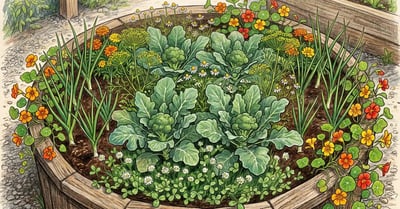
Clover or trefoil as a living mulch under brassicas. RHS documents that a low clover ground layer breaks up the visual cue cabbage root fly uses to locate its hosts, and fixes nitrogen for the heavy-feeding brassicas above. This is the single most underused fall pairing.
Cilantro, dill, parsley, and fennel at bed edges. Umbel flowers feed Braconid and Ichneumonid parasitoid wasps that lay eggs in cabbage caterpillars (Oregon State Extension). Let a few cilantro plants bolt and you keep beneficials in the bed.
Why This Works: Scent and Visual Confusion
Most insect pests find their host plants by smell first, sight second. Cabbage moth follows the airborne sulfur signal of crucifers. Carrot rust fly follows the carrot volatile. Strong, conflicting scents from alliums or herbs and broken visual patterns from living mulches make it harder for them to locate and lay eggs. This is the same mechanism Indigenous Three Sisters polyculture exploits, and it is the reason a chaotic-looking permaculture bed often has fewer pests than a tidy monoculture row.
What NOT to Pair in Fall
| Avoid | Why |
| Alliums (garlic, onions, leeks) next to legumes (peas, beans) | Allium root exudates suppress the Rhizobium bacteria that legumes need for nitrogen fixation. Pea yields drop. Keep at least 2 to 3 feet of separation. |
| Brassicas next to strawberries | Root-zone competition and shared Verticillium and Botrytis disease pressure. Put strawberries in a separate bed. |
| Same-family blocks (broccoli next to cabbage next to kale) | Concentrates cabbage-moth egg laying and brassica diseases. Break up with garlic, herbs, or non-host crops. |
| Garlic adjacent to other alliums (onions, leeks) | Concentrates allium root maggots and onion flies. Separate by other crops. |
Sources: RHS Companion Planting Guide, UMD Extension on Growing Strawberries, UC IPM on Imported Cabbageworm.
Garlic Is a Fall-Only Crop
Of every fall planting you can make, garlic is the one with the hardest deadline. Penn State Extension explains the biology: garlic planted in fall develops roots before winter but no top growth; it then needs 4 to 8 weeks at temperatures below about 40 °F (a process called vernalisation) to trigger bulb division. Skip the cold period and you get one large clove instead of a bulb full of them.
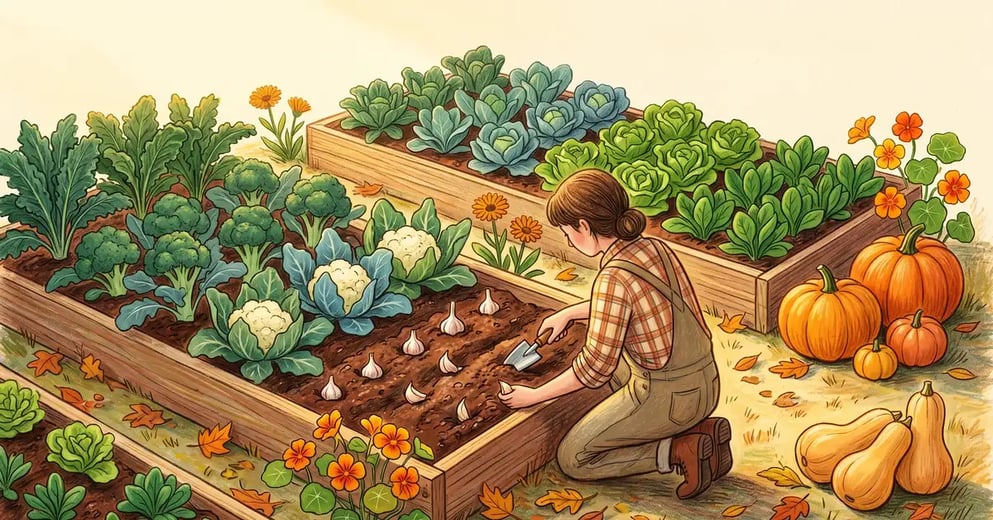
Oregon State Extension is blunt about the consequence: spring-planted garlic produces only an immature single clove. Plant in fall, period. The window is mid-October through mid-November in most temperate regions, roughly 4 to 6 weeks before the first hard frost in your zone (Old Farmer's Almanac). Tuck cloves 2 inches deep, pointed end up, 6 inches apart, and mulch 4 to 6 inches with straw or shredded leaves once the ground starts to cool.
Cover Crops Are Companion Plants Too
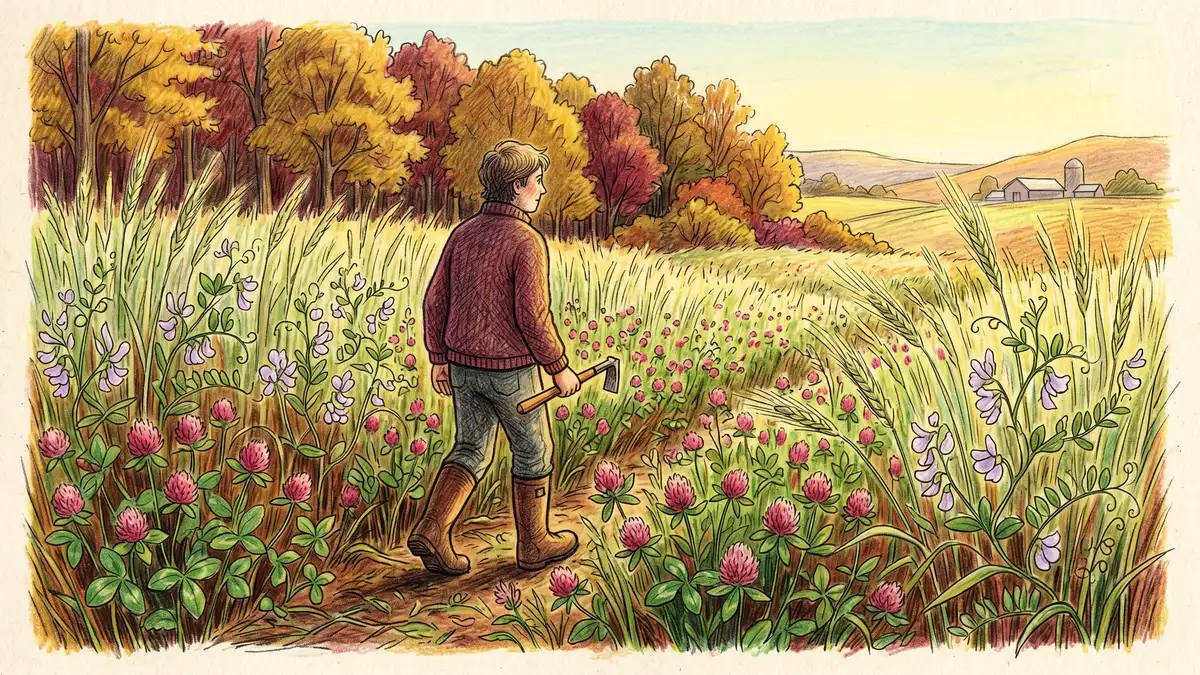
Any bed you are not actively growing food in should be planted with a cover crop by early to mid-October in temperate zones. Bare winter soil erodes, leaches nutrients, and compacts. Cover crops are companion planting at the bed scale: they feed soil microbes, fix nitrogen, and break compaction while taking your place over winter.
Penn State Extension's go-to recommendation is winter rye plus hairy vetch: rye covers the soil quickly and prevents erosion, vetch fixes nitrogen for next spring's heavy feeders. USDA SARE calls hairy vetch the most widely used winter annual legume in US agriculture for exactly this reason.
Daikon (forage) radish is the small-garden secret weapon. USDA SARE and UMD Extension document that its deep taproot biodrills compacted soil and then winterkills at 17-20 °F, leaving channels for next spring's roots without any termination work.
Common Mistake to Avoid
Do not direct-seed brassicas or legumes within 14 to 21 days of terminating winter rye. USDA SARE documents that rye is allelopathic during decomposition; its breakdown products suppress small-seeded crop germination for two to three weeks after the cover crop is cut. Wait the full window or transplant established starts instead.
Fall Planting Calendar by US Region
| Region | First Frost | Brassicas Out | Plant Garlic |
| Mild winter (zones 8-10, coastal CA, Gulf, FL, southern AZ/TX) | Dec-Jan or no frost | Sept-Oct | Nov to early Dec |
| Temperate (zones 6-7, mid-Atlantic, Piedmont, OR/WA west of Cascades, lower Midwest) | Mid-Oct to early Nov | Mid-Aug to early Sept | Mid-Oct to mid-Nov |
| Cold (zones 3-5, New England, upper Midwest, northern Rockies) | Mid-Sept to early Oct | Late July to mid-Aug | Late Sept to mid-Oct |
Sources: Old Farmer's Almanac, Frost Dates by Zip Code, UMD Extension Vegetable Planting Calendar, Penn State Extension on Garlic.
A Five-Step Fall Plan
Find your first frost, count backward, add 14 days
Look up your ZIP code's average first frost on the Old Farmer's Almanac frost calculator. For every crop, subtract the seed packet's days-to-maturity and add 14 days. That gives you the latest reasonable sowing date. Pick the earlier of that and your calendar.
Transplant brassicas, sow direct greens
In zones 6-7 this is mid-August to early September; in zones 3-5 it is late July to mid-August. Transplant broccoli, cauliflower, cabbage, Brussels sprouts, and kale. Direct-sow spinach, lettuce, arugula, radishes, and a second round of carrots in the same window. Read our companion planting chart for pair-friendly bed layouts.
Plant fall perennials and bulbs
Mid-September through early October: plant strawberry crowns, asparagus, rhubarb, and pollinator bulbs (daffodils, alliums). Fall-set strawberries outperform spring-planted runners.
Plant garlic, then cover-crop everything bare
Mid-October to mid-November in temperate zones: plant garlic and shallots 2 inches deep, pointed end up, 6 inches apart. The same week, sow winter rye plus hairy vetch (or daikon radish) over any bed you are not actively cropping. Build a fall compost pile with leaf fall while you are at it.
Mulch heavily before the ground freezes
Once the surface starts to chill, lay 4 to 6 inches of straw or shredded leaves over garlic, strawberries, overwintered onions, and perennial beds. Mulch holds soil temperature steady through freeze-thaw cycles and shelters earthworms and beneficial soil life.
Get Our Free Companion Planting Chart
Join 10,000+ gardeners getting weekly tips on what to plant together, soil health, and permaculture techniques.
Send Me the ChartFrequently Asked Questions
What vegetables can you plant in fall?
Brassicas (broccoli, cauliflower, cabbage, Brussels sprouts, kale, collards), alliums (garlic, shallots, onions, leeks, scallions), root crops (carrots, beets, radishes, turnips, parsnips), and leafy greens (spinach, lettuce, arugula, mache, mizuna, chard) all qualify. Hardy herbs like cilantro and parsley extend the list, and fall is also the right time to plant strawberry crowns, asparagus, and garlic.
What are the best fall companion planting pairs?
Brassicas with alliums (garlic and onions deter cabbage moths), carrots with onions (masks scent from carrot rust fly), lettuce/radishes/carrots in one bed (three rooting depths, three maturity windows), and a clover or spinach living mulch under tall brassicas. Cilantro, dill, parsley, and fennel allowed to flower at bed edges feed parasitoid wasps that attack cabbage caterpillars.
When should I plant garlic?
Mid-October through mid-November in most temperate zones, roughly 4 to 6 weeks before the first hard frost. Plant cloves 2 inches deep, pointed end up, 6 inches apart, then mulch 4 to 6 inches with straw or shredded leaves once the soil starts to cool. Garlic requires 4 to 8 weeks of temperatures below 40 °F to vernalise; spring-planted garlic produces only a single immature clove.
What perennials should I plant in the fall?
Strawberry crowns (mid-September to early October in most US zones), asparagus and rhubarb crowns, comfrey root cuttings, and pollinator-friendly bulbs like daffodils and alliums. Fall planting gives perennial roots time to establish before winter dormancy, producing measurably stronger spring growth than spring-planted equivalents.
What should I plant in the fall for spring?
Garlic, shallots, and overwintering onions for early-summer harvest. Fall-planted strawberries for next-year's berries. Spinach and mache for early-spring greens (they survive winter under row cover or mulch in most zones). Cover crops like winter rye, hairy vetch, and crimson clover feed soil microbes over winter and provide spring nitrogen.
Can I plant broccoli with cauliflower in fall?
You can, but it concentrates cabbage-moth egg laying and brassica disease. Break up the brassica block with garlic or onions between the rows and a few cilantro plants at the edges. The pairing works, but only if you are interplanting actively.
What is the best fall cover crop?
For most temperate-zone gardens, the winter rye plus hairy vetch mix recommended by Penn State Extension covers most needs: rye prevents erosion, vetch fixes nitrogen. Daikon radish is the small-garden alternative because it winterkills at 17 to 20 °F and biodrills compacted soil without needing termination. Plant cover crops by early October in zones 3-5 and by late October in zones 6-7.
Ready to Grow Smarter?
Get our free beginner's guide to permaculture gardening, 20 pages of practical tips you can use this weekend.
Read the Free GuideResources
- Penn State Extension, Season Extenders and Growing Fall Vegetables
- Penn State Extension, Growing Garlic, Fall Planting
- Penn State Extension, Maximizing Your Vegetable Garden
- Penn State Extension, Cover Crops for Vegetable Gardens
- NC State Extension, Growing a Fall Vegetable Garden
- NC State Extension, Growing Strawberries in the Garden
- UMD Extension, Vegetable Planting Calendar
- UMD Extension, Growing Strawberries in the Home Garden
- UMD Extension, No-Till Spring Vegetables After Forage Radish
- Oregon State Extension, Companion Planting Guide
- Oregon State Extension, Fall Is the Best Time to Plant Garlic
- Royal Horticultural Society, Companion Planting
- USDA SARE, Managing Cover Crops Profitably, Hairy Vetch
- USDA SARE, Managing Cover Crops Profitably, Cereal Rye
- Old Farmer's Almanac, How to Plant a Fall Vegetable Garden
- Old Farmer's Almanac, Planting Garlic in Fall
- Old Farmer's Almanac, Frost Dates by Zip Code
- UC IPM, Imported Cabbageworm on Cole Crops