
The companion planting pairings that work for tomatoes in July do not work for cabbage in April. The soil is colder, the pests are different, and half your summer favourites cannot germinate yet. This is why most generic companion planting charts confuse new gardeners: they list everything in one big block without telling you what season it actually applies to.
This guide gives you the working pairings for spring, summer, and fall, with the soil temperature thresholds, the pest pressure each season actually faces, and the rotation pattern that connects one season to the next in the same bed. If you have come from our companion planting chart, this is the seasonal layer on top of it.
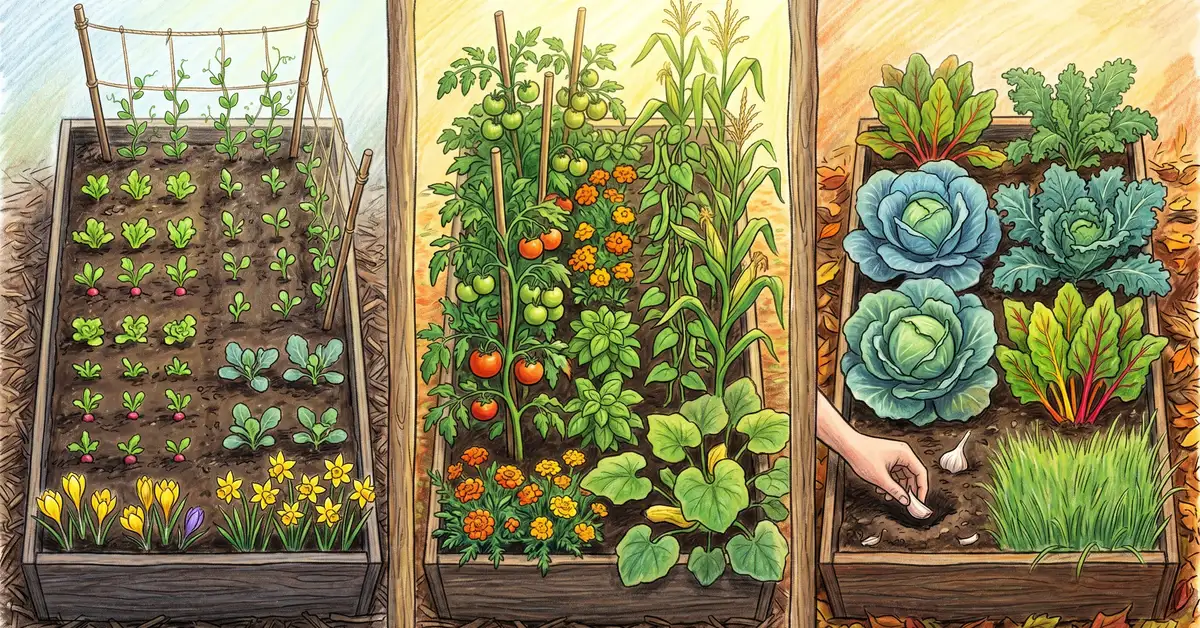
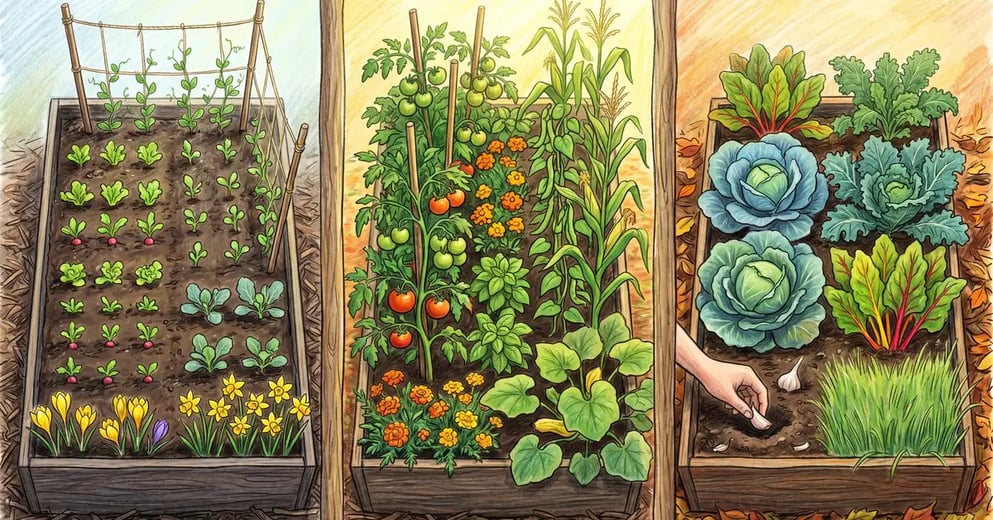
The Quick Map of the Three Seasons
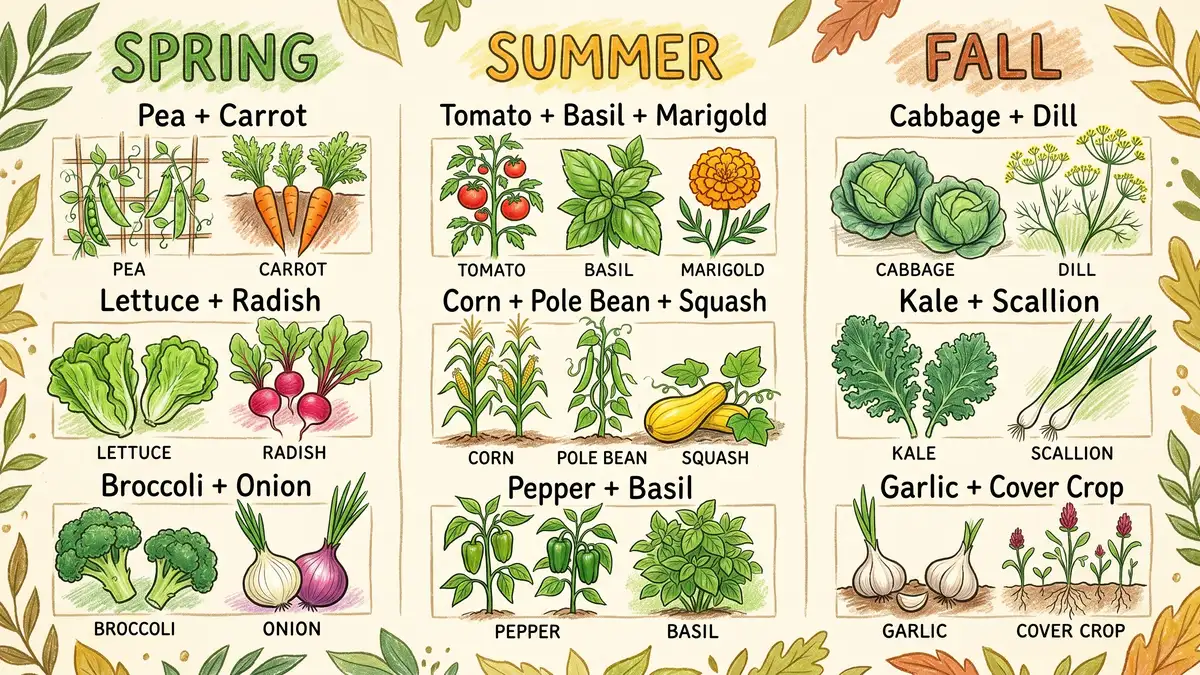
Penn State Extension draws the basic line: cool-season crops germinate at soil temperatures of 40 to 50 F and grow best between 50 and 70 F. Warm-season crops want 65 F+ soil and stall below 60 F. The Weekend Gardener's calendar runs three working windows:
| Season | Soil temp | Window | Headline crops |
| Spring | 40 to 60 F | 4 to 6 weeks before last frost to about 2 weeks after | Peas, lettuce, spinach, radish, brassicas, onions, beets |
| Summer | 65 to 85 F | 2 weeks after last frost to 8 weeks before first frost | Tomato, pepper, eggplant, corn, beans, squash, cucumber |
| Fall | 50 to 65 F | 8 weeks before first frost to 2 weeks after | Cabbage, kale, lettuce, garlic (overwintering), radish, swiss chard |
Sources:.
Key Takeaway
Companion planting changes with soil temperature. Spring pairs cool-tolerant crops (peas, lettuce, brassicas, radish) that share the bed for 8 to 12 weeks before warm-season crops arrive. Summer pairs heat-loving crops (tomato, pepper, corn) with aromatic herbs and trap-crop flowers. Fall pairs frost-tolerant crops (cabbage, kale, garlic) with cover crops and overwintering alliums. Each season has its own pairings, its own pests, and its own rotation logic. Mix the seasons and the crops fail.
Spring Companions: Cool Soil, Fast Crops
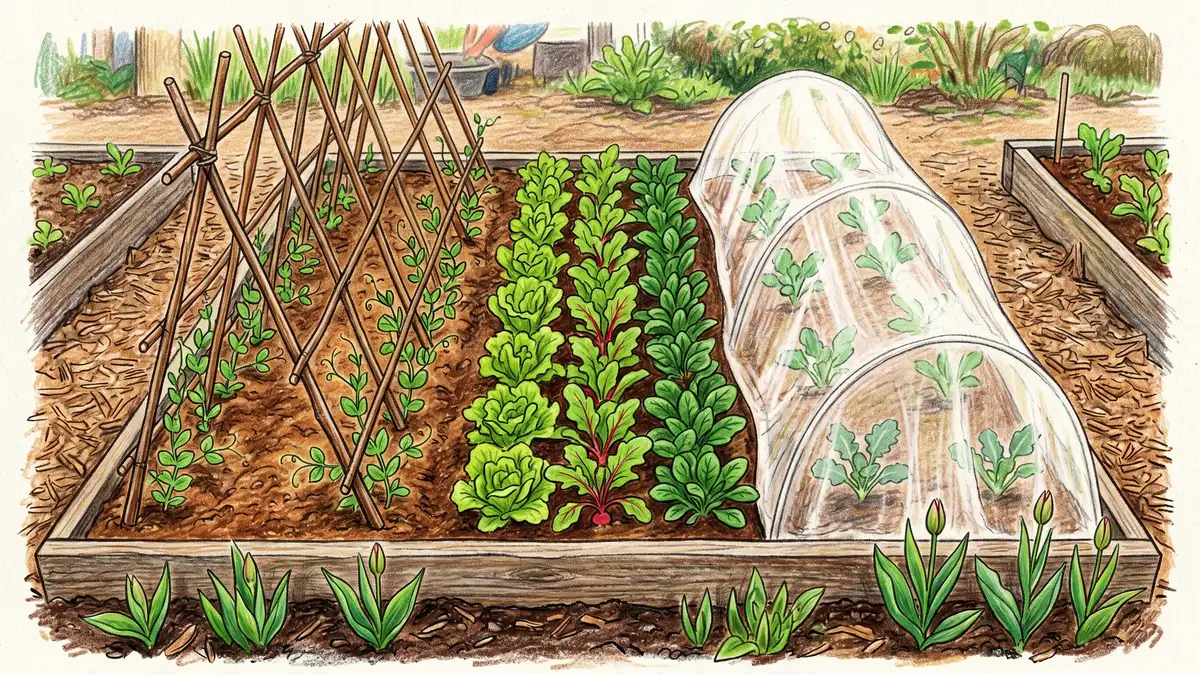
Spring is the easiest season for new companion planters because the crops grow fast, mature on overlapping schedules, and clear the bed before summer crops need the space. The catch is timing: match the pairing to the actual soil temperature, not to the calendar date. Buy a soil thermometer and check the top 4 inches at 9 am.
| Pairing | Why it works |
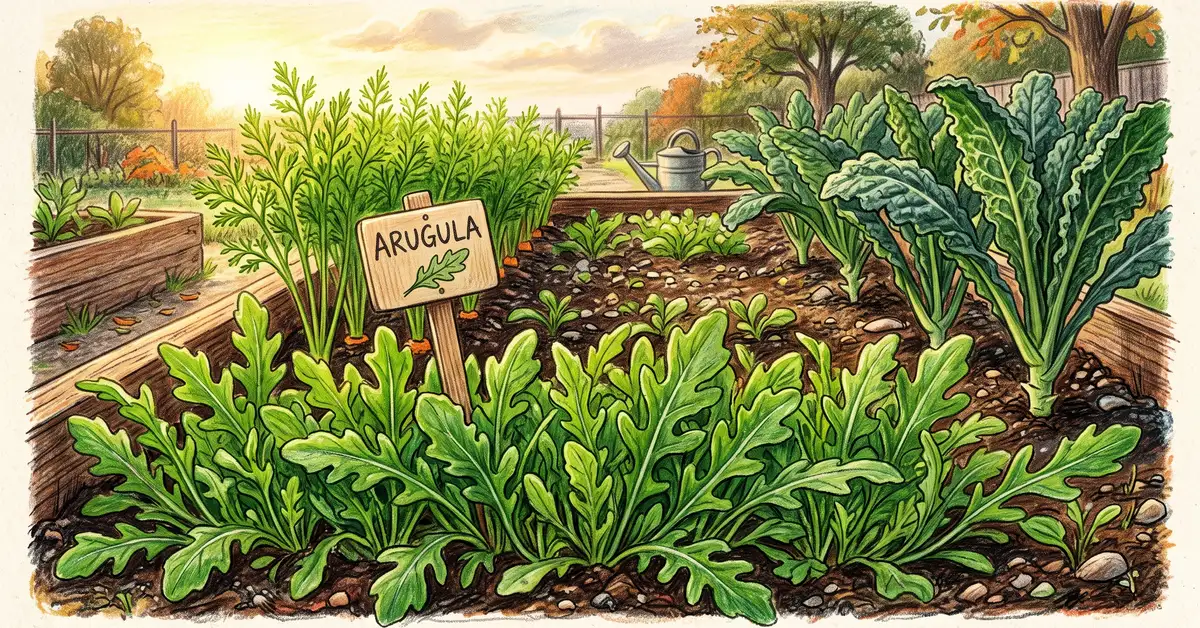
| Peas + carrots | Peas climb the trellis fast; carrots fill the soil around the trellis base. Different root depths, no competition. |
| Peas + spinach | Both thrive in pre-frost cool soil. Peas fix nitrogen; spinach uses it. Solara companion guide. |
| Lettuce + radish | Radish matures in 3 to 4 weeks and clears space before lettuce hits full size. Classic succession pairing. |
| Broccoli + onion / garlic | Allium sulfur volatiles deter cabbage moth from brassicas. See what to plant with broccoli and brassicas. |
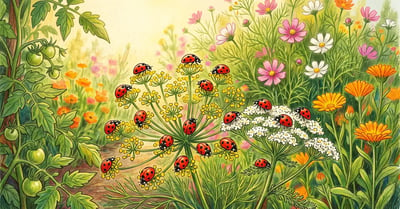
| Cabbage + dill / chamomile | Flat-flower herbs feed parasitoid wasps that lay eggs in cabbage worms. |
| Beet + bush bean | Beans fix nitrogen for the heavy-feeder beet; non-overlapping nutrient demand. |
| Spinach + strawberry | Strawberry leaves shade emerging spinach in late spring; spinach is harvested before strawberry runners spread. |
Sources:.
The spring rule of thumb: every bed should pair one fast crop (radish, lettuce, spinach) with one slow crop (broccoli, cabbage, kale, carrot, beet). The fast crop is out before the slow crop reaches full size, doubling the bed's effective yield in the same season. For a fuller spring walk-through, see our existing spring companion planting guide.
Summer Companions: Warm Soil, Heavy Yields
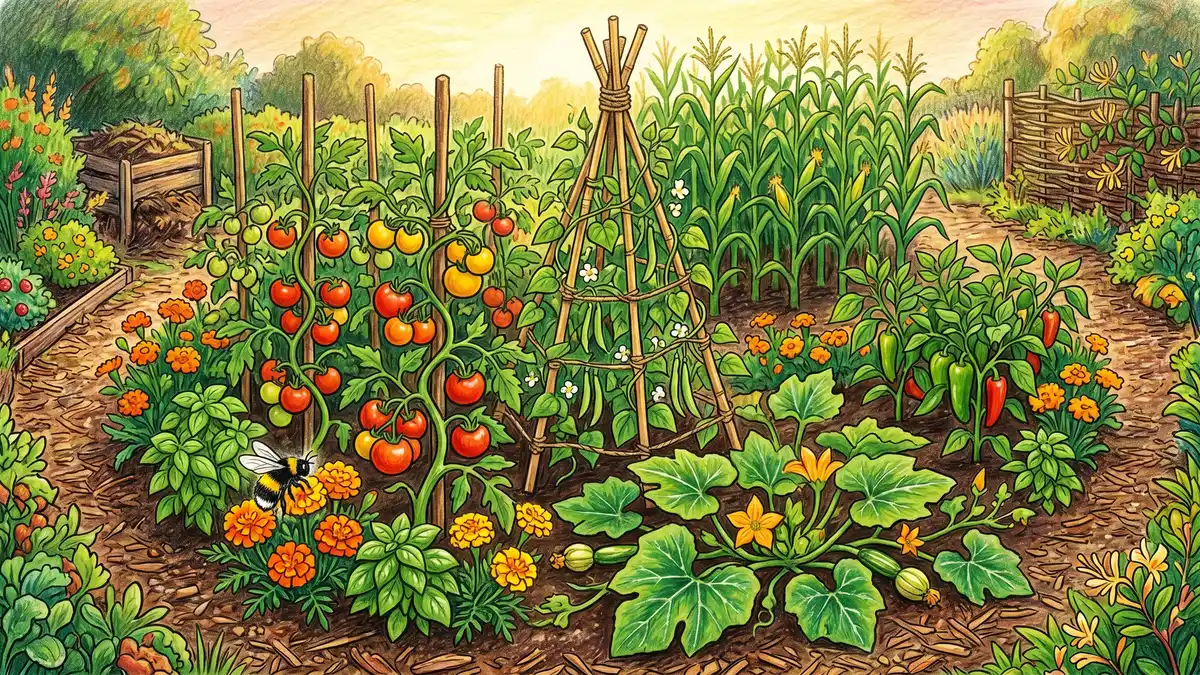
Summer is the high-yield season but also the high-pest-pressure season. Aphids, cabbage worms, squash bugs, hornworms, flea beetles, and Japanese beetles all hit at once. The aromatic herb companions and trap-crop flowers earn their place here.
| Pairing | Why it works |
| Tomato + basil + marigold | Basil masks tomato volatiles and primes wound response. Marigold suppresses soil nematodes.. |
| Pepper + basil + parsley | Volatile-masking herbs deter aphids and pollinator attraction at flowering. |
| Three Sisters (corn + pole bean + winter squash) | The peer-reviewed polyculture.. See our companion planting corn deep dive. |
| Cucumber + dill + nasturtium | Dill attracts cucumber-beetle predators; nasturtium acts as squash-bug trap crop. |
| Squash + nasturtium + radish | Nasturtium pulls squash bugs; radish deters squash vine borer at the stem base. |
| Eggplant + basil + thyme | Aromatic deterrent against flea beetle and Colorado potato beetle. |
| Lettuce + tomato (interplanted in shade) | Tall tomato shades lettuce, extending lettuce season into early summer. |
Sources:.
Why This Works: Niche Stacking in Summer Beds
A well-planned summer bed packs three vertical layers and at least two ecological roles in every square foot. Pole beans climb the tomato cage, basil tucks into the gaps at mid-height, marigold and nasturtium cover the soil at knee height, and the whole bed feeds pollinators. The cabbage white butterfly cannot smell your tomatoes through the basil, the aphids land on the nasturtium instead of the eggplant, and the parasitoid wasps from the dill flowers feed on whatever pest larvae survive the first wave. This is the same niche-complementarity principle that drives the Three Sisters polyculture; you are just running it at a smaller scale.
Pairings to Avoid in Summer
| Avoid | Why |
| Tomato + fennel | Fennel allelopathy suppresses tomato and most other vegetables. Plant fennel in its own pot at least 10 feet away. |
| Beans + onion / garlic / chive | Allium sulfur compounds suppress nitrogen-fixing rhizobia in bean roots. Plant beans away from alliums. |
| Tomato + potato | Both nightshades; share early blight and Colorado potato beetle. Plant in separate beds. |
| Cucumber + sage | Sage volatiles suppress cucumber growth at close range. |
Sources:.
Fall Companions: Cool Soil Returning, Overwintering Starts
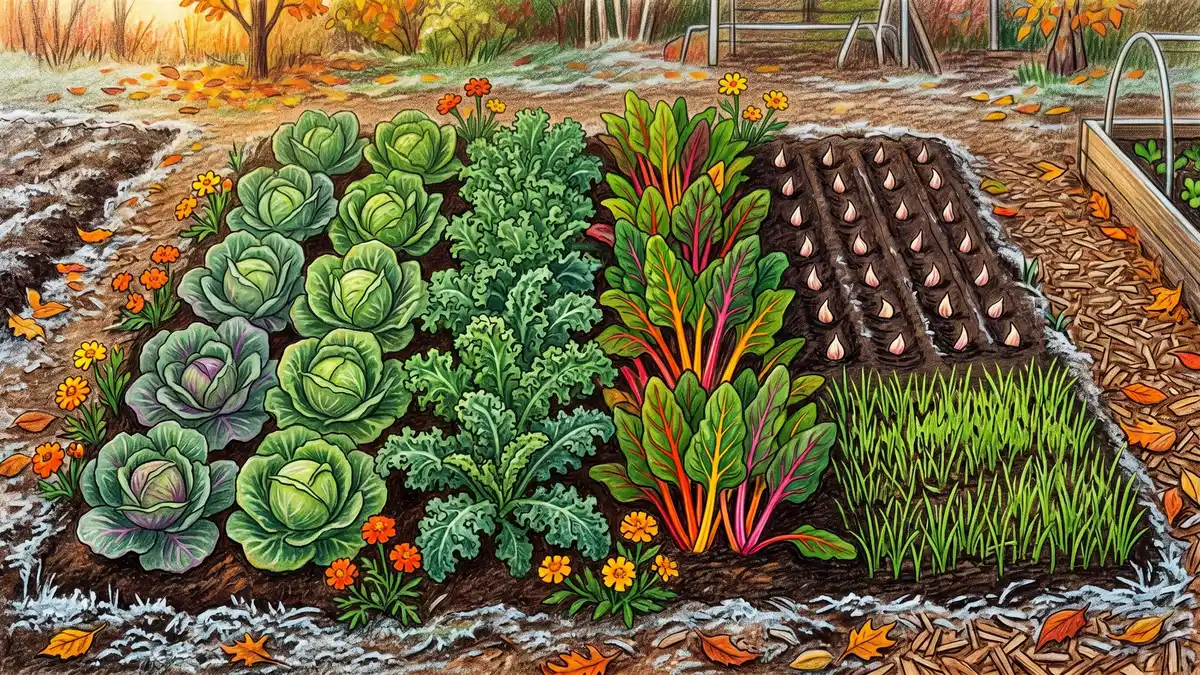
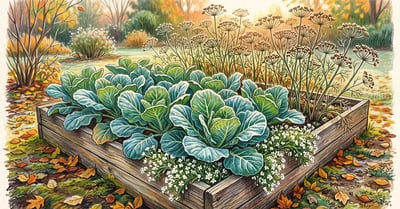
Fall is the season most gardeners give up too early on. Penn State Extension's season extenders guide documents that frost-tolerant brassicas (cabbage, kale, Brussels sprouts), root crops (carrot, beet, parsnip), and overwintering alliums (garlic, shallot) can produce well into November and December in much of the US, especially with a row cover.
| Pairing | Why it works |
| Cabbage + dill / chamomile | Flat-flower herbs feed parasitoid wasps that target late-season cabbage worm pulses. |
| Kale + scallion / leek | Allium volatiles deter cabbage moth from kale. |
| Lettuce + radish (succession) | Fast radish clears space for late-season lettuce in cooling soil. |
| Garlic + cover crop (winter rye / clover) | Garlic planted late October to early November overwinters under or beside cover crop biomass. See companion planting mint for related allium uses. |
| Carrot + onion / leek | Allium volatiles deter carrot fly through the fall harvest window. |
| Spinach + winter cover (under floating row cover) | Spinach survives single-digit frosts under cover; companion cover crop fills empty space. |
Sources:.
For the full fall planting playbook see our fall companion planting guide.
Cover Crops as Fall and Winter Companions
Cover crops are the often-skipped fourth companion of the fall garden. They sit in the empty space between your last fall vegetable and next spring's planting, fixing nitrogen, building organic matter, suppressing winter weeds, and protecting soil from rain compaction. The three workhorses for home gardens:
Winter rye (Secale cereale)
The most cold-tolerant home cover crop. Drilled or broadcast in mid-September to mid-October, it grows through fall, overwinters, and resumes in spring. USDA NRCS Cereal Rye Fact Sheet (PDF) documents biomass production of 3 to 5 tons per acre in temperate zones.
Hairy vetch (Vicia villosa)
Legume that fixes 100 to 200 lb N per acre. USDA NRCS Hairy Vetch Fact Sheet (PDF). Best planted with winter rye as a rye-vetch mix; the rye gives the vetch a trellis.
Crimson clover (Trifolium incarnatum)
Showy red-flowered legume; fixes 70 to 150 lb N per acre. USDA NRCS Crimson Clover Fact Sheet (PDF). Pollinators feed on the spring blossoms before you terminate the crop.
For the full menu and selection logic see USDA SARE's Managing Cover Crops Profitably and UMN Extension's cover crop selection guide for vegetable growers.
The 3-Year Rotation Across All Three Seasons
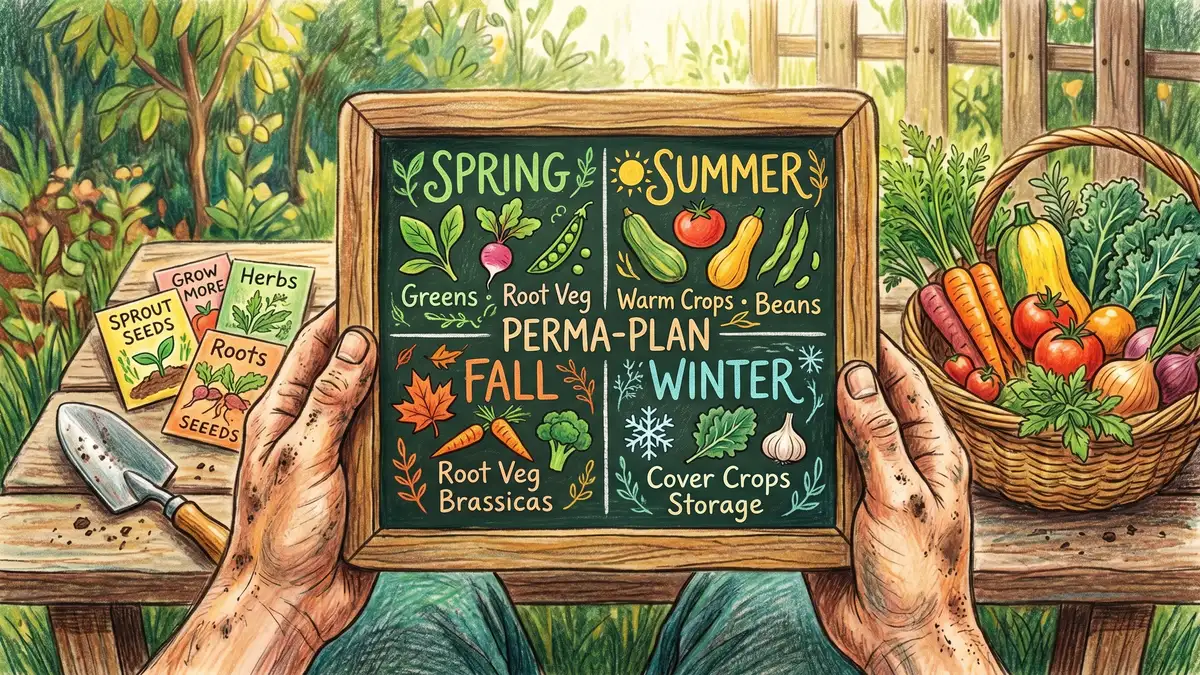
Seasonal pairing is only half of the planning job. The other half is rotating plant families between years so soil diseases do not build up in the same bed. Penn State Extension recommends a 3-year minimum rotation. Combined with seasonal pairing, a 3-bed home garden produces around 9 distinct crops per year while never replanting the same family in the same spot for at least 3 years.
A working example over 3 years in the same 4 by 8 ft bed:
Year 1: Spring peas (Fabaceae) → summer tomato + basil (Solanaceae + Lamiaceae) → fall cover crop (winter rye + crimson clover).
Year 2: Spring lettuce + carrot (Asteraceae + Apiaceae) → summer pepper + eggplant (Solanaceae) → fall garlic (Alliaceae) overwintering.
Year 3: Spring broccoli + onion (Brassicaceae + Alliaceae) → summer cucumber + squash + nasturtium (Cucurbitaceae) → fall kale + scallion (Brassicaceae + Alliaceae).
By year 4 you cycle back to year 1, the soil never sees the same disease pulse twice in a row, and the bed produces continuously. Peer-reviewed work on legume rotation in PMC10245104 documents the nitrogen-cycling benefit: a pea or bean year leaves 40 to 60 lb N per acre behind for the next year's heavy feeder. Plan the rotation around that gift.
Frequently Asked Questions
What can you plant together in spring?
Peas with carrots, peas with spinach, lettuce with radish, broccoli with onions, cabbage with dill or chamomile, beets with bush beans, and spinach near strawberry. Spring pairings work in cool soil (40 to 60 F) and mature on overlapping 8 to 12 week schedules so the fast crops clear the bed before warm-season crops arrive. Use a soil thermometer to confirm 40 to 50 F at 4 inch depth before sowing.
What can you plant together in summer?
Tomato with basil and marigold, pepper with basil and parsley, Three Sisters (corn with pole beans and winter squash), cucumber with dill and nasturtium, squash with nasturtium and radish, eggplant with basil and thyme. All of these pairings rely on aromatic herbs masking the crop's volatile signature plus trap-crop flowers drawing pests to the perimeter.
What can you plant together in fall?
Cabbage with dill and chamomile, kale with scallion and leek, lettuce with radish, garlic with a winter cover crop, carrot with onion. Fall pairings are essentially spring pairings repeated in cooling soil rather than warming soil, plus overwintering alliums (garlic, shallot, leek) planted in October for next summer's harvest.
What is the difference between cool-season and warm-season companion planting?
Cool-season pairings (spring and fall) work in soil between 40 and 65 F and feature peas, lettuce, spinach, brassicas, beets, carrots, and radish. Warm-season pairings (summer) work in soil 65 F+ and feature tomato, pepper, eggplant, corn, beans, squash, and cucumber. Mixing the two seasons (planting tomatoes in 50 F soil or lettuce in 80 F soil) fails regardless of how good the companion pairing is on paper.
How do you rotate crops between seasons?
Rotate by plant family on a 3-year cycle. A working pattern: year 1 legume in spring then nightshade in summer then cover crop in fall; year 2 lettuce or carrot in spring then peppers in summer then garlic in fall; year 3 brassica plus allium in spring then cucurbit in summer then kale plus scallion in fall. The legume year fixes nitrogen for the heavy feeder year that follows. Penn State Extension and Cornell Cooperative Extension both recommend the 3-year minimum.
When should I plant garlic for next summer?
UMN Extension recommends planting garlic 6 to 8 weeks before the ground freezes, usually mid-October to early November in most of the US. Plant individual cloves 4 to 6 inches deep, pointed end up, in rows 8 inches apart. The garlic establishes root systems before dormancy and resumes growth in early spring, harvesting in July or August.
Do cover crops count as companion plants?
Yes, in the broadest sense. A fall-sown cover crop like winter rye plus hairy vetch shares the bed with overwintering garlic, feeds the soil with biomass and fixed nitrogen, suppresses weeds, and prevents winter soil erosion. The vetch follows the rye trellis the same way pole beans climb a corn stalk in the Three Sisters. USDA SARE's Managing Cover Crops Profitably documents the practice in detail.
Get the Weekly Dig
One practical permaculture guide a week, written for gardeners who do this on weekends: companion pairings that hold up under scrutiny, and the ones that do not. Free, no spam, unsubscribe any time.
Join the Weekly DigResources
- Penn State Extension, Cool-season vs Warm-season Vegetables
- Penn State Extension, Maximizing Your Vegetable Garden
- Penn State Extension, Season Extenders and Growing Fall Vegetables
- Penn State Extension, Plant Rotation in the Garden Based on Plant Families
- UMN Extension, Companion Planting in Home Gardens
- UMN Extension, Cover Crop Selection for Vegetable Growers
- UMN Extension, Tips for Garlic Planting Season
- Iowa State Extension, Soil Temperature and Planting Conditions for Spring
- Iowa State Extension, Planting and Harvesting Your Vegetable Garden
- Cornell Cooperative Extension, Creating a Three Sisters Garden
- Cornell Cooperative Extension, Cool Season Vegetables (PDF)
- Cornell Cooperative Extension, Companion Planting and Flower Borders
- Cornell Garden-Based Learning, Vegetable Growing Guides
- UMD Extension, Vegetable Planting Calendar
- UMD Extension, Growing Garlic in a Home Garden
- Oregon State Extension, Monthly Garden Calendars
- Illinois Extension, Vegetable Succession Planting Chart (PDF)
- University of Delaware Extension, The New Companion Planting: Adding Diversity
- USDA SARE, Selecting the Best Cover Crops for Your Farm
- USDA NRCS, Cereal Rye Cover Crop Fact Sheet (PDF)
- USDA NRCS, Hairy Vetch Cover Crop Fact Sheet (PDF)
- USDA NRCS, Crimson Clover Cover Crop Fact Sheet (PDF)
- USDA NAL, The Three Sisters of Indigenous American Agriculture
- People and Nature 2024, Yield and Labour Demands of Maize, Beans and Squash (peer-reviewed)
- Ethnobiology Letters, Food Yields and Nutrient Analyses of the Three Sisters (peer-reviewed)
- PMC5746795, Companion Plants for Aphid Pest Management (peer-reviewed)
- PubMed 27860184, Calendula officinalis as a Floral Resource (peer-reviewed)
- PMC10245104, Legume Rotation Yield and Nitrogen Uptake (peer-reviewed)