
You picked the perfect sunny corner for raspberries, watered them all summer, and got a handful of small berries while the canes wilted from the bottom up. The site was fine. The problem was probably what grew there last year, or what is growing next to your patch right now.
Raspberries and blackberries (collectively called caneberries or brambles) are heavy feeders with picky neighbours. The right companion plants boost pollination, deter Japanese beetles, and cover the soil between rows. The wrong neighbours pass Verticillium wilt straight into the root zone and kill your patch in one season. This guide covers both lists, the science behind them, and exactly how to lay out a backyard berry bed.
Key Takeaway
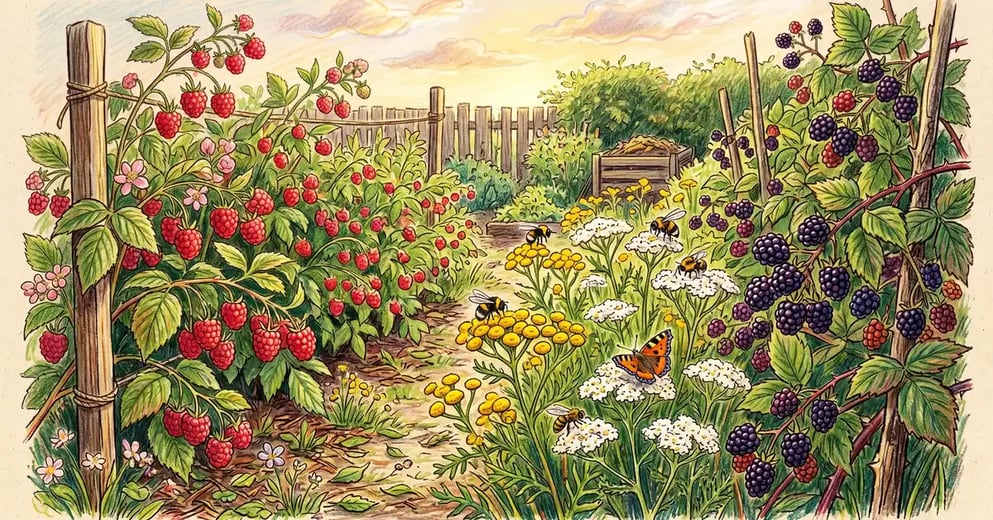
The best companions for raspberries and blackberries are tansy, yarrow, garlic, chives, marigolds, nasturtiums, and comfrey. The worst are anything in the Solanaceae family (tomatoes, peppers, potatoes, eggplant), strawberries, and roses, all of which share Verticillium wilt and viral diseases with caneberries. Yes, you can plant raspberries and blackberries near each other if you keep red and black raspberries separated by 75 ft (23 m) to prevent virus transmission.
Best companion plants for raspberries and blackberries
Caneberry companion lists from UMass Extension and the Southeast Regional Caneberry Production Guide converge on the same group of useful neighbours. Each one earns its place by doing a measurable job: deterring a specific pest, attracting a specific pollinator, mining nutrients from below the root zone, or covering exposed soil between rows.
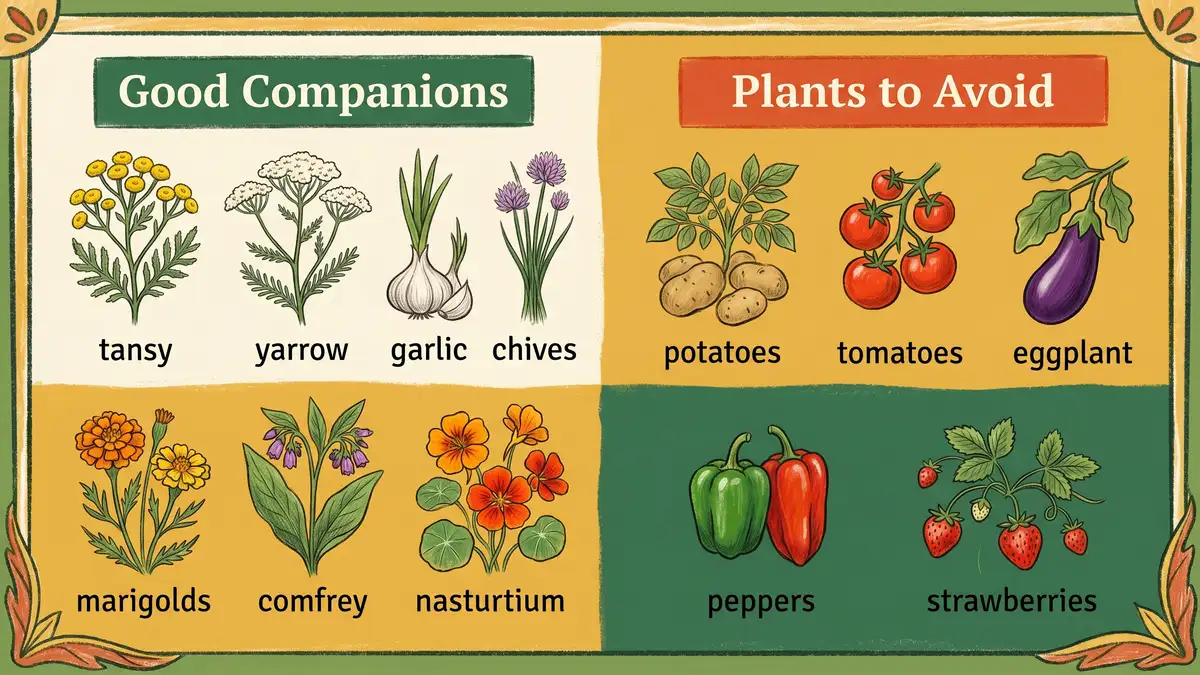
Companion lists compiled from Bunny's Garden raspberry guide and Epic Gardening's blackberry list, cross-checked against extension sources.
| Companion | What it does | Best placement |
| Tansy | Repels Japanese beetles, ants, raspberry beetle | Row ends, 3 ft (0.9 m) from canes |
| Yarrow | Attracts predatory wasps and hoverflies; mines minerals | Scattered along row edges |
| Garlic, chives | Allium volatiles deter aphids and Japanese beetles | Continuous strip at cane base |
| Marigold (French) | Suppresses root-knot nematodes; pollinator draw | Row ends and bed corners |
| Nasturtium | Trap crop for aphids; living mulch under canes | Trailing through paths |
| Comfrey (Bocking 14) | Deep taproot nutrient mining; chop and drop fertility | Single plants at row ends only |
| Buckwheat (cover crop) | Builds soil, attracts beneficial insects | Pre-plant green manure year |
Source: Cross-referenced with Plant Addicts raspberry companion guide.
Plants to keep far away from your berry patch
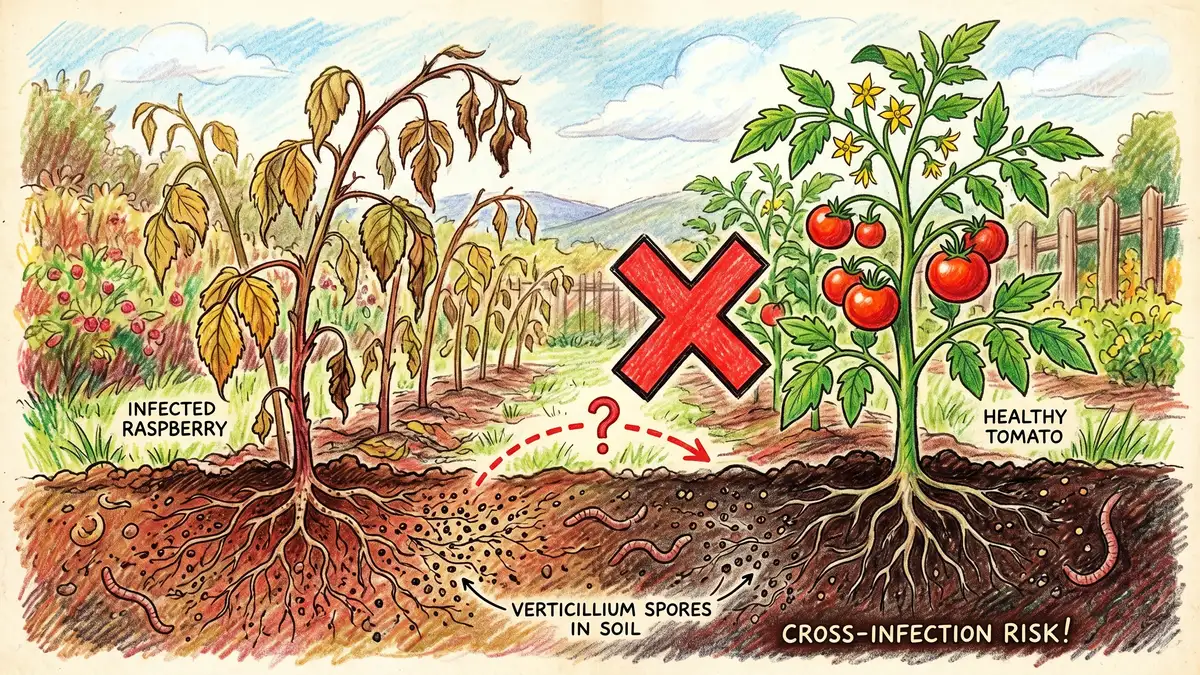
Critical Risk: Verticillium Wilt and the Solanaceae Family
The fungus Verticillium dahliae persists in soil for up to 10 years and infects both caneberries and the Solanaceae family (tomatoes, peppers, eggplant, potatoes). Penn State Extension documents that bramble plantings on land previously cropped to Solanaceae often collapse within two seasons. Wait at least 3 years (5 years is safer) before planting raspberries or blackberries on a bed that grew tomatoes, peppers, potatoes, eggplant, or strawberries. Purdue Extension's host list shows over 200 plant species can carry the fungus.
The list of plants to keep away from raspberries and blackberries:
- Tomatoes, peppers, eggplants, potatoes: Verticillium wilt host plants
- Strawberries: share Verticillium plus several leaf spot and root rot pathogens
- Roses, stone fruit (cherry, peach, plum): alternate hosts for cane diseases and fire blight relatives per University of Illinois Extension
- Black walnut: produces juglone, allelopathic to most berries within 50 ft (15 m) per Washington State University Extension
- Wild brambles in fencerows: virus reservoirs that infect cultivated brambles within 1,000 ft (305 m)
- Grapes: shared anthracnose pathogens per Ohio State Extension
Can raspberries and blackberries be planted together?
Yes, with one caveat. OSU Extension notes that black raspberries (and to a lesser extent purple raspberries) are highly susceptible to viruses carried symptomlessly by red raspberries. The rule used by commercial growers is simple: plant red raspberries at least 75 ft (23 m) away from black raspberries. Blackberries can be planted closer to red raspberries because the virus transmission is weaker.
For a typical backyard, that 75 ft separation means putting red raspberries on one side of the property and any black raspberry or blackberry bed on the other. Different cultivars within the same species (two red raspberry varieties, for example) can share a bed without issue.
Why This Works (the permaculture lens)
A traditional caneberry row is a monoculture: same species, same root depth, same nutrient needs, all competing in the same layer. A guild planting (a small mixed plant community designed around the main crop) fills the layers above and below the canes, builds soil through chop-and-drop comfrey, and pulls in pollinators that would otherwise skip a wind-pollinated raspberry row. This is the same principle as companion planting in your vegetable beds, scaled up to fruit. The patch becomes more resilient because each function (pest control, pollination, fertility, ground cover) is performed by more than one plant.
How to design a backyard raspberry guild
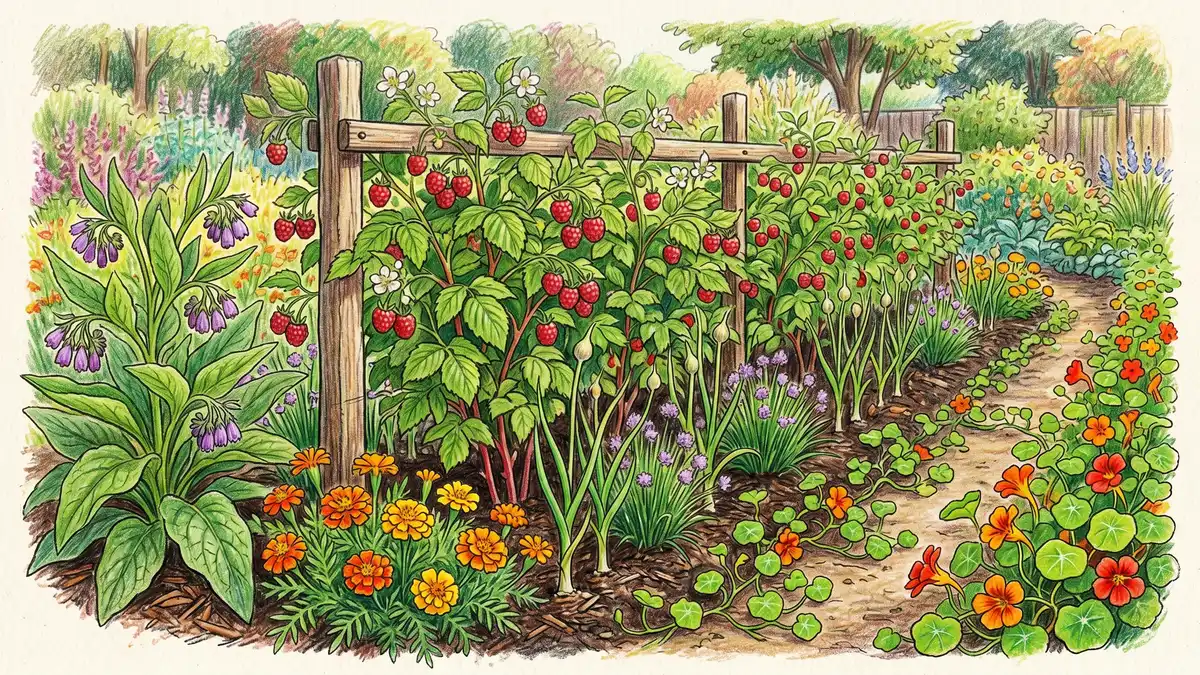
A simple guild for a 10 ft (3 m) raspberry row uses three layers of companions placed by function:
Year before: prep with buckwheat
Sow a buckwheat green manure crop the summer before planting. Buckwheat builds soil structure and attracts beneficial insects. Chop it down at flowering and let it decompose into the bed.
Plant canes 3 ft apart in spring
Space red raspberry primocanes 2 to 3 ft (0.6 to 0.9 m) apart in rows. Blackberries need 3 to 6 ft (0.9 to 1.8 m) depending on cultivar. Trellis at 4 to 5 ft (1.2 to 1.5 m) height for blackberries per University of Florida IFAS Extension.
Underplant with alliums
Plant a continuous strip of garlic and chives at the base of the cane row. Garlic goes in autumn, chives are perennial and divide every 2 to 3 years. Both deter Japanese beetles and aphids.
Bookend with tansy and marigold
Plant tansy and French marigolds at each end of the row. Tansy is a perennial; marigolds are reseeding annuals. Both protect the row ends, which is where Japanese beetles tend to enter.
Comfrey at the corners only
Plant Bocking 14 (sterile cultivar) comfrey at the two outer corners. Cut leaves 3 to 4 times per season and lay them on the cane row as mulch. Never plant comfrey between canes (it crowds them) and never plant fertile-seed comfrey (it spreads).
Comfrey: the classic raspberry companion
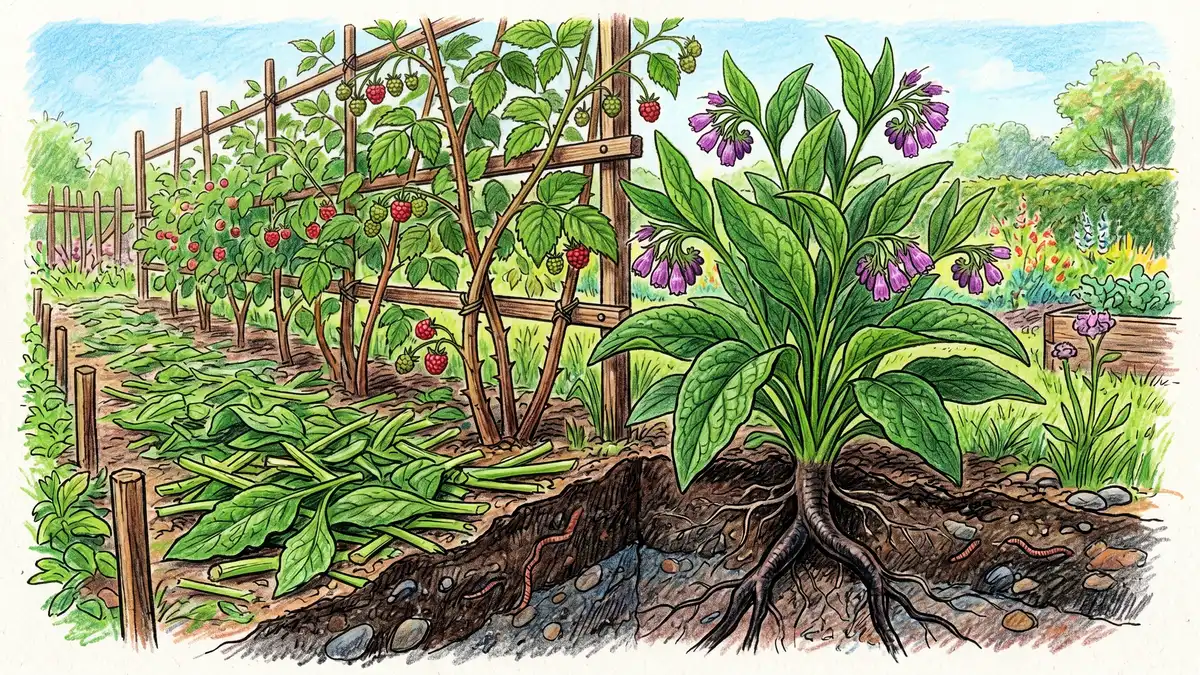
Comfrey is the most cited single companion in permaculture berry plantings, and the reason is its taproot. Comfrey roots reach 6 to 10 ft (1.8 to 3 m) deep, mining potassium, calcium, and trace minerals that surface-feeding raspberries cannot reach.
Use only the Bocking 14 sterile cultivar. Regular comfrey (Symphytum officinale) reseeds aggressively and becomes a weed problem. Bocking 14 produces no viable seed and stays where you plant it.
Standard chop-and-drop schedule: cut the leaves at the base 3 to 4 times per growing season, lay them directly on the raspberry row as mulch. They wilt in two days and decompose into the top inch of soil within 3 to 4 weeks, releasing potassium that supports fruit production. For more on this technique see our chop and drop mulching guide.
Garlic and chives: the everyday pest deterrent layer
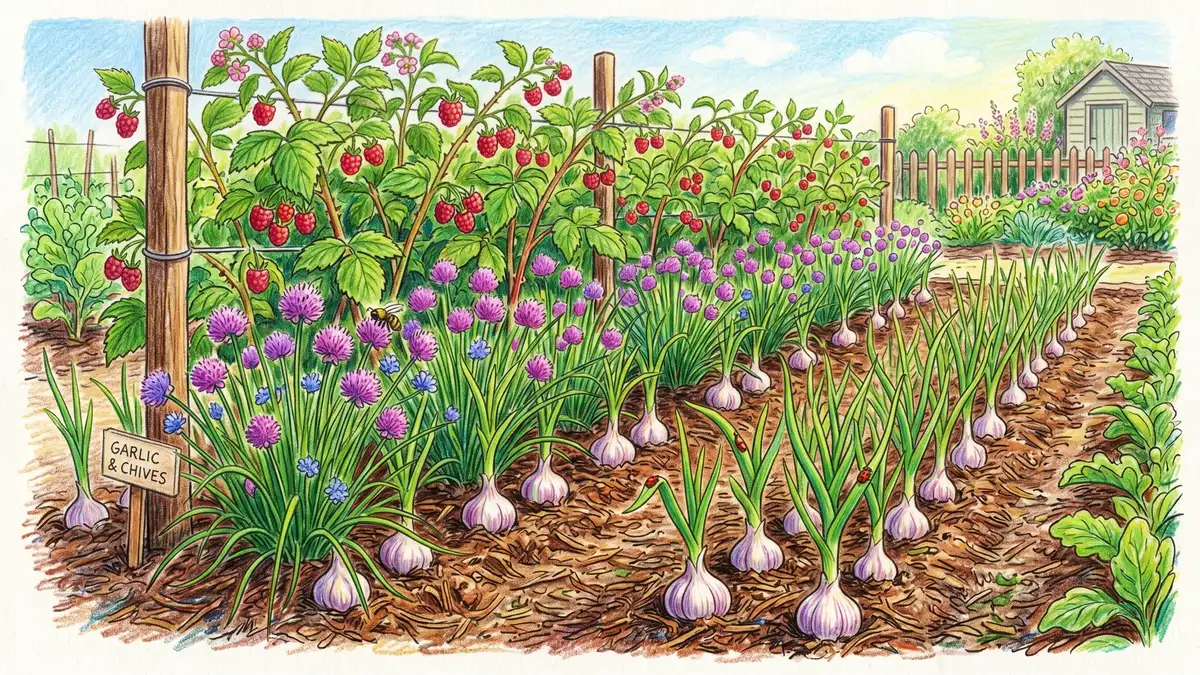
Alliums (garlic, chives, onions, shallots) release sulphur volatile compounds that deter several common caneberry pests, particularly aphids and Japanese beetles. Kellogg Garden's companion planting research documents the same deterrent effect, and chive flowers attract hoverflies that predate on aphid colonies.
Practical layout: plant a continuous strip of garlic cloves in autumn at the base of each raspberry row, 4 in (10 cm) apart. Add a few clumps of chives every 3 ft (0.9 m) as a perennial backbone. The garlic harvests in early summer, leaving the chives to continue protecting the row. Onions and shallots work the same way if you prefer them.
Pollinators and pest control beyond chemistry
Raspberries are partially wind-pollinated but yield significantly better with insect pollination. Tansy, yarrow, marigolds, and the flowering heads of chives all attract bees, hoverflies, and small predatory wasps. West Virginia University Extension notes that spotted wing drosophila (SWD), the most damaging berry pest of the 2020s, is partly suppressed by maintaining a diverse insect community around the patch, since predatory beetles and parasitic wasps reduce SWD populations.
If SWD is present in your area, companion plants do not replace netting or trapping but they reduce overall pest pressure. Combined with healthy soil supporting active soil bacteria and fungi, a well-companioned berry patch is more resilient than a sprayed monoculture row.
Common mistakes to avoid
- Planting too close to old vegetable beds. If your raspberry bed is downhill from last year's tomato patch, soil-borne fungi can still reach the canes. Use a physical barrier or a 3-year wait.
- Letting comfrey compete with canes. Plant it at the corners only. Bocking 14 will not reseed but its leaves can shade out new primocanes if planted between them.
- Mixing red and black raspberries. Red raspberries carry viruses symptomlessly. Black raspberries get them and die. Keep them 75 ft (23 m) apart.
- Skipping the 3-year crop rotation. Replanting brambles on a failed bramble bed almost always fails again. Move to fresh ground.
- Forgetting to thin canes. Companion plants do not solve airflow problems. Thin to 4 to 6 canes per running foot for raspberries.
For broader pillar context, see our complete companion planting chart and our overview of 12 permaculture principles in the garden.
Get the Free GrowPerma Newsletter
Weekly companion planting and food forest guides written for weekend gardeners. No spam, unsubscribe anytime.
Read the Free GuideFrequently Asked Questions
Can I plant blackberries and raspberries together?
Yes, with one caveat: keep red raspberries at least 75 ft (23 m) from black raspberries because red raspberries can carry viruses symptomlessly that kill black raspberries. Blackberries and red raspberries can share a bed because virus transmission between them is weaker. Different cultivars of the same species can grow side by side without issue.
What should you not plant near raspberries or blackberries?
Avoid tomatoes, peppers, eggplants, potatoes, strawberries, roses, and stone fruit (cherry, peach, plum). All can carry Verticillium wilt and other soil-borne diseases that infect brambles. Keep brambles at least 50 ft (15 m) from any black walnut tree due to juglone allelopathy.
What is the best companion plant for raspberries?
Garlic and chives planted as a continuous strip at the base of the cane row, plus tansy or marigolds at the row ends. For long-term soil building, add Bocking 14 comfrey at the corners for chop-and-drop fertility. This combination covers pest deterrence, pollinator attraction, and fertility cycling.
Can raspberries grow under fruit trees?
Only under nitrogen-fixing trees or in dappled light. Raspberries need at least 6 hours of direct sun for good fruit set. Under heavy-shade fruit trees (apples in full canopy) they will live but produce poorly. Avoid planting under stone fruit (cherry, peach, plum) due to shared disease risks.
Can I plant carrots with raspberries?
Yes, carrots have shallow roots and tolerate the partial shade at the base of cane rows. They are not strong companions (no documented pest deterrence) but they do not compete with raspberry roots and they make use of space between canes during the first year of establishment.
Do raspberries need a companion plant?
Not strictly, but yields and pest resistance improve significantly with the right companions. A bare-soil raspberry row works but loses moisture faster, attracts more weed pressure, and depends entirely on whatever pollinators happen to find it. A guild planting solves all three problems.
How far apart should raspberries and blackberries be planted?
Raspberry canes: 2 to 3 ft (0.6 to 0.9 m) apart in rows, with 8 to 10 ft (2.4 to 3 m) between rows. Blackberries: 3 to 6 ft (0.9 to 1.8 m) apart depending on cultivar (trailing varieties need more space than erect ones). Keep red raspberries 75 ft (23 m) from black raspberries.
Build a Productive Berry Patch
Our free permaculture starter guide walks you through guild planting, soil prep, mulching, and food forest layers. Practical steps designed for weekend gardeners with limited time and real budgets.
Start with the Free GuideResources
- Bramble Fruit Fact Sheet (UMass Extension)
- Southeast Regional Caneberry Production Guide (NC State)
- Bramble Disease: Verticillium Wilt (Penn State Extension)
- Verticillium Wilt of Woody Plants (Purdue Extension)
- Anthracnose of Raspberry and Blackberry (Ohio State Extension)
- Growing Raspberries in Your Home Garden (Oregon State Extension)
- How to Build a Blackberry Trellis System (UF/IFAS Extension)
- Spotted Wing Drosophila (WVU Extension)
- Black Walnut Allelopathy (Washington State Extension)
- Fire Blight (Illinois Extension)
- Bocking 14 Comfrey Reference
- Organic Raspberry Production (Michigan State Extension)