
The best radish companions are carrots, parsnips, lettuce, spinach, peas, cucumbers and squash. Radishes germinate in 4 to 7 days and mature in 21 to 30, so they mark a slow row, break the soil crust, and harvest out before the main crop needs the space. Keep them away from hyssop, from other brassicas such as broccoli, kale and cabbage, and from grapes. Sown as a ring around cucumber and squash transplants they also work as a trap crop, and they pull flea beetles and cucumber beetles off the plant you actually care about. Our guide to flea beetle control covers that damage pattern in detail. Below: every pairing that works, the ones to skip, the sowing pattern, and what to plant once the radishes come out.
Quick takeaway
Sow radish seed in the same row as carrots, parsnips, and lettuce to mark the row and break the soil crust. Tuck a band of radishes at the base of each cucumber and squash transplant to draw flea beetles and cucumber beetles away from the main crop. Skip planting radishes next to hyssop or with other brassicas (broccoli, kale, cabbage) because they compete for the same nutrients and share flea beetle pressure. Succession sow every 14 to 21 days through spring and again from late August through October.
Why radishes work as companions
Three traits make Raphanus sativus the ideal underplant. The seed germinates in 4 to 7 days at soil temperatures as low as 45 F (7 C), beating almost every other garden crop to the surface. The plant matures in 22 to 30 days, which means it harvests out before slower neighbors need the bed. And the taproot is just long enough (3 to 6 inches / 7 to 15 cm) to break a crust on heavy soil and aerate the top layer for shallow-rooted neighbors without competing for deep moisture.
Cornell Cooperative Extension and Penn State Extension both recommend radishes specifically for this companion role in raised beds, intensive plantings, and square-foot gardens. The crop is too small and too fast to take much from a bed, but it pulls real work out of every square inch while it is there.
The 10 best radish companions
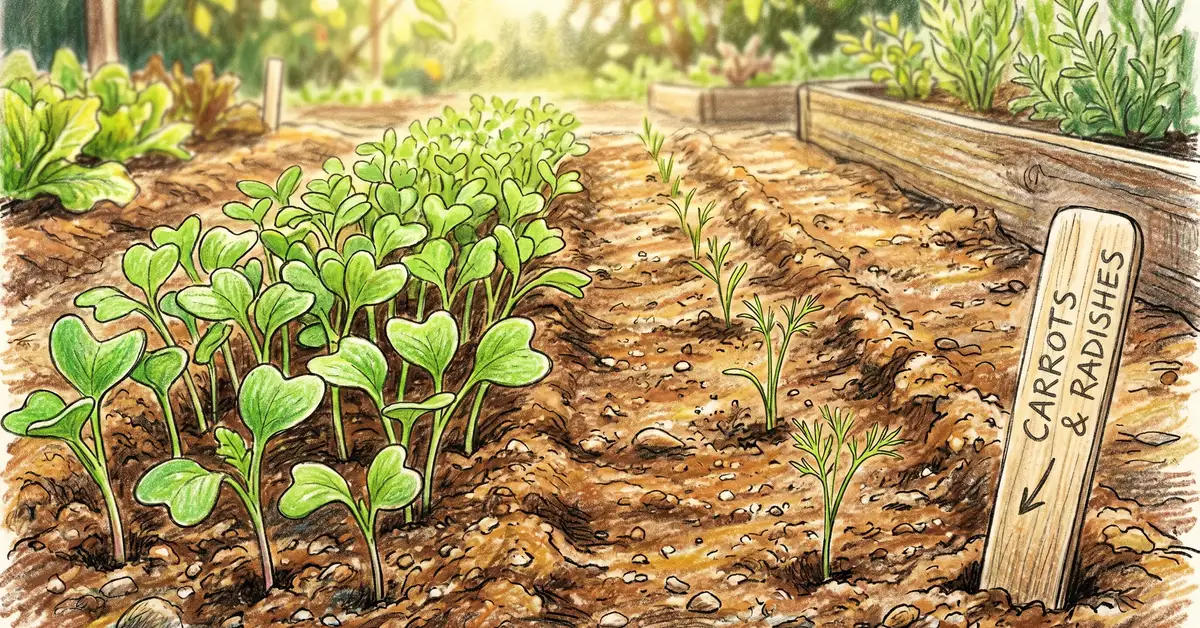
Carrots and parsnips (row markers)
Carrots take 14 to 21 days to germinate. Parsnips take 21 to 28. Mix a pinch of radish seed into the carrot row at sowing. The radishes pop in 5 days, mark the row so you can weed without uprooting the slow seedlings, and harvest out by the time the carrots need the space.
Lettuce, spinach, arugula (mutual shade)
Sown together at the same time. Lettuce leaves mature in 30 to 50 days. Radishes shade the soil surface in the first 3 weeks, then harvest out as the lettuce closes the canopy. The pairing is the foundation of intensive raised-bed plantings.
Peas and beans (nitrogen partners)
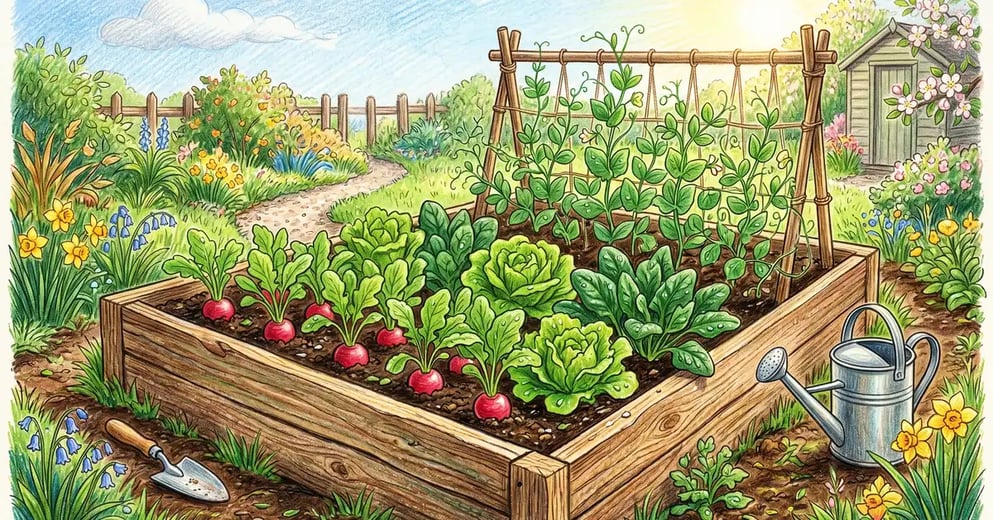
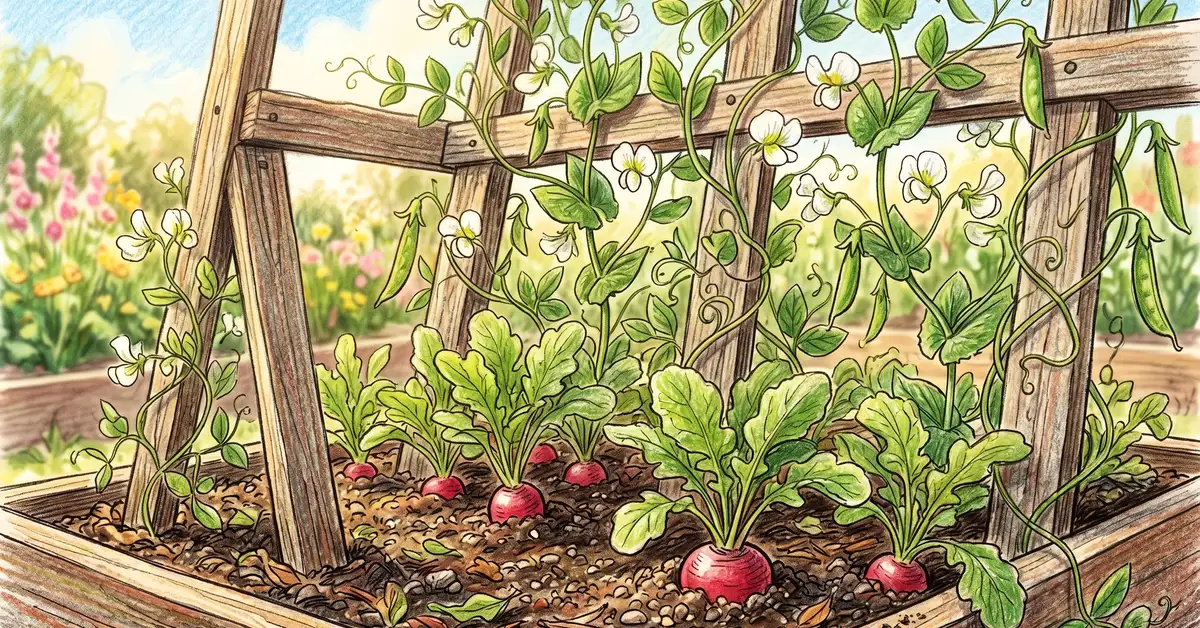
Sow radishes at the base of pea trellises and pole bean teepees. Legumes fix nitrogen via Rhizobium bacteria, which boosts radish leaf and root size. Radishes harvest before the peas vine over them. UC ANR field trials report 15 to 25 percent yield bump for radishes planted with peas.
Cucumbers (trap crop)
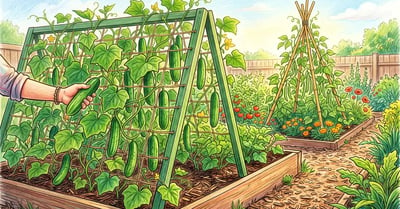
Plant a 12 inch (30 cm) band of radishes around each cucumber transplant. Striped cucumber beetles preferentially attack the radish foliage. Iowa State Extension trials documented 60 to 80 percent reduction in beetles on the main cucumber crop. Sacrifice the radishes; the cucumbers survive.
Squash and zucchini (flea beetle decoy)
Same logic as cucumbers. Flea beetles and squash bugs prefer radish leaves to squash leaves. Plant a perimeter ring of radishes around squash transplants. Let the radishes bolt if they want; the flowers feed beneficial insects.
Tomatoes and peppers (soil break)
Sow radishes around tomato and pepper transplants the same day you set the transplants out. Radishes break the soil crust and harvest out 3 weeks later, leaving the bed open as the nightshades expand. Pull radishes when nightshade canopies start to shade them.
Nasturtium (aphid decoy)
Radish and nasturtium share the same family-adjacent aphid pressure. Plant nasturtium at the edge of the bed; aphids land on nasturtium before radish. Bonus: both flowers are edible and look great in a salad.
Chervil, chives, parsley, dill (umbel beneficials)
Dill, chervil, and parsley umbels feed parasitic wasps that control aphids and cabbage moth caterpillars. Plant these herbs at the bed edge. Chives at the base of radishes deter root maggot flies (Penn State Extension).
Beets (root-zone partner)
Both are root crops but at different depths. Radish at 3 to 6 inches, beet at 5 to 8 inches. Sow together in the same row. Pull radishes at 25 days; the beets thrive in the newly opened space.
Strawberries (perennial bed interplant)
Tuck radishes between strawberry crowns in early spring before runners spread. Radishes are out by the time strawberries set fruit. Strawberry leaves shade out spring weeds the radishes did not get to.
Why this works (the permaculture angle)
This is the "fast crop subsidizes slow crop" pattern, one of the oldest in agroecology. The radish does work the slow crop cannot do yet (mark rows, shade soil, deter pests, break crust) and harvests out before the slow crop needs the space. The bed produces two crops where conventional spacing produces one. The pattern scales from a single 4 ft by 8 ft (1.2 m by 2.4 m) raised bed to a quarter-acre market garden.
The cucumber beetle trap crop trick
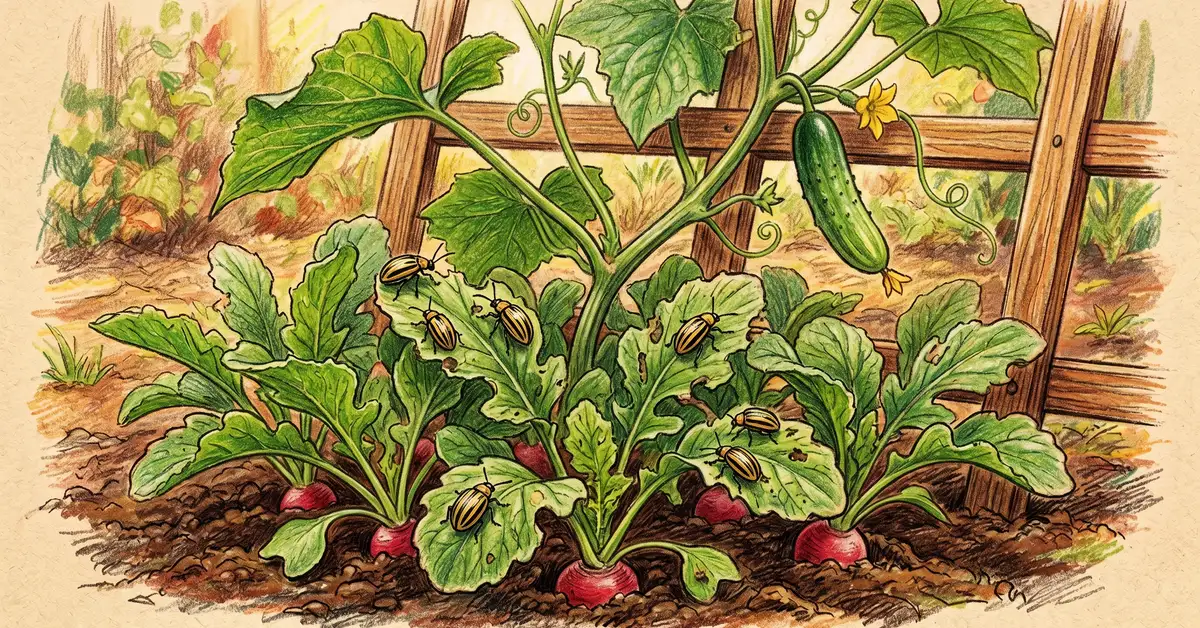
Cucumber beetles (Acalymma vittatum striped and Diabrotica undecimpunctata spotted) chew cucumber foliage and transmit bacterial wilt that kills the vine. Iowa State Extension and University of Maine Cooperative Extension both document a simple intervention: plant a 12 inch (30 cm) wide band of radishes around each cucumber transplant when the transplant goes in. Both beetle species preferentially feed on the radish leaves over the cucumber leaves.
Iowa State field trials reported 60 to 80 percent fewer adult beetles on the cucumber crop after deploying radish trap rows. The radish leaves get chewed up; the cucumbers stay clean enough to set fruit. After radishes finish in about 4 weeks, remove the chewed-up plants and replace with a second sowing or any other companion (basil, marigold, dill).
The same pattern works for squash, melons, and any other cucurbit. The radish is cheap. The cucumber crop is not. The math is obvious.
What NOT to plant with radishes
Avoid these neighbors
Hyssop (allelopathic, suppresses radish germination). Other Brassicaceae family members planted in the same bed: broccoli, cabbage, kale, cauliflower, Brussels sprouts, kohlrabi, turnips (all share flea beetle, cabbage worm, root maggot pressure and compete for the same nutrients). Grapes (older permaculture texts note radish stunts grape vigor, evidence is anecdotal but the cost of testing is high). Pole beans planted directly over radish (shade radish out too early before harvest).
The brassica family note matters: broccoli, kale, cabbage, and radishes all belong to Brassicaceae. When clustered, flea beetle damage explodes because the pest has a continuous food source. Rotate radish and brassica beds across the garden, never side-by-side.
Sowing pattern for backyard beds
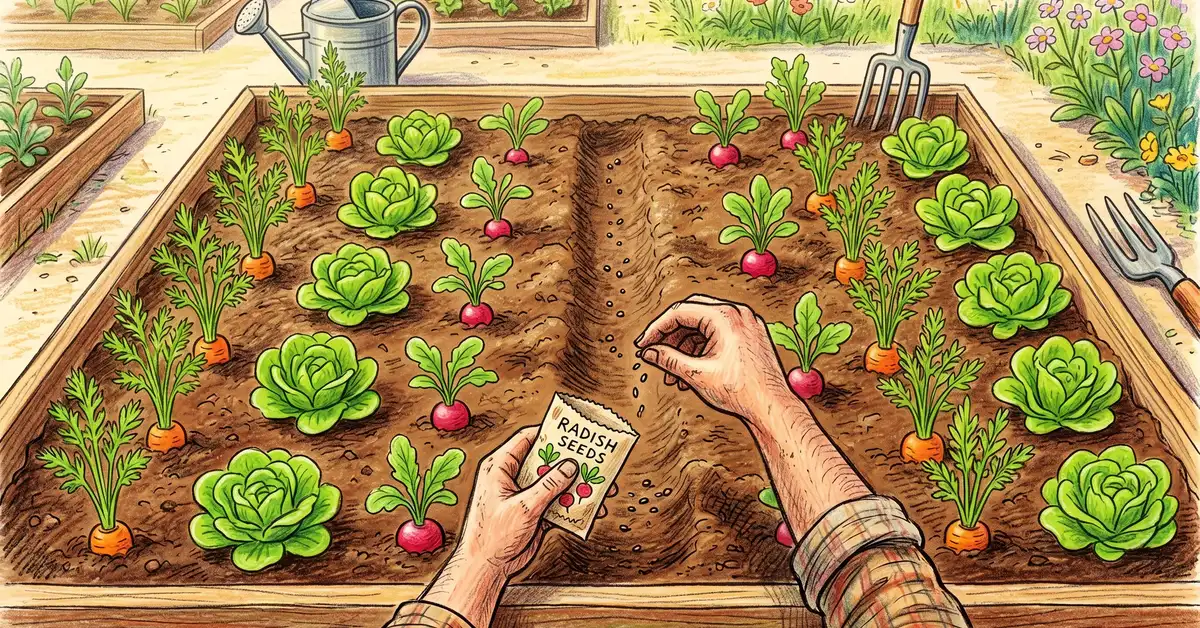
Three sowing patterns cover almost every backyard scenario.
Mixed-seed row
For carrot and parsnip rows: mix a pinch of radish seed (about 10 percent by volume) into the slow crop seed before sowing. Broadcast the mix along the row at recommended carrot density. Radishes germinate first and mark the row.
Perimeter ring
For cucumbers, squash, tomatoes, peppers: sow a 6 to 12 inch (15 to 30 cm) ring of radishes around each transplant at the same time as transplanting. The ring acts as marker, shade, and trap crop simultaneously.
Succession sowings
Sow a fresh batch of radishes every 14 to 21 days from last spring frost through about 70 F (21 C) max temperatures, then again from late August through October. Spring and fall are radish's two seasons; summer heat above 80 F (27 C) turns roots woody and bitter.
Seeding rates and timing by USDA zone
| USDA Zone | Spring sowing window | Fall sowing window |
| 3 to 4 | April 15 to June 15 | August 1 to September 15 |
| 5 | April 1 to June 1 | August 15 to October 1 |
| 6 | March 15 to May 15 | September 1 to October 15 |
| 7 | March 1 to May 1 | September 15 to November 1 |
| 8 | February 15 to April 15 | October 1 to November 30 |
| 9+ | January 15 to March 15 | October 15 to January 1 |
Sources: Cornell Cooperative Extension, Penn State Extension home vegetable guide, University of Maryland Extension.
Seed depth is 0.25 to 0.5 inches (0.6 to 1.3 cm). Spacing in row is 1 inch (2.5 cm) before thinning. Thin to 2 to 3 inches (5 to 7.6 cm) after true leaves form. A 4 ft (1.2 m) row needs about 1/4 teaspoon of seed. A 4 ft by 8 ft raised bed needs roughly 1 teaspoon for full coverage as a fast underplanting.
What to plant after radishes
A spring radish row is empty again 3 to 4 weeks after sowing, and it leaves the top few inches loose and free of crust. Radishes are light feeders on a short season, so they carry almost no nutrient debt forward. One rule decides the follow crop: never follow radishes with another brassica, because flea beetle, cabbage worm and root maggot pressure builds in a bed that grows the same family twice running.
| Follow radishes with | Why it works | When |
|---|---|---|
| Bush beans | Fix their own nitrogen and root straight into the loosened top layer | Direct sow after last frost |
| Lettuce, spinach, arugula | Shallow rooted, so they use the top 4 inches (10 cm) the radishes just opened | Direct sow, spring or late summer |
| Cucumbers and squash | Need a warm, clear bed in late May, which is when a spring radish row finishes | Transplant once soil holds 65 F (18 C) |
| Carrots | Germinate slowly, and a crust-free seedbed is most of the battle | Direct sow, spring or midsummer |
| Garlic | An August or September radish sowing clears in time for October cloves | Plant cloves mid-October |
| Any brassica (avoid) | Broccoli, kale, cabbage, cauliflower, turnips and radishes share the same three pests | Rotate to another bed instead |
Sources: Penn State Extension radishes in home gardens, NC State Extension Gardener Handbook, University of Maryland Extension.
Choosing the right radish variety for the job
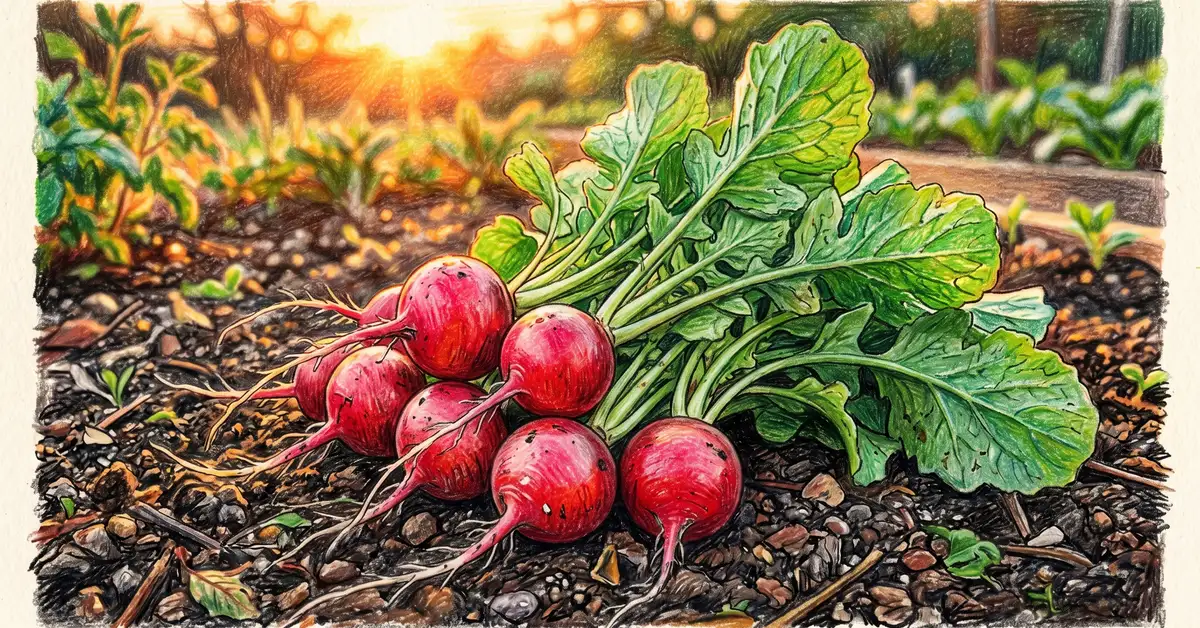
| Variety | Days to harvest | Best use |
| Cherry Belle | 22 to 28 | Classic round red, fastest. Row marker, companion crop. |
| French Breakfast | 23 to 30 | Elongated. Salad table use, succession. |
| Easter Egg blend | 25 to 30 | Multi-color mix. Kids gardens, demo plots. |
| Watermelon | 55 to 65 | Big bicolor winter radish, takes summer heat. |
| Daikon (Minowase, Long White) | 60 to 70 | Bio-driller cover crop in fall. Winter-kills in zones 5 to 7. |
| China Rose | 55 to 60 | Cool-weather storage radish, fall sowing. |
Sources: Penn State Extension home vegetable variety guide, NC State Extension.
Daikon: the off-season companion
Daikon (Raphanus sativus var. longipinnatus) extends the companion role beyond the kitchen radish window. Sown in August and September in zones 5 to 7, the taproot drills 18 inches (45 cm) deep into compacted soil and then winter-kills in December. By March the bed has tubes of organic matter and air channels where the roots were. This biological tillage drops the need to physically work the bed before planting tomatoes or squash in May. On ground that is already hard packed, daikon works better as the second pass than the first: open the top 8 to 10 inches (20 to 25 cm) once with a tool, then let the roots keep it open. Our broadfork picks by garden size set out which tine length suits which soil. Daikon also goes in between tomato rows in late August, while the plants are still standing: the radishes start in the shade, and the taproots are already down by the time the tomatoes come out.
Tillage daikon also pairs well with overwintering garlic. Plant garlic cloves in mid-October, broadcast tillage daikon between rows. Daikon dies before garlic puts on heavy spring growth. The decomposing radish feeds the garlic root zone with nutrients. For the deeper context, read our guide on winter companion planting with cover crops.
Common mistakes
- Forgetting to thin. A row of unthinned radishes produces all tops and no roots. Pinch to 2 to 3 inches (5 to 7.6 cm) once true leaves appear.
- Sowing in summer heat. Soil above 80 F (27 C) makes radishes woody, hollow, and bitter. Skip July and August in zones 5 plus, pick up again at the end of August.
- Letting radishes bolt while still mixed with carrots. Pull at harvest time even if you do not plan to eat them. Flowering radishes shade out the carrots they were supposed to help.
- Planting brassicas next to radishes. Same family means shared flea beetles, cabbage moths, and root maggots. Separate brassica and radish beds across the garden.
- Treating bolted radishes as wasted. The flowers feed pollinators, the seed pods are edible and delicious, and the spent plants are excellent green manure when chopped and dropped.
Where this fits in a broader companion system
The radish underplant is the smallest and fastest part of a larger pattern: fast crops subsidize slow crops, beneficial flowers feed predator insects, and every bed produces multiple harvests per season. The lettuce and radish row, the carrot and radish row, the cucumber and radish ring are not isolated tricks. They are the same pattern repeated.
For the framework around individual companion pairings, read our guides on the complete companion planting chart for every vegetable and 12 permaculture principles explained with garden examples.
Get the Weekly Dig
One practical permaculture guide a week, written for gardeners who do this on weekends: companion pairings that hold up under scrutiny, and the ones that do not. Free, no spam, unsubscribe any time.
Join the Weekly DigFrequently asked questions
What is the best companion for radishes?
Lettuce is the single most consistent companion. Both crops germinate fast, share cool-season preferences, and harvest within the same 30 to 50 day window. Sow lettuce and radish seed together at the same depth and spacing. Pull radishes at 25 days; the lettuce uses the freed space without missing a beat.
What should you not plant with radishes?
Hyssop (allelopathic). Brassica family members planted side-by-side, including broccoli, kale, cabbage, cauliflower, Brussels sprouts, kohlrabi, and turnips, because they share flea beetle and cabbage moth pressure. Grapes per older permaculture literature. Pole beans planted directly over radishes (they shade radishes out before harvest).
Can I plant radishes with tomatoes?
Yes. Sow a ring of radish seed around each tomato transplant on transplant day. The radishes break the soil crust, mark the bed, and harvest out 3 to 4 weeks later, leaving the bed open as the tomato canopy expands. Pull radishes when tomato leaves begin to shade them so they do not bolt and shade the root zone.
What can I plant with radish?
Carrots, parsnips, lettuce, spinach, arugula, peas, beans, cucumbers, squash, tomatoes, peppers, beets, strawberries, chervil, chives, dill, parsley, nasturtium. Avoid hyssop, brassicas (broccoli, kale, cabbage), and grapes. The pattern: fast radishes paired with slower crops or used as trap crops around vulnerable transplants.
How close can radishes be to other plants?
Mixed in the same row at recommended density. Carrot rows can hold 10 percent radish seed without measurable yield penalty for the carrots. For trap crop rings around cucumbers and squash, plant the radishes 6 to 12 inches (15 to 30 cm) from the transplant. For lettuce and radish co-sowing, use the lettuce spacing because lettuce is the longer-season crop.
Are radishes a good companion plant for cucumbers?
Yes, the best documented one. Iowa State Extension trials reported 60 to 80 percent reduction in striped cucumber beetle populations on cucumber transplants when surrounded by a radish trap ring. Sacrifice the radishes; the cucumbers survive intact and avoid bacterial wilt transmitted by beetle feeding.
How often should I plant radishes for continuous harvest?
Sow a fresh row every 14 to 21 days from last spring frost until daytime highs exceed 80 F (27 C), then resume from about 6 weeks before first fall frost. In zones 5 to 7 that is March or April through early June, then August through mid-October. Zones 8 and warmer extend the windows on both ends.
Can I let radishes flower and seed?
Yes. Bolted radishes attract beneficial insects (hoverflies, parasitic wasps, small bees) that control aphids and cabbage moth caterpillars in nearby crops. The young seed pods (rat-tail radish pods) are edible raw or pickled. Save mature seed to sow free crops next season.
Resources
- Cornell Cooperative Extension: Growing Guide for Radishes
- Penn State Extension: Radishes in Home Gardens
- University of Maryland Extension: Radishes
- Iowa State Extension: Cucumber Beetles
- University of Maine Cooperative Extension: Vegetable Garden Manual
- NC State Extension: Vegetable Gardening Handbook
- Michigan State Extension: Cucumber Beetles in the Home Garden