
Carrots have one big enemy in the home garden — the carrot rust fly (Psila rosae) — and one beautifully simple defence: plant onions, garlic, chives, or leeks next to them. Mixed-cropping research published in 1984 showed up to 65 percent reduction in carrot fly attack versus carrot monoculture, and that result has been replicated and refined ever since. The right four or five companions don't just protect against pests — they double your yield per square foot, mark the slow-germinating carrot row, and turn what most gardeners experience as a fragile crop into a reliable one. pairing carrots with leeks
This is the working list: the 12 best companions, the four plants you should never put near carrots, the spacing and timing that actually move the needle, and a 4 by 4 ft (1.2 by 1.2 m) raised bed layout you can copy this weekend. Every claim is sourced to peer-reviewed research or university extension services.
Key Takeaway
Plant onions, chives, or leeks alongside carrots — that's 80 percent of the benefit right there. Add radishes in the same row to mark the slow germination, lettuce or spinach for shallow-root space efficiency, and one French marigold every 2 ft (60 cm) for nematode pressure. Keep dill, fennel, parsnips, and celery on the other side of the garden. A 4×4 ft (1.2×1.2 m) raised bed planted this way produces roughly twice the yield of carrots grown alone, with virtually no carrot fly damage.
The 12 Best Carrot Companions
The companions below are ranked by evidence strength and practical impact. The Allium family is the gold standard, supported by both peer-reviewed studies and 50+ years of extension service guidance.
| Companion | Latin name | Mechanism | Spacing |
| Onions | Allium cepa | Sulfur volatiles repel carrot rust fly; shallow roots avoid taproot competition | 3–5 in (8–13 cm) apart, alternate rows 12 in (30 cm) from carrots |
| Garlic | Allium sativum | Strongest sulfur volatile; deters rust fly + aphids | 4–6 in (10–15 cm) at row edges |
| Chives | Allium schoenoprasum | Perennial; year-on-year pest protection; minimal underground competition | Border row at 6 in (15 cm) spacing |
| Leeks | Allium porrum | Same Allium effect; harvested before carrots size up | 4–6 in (10–15 cm) in alternate rows |
| Radishes | Raphanus sativus | 5–7 day germination marks carrot rows; harvested by week 4 freeing space | Sown in the carrot row, thinned every 2–3 in (5–8 cm) |
| Lettuce | Lactuca sativa | Shallow roots use space above carrot taproots; living mulch reduces evaporation | 6–8 in (15–20 cm) interplanted between carrot rows |
| Spinach | Spinacia oleracea | Same shallow-root strategy as lettuce; cool-season match for spring carrots | 4–6 in (10–15 cm) between carrot rows |
| Tomatoes | Solanum lycopersicum | Robert Carrière's classic pairing; foliage shade reduces carrot fly egg-laying | One tomato per 2 sq ft (0.18 m²) at bed edges, 12 in (30 cm) from carrots |
| Rosemary rosemary as a companion | Salvia rosmarinus | Aromatic terpenes confuse carrot fly scent location | One plant per bed corner; perennial in zones 7+ |
| Sage | Salvia officinalis | Same aromatic confusion mechanism; pairs well with rosemary | Bed corners; 12 in (30 cm) from any carrot |
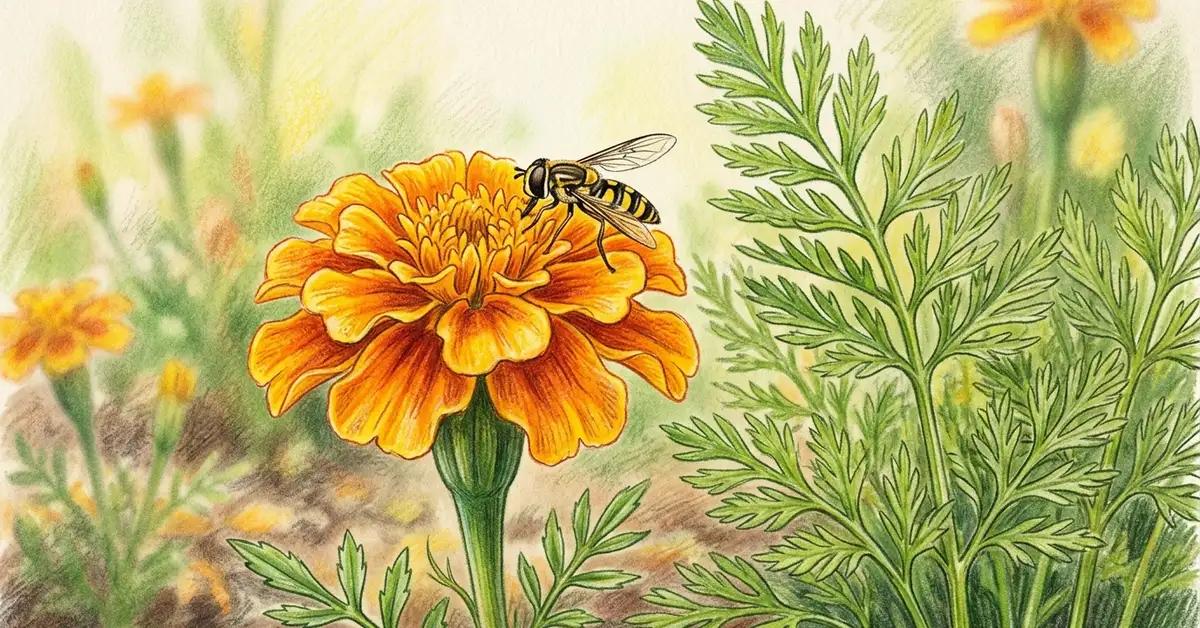
| Marigold (French) | Tagetes patula | α-terthienyl in roots suppresses root-knot nematodes at density | Need ≥1 plant per 2 sq ft (0.18 m²) for nematode effect |
| Nasturtium | Tropaeolum majus | Trap crop for aphids; pulls them away from carrot foliage | One plant every 4 ft (1.2 m) at bed edges |
Sources:.
The "Do Not Plant Near Carrots" List
The "what not to plant" question gets searched almost as much as the positive list — and for good reason. Four plants will materially hurt your carrots if you plant them too close.
Avoid these four near carrots
1) Dill (Anethum graveolens) once it bolts — terpenes (trans-anethole, fenchone, limonene) suppress nearby seed germination by 40 to 80 percent across 21+ documented species. Bolted dill also attracts the same carrot rust fly that onions are repelling. 2) Fennel (Foeniculum vulgare) — same Apiaceae family, same allelopathic compounds, same pest spectrum. Fennel is famously antagonistic to almost every neighbor. 3) Parsnips (Pastinaca sativa) — share carrot fly + carrot weevil + leaf blight diseases. Cross-contamination is a near-certainty. 4) Celery (Apium graveolens) — third member of Apiaceae you don't want adjacent; same shared pests as parsnips, plus heavier nutrient demand competing for carrot resources.
Source:.
Carrot Rust Fly: The Pest Companion Planting Solves
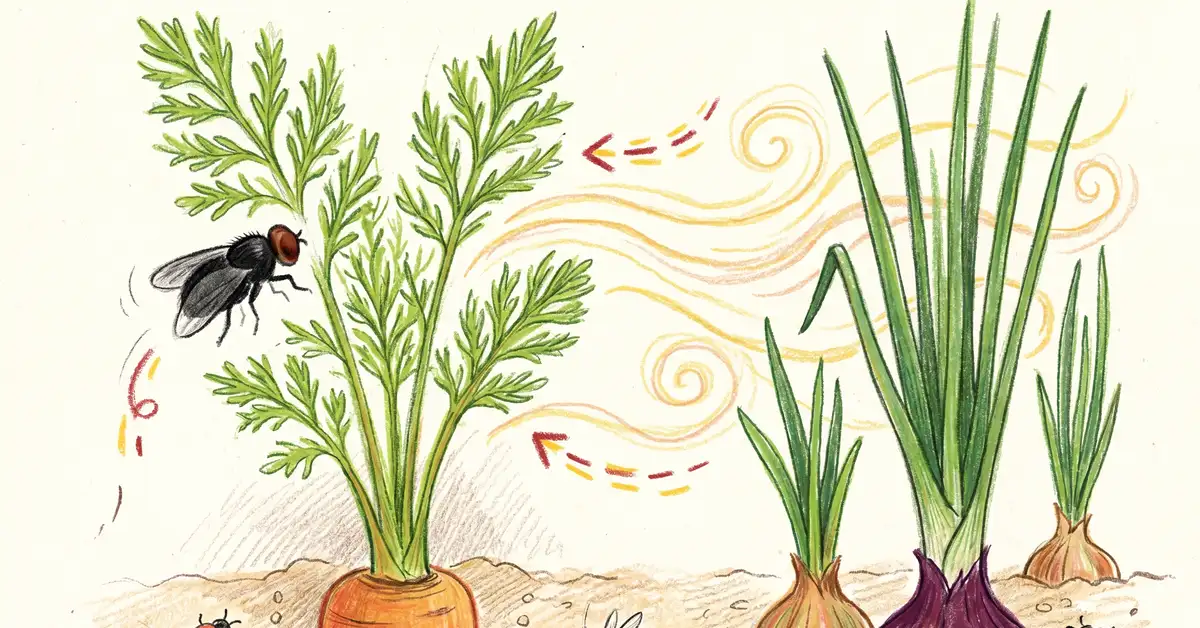
If you've ever pulled a carrot and found brown tunnels running through it, that's Psila rosae — the carrot rust fly, also called the carrot fly. The female lays eggs at the base of the carrot top; larvae burrow into the root and tunnel for 4 to 6 weeks. The Pacific Northwest Pest Management Handbook documents the lifecycle: two to three generations per year in most US zones, overwintering as pupae or larvae in soil, peak adult emergence in late spring and again in late summer.
The mechanism Allium companions exploit: rust fly females locate carrots by scent. Onion, garlic, chive, and leek roots and foliage release diallyl disulfide and dimethyl disulfide — sulfur compounds strong enough to mask the carrot's signature volatiles. The fly can't find the host. The British Columbia carrot rust fly IPM guide documents that this masking effect is most pronounced when the Allium plant tissue is actively growing — bolted or dormant alliums lose much of their protective power. That's why chives, which produce volatile compounds across the full growing season, are particularly effective.
The dosing matters. K-State Extension's Cornell-derived companion guide recommends roughly one Allium plant for every two to three carrot plants by density — scattered through the bed or in alternate rows. A token half-row of onions at one end won't do it.
Spatial Strategy: How Carrots Share a Bed
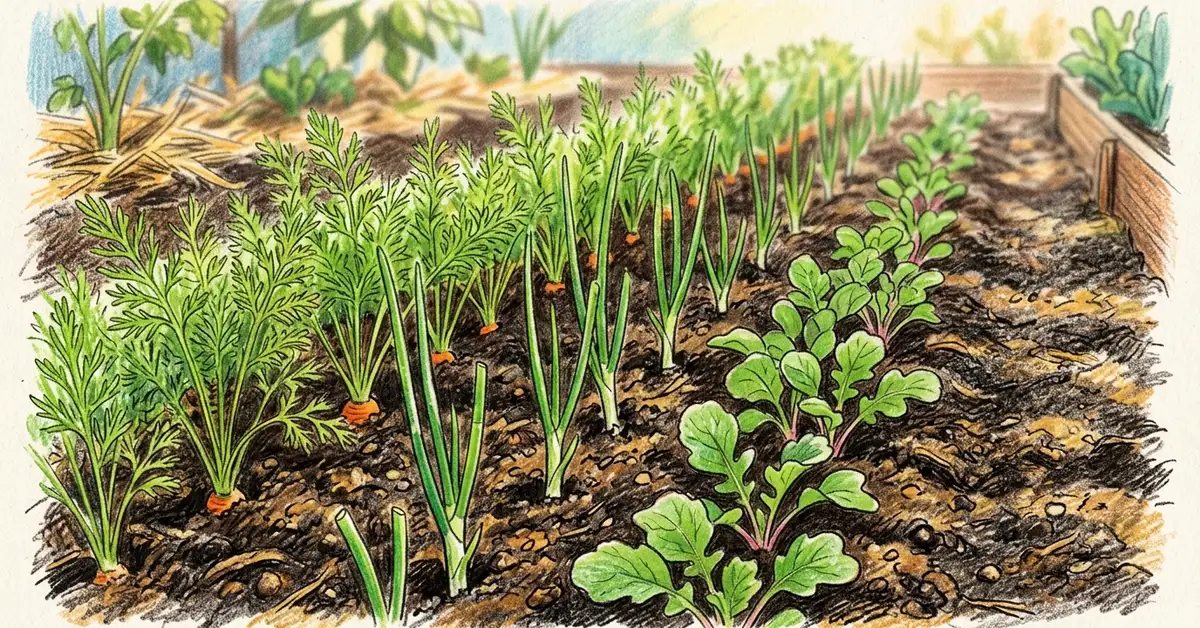
Carrots have one of the deepest taproots of any common garden vegetable — 8 to 12 inches (20 to 30 cm) at maturity, sometimes deeper for full-size cultivars. That depth creates an opportunity. Penn State Extension's vegetable garden optimization guide notes that lettuce roots typically only reach 2 to 4 inches (5 to 10 cm), and spinach is similar. The two crops occupy entirely different soil volumes — they cannot compete for nutrients or water with carrots.
That vertical stratification is the foundation of intensive carrot interplanting. You can stack three or four crops in the same square foot:
- Carrots take the deep zone (8–12 in / 20–30 cm)
- Onions/chives use the shallow fibrous zone (4–6 in / 10–15 cm)
- Lettuce and spinach use the surface zone (2–4 in / 5–10 cm)
- Radishes cycle through fast (gone by week 4)
Add the temporal stratification — radishes cycling through, lettuce maturing in 30 to 45 days, carrots maturing at 60 to 80 days — and the bed produces continuously rather than emptying in one harvest. This is exactly the polyculture pattern documented in our companion planting chart guide and discussed for the broader cluster in our flowers in the vegetable garden guide.
The 4×4 ft Raised Bed Layout
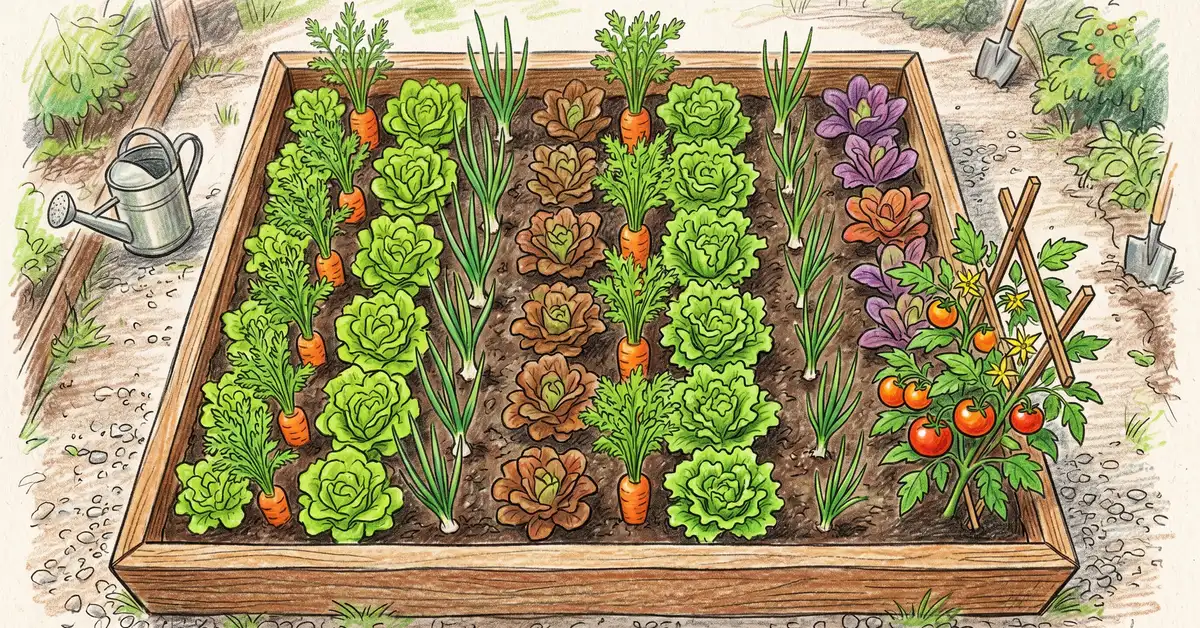
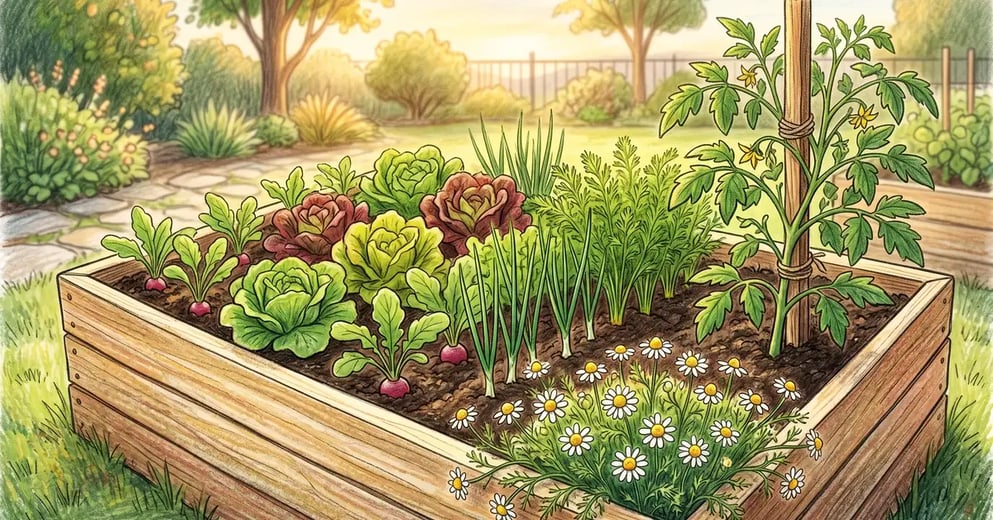
Here's the plan-and-plant template, designed for a standard 4 by 4 ft (1.2 by 1.2 m) raised bed in roughly USDA zones 4 to 9. Adapt cultivar selection to your zone but keep the structure.
| Position | What to plant | Quantity |
| Center stripe (3 rows, 12 in / 30 cm apart) | Carrot seed (Nantes, Danvers, or Imperator) interplanted with radish at sowing | ~30 carrot seeds per row + 10 radishes per row |
| Two outer rows (12 in / 30 cm from carrot rows) | Yellow onion sets or scallions | ~16 sets per row, 4 in (10 cm) spacing |
| Between carrot rows in vacant space | Lettuce transplants (loose-leaf type) | 4–6 transplants per row, 8 in (20 cm) spacing |
| One bed corner | Determinate tomato (zones 5+) | 1 plant; staked |
| Opposite corner | Rosemary or sage (perennial in zones 7+) | 1 plant |
| Edge perimeter | French marigold (Tagetes patula) | 4–6 plants for nematode density |
| Edge accent | Chives | 2 clumps; perennial |
Source: layout adapted from.
Time-and-cost sketch: about 2 to 3 hours to plant on a Saturday, materials around $25 to $40 for seeds and transplants. Yields a typical 4×4 bed at this density: 8 to 15 lbs (3.6 to 6.8 kg) of carrots plus 6 to 10 lbs (2.7 to 4.5 kg) of onions, lettuce, radishes, and tomato across the season.
Why This Works: The Permaculture Bridge
What you've just designed is a polyculture that works on three layers — root depth, growth speed, and pest signature. Each plant fills a niche the others leave open. Carrots take the deep mineral layer. Onions occupy the shallow layer and protect the bed from carrot fly. Radishes occupy the bed during the slow weeks while carrots germinate, then exit. Lettuce uses the cool weeks before summer heat. Marigolds run in the background suppressing nematodes. This is the same stacking pattern that runs healthy native ecosystems — every species occupies a niche another doesn't, so the system holds together with far less labor than a row of one crop fighting alone. Every successful permaculture vegetable bed runs on this logic; carrots are just one of the easiest places to see it work.
Build the Carrot Row in Four Weekend Steps
Prep the soil (Saturday morning, 1 hour)
Loosen the top 12 inches (30 cm). Carrots need stone-free, deep-tilled soil — every rock or compacted layer becomes a forked or stunted root. Do not add fresh manure or high-N fertilizer; excess nitrogen causes hairy, forked carrots. A two-inch (5 cm) compost top-dress is plenty.
Sow carrot + radish together (Saturday afternoon, 1 hour)
Mark three rows down the center of the bed at 12 inches (30 cm) spacing. Mix carrot seed with radish seed at roughly 4:1 carrot to radish. Sow shallowly — 1/4 inch (0.6 cm) deep — and water gently. The radishes will emerge in 5 to 7 days and mark the row clearly while carrots take their slow 14 to 21 days.
Plant the alliums and lettuce (Sunday morning, 1 hour)
Plant onion sets in two rows 12 inches (30 cm) outside the carrot rows, 4 inches (10 cm) apart. Set lettuce transplants between carrot rows, 8 inches (20 cm) apart. Add chive clumps at the bed edges, marigolds along the perimeter, and a tomato plus rosemary in opposite corners.
Manage the rotation (week 3 onwards, 30 min/week)
Around week 4, harvest radishes — selectively, to leave space for carrot expansion. Harvest lettuce as cut-and-come-again from week 5 onwards. Pull onions in mid-summer when tops fall over. Carrots come out at week 8 to 12 depending on cultivar. The bed will continue producing successively for 90 to 120 days from a single planting weekend.
Source:.
The Marigold Caveat (Most Garden Articles Get This Wrong)
"Plant marigolds with everything" is one of the most repeated companion-planting claims, and most of the time it's misleading. Laidback Gardener's marigold-nematode myth review documents the real research: French marigolds (Tagetes patula) — not African marigolds, not other Tagetes species — produce α-terthienyl in their roots, which suppresses root-knot nematodes. But the suppression effect requires dense planting, roughly one plant per 2 sq ft (0.18 m²), and is most pronounced when used as a cover crop the year before the target vegetable crop. A single decorative marigold at the corner of your bed is mostly a pollinator attractor — useful, but not nematode control.
Practical implication: if you have a known nematode problem, plant marigolds densely as a cover crop in mid-summer to mid-fall, then plant carrots in that bed the following spring. If you don't have a nematode problem, the marigolds in your carrot bed earn their space by attracting hover flies and parasitoid wasps that hunt aphids — see our beneficial insects guide for the full beneficial-insect picture.
Get the Weekly Dig
One practical permaculture guide a week, written for gardeners who do this on weekends: companion pairings that hold up under scrutiny, and the ones that do not. Free, no spam, unsubscribe any time.
Join the newsletterFrequently Asked Questions
Can you plant carrots with onions?
Yes — this is the single best carrot pairing supported by evidence. A peer-reviewed 1984 study documented up to 65 percent reduction in carrot rust fly attack when carrots and onions were intercropped versus carrots planted alone. The mechanism: sulfur volatiles released by onion foliage and roots mask the carrot's scent, preventing rust fly females from locating egg-laying sites. Plant onions in alternate rows 12 inches (30 cm) from carrots, with about one onion plant per two carrots by density.
Can you plant carrots next to tomatoes?
Yes. The carrot-tomato pairing has been repeated in companion planting literature for decades. The benefits: tomato foliage shades the soil and reduces carrot fly egg-laying near the bed; carrots' deep taproots loosen soil for the tomato. Place tomatoes at the bed corner or edge, 12 inches (30 cm) from any carrot row, and stake the tomato so it doesn't shade carrots out as it grows. One determinate tomato per 4×4 ft bed is plenty.
Can you plant carrots and lettuce together?
Yes — they're an excellent pair. Lettuce roots stay in the top 2 to 4 inches (5 to 10 cm) of soil while carrot taproots run 8 to 12 inches (20 to 30 cm) deep, so they don't compete for nutrients or water. Lettuce also forms a living mulch around the carrot row, reducing evaporation and weed pressure. Sow lettuce as a cool-season transplant between carrot rows at 8 inches (20 cm) spacing; harvest as cut-and-come-again from week 5 onwards.
What can I plant with carrots to prevent carrot flies?
The Allium family — onions, garlic, chives, and leeks. Sulfur compounds (diallyl disulfide and dimethyl disulfide) released by Allium roots and foliage mask the carrot's signature volatiles. BC's carrot rust fly IPM guide notes the masking effect requires actively growing Allium tissue — perennial chives are particularly effective because they produce volatiles across the full season. Other deterrents: rosemary, sage, and thyme provide aromatic confusion at lower potency.
What should you not plant near carrots?
Four plants belong elsewhere in the garden. Dill and fennel — both Apiaceae family — produce terpene compounds (trans-anethole, fenchone, limonene) that suppress germination of nearby seeds by 40 to 80 percent, and once they bolt they attract the same carrot rust fly your alliums are repelling. Parsnips share carrot diseases and pests almost completely. Celery is a third Apiaceae member that competes for resources and shares the same pest spectrum. Move all four to a different bed or different season.
How do I plant carrots and radishes together?
Sow them in the same row, at the same time. Mix carrot and radish seed at roughly 4 carrots to 1 radish ratio, then sow at quarter-inch (0.6 cm) depth. Radishes germinate in 5 to 7 days and mark the row clearly while carrots take their slow 14 to 21 days. Around week 4, harvest the radishes — they're ready when the shoulders are finger-sized — freeing the row for carrot expansion. University of Minnesota Extension documents up to 30 percent yield improvement in this dual-sowing system versus separate beds.
Resources
- University of Minnesota Extension — Companion Planting in Home Gardens
- Penn State Extension — Maximizing Your Vegetable Garden
- NC State Extension — Pests of Carrots
- UC IPM — Cultural Tips for Growing Carrot
- Pacific Northwest Pest Management Handbook — Carrot Rust Fly
- British Columbia — Carrot Rust Fly IPM Guide (PDF)
- Uvah & Coaker, "Effect of mixed cropping on some insect pests of carrots and onions" (Wiley, 1984)
- Cambridge Bulletin of Entomological Research — Carrot Fly Overwintering Stages
- K-State Extension — Companion Planting (Cornell-derived PDF)
- Savvy Gardening — How to Plant and Thin Carrot Seedlings
- Garden Betty — Intensive Plant Spacing for Raised Beds
- Laidback Gardener — The Marigold-Nematode Myth Review
Plant the right four companions and your carrots become reliable. Skip them, and you keep playing carrot fly roulette every season. Pick one weekend in the next month, sketch a 4×4 bed, sow carrots and radishes together with onions and chives at the edges, and you'll be harvesting clean roots before mid-summer.
If you want the broader picture of companion-planting strategy, our companion planting chart guide covers every common vegetable, and our tomato companion guide handles the other half of most kitchen-garden beds. For the underlying soil that supports any high-yield bed, see the soil health guide, and for the design philosophy that holds it all together, start at our permaculture for beginners introduction.