
A 1,000 sq ft suburban backyard cannot solve climate change. But your 1,000 sq ft, scaled to the 40 million acres of US residential lawn, is suddenly a 0.5 to 6.0 million tonne carbon sink that does not require permission, capital, or a new policy. Carbon farming in your backyard is the part of the climate solution you actually control.
This guide gives you the math on what a typical US backyard can sequester, the five practices that actually move carbon from atmosphere to soil, the one-weekend conversion plan, and the honest answer on what does not count. No greenwashing, just numbers and steps.
What carbon farming actually means in a backyard
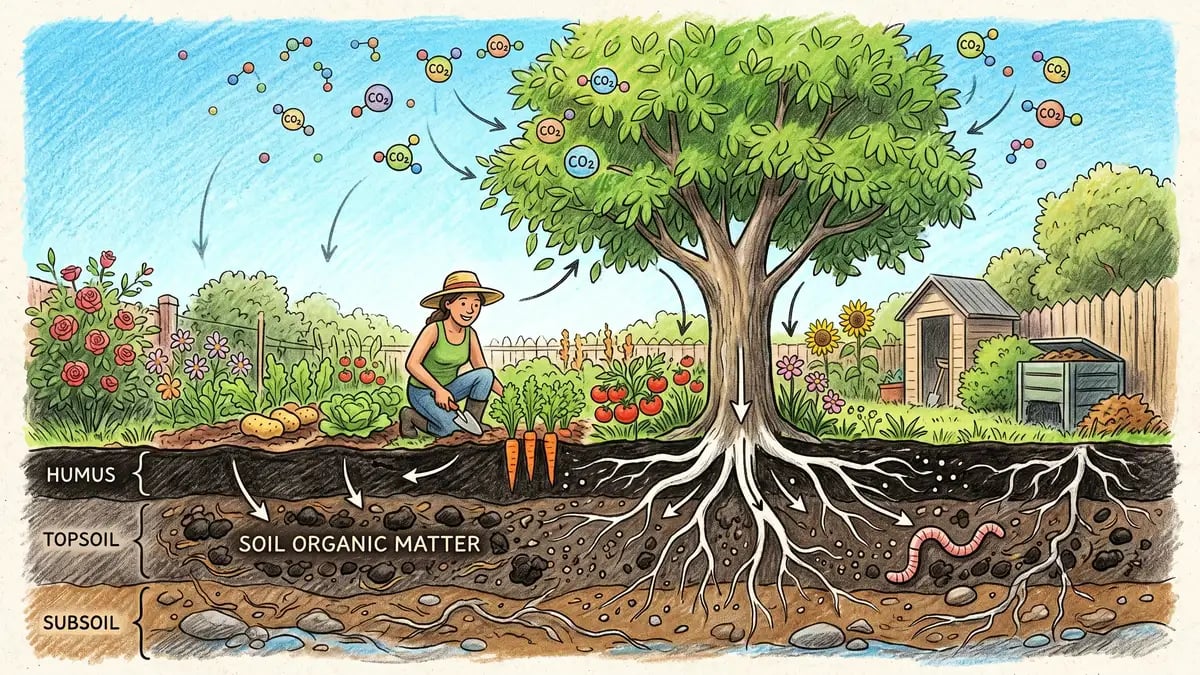
Carbon farming is the practice of managing land to move atmospheric CO2 into stable soil carbon and aboveground biomass. The term was coined in agricultural contexts (cropland, rangeland, agroforestry) but the same biology works in a 1,000 sq ft backyard. Plants pull CO2 out of the air through photosynthesis, convert it to sugars, and either store it in biomass (leaves, roots, wood) or pump it into soil as root exudates that feed microbes. Healthy soil locks meaningful amounts of that carbon away for decades to millennia.
The scale-up math is where backyards matter. USDA NRCS soil health data documents 0.4 to 1.5 tCO2e per acre per year on managed regenerative land. The US has roughly 40 million acres of residential lawn per NASA satellite analysis, the country's largest irrigated crop. Converting 10 percent of that to regenerative gardens would sequester 1.6 to 6.0 million tCO2e per year, comparable to taking 350,000 to 1.3 million passenger cars off the road annually per EPA emissions equivalents.
Why this works (the underground part nobody photographs)
The carbon flow has two routes. Above ground, biomass (a tree trunk, a hedge, comfrey leaves) holds carbon for as long as it lives. Below ground, plants pump 20 to 40 percent of the carbon they fix through their roots as exudates, which feed soil microbes and arbuscular mycorrhizal fungi. The microbes process those sugars into stable soil organic matter, including glomalin, a sticky protein that binds soil aggregates and can persist 40+ years per USDA-ARS research on Sara Wright's glomalin discovery. Healthy soil is roughly 50 percent carbon by weight of organic matter. The math is simple: more biomass + less disturbance = more soil carbon, locked in for decades.
The five practices that actually sequester carbon at backyard scale
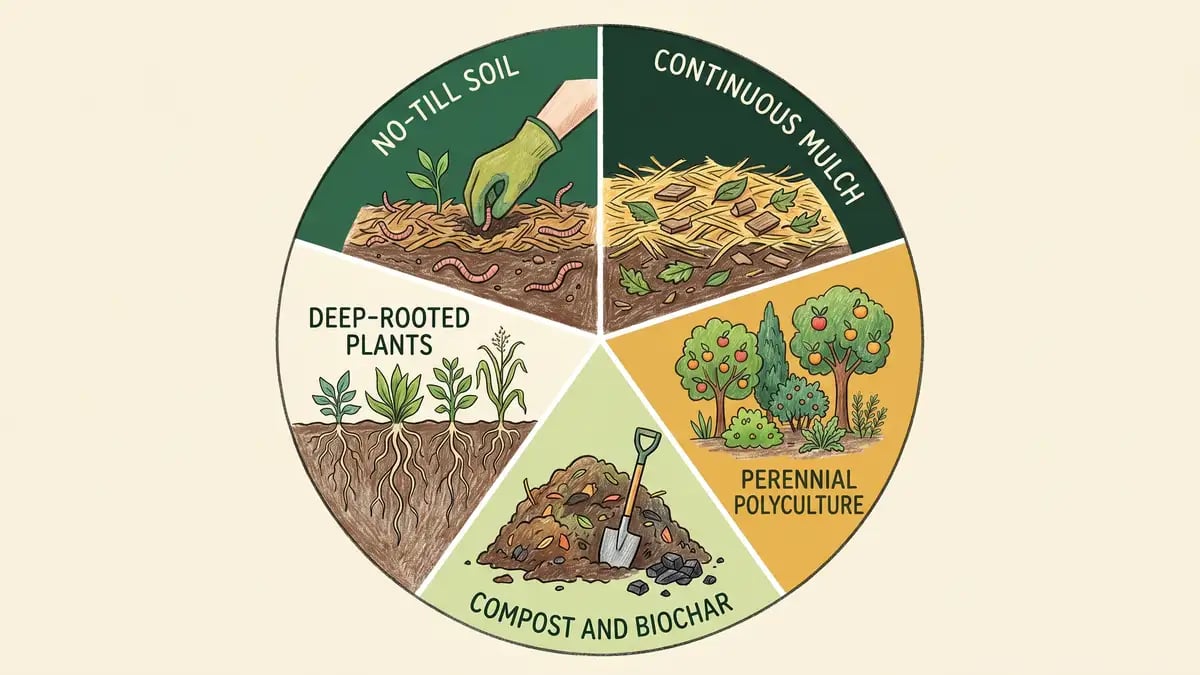
Not every "regenerative" practice moves the climate needle. These five do, and they compound when used together:
| Practice | How it sequesters | Backyard impact |
| No-till soil | Stops oxidation of buried organic matter, protects mycorrhizal networks | 0.5 to 1.0 percentage point SOM gain per year for first 5 years (10 tCO2e/acre per 1% SOM in top 12 in) |
| Continuous mulch + cover crops | Surface biomass feeds soil from top down, prevents erosion of stored carbon | 50-75% reduction in soil moisture loss, 2-3x earthworm density within 18 months per USDA-ARS |
| Perennial polyculture (food forest, guilds) | Deep root systems pump exudates year-round, biomass accumulates | 100-200 tCO2e per acre in mature food forest carbon stock per Project Drawdown |
| Compost + biochar amendments | Compost adds stable organic matter; biochar locks carbon for centuries | 1 lb biochar = ~3 lb CO2 sequestered, stable 100-1,000+ years per International Biochar Initiative |
| Deep-rooted perennials (trees, comfrey, alfalfa) | Roots reach 6-15 ft, depositing carbon below tillage depth | Mature 30 ft shade tree sequesters ~48 lb CO2/year per Arbor Day Foundation |
Source: USDA NRCS Soil Health, Rodale Institute Farming Systems Trial, Project Drawdown, International Biochar Initiative, Arbor Day Foundation.
What a typical US backyard can realistically sequester
Honest numbers for a 5,000 sq ft (0.115 acre) suburban backyard converted to regenerative practice:
- Annual soil sequestration: 0.05 to 0.17 tCO2e per year from soil organic matter gains (years 1-5 fastest).
- Tree carbon stock: 4 mature shade trees + 2 dwarf fruit trees over 20 years = 6,000 to 12,000 lb (2.7 to 5.4 tCO2e) locked in standing biomass.
- Biochar additions: 50 lb of biochar applied over 5 years = 150 lb (0.07 tCO2e) of essentially permanent carbon.
- Avoided emissions: Replacing a 21 in gas mower (40 hours/year at 1.04 lb CO2/hour per EPA Office of Transportation and Air Quality) avoids 42 lb CO2 per year. Replacing synthetic fertiliser (4 lb N/year from a 50 lb bag with 9 lb CO2e per lb N) avoids 36 lb CO2e per year.
- Total over 20 years: 4 to 8 tCO2e sequestered + 1.5 tCO2e avoided emissions. Comparable to the lifetime emissions of one round-trip transatlantic flight per person.
One backyard does not reverse climate change. The point is not that you alone offset your lifestyle. The point is that 40 million acres of US residential land, currently a net emitter through mowing and fertiliser, becomes a meaningful carbon sink at the population scale. Project Drawdown ranks regenerative practices among the top 30 climate solutions globally for this reason.
The one-weekend backyard carbon farming conversion
This is the realistic ramp from typical suburban lawn to a regenerative carbon-farming garden. Time and cost for a 1,000 sq ft converted area:
Saturday morning: stop mowing
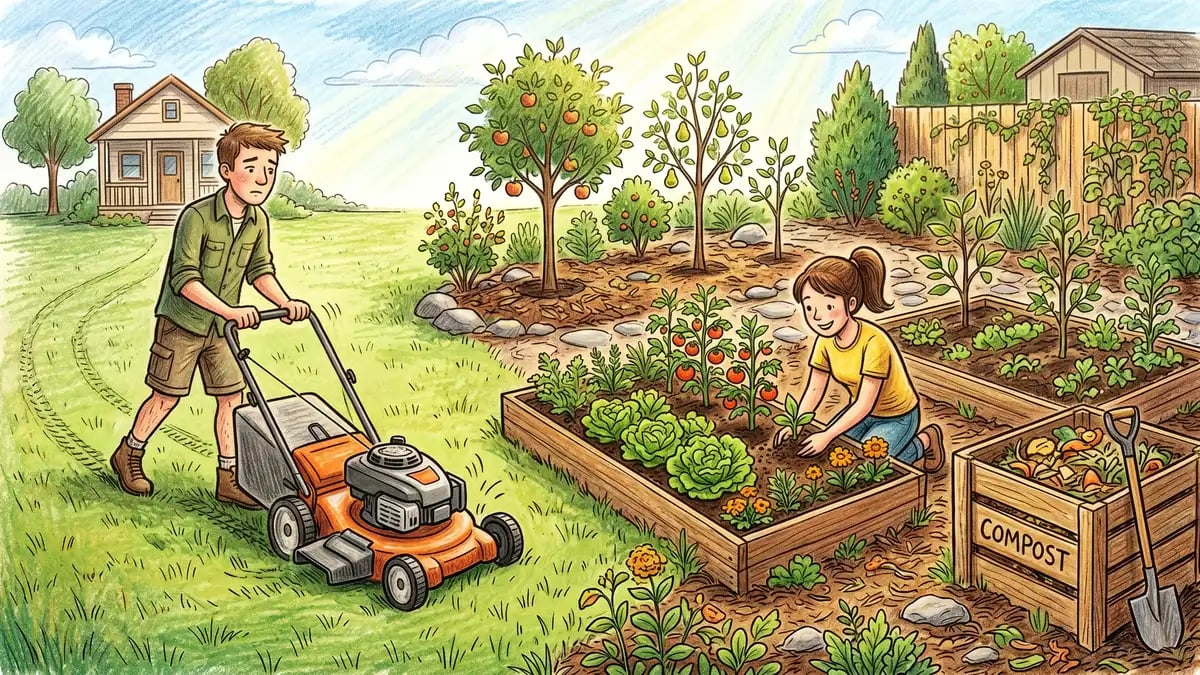
Park the gas mower. Cut grass at the highest mower setting one last time (3 to 4 in). The clippings stay on the ground as the first mulch input. Time: 30 minutes. Cost: $0.
Saturday afternoon: sheet mulch a 200 sq ft starter area
Lay one to two layers of cardboard over the lawn (overlap 6 in). Top with 4 to 6 in of bulk compost. Buy compost from a local landscape supplier ($35-50 per cubic yard for ~1.5 yards needed) rather than bagged. Time: 3 hours. Cost: $60-90.
Sunday morning: plant the carbon-banking starter set
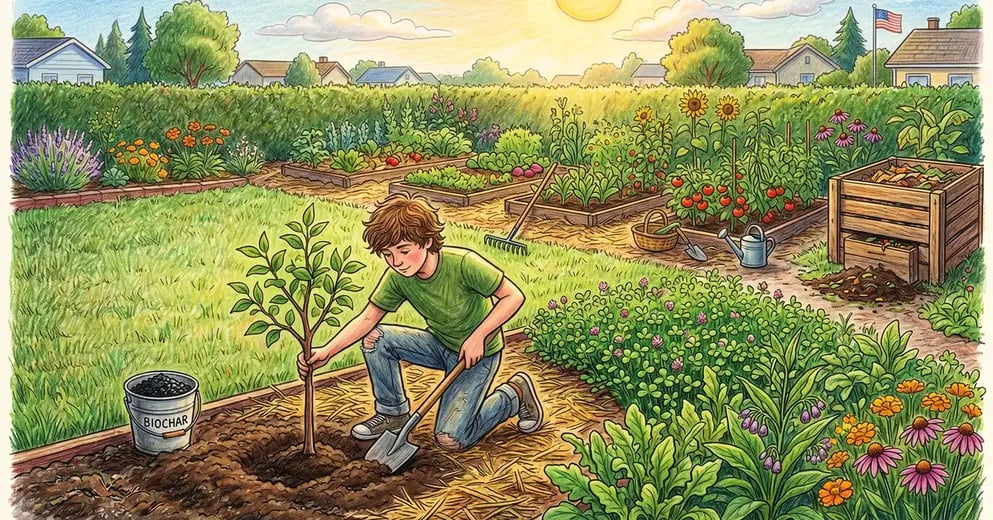
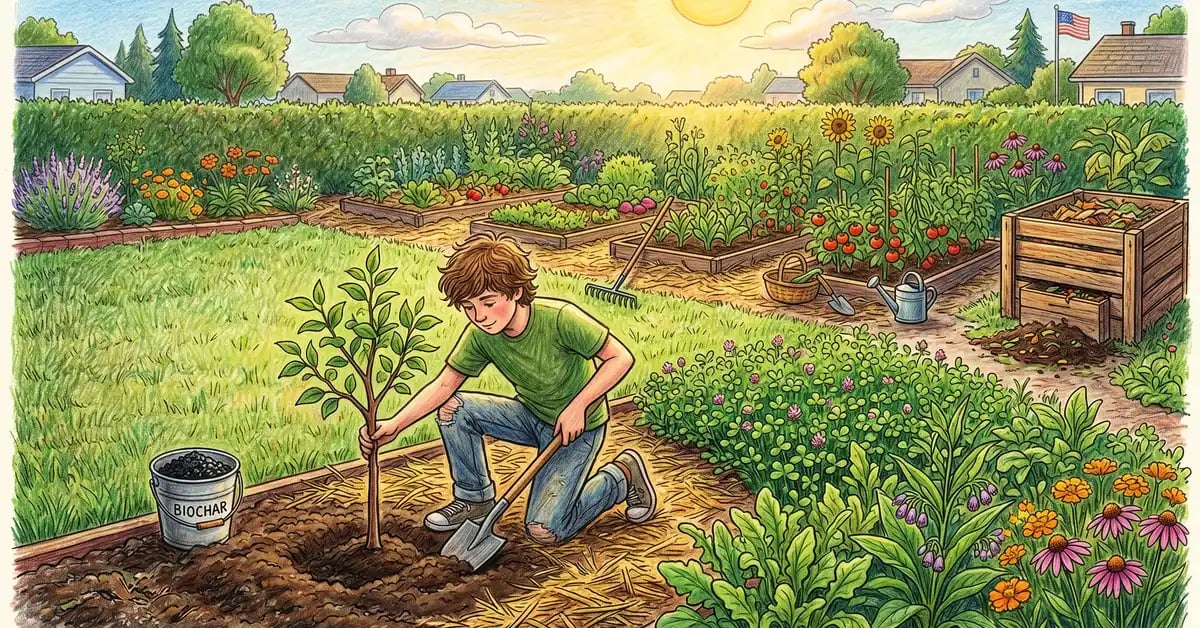
Plant 1 fruit tree (apple, pear, or persimmon for Zones 4-9), 3 comfrey 'Bocking 14' crowns, 1 oz of white clover seed broadcast over the entire converted area, and 6 tomato or pepper transplants. Time: 2 hours. Cost: $80-120.
Sunday afternoon: start the compost system
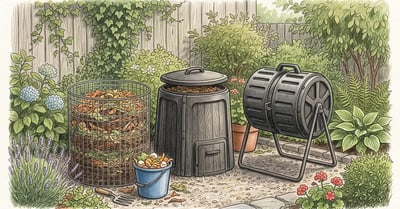
Set up a basic compost bin (DIY pallet bin or $100 tumbler). Add kitchen scraps + lawn clippings + cardboard. Within 90 days you have your own free compost source for ongoing additions. Time: 1 hour. Cost: $0-100.
Over the next 6 months: stop fertilising, top up mulch, add biochar (optional)
Switch to compost-only feeding. Maintain 3-6 in of organic mulch year-round. Add 10-20 lb of biochar (purchased or DIY in a metal bucket) once per year. Total ongoing time: 1 hour per month.
Total weekend investment: about 6 to 8 hours and $140 to $310. Annual ongoing cost after year 1: under $50 (compost top-up, biochar). Annual ongoing time: about 12 hours.
Biochar deserves its own paragraph because it is the only backyard practice that creates near-permanent carbon storage. You make it by partially burning organic material (sticks, garden waste) in low-oxygen conditions (a metal bucket inside a larger bucket with a tight lid, smoke escaping through a small hole). The result is charcoal: 80-85 percent stable carbon by weight that, when buried, persists in soil for 100 to 1,000+ years per peer-reviewed International Biochar Initiative data. 1 lb of biochar locks away roughly 3 lb of CO2 equivalent. A typical backyard production session yields 5 to 10 lb of biochar in 2-3 hours.
The catch: biochar production is itself a small emissions source (some carbon escapes as CO2/methane during pyrolysis). Done right, the net storage is still 60-70 percent of theoretical maximum, which is far better than the alternative of burning the same wood for heat or letting it decompose to CO2.
What does NOT count as carbon farming (the greenwashing list)
Be honest with yourself about these. The following practices are marketed as climate-friendly but contribute minimal or negative net carbon: 1. Peat moss (releases ancient soil carbon when harvested). 2. Synthetic fertiliser (production emits 1 to 9 lb CO2e per lb N). 3. Gas-powered lawn mowers (1.0 to 1.5 lb CO2 per hour per EPA). 4. Plastic landscape fabric (microplastic + manufacturing emissions, blocks soil-atmosphere exchange). 5. Buying carbon offsets to justify a fertiliser-and-mower lawn (the offsets often double-count or fail to verify). The point of carbon farming is to actually move carbon, not to feel better about not moving carbon.
Trees: the highest-leverage single action
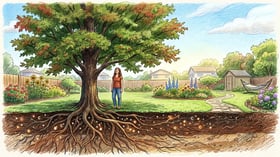
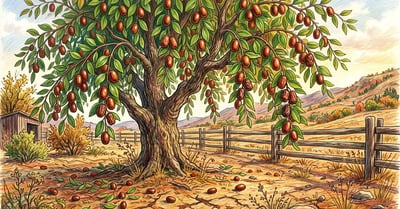
If you do one thing this year, plant a tree. A mature 30 ft shade tree (red maple Acer rubrum, oak Quercus, sycamore Platanus) sequesters approximately 48 lb of CO2 per year and stores 2,000 to 6,000 lb of carbon in its lifetime per Arbor Day Foundation. Fruit trees and food-forest species add edible yield to the carbon store. A 1/4 acre backyard food forest at maturity holds 100 to 200 tCO2e per Project Drawdown multistrata agroforestry data.
Trees do not require permission. You do not need to wait for a policy. The 4 hours and $30 to $80 it takes to plant a single nursery-grown tree this autumn is the largest single climate action available to a US homeowner with a backyard.
How to measure your soil carbon increase
You do not need to be a soil scientist to track progress. Three options:
- University extension soil testing: $25-50 per sample. Send a sample at year 1 baseline and again at year 3. Look for soil organic matter (SOM) percentage increase. Cornell, Penn State, UC ANR all offer this through Cornell Soil Health Lab or your state extension service.
- Jar test (free, visual): Fill a clear jar with soil + water, shake, let settle. The dark band at the top is organic matter. Baseline lawn typically shows 1-2 percent visible organic matter. Healthy garden soil shows 4-6 percent. Compare year-over-year photos.
- Loamful or BloomingTables home test kits: $30-60. Less accurate than lab tests but useful for year-to-year tracking.
The aggregate increase across 5 years from lawn baseline (1.5 percent SOM) to garden baseline (4 percent SOM) in the top 12 in (30 cm) represents roughly 25 tCO2e per acre, or 2.9 tCO2e for a 5,000 sq ft yard.
Get the Weekly Dig
One practical permaculture guide a week, written for gardeners who do this on weekends: permaculture design for real backyards. Free, no spam, unsubscribe any time.
Join the Weekly DigHow this fits the larger climate-action picture
Backyard carbon farming complements household action on energy, transport, and diet. It does not replace voting, organising, or grid decarbonisation. But it is the rare climate practice that is fully within your control, costs less than the alternative (gas mower + synthetic fertiliser), produces edible food, builds local ecosystem resilience, and accumulates with time rather than depreciating.
If you want the soil-biology depth, pair this with our soil health guide. For the no-till transition specifically, see no-till vs tilling. For the food-forest depth that maximises carbon stock per square foot, see food forest understory strategies. And for the wider context, what is permaculture covers the underlying design framework.
Frequently asked questions
What is carbon farming?
Carbon farming is the practice of managing land to move atmospheric CO2 into stable soil carbon and aboveground biomass. The term originated in commercial agriculture but the same biology works at backyard scale. Plants photosynthesise CO2 into biomass and root exudates, which feed soil microbes that build stable soil organic matter, locking carbon away for decades to centuries.
How does carbon farming work in a backyard?
Through five compounding practices: no-till to prevent oxidation of stored carbon, continuous mulch to feed soil from the top down, perennial polyculture with deep root systems, compost and biochar amendments, and deep-rooted plants like trees and comfrey. A 5,000 sq ft regenerative backyard sequesters 0.05 to 0.17 tCO2e per year in soil plus 2.7 to 5.4 tCO2e in trees over 20 years.
How to increase soil carbon at home?
Stop tilling. Apply 3 to 6 in of organic mulch year-round. Plant deep-rooted perennials including trees and comfrey. Add compost and biochar to garden beds. Use cover crops between vegetable rotations. Soil organic matter typically increases 0.5 to 1.0 percentage point per year for the first 5 years under these practices, equivalent to 5 to 10 tCO2e per acre per 1 percent SOM gain in the top 12 in of soil.
What is regenerative gardening?
Regenerative gardening means improving soil, biodiversity, and water cycle health every year rather than just maintaining or extracting. The defining practices: no-till or minimal-till, continuous living roots, surface mulch, plant diversity, integrated animal cycles where possible, and reduced synthetic inputs. It overlaps heavily with permaculture and organic gardening but is specifically framed around soil regeneration metrics.
Is carbon farming good for the environment?
Yes when practiced honestly. Backyard-scale carbon farming sequesters real carbon (4 to 8 tCO2e per 5,000 sq ft over 20 years), reduces synthetic fertiliser and gas mower emissions, increases soil moisture retention by 50 to 75 percent, supports pollinators and beneficial insects, and produces edible food. The risk is greenwashing: claiming carbon benefits while continuing to use peat moss, synthetic fertiliser, gas-powered tools, or buying offsets to justify high-emission practices.
How long does it take to see results from backyard carbon farming?
Soil organic matter gains start in year 2 and become measurable by year 3 with university extension soil testing. Trees begin meaningful sequestration in year 5 to 10 and reach maximum annual rate at year 20+. Biochar additions are essentially instant and permanent. Food forest carbon stock builds toward 100 to 200 tCO2e per acre over 15 to 25 years per Project Drawdown.
How to measure carbon sequestration in soil?
The most accurate method is a soil organic matter (SOM) test from a university extension lab ($25 to $50 per sample). Send a baseline sample at year 1 and a follow-up at year 3. Calculate sequestration as (final SOM percent minus baseline SOM percent) times bulk density times depth times 5.86 (the carbon-to-CO2 conversion factor). A jar test gives a free visual estimate. Home test kits like Loamful sit between the two for accuracy.
Does planting one tree make a difference?
At individual scale, planting one tree sequesters about 48 lb CO2 per year at maturity and stores 2,000 to 6,000 lb over its lifetime. That is small compared to a household carbon footprint of 30,000 to 60,000 lb per year. At population scale, US households planting 100 million trees over a decade would sequester 24 to 60 million tCO2e per year at maturity. Trees are the highest-leverage single action for backyard climate work because they cost $30 to $80, take 4 hours to plant, and require no ongoing input.
Resources
- Project Drawdown: Regenerative Annual Cropping
- Project Drawdown: Multistrata Agroforestry
- USDA NRCS: Soil Organic Carbon Soil Health Guide
- Rodale Institute Farming Systems Trial
- International Biochar Initiative: Biochar Basics
- Arbor Day Foundation: Tree Carbon Facts
- Cornell Soil Health Lab
- NASA: US Lawn Area Satellite Analysis
- USDA-ARS: Glomalin Soil Carbon Research