You planted a young apple tree on your homestead last fall. Now the question is what to grow under it, around it, and through it so the soil keeps building, the pollinators show up, and you stop weeding every weekend. The answer is a food forest understory, and it changes everything about how a backyard orchard works.
A food forest is a polyculture designed in seven vertical layers. The canopy and lower tree layers carry the headline fruit (apple, pear, plum, cherry, persimmon), but the understory layers do the underground labour: fixing nitrogen, mining minerals from subsoil, feeding pollinators, smothering weeds, and producing a steady drip of mulch. Get the understory right and your fruit trees grow faster, fruit harder, and need almost no synthetic inputs.
This guide gives you the practical plant list, the spacing logic, the function-based selection framework, and the yields you can realistically expect from a 1,000 sq ft (100 sq m) homestead food forest in USDA Zones 5 to 7. We focus on apple guilds because apple is the most-planted home fruit tree in the US, but the same logic transfers to pear, plum, peach, and persimmon.
The 7-layer model: who does what under the canopy
Robert Hart codified the seven-layer model at his Shropshire forest garden in the 1980s, and Martin Crawford expanded it in his 2010 book Creating a Forest Garden. Dave Jacke and Eric Toensmeier later adapted the model to North American climates in their two-volume Edible Forest Gardens (2005). The model is not arbitrary. It mirrors the structure of a young temperate forest, where each layer captures a different slice of available light, water, and nutrients.
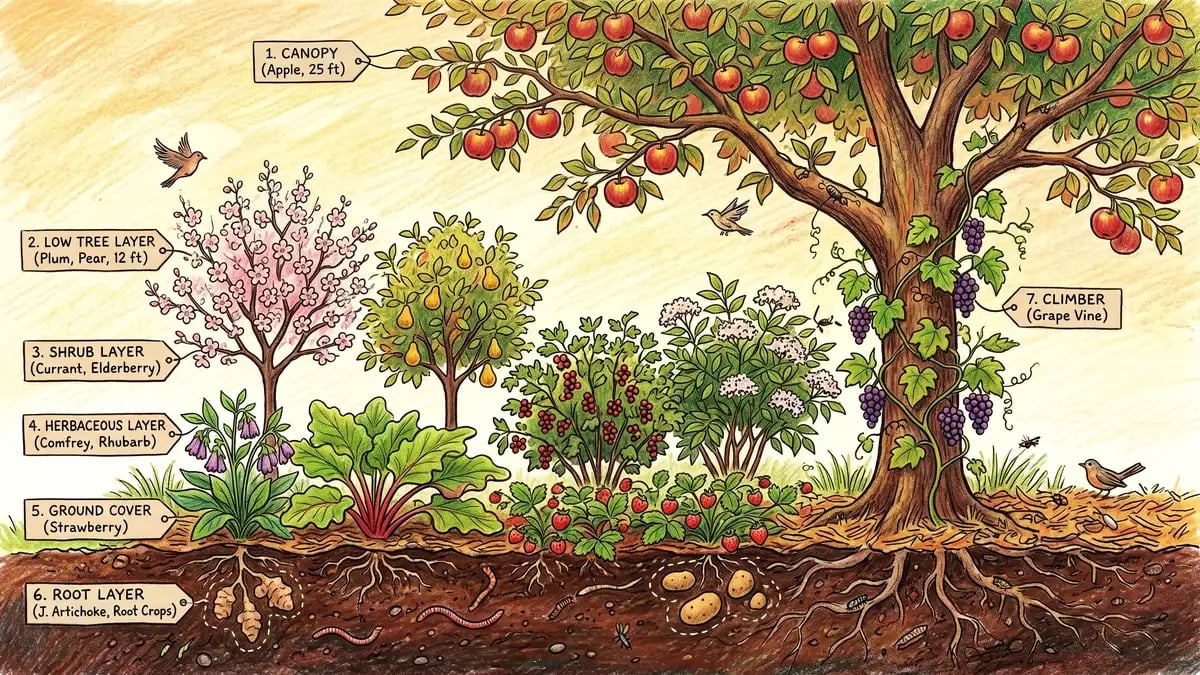
Here is the layer breakdown for a US backyard food forest, with practical height ranges and the role each layer plays in the understory companion-planting framework:
| Layer | Height | Example species | Primary function |
| 1. Canopy | 25-40 ft (8-12 m) | Standard apple, walnut, chestnut | Main fruit/nut yield, structure |
| 2. Low tree | 10-25 ft (3-8 m) | Dwarf apple, plum, pear, mulberry | Secondary fruit, midstory shade |
| 3. Shrub | 3-10 ft (1-3 m) | Currant, gooseberry, elderberry, hazel | Berry yield, pollinator habitat |
| 4. Herbaceous | 1-3 ft (30-90 cm) | Comfrey, rhubarb, sorrel, lovage | Dynamic accumulation, mulch |
| 5. Ground cover | 2-12 in (5-30 cm) | Strawberry, creeping thyme, clover | Weed suppression, soil cover |
| 6. Root | Underground | Garlic, Jerusalem artichoke, daffodil | Subsoil mining, vole deterrent |
| 7. Vine | Variable | Hardy kiwi, grape, hops, groundnut | Vertical space use |
Source: Hart (1996), Crawford (2010), Jacke and Toensmeier (2005), adapted for US Zones 5-7.
The understory is layers 3 through 6. Those are the layers you design when you do companion planting in a food forest. Layer 1 and 2 are your fruit trees, the headline production. Layer 7 (vines) is optional and often added later. Everything else is what we call the understory functional matrix.
Function over species: the six jobs an understory plant should do
Conventional companion planting in vegetable gardens pairs species by reputation ("tomatoes love basil"). Food forest design works differently. Instead of pairing species, you assemble a community where every plant performs at least one of six functional jobs. Pick plants by job. The species are interchangeable.
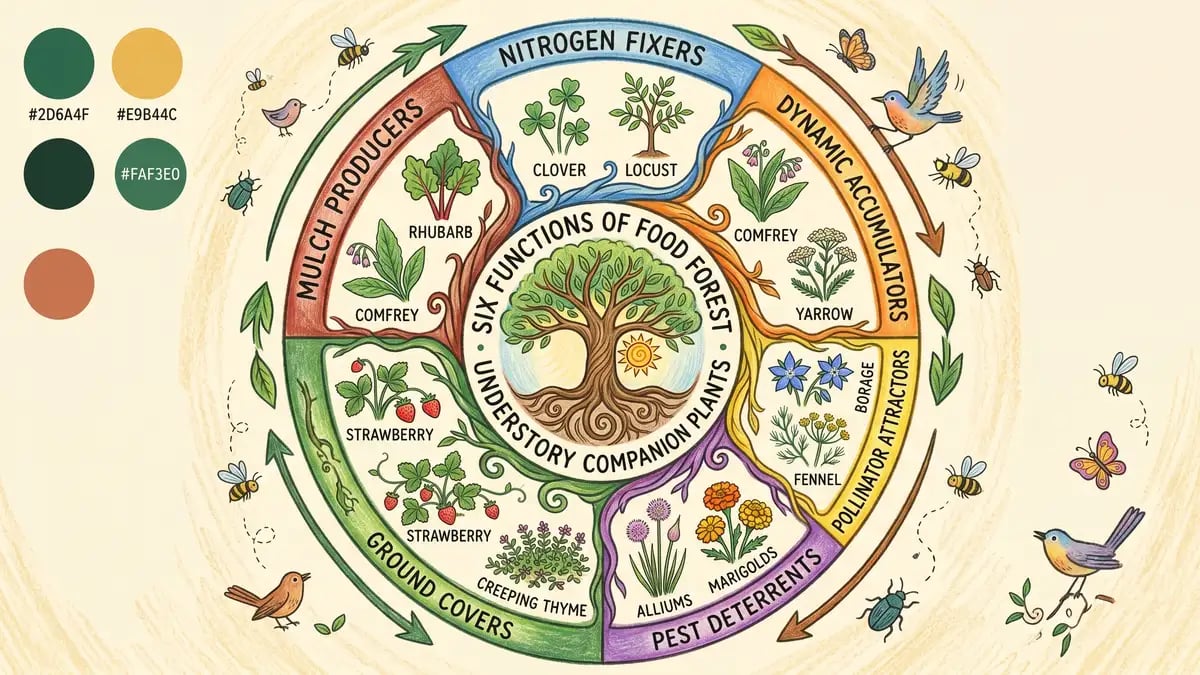
The six functions, with the workhorse species for each in a US Zone 5-7 setting:
- Nitrogen fixers. Plants in the legume family (Fabaceae) plus a handful of actinorhizal genera that host symbiotic bacteria converting atmospheric N to plant-available form. White clover (Trifolium repens), red clover (Trifolium pratense), lupin (Lupinus perennis), Siberian pea shrub (Caragana arborescens), and autumn olive (Eleagnus umbellata, where not invasive). According to US Forest Service research on agroforestry nitrogen budgets, a well-established legume understory delivers 50 to 200 lb of nitrogen per acre per year, replacing most or all synthetic N requirements for fruit trees.
- Dynamic accumulators. Deep-rooted herbaceous plants that mine subsoil minerals and concentrate them in leaf tissue. The classic is comfrey (Symphytum × uplandicum 'Bocking 14'), with a taproot reaching 6 to 10 ft (2 to 3 m) and leaf NPK measured at roughly 3-1-7 in dried tissue per NC State Extension. Yarrow (Achillea millefolium), borage (Borago officinalis), dandelion (Taraxacum officinale), and chicory (Cichorium intybus) round out the group.
- Pollinator attractors. Open-form flowers that feed honeybees, native bees, hoverflies, and parasitic wasps. Borage, comfrey, fennel (Foeniculum vulgare), bee balm (Monarda didyma), and any flowering herb in the Apiaceae family. Penn State Extension's native plants for pollinators guide is the definitive US regional reference.
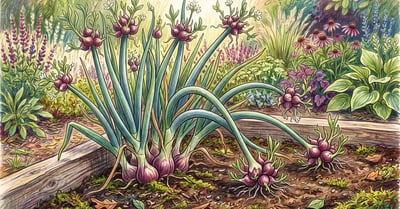
- Pest deterrents. Alliums (garlic Allium sativum, chive A. schoenoprasum, walking onion A. proliferum) emit sulphur compounds that disrupt apple maggot, codling moth, and rodent activity around the tree base. Daffodil (Narcissus) bulbs planted in a tight ring around the trunk are toxic to voles and gophers and form a living fence according to University of Maryland Extension.
- Ground covers. Low-growing perennials that fill horizontal space so weeds cannot. Wild strawberry (Fragaria virginiana), creeping thyme (Thymus serpyllum), Roman chamomile (Chamaemelum nobile), and white clover are the four most reliable in US backyards.
- Mulch producers. Plants that produce large biomass you cut and drop in place several times per season. Comfrey is the workhorse (cut 4 to 6 times per year, dropping 3 to 5 lb of biomass per plant per cutting). Rhubarb (Rheum rhabarbarum) and lovage (Levisticum officinale) follow.
Why this works: the function-first principle
A conventional orchard grows one species (the fruit tree) and feeds it from a bag. A food forest understory grows ten or twelve species and lets the community feed itself. Each layer captures sunlight the layer above does not use. Each functional plant performs a job that the soil, the fruit tree, or the gardener would otherwise have to do. The system is more complex on paper, and simpler in practice, because most of the labour is happening underground while you sleep. This is permaculture principle 8 (integrate rather than segregate) in its most literal form, as articulated by Bill Mollison in Permaculture: A Designers' Manual.
The apple tree guild: a complete planting list for 100 sq ft
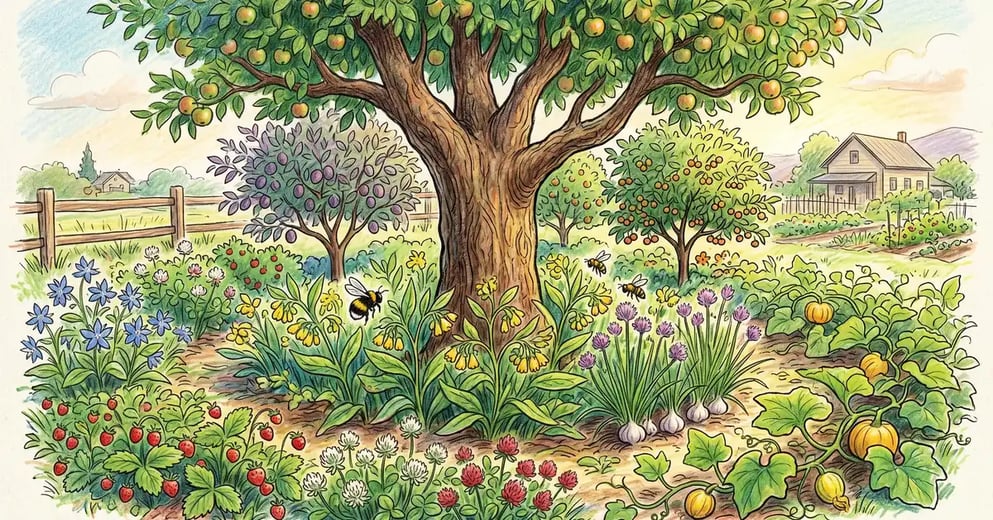
A guild is a single fruit tree with its full understory community planted as one functional unit. The classic North American apple guild was first documented by Dave Jacke in 2005 and refined by practitioners across Zones 4 to 8 over the next two decades. Here is the proven 100 sq ft layout for a Zone 5 to 7 backyard:
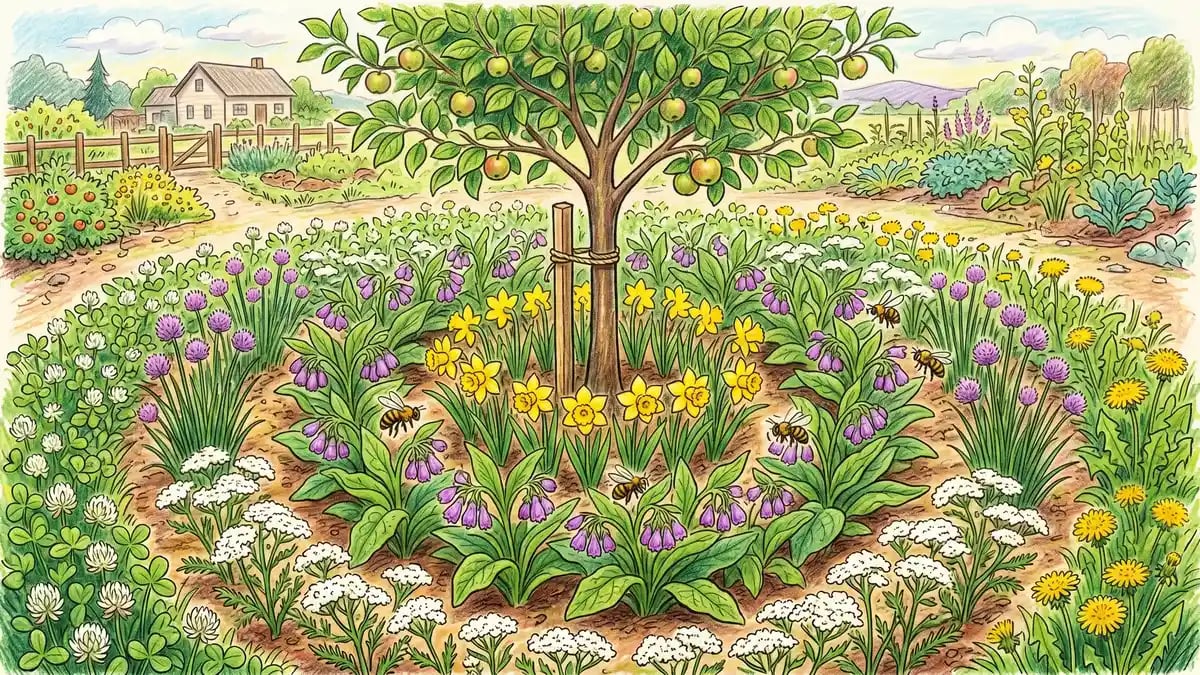
| Zone from trunk | Species | Quantity | Function |
| 0 to 2 ft (vole ring) | Daffodil (Narcissus) | 12 bulbs | Pest deterrent (rodent) |
| 2 to 4 ft | Garlic + chive | 15 cloves + 4 clumps | Pest deterrent (insect) |
| 4 to 8 ft (inner drip line) | Comfrey 'Bocking 14' | 3 plants | Dynamic accumulator + mulch |
| 4 to 8 ft | Yarrow (Achillea) | 2 plants | Pollinator + accumulator |
| 6 to 10 ft (outer drip line) | White clover seed | 2 oz | Nitrogen fixer + ground cover |
| 6 to 10 ft | Wild strawberry | 12 crowns | Ground cover + edible yield |
| 4 to 8 ft | Borage (Borago) | 1 plant (self-seeds) | Pollinator + accumulator |
| 8 to 12 ft (guild edge) | Currant or gooseberry | 1 shrub | Shrub layer fruit |
Source: Jacke and Toensmeier (2005), adapted from Permaculture Research Institute trial plots and Cornell Small Farms Program agroforestry trials.
That entire guild fits inside a 12 ft (3.6 m) diameter circle, holds 8 plant species across 5 functional roles, and costs around $60 to $90 in starter material if you propagate the comfrey and clover from a friend's patch. The shrub-layer currant adds a second food crop without competing with the apple tree above.
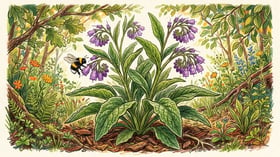
The comfrey deserves its own paragraph. A single 'Bocking 14' plant produces 15 to 25 lb of biomass per year across 4 to 6 cuttings, which you simply chop and drop at the base of the apple tree. Its taproot mines potassium and trace minerals from 6 to 10 ft down, far below the apple's reach. The plant is sterile (does not seed), which means it stays where you put it. The University of Maine Cooperative Extension documented an apple-comfrey trial where comfrey-mulched trees showed 40 percent more leaf area and 22 percent higher fruit yield by year four compared to bare-soil controls.
Spacing, timing, and what to plant when
Order matters when you build a guild. Planting everything at once creates competition that the young apple cannot win. Follow this sequence over the first three years and the guild establishes itself without nursing.
Year 1 (planting year)
Plant the apple tree in spring. Immediately plant the daffodil ring (autumn, 6 in deep, 12 bulbs in a 2 ft radius circle). Sow white clover seed in the entire outer ring (6 to 10 ft) in early autumn. Nothing else. Cost: $25-35. Time: 2 hours including soil prep.
Year 2 (establishment)
Plant 3 comfrey crowns at 4 to 6 ft from trunk (spring). Add yarrow and borage at the same radius (2 plants each, summer). Plant garlic cloves in autumn at 2 to 4 ft radius. Begin chopping comfrey 2 to 3 times once leaves reach 18 in. Cost: $20-30. Time: 3 hours total over the season.
Year 3 (productive guild)
Add the shrub layer: 1 currant or gooseberry at 8 to 12 ft from trunk. Plant 12 wild strawberry crowns in the outer ring. Add chive clumps in any bare spots. By the end of year 3, the guild is self-mulching, self-feeding, and producing currants and strawberries while the apple builds toward full crop in year 5 to 7. Cost: $15-25.
Warning: don't crowd the trunk. Keep a 1 ft (30 cm) bare circle directly around the apple trunk for the first 3 years. Competing herbaceous growth right up against the trunk slows root establishment and creates voles a hiding place. The daffodil ring sits just outside this clean zone. After year 3, you can let clover and strawberry creep in if you want.
Yield expectations and the USDA payment angle
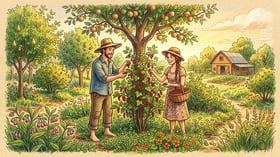
A mature backyard food forest on 1,000 sq ft (roughly the size of an average suburban side yard) realistically produces 150 to 350 lb of fruit, berries, and herbs per year by year 5 to 7. The USDA's National Agroforestry Center documents multistrata systems yielding 2 to 4 times more total biomass per acre than conventional fruit monoculture, with the gap widening as the system matures.
Project Drawdown's multistrata agroforestry solution estimates that scaling these systems to 0.5 to 1.0 billion ha globally by 2050 would sequester 9 to 26 gigatonnes of CO2 equivalent, with carbon stocks reaching 100 to 200 tCO2e per ha at maturity. The point for your backyard: the same biological mechanism that makes the system productive (deep roots, continuous canopy, no-till soil) also locks meaningful carbon into the soil under your trees.
If you have more than 1 acre and farm full or part time, the USDA NRCS Environmental Quality Incentives Program (EQIP) pays $30 to $150 per acre per year for establishing multistrata agroforestry plantings. Conservation Practice Standard 379 (Multi-Story Cropping) is the relevant payment code. Contact your local NRCS office for the current state rate sheet.
Common mistakes that kill a young guild
Six failure patterns show up again and again in homestead food forests. Each has a fix:
- Too much shade too fast. If you plant multiple shrubs in the inner drip line, they steal light from the apple. Keep shrubs at the guild edge (8 to 12 ft from the trunk).
- Aggressive ground cover that climbs the trunk. Avoid mint, periwinkle, and English ivy. They smother fruit trees. Stick to clover, strawberry, and thyme.
- Wrong comfrey cultivar. Common comfrey (Symphytum officinale) seeds and spreads everywhere. Use 'Bocking 14', a sterile cultivar that stays put. Available through specialty nurseries.
- Skipping the vole ring. Voles can girdle a young apple in one winter. The daffodil ring is non-negotiable in any state with vole pressure (which is most of the US).
- Tilling between layers. Tilling kills the mycorrhizal network the guild depends on. After planting, the soil is never disturbed again. Mulch only.
- Treating it as a herb garden. Understory plants are not for harvest in the first 3 years. Their job is to build soil and stabilize the system. Once the canopy closes, you can harvest currants, strawberries, and herbs in normal quantities.
Get the Weekly Dig
One practical permaculture guide a week, written for gardeners who do this on weekends: food forest and guild designs that produce. Free, no spam, unsubscribe any time.
Join the Weekly DigHow this scales beyond a single tree
The guild template repeats. Five apple guilds in a row, spaced 15 ft (4.5 m) apart, form a homestead orchard alley. Ten guilds laid out in a rough semi-circle on a south-facing slope is the typical 0.25-acre backyard food forest. The understory plants from one guild flow into the next, creating a continuous polyculture matrix rather than discrete circles. This is how the Beacon Food Forest in Seattle, the Wellspring Forest Farm in New York, and dozens of US homestead-scale forests operate.
For zone planning, ground cover composition, and how this connects to permaculture as a whole-design framework, start with our pillar pages. The pillar on companion planting fundamentals covers the vegetable-garden version of the same principles, and the soil health pillar goes deeper on the mycorrhizal mechanisms that make any guild work.
Frequently asked questions
What is the difference between a food forest and a conventional orchard?
A conventional orchard grows one species in monoculture with regular tilling, synthetic fertiliser, and herbicide weed control. A food forest grows 5 to 30+ species across 4 to 7 vertical layers with no tilling, no synthetic inputs, and self-mulching ground cover. The conventional orchard produces one crop (the fruit) and requires inputs every year. The food forest produces fruit, berries, herbs, and biomass and requires inputs mainly in years 1 to 3.
How many understory plants do I need per fruit tree?
A basic functional guild needs 5 species covering 5 roles: nitrogen fixer, dynamic accumulator, pollinator attractor, pest deterrent, ground cover. A robust guild has 8 to 12 species across 6 to 7 roles plus a shrub-layer companion. More than 15 species in a 100 sq ft guild starts to create competition without functional benefit.
How long until a food forest is productive?
Berries from the shrub layer come in year 2 to 3. Herbs from the herbaceous layer are usable from year 1. Main canopy fruit comes in year 4 to 6 for dwarf apple and pear, year 5 to 8 for standard apple and plum. Full system maturity (steady annual yields and self-regulating soil) is year 7 to 10.
Can I grow a food forest in a small backyard?
Yes. A single dwarf fruit tree guild fits in 80 to 150 sq ft and produces 30 to 80 lb of fruit per year at maturity. Three guilds fit in a typical 500 sq ft suburban side yard and form a complete mini food forest. The 7-layer model scales down to a single guild without losing function.
What is the best fruit tree to start a food forest in the US?
Apple (Zones 3 to 9) is the most-planted home fruit tree because it tolerates the widest range of soils and climates. Pear (Zones 4 to 9) is the next most reliable. For Zone 7 to 9, persimmon (Diospyros virginiana for cold-hardy, Diospyros kaki for milder) is the practitioner favourite for low-maintenance high yield. Start with a standard or semi-dwarf rootstock for longevity (40+ years vs 15-20 for full dwarf).
Do I need to fence a food forest?
For the first 3 years, yes if you have deer, rabbits, or groundhogs. A 6 ft (1.8 m) deer fence is the standard, often dropped to 4 ft once the canopy closes and the system becomes less appealing. The daffodil and allium rings handle voles and mice from inside the fence line.
Can I get paid for planting a food forest on my homestead?
Yes if you have more than 1 acre and your property qualifies as agricultural land under your state's definition. USDA NRCS EQIP pays $30 to $150 per acre per year for multistrata agroforestry under Conservation Practice Standard 379. Voluntary carbon markets pay $5 to $50 per tCO2e for verified sequestration. Most homesteaders pursue EQIP first because the verification burden is lower.
What is the difference between a guild and a polyculture?
A guild is a single fruit tree with its full understory community planted as a functional unit. A polyculture is any mixed planting of 3+ species. All guilds are polycultures, but not all polycultures are guilds. The guild has a specific structure (one anchor tree, defined functional roles around it) while a polyculture can be any mix.
Resources
- Creating a Forest Garden by Martin Crawford (Chelsea Green, 2010)
- Edible Forest Gardens, Volumes 1 and 2 by Dave Jacke and Eric Toensmeier (Chelsea Green, 2005)
- Permaculture: A Designers' Manual by Bill Mollison (Tagari Publications, 1988)
- USDA National Agroforestry Center: Forest Farming Practices
- USDA NRCS Environmental Quality Incentives Program (EQIP)
- Penn State Extension: Native Plants for Pollinators and Beneficial Insects
- University of Maryland Extension: Voles in Home Gardens
- NC State Extension: Comfrey (Symphytum)
- Project Drawdown: Multistrata Agroforestry
- US Forest Service: Agroforestry Nitrogen Budgets in Temperate Systems