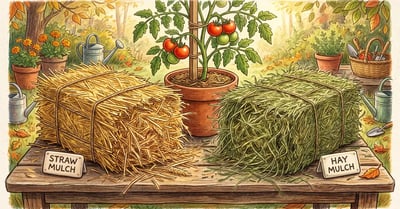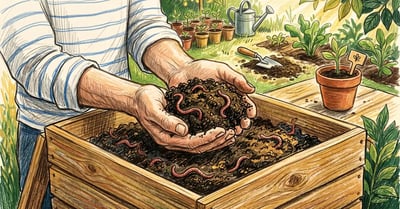

You pull your tomato cages in October, look at the empty raised bed, and your options are: cover with cardboard until spring, leave it bare to crust over and erode, or spend $5 on seed and let nature do your soil-building for the next six months. Cover crops are the third option, and they are dramatically underused in backyard raised beds.
The cover crops that work best in raised beds are not the same ones farmers use on 40-acre fields. Raised beds have shallow soil mass, edge effects, and termination constraints that rule out some traditional choices and reward others. This guide covers the seven best cover crops for raised beds, when to plant each one, how to terminate without a tractor, and the proven combinations that build soil fastest.
Key Takeaway
For winter (most US zones): a mix of cereal rye + crimson clover + hairy vetch sown 4 to 6 weeks before frost. For summer: buckwheat alone, sown after spring crops are pulled. For a quick spring or fall window: oats + field peas. For breaking up compacted soil: daikon (tillage) radish. Plant when the bed would otherwise sit bare, terminate before flowering for most species, and chop-and-drop instead of tilling in.
What makes a good cover crop for a raised bed?
Raised beds change the cover crop equation in three ways. Shallow soil mass means deep-rooted species like sweet clover or alfalfa are overkill and may even pop the bed apart. Edge effects mean wind dries the soil faster than in a field, so drought-tolerant species like cereal rye outperform finicky ones. No tractors means termination has to be possible with hand tools: scythe, hedge shears, tarp smothering, or simple pulling.
The seven species in the table below pass all three filters. UMD Extension and NCSU's cover crop planting guide both list these as the most reliable home garden choices.
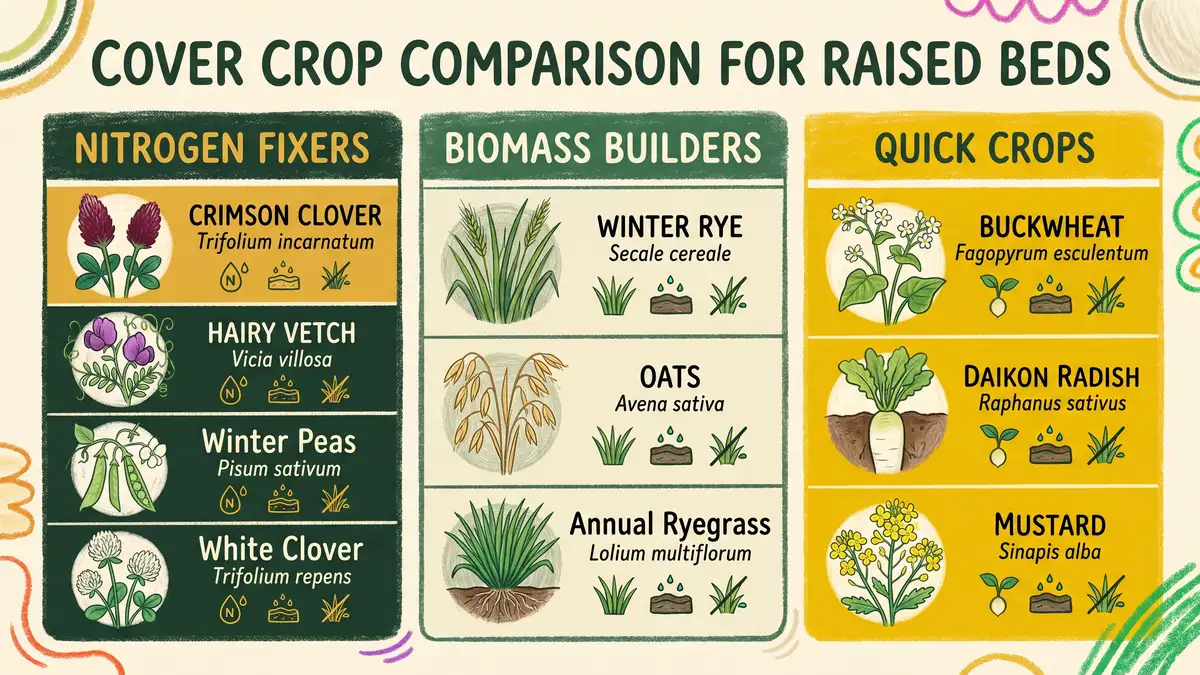
Source: Categories adapted from Rodale Institute's organic no-till cover crop guide.
The seven best cover crops for raised beds
| Cover crop | What it does | When to sow | Sowing rate |
| Cereal rye (winter rye) | Biomass, weed suppression, holds soil all winter | Late summer to 4 wk before frost | 2 oz per 100 sq ft (60 g/9 m²) |
| Crimson clover | Nitrogen fixer, pollinator draw | Late summer for fall growth | 0.5 oz per 100 sq ft (15 g/9 m²) |
| Hairy vetch | Nitrogen fixer (100-150 lb N/acre) | 4 to 6 wk before frost | 1 oz per 100 sq ft (30 g/9 m²) |
| Oats | Winter-kill mulch, fast biomass | Late summer or early fall | 2 oz per 100 sq ft (60 g/9 m²) |
| Buckwheat | Summer biomass, pollinator magnet, weed smother | Late spring through summer | 2 oz per 100 sq ft (60 g/9 m²) |
| Daikon (tillage) radish | Breaks compaction, scavenges nutrients | Late summer to 8 wk before frost | 0.25 oz per 100 sq ft (7 g/9 m²) |
| Austrian winter peas | Nitrogen fixer, edible shoots | Early fall | 4 oz per 100 sq ft (115 g/9 m²) |
Source: Sowing rates from NC State Extension cover crop guide, cross-checked with Plant Cover Crops practitioner data.
Nitrogen fixers vs biomass builders: pick both
The most common cover crop mistake in raised beds is planting only one species. A monoculture cover crop does one job. A mix does two or three at once.
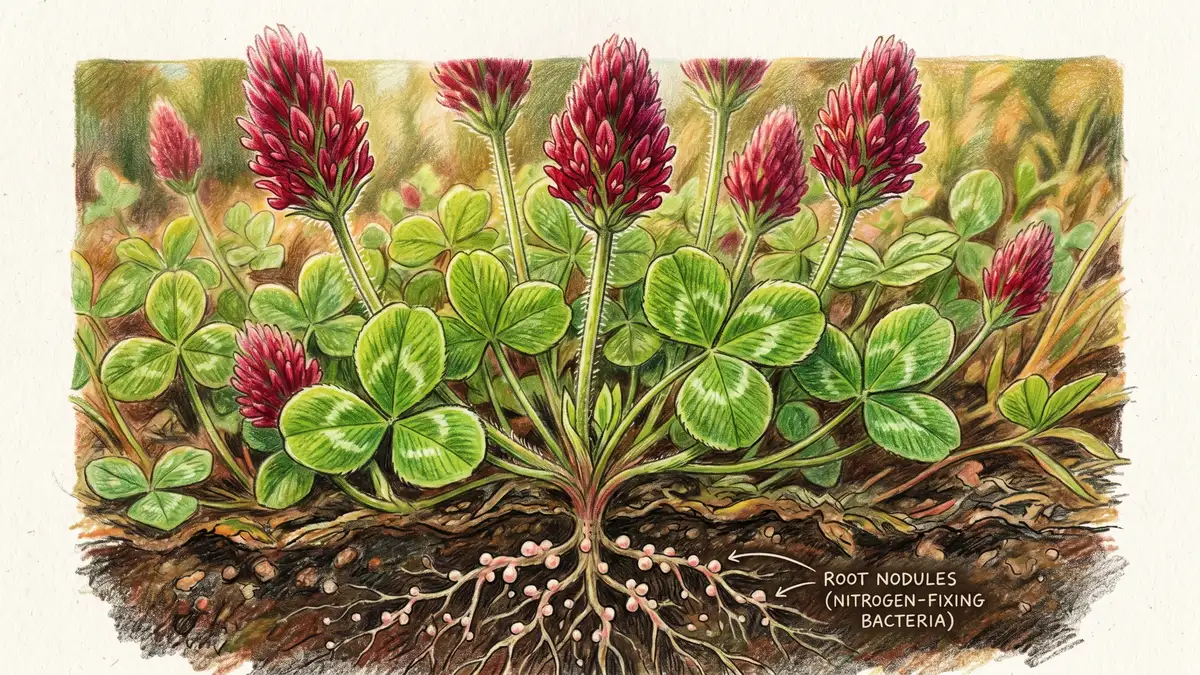
Legumes (clover, vetch, peas) partner with Rhizobium bacteria in their root nodules to pull atmospheric nitrogen out of the air and fix it into a form plants can use. Penn State Extension documents that a strong hairy vetch stand fixes 100 to 150 lb of nitrogen per acre, enough to grow a heavy-feeding crop like corn or tomatoes the following season without additional fertiliser.
Grasses (rye, oats, ryegrass) grow fast, smother weeds, and build the high-carbon biomass that creates stable soil organic matter when it decomposes. Grass roots are fibrous and reach deep, holding soil during winter rain and feeding soil bacteria and fungi as they decompose.
The classic winter mix solves both problems: cereal rye for biomass plus hairy vetch for nitrogen, with crimson clover as a third species adding pollinator value in spring. Rodale Institute tested this combination across multiple seasons and found that the rye-vetch mix consistently outperformed either species alone.
Buckwheat: the 30-day soil builder
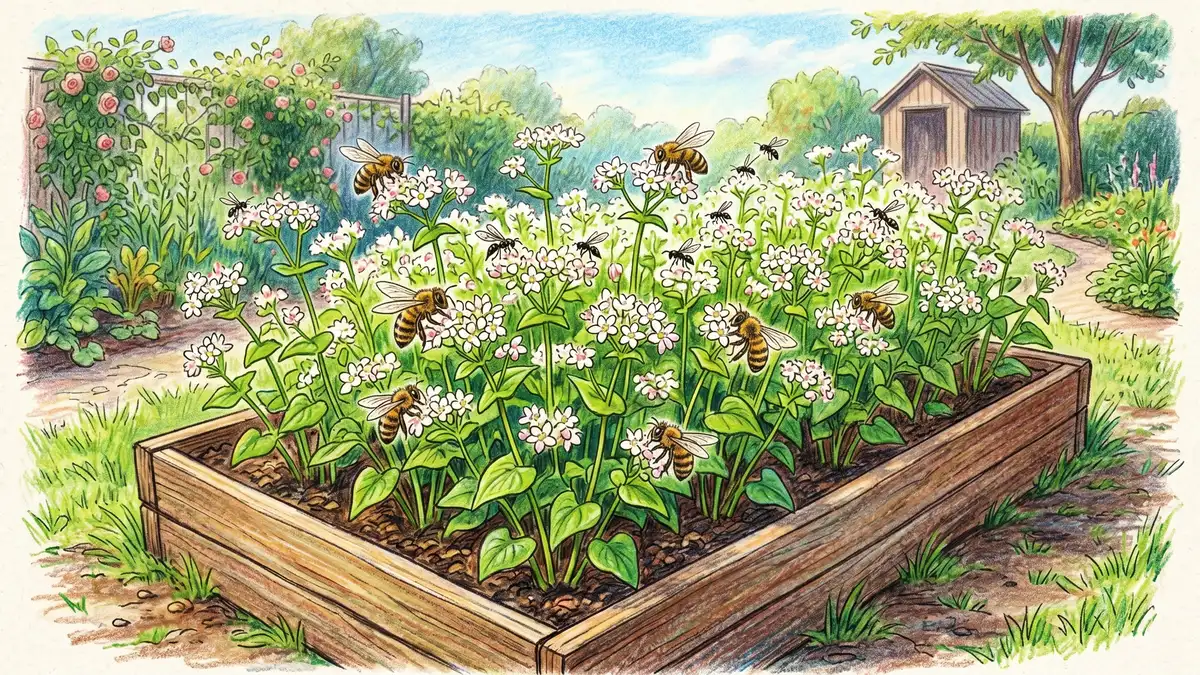
Buckwheat is the cover crop to reach for when you have a 6 to 8 week summer window between crops. It germinates in 3 to 5 days, flowers in 28 to 35 days, and produces enough biomass to smother weeds and feed soil microbes when chopped down.
Buckwheat also pulls phosphorus from soil that other plants cannot access. The Gardener's Workshop documents that buckwheat releases organic acids from its roots that solubilise bound phosphorus, then concentrates it in the above-ground biomass where it becomes available to the next crop.
The catch: terminate buckwheat at first flower, not later. If you let it set seed, you will have volunteer buckwheat in every crop bed for the next two summers.
Daikon radish: the biological subsoiler
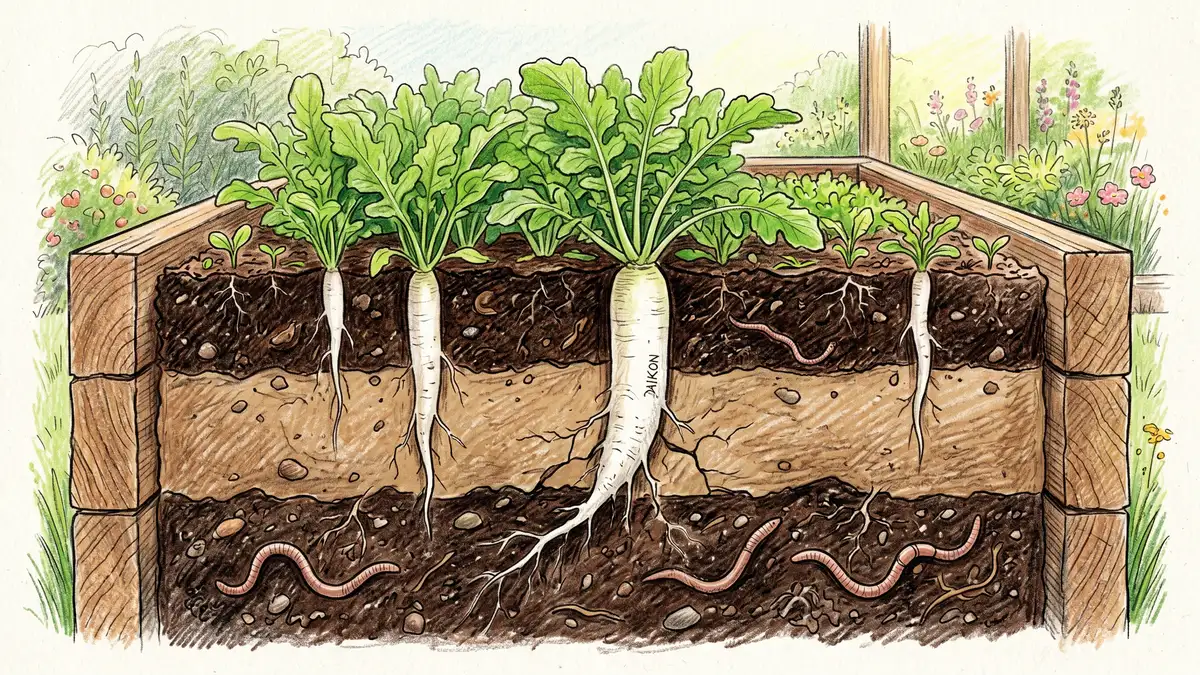
If your raised bed soil has hardened over a few seasons (foot traffic on edges, settling, low organic matter), daikon radish is the cheapest fix. Each radish punches a deep, large-diameter hole through compacted layers. The taproots reach 24 in (60 cm) or more in 8 to 10 weeks.
After hard frost, the radishes winter-kill, leaving a network of root channels filled with decomposing organic matter. Piedmont Master Gardeners describes daikon as a "biological subsoiler" that does mechanical work no hand tool can match in a confined raised bed.
One warning: dying daikon radishes smell like rotting cabbage for about two weeks in early spring. Plant them where you can walk past without your neighbour complaining.
Termination without tractors
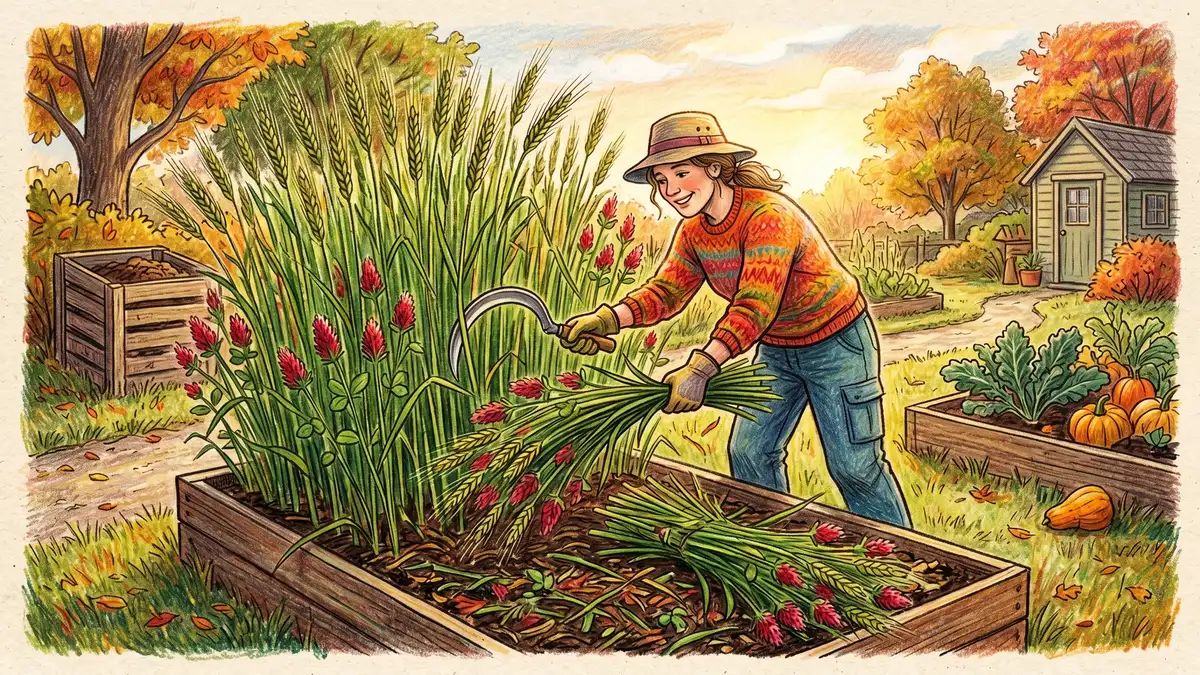
The biggest obstacle to backyard cover cropping is termination. Farmers roll-crimp or till in. Neither option works in a 4 x 8 raised bed. The hand-tool methods that do work:
Chop and drop with hedge shears
Cut the cover crop at the soil line with hedge shears or a scythe. Leave biomass on the bed as mulch. Plant transplants directly through it 2 to 3 weeks later when the residue has wilted.
Tarp smothering
Cut the cover crop short, lay a silage tarp or thick black plastic over the bed for 2 to 3 weeks. Heat plus light exclusion kills the residue and any weed seeds in the top layer. Then plant.
Winter kill
Oats, buckwheat, mustard, and forage radish all die at the first hard frost. Just leave them in place. The residue decomposes through winter and the bed is ready in spring.
Pull and compost
For small beds, pulling cover crops by hand and composting them is fast and clean. You lose the carbon-to-soil connection but you avoid any termination timing issues.
USDA NRCS termination guidelines emphasise that the right moment is before the cover crop sets viable seed but after it has built maximum biomass. For most species in raised beds, that means at first flower.
Why This Works (the permaculture lens)
Bare soil is an open wound. Every day a raised bed sits uncovered, rain compacts the surface, sun bakes out the moisture, wind carries away the lightest particles, and soil microbes lose their living root partners. A cover crop replaces all four of those losses with active gain: roots add carbon, leaves shade the surface, transpiration cools the bed, and root exudates feed the bacteria and fungi that are doing the actual soil-building work. This is the same principle as no-dig gardening: keep something growing or something covering at all times, and the soil compounds in your favour year over year.
When to sow by USDA zone
| USDA zone | Winter mix sow date | Summer mix sow window |
| Zone 3 to 4 | Early to mid August | Late May to early August |
| Zone 5 | Mid August to early September | Mid May to mid August |
| Zone 6 | Late August to mid September | Early May to late August |
| Zone 7 | Mid September to early October | Late April to early September |
| Zone 8 | Late September to late October | Mid April to mid September |
| Zone 9 to 10 | October to November | Year round with summer break |
Source: Aggregated from Bentley Seeds USDA zone planting guide and Sustainable Market Farming's winter cover crop calendar.
Mistakes that ruin cover crop benefit
Cover Crop Failures to Avoid
The four mistakes that cost backyard gardeners the cover crop payoff: terminating too late so the crop sets seed and volunteers in next year's vegetables; terminating too early before biomass develops; piling thick mulch over freshly cut green cover crop (anaerobic rot smell, kills soil life); and skipping winter watering for fall-sown stands during dry autumns.
For broader soil context, see our complete cover crops guide, our winter cover crops article, and the wider soil health pillar.
Get the Free GrowPerma Newsletter
Weekly soil-building and cover crop guides written for weekend gardeners. No spam, unsubscribe anytime.
Read the Free GuideFrequently Asked Questions
What is the best cover crop for raised beds?
For winter: a mix of cereal rye, crimson clover, and hairy vetch sown 4 to 6 weeks before frost. For summer: buckwheat alone. For compacted soil: daikon radish. For a quick fall window: oats with field peas. The right answer depends on the season and your soil goal.
Can you use cover crops in raised beds?
Yes, raised beds work especially well for cover cropping because you have tight control over timing, sowing density, and termination. The main constraint is hand-tool termination, which rules out tractor-dependent species like cereal rye in very large sowing rates.
When should I plant cover crops in raised beds?
Sow winter cover crops 4 to 6 weeks before your average first frost date. Sow summer cover crops as soon as a spring crop is pulled and you have at least 6 weeks before the next planting. Sow daikon radish 8 to 10 weeks before hard frost so it has time to develop a deep taproot.
How do you terminate cover crops in a raised bed without tilling?
Four options: chop at soil line with hedge shears or scythe and leave as mulch; cover with a silage tarp for 2 to 3 weeks; let winter-killed species die naturally; or pull by hand and compost. Most home gardeners use a combination depending on the species.
What is the fastest cover crop for raised beds?
Buckwheat. It germinates in 3 to 5 days, flowers in 28 to 35 days, and produces enough biomass to smother weeds and build soil in 6 to 8 weeks. Best used between spring and fall vegetable crops.
Do cover crops really fix nitrogen?
Legume cover crops (clover, vetch, peas) partner with Rhizobium bacteria in root nodules to fix atmospheric nitrogen into plant-available forms. A hairy vetch stand can fix 100 to 150 pounds of nitrogen per acre, enough to support a heavy-feeding crop the next season. Grass cover crops do not fix nitrogen.
Can I plant cover crops over winter in zone 5 or zone 6?
Yes, sow cereal rye and hairy vetch 4 to 6 weeks before your first hard frost. Rye survives temperatures down to -30 F (-34 C) and resumes growth in spring. Hairy vetch is hardy to about -15 F (-26 C) and similarly resumes growth in spring.
Build Living Soil With Cover Crops
Our free permaculture starter guide walks you through cover cropping, no-dig methods, and your first food forest layer. Practical steps designed for weekend gardeners with limited time and real budgets.
Start with the Free GuideResources
- Cover Crops for Gardens (UMD Extension)
- Planting Methods, Rates, and Dates (NC State Extension)
- Growing Cover Crops for Nitrogen (Penn State Extension)
- Choosing Cover Crops for Organic No-Till (Rodale Institute)
- Cover Crop Termination Guide (USDA NRCS PDF)
- Forage Radishes as a Cover Crop (Piedmont Master Gardeners)
- Best Cover Crops for Raised Beds Over Winter (Gardenary)
- Benefits of Buckwheat (The Gardener's Workshop)
- Planning Winter Cover Crops (Sustainable Market Farming)
- Austrian Winter Peas (Plant Cover Crops)
- USDA Hardiness Zone Planting Guide (Bentley Seeds)