The shrub layer is where a temperate food forest actually pays you back. Canopy trees are the long game — chestnuts and walnuts that take 15-20 years to hit full production. Annual vegetables are the short game — high yield but you replant every year. Berry bushes sit in the sweet spot: they start producing in year 2 or 3, peak by year 5-8, and keep yielding 5 to 25 pounds per plant per year for the next 15-25 years. growing sea buckthorn acidifying soil for blueberries gooseberries and currants in food forests when each berry actually ripens how to grow elderberry when to prune berry bushes hedgerow boundary planting
For a homesteader on a 5-15 year ROI horizon, the shrub layer is the engine. Pick the right species for your soil pH and USDA zone, and a quarter-acre can put 50-100+ pounds of fruit per year on your table while doing the heavy lifting on nitrogen, pollinator forage, and biomass — without the input bills of an annual garden.
Quick answer
The most productive temperate food forest berry bushes are blueberries (5-10 lb/plant, but only at pH 4.5-5.5), raspberries and blackberries (5,000 lb/acre at scale, pH 6.0-6.5), aronia (5-7 lb average, up to 30 lb at peak), elderberry, currants and gooseberries (cold-hardy zone 3+), honeyberry (8-9 lb/plant, hardy to zone 1), serviceberry (10 lb/plant, fruit for 20 years), goumi (25 lb/plant + nitrogen-fixing), and sea buckthorn (heavy yields + 90 kg/ha/year nitrogen fixation). The single biggest design decision is soil pH: blueberries demand acidic (4.5-5.5); everything else prefers neutral (6.0-7.0). Pick one camp.
What the shrub layer actually does in a food forest
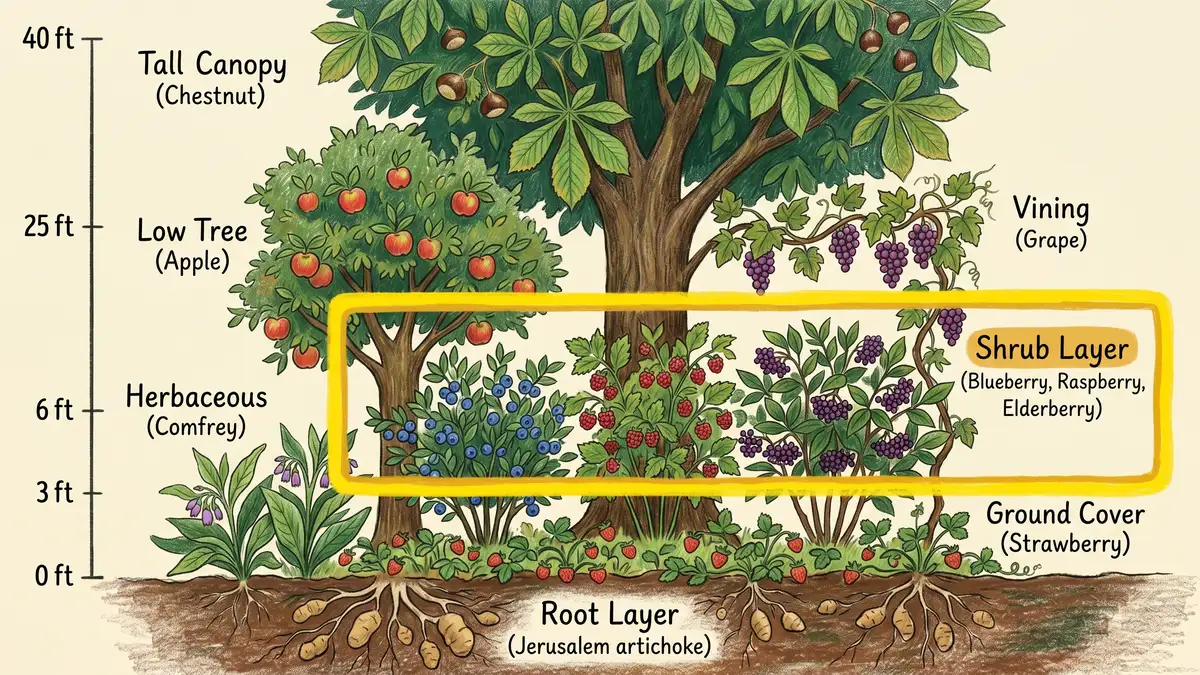
In Robert Hart's seven-layer food forest model — the framework refined by Martin Crawford, Geoff Lawton, and most contemporary practitioners — the shrub layer sits between the low-tree canopy (apple, plum, hazelnut) and the herbaceous layer (comfrey, sorrel). Functionally, it does work the canopy can't: dense planting, high yield per square foot, fast establishment, and biological roles that compound over decades.
A productive food forest shrub isn't just a small fruit-producer. The best ones meet at least one of these criteria, and the great ones meet several:
- Direct edible yield — fruit, nuts, leaves, or flowers
- Nitrogen fixation or accumulation — sea buckthorn, goumi, elderberry as a deep-rooted accumulator
- Pollinator support — early bloomers like serviceberry and honeyberry feed bees in early spring
- Wildlife habitat — songbirds, ground-nesting birds, beneficial insects
- Structural support — for climbing layers like grapes and hardy kiwi
According to Growing With Nature's shrub layer overview, an optimised quarter-acre temperate food forest typically allocates 6-12 shrubs around every 2-3 canopy or sub-canopy trees. That inverted ratio — fewer big trees, more shrubs, dense ground layers — maximises total yield per square metre while keeping the system structurally diverse.
Why this works (the permaculture insight)
Annual vegetable gardens demand soil amendments every year, irrigation, and replanting. The shrub layer flips that economics: you invest labour and money in years 1-3, and the system pays you back in stable yields for two decades with minimal intervention. This is the core permaculture principle of obtaining a yield while building capital — every chop-and-drop pruning, every fallen leaf, every nitrogen-fixing root makes next year's harvest cheaper, not more expensive.
The pH split: the single biggest design decision
Before picking species, look up your soil pH. The temperate berry world divides cleanly along a 1.5-point pH line, and trying to bridge that line is one of the most expensive mistakes a new food forester can make.
Acidic specialists (pH 4.5-5.5): blueberries and cranberries. That's basically it.
Neutral generalists (pH 6.0-7.0): raspberries, blackberries, currants, gooseberries, elderberries, serviceberries, aronia, honeyberries (5.5-7.5 tolerated), goumi, and most others.
pH is logarithmic — pH 5.0 is 10× more acidic than pH 6.0 and 100× more acidic than pH 7.0 — so this isn't a small adjustment. Peer-reviewed cranberry research from PMC documented that plants grown above pH 5.5 showed yield reductions of 29-56% and fruit-size reductions of 25-35%. The same research applies to blueberries, which share cranberry's pH requirements.
If your soil is naturally pH 6.5-8.0 (typical across much of North America), the math on amending to grow blueberries doesn't work. One documented case required 2 tons of elemental sulphur per 3 acres applied six months before planting, with ongoing maintenance every 1-2 years — costs of $2,000-$4,000 per acre. A single mature blueberry plant produces $5-$10 of retail-equivalent fruit per year. The amendment payback period extends past 400 years.
The honest call on blueberries
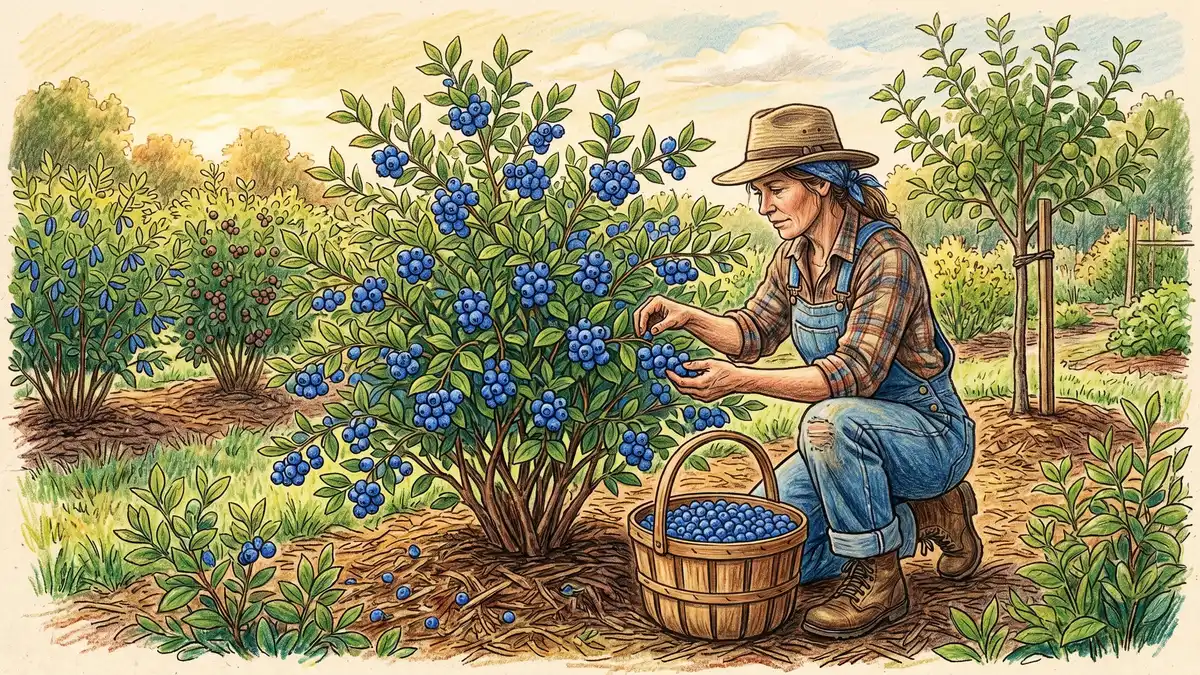
If your native soil is acidic (most of New England, parts of the Pacific Northwest, much of the Southeast under pines), blueberries are the gold-standard crop and the math works. If your soil is neutral or alkaline, skip blueberries entirely and build your shrub layer around raspberries, currants, elderberries, aronia, and serviceberries. A mixed neutral-soil shrub layer can produce 50-100+ pounds per quarter-acre with no pH amendment whatsoever.
The 10 best berry bushes for a temperate food forest shrub layer
Yields below are from university extension and peer-reviewed sources. Take "pounds per plant" as a mature-plant ballpark — varieties, climate, and management all create wide ranges.
| Berry bush | Yield (mature plant) | USDA zone | Soil pH | First crop |
| Highbush blueberry (Vaccinium corymbosum) | 5-10 lb (1-3 lb half-high) | 4-7 (north), 6-10 (south) | 4.5-5.5 (mandatory) | Year 3-5; peak yr 5-6 |
| Raspberry (Rubus idaeus) | ~5,000 lb/acre (8-12 lb / 50 ft row) | 3-9 | 6.0-6.5 | Year 2 (primocane), Year 3 (floricane) |
| Blackberry (Rubus fruticosus, thornless cv.) | Comparable to raspberry | 5-9 (some 4) | 6.0-6.5 | Year 2-3 |
| Black/red currant (Ribes nigrum / rubrum) | 3-10 lb | 3-7 (some to 2) | 6.0-7.0 | Year 2-3 |
| Gooseberry (Ribes uva-crispa) | 3-10 lb | 3-7 | 6.0-7.0 | Year 2-3 |
| Honeyberry / haskap (Lonicera caerulea) | 8-9 lb (yr 6 trial) | 1-8 (true zone 1) | 5.5-7.5 | Year 2-3 |
| Aronia / chokeberry (Aronia melanocarpa) | 5-7 lb avg, up to 30 lb peak | 3-9 | 5.0-7.0 (broad) | Year 3 |
| Elderberry (Sambucus nigra/canadensis) | Heavy (anecdotal); reaches 10-15 ft | 3-9 | 5.5-6.5 | Year 2-3 |
| Serviceberry (Amelanchier alnifolia) | 10 lb (top cv.); fruit for 20 yrs | 3-8 | 6.0-7.0 (broad) | Year 3-5; peak yr 8 |
| Sea buckthorn / seaberry (Hippophae rhamnoides) | "Large yields"; vitamin C powerhouse | 3-8 | 5.5-7.5 | Year 3-5 |
| Goumi (Elaeagnus multiflora) | 25 lb at maturity (yr 4+) | 4-8 | Tolerates poor soil | Year 2-3 |
Sources:
The nitrogen-fixing berry guild: why it matters after year 5
| Species | N-fixation | Fruit yield | Best position in design |
| Sea buckthorn (Hippophae rhamnoides) | Up to 90 kg/ha/yr (with deep-rooted tree partners) | Heavy yields; 6-10× RDA vitamin C per serving | Windy edges, full sun (fails in shade); plant 1 male per 6-8 females |
| Goumi (Elaeagnus multiflora) | Yes (Frankia partnership); rate not formally quantified | ~25 lb/plant at maturity (year 4+) | Tucked between fruiting shrubs; tolerates poor soil and partial shade |
| Autumn olive (Elaeagnus umbellata) | High nitrogen-fixing rates documented | Edible berries | Avoid — invasive across most of eastern US; plant goumi instead |
Source:
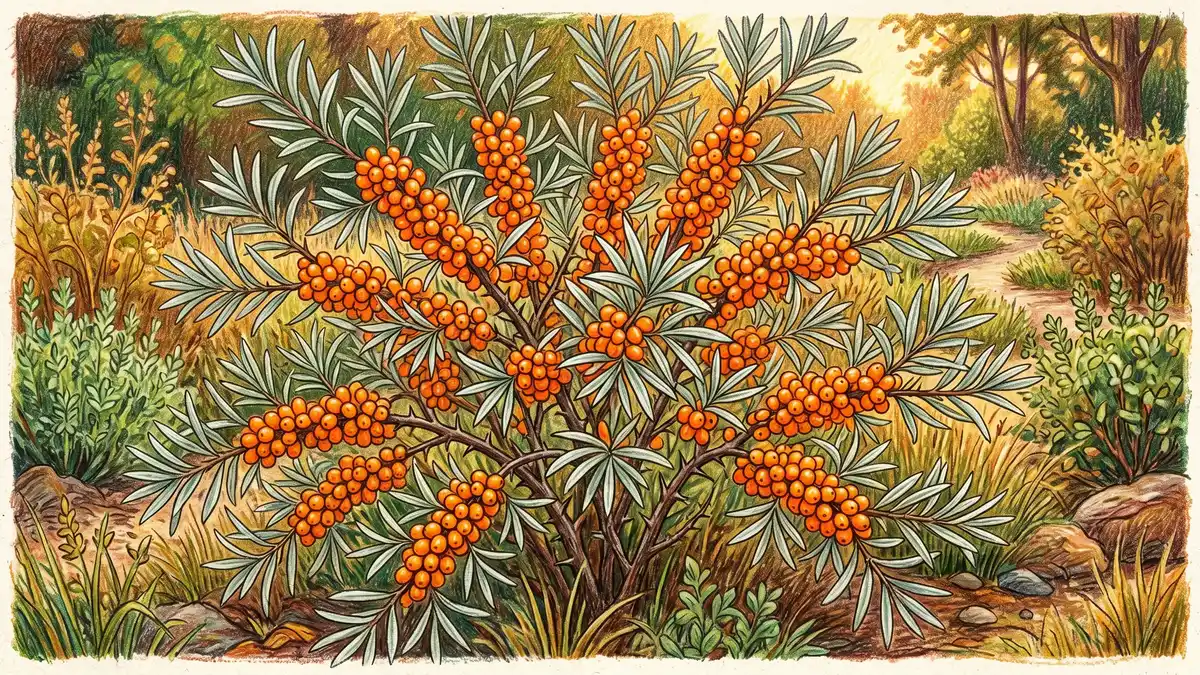
Three berry shrubs fix atmospheric nitrogen via root-associated bacteria: sea buckthorn (Hippophae rhamnoides), goumi (Elaeagnus multiflora), and autumn olive (Elaeagnus umbellata — but it's invasive across much of the eastern US, so plant goumi instead). All three are in the family Elaeagnaceae and partner with Frankia bacteria.
According to Winrock International's research on Elaeagnus species, sea buckthorn interplanted with deep-rooted trees like walnuts can fix up to 90 kg of nitrogen per hectare per year. For a quarter-acre food forest (about 0.1 hectare), one or two female sea buckthorn plants plus a male pollinator can theoretically contribute 9-18 kg of nitrogen annually — equivalent to 20-40 pounds of synthetic urea you don't need to buy.
The case for allocating 10-20% of your shrub layer to nitrogen-fixers gets stronger every year. By year 5, the system is feeding itself; by year 10, your fertilizer bill is zero and the shrubs are still producing fruit, biomass for chop-and-drop mulching, and pollinator forage. Mark Shepard's New Forest Farm in Wisconsin and Martin Crawford's Agroforestry Research Trust forest garden both build heavily around this principle.
Sea buckthorn note: it's dioecious (separate male and female plants). You need at least one male plant for every 6-8 females, or you'll get zero berries. This is the single most common sea buckthorn failure.
Cold-hardy bushes for zone 2-4 homesteads
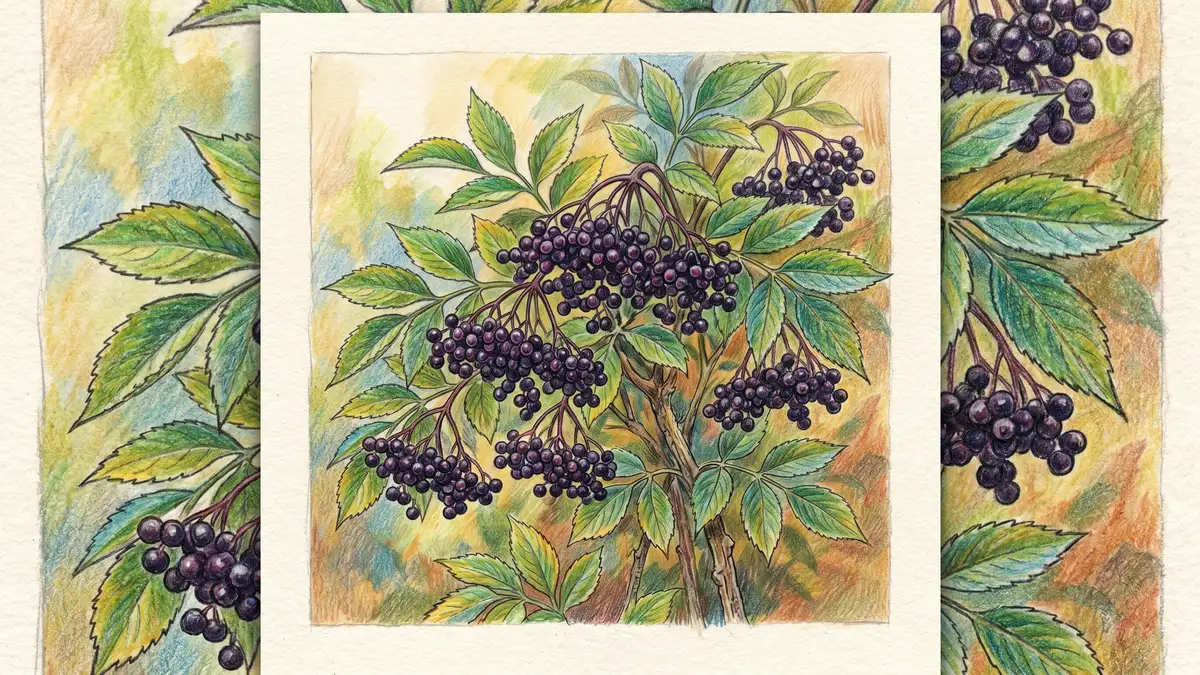
Northern homesteaders used to be limited to a tiny berry palette. Cultivar development in the last decade has changed that completely. If you're in Maine, northern Minnesota, the Canadian prairies, or anywhere else hitting USDA zone 2-4 minimums, you can now build a productive shrub layer around:
Honeyberry (Lonicera caerulea) — hardy to zone 1, ripens in late June (weeks before strawberries), 8-9 lb per mature plant. The breakthrough crop for northern food forests. Requires a compatible pollinator variety; bloom timing matters because they flower very early and can lose crops to late spring frost in cold-pooling sites.
Currants and gooseberries (Ribes spp.) — most varieties zone 3-7, some to zone 2. Self-fertile, productive 15-20+ years, modest pruning.
Sea buckthorn (Hippophae rhamnoides) — zone 3-8 with strong performance in 3-5. The vitamin C content is extraordinary: 6-10× the US RDA per serving.
Aronia (Aronia melanocarpa) — zone 3-9, native to North America, extremely pest-resistant, 5-7 lb average per plant with peaks to 30 lb.
Serviceberry (Amelanchier alnifolia) — zone 3+, the saskatoon of the Canadian prairies. Self-fertile, stunning four-season ornamental value, 10 lb per top-cultivar plant, fruit for 20 years.
For a deeper look at which native plants work best across food-forest layers in cool climates, see our guide to the 7 layers of a food forest.
Spacing and stacking: how to actually plant them
Crawford's spacing recommendations from the Agroforestry Research Trust, combined with Penn State and Cornell production guides, point to consistent ranges:
Build around canopy and sub-canopy trees first
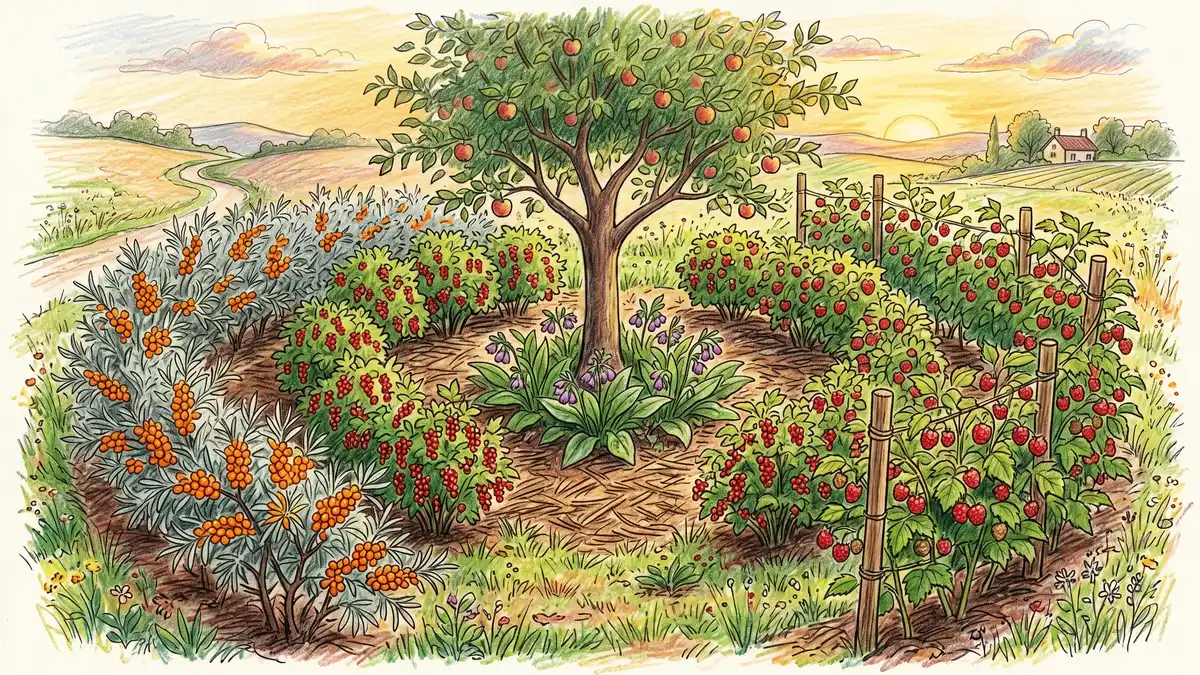
Plant 2-3 fruit or nut trees per quarter-acre, then plan the shrub layer in their drip-line shadow patterns. Apple-and-comfrey-and-currant guilds are the classic temperate pattern.
Space shrubs 4-8 feet apart depending on mature size
Currants, gooseberries, blueberries, and honeyberries: 4-5 ft. Larger shrubs (elderberry, sea buckthorn, serviceberry, goumi): 6-10 ft. Raspberries: 24 in apart in rows 8-10 ft apart.
Layer the herb and ground levels underneath
Comfrey at the base of canopy trees as a dynamic accumulator. Strawberries, mints, alpine strawberry, and creeping thyme as ground cover under shrubs. Garlic and chives for pest deterrence.
Place nitrogen-fixers strategically (10-20% of shrub layer)
Sea buckthorn on windy edges (it tolerates wind and salinity). Goumi tucked between fruiting shrubs as a fertility plant. Plan for harvest access and dioecious pollination needs.
The pest reality: deer and birds will take 40-50% if you let them
Unprotected berry crops face heavy browse pressure. Penn State and Cornell research show that uncontrolled deer and bird damage routinely destroys 40-50% of annual fruit production. A documented blueberry grower in a New York State Horticultural Society case study lost 40% of one season's crop to spotted-wing drosophila and birds.
Practical countermeasures, in rough order of cost-effectiveness:
- Bird netting — 80-gram nets effectively exclude spotted-wing drosophila on small fruit. Initial cost around $4,600 for a half-acre, amortising to about $657/year over 5 years; pays back inside 2-4 years even at wholesale prices.
- Deer fencing — 8-foot perimeter fencing for any property with regular deer pressure. Non-negotiable for serious yield.
- Plant deer-resistant species in exposed positions — gooseberries, currants, and aronia get browsed less than blueberries and raspberries. Plant the sensitive species deeper inside protected zones.
- Diverse plantings — birds focus pressure on monocultures. Mixing 6-8 species across the shrub layer dilutes losses to any single crop.
Common mistakes that kill productivity
Ignoring soil pH — already covered. Test your soil before you order plants.
Not checking currant restrictions — black currants and gooseberries (genus Ribes) are alternate hosts for white pine blister rust. Some US states ban or restrict planting; Maine's Forest Service rule is one example. Check your state's regulations before ordering.
Single sea buckthorn plants — dioecious. No male, no berries. Ratio: 1 male per 6-8 females.
Underestimating elderberry size — they reach 10-15 ft, well into sub-canopy territory. Don't plant them under low fruit trees.
Late frost on serviceberry and honeyberry — both bloom early. If your site has cold-air pooling, you'll lose crops some years.
Skipping the pollinator pair — most blueberries, honeyberries, and pawpaws need at least two varieties for cross-pollination. Single-variety plantings underperform dramatically.
For more on how berry shrubs fit into a fully integrated food forest design, see our food forest design guide and our walkthrough of companion planting principles that translate directly to shrub-layer guild design.
If you remember six things
(1) Test your soil pH before ordering plants — it determines whether you can grow blueberries or whether you focus on the neutral-soil palette. (2) Most shrubs start producing in year 2-3 and peak by year 5-8 — perennial ROI beats annual gardening once you cross that threshold. (3) Allocate 10-20% of the shrub layer to nitrogen-fixers (sea buckthorn, goumi) — fertility cost goes to zero by year 5. (4) Sea buckthorn is dioecious — 1 male per 6-8 females, no exceptions. (5) Honeyberry is the breakthrough crop for zone 1-3 homesteads. (6) Plan deer fencing and bird netting from day one — you can lose 40-50% of your harvest without them.
Get the Weekly Dig
One practical permaculture guide a week, written for gardeners who do this on weekends: food forest and guild designs that produce. Free, no spam, unsubscribe any time.
Join the Weekly DigFrequently asked questions
What are the best berry bushes for a food forest?
The most productive temperate food forest berry bushes are: blueberries (5-10 lb/plant if soil is acidic), raspberries and blackberries (~5,000 lb/acre at scale), aronia (5-7 lb avg, up to 30 lb peak), elderberry, currants and gooseberries (cold-hardy zone 3+), honeyberry (8-9 lb/plant, hardy to zone 1), serviceberry (10 lb/plant, fruit for 20 years), goumi (25 lb/plant + nitrogen-fixing), and sea buckthorn (large yields plus 90 kg/ha/year nitrogen fixation). Pick based on your soil pH and USDA zone first; aesthetics second.
How long do berry bushes take to produce fruit?
Most temperate berry bushes begin producing fruit in their second or third year after planting. Primocane (fall-bearing) raspberries can produce a worthwhile harvest in year 2. Blueberries, serviceberries, and sea buckthorn typically need 3-5 years to begin meaningful production. Full peak production for most species arrives in years 5-8 and continues for 15-25 years with reasonable pruning and management.
What soil pH do berry bushes need?
Soil pH splits berry bushes into two camps. Blueberries and cranberries require acidic soil (pH 4.5-5.5) and suffer 29-56% yield reductions in higher-pH soils. Raspberries, blackberries, currants, gooseberries, elderberries, serviceberries, aronia, honeyberries, and most other temperate berries prefer slightly acidic to neutral soil (pH 6.0-7.0). If your soil is naturally pH 6.0-7.5, skip blueberries entirely rather than amending — the math doesn't work.
Are there nitrogen-fixing berry bushes?
Yes — three berry shrubs fix atmospheric nitrogen via root-associated Frankia bacteria: sea buckthorn (Hippophae rhamnoides), goumi (Elaeagnus multiflora), and autumn olive (Elaeagnus umbellata, but invasive across much of the eastern US — plant goumi instead). Sea buckthorn interplanted with deep-rooted trees can fix up to 90 kg of nitrogen per hectare per year. Allocating 10-20% of your shrub layer to nitrogen-fixers eliminates the need for synthetic fertilizer by year 5 in most temperate food forests.
Do deer eat berry bushes?
Yes, often heavily. Unprotected berry crops face deer and bird browse pressure that routinely destroys 40-50% of annual fruit production in regions with active deer populations. Blueberries and raspberries are particularly vulnerable. Practical defenses: 8-foot perimeter fencing for deer, 80-gram bird netting for spotted-wing drosophila and birds (initial cost ~$4,600 per half-acre, amortizing to about $657/year), and species diversification so no single crop carries the full pressure. Currants, gooseberries, and aronia are browsed less than blueberries.
Which berry bushes are most cold-hardy?
For USDA zones 2-4 homesteads, the most reliable berry shrubs are: honeyberry / haskap (zone 1-8, the breakthrough crop for northern food forests, 8-9 lb/plant, ripens before strawberries), currants and gooseberries (zone 3-7, some to zone 2), sea buckthorn (zone 3-8 with peak performance in 3-5), aronia (zone 3-9), and serviceberry (zone 3+, the saskatoon of the Canadian prairies, fruits for 20 years). All of these reliably produce in conditions where blueberries and most raspberries struggle.
Resources
- Growing With Nature — The shrub layer in a food forest
- Iowa State Extension — Blueberry yields
- Penn State Extension — Raspberry production
- NC State Extension — Rubus (blackberry) production
- Utah State Extension — Serviceberry in the garden
- UW-Madison CIAS — Seaberry / sea buckthorn profile
- Winrock International — Elaeagnus as nitrogen fixers
- Farm Progress — Aronia berry farm-family case study
- Honeyberry USA — Cultivar performance data
- PMC — Soil pH effects on cranberry productivity
- Martin Crawford — Creating a Forest Garden (Agroforestry Research Trust)
- Maine Forest Service — White pine blister rust rule (currant restrictions)