You're done with annual replanting. You want vegetables and fruit that come back every spring on their own, build the soil while they grow, and produce more food each year than the last — in roughly the same square footage you'd give a tomato bed. That's the case for edible perennials. Plant once, harvest for 10–20 years. Pay for the crowns or seeds in Year 2 (most species), then collect food essentially free for a decade or longer. how to grow sea buckthorn
This article is the homesteader's working list: 25+ vetted edible perennial vegetables, herbs, and fruits that earn their place in a food forest. Each entry has the USDA zones it actually works in, expected yield per plant per year, time to first real harvest, and the practitioner-tested cultivar to start with. We'll cover Robert Hart's 7-layer food forest framework so you know where each plant fits, then walk through the species — top to bottom, canopy to root layer.
The short answer
The "power perennials" every food forest should include: asparagus (15–20 year lifespan, 0.5–1 lb/crown/year), rhubarb (5–10 lb/plant/year, harvest year 2), sunchoke (5–15 lb/plant/year, contain it!), perennial kale 'Daubenton' (3–5 lb/plant/year, evergreen leaves), walking onions (self-propagating), blueberry (5–10 lb/bush/year), raspberry (1–2 lb/cane/year), elderberry, currants, and sorrel. Pick species that match your USDA zone first, sun second, soil third. Plant in fall or early spring. Year 1 is establishment — water consistently. Real yield arrives Year 2–4.
The 7-Layer Framework: Where Each Plant Fits
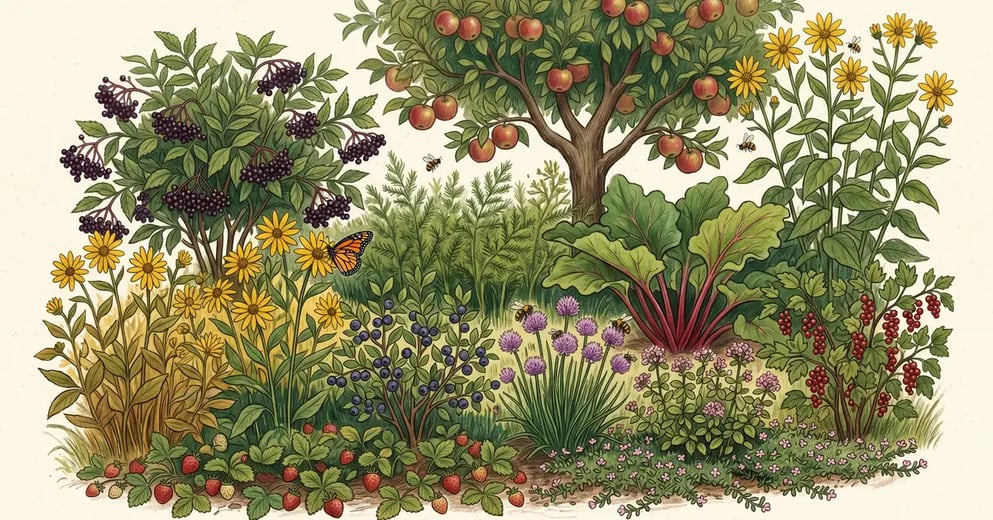
Robert Hart's food forest model from his 1991 book Forest Gardening still sets the design standard. He observed that productive forest ecosystems stack plants vertically across seven distinct layers — and that you can mimic that structure in a backyard to multiply yield per square foot. Toby Hemenway carried the framework into mainstream permaculture in Gaia's Garden, and Martin Crawford's 30-year Devon forest garden has produced 2–3 tonnes of perennial food annually on roughly half a hectare to validate it. The lesson: a good food forest isn't a vegetable patch with extra plants — it's a stratified system where each layer produces something edible and supports the layers above and below.
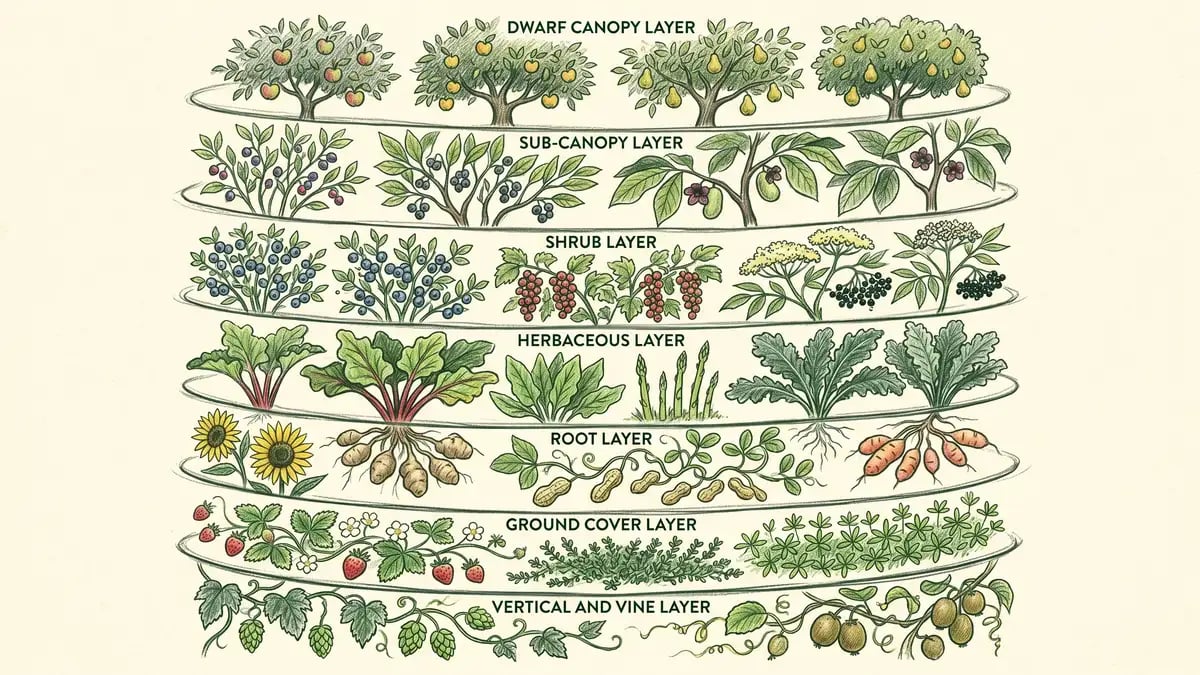
| Layer | Height | Edible perennials | First harvest |
| 1. Canopy | 30–50 ft (9–15 m) | Standard apple, pear, walnut, chestnut, pawpaw | Year 5–7+ |
| 2. Sub-canopy / dwarf trees | 15–25 ft (4.5–7.5 m) | Serviceberry, dwarf apple, sea buckthorn, aronia | Year 3–5 |
| 3. Shrub layer | 6–12 ft (1.8–3.6 m) | Elderberry, currants, gooseberry, blueberry, honeyberry, jostaberry | Year 2–4 |
| 4. Herbaceous layer | 1–4 ft (0.3–1.2 m) | Asparagus, rhubarb, perennial kale, sorrel, lovage, sea kale | Year 1–3 |
| 5. Ground cover | 0–12 in (0–30 cm) | Wild strawberry, creeping thyme, white clover, sweet woodruff | Year 1–2 |
| 6. Root layer | Below soil | Sunchoke, groundnut, oca, yacon, skirret, scorzonera | Year 1–3 |
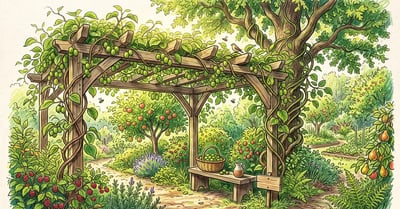
| 7. Climber / vine | Trained on supports | Hardy kiwi, hops, perennial pea, climbing groundnut | Year 3–5 |
Source: Eartheasy — Edible Perennials: Building Your Personal Food Forest and Martin Crawford's Creating a Forest Garden (2010).
For the deeper structural design, our food forest guide covers tree spacing, sun mapping, and how to phase a plot over 5 years. The 7 layers in detail walks through each layer with diagrams. This article focuses on which plants fill those layers — specifically, the herbaceous, shrub, root, and ground cover layers where most edible perennials live.
Why this works (the permaculture insight)
Annual vegetables exist because we kill the soil every year. Tomatoes, lettuce, beans — all originally evolved as pioneers colonising freshly disturbed ground. We've selected for that pioneer behaviour for 10,000 years and now spend half our gardening energy mimicking annual disturbance: tilling, fertilising, weeding, replanting. Edible perennials skip all of that. They're forest-edge and grassland species evolved to build soil over years. Once established, they pull nutrients from depths annuals can't reach (asparagus to 6 ft / 1.8 m, comfrey to 8–10 ft / 2.4–3 m), feed the soil microbiome continuously, and require almost zero soil disturbance to harvest. The work shifts from reset-every-spring to harvest-and-mulch — which is why Year 5 of a food forest produces 2–5× the calories of Year 1 with a fraction of the labour.
The Power Perennials: Top 12 Vegetables Every Food Forest Should Have
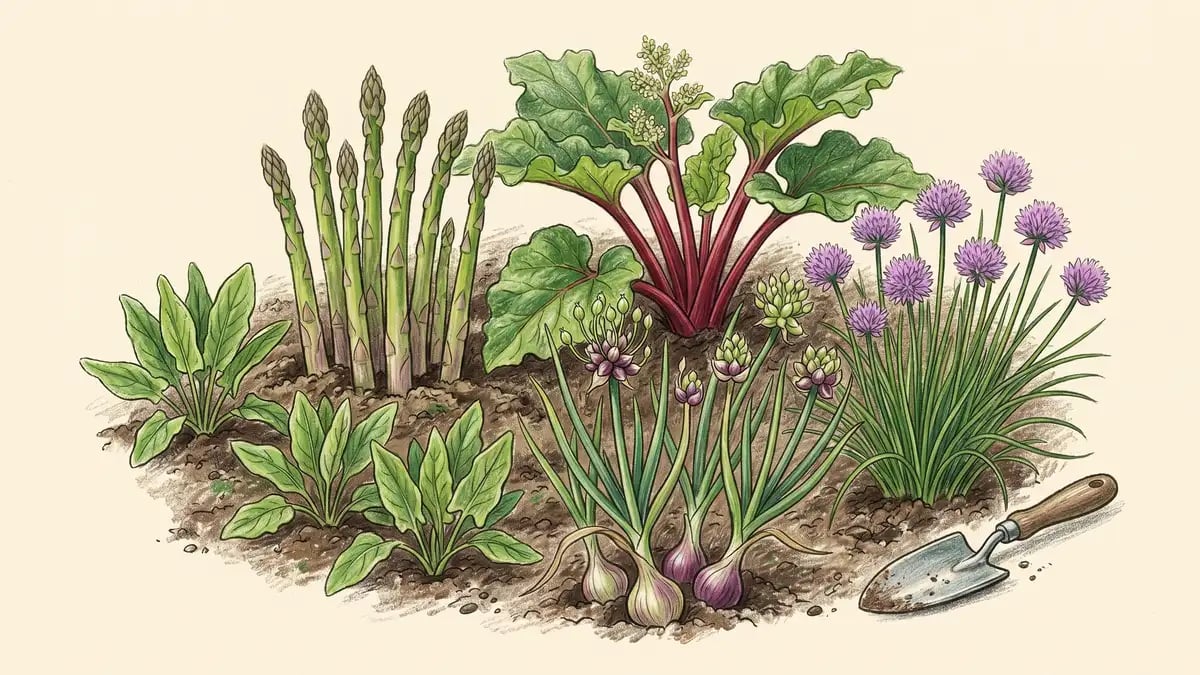
Not all edible perennials are worth planting. Some are genuinely productive (asparagus, rhubarb, sunchoke). Some are interesting but produce a fraction of an annual equivalent (skirret, ramps). Some are aggressive enough to take over a yard if you turn your back (sunchoke, walking onions, mint). The list below is the practitioner shortlist — the species that earn their square footage in a homestead-scale food forest, ranked by yield density and ease of establishment.
| Plant | USDA zones | Yield/plant/year | First harvest | Lifespan |
| Asparagus | 2–10 | 0.5–1 lb (0.23–0.45 kg) | Year 3 full | 15–20 yr |
| Rhubarb | 2–8 | 5–10 lb (2.3–4.5 kg) | Year 2 | 15–20 yr |
| Sunchoke (Jerusalem artichoke) | 2–10 | 5–15 lb (2.3–6.8 kg) | Year 1 | Indefinite |
| Perennial kale 'Daubenton' | 5–9 | 3–5 lb (1.4–2.3 kg) | Year 1 | 3–5 yr |
| Sorrel (French) | 3–8 | 0.5–1 lb (0.23–0.45 kg) | Year 1 | 5–8 yr |
| Walking onion (Egyptian) | 3–9 | 5–15 bulblets | Year 1 | Indefinite |
| Sea kale | 3–9 | 0.5–2 lb blanched (0.23–0.9 kg) | Year 3 | 10–15 yr |
| Good King Henry | 4–9 | 0.5–1 lb (0.23–0.45 kg) | Year 2 | 8–12 yr |
| Lovage | 3–8 | 0.5–1 lb leaves (0.23–0.45 kg) | Year 1 | 3–8 yr |
| Scorzonera | 3–9 | 0.5–1.5 lb roots (0.23–0.68 kg) | Year 2 | 8–12 yr |
| Skirret | 4–9 | 0.5–1.5 lb tubers (0.23–0.68 kg) | Year 3 | 8–15 yr |
| Groundnut (Apios) | 3–9 | 0.5–2 lb tubers (0.23–0.9 kg) | Year 3+ | 10+ yr |
Source:, and Eric Toensmeier & Jonathan Bates, Perennial Vegetables (Chelsea Green, 2013).
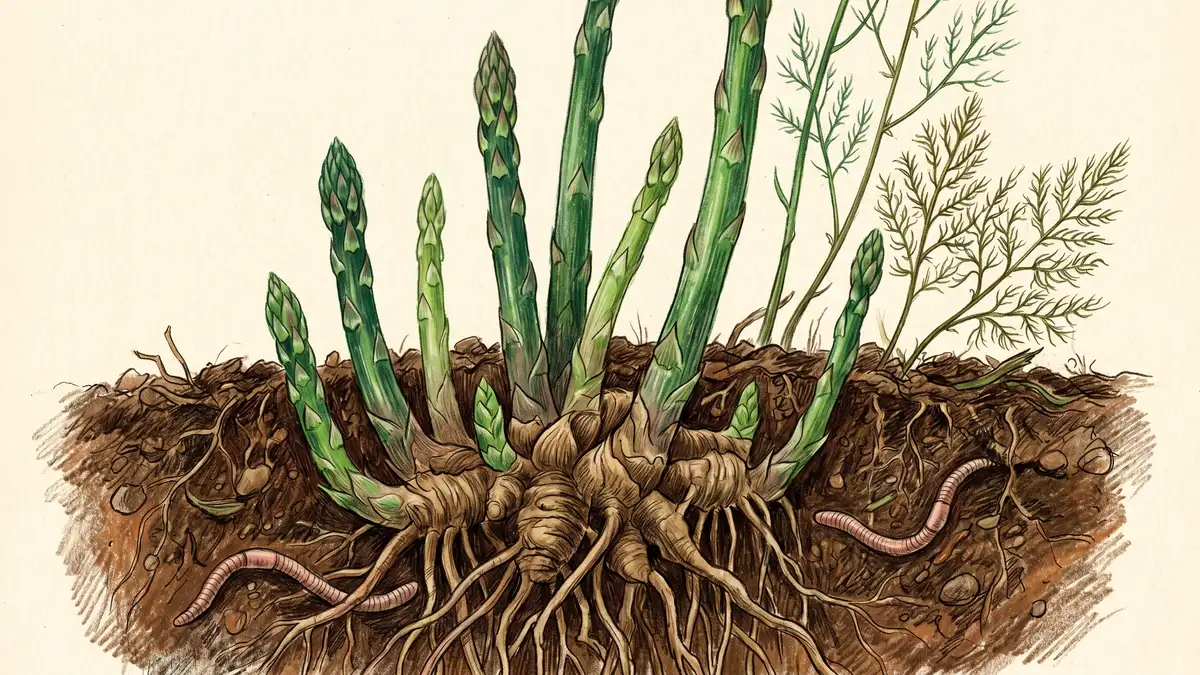
Asparagus is the highest-ROI perennial vegetable in temperate zones. Plant 1-year crowns in a 12-inch (30 cm) deep trench in early spring, full sun, well-drained soil at pH 6.5–7.5. Don't harvest Year 1. Light cuts in Year 2. Full harvest Year 3 onwards — 6 to 8 weeks of spears each spring. A 25-crown bed (covering about 100 sq ft / 9 m²) produces 12–25 lb annually for the next two decades. CSU Extension's Colorado vegetable guide covers cold-climate establishment in detail.
Rhubarb earns its spot for raw productivity — a single mature crown puts out 5–10 lb of stalks every year for 15–20 years. Plant crowns in fall or early spring, 4 ft (1.2 m) apart, full sun in the north and afternoon shade in zones 7–8. Harvest lightly in Year 2 (less than 10% of the plant) and full from Year 3. Don't eat the leaves — they're toxic — but the stalks are worth the wait. Cultivar 'Crimson Red' delivers the best colour and anthocyanin load for cold zones; 'Victoria' is the workhorse heirloom.
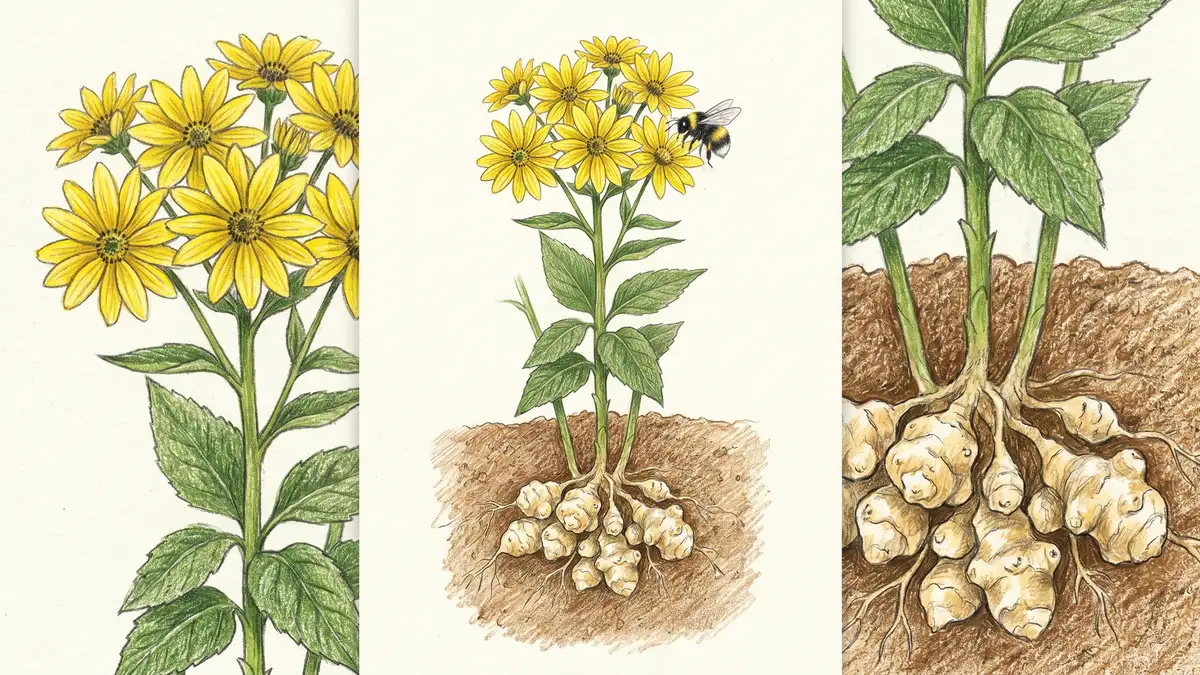
Sunchokes (Jerusalem artichokes) deliver the highest calorie yield per square foot of any temperate perennial — 5–15 lb of tubers per plant per year, harvested after the first hard frost when starches convert to sugars. The catch: they spread aggressively via rhizomes and are extremely hard to eradicate. Plant them in a contained bed, dedicated corner, or buried bottomless container, never in a mixed vegetable garden. They tolerate poor soil, partial drought, and zone 2 winters, and produce edible tubers from Year 1 onward.
Perennial kale 'Daubenton' is the most reliable evergreen brassica for zones 5–9. Unlike annual kale, it doesn't go to seed in its second year — it just keeps producing tender leaves year-round (with some winter slowdown in zone 5). Pick outer leaves continuously, leaving the central growing point intact. After 3–5 years, productivity drops and the central stem lignifies; take cuttings then to propagate the next generation. Available from specialty European seed houses and increasingly from US perennial-vegetable nurseries.
Walking onions (Egyptian / topset onions) propagate themselves by producing aerial bulblets at the top of each stalk that bend over and root where they touch — hence "walking." Year 1 produces light eating; from Year 2 you'll have free onions for life. Manage them like a permanent perennial bed corner because they spread relentlessly. Harvest the green tops like scallions year-round and the bulblets in midsummer for cooking onions. Practitioner consensus from Epic Gardening's perennial vegetable roundup is that they're zone 3–9 hardy and essentially indestructible.
Sorrel is the quickest perennial leafy green to establish — Year 1 light harvest, then 5–8 years of sharp lemony leaves from spring through early summer. French sorrel (Rumex acetosa) bolts in summer heat above 75°F (24°C), so site it where it gets afternoon shade in zones 7–8. The leaves contain oxalic acid; eat in moderation if you have kidney concerns. Excellent for fresh salads and sorrel soup.
For a more comprehensive tour of perennial root crops including yacon, oca, mashua, skirret, and groundnut, EcoDesignHive's 100+ perennials list is the most thorough open-access reference. Garden Betty's perennial vegetables guide covers the easier-to-source temperate species in plain language.
Perennial Fruit Shrubs and Small Trees
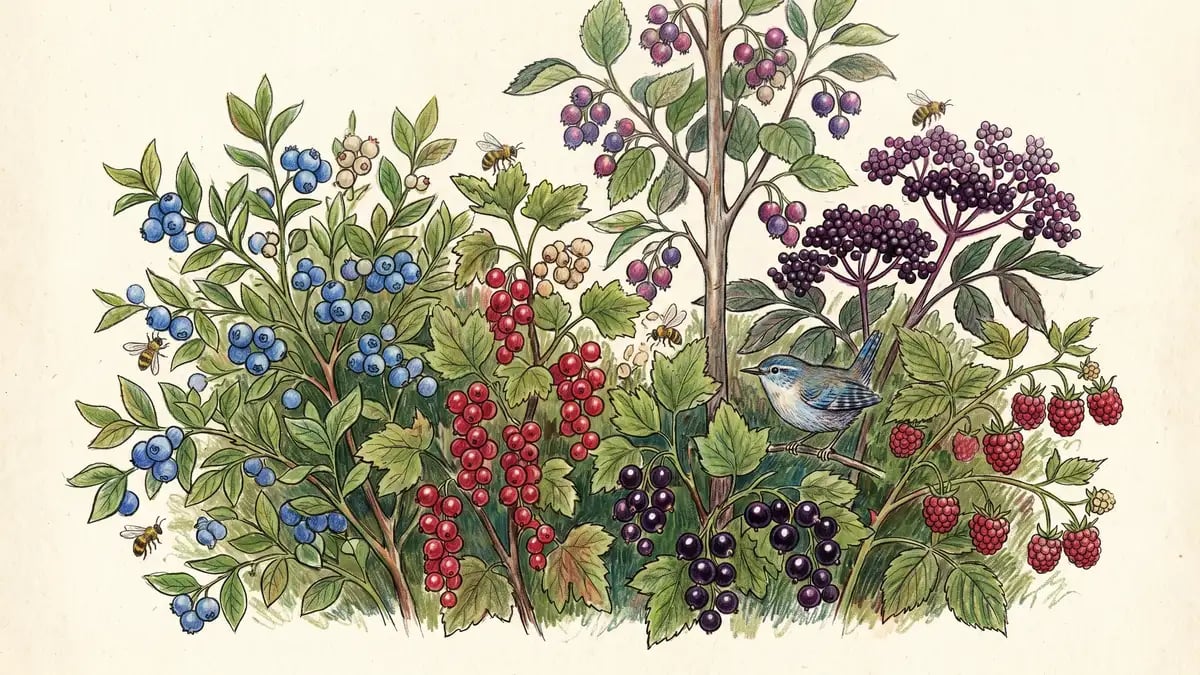
The shrub layer is where most homestead food forest yield actually comes from — pound for pound, perennial berries beat almost every other category. Pair these with the fruit-tree-guild approach in our fruit tree companion planting guide for systems where the shrubs share root and pollinator support with the canopy.
| Shrub / small tree | USDA zones | Yield/plant/year (mature) | First harvest | Notes |
| Blueberry (highbush) | 3–7 (cultivar dependent) | 5–10 lb (2.3–4.5 kg) | Year 3–4 | Acidic soil pH 4.5–5.5 essential |
| Raspberry (summer-bearing) | 3–8 | 1–2 lb per cane (0.45–0.9 kg) | Year 2 | Plant in dedicated row; spreads |
| Blackberry (thornless) | 5–9 | 5–10 lb per plant (2.3–4.5 kg) | Year 2 | Vigorous; needs trellis |
| Black currant | 3–7 | 5–10 lb (2.3–4.5 kg) | Year 3 | High vitamin C; check state restrictions |
| Red / white currant | 3–7 | 3–7 lb (1.4–3.2 kg) | Year 3 | Tolerates partial shade |
| Gooseberry | 3–8 | 3–8 lb (1.4–3.6 kg) | Year 3 | Thornless cultivars available |
| Honeyberry / haskap | 2–7 | 4–8 lb (1.8–3.6 kg) | Year 3 | Earliest fruit of the year; cold-hardy |
| Jostaberry (gooseberry × black currant) | 3–8 | 5–10 lb (2.3–4.5 kg) | Year 3 | Thornless, disease-resistant |
| Elderberry | 3–9 | 10–15 lb (4.5–6.8 kg) | Year 2–3 | Cook before eating; fast-growing |
| Aronia (chokeberry) | 3–8 | 10–25 lb (4.5–11.3 kg) | Year 3 | Highest-antioxidant berry; very tart |
| Serviceberry / saskatoon | 2–8 | 5–15 lb (2.3–6.8 kg) | Year 3–5 | Pollinators love the early flowers |
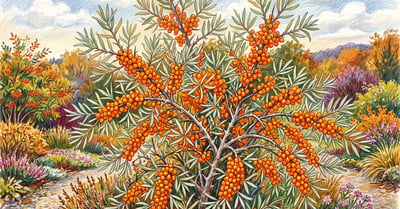
| Sea buckthorn | 3–7 | 10–25 lb (4.5–11.3 kg) | Year 4–6 | Nitrogen-fixing; needs male and female |
| Pawpaw (small native tree) | 5–8 | 20–50 lb at maturity (9–22.7 kg) | Year 5–7 | Largest native US fruit; tropical flavour |
| Goumi | 4–9 | 5–10 lb (2.3–4.5 kg) | Year 3 | Nitrogen-fixing; edible berries |
Source:, and Virginia Cooperative Extension.
The biggest mistake homesteaders make is buying one of each — one blueberry, one raspberry, one currant — and getting modest harvests every season. The yields above are per established plant; for a household of four, plan on 3–6 blueberry bushes, 6–12 raspberry canes, 2–3 currants, and at least one elderberry. Most berries need 2–3 years of root establishment before they hit those numbers, so plant in Year 1 and accept that Year 4 is when the food forest pivots from "interesting project" to "actually feeding us."
Perennial Herbs (the Easiest Win)
Perennial herbs are the lowest-effort, highest-flavour layer of the food forest. Most cost $3–6 per starter plant, establish in one season, tolerate poor soil, and produce useful flavouring leaves for 5–15 years. They also fill the beneficial-insect-attractant role for the rest of the food forest — see our companion flowers guide for which herbs bring in which pollinators and parasitic wasps.
The reliable perennial herb shortlist: chives (zones 3–9, indefinite), thyme (zones 4–9, 5–8 years), oregano (zones 4–10, indefinite if divided), sage (zones 4–8, 5–8 years), rosemary (zones 7–10 outdoors; container in colder zones), tarragon (French — zones 4–8), lemon balm (zones 4–9, indefinite — contain it like mint), lovage (zones 3–8), sweet cicely (zones 3–7, anise-flavoured), winter savory (zones 5–8), and mint (any temperate zone, contain in a buried pot or it takes over). Plant herbs in their preferred microclimate — Mediterranean herbs (rosemary, thyme, oregano, sage) want full sun and dry well-drained soil; cool-climate herbs (chives, sweet cicely, lovage) tolerate partial shade and richer moisture.
Want a printable USDA-zone perennial planting calendar?
We'll send you a one-page chart matching the top 25 edible perennials to your hardiness zone, with month-by-month planting and harvest windows.
Get the planting calendarUSDA Zone Quick-Reference: What Actually Grows Where
| USDA zone | Climate | Best edible perennials | Skip |
| 2–4 (cold) | Northern plains, Maine, Alaska parts | Asparagus, rhubarb, sunchoke, walking onions, sorrel, haskap, saskatoon, currants, gooseberry, hardy raspberry | Tree collards, oca, yacon, citrus |
| 5–6 (cool temperate) | Most of New England, Midwest, Pacific NW | All of zone 2–4 plus perennial kale, lovage, sea kale, good King Henry, blueberry, elderberry, pawpaw, goumi | Tree collards, citrus |
| 7–8 (warm temperate) | Mid-Atlantic, Carolinas, Pacific NW lowlands | All of zone 5–6 plus tree collards, perennial leeks, fig, Asian pear, rosemary, French tarragon | Tropical perennials |
| 9–11 (subtropical) | Florida, Gulf Coast, Southern California, Arizona | Tree collards, oca, yacon, mashua, citrus, avocado, banana, papaya, cassava, taro, perennial peppers | Many cool-temperate brassicas, classic rhubarb (struggles in heat) |
Source: Virginia Cooperative Extension and Epic Gardening's zone-by-zone roundup.
Use the USDA zone as a hard filter, not a suggestion. A "marginal" rating means crop failure 1 year in 3, which kills ROI. If you're in zone 5 and a plant is rated zones 6–9, expect winterkill. Stick to species rated at least one zone colder than yours for reliable establishment.
What to Plant in Year 1 (and What to Wait On)
Year 1 — establish the fast producers
Plant rhubarb crowns, perennial kale starts, sunchoke tubers, walking onions, and sorrel in early spring as soon as soil works. Add 2–4 raspberry canes and 2–3 currant or gooseberry shrubs. These will produce some food in Year 1 (sunchoke, walking onions, sorrel, perennial kale) and set up Year 2 harvests. Total cost: $80–150.
Year 1 fall — invest in the long-haul species
Plant asparagus crowns and blueberry bushes in fall (or following spring). These are 3+ year wait crops, so the sooner they're in the ground, the sooner the clock starts. Add a serviceberry, an elderberry, and your first perennial herb starts (chives, thyme, oregano, lemon balm, lovage). Total cost: $120–250.
Year 2 — fill out the layers
Now you know which species like your site. Add the slower or more specialised perennials: sea kale, Good King Henry, scorzonera, skirret if you can find it, lovage starts, more herbs. Plant a hardy kiwi vine on a trellis if you want vertical food. Replace any Year 1 failures with proven-hardy alternatives. Total cost: $80–200.
Year 3 — focus on yield management, not new species
By now, asparagus is in full production, blueberries are starting, rhubarb is mature, sunchokes need containment, and you have continuous greens. Stop adding species. Start managing what you have: prune, mulch, divide overgrown clumps, and harvest properly. This is when the food forest stops being a project and starts being a pantry.
Common mistakes that kill perennial food forests
Skipping Year 1 watering. Most perennial deaths happen because the homesteader assumes "perennial = drought-tolerant" from the start. They're not — they're drought-tolerant after 2–3 years of root establishment. Water deeply once a week through Year 1. Letting sunchokes, mint, and walking onions roam free. All three will dominate a mixed bed within 2–3 seasons. Plant them in dedicated, contained zones from the start. Buying out-of-zone species. Tree collards in zone 5, citrus in zone 7, oca in zone 6 — all eventual crop failures. Stick to species rated at least one zone colder than yours. Overcrowding. A mature rhubarb is 4 ft (1.2 m) wide. Plant on the spacing the mature size demands, not the size of the crown you bought.
Costs and Sourcing
A 30-species starter food forest costs roughly $250–650 in plants and crowns. The bulk is fruit shrubs and small trees ($15–35 each); perennial vegetables run $5–15 per crown or starter plant; herb starts are $3–6 each. Bulk crowns from wholesalers (asparagus, rhubarb) run $0.30–0.50 each in lots of 25+. Seeds are cheaper but slower — most perennials are propagated from divisions, not seed.
For sourcing, the practitioner go-tos are One Green World (broad selection of Pacific Northwest-tested perennials), Burnt Ridge Nursery (fruit and nut trees, food forest specials), Whitman Farms (heritage fruit cultivars), Edible Acres (ethically wild-collected and propagated rare perennials including ramps and groundnut), Experimental Farm Network (open-source perennial breeding), and the Plants For A Future seed list for international varieties. Local extension offices and master gardener plant sales are the cheapest source for region-tested asparagus, rhubarb, and herb starts — typically half the catalogue price.
Want a year-by-year food forest plan that doesn't fall apart in Year 2?
Our weekly newsletter walks through one design decision at a time — site assessment, species sequencing, soil prep, and the establishment steps that separate productive food forests from expensive landscaping. Built for homesteaders who want yield, not theory.
Join the GrowPerma newsletterFrequently Asked Questions
What vegetables are perennial?
The reliable perennial vegetables for North American climates are: asparagus, rhubarb, sunchoke (Jerusalem artichoke), walking onions, sorrel, perennial kale 'Daubenton', sea kale, Good King Henry, lovage, scorzonera, salsify, skirret, groundnut, oca and yacon (warm climates), watercress (water gardens), ramps (shade), and several wild greens like sea beet and Turkish rocket. Asparagus, rhubarb, and sunchoke are the highest-yield trio for cold-temperate zones; perennial kale and sorrel add reliable greens.
What is the easiest perennial vegetable to grow?
Sunchokes (Jerusalem artichokes) are the easiest by a wide margin. Plant tubers in spring, water during the first month, and they'll produce 5–15 lb of edible tubers per plant in Year 1. They tolerate poor soil, drought, partial shade, and zone 2 winters. The only catch is containment — they spread aggressively. Rhubarb is a close second for zones 2–7: plant a crown, water it through Year 1, and you'll harvest 5–10 lb of stalks every spring for 15–20 years with essentially zero maintenance.
How long do perennial vegetables take to start producing?
It varies dramatically by species. Sunchokes, walking onions, sorrel, and perennial kale produce light harvests in Year 1. Rhubarb gives a small Year 2 harvest. Most berry shrubs (raspberries, currants) hit production in Year 2–3. Asparagus, blueberries, and most fruit trees need 3–5 years to establish before full harvest. Pawpaw and chestnut take 5–7 years. The standard food forest sequence is: quick yields Year 1–2, mid-range yields Year 3–4, and the slow-establishing canopy producers from Year 5+.
Is a food forest the same as a perennial garden?
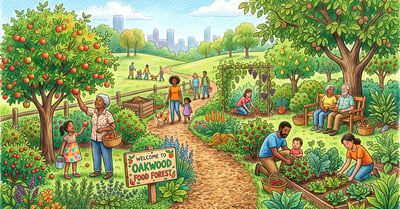
Not quite. A perennial garden is a flat planting of perennial vegetables and herbs — usually one or two layers. A food forest is a layered system designed to mimic forest structure: 7 vertical layers (canopy, sub-canopy, shrub, herbaceous, ground cover, root, vine) all stacked into the same footprint. A perennial garden might give you asparagus and rhubarb. A food forest gives you asparagus and rhubarb at ground level, blueberries and currants at waist height, dwarf apples overhead, sunchokes underground, and strawberries between everything else — same square footage, multiple times the yield.
What perennial vegetables grow in zone 6?
Zone 6 has the broadest perennial vegetable selection of any North American zone. Reliable picks: asparagus, rhubarb, sunchoke, walking onions, perennial kale 'Daubenton', sorrel (with afternoon shade), sea kale, Good King Henry, lovage, scorzonera, salsify, skirret, groundnut, raspberries, blackberries, blueberries, all currants, gooseberry, jostaberry, honeyberry, elderberry, serviceberry, aronia, pawpaw, goumi, sea buckthorn, and most perennial herbs (chives, thyme, oregano, sage, lemon balm, lovage, sweet cicely, winter savory, French tarragon). Tree collards, oca, and yacon are marginal — skip them.
Can I grow a food forest in a small backyard?
Yes. The minimum practical size for a layered food forest is about 400–500 sq ft (37–46 m²) — roughly a 20×25 ft (6×7.5 m) plot. That's enough for one dwarf fruit tree, 2–3 berry shrubs, 6–10 perennial vegetables, ground cover, and an herb cluster. Smaller spaces work as partial food forests — a corner with a serviceberry, blueberry, rhubarb, perennial herbs, and walking onions still beats lawn for productivity. Our small food forest design guide covers the 500 sq ft template in detail.
Are perennial vegetables more nutritious than annuals?
Often, yes. Deeper-rooted perennials like asparagus (6 ft / 1.8 m roots), rhubarb (4 ft / 1.2 m), and comfrey (8–10 ft / 2.4–3 m) mine minerals from subsoil layers that shallow-rooted annuals can't reach — concentrating potassium, calcium, and trace minerals in their tissues. Aronia berries have measurably higher anthocyanin content than blueberries. Sea buckthorn is among the highest vitamin C foods on earth. The trade-off: most perennials are eaten in smaller quantities than their annual counterparts (you don't eat a kilogram of sorrel at a sitting), so they tend to be high-density nutrient supplements rather than calorie staples — sunchokes and chestnuts being the major exceptions.
Resources
- Epic Gardening — 41 Perennial Vegetables to Grow by Hardiness Zone
- Garden Betty — 38 Perennial Vegetables to Plant Once and Enjoy for Years
- Eartheasy — Edible Perennials: Building Your Personal Food Forest
- EcoDesignHive — 100+ Perennial Vegetables for Food Forest
- Rural Sprout — 14 Perennial Vegetables You Can Plant Once
- Permaculture Women's Guild — 16 Best Edible Perennials
- Virginia Cooperative Extension — Edible Gardening
- CSU Extension — Colorado Vegetable Guide (PDF)
- UNH Extension — The Vegetable Garden (PDF)
- University of Wyoming — Seasonal Garden Calendar
- USDA National Agricultural Library — Vegetable Gardening Resources
- Food Forest Card Game — 21 Choice Perennial Vegetables for 4-Season Climates