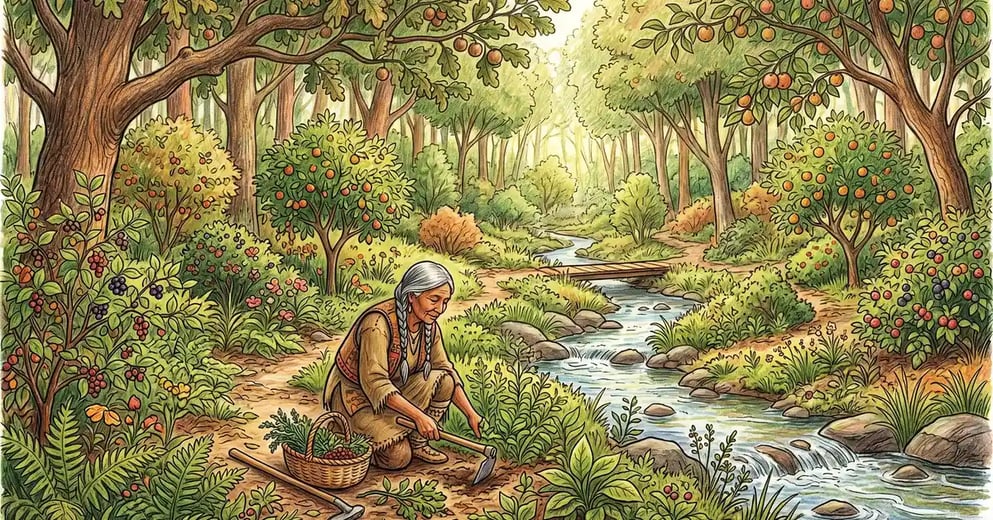
Modern permaculture talks about food forests like they were invented in the 1970s. The truth is older and more interesting. Indigenous peoples across at least six continents have been designing, planting, and managing multi-layered food forests for thousands of years. The Coast Salish people of British Columbia tended forest gardens still bursting with hazelnut and crabapple 150 years after their villages were abandoned. The Maya have managed multi-strata homegardens in Mesoamerica for over 3,000 years. The Chagga people of Mount Kilimanjaro have built one of the most studied agroforestry systems on Earth across hundreds of years. land restoration projects by the numbers the Amazon's dark earth milpa forest garden cycle
For a modern home gardener trying to learn permaculture, this matters in two ways. First, it changes the story: the principles you're being taught are not new, they're a 20th-century formalization of practices Indigenous communities have been demonstrating for millennia. Second, it points you toward better teachers. The deepest knowledge of designing a resilient food forest in your bioregion almost certainly lives with the Indigenous people who have managed that land longest.
Quick answer
Indigenous food forests are managed multi-layered perennial polyculture systems that predate modern permaculture by thousands of years. Documented examples include Coast Salish forest gardens in British Columbia, Mayan homegardens in Mesoamerica, Chagga homegardens on Mount Kilimanjaro, Kerala kavu sacred groves in India, and pekarangan home gardens in Indonesia. Modern home gardeners can learn from these systems by leading with native species, prioritizing perennials, layering vertically, and supporting Indigenous food sovereignty movements in their bioregion.
The Coast Salish forest gardens of British Columbia
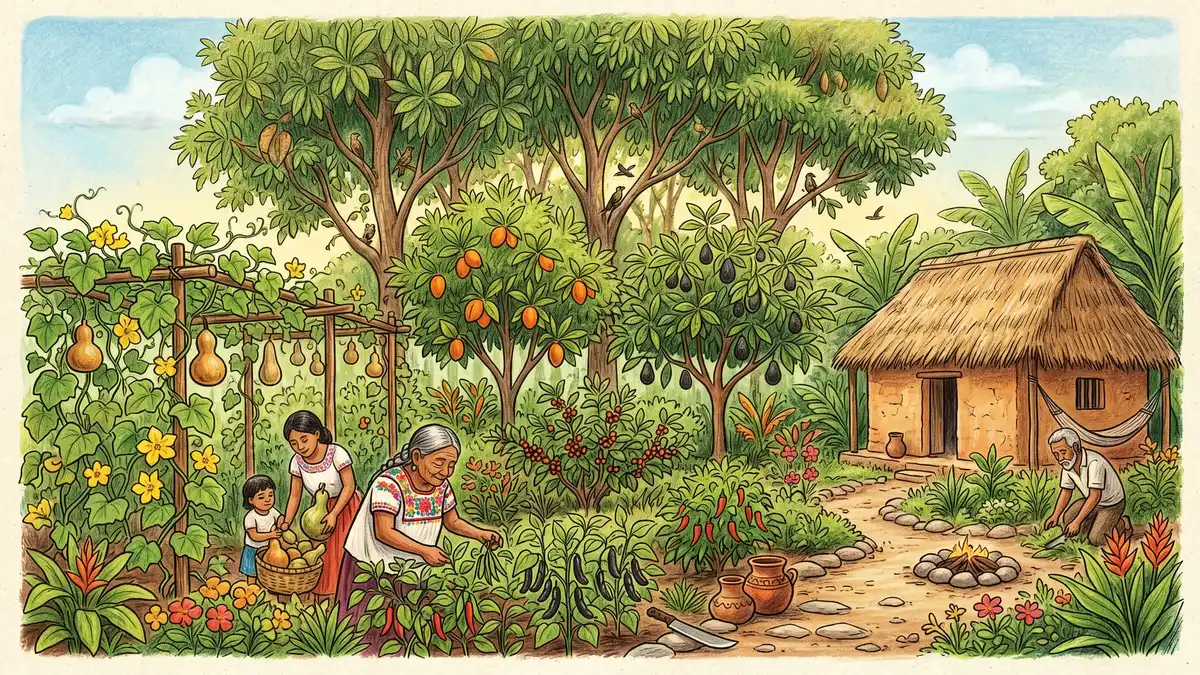
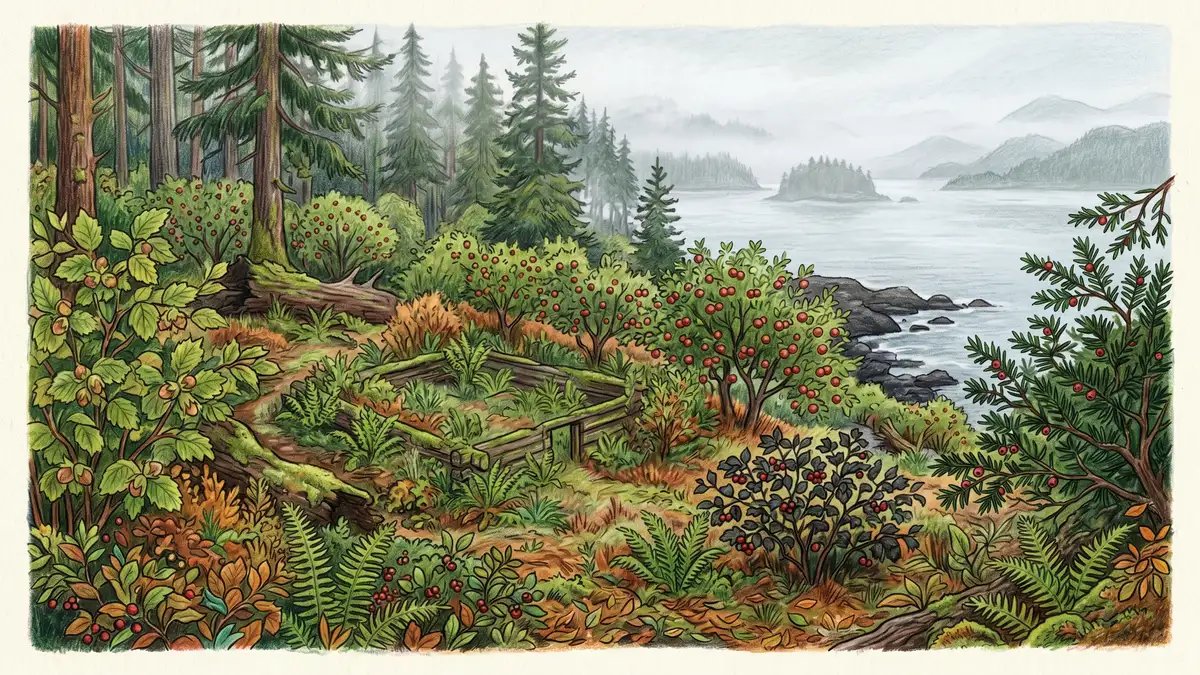
In 2021, Dr. Chelsey Geralda Armstrong at Simon Fraser University published a study in Ecology and Society that quietly rewrote how Western science understands Pacific Northwest forests. Her team surveyed former Ts'msyen and Coast Salish village sites in coastal British Columbia, places abandoned 150 years ago after disease and colonization displaced their inhabitants. What she found was not wild forest. It was forest garden: deliberate plantings of Pacific crabapple, hazelnut, hawthorn, wild cherry, salmonberry, and Pacific yew, still thriving in patterns that match no natural forest succession.
The numbers are striking. Smithsonian Magazine's coverage of the Armstrong study reports that the abandoned forest garden sites have approximately 4 times the functional plant diversity of surrounding "natural" forests. Canadian Geographic's longer feature captures the implication: the line between "managed" and "wild" Pacific Northwest forest is much blurrier than Western ecology assumed. Many landscapes called wilderness were in fact food forests.
Why this works (the permaculture angle)
When Bill Mollison and David Holmgren formalized permaculture in 1978, they explicitly drew on Indigenous and traditional farming practices. The modern food forest design isn't a discovery, it's a rediscovery. Recognizing this changes the work: instead of importing a tropical model into your temperate backyard, you can ask what was here before, what Indigenous communities managed in your specific bioregion, and what species and patterns deserve to be reintroduced.
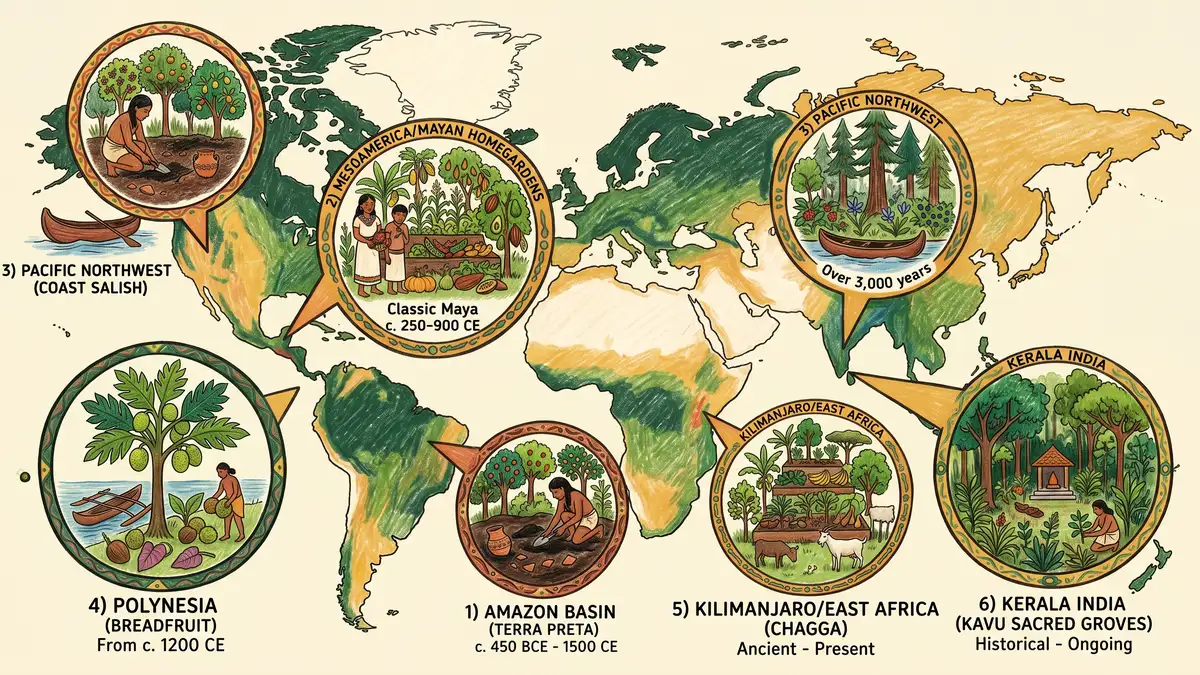
Six traditional food forest systems from around the world
| Tradition | Region | Age | Signature pattern |
| Coast Salish, Ts'msyen forest gardens | Pacific Northwest, Canada | 500+ years documented | Hazelnut, crabapple, hawthorn under conifer canopy |
| Amazonian terra preta and food forests | Amazon basin | 2,000+ years | Engineered fertile black earth + managed forest species |
| Mayan multi-strata homegardens | Yucatan, Guatemala, Belize | 3,000+ years | Ramon canopy + avocado, mamey, beans, gourds |
| Polynesian ahupua'a / breadfruit | Hawaii, Pacific islands | 1,500+ years | Breadfruit-coconut-taro stacking from mountain to sea |
| Chagga homegardens | Mount Kilimanjaro, Tanzania | 500+ years | Coffee under banana over yam and taro, 25+ banana varieties |
| Kerala kavu sacred groves | Southern India | 1,000+ years | Tropical canopy with 50+ species + shrine integration |
Sources:.
What the Amazon tells us about engineered fertility
Terra preta de indio, the dark anthropogenic earth of the Amazon, is one of the most studied Indigenous agricultural achievements. Pre-Columbian Indigenous peoples in the Amazon basin deliberately created productive soils by adding charred biomass, pottery sherds, bone, and food waste over generations. The result, documented across thousands of sites, is a dark fertile soil that remains 2 to 3 times more productive than surrounding tropical earths 2,000 years after creation.
The food forests grown on terra preta were not subsistence systems. They were so productive that recent population estimates for the pre-Columbian Amazon have risen significantly, with some researchers estimating the basin supported 8 to 20 million people before European contact. These were not wilderness peoples; they were agriculturalists managing forest landscapes. Modern permaculture's interest in biochar (covered in our biochar guide) traces directly back to this Indigenous technology.
The Chagga homegardens of Kilimanjaro
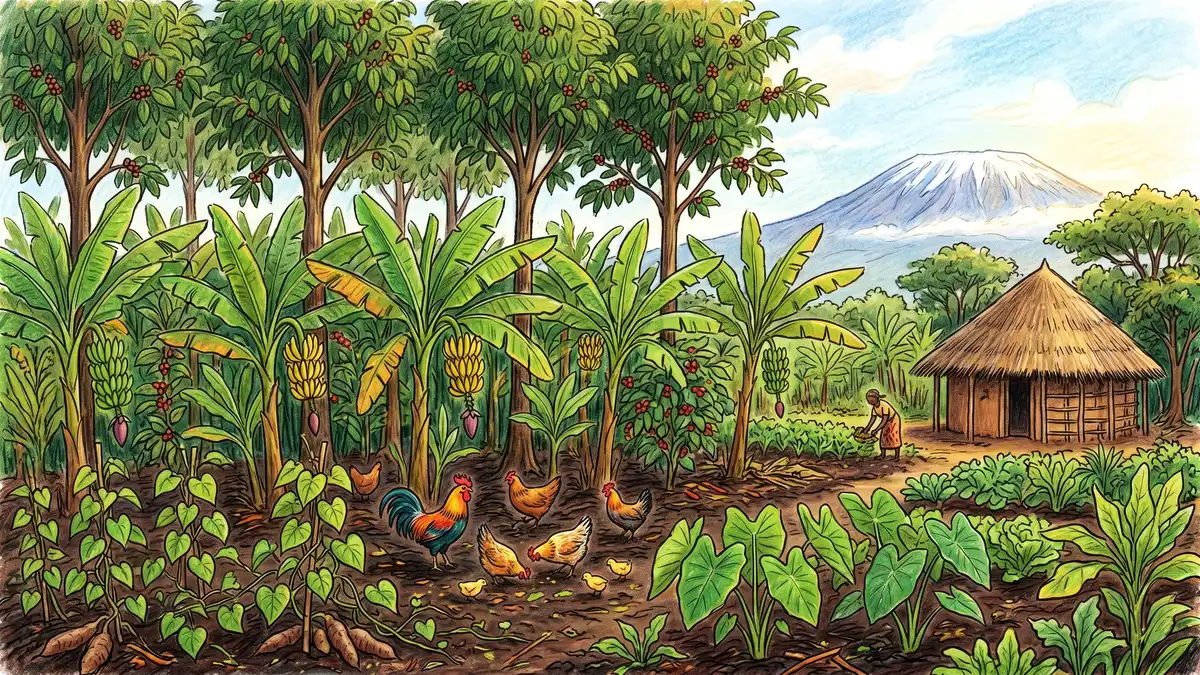
On the southern slopes of Mount Kilimanjaro in Tanzania, the Chagga people have built one of the world's most-studied multi-storey agroforestry systems. A typical Chagga homegarden (kihamba) contains roughly 25 named banana varieties, several coffee species, a canopy layer of fruit and timber trees, an understory of beans and vegetables, and root crops including yam, taro, and sweet potato. The whole system runs on dense planting (typically 1,000+ banana plants per hectare) without external fertilizer inputs, sustained by composted on-site organic matter and the slow turnover of leaf litter.
ProAgriMedia's agroforestry overview of the Chagga system documents that productivity per hectare consistently exceeds equivalent monoculture coffee plantations while requiring fewer external inputs. The system has supported continuous cultivation across the same land for centuries, with no decline in fertility, an outcome that conventional agriculture has yet to match anywhere.
What modern gardeners can take from these traditions
Lead with native species
Every documented Indigenous food forest is rooted in native species first. Imported species can be added, but the structural plants come from the local ecology. Find out what trees and shrubs the Indigenous people of your bioregion managed: in the Pacific Northwest, that's Pacific crabapple, hazelnut, hawthorn, salmonberry. In the eastern US, that's persimmon, pawpaw, hickory, serviceberry. In Britain, it's hazel, crabapple, hawthorn, elder.
Prioritize perennials
All six traditions above are dominated by perennials, not annuals. The Mayan homegarden, the Chagga kihamba, the Kerala kavu, and the Coast Salish forest garden all build around long-lived trees and shrubs. Annual vegetables are the seasoning, not the backbone.
Layer vertically
The canopy, sub-canopy, shrub, herbaceous, ground cover, root, and vine layers of the 7-layer food forest model are present in every Indigenous tradition above. The principle is universal.
Embed meaning, not just function
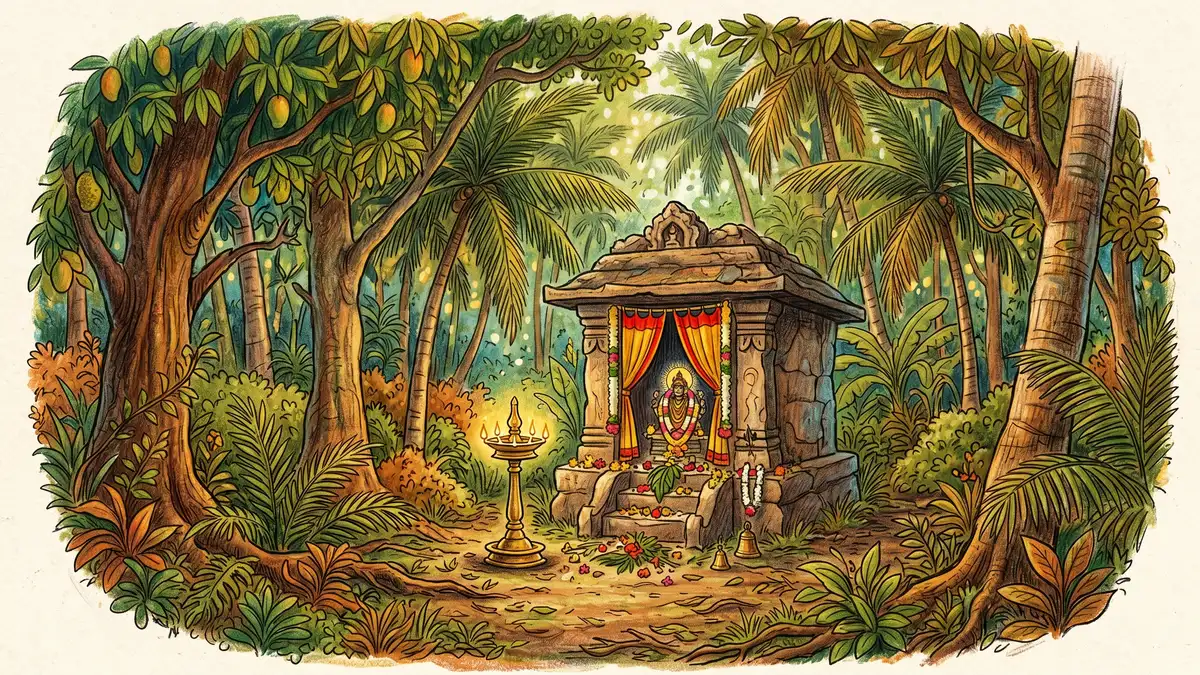
Kerala kavu groves have shrines. Mayan homegardens have ceremonial spaces. Polynesian ahupua'a systems contain sacred boundaries. The food forest is a relational system, not a production line. Modern permaculture often skips this, but it matters: a garden you have a relationship with gets tended better and longer than a garden you have a project plan for.
Learn from living Indigenous practitioners
If you can, support and learn from Indigenous food sovereignty initiatives in your region. In the US, the Indigenous Food and Agriculture Initiative, the Sogorea Te Land Trust in California, and dozens of Tribal nation food sovereignty programs are actively teaching traditional food forest practices. In Canada, look for First Nations land-back and food sovereignty work.
A note on respectful learning
Indigenous food forest practices belong to Indigenous people. Learning from them is welcome; appropriating them is not. The difference: a respectful learner cites the source, supports Indigenous-led initiatives, returns benefit where possible, and recognises that the knowledge is held in living communities, not in old books. If you want to apply traditional patterns to your bioregion, consider what tribal or First Nation communities are local to your area, and how you can support their work as you learn.
Get the Weekly Dig
One practical permaculture guide a week, written for gardeners who do this on weekends: food forest and guild designs that produce. Free, no spam, unsubscribe any time.
Join the Weekly DigFrequently asked questions
Did Indigenous peoples really practice "food forestry" before the term existed?
Yes, and the evidence is now well-documented. Armstrong's 2021 study in Ecology and Society used soil analysis, plant inventories, and ethnobotanical records to confirm that Coast Salish and Ts'msyen communities in British Columbia tended deliberate forest gardens for centuries. The terra preta soils of the Amazon, the Mayan multi-strata homegardens, and the Chagga homegardens of Kilimanjaro are similarly well-documented. The term "food forest" is recent; the practice is ancient.
How is an Indigenous food forest different from a modern permaculture food forest?
The structural design is broadly similar (multi-layered, perennial-dominated, polyculture). The differences are in lineage and meaning: Indigenous systems carry generations of place-specific knowledge, often embed cultural and spiritual significance, and use native species selected over centuries. Modern permaculture food forests are typically newer, often blend native and introduced species more loosely, and treat the design more as a technique than a relationship.
What native plants would I use to build an Indigenous-inspired food forest in temperate North America?
For zones 5 to 8 in the eastern US: persimmon, pawpaw, hickory, black walnut, serviceberry, hazelnut, hawthorn, elderberry, raspberry, currant. For the Pacific Northwest: Pacific crabapple, Beaked hazelnut, hawthorn, salmonberry, thimbleberry, Pacific yew, salal. For the prairies: chokecherry, buffaloberry, saskatoon, hazelnut, plum. Match to your specific bioregion.
Can I just copy a Mayan or Chagga homegarden in my temperate garden?
No, those systems are climate-specific. But the structural principles transfer: multi-layered design, perennial backbone, polyculture, on-site nutrient cycling, sacred or aesthetic meaning. Apply the principles, not the species lists.
Where can I learn more about Indigenous agriculture?
The Indigenous Food and Agriculture Initiative (University of Arkansas), the Native American Food Sovereignty Alliance, the Sogorea Te Land Trust, and the Slow Food Indigenous Terra Madre network are all entry points. Robin Wall Kimmerer's Braiding Sweetgrass is a widely recommended book that bridges Indigenous knowledge and Western science.
How does this connect to other traditional growing systems around the world?
Indigenous food forests are one of several traditional resilient growing systems that pre-date modern permaculture, alongside Japanese natural farming, Korean natural farming, biodynamic agriculture, and traditional Mediterranean polyculture. All share an emphasis on long time horizons, low external inputs, and relational rather than transactional design.
Resources
- Smithsonian Magazine, Indigenous Peoples in BC Tended Forest Gardens
- Canadian Geographic, Indigenous forest gardens of coastal BC
- Dr. Chelsey Geralda Armstrong, Forest Gardens research page
- Living on Earth, First Nations Forest Gardens interview
- Cornell CSS, Terra Preta de Indio research page
- Food Unfolded, What We Can Learn from Ancient Amazonian Soil
- IntechOpen, A History of Knowledge of the Amazonian Dark Earths
- Refracting Africa, Chagga Homegardens of Kilimanjaro
- ProAgriMedia, Multi-storey Home Gardens of Mt Kilimanjaro
- Terra preta on Wikipedia (with citations)