
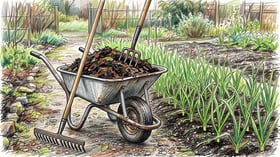
You have a wheelbarrow of finished compost and a garden that needs feeding. The question is how deep to lay it on, whether to dig it in, and whether September beats March. compost vs garden soil
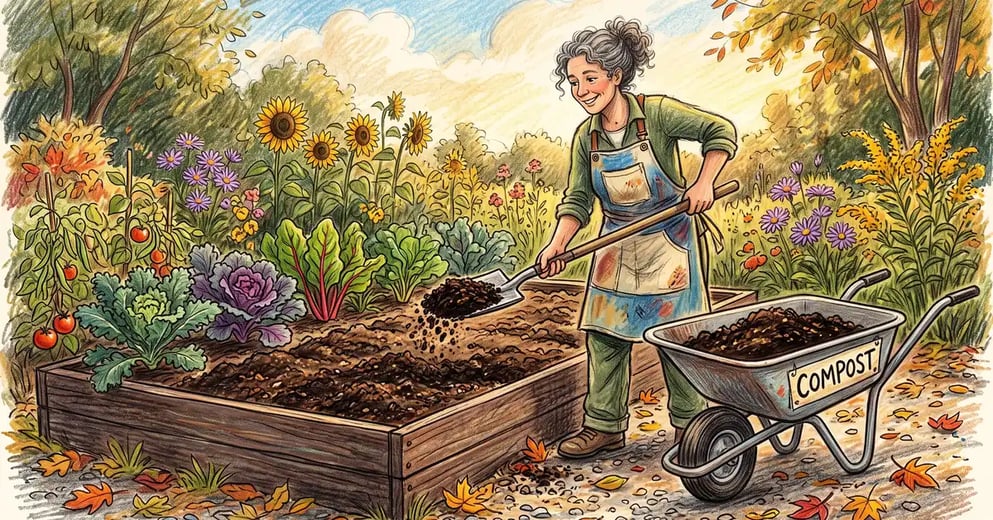
Top dressing means spreading compost on the surface and leaving it there. No fork, no tiller, no turning the soil over. Worms, roots and rain do the mixing. It is the only sensible way to feed a lawn, and the lowest-effort way to feed a planted bed. The numbers matter more than people expect: a quarter inch is right for turf and useless on a new bed, while three inches suits a tired vegetable bed and kills a lawn.
How Much Compost Should You Top Dress With?
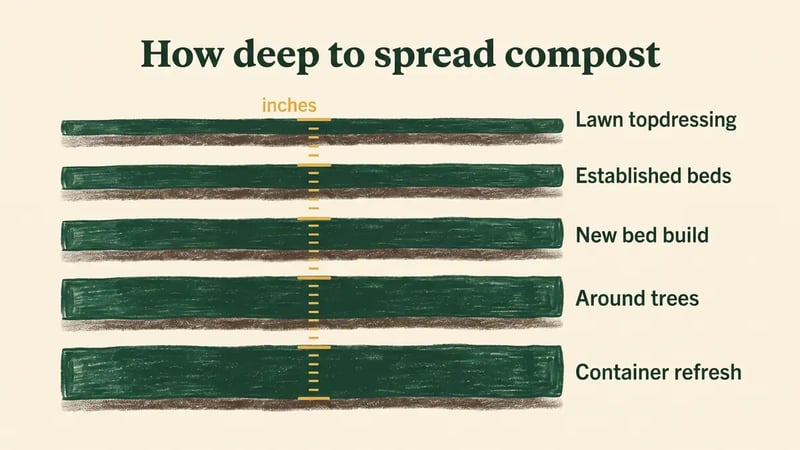
Depth depends on what you are covering. Grass has its growing point at the soil surface and dies if you bury it. Bare soil has no such limit.
For established lawns, Clemson Cooperative Extension puts the working figure at about a quarter inch per application, and never more than half an inch at a time. NC State Extension frames the same limit differently in its organic lawn care guide: never apply more than will cover half the height of the grass blades, because a thicker layer blocks sunlight and fouls the mower.
For beds the range opens up. UC Master Gardeners recommend half an inch to three inches on annual beds at least once a year. Oregon State Extension goes further for heavy ground: two to three inches spread on top of clay beds rather than dug in.
Key Takeaway
Match the depth to the surface, not to how much compost you happen to have. A quarter inch on turf, one to three inches on open beds. Too deep on a lawn smothers it. Too shallow on a bed is just a smaller version of the right answer, so it still works.
How Do You Work Out How Much Compost to Buy?
NC State Extension gives the conversion directly: one cubic yard of compost covers about 324 square feet at one inch deep, 216 square feet at two inches, and 108 square feet at three inches. Everything else follows from that.
A 4 by 8 foot raised bed is 32 square feet. At one inch that is roughly a tenth of a cubic yard, about three standard bags. At two inches, six bags, which is where bulk delivery starts to pay.
| Area | Depth | Compost needed | Buy as |
| 4 x 8 ft raised bed (32 sq ft) | 1 in. | 0.10 cu yd (2.7 cu ft) | 3 bags |
| 4 x 8 ft raised bed (32 sq ft) | 2 in. | 0.20 cu yd (5.3 cu ft) | 6 bags |
| Lawn, 1,000 sq ft | 1/8 in. | 0.39 cu yd | Bulk |
| Lawn, 1,000 sq ft | 1/4 in. | 0.77 cu yd | Bulk |
| Lawn, 5,000 sq ft | 1/4 in. | 3.9 cu yd | Bulk |
Coverage figures derived from NC State Extension, Organic Lawn Care, cross-checked against Clemson HGIC top dressing guidance.
Bulk compost runs roughly $35 to $55 a cubic yard in most US markets, plus $60 to $100 delivery. Bagged costs two to three times as much per equivalent volume, so break-even sits near one cubic yard. A two-bin home compost system yields enough for a couple of raised beds a year and nothing at all for a lawn.
Why This Works: Feeding the Soil, Not the Plant
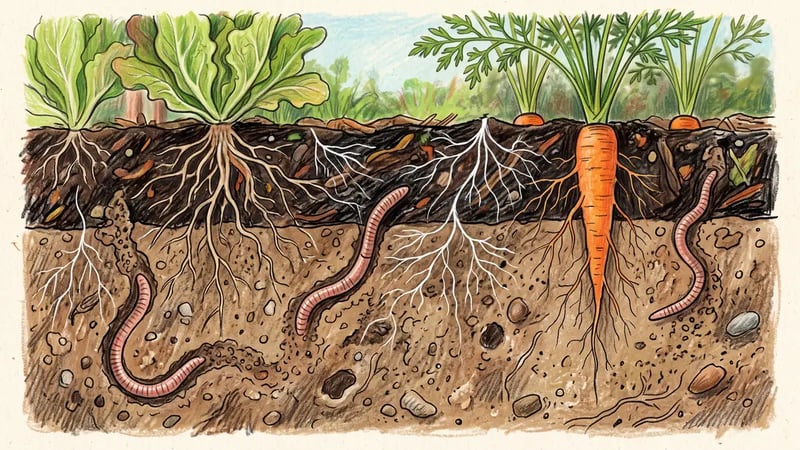
Digging compost in gives roots a quick nutrient hit. Leaving it on top does something different. Earthworms drag it down through their burrows, which builds vertical channels for water and air at the same time as it distributes the organic matter. You are copying the way a forest floor feeds itself, one layer at a time. The soil food web does the tillage for you, and it never tears up the fungal networks the way a spade does.
When Is the Best Time to Top Dress?
For beds, fall is the strongest window in most temperate US zones. Spread after the last harvest and the layer has all winter to be pulled down and colonised. Nothing is growing, so nothing gets buried. It stacks with the rest of the autumn list too: sowing cover crops where beds sit empty, then mulching over the top.
Spring works too, and is better if your compost is only just finished. A fall application of half-ready compost has months to finish quietly. A spring one sits under your seedlings still consuming nitrogen.
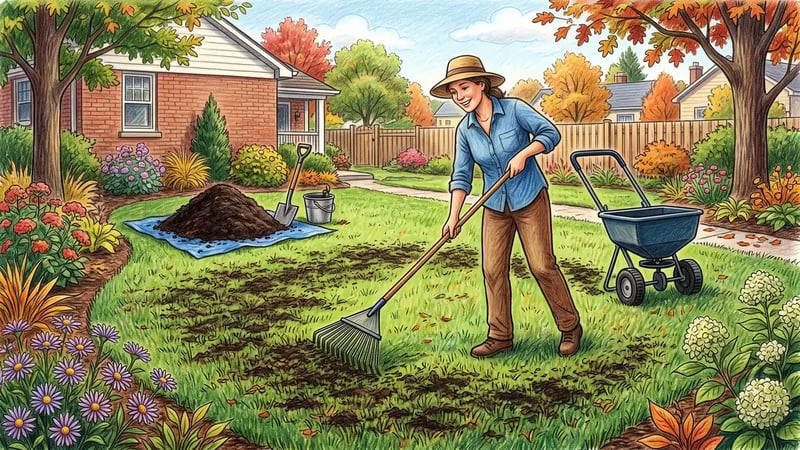
Lawns follow the grass, not the calendar. Cool-season turf such as Kentucky bluegrass, fescue and ryegrass wants early fall, when root growth peaks and the compost doubles as a seedbed for overseeding. Warm-season turf such as bermuda and zoysia wants late spring, once it is growing out of dormancy. Top dressing dormant grass achieves nothing.
Mow short and clear the surface
On lawns, mow a notch lower than usual and bag the clippings so compost reaches soil. On beds, pull spent crops and rake level. Ten minutes.
Core aerate first, on turf only
Pull cores, leave them on the surface, top dress over the holes. Penn State Extension recommends following with several passes of a drag mat, which breaks up the cores and pulls the mix into the holes. This roughly doubles what a lawn application achieves.
Spread in small heaps, then level
Tip several small piles in a grid rather than one big one, then spread outward with the back of a leaf rake. A drop spreader handles screened compost; anything coarse jams it. Allow 45 minutes for 1,000 square feet.
Check the grass is still visible
On turf this is the whole test. Stand back. If the lawn reads brown rather than green flecked with brown, rake some off onto a bed.
Water it in, then leave it alone
A light watering settles the compost against the soil and starts the biology. After that, no forking, no raking. The worms have it from here.
Need the gear for this?
Bins and tumblers picked by yard size, with the honest trade-offs for each.
See the compost bin picksWhat Does Top Dressing Actually Change?
The mechanism is well documented; the home-scale numbers are thinner than you would hope. The US EPA's summary of compost research reports lower bulk density, better infiltration, higher organic matter and larger populations of beneficial soil organisms. It does not separate surface application from digging in.
Water holding is easiest to quantify, and published figures diverge widely. University of Minnesota Extension puts the gain at roughly 3,400 gallons per acre for every 1% rise in organic matter in medium-textured soil. Other USDA-linked figures run to 20,000 and above, because they measure different depths and textures. Treat the low number as your planning assumption.
Expect color and infiltration changes on turf within two to six weeks, deeper rooting inside six months, and a measurable rise in organic matter on a soil test between six and eighteen months. Taking soil from 2% to 4% organic matter is a five to ten year project. That slow arc is the argument for building living soil rather than fertilizing plants.
To know whether it is working on your ground rather than average ground, get a baseline. A soil test reporting organic matter costs under $30 at most state extension labs, and a retest two years on turns "the soil looks better" into a number. Two free proxies meanwhile: push a screwdriver in and note how far it goes, and count worms in a spadeful.
Key Takeaway
Top dressing compounds. One application changes very little; ten annual applications change everything. The gardeners with dramatic soil did the same modest thing every autumn for a decade.
What Can Go Wrong With Compost Top Dressing?
Two failures cause most of the damage, and both are avoidable before the compost leaves the pile.
Unfinished compost. NC State Extension warns that fresh compost used as a lawn top dressing can kill grass and tie up soil nitrogen. Decomposing material still has a carbon to nitrogen ratio the microbes are working through, and they take nitrogen from the surrounding soil to do it. Your plants queue behind the bacteria. Finished compost is dark, crumbly, cool to the hand and smells of forest floor. If you can still identify what went in, it is not ready.
Persistent herbicides. This one costs a season and hides in mature, good-looking compost. UF/IFAS Extension names four: clopyralid, aminopyralid, aminocyclopyrachlor and picloram. They are sprayed on hayfields and pastures, pass intact through horses and cattle, survive composting, and stay active for a year or more. Oregon State Extension bulletin EM 9307 documents the damage: poor germination, dead seedlings, cupped leaves, misshapen fruit.
Common Mistake to Avoid
Spreading unknown manure-based compost across every bed at once. If the source is new to you, run a bioassay first: plant three pea or bean seeds in a pot of the compost and three in ordinary soil, then compare after three weeks. Twisted, cupped or fern-like growth means contamination. Tomatoes, peas, beans, potatoes, lettuce, carrots and beets are the sensitive crops. Corn, onions, leeks and asparagus barely react, so a healthy corn seedling proves nothing.
Why This Works: Stacking Functions
A single quarter-inch layer on a lawn does four jobs at once. It feeds the turf, smooths the surface, holds moisture around overseeded grass, and inoculates the thatch layer with the microbes that digest thatch. In permaculture terms that is stacking functions, and it is why the practice earns its place despite being slower than a bag of fertilizer. A food forest runs on the same logic at scale.
Frequently Asked Questions
Is compost good for top dressing lawns?
Yes, and it is the most useful thing you can do for a tired lawn short of replacing it. Compost adds organic matter where turf roots live, improves infiltration on compacted ground, and feeds the microbes that break down thatch. The catch is depth: Clemson Extension recommends about a quarter inch per application and never more than half an inch, because grass blades have to stay visible. Applied after core aeration and repeated annually, it gives a measurably thicker lawn by year three.
How do you spread compost on a large lawn?
Above about 3,000 square feet, hand-raking stops being realistic. A push drop spreader handles finely screened compost, though anything coarse or damp will bridge and jam it, so screen through half-inch hardware cloth first. Above roughly 10,000 square feet, rent a compost topdresser for the day. The method that scales: tip small heaps in a grid, spread each outward with a drag mat, then walk the area checking grass shows through everywhere.
Should you dig compost in or leave it on top?
Leave it on top for anything already planted and for any bed you intend to keep no-dig. Surface application lets earthworms do the incorporating, which builds drainage channels while distributing organic matter and leaves fungal networks intact. Dig it in only when building a bed from scratch on poor ground, where you need organic matter at root depth now rather than in two years. The no-till versus tilling evidence is fairly settled: surface is slower to show and better long term.
How often should you top dress with compost?
Once a year is the maintenance rhythm for lawns and established beds alike. Twice a year, spring and fall, is worth it for the first two or three years if you start from compacted, low organic matter soil. After that the returns drop off and the risk of phosphorus and salt accumulation rises, particularly with manure-based compost in dry regions. New beds are the exception: one heavier application at the start, then the annual rhythm.
Can you top dress with homemade compost?
Yes, and it is the safest compost you will ever use because you know every input. The limitation is volume: a two-bin household system produces enough each year for a couple of raised beds, nowhere near enough for a lawn. bed sizes matched to your compost supply Screen through half-inch mesh before spreading on turf and return the coarse fraction to the pile. For more volume, leaf mold from fall leaves is the cheapest way to bulk it out, though it conditions soil rather than feeding it.
Get the Weekly Dig
One practical permaculture guide a week, written for gardeners who do this on weekends: composting that actually finishes and soil that feeds itself. Free, no spam, unsubscribe any time.
Join the Weekly DigResources
- Clemson Home and Garden Information Center: Topdressing a Home Lawn
- NC State Extension: Organic Lawn Care, Composting and Spreaders
- Penn State Extension: Using Composts to Improve Turf Performance
- UC Marin Master Gardeners: How to Use Compost
- Oregon State Extension: Clay Soil Challenges and Solutions
- Oregon State Extension EM 9307: Herbicide-Contaminated Compost and Soil Mix
- UF/IFAS Extension: Compost Contamination and Your Vegetable Garden
- US EPA: Benefits of Using Compost
- University of Minnesota Extension: Soil Organic Matter and Soil Water