
How Do You Read a Soil Test Report?
Start with pH, then read the rating words rather than the raw numbers. A soil test report is a wall of abbreviations and decimals, and the instinct is to hunt for whichever number looks worst. That is usually the wrong move, because pH controls whether the other numbers even matter. testing your soil texture what to measure and how to read it whether greensand will fix a low potassium reading
Here is the thing nobody explains when the report arrives: the ppm figures on your page are not absolute measurements of what is in your soil. They are the output of a specific chemical extraction, calibrated against yield trials, and they are only meaningful inside that lab's own interpretive framework. Compare them to a neighbour's report from a different lab and you are comparing nothing at all.
This guide walks through what each field means, which numbers are actionable, and which ones gardeners routinely chase for no reason.
What we will cover:
- What every field on the report actually measures, in one line each
- Why two labs can test the same soil and report wildly different phosphorus
- The cation ratio theory that extension research does not support
- How to turn a lime recommendation in tons per acre into something you can spread on a garden bed
Key Takeaway
Two numbers on the report drive almost every decision you will make: pH and organic matter. pH governs whether nutrients are available at all, and organic matter is what your nitrogen recommendation is calculated from. Everything else is secondary, and several fields are worth actively ignoring.
What Does Each Field on the Report Mean?
Most reports carry the same dozen fields, whatever the lab calls them. Here is what each one is telling you.
| Field | What It Measures | Act On It? |
| pH | Active acidity the roots experience | Yes, first priority |
| Buffer pH / lime index | Reserve acidity, used only to calculate lime rate | No, it feeds the lime rec |
| Organic matter % | Water holding, nutrient retention, N supply | Yes, long-term |
| Phosphorus (P) | Extractable P, calibrated to yield response | Yes, but rarely upward |
| Potassium (K) | Exchangeable or extractable K | Yes, if rated low |
| Calcium, Magnesium | Nutrients plus inputs to CEC and lime need | Usually handled by liming |
| CEC | Capacity to hold cations against leaching | Context only, not a target |
| Base saturation % | Share of CEC held by base cations | No, see below |
| Micronutrients | Fe, Mn, Zn, Cu, B in ppm | Only if a deficiency is visible |
| Soluble salts / EC | Total dissolved ions, flags over-fertilizing | Yes, if flagged high |
Sources: Penn State Agricultural Analytical Services Lab, Oregon State University Extension EC 1478, University of Minnesota Soil Testing Laboratory
The rating words matter more than the values. Colorado State Extension defines the critical level as the soil test value at which roughly 90 to 95 percent of maximum yield potential is reached. Above that, adding more of a nutrient buys you almost nothing. "High" does not mean good, it means stop.
Why Does pH Matter More Than the Nutrient Numbers?
Because a nutrient that is present but locked up may as well not be there. pH is a logarithmic scale, so the differences are bigger than they look. NC State Extension puts it plainly: a soil at pH 5 is ten times more acidic than one at pH 6 and a hundred times more acidic than pH 7.
At the alkaline end, iron and manganese availability falls away sharply, which is why chlorosis on high-pH soils so often looks like an iron deficiency when the real problem is pH blocking uptake. At the acid end, aluminium becomes soluble enough to damage roots and phosphorus gets fixed by iron and aluminium oxides. Both effects are described in Purdue Extension's soil pH bulletin.
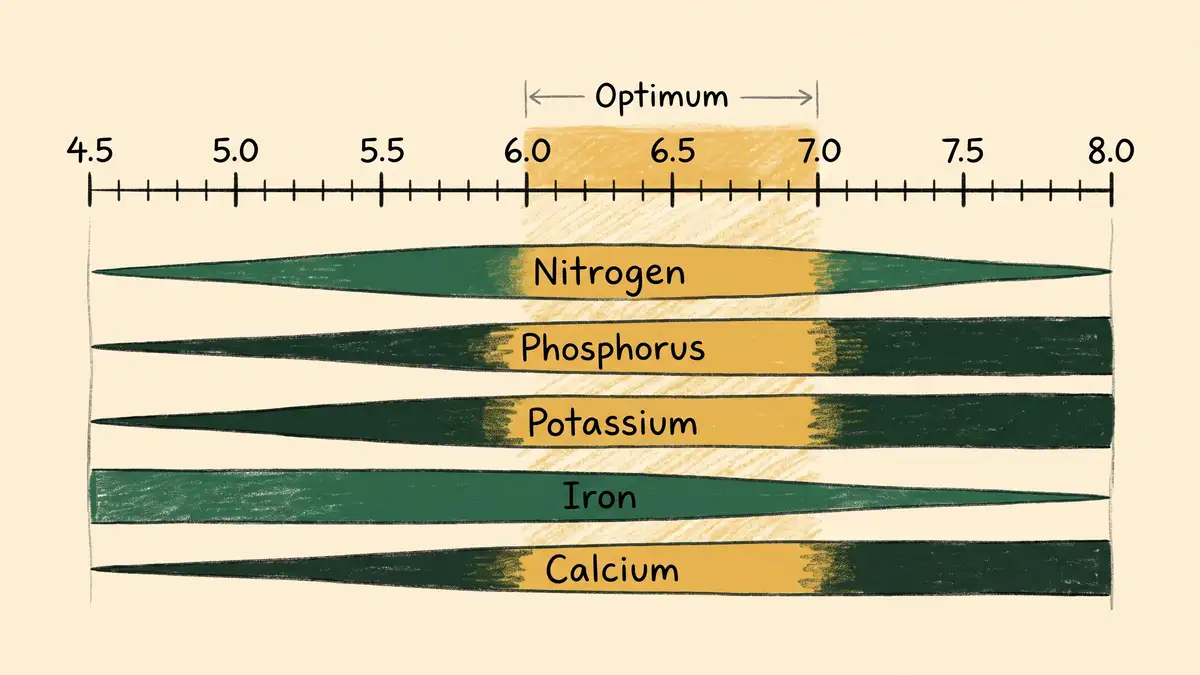
Target pH is crop-specific, and the spread is wider than most people assume. From NC State's table for mineral soils: vegetable gardens and roses at 6.5, most beans, brassicas and potatoes at 6.0, flower gardens and shrubbery at 6.0, centipedegrass at 5.5, azaleas and rhododendrons at 5.0, and blueberries all the way down at 4.5.
Why This Works: One Number, Many Crops
That spread is exactly why a single blanket lime application across a mixed planting is a mistake. A permaculture guild containing blueberries under an apple tree is asking for two different pH targets within a few feet of each other. The practical answer is not to average them, it is to test and manage by bed, and to group plants with similar requirements together in the first place. Design solves what amendment cannot.
Need the gear for this?
Which broadfork holds up in clay, which one suits a small bed, and what to skip.
See the broadfork picksWhy Do Two Labs Give Different Results for the Same Soil?
Because they use different chemical extractants, and the numbers are not interchangeable. This is the single most confusing thing about soil reports and it is not the labs being careless.
The common extractants are Bray-1 (acidic, valid up to about pH 7.4), Olsen (sodium bicarbonate, required at pH 7.4 and above and especially on calcareous soils), and Mehlich-3 (multi-element, now the default at many labs including Penn State). University of Minnesota Extension ran all three on the same sites and the results are startling.
| Site | Bray-1 | Olsen | Mehlich-3 (ICP) |
| Benson, MN (pH 7.9) | 11 ppm, "medium" | 9 ppm, "medium" | 41 ppm, "very high" |
| Crookston, MN (pH 8.1) | 4 ppm, "very low" | 3 ppm, "very low" | 26 ppm, "high" |
Source: University of Minnesota Extension, What Is the Best Soil Test Option for Phosphorus?
Same soil. One method calls the phosphorus very low and another calls it high. On calcareous soils an acid extractant dissolves phosphorus that plants cannot actually reach, which is why Minnesota recommends Olsen for their high-pH ground regardless of what is fashionable.
Never Compare ppm Across Labs
Track your soil over time using one lab and one method, and read the category rather than the raw number. If your lab changes its extraction method, your historical numbers are no longer a continuous series. This also means a fertilizer guideline calibrated for Bray-1 cannot be applied to a Mehlich-3 result.
Should You Balance Your Calcium to Magnesium Ratio?
No, and this is worth being direct about because the idea is everywhere in gardening circles. The theory says there is an ideal base saturation ratio between calcium, magnesium and potassium, and that adjusting your soil toward it improves everything.
University of Minnesota Extension addressed this directly in 2025, and the conclusion is that targeting specific cation ratios is not supported by modern crop nutrition research and can drive fertilizer applications you do not need. Oregon State makes the underlying point: base saturation is largely an indirect expression of pH, and it is not required to make a lime or fertilizer recommendation.
The mechanism is straightforward once you see it. Base saturation rises as pH rises, sitting around 50 percent near pH 5 and approaching 100 percent near pH 7, as Ohio State Extension's worked calculations show. So when a lab sells you on correcting base saturation, it is mostly telling you to correct your pH, with extra steps and extra products.
Where Is the Nitrogen on My Report?
Usually absent, and deliberately so. Nitrogen moves through soil and transforms between forms far too quickly for a single snapshot to be useful. A number taken in October tells you very little about April.
Iowa State Extension explains that nitrogen recommendations are instead calculated from organic matter, since organic matter is the reservoir that releases nitrogen as it breaks down. That is why the organic matter percentage on your report is doing more work than it appears to.
Practically, this means nitrogen is managed rather than measured. Build organic matter, use cover crops and compost, and watch the plants. Yellowing lower leaves on a heavy feeder mid-season is a better nitrogen signal than anything a lab will print.
How Do You Turn a Lime Recommendation Into Something You Can Spread?
Divide pounds per acre by 43.5 to get pounds per 1,000 square feet. Most reports quote lime in tons or pounds per acre, which is useless standing in a backyard.
NC State works the conversion through: a recommendation of 0.75 tons per acre is 1,500 pounds per acre, and 1,500 divided by 43.5 gives roughly 34.5 pounds per 1,000 square feet. For a 4 by 8 foot raised bed, that is about a pound.
Use the report's rate, not a rule of thumb
Lime requirement depends on buffer pH, not just pH. Two soils reading pH 5.5 can need very different amounts. This is why a home pH meter cannot generate a lime recommendation.
Convert to your bed size
Pounds per acre divided by 43.5 gives pounds per 1,000 square feet. Then scale to the actual area you are treating.
Spread in two perpendicular passes
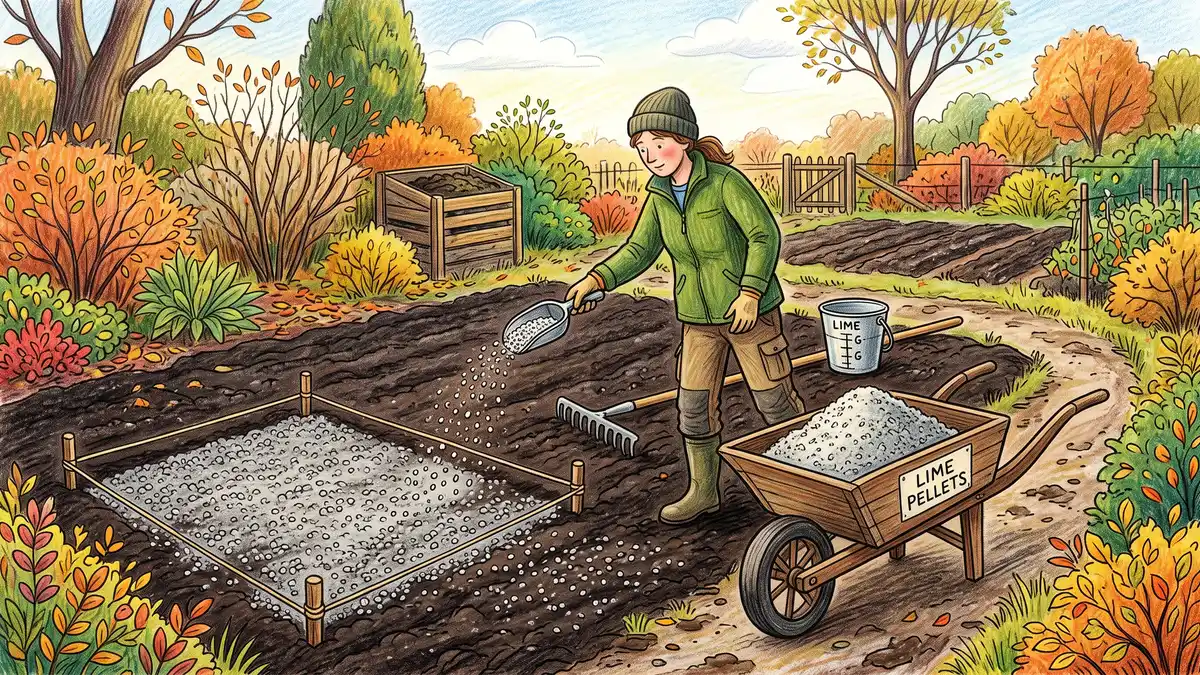
NC State recommends applying half the material walking in one direction and the other half walking at right angles. Hand-broadcasting in a single pass gives you limed and unlimed stripes.
Incorporate 4 to 8 inches deep
Lime moves very little on its own, neutralizing acidity only where it sits. Work it in with a fork or tiller at bed preparation. On established plantings you have to accept surface application and a slower response.
Source: NC State Extension, Soil Acidity and Liming: Basic Information for Farmers and Gardeners
Fall is the right time for this. Lime is slow to react, and applying in autumn gives it months to work before spring planting. It pairs naturally with the rest of your end-of-season garden preparation.
Key Takeaway
A useful reading order: pH first, organic matter second, then any nutrient the lab has rated low. Ignore base saturation ratios, ignore micronutrient numbers unless you can see a deficiency in the plants, and never add phosphorus to a soil already rated high in it. Most garden soils need less intervention than the report seems to suggest.
Frequently Asked Questions
How do you read soil test results?
Start with pH, because it determines whether the other nutrients are available at all. Then check organic matter, which is what your nitrogen recommendation is derived from. Then look at the rating words beside phosphorus and potassium rather than the ppm values, since those numbers only mean something inside that lab's own calibration. Act on anything rated low, leave anything rated optimum alone, and treat "high" as a signal to stop adding rather than as a good score.
Why does my soil test not show nitrogen?
Because nitrogen moves and transforms too fast for a single measurement to be useful for a whole season. Iowa State Extension notes that nitrogen recommendations are based on organic matter content instead, since organic matter is the reservoir that mineralises nitrogen over time. This is one reason organic matter deserves more attention than it usually gets. Manage nitrogen through compost, cover crops and observation of the plants rather than expecting a number on a report.
How deep should I take a soil sample?
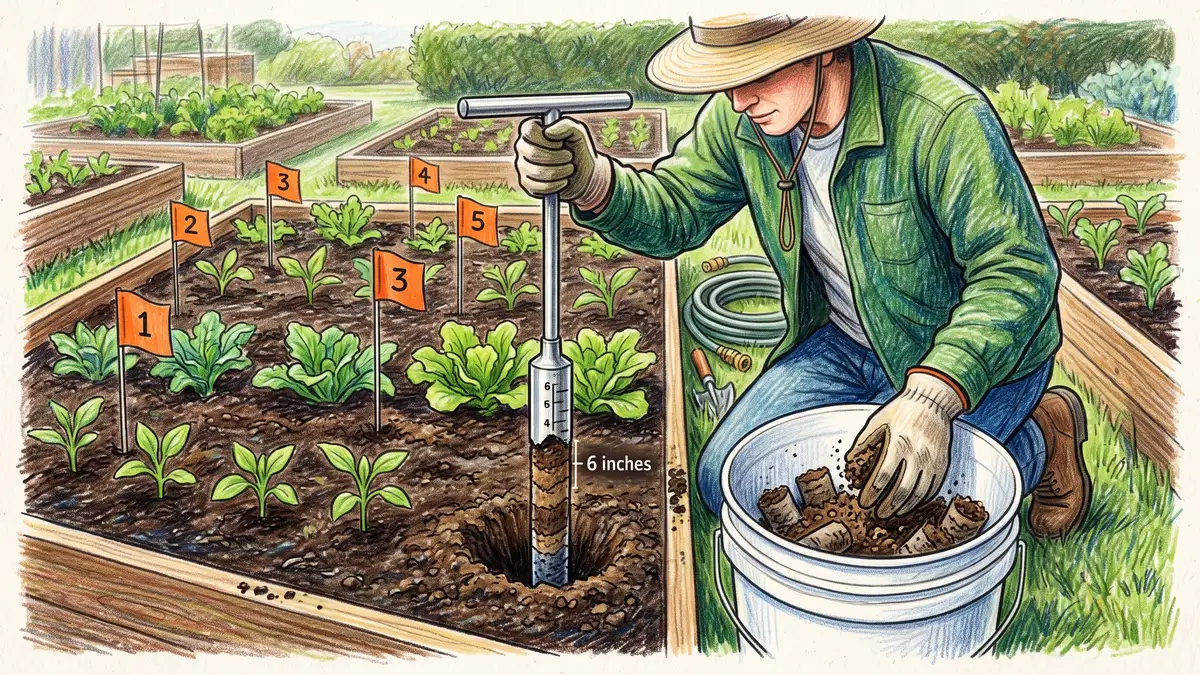
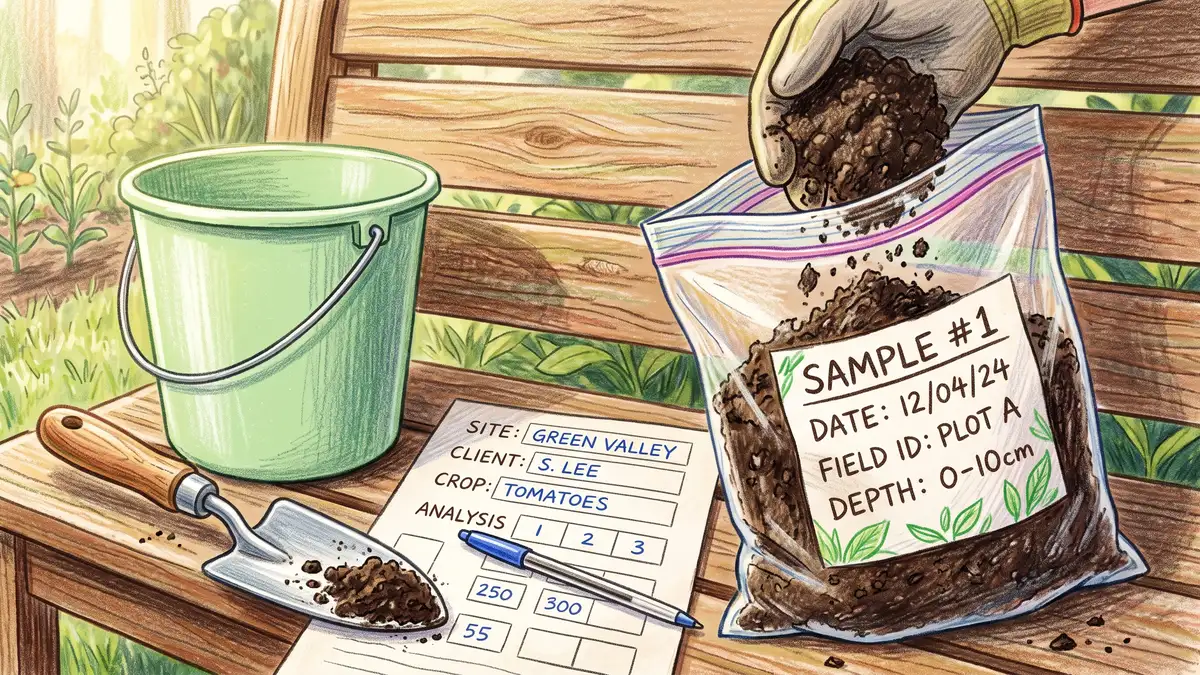
Six inches for garden beds, which is the depth phosphorus and potassium recommendations are calibrated to. Take 10 to 15 separate cores scattered across the area, drop them all into a clean plastic bucket, break the cores up and mix thoroughly, then send a subsample from that composite. One core from one spot will give you a precise measurement of one square inch of your garden, which is not what you want to know.
How often should I test my soil?
Every three to four years is adequate for most home gardens, which is enough to track pH drift and immobile nutrients like phosphorus and potassium without wasting money. Test more often if you are actively correcting a problem, have just brought new ground into cultivation, or are seeing symptoms you cannot explain. Testing every year on stable, well-managed beds mostly generates noise rather than information.
Why did two labs give me different phosphorus numbers?
Different extractants. Bray-1, Olsen and Mehlich-3 pull different amounts of phosphorus out of the same soil, and the gap widens on high-pH and calcareous ground. University of Minnesota Extension found one Minnesota site where Bray-1 read 4 ppm and rated "very low" while Mehlich-3 read 26 ppm and rated "high". Neither is wrong; they are different questions. Stay with one lab, read the category rather than the number, and never compare ppm values across labs.
Should I try to correct my calcium to magnesium ratio?
No. The idea that there is an ideal base saturation ratio to balance toward is not supported by modern research, and University of Minnesota Extension warns it leads to fertilizer applications that are not needed. Base saturation largely tracks pH anyway, sitting near 50 percent around pH 5 and approaching 100 percent near pH 7. If a lab or consultant is recommending products to correct your ratios, they are usually selling you a more expensive route to fixing your pH.
What pH should my vegetable garden be?
Around 6.5 for a general vegetable garden on mineral soils, per NC State's target table, with beans, brassicas, potato and spinach comfortable a little lower at 6.0. The bigger point is that targets vary by crop far more than people expect. Blueberries want 4.5, azaleas and rhododendrons 5.0, and lawns sit between 5.0 and 7.0 depending on species. Group plants with similar pH needs together rather than trying to hit a compromise number across a mixed bed, an idea that sits at the heart of permaculture design. For the wider picture on feeding soil rather than plants, see our soil health guide.
Get the Weekly Dig
One practical permaculture guide a week, written for gardeners who do this on weekends: building living soil without buying it in bags. Free, no spam, unsubscribe any time.
Join the Weekly DigResources
- NC State Extension — Soil Acidity and Liming: Basic Information for Farmers and Gardeners
- University of Minnesota Extension — What Is the Best Soil Test Option for Phosphorus?
- University of Minnesota Extension — Base Saturation and Cation Ratios
- Colorado State University Extension — Soil Test Interpretation
- Purdue University Extension HO-240-W — Soil pH and Plant Nutrients
- Iowa State University Extension — How to Interpret Soil Test Results
- Ohio State University Extension — Calculating Cation Exchange Capacity and Base Saturation
- Penn State Agricultural Analytical Services Lab — Soil Fertility Testing
- University of Minnesota Soil Testing Laboratory — Interpreting Results for Horticultural Crops
- Iowa State University Extension — A Recipe for Success With Soil Sampling